




















Quick Summary:
The MVP-based ServiceNow implementation cost is $8,000 to $15,000, and a mid-complex ServiceNow deployment ranges from $15,000 to $20,000. The fully-featured enterprise ServiceNow implementation costs around $25,000 or higher, depending on modules, integrations, and scalability.
Cost Impacted by Project or Implementation Complexity:
-
- Simple/MVP-Based Implementations ($8,000 – $14,000): Include features like basic ITSM (incident, problem, change management), user roles & access control, and standard workflows.
- Mid-Complex Implementations ($14,000 – $22,000): Features available such as multiple modules (ITSM + HRSD/ITOM), custom workflows, self-service portals, and third-party integrations.
- Complex/Enterprise Implementations ($25,000+): Involve functionalities like AI-based automation, predictive intelligence, advanced analytics dashboards, multi-module deployment (ITSM, ITOM, CSM, SecOps).
Cost Based on ServiceNow Modules:
-
- ITSM (IT Service Management): $15,000 to $20,000
- ITOM (IT Operations Management): $18,000 to $22,000
- HRSD (HR Service Delivery): $19,000 to $24,000
- CSM (Customer Service Management): $20,000 to $25,000
- SecOps (Security Operations): $22,000 to $25,000+
Cost Based on Different Organization Sizes:
-
- Small Business Implementation: $8,000 to $15,000
- Mid-Sized Business Implementation: $15,000 to $20,000
- Large Enterprise Implementation: $20,000 to $25,000+
Additional Cost:
-
- Maintenance Services: The cost to maintain a ServiceNow platform is around 10% to 20% of the initial implementation cost.
- Licensing Fees: ServiceNow uses a subscription-based model, typically costing $50 to $150 per user/month, depending on modules.
- Security Measurements: Implementing data encryption, compliance standards, and role-based access controls is important, and the cost can increase due to security and regulatory requirements.
The world of ServiceNow can feel like a secret treasure hunt because of the many types of modules, licenses, hidden costs, and any unexpected surprises or budget shocks. It can be very difficult to know what ServiceNow will ultimately cost you when you are exploring Services such as ITSM, HRSD, ITOM, or a full migration to ServiceNow.
As it relates to pricing in 2026, a variety of new flexible subscription options, specialized support packages, and developer expenses can shift your total investment significantly.
Therefore, we provided this blog to make everything easier to understand, from license and consulting fees to migration costs and ongoing support.
This blog outlined all of the ServiceNow pricing and implementation costs. The reader will have a detailed plan so that they will be able to move forward with the ServiceNow deployment process and not worry about any unexpected bills.
Why Understanding Servicenow Pricing Is Critical For Businesses In 2026?
Review the comprehensive ServiceNow pricing and implementation cost; ITSM’s, HRSDs, ITOMs, service, support consulting, migration fees, developer fees, and licensing to effectively forecast your company’s needs. Manage budgets & obtain maximum Return-on-Investment(RoI) from ServiceNow implementations.
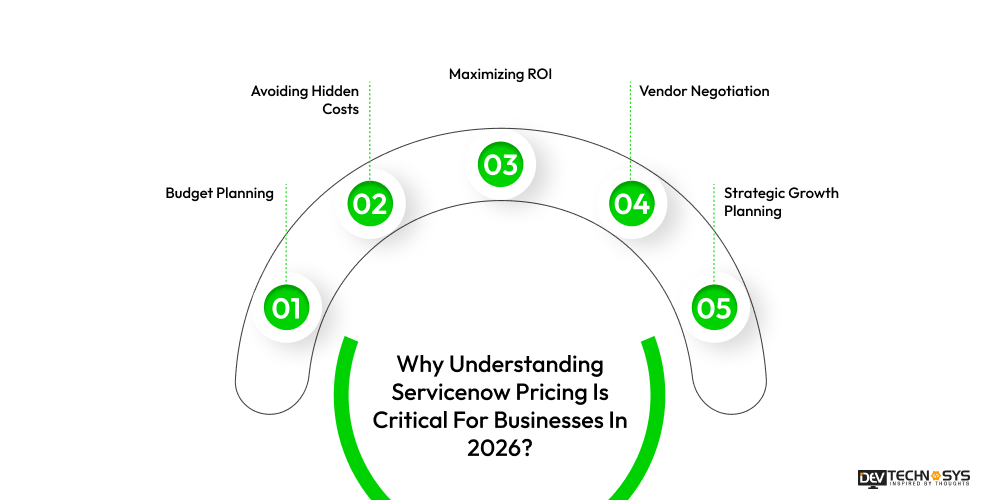
1. Budget Planning
Businesses can better allocate budgets and avoid overspending on license fees, module fees, or consulting fees by knowing upfront what their ServiceNow cost per user is. So that IT initiatives and digital transformation projects remain financially viable.
2. Avoiding Hidden Costs
There are many unexpected costs related to ServiceNow, such as migration costs, software customization costs, and developer costs. Understanding these costs early on will help organizations avoid having to deal with unexpected costs as their implementation progresses and will also have a positive impact on ROI.
3. Maximizing ROI
By having a clear understanding of the ServiceNow pricing model, businesses will be able to prioritize the modules and features that provide them with the most value so that they can ensure they get the maximum return on their investment for their ITSM, ITOM, or HR Service Delivery solutions.
4. Vendor Negotiation
Organizations will be empowered to negotiate more favorable contracts with their vendors by understanding the various licensing models, support packages, and ServiceNow subscription pricing tiers available and using this information to negotiate better pricing and service levels that align with their size and future growth objectives.
5. Strategic Growth Planning
Knowing what things will cost assists businesses in predicting their future expenses as they grow. ServiceNow usage, adding more modules, and processing newly developed processes will help them avoid putting pressure on their budgets, but will also allow them to continue going through the phase of digital transformation into 2026.
Industry Insights: According to The Wall Street Journal, Bill McDermott, the CEO of ServiceNow, estimates that the company’s entire addressable market is at least $600 billion, which is a lot more than the $90 billion it was when he came.
What is the ServiceNow Implementation Cost in 2026?
The ServiceNow implementation cost is basically based on the business’s size and the complexity of the ServiceNow implementation. It involves various types of factors such as the number of modules, integration needs, customization level, and more.
Small businesses typically cost around $8,000 to $15,000, and mid-sized businesses can take around $15,000 to $20,000. The large-sized businesses’ costs go as high as $25,000 or more because of multiple modules and worldwide deployment. Let’s get the exact ServiceNow pricing and implementation cost in detail in the table below:
| Category | Small Business | Mid-Sized Company | Large Enterprise |
| Licensing / Platform | $3,000 – $5,000 | $5,000 – $8,000 | $8,000+ |
| Implementation | $5,000 – $10,000 | $8,000 – $12,000 | $15,000+ |
| Customization | $0 – $2,000 | $2,000 – $5,000 | $5,000+ |
| Integration | $0 – $1,000 | $1,000 – $3,000 | $3,000+ |
| Training | $0 – $2,000 | $1,000 – $3,000 | $3,000+ |
| Annual Support | $0 – $1,000 | $1,000 – $2,000 | $3,000+ |
| Total (Year 1) | $8,000 – $15,000 | $15,000 – $20,000 | $25,000+ |
5 Key Factors That Affect the ServiceNow Implementation Cost
Every business fixes a budget for every type of implementation, but it can fluctuate without knowing about the major cost-affecting factors. There are a number of factors that affect the ServiceNow platform implementation & integration services cost. So, consider the various types of factors to avoid the additional ServiceNow pricing and implementation cost:
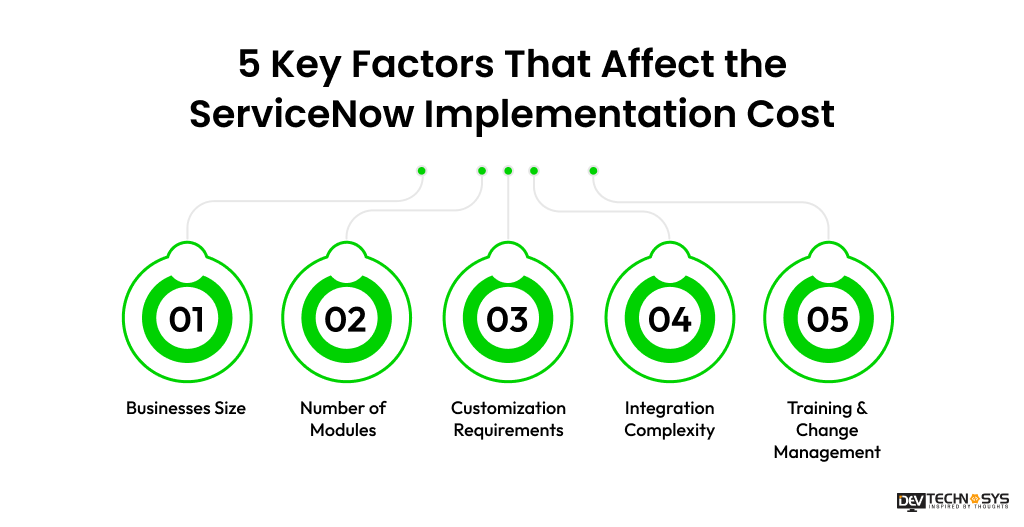
1. Businesses Size
It is one of the most common or well-known factors that can highly impact the ServiceNow implementation cost. The large enterprise businesses require a higher number of modules, departments, workflows, and more, which can directly affect the cost. The small businesses require limited modules and low-level implementation complexity.
| Level | Description | Cost Impact |
| Small | Limited users, simple processes | Low |
| Medium | Moderate users, some complexity | Moderate |
| Large | Enterprise-wide, complex operations | High |
2. Number of Modules
Moving to the second cost-impacting factor, there are various types of ServiceNow modules, such as HR, ITSM, CSM, ITOM, and more. Implementation of more modules can lead to a higher cost. Every ServiceNow managed service requires licensing fees, configuration requirements, integration complexity, and creating multi-module deployments.
| Level | Description | Cost Impact |
| Few Modules | 1–2 modules (e.g., ITSM only) | Low |
| Moderate | 3–5 modules | Medium |
| Many | Multiple enterprise-wide modules | High |
3. Customization Requirements
All the ServiceNow features can not fulfill the specific requirements of the project; that’s why businesses integrate custom features and workflows. It involves reports, UI dashboards, functionalities, and services; it can increase the implementation cost and time. The additional custom changes can enhance the project complexity and future upgrades.
| Level | Description | Cost Impact |
| Minimal | Out-of-the-box configuration | Low |
| Moderate | Some workflows & UI customization | Medium |
| Extensive | Heavy customization & scripting | High |
4. Integration Complexity
The overall cost of ServiceNow integration can be impacted by integrating ServiceNow with other systems. It is common for some integrations to be costly; they may require mapping, APIs, 3rd party tools, legacy systems, etc. The ongoing maintenance of data flow and testing out the different integrations will also need to be factored into the total implementation costs for ServiceNow.
| Level | Description | Cost Impact |
| Simple | Few integrations (1–2 systems) | Low |
| Moderate | Multiple systems with standard APIs | Medium |
| Complex | Legacy systems & custom integrations | High |
5. Training & Change Management
The last cost-impacting factor is the employee onboarding, training, and organization change management portion of the implementation. Proper or effective training will provide you with a good return on your investment, but it will not come without a budget allocation, affecting the total implementation cost of ServiceNow.
| Level | Description | Cost Impact |
| Basic | Minimal user training | Low |
| Structured | Role-based training programs | Medium |
| Extensive | Org-wide change management strategy | High |
What is the Hidden ServiceNow Implementation Cost in 2026?
There are different types of hidden factors raised during the implementation of ServiceNow, and they can directly affect the overall implementation cost. Before implementation, businesses must be aware of the hidden factors to avoid them and streamline each process of implementation.
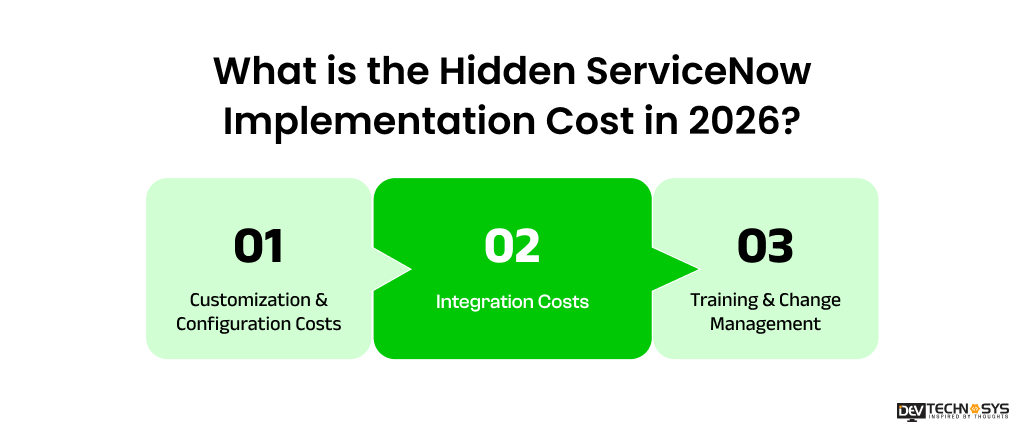
1. Customization & Configuration Costs
The costs associated with installation and customization may be higher than originally anticipated. The amount of time spent customizing will be increased if the organization has multiple departments that need to use the same application system. This leads to extra staff being needed for the implementation phase, which will raise the cost of consulting as well.
2. Integration Costs
The complexity and time required to integrate ServiceNow with third-party ERP, CRM, and HR applications can lead to additional integration costs. The development of APIs, mapping data, and testing those integrations requires skilled resources to accomplish this, which is often underestimated. Certain third-party systems may contain unfathomable complexities.
3. Training & Change Management
Finally, the costs of employee onboarding, training, and change management are underestimated. Each employee’s participation in onboarding, training, and change management includes a monetary expense for workshops, e-learning, and documentation, as well as ongoing support after implementation is complete. If individuals do not accept using the new workflow, this will erode the return on investment from the implementation.
How Much Do ServiceNow Modules Cost In 2026?
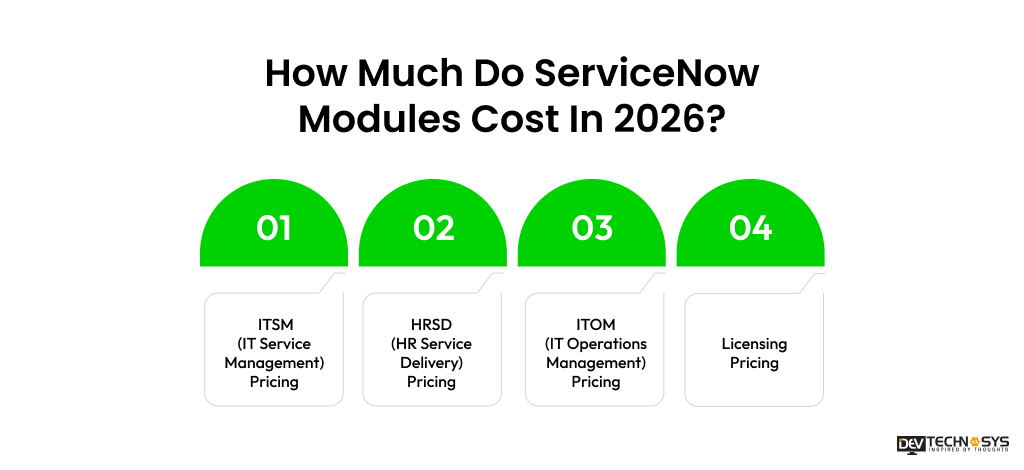
There are various types of ServiceNow modules available to use in every phase of implementation. It includes ITSM, HRSD, ITOM, and licensing; each module has different pricing. So, let’s take a look at the ServiceNow modules pricing with detailed information.
1. ITSM (IT Service Management) Pricing
One of the most fundamental components of ServiceNow for IT Service Management (ITSM) is the functionality for managing all aspects of information technology (IT) services, including incidents, problems, changes, and requests. When determining ServiceNow pricing for its ITSM module, it uses multiple editions, including Standard, Professional, and Enterprise editions. The monthly ITSM ServiceNow price to access this module ranges from $100-$150 per user, depending on any add-ons.
| ITSM Tier | Estimated Cost (Per User/Month) | Features Included |
| Standard | $100 | Incident, problem, change management |
| Professional (Pro) | $100 – $120 | Adds automation, analytics, and SLA tracking |
| Enterprise | $100 – $150+ | Advanced workflows, AI, predictive intelligence |
2. HRSD (HR Service Delivery) Pricing
The HRSD module provides automated processes for delivering HR services such as case management, onboarding, etc. On the basis of completed cases(upon completion), the monthly fee charged for each will be $80-$120. The cost of implementing HRSD can increase as a result of multiple factors, including the quantity of HR Agents assigned per service, the availability of workflow automation, the number of operational processes performed, etc.
| HRSD Tier | Estimated Cost (Per User/Month) | Features Included |
| Basic HRSD | $80 | HR case management, employee requests |
| Advanced HRSD | $80 – $100 | Onboarding, lifecycle workflows |
| Enterprise HRSD | $100 – $120+ | Full HR automation, AI-driven services |
3. ITOM (IT Operations Management) Pricing
ITOM (IT operations management) manages the IT infrastructure, such as discovery, event management, service mapping, and more. The ServiceNow ITOM pricing is per managed configuration item (CI); it is around $50 to $100 per month, or it can be higher due to modules purchased, enterprise agreements, and the scale of IT assets. The higher infrastructure growth can incur a higher ServiceNow ITOM license cost to maintain their operations and speed.
| ITOM Tier | Pricing Model | Estimated Cost |
| Discovery | Per CI (asset-based) | $50 – $70 per node/year |
| Standard ITOM | Per user / CI | $70 – $90/user/month |
| Advanced ITOM (AIOps) | Custom pricing | $100+ per user/month or higher CI cost |
4. Licensing Pricing
ServiceNow licensing is one of the most well-known modules that can be used edition-wise, such as standard, pro, and enterprise. The ServiceNow license cost starts from $70 to $140 per month, which can be based on module selection and role. The final cost can fluctuate because of AI add-ons, advanced analytics, reporting, enterprise contracts, and many more.
| License Type | Estimated Cost (Per User/Month) | Description |
| Fulfiller License | $70 – $90 | Core users managing tickets/workflows |
| Professional License | $90 – $110 | Advanced features and automation |
| Premium (AI Add-ons) | $110 – $140+ | Includes AI, analytics, and automation tools |
Industry Insights: According to Gartner, ServiceNow enterprise agreements commonly include three-year contracts with built-in annual price escalations ranging between 8% and 15%.
What are the Main Elements of the ServiceNow Implementation Cost?
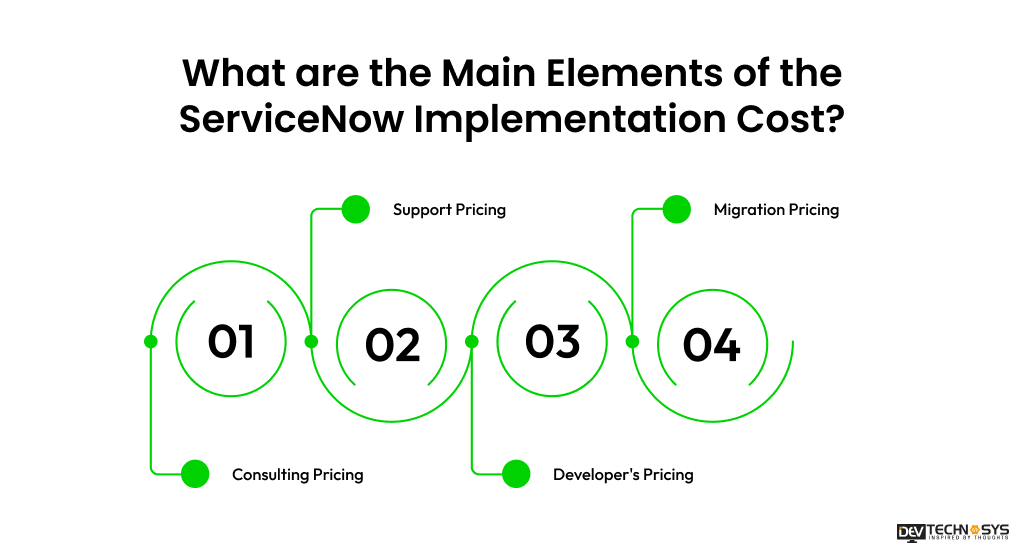
There are various elements of the ServiceNow implementation that mainly affect the overall cost of implementation. It includes developers’ costs, consulting prices, supporting prices, and migration pricing. Let’s take a look at the cost of the main elements of ServiceNow implementation.
1. Consulting Pricing
ServiceNow consulting services in USA make up a significant amount of the cost for implementing ServiceNow. There are a variety of services provided by consulting partners, including workflow customization, designing, deploying, and advising on how to achieve sustainable success. The consulting fee can vary due to factors including the experience of the consultant, with an average fee of $150-$250 per month.
| Consulting Level | Estimated Cost | Description |
| Basic Consulting | $150/hour | Configuration, small implementations, minor workflows |
| Advanced Consulting | $150 – $200/hour | Custom workflows, integrations, mid-size deployments |
| Expert / Architect | $200 – $250+/hour | Enterprise architecture, complex multi-module implementations |
2. Support Pricing
Support services include many phases, including ongoing maintenance and support, troubleshooting, application upgrades, fixing bugs and glitches in applications, upgrading outdated features of applications, and optimizing performance. Support fees are typically in the range of 10% to 25% of the total ServiceNow implementation costs. Support services may also include more advanced services. The ServiceNow support services fees have the potential to substantially increase your overall ServiceNow implementation cost.
| Support Level | Estimated Annual Cost | Description |
| Basic Support | 10 – 15% of the implementation cost | Bug fixes, minor updates, limited support hours |
| Standard Support | 15 – 20% | Regular maintenance, upgrades, and performance monitoring |
| Premium Support | 20 – 25%+ | 24/7 support, proactive monitoring, continuous optimization |
3. Developer’s Pricing
Developer’s pricing includes ServiceNow developers, admins, architects, quality assurance engineers, and more to maintain the development process of the ServiceNow platform. The cost to hire ServiceNow developers is based on the developer’s experience level, skill set, and location. The cost can be increased because of customization needs or requirements, integrations, and enhancements.
| Developer Level | Estimated Cost | Description |
| Junior Developer | $15 – $18/hour | Basic configuration, scripting, and small changes |
| Mid-Level Developer | $18 – $22/hour | Custom development, integrations, workflow automation |
| Senior Developer / Architect | $22 – $25+/hour | Complex architecture, advanced customization, large-scale systems |
4. Migration Pricing
The migration mainly works by transferring data from legacy systems to ServiceNow. It involves several types of services such as data extraction, cleansing, validation, and transformation. The migration process ensures data accuracy and compatibility. The migration pricing typically ranges from $5,000 to $20,000, depending on the complexity and data volume.
| Migration Type | Estimated Cost | Description |
| Simple Migration | $5K – $7K | Small datasets, minimal transformation |
| Moderate Migration | $7K – $15K | Medium data volume, some data cleansing and mapping |
| Complex Migration | $15K – $20K+ | Large datasets, multiple systems, heavy transformation, and validation |
5 Tips to Optimize the ServiceNow Implementation Cost
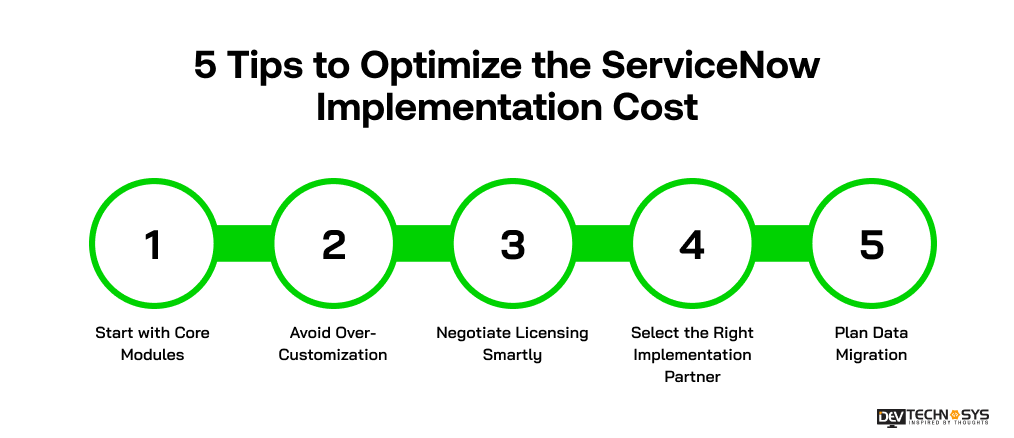
To maintain or reduce the ServiceNow implementation cost, there are many ways to help businesses implement ServiceNow within a fixed cost. It includes negotiating licensing, starting with basic modules, avoiding over-customization, and many more. Let’s consider the ways to optimize the ServiceNow implementation cost.
1. Start with Core Modules
Start with the simple or basic modules like ITSM instead of integrating all types of modules. This can reduce the starting cost and make the process simple and easy. Businesses can expand later as per real-time needs, and it prevents the integration of a higher number of features and services.
2. Avoid Over-Customization
The higher number of customizations can increase the development time, testing effort, design efforts, and ongoing maintenance. Businesses can use out-of-the-box features instead, if it can be possible. The ServiceNow platform is designed with best practices, so businesses can implement their built-in functionalities to avoid to hire ServiceNow developers for customization.
3. Negotiate Licensing Smartly
The ServiceNow pricing 2026 can be negotiable more than the other platforms. It offers higher negotiability in enterprise deals, and businesses also go for discounts, price caps, and multi-year contracts. A well-structured licensing strategy can significantly reduce long-term costs and prevent unexpected increases during contract renewals or expansions.
4. Select the Right Implementation Partner
In this another cost-reducing way, choose the best or right implementation partner, which can reduce the money and time. The talented or skilled implementation team can reduce the working efforts, errors, deliver faster deployment, and avoid rework. When choosing the right partner, businesses can compare their cost and working criteria with others.
5. Plan Data Migration
Failing to have a good plan for data migration can result in over-budget, time-consuming, and costly errors. Make sure your data is clean and valid before migrating it to avoid having to redo it once you are done. Only transfer what you need from your old systems, not everything. Using a well-organized migration plan will simplify your transition process and lower the risks of additional or unexpected costs after implementation.

Conclusion
Understanding ServiceNow pricing and implementation costs for 2026 is important when determining how to make informed decisions regarding digital transformation. Pricing differs depending on the licensing, customization, integration, and size of your organization. Therefore, you will need to plan your deployment effectively. Working with an established ServiceNow development company will allow for faster deployments, optimized expenses, and the ability to create sustainable long-term value.
This guide will assist leaders in accurate funding and to help minimize unforeseen project risk today by aligning business objectives with appropriate modules and implementation strategies to achieve maximum return on investment.
For the ServiceNow implementation, you need to connect with the right ServiceNow development company to offer affordable services. Dev Technosys comes in with 15+ years of experience in offering engineering and ServiceNow services and a team of talented developers who are specialized in ITSM, consulting, supporting, ITOM, and HRSD.