












Key takeaways:
-
-
-
- Banking app development has become a priority for banks and fintech industries, as this mobile-first generation is searching for convenience.
-
- For enhanced security, hassle-free financial services, 24/7 banking access, and improved usr experience, digital banking platform development is necessary.
-
-
-
- By 2034, the banking app market is expected to reach USD 190.94 billion. This estimation explains that people will hugely depend on banking apps.
- The average cost to develop a banking app in 2026-2027 can range from $30,000-1,50,000. The cost is determined by the platform’s complexity and several other factors.
-
-
Earlier, when it came to going to a bank, people feared long queues, hectic paperwork, and unnecessary delays. But today, mobile technology has revolutionized the way people access financial services. That’s how banking applications have become our daily, seamless banking partner.
Banking application development has increased user expectations for secure, fast, and convenient banking solutions. This has attracted startups, financial institutions, and fintech companies to invest in and enhance user satisfaction.
This banking app development guide explains everything from what banking software development is to future trends. With this, businesses can meet user needs while staying competitive in the digital baking ecosystem.
What is Banking App Development?
Mobile banking app development is a proces to create a secure and seamless platform for financial services. It allows customers to check their balance, transfer money, pay bills, manage accounts, and use other services without branch visits.
Basically, the banking app development process develops a digital solution letting people access bank services anytime, anywhere. Modern banks in 2026 are highly dependent on mobile apps because people want secure, fast, and easy banking services.
High-level banking software development services offer:
- 24/7 banking access
- Low dependence on physical branches
- Improve customer experience
- Increase transaction speed
- Enhance security with digital authentication
Market Overview of Global Banking Applications
Understanding the banking app market tells businesses about current trends, customer expectations, and growth opportunities. We will be analyzing market research on banking apps researched by Fortune Business Insights.
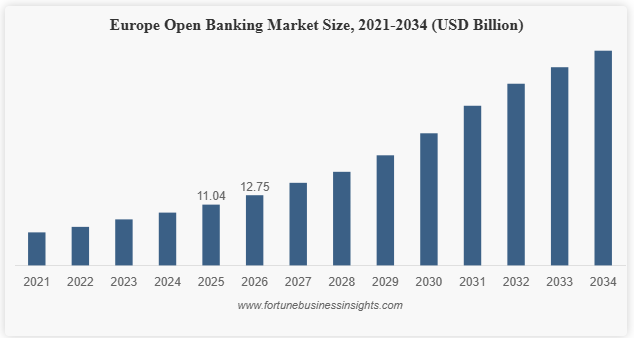
- The global open banking market reached USD 35.30 billion in 2025 and continues expanding rapidly worldwide.
- The market is projected to grow from USD 42.10 billion in 2026 to USD 190.94 billion by 2034.
- Open banking is expected to grow at a 20.8% CAGR during the forecast period, driven by fintech innovation.
- Europe dominated the open banking market with a 31.30% share in 2025, leading global adoption.
- Global digital banking payment transactions are expected to grow by over 500%, from USD 57 billion to USD 330 billion by 2027.
Banking System Design: The Multi-Tier Fintech Architecture
Building a resilient digital banking application requires moving past traditional monolithic server frameworks. Modern banking platforms rely on a decoupled, highly secure, multi-tier microservices architecture designed to process thousands of transactions per second with zero downtime. This structural blueprint details how data safely traverses from a user’s phone down to the core ledger.
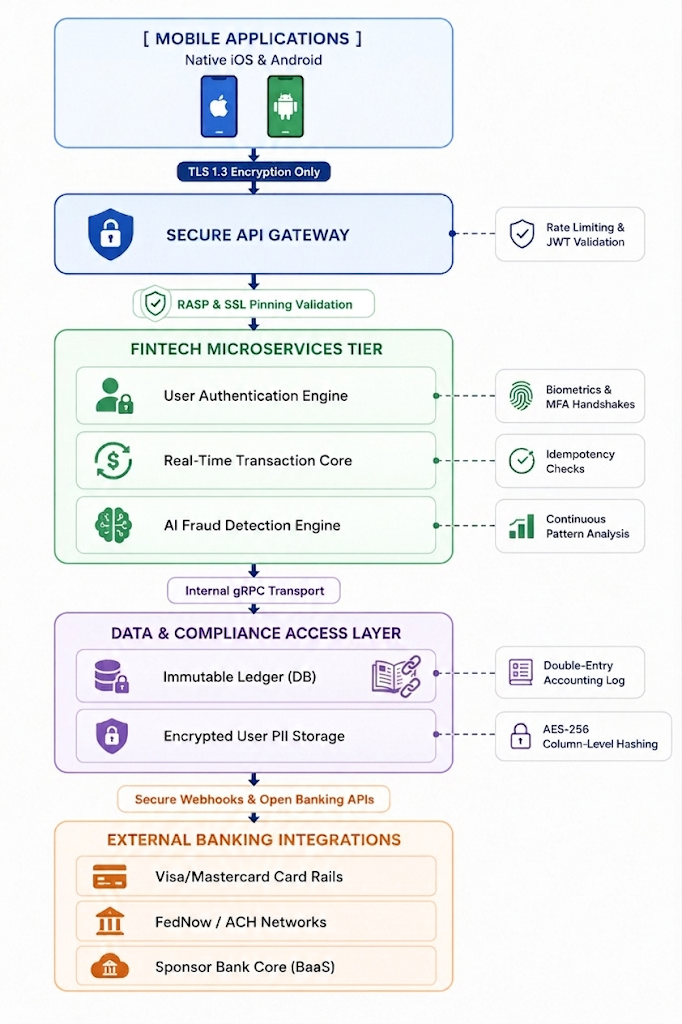
We are now decoupling the 4 structural tiers for better understanding this banking app architecture:
1. The Edge and Secure API Gateway
The API gateway serves as the single access point for mobile apps. It protects users’ internal microservices from the public internet. It applies rate limits to defend against DDoS attacks and validates incoming JSON Web Tokens (JWTs). This is helpful in verifying whether the user is currently logged in.
2. The Microservices Engine
Rather than relying on a single server to handle everything, the business logic is split into separate, scalable services. These are written in high-concurrency programming languages such as Go or Java.
The Advantage: If the “AI Fraud Detection Engine” undergoes a massive traffic spike during holiday shopping. It auto-scales dynamically without slowing down the user login or account balance retrieval services.
3. The Enterprise Ledger & Data Access Tier
This ensures the segregation of general operations data and transaction logs.
● User PII:
USER PII is segregated into a local database that is encrypted with column-level AES-256 encryption standards. This is beneficial to ensure compliance with the GDPR and SAMA data locality laws.
● The Transaction Ledger:
Operated as an immutable double-entry database (such as PostgreSQL, with write-once and read-many schemas). There are no changes to the balances; they are calculated dynamically from a read-only log of balanced debits and credits. This is to guarantee that there are no data inconsistencies.
4. The Third-Party Integration Fabric
A contemporary banking application does not exist alone. In this tier, it communicates with other financial applications via secure, asynchronous webhooks. It manages real-time synchronization of data between your application’s ledger, debit card networks (Visa/MasterCard), and real-time settlement systems (FedNow, SEPA).
How Beneficial is Banking Software Development for Financial Institutions and Users?
The Hybrid application development for banking services plays vital but different roles for banks and customers. We will learn how differently core banking mobile solutions are valuable for financial institutions and end users.
1. Benefits for Financial Institutions
- Reduction in Operational Costs – Online banking platform development reduces the requirement for physical branches, infrastructure, and manual tasks.
- Enhancing User Engagement – To improve customer engagement, banks offer regular notifications, transaction updates, and customized notifications.
- Data-Driven Analytics – Financial institutions can get high-quality, valuable data to understand customer behaviour and implement changes.
- Competitive Edge – To stay competitive for the long term in the online fintech market, banking apps need to become profitable for banks.
2. Benefits for Customers
- 24/7 Banking Services – Customers can review their balance, maintain transaction history, transfer money, and pay bills anytime, anywhere, without visiting the bank.
- Effortless Transactions – Payments can be transferred easily and quickly, as well as accounts can be managed from a smartphone.
- Upgraded Security – For utmost security, these apps integrate biometric login, data encryption, and two-factor authentication to secure users’ money while gaining their trust.
- Improved Financial Management – Finances can be managed in a better way by tracking spending insights, transaction history, and budgeting tools.
What is Banking App Development Process: A Step-by-Step Roadmap
The mobile banking app development process involves a comprehensive process. It includes market research, feature and tech stack selection, UI/UX designing, development, testing, deployment, and after-release support. Here, we will understand the complete banking software development process thoroughly:
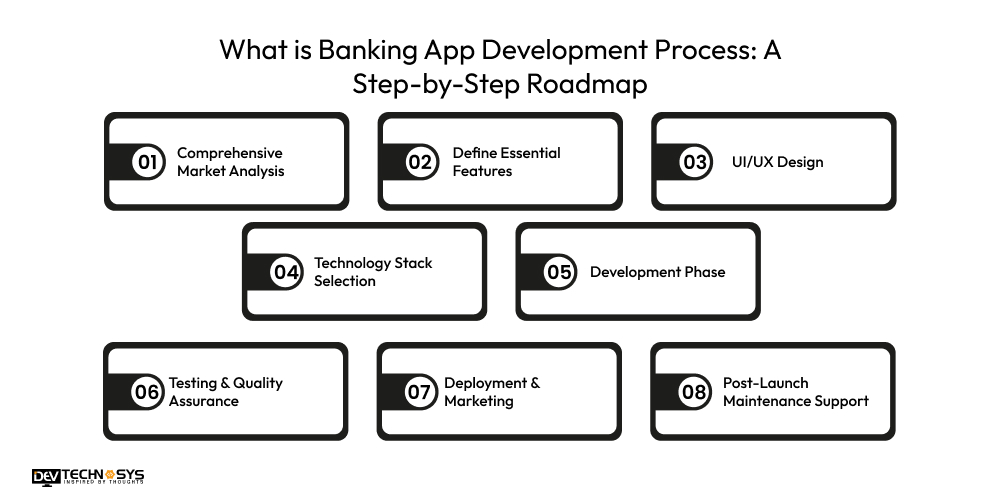
1. Comprehensive Market Analysis
The first step in the banking, fintech, or eWallet app development process is doing thorough research about industry requirements. It includes a detailed study on the latest market trends, customer needs, and competitors.
Also, define the app’s purpose, target audience, and core functions. All this information ensures the final solution corresponds to business goals and user expectations.
2. Define Essential Features
Next, it’s time to decide the feature set of the banking app that brings scalability to the app. The essential features of a banking app include account management, transfers, bill payments, and security features. Make sure you prioritize core features first, as per the user needs and security standards for user-centric experiences.
3. UI/UX Design
The design of a banking application should be intuitive and engaging. For this, focus on designing an engaging user interface (UI) and a seamless user experience (UX). People look for banking apps that are easy to use and visually appealing. These apps should be optimized for mobile devices with security and functional flow.
4. Technology Stack Selection
Choosing the right technologies for backend, frontend, and database is an essential step in the fintech app development process. Frameworks like React Native, Node.js, or cloud services like AWS are highly preferred for banking apps. These technologies are necessary to meet security requirements and scalability, and are also responsible for the app’s performance.
5. Development Phase
At this stage of the digital banking development workflow, developers work on writing code, building features, and adding security measures. During this development stage, developers generally used agile development methodology.
It enables iterative progress by streamlining front-end and back-end development in parallel. This is the final app development stage that ensures the app meets the goals efficiently.
6. Testing & Quality Assurance
Before launching the custom fintech software solutions for public use, it is extremely important to conduct thorough testing. It includes bug fixing, performance testing across devices, and security standards.
In this step, multiple tests, such as manual, automated, and penetration testing, are conducted. Its main purpose is to guarantee the reliability of secure financial app development.
7. Deployment & Marketing
The final banking application development step, just after testing, is to deploy it on the app stores. It makes sure the app is launched without any hassle or technical issues.
However, launching the app is not enough; you have to promote the application to reach its targeted audiences. To promote the app, businesses can implement several digital marketing strategies.
8. Post-Launch Maintenance Support
Don’t think the development task ends with deployment. A reliable fintech app development company works hard even after the launch. After-launch services include regular performance monitoring, feature upgrades, security patches, and adding new versions.
These implementations are done after understanding the market demand and feedback from the users. It not only enhances user experience but also increases their trust.
Pick what you need below — you can select more than one — then tap Get detail to continue.Want a chatbot demo or pricing? Fill the form and talk to our experts today.
Chatbot demo dashboard
Cost to develop an app
Industry report
Case study
The Step-by-Step Banking App Development Roadmap & Timeline
It takes approximately 4 to 7+ months to develop a banking app in 2026-2027. The final banking app development timeline is determined by the app’s complexity, security requirements, and integrations. An MVP can be completed within a few months because of limited integrations. In comparison, enterprise-grade banking applications require additional time for integrations, testing, and regulatory validation.
| Development Stage | Primary Deliverable | Estimated Duration | Project Progress |
| Comprehensive Market Analysis | Business strategy, market insights, and project roadmap | 2–3 Weeks | 10% |
| Define Essential Features | Finalized feature list and development scope | 2–3 Weeks | 20% |
| UI/UX Design | Approved wireframes, prototypes, and visual interface | 3–4 Weeks | 35% |
| Technology Stack Selection | Confirmed architecture, frameworks, and integrations | 1–2 Weeks | 45% |
| Development Phase | Fully functional banking application with core modules | 8–16 Weeks (2–4 Months) | 80% |
| Testing & Quality Assurance | Bug-free, secure, and performance-tested application | 3–5 Weeks | 95% |
| Deployment & Marketing | Live application on app stores with launch support | 1–2 Weeks | 100% |
| Post-Launch Maintenance & Support | Continuous updates, monitoring, and feature enhancements | Ongoing | Continuous Growth |
Choosing the Scalable and Right Banking App Technology Stack in 2026–2027
The technology stack required by a banking application in 2026-2027 is comprised of:
- Flutter or Swift/Kotlin in case of mobile development
- js/Java Spring Boot for the back-end
- PostgreSQL for the database
- AWS cloud environment
- OAuth 2.0 protocol for authentication
- Open Finance/Plaid APIs for financial integration
- AES-256 encryption and PCI DSS/GDPR/KYC/AML compliance for security purposes
Have a look at the banking app tech stack; it is highly recommended and important for development.
| Technology Layer | Best Technologies | Primary Purpose |
| Mobile Development | Flutter, Swift, Kotlin | Build secure Android & iOS banking apps |
| Frontend | React.js, Angular | Create responsive customer dashboards |
| Backend | Node.js, Java Spring Boot, .NET Core | Process transactions and business logic |
| Database | PostgreSQL, MongoDB, Redis | Store customer and transaction data |
| Cloud Platform | AWS, Microsoft Azure, Google Cloud | Deliver scalable and highly available infrastructure |
| Payment Integration | Stripe, Plaid, Open Banking APIs | Enable payments, transfers, and account linking |
| Authentication | OAuth 2.0, OpenID Connect, Biometrics | Secure user identity and account access |
| Security | AES-256, SSL/TLS, PCI DSS, GDPR, KYC/AML | Protect financial data and ensure compliance |
| AI & Automation | TensorFlow, OpenAI APIs | Detect fraud and personalize banking experiences |
| Notifications | Firebase Cloud Messaging, Twilio | Send real-time transaction alerts and OTPs |
| DevOps | Docker, Kubernetes, GitHub Actions | Automate deployment and scaling |
| Monitoring | Grafana, Datadog, New Relic | Monitor uptime, performance, and system health |
Which Features Does a Modern Banking App Must Have?
Features play a pivotal role in upgrading the banking experience of users who want ease and convenience. Account management, bill payment, fund transfer, security, and financial insight are essential features of a banking app. Here, we will discuss some of these important banking apps features thoroughly.
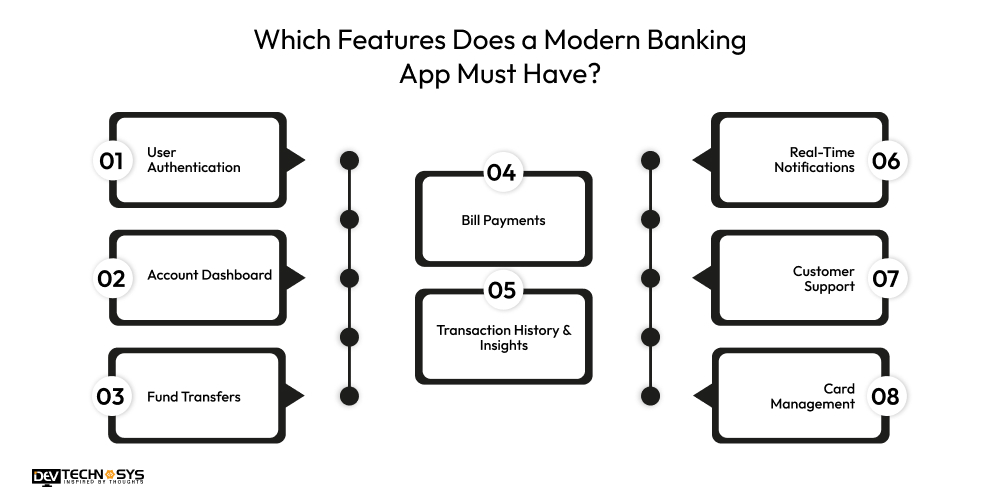
1. User Authentication
A secure way to log in with biometrics, PINs, and two-factor authentication is necessary to protect users’ money and financial data. This feature adds to the user security, allowing them to access banking services with proper safety.
2. Account Dashboard
To get an overview of balance, transactions, and account details in one place, an account dashboard is built. With this, users can quickly have their data, monitor their activities, and manage finances and multiple accounts.
3. Fund Transfers
Let customers send and receive money in no time without visiting a physical bank, through fund transfer. It is a quick, secure, and convenient digital feature that satisfies users who have to make payments regularly.
4. Bill Payments
Banking apps allow users to pay utility bills and other expenses directly through the bill payment feature. It simplifies payment and helps customers complete transactions all under a single platform without hassle.
5. Transaction History & Insights
To track or manage finances, transaction history, and insight features must be added to the banking app. It also records spending patterns and provides financial insights. Through this features, users understand their expenses and manage budgets efficiently.
6. Real-Time Notifications
A real-time notification option provides customers with instant alerts on any transaction made to track spending efficiently. This helps users stay informed about the activity on their accounts and stay updated on financial operations.
7. Customer Support
The customer support feature is really essential in an AI-powered banking application. Either through chat, call, support ticket, or AI chatbots, users’ problems should be tackled immediately without any delays. This builds user trust in the application and user retention.
8. Card Management
A banking app with a card management feature lets customers block or unblock cards and set spending limits. It also allows managing card settings directly from the mobile application. This feature offers better control and security for managing debit or credit cards.
Most Common Types of Banking Application Development
From personal banking to business services, banking applications can cater to every need. In this section, we are going to learn about the types of banking app development. These types work as per the demand and requirements of financial institutions and fintech companies.
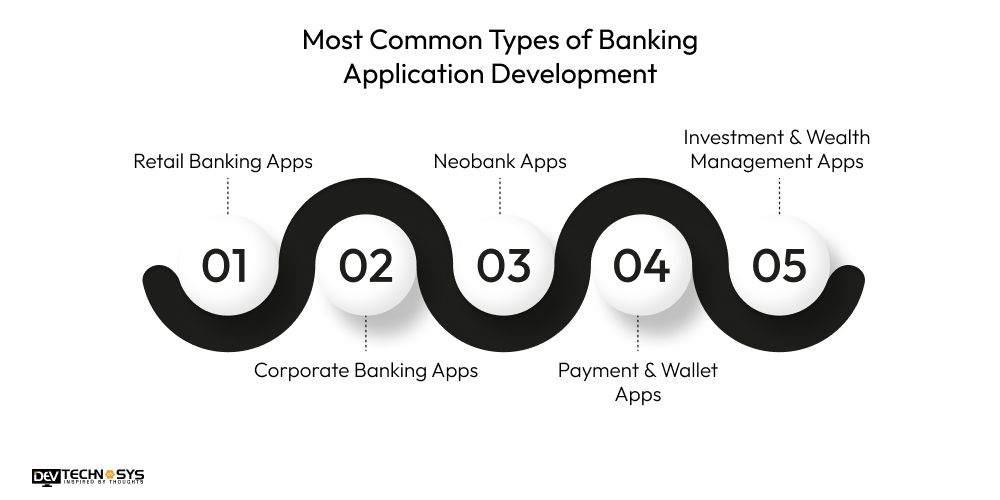
1. Retail Banking Apps
Retail banking apps are developed specifically for individual financial management. They offer services like account management, fund transfers, bill payments, and personal financial tracking. This banking type is widley used for daily banking activities and is used by personal account holders.
Real-world examples:
- Chase Mobile
- Bank of America Mobile Banking
- HSBC Mobile Banking
- Wells Fargo Mobile
- Santander Mobile Banking
2. Corporate Banking Apps
The financial platforms built specifically for businesses are known as corporate banking apps. Such applications provide users with payroll management, bulk payments, invoicing, and detailed transaction monitoring. It helps manage company transactions with multi-user access and approvals.
Real-world examples:
- HSBCnet
- CitiDirect BE
- Barclays Corporate Banking
- Bank of America CashPro
- Standard Chartered Straight2Bank
3. Neobank Apps
Neobanks, also known as digital banks, are platforms that are entirely digitalized and have no physical branches. The main focus of these banks remains on lower fees, immediate account opening, and the latest user-friendly interfaces. It could be the digital-first banking experience usually operated by FinTechs.
Real-world examples:
- Revolut
- N26
- Chime
- Monzo
- Starling Bank
4. Payment & Wallet Apps
Payment and wallet apps are created with only purpose of cashless transactions and contactless payment. It includes money transfers, mobile payments, digital wallets, and fast payment transfers. Along with that, such platforms also support peer-to-peer (P2P) payments and is widley used for everyday online purchases.
Real-world examples:
- PayPal
- Google Pay
- Apple Pay
- Samsung Wallet
- Alipay
5. Investment & Wealth Management Apps
Investment and wealth management apps allow users to invest, track portfolios, and access stock markets. It also lets them manage mutual funds and retirement plans with maximum security. In short, these apps are highly preferred by individuals looking for long-term financial growth
Real-world examples:
- Robinhood
- E*TRADE
- Wealthfront
- Acorns
- Fidelity Investments

Who Builds a Banking App: Explain Development Team Structure
Another essential thing in the banking application development guide is the development team. Creating a successful banking app requires a team of highly professional and skilled developers. They all work together to design, develop, test, and secure the banking platform. Now, we will be discussing the team structure, which a banking app development company always works on.
Role |
Primary Responsibilities |
Key Focus Areas |
Example Tools/Technologies |
| Product Manager | Defines product vision, roadmap, and features | Strategy, roadmap, stakeholder alignment | Jira, Trello, Confluence |
| Business Analyst | Gathers requirements, analyzes workflows | Requirements documentation, compliance needs | MS Excel, Lucidchart, Figma |
| UI/UX Designer | Designs user interface & experience | Wireframes, prototypes, usability testing | Figma, Sketch, Adobe XD |
| Front-End Developer | Implements app interface for users | Responsive design, performance, accessibility | React Native, Flutter, Swift, Kotlin |
| Back-End Developer | Builds server-side logic & APIs | Database management, security, and scalability | Node.js, Java, Python, SQL/NoSQL |
| QA & Test Engineer | Test functionality, security, and usability | Manual & automated testing, bug reporting | Selenium, Appium, JIRA, Postman |
| Database Administrator (DBA) | Manages data storage and integrity | Backup, scaling, query optimization | MySQL, PostgreSQL, MongoDB |
| Compliance Officer | Ensures regulatory compliance | KYC, AML, PCI-DSS adherence | Internal policies, compliance software |
| Customer Support Specialist | Handles user issues & feedback | Support channels, reporting issues | Zendesk, Freshdesk, Intercom |
How Much Does A Banking Application Development Cost?
The average banking app development cost can be estimated between $30,000 and $1.50,000. Basically, complexity is something that matters most and affects the final developemnt budget.
- A simple app, developed with an MVP strategy, has lower complexity. So the development cost will be from $30,000 to $65,000.
- A moderate app combines simple and advanced integrations, resulting in mid-level complexity. This takes the development expenses from $75,000 to $1,15,000.
- Whereas a fully functional app with advanced additions can be more complex, making the budget range between $1,15,000 and $1,50,000.
The concept of banking and fintech app development cost can be explained through a breakdown table:
| Banking App Type | Estimated Development Cost | Best For | Complexity Level |
| Basic Banking App (MVP) | $30,000–$65,000 | Startups & MVP Validation | Low |
| Standard Banking App | $75,000–$115,000 | Growing Fintech Businesses | Medium |
| Advanced Digital Banking App | $115,000–$150,000+ | Banks & Financial Institutions | High |
5 Major Factors Influencing the Banking App Development Cost in 2026-2027
Despite complexity, multiple factors are also impacting the cost to build a banking app. It includes banking app UI/UX design, backend infrastructure, security & compliance, platform selection, maintenance & updates, APIs, and others. We will now understand how these factors affect the banking or fintech software development expenses.
1. Platform Choice
The selection between iOS, Android, or cross-platform development directly impacts the banking app budget. Different platforms require separate development approaches, testing processes, and optimization efforts. This can increase project cost, implementation complexity, and long-term scalability requirements.
| Platform Strategy | Estimated Cost | Best For |
| Single Platform (iOS or Android) | $10,000–$18,000 | MVP launches |
| Cross-Platform App | $15,000–$24,000 | Startups targeting both users |
| Native iOS + Native Android | $24,000–$30,000 | Enterprise banking solutions |
2. Security & Compliance
To build a secure banking app, it is important to implement advanced security measures. It includes end-to-end encryption, multi-factor authentication, secure APIs, fraud detection, and regulatory compliance. Meeting security standards like PCI DSS, GDPR, KYC, and AML can increase banking and investment app development costs.
| Security Layer | Estimated Cost | Business Impact |
| Basic Encryption & Authentication | $5,000–$8,000 | Essential protection |
| KYC/AML Integration | $8,000–$12,000 | Regulatory onboarding |
| PCI DSS & GDPR Compliance | $12,000–$16,000 | Legal compliance |
| Fraud Detection & Advanced Security | $16,000–$20,000 | Enterprise-grade protection |
3. Post-Launch Maintenance
To achieve optimal performance, security, and reliability, banking applications need to be maintained after release. It involves upgrades, bug fixes, OS compatibility, performance tuning, monitoring, security updates, and other features. These post-launch maintenance activities raise the mobile banking app development and operational cost.
| Maintenance Activity | Estimated Annual Cost | Purpose |
| Bug Fixes & Updates | $2,500–$3,500 | App stability |
| OS Compatibility Testing | $3,000–$4,000 | Device support |
| Performance Monitoring | $3,500–$5,000 | User experience |
| Security Patches & Enhancements | $5,000–$6,000 | Risk mitigation |
4. Developer’s Location
The costs of software development for banking apps vary depending on where software developers work. Hiring a developer from regions like the USA, Australia, and Western Europe can be expensive. Labor rates, technical skills, market demand, regulatory issues, and operational expenses affect the total cost.
| Development Region | Estimated Cost | Typical Expertise |
| South Asia | $10,000–$15,000 | Fintech outsourcing |
| Eastern Europe | $14,000–$18,000 | Enterprise development |
| Middle East | $16,000–$20,000 | Regional compliance expertise |
| North America / Western Europe | $20,000–$23,000 | Premium fintech engineering |
5. Development Team
The choice of the development team is crucial for determining the expenses of banking CRM software development. Freelancers are fit for small projects, and an in-house team provides more resources. In contrast, a software development company ensures an end-to-end experience, proper workflow, and scalable project execution.
| Team Model | Estimated Cost | Best Suited For |
| Freelancers | $12,000–$16,000 | MVPs and small banking projects |
| In-House Team | $16,000–$21,000 | Long-term product development and internal control |
| Development Company | $21,000–$25,000 | End-to-end fintech app development with specialized experts |
Common Challenges in Banking App Development and Their Solutions
Even after everything goes well, there are some issues that appear with the cloud-based banking software development. Understanding these common challenges helps businesses make smart decisions and try to avoid them as much as possible. We have also outlined the measures to tackle these difficulties with ease.
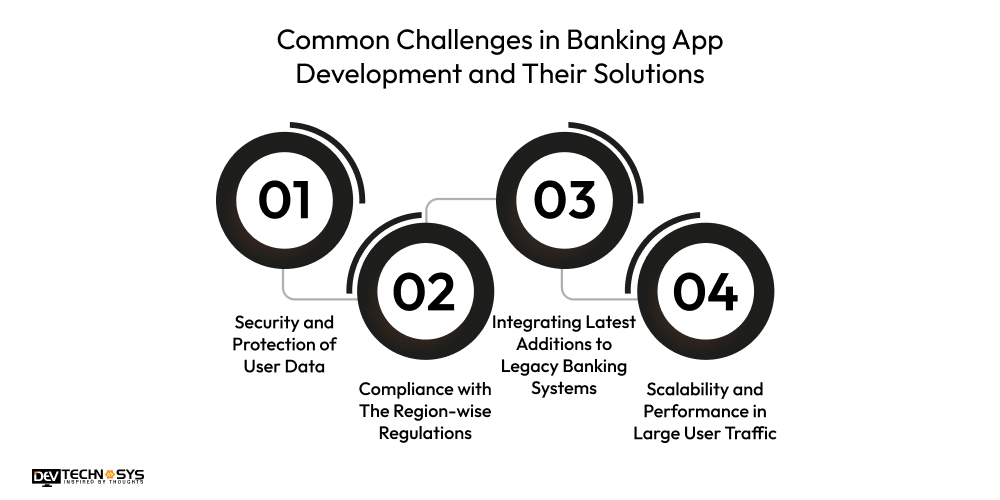
1. Security and Protection of User Data
One of the most crucial and worth-concerning issues is related to security and data protection. As users provide their sensitive and personal data to the banks, there is a risk of cyberattacks, fraud, and data breaches.
Solutions to Security and Data Protection:
- Implement strong end-to-end data encryption
- Use multi-factor authentication (MFA)
- Conduct regular security audits and testing
- Apply biometric authentication for secure access
2. Compliance with The Region-Wise Regulations
While developing financial apps, developers must follow banking regulations, data privacy laws, and industry standards. The regulations and compliance are different according to countries. Therefore, maintaining it is a bit challenging for banking app developers.
Solutions to Regulatory Compliance:
- Follow global financial compliance standards
- Implement secure data privacy practices
- Conduct regular compliance checks
- Work with legal and regulatory experts
3. Integrating Latest Additions to Legacy Banking Systems
Even after digitalization, there are many financial institutions that are working on outdated core banking systems. These legacy systems can create compatibility, performance, and security-related issues. So, integrating modern banking solutions can sometimes be difficult.
Solutions to Integration with Legacy Banking Systems:
- Use an API-based integration for digital banking architecture
- Implement middleware for system communication
- Gradually modernize legacy infrastructure
- Perform compatibility and performance testing
4. Scalability and Performance in Large User Traffic
There might be some days when a large number of users make multiple transactions simultaneously. The poor scalability of the app can slow down the application and can even lead to system crashes and downtime during high traffic.
Solutions to Scalability and Performance:
- Use a scalable cloud infrastructure
- Optimize backend and database performance
- Implement load-balancing systems
- Monitor performance and scale resources
What are the Future Trends in Banking App Development?
With the growing advancements, the banking industry also comes with next-generation banking technology solutions. Adding these latest trends in banking on-demand app development services will enhance banking services and take them to the next level.
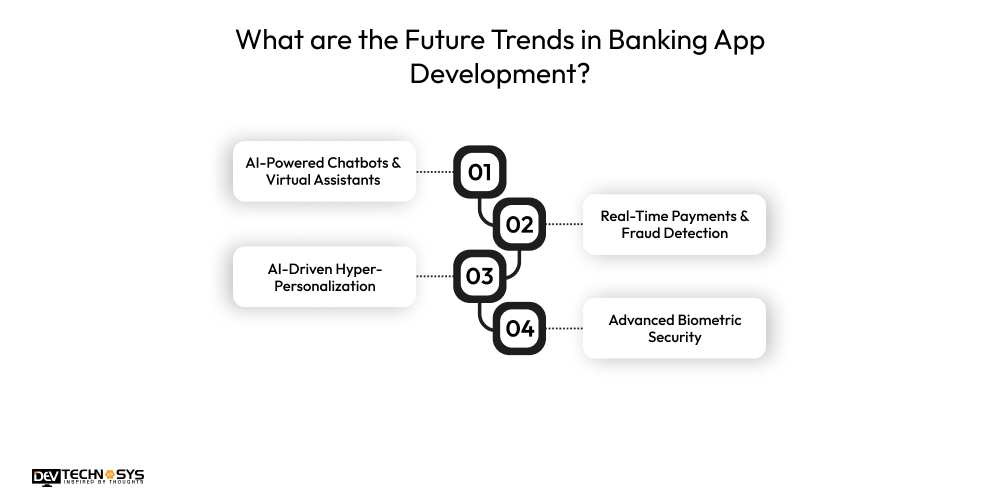
1. AI-Powered Chatbots & Virtual Assistants
AI-powered chatbots and virtual assistants allow banks to provide customers with instant support. It answers queries and resolves common issues instantly while guiding users through transactions. It also improves customer service by reducing operational workload.
2. Real-Time Payments & Fraud Detection
Modern banking apps are adopting real-time payment systems that allow instant money transfers. At the same time, AI-based fraud detection monitors transactions continuously to identify suspicious activities and prevent financial fraud.
3. AI-Driven Hyper-Personalization
AI-driven hyper-personalization provides users with tailored recommendations, offers, and smart financial insights. All this is because AI in banking industry analyzes user behaviour, spending habits, and financial goals. It also helps users manage their finances more efficiently.
4. Advanced Biometric Security
Advanced biometric security uses technologies such as fingerprint scanning, facial recognition, and voice authentication to protect banking apps. These methods enhance security while providing a faster and more convenient login experience for users.
Build vs. Buy vs. Partner: Choosing Your Core Banking Infrastructure
Choosing the appropriate strategy for core banking architecture is a really essential strategy. It significantly affects scalability, security, time to market, and future profitability. Financial institutions and fintech companies have to choose whether to:
- Create a completely bespoke system
- Use a preexisting solution
- Work with technology partners
Understand the table below, which helps fintech or banking businesses make informed decisions.
| Factor | Build | Buy (Ready-Made Solution) | Partner with Dev Technosys |
| Estimated Cost | $30,000 – $150,000+ | $5,000 – $30,000 | $30,000 – $150,000+ (optimized with flexible engagement models) |
| Time to Market | 4–7+ Months | 2–8 Weeks | 4–7 Months (faster with agile delivery) |
| Customization | Fully tailored architecture | Limited configuration options | Fully tailored with expert consultation |
| Compliance (PCI DSS, GDPR, KYC, AML) | Self-managed implementation | Vendor-dependent compliance | Built-in compliance expertise with governance support |
| API & Banking Integrations | Extensive but complex to implement | Limited integrations available | Seamless integration with modern fintech ecosystems |
| Scalability | High but requires internal planning | Moderate scalability limits | Enterprise-ready scalable architecture |
| Data Ownership | Full ownership and control | Vendor-controlled data systems | Full ownership with secure infrastructure setup |
| Security Control | Fully managed in-house | Standard built-in security | Enterprise-grade security frameworks and audits |
| Future Expansion | Flexible but resource-heavy | Restricted roadmap flexibility | Easily extensible with expert-led upgrades |
| ROI Potential | High long-term ROI | Quick short-term ROI | Balanced ROI with scalability and efficiency |
| Maintenance | Internal team responsibility | Subscription-based vendor support | Dedicated support, monitoring, and optimization |
| Best For | Large enterprises, banks, fintech innovators | MVPs, small financial apps, startups | Startups to enterprises needing end-to-end banking solutions |
2026-2027 Banking App Security & Regional Compliance Blueprint
Developing an application for mobile banking services not only implies coding the solution properly but also building a digital stronghold that would comply with the international financial regulations. In case your application deals with money transactions or processes financial information, compliance is not a choice. It can be considered as the foundation of your business logic.
Below is the complete list of international compliance requirements and security architecture of modern digital banking platforms.
Regional Compliance List
In order to release a banking application, it’s important to follow the particular financial regulations of your target region. Below is the structural overview of the requirements for the US, Europe, UK, and Middle East regions:
1. United States
- GLBA (Gramm-Leach-Bliley Act):
It manages the handling and protection of consumers’ non-public personal information (NPI). Financial institutions must have robust data privacy laws and security programs in place.
- FinCEN & BSA (Bank Secrecy Act):
It mandates the automation of Anti-Money Laundering (AML) tracking and Know Your Customer (KYC) to track and report suspicious transactions.
2. Europe & United Kingdom
- PSD2 & PSD3 (Payment Services Directives):
These regulations form the basis for open banking. SCA (strong customer authentication) mandates multi-factor authentication (MFA) to drastically reduce fraud from electronic payments.
- GDPR (General Data Protection Regulation):
GDPR is a strict law for fintech software development in UK. It controls where your data can be hosted and requires users’ consent. It grants consumers the absolute right to be forgotten.
3. Middle East (UAE & Saudi Arabia)
- SAMA Cyber Security Framework:
It is a mandatory compliance framework for fintech and digital banking in the Kingdom of Saudi Arabia.
- CB UAE & NESA Guidelines:
The National Electronic Security Authority (NESA) regulations require local data residency (storing data within the UAE).
Mobile App Integrity: Securing the Runtime Environment
Simple biometrics such as FaceID or fingerprint recognition safeguard the entrance gate only. The security of fintech applications means protecting the application itself when it is running in an actual runtime environment.
In order to avoid sophisticated attacks, reverse engineering, and data leakage, the developers should include the following basic elements in their mobile apps:
1. RASP (Runtime Application Self-Protection)
What is it:
RASP is the technology embedded in your mobile application and constantly monitors the health and state of its runtime environment.
- How it works:
If the user tries to launch your banking application on jailbroken iPhones or rooted Android phones, RASP will detect it immediately.
- Why it is important:
RASP is helpful in the session right away. It blocks suspicious transactions and ensures no malware is installed on the user’s phone. It protects the application from tampering and prevents sensitive information leaks.
2. SSL Pinning (Secure Socket Layer Pinning)
What it is:
SSL Pinning is a sophisticated cryptography-based solution. It helps “pin” the user’s mobile banking application only to your backend server certificates.
- How it works:
SSL Pinning is configured to trust any general certificate authorities on the mobile device. It sets the app to trust only your particular backend server certificate fingerprint.
- Why it matters:
SSL Pinning eliminates any Man-in-the-Middle (MITM) attacks. So preventing any possibility of hackers intercepting, reading, or changing any financial transaction payload sent over the public Wi-Fi network.
3. Code Obfuscation
What it is:
Code obfuscation is a way of changing the application code to make it impossible to read and comprehend by humans, but leaving its functionality intact.
- How it works:
It is done by changing class names, encryption keys, variable names, and other internal logic strings to produce confusing code.
- Why it matters:
When an attacker downloads your application package (APK or IPA file), they cannot disassemble it to find security vulnerabilities and create clone apps.
Conclusion
By concluding this blog, we can say that banking apps have transformed the world of financial services. The purpose of financial institutions and fintech organizations in building apps is to provide customers with satisfaction.
Developing a banking app requires a proper development strategy with a considerable timeline and a qualified development team. This trio can take mobile app development services to another level and offer users what they are truly searching for.
We hope the information you needed is fulfilled through this banking application development guide. So get ready to build your own banking app and be the next top one in this highly competitive landscape.
Frequently Asked Questions
Find answers to the most common questions related to this article.
The average cost to develop a banking app can be somewhere between $8,000 and $30,000. The final development cost is decided on the basis of the app’s complexity. An MVP app has less complexity, so it is less costly than the highly complex advanced applications. However, some factors, including the app’s security, platform choice, design, backend, APIs, and technologies, affect the final cost.
A simple app constructed with an MVP structure takes less time to get developed. It will be fully built within 4 to 6 months. Whereas a fully-functional and high-level application has lots of integrations and takes a longer time for development. Generally, it takes more than 7 months to develop, depending on its complexity.
Despite the positives of banking application development, there are some drawbacks faced during development. These potential challenges include:
Security and Protection of User Data
Compliance with The Region-wise Regulations
Integrating Latest Additions to Legacy Banking Systems
Scalability and Performance in Large User Traffic
If these issues are not solved in time, they can lead to a drastic and negative impact on the banking app and its services.
Developing a banking app requires a full-fledged process that has to be followed strategically. The steps to make a banking app are:
Comprehensive Market Analysis
Define Essential Features
UI/UX Design
Technology Stack Selection
Development Phase
Testing & Quality Assurance
Deployment & Marketing
Post-Launch maintenance Support
Following the steps properly without missing any essential parts can lead to a successful banking application development.
To ensure security in a banking app, you require multiple layers of protection. Use strong encryption, secure APIs, and multi-factor authentication to safeguard user data. Regular security audits, compliance with financial regulations, and real-time fraud detection systems help prevent threats. Additionally, keeping the app updated ensures vulnerabilities are quickly fixed, and user trust remains intact.