










Key takeaways:
-
- The cost to develop an app like Cash ranges from $30,000 to $150,000+, depending on features, security, platform choice, and scalability requirements.
- Higher-end versions with advanced features such as crypto support, AI fraud detection, and enterprise-grade compliance can significantly increase development time and overall costs.
- To develop an app like Cash, you need a secure peer-to-peer payment system, a user-friendly interface, real-time transactions, compliance with financial regulations, and scalable backend infrastructure.
- User trust and security are paramount; encryption, two-factor authentication, and fraud prevention are non-negotiable.
What once started as a simple mode to make and receive payments has now become an entire digital financial ecosystem. This allows users to pay, transfer, manage money, and track transactions from a centralized platform.
This makes platforms like Cash App a strong benchmark for financial startups and enterprises planning to enter this competitive market. According to Future Business Insights, the global market of mobile payments is predicted to reach USD 5.66 trillion by 2032.
To build an app like Cash in 2026-2027, there is more than just cloning its interface. It demands secure payment infrastructure, seamless UI/UX, security & compliance measures, a scalable tech stack, and more. This guide covers all the information needed to build an app like Cash.
From market stats to features and tech stack to monetization models, this guide breaks down what it makes an app like Cash.
Quick Summary:
This blog will help you understand how to build an app like Cash and similar apps. It will also explore the development stages, cost, features, benefits, and monetization techniques.
What is a Cash App?
Cash is an online mobile payment app that allows users to send or receive money on their smartphones or mobile devices. It provides a seamless, secure, and reliable payment transaction.
Users can add their bank accounts or debit cards for easy or quick payment transactions via the Cash app. If you build a mobile payment app, it is a massive opportunity for entrepreneurs to grow their businesses and reach a reputed position in this competitive market.
- It provides a secure and convenient way to manage financial transactions.
- This platform provides a two-factor authentication method for secure payment transfers.
- The cash app allows users to pay bill payments deposits, and invest in bitcoin and stocks.
- It allows users to check their current balances of linked accounts and their transaction history.
How Does Cash App Work?
Most businesses don’t know the exact or proper process to start a cash app. So, here we provide the essential steps on how the cash app works:
- Account Creation: Firstly, download the Cash app via the Play Store or App Store, then create an account and link your bank account or debit card.
- Transfer Money: To send money, scan the receipt’s QR code or enter the phone number or email, and to receive money, provide your linked contact information or QR code.
- Investing: It allows users to invest in stocks, cryptocurrencies, and bitcoins and show the livestock market in a cash app.
Mobile Payment App Market Size, Trends & Growth Opportunities
-
The global payment app market is experiencing rapid growth due to mobile adoption and mobile-first solutions. Also, people are demanding faster, convenient, and cashless transactions. This has shown potential for businesses entering the mobile payment space. We will now understand the market analysis made by Precedence Research on mobile payment apps.
- The global mobile payments market reached $6.84 trillion in 2025.
- The market is expected to reach $9.07 trillion in 2026.
- By 2035, the global mobile payments market could reach approximately $115.03 trillion in transaction value.
- The market is projected to grow at a 32.61% CAGR between 2026 and 2035.
- Asia Pacific held the largest regional share, accounting for 40% of the market in 2025.
- Personal users represented the leading end-user segment, capturing approximately 70% market share in 2025.
What are the Top 10 Mobile Payment Apps Like Cash App?
To develop an app like Cash with high-quality functionality and design, businesses must observe the existing mobile payment apps to understand their workings. So, here we provide the best fintech apps to help businesses get clarity of features or designs:
App |
Launch Year |
Rating |
Platform |
| Cash App | 2013 | 4.8 | iOS, Android |
| Klarna | 2005 | 4.7 | iOS, Android |
| Venmo | 2009 | 4.5 | iOS, Android |
| Zelle | 2017 | 4.4 | iOS, Android |
| PayPal | 1998 | 4.8 | iOS, Android, Web |
| Apple Cash | 2017 | 4.7 | iOS only |
| Google Pay | 2017 | 4.6 | iOS, Android |
| Brigit | 2018 | 4.3 | iOS, Android |
| ZainCash | 2016 | 3.7 | iOS, Android |
| Empower | 2016 | 4.4 | iOS, Android |
1. Klarna
It is a financial technology that provides online payment solutions and buy-now-pay-later services to users. Build app like Klarna allows users to pay in installments over weeks or months. This platform provides advanced features such as instant credit decisions, a smooth checkout, and installment history.
2. Soliq
This is an online payment platform, it provides a wide range of payment solutions such as bill payments, mobile recharges, credit card bills, and online shopping.
It allows customers to pay for goods, services, groceries and utilities with secure payment way. If you, build an app like Soliq, it is an excellent opportunity to grow your business and investing in new revenue streams.
3. Brigit
It is one of the most popular financial apps designed to manage finances organizationally. This platform observes or analyzes users’ spending patterns to offer personalized recommendations.
Build an app like Brigit that provides advanced features such as cash flow tracking, financial insights, interest-free cash advances, and automatic budgeting.
4. ZainCash
It is one of Iraq’s most famous and reliable mobile payment apps. This platform offers various financial services, such as business transactions, digital transactions, and financial management tools.
If you build a payment app like ZainCash, it allows users to make secure payment transactions like bill payments and credit card bills and transfer or receive money.
5. Empower
This financial app is designed to help users manage their financial transactions and save effortlessly. It allows users to set automatic savings and budgeting tools, track expenses, and receive personalized recommendations and economic insights. To build an app like Empower, contact a cash app development company to provide valuable data insights and apps.
Planning a Mobile App?
Get a tailored development cost estimate in 3 simple steps — app basics, features, timeline, and your contact details.
- 3 quick steps
- 100% free
- Reply in 1 business day
2 Minutes Read
5 Benefits For Businesses to Build An App Like Cash
In this digital age, people use mobile payment apps for instant and secure transactions for every small or large payment. So, investing in BNPL app development is a massive opportunity for entrepreneurs to grow and take their businesses to the next level.
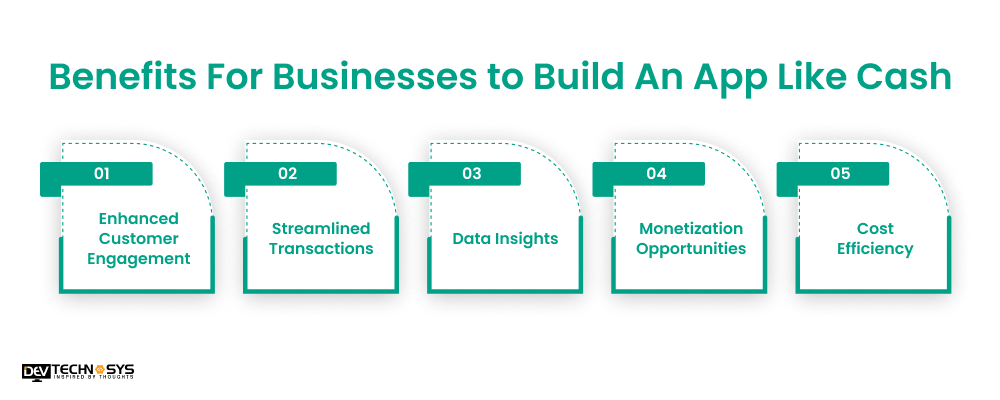
1. Enhanced Customer Engagement
A well- designed or dedicated Cash clone app attracts more users or customers worldwide and it can enhance the customer experience. Businesses can offers perosonalized recommendations, promotions, loyalty rewards, and exclusive deals. So, these can enhance the customer engagement and increase customer relationships.
2. Streamlined Transactions
A mobile payment app like Cash App provides streamlined transactions with integrated payment solutions. Businesses can provide secure, quick, and reliable mobile payments to enhance the user experience.
Build a cash advance app like Moneylion to provide advanced features such as instant transfers, bill payments, mobile recharges, and increasing conversion rates.
3. Data Insights
Mobile payment apps observe or analyze customers’ habits, behaviors, purchasing patterns, demographics, preferences, and favorite services. Using these valuable data insights, they can identify new areas for improvement and offer crazy deals or more attractive offers.
4. Monetization Opportunities
The Cash clone apps provide the best monetization opportunities to make an acceptable profit from the app. It includes many advanced monetization streams such as advertising, paid collaborations, freemium models, subscription plans, delivery fees, platform fees, and in-app purchases.
5. Cost Efficiency
It involves many highly developed automated operations to perform the operations smoothly and reduce the development cost. Mobile app payments, like the Cash app, provide automated payments to reduce manual errors and administrative costs. So, these automated operations can reduce financial management costs.
Working with Dev Technosys to build an app like Cash was a game-changer for our project. They have 14+ years of experience in app or web development with a expert team. I highly recommend Dev Technosys as it delivers high-quality or scalable apps or websites within a period and budget, giving us incredible results.
– Nora Walker
How to Build an App Like Cash? 8 Key Steps Explained
To develop an app like Cash, businesses need to follow the development stages strategically. The development begins with market research & validation and continues even after launch. We have explained a roadmap that supports streamlined and strategic development. It also helps businesses reduce risks, control costs, and create a payment experience users can trust. Have a look at the 8 essential steps to create an app like Cash in 2026-2027.
-
Validate the Market & Define Your Opportunity
The first step is to identify your target audience and their payment needs. This is the time when businesses must determine their competitors and market gaps. They must analyze other popular market leaders like Venmo and PayPal to understand their strengths and weaknesses. Enterprises should define their unique value proposition, revenue model, target geography, and regulatory requirements.
-
Map Out the Right Payment App Features
The next step is to distinguish the features your app needs before development begins. You should start with core features like registration, digital wallets, P2P transfers, transaction history, notifications, and secure authentication. Then go for advanced functionalities such as bill payments, multi-currency support, fraud detection, analytics, and investment services. Basically, feature selection should be done based on the business goal.
-
Build a Future-Ready Technology Foundation
This is the time to choose the technologies for your app-like Cash development. The perfect tech stack supports secure transactions, high performance, seamless integrations, and future scalability. Generally, a tech stack for a payment app includes:
- Flutter or React Native for cross-platform development
- Node.js or Python for backend services
- PostgreSQL or MongoDB for data management
- AWS or Azure for reliable payment processing
-
Design a Simple & Trustworthy Payment Experience
Now comes creating a simple, trusted, and frictionless experience for every financial interaction. Make the user journey from onboarding, identity verification, adding & sending funds, to viewing transactions smooth and seamless. Businesses must include clear navigation, intuitive dashboards, responsive screens, and transparent payment confirmations. If the interface of a fintech app is well designed, it can improve usability, trust, and user retention.
-
Develop the Core Payment Infrastructure
This is the final development step where the approved design is transformed into a functional payment platform. This stage involves developing the frontend, backend, APIs, database, and payment infrastructure. It also includes payment gateway, KYC/AML, authentication, encryption, and transaction controls. Many developers suggest building the core payment experience first and adding implementations later, based on user and market demand.
-
Test Every Transaction, Feature & Security Layer
As final development is done, the platform is thoroughly tested before launch. Every payment flow, API integration, user journey, and security layer is examined. Across devices and platforms, functional, integration, performance, compatibility, and security testing are performed. At this stage, businesses should validate transaction accuracy, handle failed payments, ensure authentication, and verify data protection. Rigorous testing and QA ensure deployment of a perfect and reliable payment app.
-
Launch, Promote & Scale Your Payment App
Your payment app, like Cash, can now be launched for public use. Businesses can deploy their app on the Play Store through App Store Optimization (ASO). They must begin with less and gradually expand later on according to user feedback. Launch is not enough; to make the platform reach the targeted audience, businesses must go for marketing strategies. It includes digital marketing, referral programs, paid partnerships, and others.
-
Post-Launch Maintenance and Support
Many businesses think that deployment is the last development step. Somehow, it is; but to make the platform scalable, trustworthy, and user-friendly, continuous maintenance and support are needed. It includes regular updates, bug fixes, performance monitoring, security patches, API maintenance, and compliance updates. It is important to improve features, resolve issues, and continuously enhance the overall payment experience.
How Long Does It Take to Build an App Like Cash?
Usually, it takes 3 to 7+ months to make an app like Cash in 2026-2027. The final development timeline is influenced by the platform’s complexity, integrations, number of features, and security requirements. A simple app with basic integrations, features, and security takes 3 to 5 months. Whereas a fully functional, advanced platform with modern integrations and the latest technologies takes 7+ months. In this section, we have explained the entire timeline to create an app like Cash.
Development Stage |
Estimated Timeline |
Expected Outcome |
| 1. Market Validation & Strategy | 2–3 Weeks | A validated payment concept with a defined market opportunity |
| 2. Feature & Product Planning | 2–3 Weeks | A prioritized product roadmap ready for execution |
| 3. Technology & Architecture Planning | 2–4 Weeks | A secure and scalable technical blueprint |
| 4. UI/UX Design | 3–5 Weeks | A complete, user-ready payment app design system |
| 5. App Development & Integrations | 8–14 Weeks | A functional Cash App-like payment platform |
| 6. Testing & Quality Assurance | 3–5 Weeks | A validated, secure, and launch-ready application |
| 7. Launch & Market Rollout | 1–2 Weeks | A production-ready app available to target users |
| 8. Post-Launch Support & Optimization | Ongoing | Continuous improvements, updates, monitoring, and long-term stability |
At a Glance: Cash App-Like Development Timeline
| Product Scope | Approximate Timeline | Development Goal |
| MVP Payment App | 3–4 Months | Launch a focused payment product and validate demand |
| Mid-Level Payment App | 4–6 Months | Introduce broader payment functionality and integrations |
| Advanced Payment Platform | 6–7+ Months | Build a scalable, feature-rich fintech ecosystem |
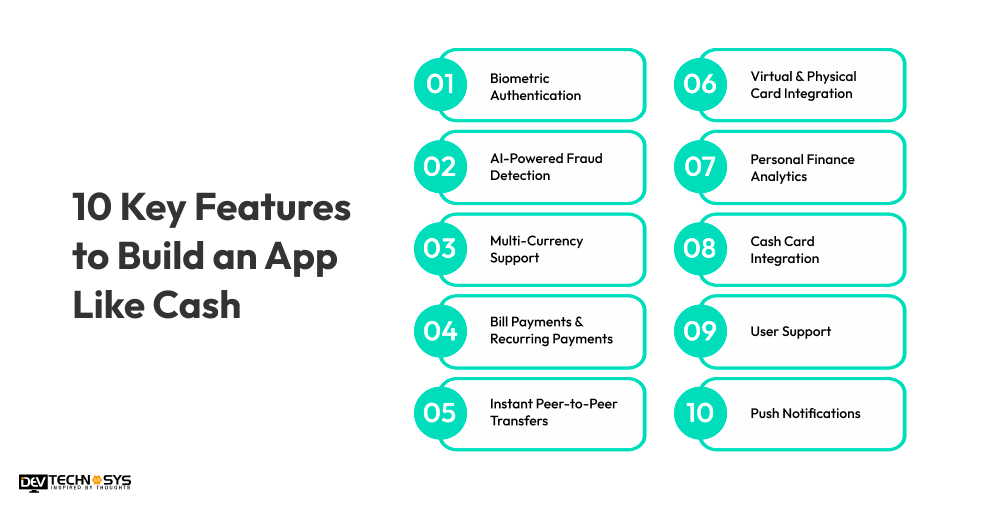
10 Key Features to Build an App Like Cash
Build an e-wallet app like Freecharge with additional features and comprehensive integrated functions. Here we provide the list of the premium features:
User Panel |
Admin Panel |
Moderator Panel |
| User sign-up/login | Manage users | Monitor registrations |
| Add, store, transfer funds | Track wallets, manage funds | Review wallet issues |
| Send/receive money | Monitor transactions | Flag suspicious transfers |
| View history | Access reports | Review disputes |
| 2FA, PIN, biometrics | Enforce policies | Identify threats |
| Receive alerts | Configure alerts | Monitor fraud alerts |
| Pay bills, recharge | Manage billers | Verify unusual payments |
| Chat, raise tickets | Respond to tickets | Resolve escalations |
| View personal insights | Track usage & revenue | Analyze flagged activity |
| Provide feedback | View & implement | Monitor report |
1. Biometric Authentication
Cash app clone enables secure login using biometric authentication such as fingerprints or facial recognition, enhancing user security, reducing password dependency, and preventing unauthorized access, ensuring safe transactions for every account holder.
2. AI-Powered Fraud Detection
On demand app development company will use AI-powered fraud detection to monitor user behavior in real-time, identifies suspicious activities, and flags potentially fraudulent transactions instantly. The use of artificial intelligence (AI) in fintech helps protect both users and the platform from financial risks.
3. Multi-Currency Support
Enables cross-border remittance and allows users to transact in various local and international currencies, automatically calculating exchange rates for cross-border transfers with minimal delay or extra fees.
4. Bill Payments & Recurring Payments
Let’s users schedule and automate fintech regulation, subscriptions, and utilities, reducing manual effort while ensuring payments are made on time without missed deadlines.
5. Instant Peer-to-Peer Transfers
Peer to Peer payment app allows users to send and receive money in real-time across multiple banks or digital wallets, providing a seamless and convenient payment experience.
6. Virtual & Physical Card Integration
Fintech app development like cash provides users with virtual or linked physical debit cards for payments, strengthening digital payment infrastructure and allowing seamless online and offline transactions directly from their app wallet.
7. Personal Finance Analytics
Offers insights into spending patterns, budgets, and saving goals, helping users make informed financial decisions and efficiently track their expenses.
8. Cash Card Integration
Cash alternatives offers a virtual debit card linked to the mobile app’s wallet balance, which users can use for online shopping.
9. User Support
Mobile payment apps like Cash provide user support to resolve issues, and users can connect to the help center.
10. Push Notifications
Cash similar apps send alerts to users when new services arrive, or the app is updated, and it provides updates regarding bill payments.
Free App Idea Reality Check: Let's Stress-Test Your Concept
Share your app idea with us. Within 3 business days, we'll uncover UX gaps, feature opportunities, and potential development challenges, so you can build with confidence. No strings attached.
How Much Does it Cost to Build an App Like Cash?
The average cost to develop an app like Cash can be estimated from $30,000 to $1,50,000. The overall development expense is determined by the platform’s complexity. The complexity of an eWallet app like Cash depends on the integrations, number of features, security requirements, and more. We will understand the complete cost structure in this way:
-
Basic App
A basic app developed with an MVP strategy has limited integrations, making it less complex to build.
Cost Range: $30,000-$70,000
-
Mid-Level App
A mid-level app is a combination of simple and advanced integrations, making it moderately complex to develop.
Cost Range: $70,000-$1,10,000
-
Enterprise-Level App
An enterprise-level app integrates high-level features, advanced technologies, AI, and other advancements. This makes it highly complex to create.
Cost Range: $1,10,000-$1,50,000
Cash App Development Level |
Estimated Cost |
Complexity |
What You’re Building |
Key Features |
| Launch-Ready MVP | $30,000 – $70,000 | Low | A focused payment app built to validate your idea and acquire early users | Digital wallet, P2P transfers, bank linking, basic security |
| Growth-Stage Fintech App | $70,000 – $110,000 | Medium | A feature-rich payment platform designed to support a growing customer base | Bill payments, KYC/AML, APIs, biometrics, payment gateways |
| Cash App-Style Enterprise Platform | $110,000 – $150,000+ | High | A scalable fintech ecosystem built for high transaction volumes and advanced financial services |
AI fraud detection, multi-currency, analytics, automated compliance, APIs |

What Are The Major Factors That Affect Cash Clone App Development Costs?
Despite the complexity, multiple factors are responsible for influencing the cost to build an app like Cash. Feature set, platform choice, backend infrastructure, UI/UX, and after-launch maintenance are among these factors. We will now understand some of these factors and how much they affect the Cash-like app development cost.
1. Advanced and Core Features
Features are one of the most common factors that can easily increase the cost of app development. Businesses need to make a list of features that what features they must choose and also look out for their fixed budget for development.
Feature Area |
Estimated Cost |
What Adds to the Budget |
| User & Wallet Management | $4,000 – $5,500 | Registration, profiles, wallets, balances, transaction history |
| Payments & Transfers | $5,000 – $7,000 | P2P transfers, bank linking, payment gateways, recurring payments |
| Security & Verification | $6,000 – $8,500 | KYC/AML, MFA, biometrics, transaction verification, fraud controls |
| Advanced Fintech Functions | $8,000 – $10,000 | Multi-currency, analytics, APIs, automated payment workflows |
2. Development Team
These factors have the ability to change the fixed development budget because there are various developers with more experience who are in demand for higher salary packages. The table below shows the cost of developers from different regions.
Hiring Location |
Estimated Cost |
Why Businesses Choose It |
|---|---|---|
| Asia-Based Team | $10,000 – $13,000 | Competitive rates and access to skilled developers |
| Eastern Europe Team | $13,000 – $16,000 | Strong engineering expertise and favorable rates |
| Latin America Team | $15,000 – $19,000 | Convenient time zones and growing fintech expertise |
| North America Team | $19,000 – $23,000 | Local collaboration and access to specialized talent |
3. UI/UX Design
Designing a user-interface can be very costly because designing has various paid tools. Businesses choose the designing tools according to their project’s requirements and demands. So, look out at the below design table:
Design Component |
Estimated Cost |
What’s Included |
| User Flow & Wireframes | $5,000 – $7,000 | User journeys, information architecture, low-fidelity screens |
| Visual Interface Design | $7,000 – $11,000 | Branded screens, dashboards, typography, icons, design system |
| Interactive Prototyping | $10,000 – $16,000 | Clickable prototypes, transitions, interactions, usability flows |
| Design Handoff & Refinement | $15,000 – $20,000 | Developer-ready assets, responsive layouts, testing, final refinements |
4. Backend Development
Backend processes are time-consuming, and they also can charge more as compared to other development stages. It includes various types of implementation phases and also includes a wide variety of functions and features.
Backend Component |
Estimated Cost |
Development Scope |
| API & Database Layer | $10,000 – $14,000 | APIs, database architecture, authentication, user management |
| Wallet & Transaction Engine | $13,000 – $18,000 | Wallet logic, balances, transfers, transaction processing |
| Payment Integration Layer | $17,000 – $22,000 | Gateways, banking APIs, payment services, webhook management |
| Scalable Backend Infrastructure | $20,000 – $25,000 | Cloud architecture, real-time processing, monitoring, scalability |
5. Maintenance and Support
Maintenance includes various types of phases that have to be updated in their latest versions. It includes newer versions of the operating system and fixing bugs or glitches. So, take a view on the below table:
Maintenance Area |
Estimated Cost |
Ongoing Coverage |
| Bug Fixes & App Updates | $4,000 – $8,000 | Bug resolution, OS updates, compatibility fixes |
| Security & Performance | $7,000 – $15,000 | Security patches, monitoring, performance optimization |
| API & Infrastructure Support | $12,000 – $22,000 | Third-party API updates, server management, integrations |
| Fintech Product Enhancement | $20,000 – $30,000 | New features, compliance updates, scaling, continuous improvements |
Security & Compliance for a Cash App-Like Payment Platform
Many businesses think that security and compliance are an afterthought. But this is where they make the biggest mistake. An app like Cash App has to handle financial information, payment credentials, identity data, and transaction records. This is why security controls and regulatory alignment are essential to integrate from the very beginning. Here, we have mentioned key security measures, certifications, and compliance requirements important for Cash app-like payment platforms.
Security Measures We Build Into Payment Apps
- Multi-Factor & Biometric Authentication
- End-to-End Encryption & Tokenization
- Role-Based Access Controls
- Secure API Authentication
- KYC (Know Your Customer)
- AML (Anti-Money Laundering)
- Identity Verification
- Real-Time Transaction Monitoring
- Fraud Detection & Risk Controls
- Data Retention & Consent Management
- Audit Logs & Activity Tracking
- Secure Cloud Infrastructure
- Vulnerability & Penetration Testing
- Backup & Disaster Recovery
- Incident Response
Key Certifications & Compliance Standards Needed for Payment Platforms
Standard/Certification |
Why It Matters for Payment Apps |
| ISO 27001 | Establishes a structured information security management framework |
| ISO Standards | Supports consistent quality, security, and operational processes |
| SOC 1 | Provides assurance around controls relevant to financial reporting |
| SOC 2 | Evaluates controls for security, availability, confidentiality, and related trust principles |
| GDPR | Supports privacy and personal data protection for users in the European region |
| CCPA/CPRA | Addresses California consumers’ privacy and personal-information rights |
| PCI DSS | Protects cardholder data handled during payment processing |
| GLBA | Relevant to protecting certain nonpublic personal financial information in the U.S. |
| PCI Secure Software | Provides security requirements for software involved in payment transactions |
According to a study by the PCI Security Standards Council, PCI DSS is particularly important for payment applications. It is mandatory for apps that store, process, or transmit cardholder data. It can also affect service providers that impact the security of payment environments.
Note: Security and compliance considerations, including ISO 27001, SOC 1, SOC 2, and CCPA, are part of our planning phase, not an afterthought.
Why is it Important to Fix a Budget for Your Project?
Fixing a budget for cash app development is necessary for every project to control the app’s quality and manage resources. Here, we provide some essential points on the importance of budget fixing:
- A fixed budget can allow businesses to make a project outline according to their affordances.
- It can avoid the unnecessary additions of features and determine how much can be spent on each component.
- Creating a fixed budget can help to identify the financial risks and select resources based on the funding.
- Setting a budget for your project can help you easily manage the project timeline and create realistic project operations.
Tech Stack to Build an App Like Cash
Choose the robust or powerful tech stacks for app pay cash development with unique features compared to others. With the help of a mobile app design company, you can select the best tech stacks:
Category |
Tech Stack |
Description |
| Frontend
|
HTML5, CSS | These powerful platforms build robust user interfaces. |
| Backend | Node js, Django | Powerful backend frameworks build robust applications. |
| Database | MYSQL, MongoDB | Securely stored massive data |
| APIs
|
REST, GraphQL | Sharing data between applications, systems, and devices. |
| Authentication
|
OAuth, JWT | Verifies the user’s identity and access token from a trusted server. |
| Cloud Services
|
Microsoft Azure, AWS | Allowing apps to access resources in the cloud. |
5 Monetization Techniques to Build an App Like Cash
Build a payment cards like cash app with intellectual functionalities, but unfamiliar with how to generate new revenue streams for the businesses. Here, we provide the best monetization techniques and help businesses to make money from the app:
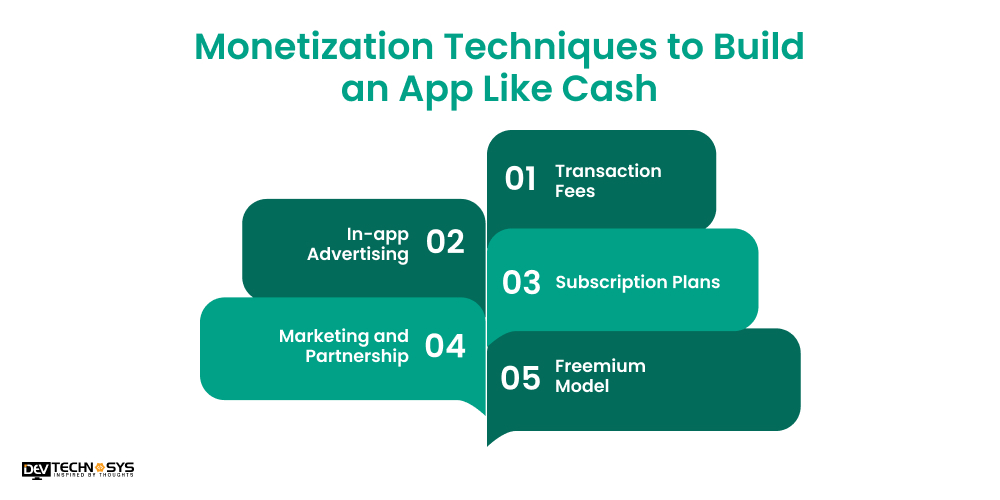
1. Transaction Fees
A mobile payment app charges transaction fees for specific transactions, such as instant transfers, credit card payments, and international transactions. Earning transaction fees can lead to a larger user base and increased business valuation.
2. In-app Advertising
In this monetization technique, allow third-party vendors or agencies to show their products in your app. Earn an advertising fee to display their products as ads. There are many advanced advertising formats, such as display ads, interstitial ads, native ads, and banner ads.
3. Subscription Plans
A mobile payments app offers subscription plans such as primary, premium, and enterprise. If users want to access the full potential of the app, they must purchase the premium or enterprise plan. According to a custom mobile application development company, these subscription plans can generate new revenue streams for the businesses.
4. Marketing and Partnership
Partnership with business-related agencies to sell their products or items through your app and earn commission on every sale of their products via your app. Offers users a discount rate investment on stocks and financial services. So, this can be a turning point for generating an acceptable profit from the app.
5. Freemium Model
In this last monetization technique, a mobile payment app offers a basic plan with minimum features. Users want to access all the app’s features, so they must buy additional features and subscription plans. These can generate revenue streams and increase the user base.
Why is Post-Launch Support Vital for Your Mobile Payments App’s Success?
Post-launch support for a mobile payments app is necessary because it handles sensitive information about users’ financial data. It includes maintaining features or functions to enhance the user experience and optimize performance speed with regulatory standards.
- It requires regular security updates and fixed patches to avoid authorized access from third parties and vulnerabilities.
- Ask an on-demand app development company to maintain your mobile payments app within a cost-effective budget.
What are the Common Pitfalls in Building a Payment App like Cash?
1. Ignoring Security Protocols
Skipping encryption, secure APIs, or two-factor authentication can make the app vulnerable to hacks, fraud, and sensitive data breaches, undermining user trust and financial safety.
2. Non-Compliance with Regulations
Failing to implement KYC, AML, or PCI-DSS standards when trying to build an app like PayPal can lead to legal penalties, account freezes, or app suspension, severely impacting operations and credibility.
3. Poor User Experience
Poor cash app development services and financial Inclusion, complicated navigation, slow load times, and unintuitive interfaces can frustrate users, reduce engagement, and drive them to competitor apps, significantly decreasing retention rates.
4. Weak Backend Infrastructure
Poor digital asset management, Insufficient server capacity, poor database design, or unreliable cloud solutions can cause transaction delays, system crashes, or downtime, negatively affecting app reliability and user trust.
5. Limited Payment Integrations
Restricting supported banks, No option for QR code payment, wallets, or currencies limits app adoption, prevents cross-border transactions, and reduces convenience, making it less competitive in the rapidly evolving digital payments market.
6. Ignoring Analytics
Investment app development without tracking user behavior, transaction trends, or app usage prevents data-driven improvements, leaving developers unaware of pain points, popular features, or opportunities for monetization.
7. Skipping Testing & Quality Assurance
Launching without comprehensive functional, security, and performance testing increases the risk of bugs, crashes, and security vulnerabilities, which can damage reputation and user confidence.
8. Neglecting Customer Support
Poor support for disputes, complaints, or payment issues erodes user trust, increases churn, and reduces positive reviews, making it difficult to scale the app effectively.
Why Choose Dev Technosys to Build an App Like Cash App?
With over 15 years of experience, Dev Technosys, a reliable fintech app development company, has delivered 50+ fintech projects. We have attained 99.9% platform uptime, 98% fraud-detection accuracy, and approximately a 30% reduction in operational costs. Our capabilities can help entrepreneurs and fintech businesses create Cash App-like platforms. We develop apps that seamlessly align with their transaction volumes, security requirements, compliance goals, and growth plans.
Conclusion
Developing a successful payment app like Cash App doesn’t mean you have to copy what is already in the market. It should be built by identifying and understanding what users exactly need next. The right and strong combination of security, features, technologies, compliance, and infrastructure is mandatory. This can turn an idea into a reliable and scalable financial product.
Whether building an MVP or planning an advanced payment platform, the development approach must align with your:
- Budget
- Target Audience
- Transaction Volume
- Growth Plans
With the right payment app development company, your idea can move from concept to a payment experience. It will become something that users choose, trust, and keep using.
Frequently Asked Questions
Find answers to the most common questions related to this article.
Yes. A payment app can be customized for a specific country. Businesses have to adapt payment methods, currencies, banking integrations, identity verification, compliance requirements, languages, and transaction rules of that country. A development team can also design the architecture for future geographic expansion. This will significantly help businesses to add new markets without rebuilding the entire platform.
Yes, a payment platform can be customized around your business model. Also, it can be customized according to target users, revenue strategy, supported currencies, transaction types, integrations, and geographic market. You can begin with essential payment functionality and gradually introduce features according to the user and the market demand.
Yes, multi-country payment platforms like Cash App can support multiple currencies. It also supports regional payment methods, banking APIs, languages, identity-verification systems, and local compliance requirements. However, international expansion requires country-specific regulatory assessment and payment integrations. Planning these requirements during architecture design makes it easier to expand the platform into additional markets later.
A Cash App-like payment app can prevent fraud by combining real-time transaction monitoring, risk scoring, and behavioral analysis. It also involves device intelligence, transaction limits, biometric authentication, and automated alerts. All these integrations help flag suspicious transactions and other risks associated with the platform. The appropriate fraud-control approach depends on transaction volume, payment methods, and user behavior.
The average cost to build an app like Cash App can be estimated at $30,000 to $1,50,000. On the other hand, it takes 3 to 7+ months to develop a payment app. Both the timeline and development cost are affected by the platform’s complexity, feature set, security requirements, and integrations