













Key takeaways:
-
- Gen AI Shopping assistant development has transformed traditional eCommerce into a personalised and conversational experience. It combines LLMs, real-time data, and AI product recommendation engines to boost engagement and conversions.
- The cost to develop an AI shopping assistant can fall somewhere between $8,000 to $30,000. The final development cost relies on the app’s features, complexity, integrations, and platforms.
- AI-powered shopping assistants for e-commerce are like virtual salespeople who understand user intent. They help users in comparing products and offer an alternative if the same product is not available.
- In 2026, generative AI shopping assistants are no longer optional; they have become a strategic growth tool. It helps businesses scale faster, monetize smarter, and deliver human-like shopping experiences.
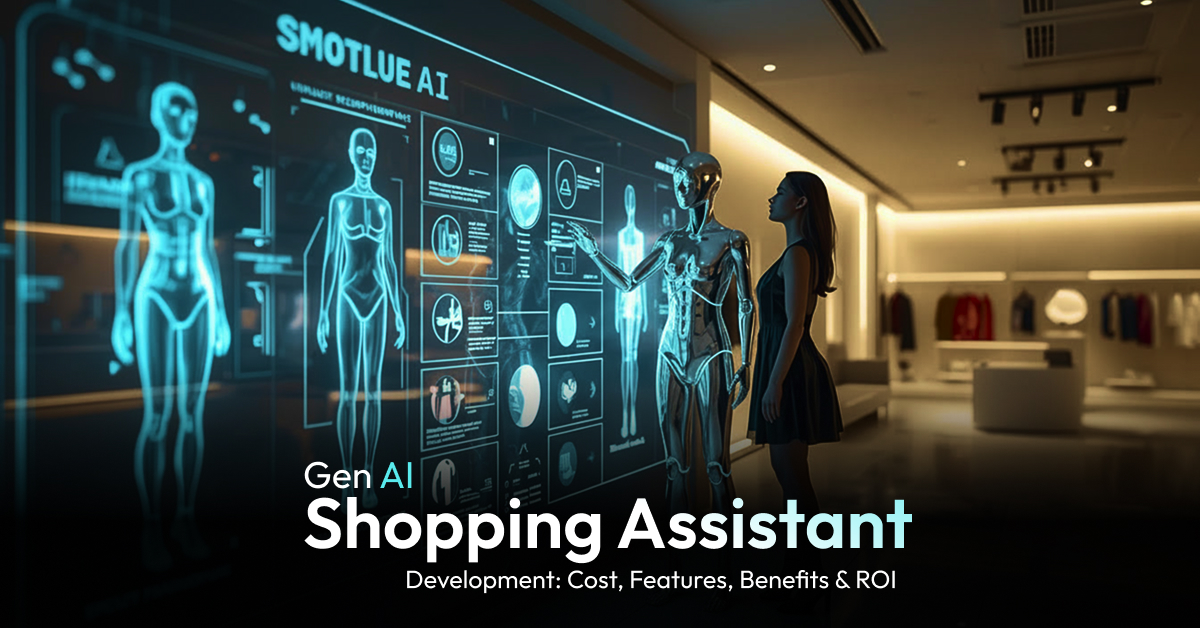
Picture yourself entering a store and a salesperson showing you exactly what you need. This sounds futuristic, but it is possible in 2026 with Gen AI shopping assistance. These assistants are revolutionizing the way enterprises sell and customers shop.
Gen AI shopping assistance comes from advances in large language models and real-time data. It simply turns your simple browsing into a mentored, personalized shopping experience. But the real magic lies behind careful, smart Gene AI assistance development.
The thoughtful development of an AI-powered shopping assistant requires planning of cost, features, and ROI. If you are someone who wants to develop an AI shopping assistant, this guide is perfect for you. It covers everything that it takes to understand and build an AI shopping assistant.
From market predictions to monetization models, this article walks you through every essential aspect of development. In short, it is not only a chatbot, but a sales partner that assists you anytime, anywhere.
What is a Generative AI Shopping Assistant?
The Generative of Gen AI shopping assistant is a chatbot that works as a virtual salesperson. It is an advanced, proactive, and conversational chatbot designed to help shoppers make informed shopping decisions. With this, shoppers can discover products, compare multiple options, and complete purchases.
AI shopping assistant development is common in e-commerce websites, which works exactly like human shop assistants. It generally utilizes Large Language Models (LLMs) and natural language processing (NLP). These models help understand complex, subtle, and open-ended queries easily and answer them in no time.
For businesses, partnering with an experienced mobile app development company is best to create an AI shopping assistant.
Industry Insight: Over 50%–60% of consumers use AI tools for purchasing tasks, as of 2025 and early 2026, according to Yahoo Finance.
How Does A Generative AI Shopping Assistant Work? A Step-By-Step Guide
Gen AI shopping assistant is a smart, intelligent digital shopping partner. It integrates artificial intelligence to understand what the customer wants and then recommends products. In a nutshell, it creates a personalized shopping experience for users with different preferences. Here are the step-by-step details on how it works.
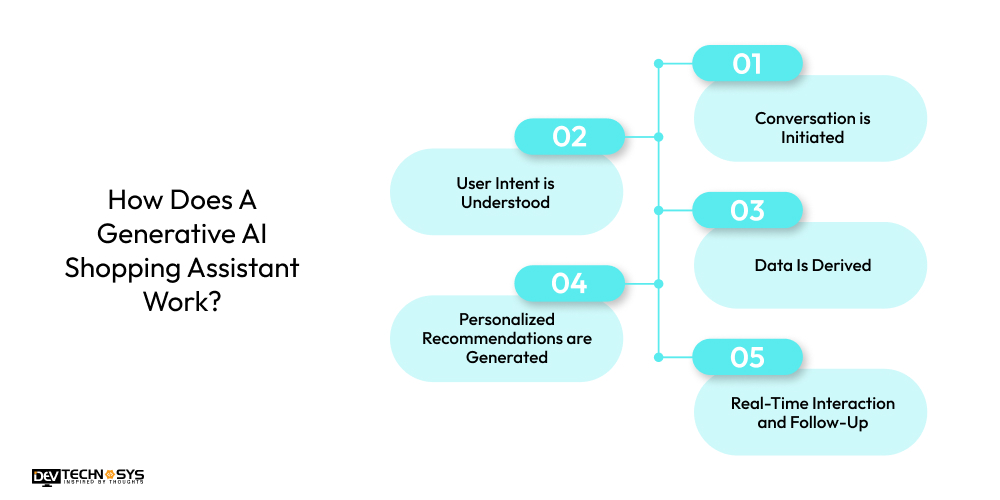
Step 1: Conversation is Initiated
First, the conversation is started by the user either through chat, voice, or search. For example, “I need running shoes under $100” or “Show me gifts for mom’s birthday.” These phrases are accepted by an AI-powered shopping assistant, just like talking to a human sales associate.
Step 2: User Intent is Understood
Next, the user intent is clearly comprehended by the assistant using Natural Language Processing (NLP). It analyzes what the user is asking for, their preferences (style, cost, purpose), and even past behavior. It means the assistant not only recognize keyword, but also the intent behind them.
Step 3: Data Is Derived
Then, the intelligent shopping assistant connects with real-time systems and offers results from various sources. AI in Ecommerce Industry gets data from product catalogs, customer profiles, browsing history, promotions, and offers. It also makes sure the recommendations are accurate and up to date.
Step 4: Personalized Recommendations are Generated
The virtual shopping assistant processes the data that is available and produces product suggestions. It even offers comparisons for features, prices, reviews, quality, and whatnot. The best part is that it also gives alternatives if the product is not in stock. Basically, it offers dramatic responses for every user.
Step 5: Real-Time Interaction and Follow-Up
The assistant also continues the conversation by asking questions for more clarity. It refines the responses according to user feedback while explaining why the product is recommended. It generates a structured and guided shopping assistance just like in-store professionals.
What Are The Market Stats For Gen AI Shopping Assistant?
The market of Gen AI shopping assistants is expanding at a rapid pace. That’s why enterprises are searching for smart options to serve customers and increase revenue. This growth is fueled by the demand for personalized recommendations and a real-time assistance experience. Let’s go through the market estimations for Gen AI shopping assistants provided by the Straits Research.
- In 2025, the market size of AI shopping assistants is globally priced at USD 4.26 billion.
- These numbers are projected to grow and reach USD 36.38 billion by 2034.
- This growth is estimated at a CAGR of 26.8% during the forecast period, 2026–2034.
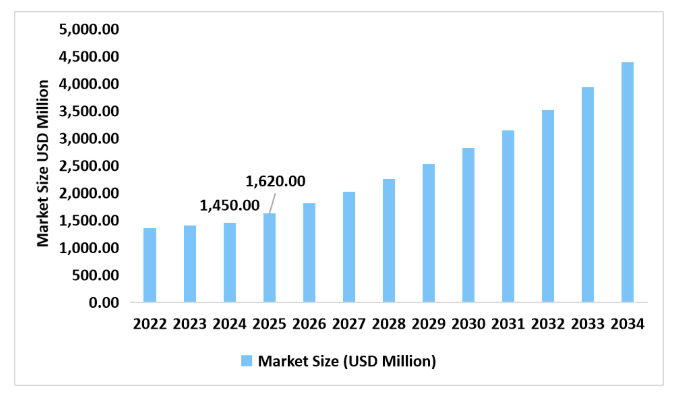
- With a revenue share of 38.42% of the total, North America dominated this market in 2025.
- The US leads the market, with a value of USD 1.45 billion in 2024, growing to USD 1.62 billion in 2025.
Why Are Entrepreneurs Investing in AI Shopping Assistant Development in 2026?
The year 2026 is the year of intelligent, conversational, and personalized AI shopping assistant development. Stepping into conversational AI shopping assistant development, enterprises can move forward in this highly competitive digital market. Let’s discuss the reasons forcing entrepreneurs invest in AI product recommendation engine development.
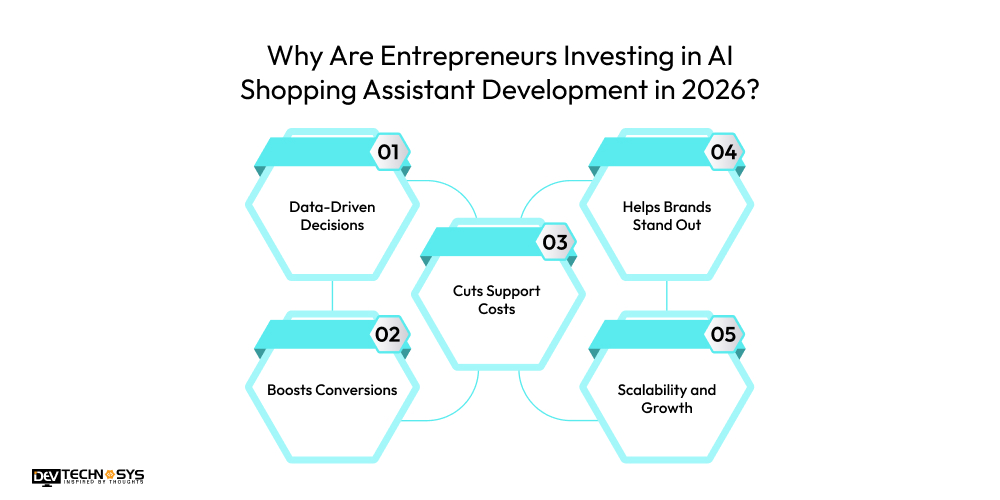
1. Data-Driven Decisions
When entrepreneurs partner with the perfect AI chatbot development company, they transform customer data into actionable insights. These assistants inspect user behaviour to predict trends and optimize inventory. The data-driven decisions enhance marketing ROI via actionable ecommerce intelligence.
2. Boosts Conversions
Entrepreneurs prefer Gen AI shopping assistant development because it helps businesses boost conversion rates and user experience. By analyzing user behavior, preferences, and intent, a shopping AI assistant delivers customized recommendations. Simultaneously, it upgrades conversion rates, average order value, and customer satisfaction.
3. Cuts Support Costs
By handling product queries, order tracking, and support, an online shopping assistant AI works 24/7. This helps businesses in strategic investment for any AI shopping assistant startup. As everything is managed by an AI assistant, enterprises can reduce support costs. The lower cost aims to surge customer engagement efficiently.
4. Helps Brands Stand Out
A personal shopping assistant AI helps brands to stand out in the crowd for multiple reasons. By offering tailored experiences to users, it takes the business towards faster decision-making and conversational buying. The assistant creates a clear edge in competitive ecommerce markets across every AI shopping assistant website.
5. Scalability and Growth
Businesses develop an AI fashion assistant app that manages everything from voice commerce to fashion retail. It helps in making organizations ready for the future and expanding globally. The AI-assisted shopping apps adapt to the new standard in the modern digital commerce market in 2026.
Want a chatbot demo or pricing? Fill the form and talk to our experts today.
Pick what you need below — you can select more than one — then tap Get detail to continue.
-
Chatbot demo dashboard
-
Cost to develop an app
-
Industry report
-
Case study
From Idea to Deployment: How to Build a Gen AI Shopping Assistant?
Developing an AI shopping assistant is a detailed and strategic process. From analyzing the market to after-launch support, every step involves proper planning and execution. When done right, this structured approach helps businesses build a user-centricand high-performing assistant. This is a guide explaining the Gen AI Shopping Assistant development process.
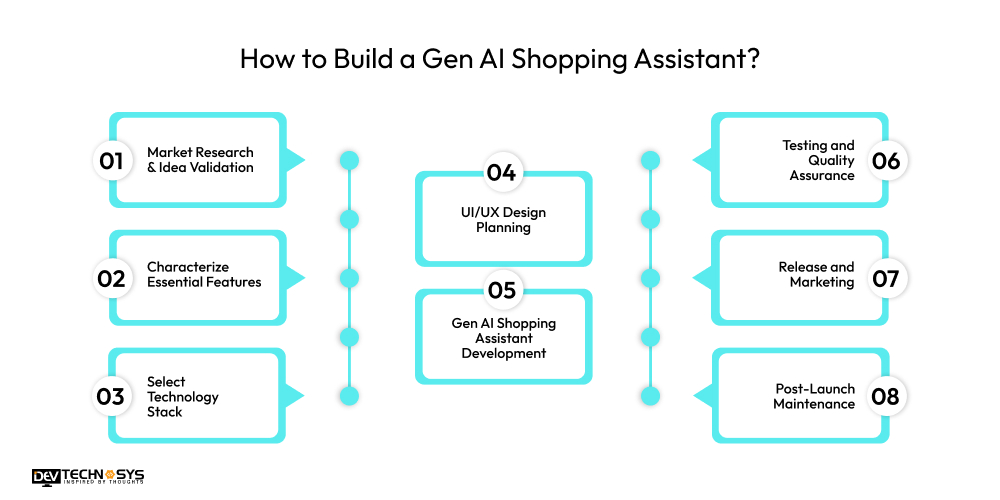
1. Market Research & Idea Validation
- During market research, businesses identify their targeted audiences, pain points, and demand for AI assistants.
- To validate this idea, they even have to analyze their competitors, ongoing commerce trends, and user behaviour.
- A thorough market research and idea validation is mandatory and the first step. It makes sure the assistant solves real problems and meets evolving consumer expectations.
2. Characterize Essential Features
- It is time to define and integrate the features that shape the capabilities of an AI shopping assistant.
- Generally, the core features include natural language understanding, product suggestion, conversational UI, multimodal capabilities, LLM-driven personalization, etc.
- Prioritizing basic but important features aligns business goals with user needs. It ensures the assistant’s stability, scalability, and future enhancement.
3. Select Technology Stack
- For the outstanding performance and scalability of the AI shopping assistant, the right tech stack is chosen.
- The corrective technologies suited for AI assistants include LLMs, AI frameworks, cloud infrastructure, APIs, and databases.
- When technologies are perfectly picked, they enable secure integrations, real-time intelligence, and smooth deployment.
4. UI/UX Design Planning
- Planning the UI/UX of the assistant is really crucial for an n intuitive, conversational, and frictionless shopping experience.
- When the interface is well-designed, it fosters user engagement, accessibility, and trust in shopping assistants.
- This planning includes conversational flows, personalization elements, responsive layouts, and voice assistant development.
5. Gen AI Shopping Assistant Development
- This is the step to transform concepts into functional AI shopping assistants for an individualized shopping journey.
- It involves training large language models, integrating recommendation engines, building AI agents, and connecting backend services.
- By leveraging generative AI, machine learning, and automation, the Gen AI shopping assistant is ready.
6. Testing and Quality Assurance
- To ensure the accuracy, security, and reliability of the assistant, a profound test is needed before launch.
- Functional testing, performance optimization, AI response validation, bug fixes, and security assessments are vital for quality assurance.
- Testing improves the performance and consistency of AI shopping assistants to offer seamless experiences to shoppers.
7. Release and Marketing
- The assistant is fully ready to be deployed to app stores or web platforms through app store optimization.
- To reach targeted audiences and increase visibility, strong marketing strategies should be implemented.
- For strategic marketing, companies should leverage SEO, content marketing, PR, and launch campaigns.
8. Post-Launch Maintenance
- After-launch maintenance and upgrades ensure long-term success through monitoring, updates, and optimization.
- It involves regular model training, feature enhancements, bug fixes, and performance tuning.
- It is helpful for AI shopping assistants to adapt to user behavior, market trends, and stay up-to-date with ecommerce demands.
What Features Are Powering Gen AI Shopping Assistant Development?
Gen AI shopping assistants are powered by a combination of foundational and advanced features. It includes understanding NL, product recommendation, data intelligence, context retention, and so on. A web app development company integrates these AI shopping assistant features while enabling intelligence and amazing experiences.
1. Key Features
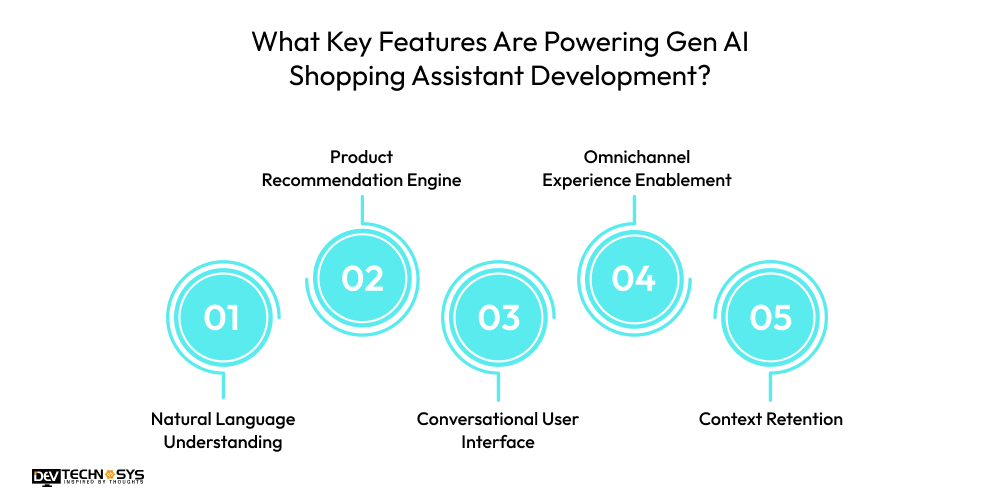
i. Natural Language Understanding
Understanding natural language is a must for AI assistants to interpret user queries, voice commands, and intent. It supports chatbots, shopping assistants, voice assistants, and intuitive access for AI shopping assistant performance.
ii. Product Recommendation Engine
An AI-driven recommendation engine puts forward products that are relevant to users. It examines users’ browsing behavior, purchase history, and preferences. This feature improves AI shopping assistant capabilities and upgrades personalization in such platforms.
iii. Conversational User Interface
An eCommerce app development company adds conversational UI, letting users communicate naturally through chat or voice. It delivers human-like engagement throughout shopping assistant apps, websites, and voice-enabled devices.
iv. Omnichannel Experience Enablement
Omnichannel is one of the essential features of AI shopping assistant, delivering consistent interactions across different platforms. This feature can seamlessly manage improving AI shopping assistant capabilities, engagement, and conversion rates.
v. Context Retention
AI assistants support context retention to recall user preferences, previous conversations, and search history. It is an essential feature, especially for an AI grocery shopping assistant, allowing AI to assist and refines customer journey.
2. Advanced Features
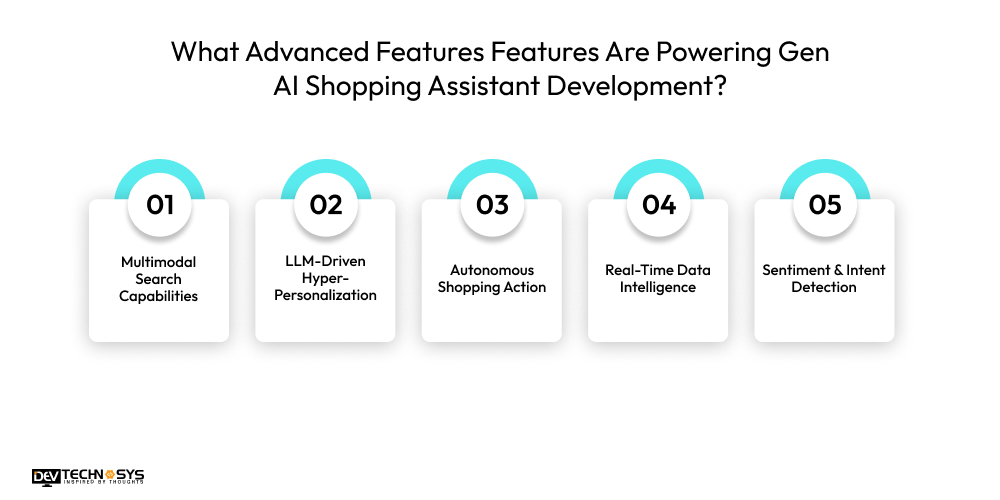
i. Multimodal Search Capabilities
Multimodal capabilities in iOS and Android app development with AI assistants let users search by text, voice, or images. It provides customers with ease by supporting visual search, voice queries, and faster discovery.

ii. LLM-Driven Hyper-Personalization
The advanced AI assistant feature includes Large Language Models hyper-personalization, offering tailored suggestions. It adapts user context and behavior to provide contextual intelligence and predictive personalization at scale.
iii. Autonomous Shopping Action
Autonomous shopping action is a feature where AI agents automatically create a cart, place orders, and track deliveries. A generative AI development company powers this features to transform old shopping bots into proactive digital buyers.
iv. Real-Time Data Intelligence
To analyze live prices availability, promotions, and trends, real-time data intelligence is accepted. It revamps the purchasing journey by offering accurate, up-to-date information for smarter purchasing decisions.
v. Sentiment & Intent Detection
Sentiment and intent detection analyzes user emotions and goals in real time. This allows chatbots and AI shopping assistants to respond empathetically and improve engagement. It even increases trust across ecommerce and on-demand shopping platforms.
What are the Use Cases of Gen AI Shopping Assistant in 2026 in Various Industries?
In 2026, the traditional chatbots are transformed into partners that manage, curate, and execute shopping journeys. Therefore, it is widely accepted by the industries and businesses throughout the world. So, it is the perfect time to explore the AI shopping assistant use cases.
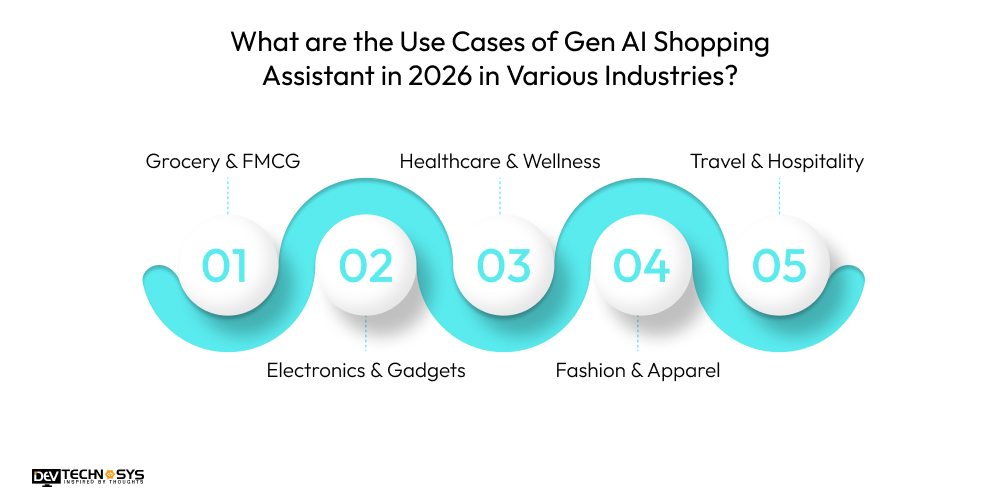
1. Grocery & FMCG
Gen AI grocery shopping assistant can help users create a personalised grocery list while predicting replenishment needs. It optimises budgets, compares prices in real-time, and suggests healthier swaps. While ordering, users can enable voice searches, faster checkouts, and waste reduction, giving higher customer lifetime value.
2. Electronics & Gadgets
An advanced AI shopping assistant guides shoppers in purchasing complex electronics. It explains and compares product specifications, features, and compatibility. An e-commerce AI shopping assistant even recommends warranties and supports after purchase, with setup, updates, and troubleshooting.
3. Healthcare & Wellness
Many shopping app development company integrates AI shopping assistant services in the healthcare and wellness industry. These services help users in personalising wellness products, supplements, and devices using compliance generative AI. It also makes sure of safe recommendations, manages subscriptions, and integrates telehealth.
4. Fashion & Apparel
AI-powered shopping assistants allow sustainable recommendations, size prediction, trend forecasting, and virtual try-ons. These AI-powered e-commerce assistants are implemented through web and Android apps in the fashion and apparel industry. It lowers returns, improves styling, and provides highly customized fashion discovery experiences.
5. Travel & Hospitality
AI shopping assistants serve as voice-activated concierges, arrange travel, evaluate costs, and customize itineraries. They improve booking performance, handle interruptions, and encourage upsells across travel e-commerce platforms. They are developed by generative AI development companies.
How Much Does Gen AI Shopping Assistant Development Cost?
The estimated price range to make an AI shopping assistant can be somewhere between $8,000 and $30,000. This cost entirely depends on the app’s complexity that fluctuates with its simplicity and advancement. Here we will explain this:
- A simple app with an MVP structure has basic but core features, APIs, security, backend, and other integrations. This lowers the complexity of the app, leading to the price ranging from $8,000 to $14,000.
- A mid-range app with personalized recommendations, visual search, and analytics integration has a bit higher complexity. Therefore, the moderate cost to build an artificial intelligence project for shopping is between $14,000 and $23,000.
- A fully-featured generative AI shopping assistant development offers high-performance, omnidata, multi-region infrastructure, advanced NLU, etc. This raises the complexity of the app, making the budget range from $23,000 to $30,000.
Now we will explain this thoroughly with a Gen AI shopping assistant development cost breakdown table.
Project Tier |
What’s Included |
Estimated Cost (USD) |
| Basic/MVP | Simple conversational chat, basic product lookup, and FAQ handling | $8,000 – $15,000 |
| Enhanced Assistant | Better intent understanding, personalized suggestions, analytics | $15,000 – $25,000 |
| Feature-Rich Version | Integrations (e.g., ecommerce platform), small-scale NLP fine-tuning, support for basic images/voice | $25,000 – $30,000 |
On the other hand, there are several factors that affect the final AI shopping assistant development cost. These factors include the app’s features, platform choice, security & compliance, third-party APIs, backend infrastructure, developer team, etc. We will discuss some of the major factors affecting the cost to create an AI app.
1. Choice of Platform
Selecting the platform, Android, iOS, or both, plays an important role in affecting the development cost. Developing an How to Build an AI App for Interview in Canada: Cost, Features and Benefits
How to Build an App Like Kling AI In Germany: Cost, Features, and Benefits
How to Build an AI Therapy App in France: Cost, Features, and Benefits
Role of AI in Wealth Management: Its Uses, Trends & Benefits
Voice Commerce in Retail: How It Works, Key Benefits & Real Challenges
How To Build An App Like NotebookLM: Feature & Cost
Frequently Asked Questions
Find answers to the most common questions related to this article.
An advanced AI shopping assistant is a supremely intelligent system that communicates with shoppers. Its purpose is to understand the preferences of users, answer their questions, and offer personalized recommendations. It helps compare products and give advice using LLMs and real-time commerce data.
The conversational AI shopping assistant examines the input provided by the customer. This examination is done on the basis of the user’s browsing style, purchase history, budget, and preferences. All these things are combined with product catalogs, reviews, pricing, and availability. Then, using ML models, the assistant suggests the most relevant options.
Generally, the cost to build ai shopping assistant platform will range from $8,000 to $30,000. The overall development cost is determined by the app’s complexity, integrations, AI model usage, customization, and other factors. It also includes ongoing expenses such as model maintenance, feature upgrades, and cloud infrastructure.
The AI-driven shopping assistant solutions work on natural language processing to understand user questions. Then, it retrieves relevant data of the product and applies recommendation algorithms. After that, it generates conversational responses for the queries asked by customers. It analyzes the user interactions and enhances the accuracy and personalization.
Yes, AI shopping assistant app development is far different from traditional chatbots. AI virtual shopping assistant uses generative models like LLMs pr NLP, to understand user context easily. It offers human-like shopping guidance across diverse scenarios. Whereas traditional chatbots work on pre-defined scripts and rules, making information limited.