














Key Takeaways:
- The global Wealthtech Market is anticipated to be worth USD 23.89 billion in 2026 with a CAGR of 06% during the forecast period from 2026 to 2035.
- The cost to develop a WealthTech Platform ranges from $8,000 to $30,000+. The total cost differs depending on features, platform selection, location of developers, tech-stack used, and more.
- The development process plays a crucial role. From idea validation to testing, deployment, and scaling, each phase directly impacts cost, timeline, and product quality.
- Monetization strategies are key to long-term success. They may include subscription models, Assets Under Management (AUM) fees, transaction commissions, and freemium offerings.
Welcome to the world of WealthTech, where algorithms not only track wealth but also help it grow. WealthTech solutions make money management smarter, automated, and deeply personalized.
For entrepreneurs, wealthTech solutions are more than a trend; they present a massive opportunity to enter the rapidly growing digital wealth management market. According to Business Research Insights, the global WealthTech market is expected to reach USD 23.89 billion in 2026, expanding at a CAGR of 25.06% from 2026 to 2035.
At the same time, more than 70% of millennials and Gen Z investors chose digital-first wealth platforms over traditional advisors. It is a testament to a clear change in modern finance management. However, building a wealthtech platform is no child’s play; it requires a trust-driven ecosystem that blends financial intelligence, seamless UX, and rock-solid security.
So, if you are a business, wondering how to build a WealthTech Platform that doesn’t just manage money, but builds wealth at scale, read this guide till the end. From must-have features and development steps to real-world cost and strategic decisions, we will cover everything in this guide to build a wealthtech platform. So stay tuned in.
What is WealthTech?
WealthTech is a digital solution, software, and wealth technology that is created to enhance, automate, and streamline wealth management and investment services. These solutions help investors and asset managers automate workflow, making managing money more efficient and making their services more accessible to both existing and future clients.
The capabilities of WealthTech solutions differ depending on specific platforms and vendors. The key components of WealthTech solutions include robo-advisors, portfolio management and analytics, digital brokerages, financial planning software, and data aggregation.
WealthTech Market Stats & Industry Growth (2026 Insights)
- The global Wealthtech Market is anticipated to be worth USD 89 billion in 2026.
- It is expected to grow steadily and reach USD 6 billion by 2035.
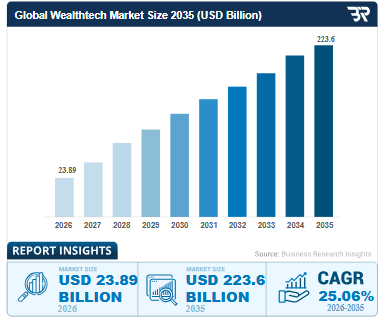
- This growth represents a CAGR of 06% during the forecast period from 2026 to 2035.
- The United States Wealthtech Market is a leading player in the wealthtech space.
- The primary market segmentation by type is Software and Services.
Why Businesses Should Invest in WealthTech Platform Development?
Businesses that want to automate administrative tasks, boost operational efficiency, and meet client demand for real-time digital access to financial data must consider investing in Wealthtech platform development. Let’s take a look at the major reasons why it’s beneficial for businesses to invest in modern WealthTech solutions.
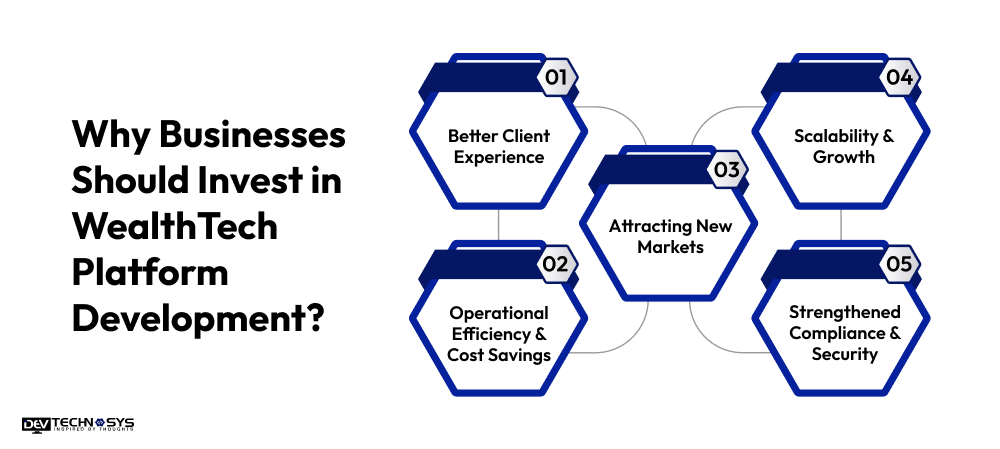
- Better Client Experience: Times have changed. Investors and asset managers today require 24/7 access to dashboards, real-time updates via user-friendly portals, and individualized services.
- Operational Efficiency & Cost Savings: With WealthTeach solutions, organizations can reduce operational costs and data entry errors. It includes providing hyper-personalized financial recommendations twitch improves customer satisfaction and long-term engagement.
- Attracting New Markets: Businesses wanting to attract new markets must invest in WealthTech platforms. Digital platforms, especially in micro-investing, attract younger and more technologically advanced markets, including millennials.
- Scalability & Growth: Companies wanting growth should use automated platforms. It leads to higher Assets Under Management (AUM) with efficient service delivery.
- Strengthened Compliance & Security: Security and regulatory compliance are critical for enterprises. Modern technologies allow firms to fulfill the increasing standards of regulatory compliance and deliver higher data accuracy for risk management.
Industry Insights: According to Global Newswire, the global WealthTech market was valued at ~$9 billion in 2025 and is expected to reach $21 billion by 2031, growing at a CAGR of 15.17%.
How to Build a WealthTech Platform From Scratch?
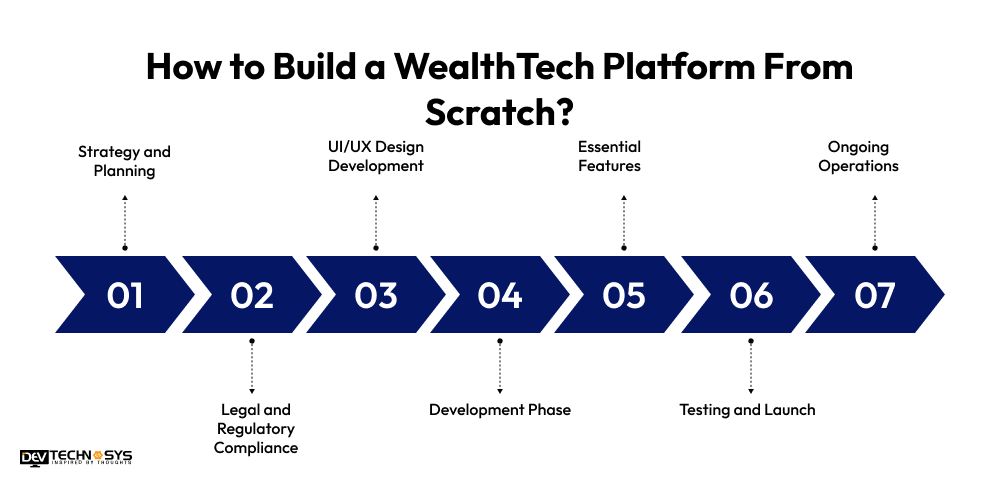
To build a WealthTech platform from the beginning, experts need to create a modular architecture, integrated with custodians and market data providers. Wealthtech platform development process involves leveraging cloud services and AI to automate Workflows. The key steps involve:
1. Strategy and Planning
To build a WealthTech platform, decide on a niche and a business model first. Think about the target audience. Who is going to use your Wealthtech solutions: individuals with high annual income, millennials, or GenZ? After that, select between self-directed investing, management-led investing, or the robo-advisory model.
For a custom software development, conduct in-depth market research to know what the current trends are and the scope. Also, to ensure that your WealthTech platform meets or exceeds the current industry standards, analyze your competitors.
By doing all this, you can ensure seamless performance and a better user experience. Create a business plan with a detailed value proposition, revenue model, and operational requirements once the research part is done.
2. Legal and Regulatory Compliance
The next step to build a WealthTech platform involves following regulations and security standards. Security is a big concern for most businesses. To ensure safety, you need to ensure regulatory compliance, including data privacy laws such as GDPR, OAuth 2.0 & Multi-Factor Authentication (MFA).
To develop a wealth management app, implement security controls such as SOC 2 Type II or ISO 270001. Automate audit trails and compliance checks, which include AML/ OFAC screenings. Ensuring legal and regulatory compliance helps maintain a legal and secure environment.
3. UI/UX Design Development
Steps to build wealth management software involve creating an intuitive interface for various user roles, involving investors and administrators. Use a microservices architecture to make the platform scalable and stable.
The UI / UX design of the WealthTech platform needs to find a good balance between extreme simplicity, high data density, and legibility. Use data storytelling strategies such as intuitive charts and graphs. This makes complex financial data easy to understand, better than numerical representation.
4. Development Phase
In this phase, everything will get assembled. It involves building robust backends and frontends using the best technologies. React Native, Flutter, Swift, and Kotlin will be used to build a robust frontend.
Node.js (Server-side runtime), Django / Flask (Python frameworks), or Spring Boot (Java framework) will be used to create a robust backend. To create a database, PostgreSQL, MySQL, MongoDB, and Cassandra will be used.
React Native is a decent choice for cross-platform development, Swift is the best choice for iOS native development, and Kotlin is the greatest choice for Android native development.
To build a personal finance management app, you must integrate third-party services such as CRMs, custodial systems, and Data providers via APIs to build a more integrated and scalable WealthTech ecosystem.
5. Essential Features
If you want to know how to build a robo advisor platform, then choose the features wisely. Experts who provide WealthTech software development services will add digital onboarding, portfolio management software features, AI and performance analytics, secure communications, and more. Use of AI in wealth management helps by delivering personalized investment insights, predicting trends, and improving decision-making with real-time data.
6. Testing and Launch
Hire fintech app developers for wealth management to test your MVP. perform rigorous testing to detect bugs, security gaps, and performance issues. Conduct utility, performance, security, functional, load, and stress testing to ensure the platform is intuitive, reliable, and capable of handling real-time financial operations efficiently. After getting a green flag from the testing team, your software development company will roll out the platform and implement user training or support.
7. Ongoing Operations
After the successful launch, it’s time for maintenance and updates. Experts at providing mobile app development services will continuously update the system based on user behavior analytics and security requirements. Develop strategies to attract users to the new platform. Hire skilled personnel to manage and grow the platform. Use analytics to track performance and adjust strategies to meet evolving market demands.
Why WealthTech Matters for Banks & Financial Institutions?
WealthTech, or wealth technology, is something that banks and other financial institutions need to stay relevant and fight well in the market. AI, data analytics, and robo-advisory technologies help businesses make things easier for their customers, make things run more smoothly, and find new ways to make money. Fast growth is happening in digital wealth management solutions. Businesses that don’t keep up with WealthTech may miss out on new ideas and customers.
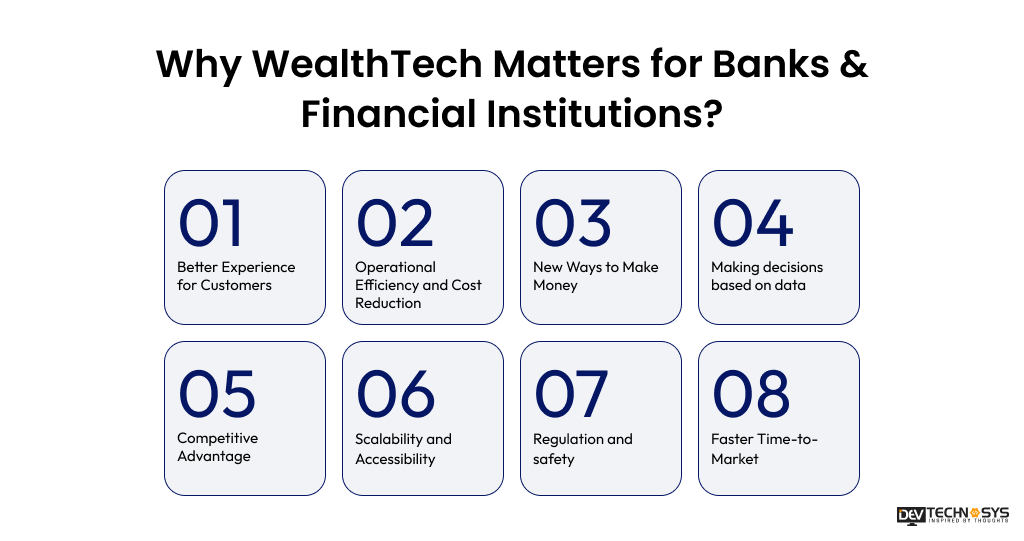
- Better Experience for Customers: Provides custom investment plans based on data and easy digital interactions.
- Operational Efficiency and Cost Reduction: Automate tasks that used to be done by hand to cut down on mistakes and make back-office work easier.
- New Ways to Make Money: Let people make money with robo-advisors, subscription services, and digital investing services.
- Making decisions based on data: Use analytics to learn more about how customers act, how much risk they pose, and how the market is changing.
- Competitive Advantage: Offer modern web development services for a wealthtech platform that are made possible by technology to compete with fintech companies.
- Scalability and Accessibility: Digital platforms let you serve a wider range of customers with little extra cost.
- Regulation and safety: Combine Know Your Customer (KYC) and Anti-Money Laundering (AML) procedures, and implement advanced security systems to better protect data.
- Faster Time-to-Market: It quickly brings new financial goods and services to market by leveraging modular and API-driven architectures.
Industry Insights: Global Growth Insights states that rapid expansion is driven by personalized investment platforms, automation, and blockchain-based financial services.
10 Key Features to Incorporate in a WealthTech Platform
Features play a crucial role in wealth management software development, so its imprtantnt to choose them wisely. Here are 10 advanced features to incorporate in a modern WealthTech platform, based on current industry trends for 2026:
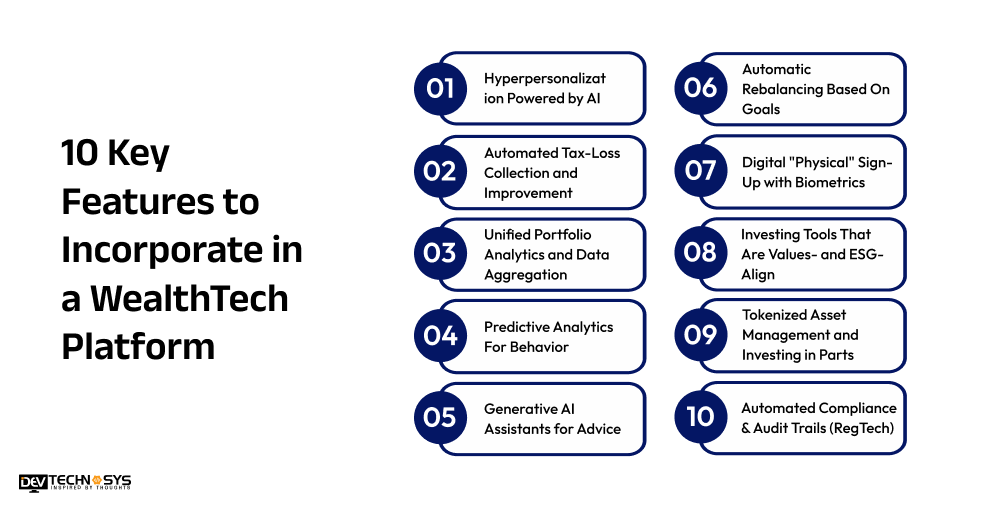
1. Hyperpersonalization Powered by AI
AI looks at more than just your risk tolerance to make highly personalized investment plans based on your buying habits, life events, and patterns of behavior. Personalized content, custom alerts, and “next-best-action” ideas for advisors are all part of this.
2. Automated Tax-Loss Collection and Improvement
With a direct link to the user’s brokerage account, an app like Fi Money instantly finds the chance to sell securities at a loss to lower capital gains tax. Advanced systems also take care of where assets are located in taxable and retirement accounts so that they are tax-efficient.
3. Unified Portfolio Analytics and Data Aggregation
A single dashboard that brings together information from different banks, alternative assets (like crypto or real estate), and bills. Instead of flat monthly reports, digital wealth management solutions with unified portfolio analytics give you a real-time, all-around picture of a client’s net worth.
4. Predictive Analytics For Behavior
Advisors can tell when a client might make an emotional choice, like selling all their stocks in a panic during a market drop, by using machine learning to look at their past actions. It helps fintech compliance development experts guess what clients want before they even ask, so you can give them proactive service instead of reactive service.
5. Generative AI Assistants for Advice
GenAI has chatbots and virtual assistants that can answer common client questions, write investment reports, and summarize talks with clients. While protecting data privacy, these assistants can provide instant engagement 24 hours a day, seven days a week.
6. Automatic Rebalancing Based On Goals
The system rebalances portfolios automatically, and not just because of changes in asset allocation; it also does this based on specific, time-bound goals, like retiring or schooling. This makes sure that the amount of risk goes down automatically as the target date gets closer.
7. Digital “Physical” Sign-Up with Biometrics
A hiring process that is completely digital, doesn’t use paper, and works well on smartphones. It includes KYC (Know Your Customer) and AML (Anti-Money Laundering) checks that happen in real time using biometric authentication. Digital log-in process through KYC AML integration lets traders begin trading almost right away.
8. Investing Tools That Are Values- and ESG-Align
Environmental, Social, and Governance (ESG) factors can be used to help investors choose portfolios. One big draw for Millennial and Gen Z investors is that it lets clients tailor their portfolios to their own values without losing performance.
9. Tokenized Asset Management and Investing in Parts
Developing on-demand app development solutions using blockchain technology allows people to own small pieces of high-value alternative assets like real estate, art, or private equity. This is one of the important robo advisor app features that democratizes access to diverse investment opportunities.
10. Automated Compliance & Audit Trails (RegTech)
Embedded regulatory technology that tracks all investment decisions, communications, and portfolio changes in real time, creating an instant, tamper-resistant audit trail. This ensures compliance with standards like GDPR, MiFID, and local KYC/AML regulations.
What is the Cost to Build a WealthTech Platform?
The cost to build a WealthTech app ranges from $8,000 to $30,000 depending on features, platform complexity, development location, expertise, teh stack, and more.
- According to a top wealthtech platform development company, the basic wealth management software development cost ranges from $8,000 to $15,000. These platforms are best for Ideal for startups & early testing) startups and early testing.
- The mid-level WealthTech apps are best suited for scaling fintech businesses and involve a few advanced features besides the basic ones, like AI-driven investment recommendations and real-time market data integration.
- Now, if you are thinking of advanced mobile banking application development, then the development cost of blockchain wealth management platform will hike up to $30,000 or higher based on the level of complexity and advanced features involved.
Advanced wealthTech platforms involve automated portfolio rebalancing, predictive analytics, multi-asset trading support, secure payment gateway integration, and blockchain-based transactions, which impact the total mobile application development cost. Now, let’s take a look at some major factors that influence the wealthtech app development cost.
1. Platform Selection
The overall cost changes a lot depending on whether you choose web, mobile, or cross-platform investment app development. Cross-platform frameworks cost less, but they may limit customizations, speed, and features specific to the platform in some advanced financial apps. Native apps for iOS and Android need separate development efforts, which raises the cost to create a wealthtech platform.
Type |
Estimated Cost ($) |
Development Timeline |
| Web App | $1,000 – $3,000 | 1 – 2 weeks |
| Mobile App (Native) | $3,000 – $5,000 | 2 – 3 weeks |
| Cross-Platform App | $2,000 – $4,000 | 2 – 3 weeks |
2. Adding Third-Party Features
Adding third-party services like payment systems, CRMs, custodial platforms, and financial data providers makes development more difficult. These integrations need secure APIs, licensing fees, and ongoing upkeep, which can make the platform’s development and long-term cost to create a wealthtech platform go up a lot.
Integration Type |
Estimated Cost ($) |
Development Timeline |
| Payment Gateway | $500 – $2,000 | 1 – 2 weeks |
| CRM Integration | $500 – $2,000 | 1 – 2 weeks |
| Custodial Systems | $1,000 – $3,000 | 2 – 3 weeks |
| Financial Data Providers | $1,000 – $3,000 | 2 – 4 weeks |
3. Regulatory Compliance & Security
WealthTech platforms have to follow strict rules like KYC, AML, and GDPR, which makes development take longer. Using advanced cybersecurity services like encryption, multi-factor authentication, and safe data storage makes sure that rules are followed.
However, adding these security features costs more, takes longer to build, and needs more maintenance over time. Here’s the table displaying the fintech wealth app development cost based on regulatory components.
Component |
Estimated Cost ($) |
Development Timeline |
| KYC Integration | $500 – $2,000 | 1 – 2 weeks |
| AML Compliance | $500 – $2,000 | 1 – 2 weeks |
| Data Encryption & Security | $500 – $3,000 | 1 – 3 weeks |
| Authentication (MFA) | $500 – $2,000 | 1 – 2 weeks |
4. Development Team Location
The location of your ewallet app development company is a big factor in how much it costs. It costs more to hire developers in places like North America or Western Europe. However, outsourcing to places like India or Eastern Europe can save you a lot of money without lowering the quality of the work or the knowledge of the developers.
Region |
Estimated Cost ($) |
Development Timeline Impact |
| North America | $20,000 – $28,000+ | Faster delivery, higher cost |
| Western Europe | $15,000 – $22,000 | Balanced speed & cost |
| Eastern Europe | $12,000 – $20,000 | Moderate timeline |
| India / Asia | $8,000 – $15,000 | Cost-effective, scalable |
5. Feature Complexity
The number and complexity of features have a direct effect on how much it costs to create. Advanced features like AI-driven suggestions, robo-advisory, predictive analytics, and real-time data processing take more time, knowledge, and money. Basic features like dashboards and portfolio tracking are cheap and take less time for your fintech app development company to develop.
Complexity Level |
Estimated Cost ($) |
Development Timeline |
| Basic Features | $1,500 – $3,000 | 2 – 3 weeks |
| Mid-Level Features | $3,000 – $6,000 | 3 – 5 weeks |
| Advanced Features | $6,000 – $10,000 | 5 – 8 weeks |
6. Maintenance After Launch
Post-launch maintenance is a recurring fee that covers things like bug fixes, updates, speed tweaks, and better security. Maintenance costs charged by top fintech app development services are usually about 15% to 20% of the initial creation cost per year. They make sure your stays safe, scalable, and in line with changing user and regulatory needs.
Maintenance Type |
Estimated Cost ($) |
Timeline |
| Bug Fixes & Updates | $500 – $1,500 | Ongoing |
| Security Updates | $500 – $1,500 | Ongoing |
| Performance Optimization | $500 – $1,000 | Ongoing |
| Feature Enhancements | $500 – $2,000 | Ongoing |
Industry Insights: According to Arizton Advisory and Intelligence, increasing smartphone usage and digital adoption are accelerating participation in WealthTech, especially among retail investors and emerging markets.
Which Approach Wins: Build, Buy, or White-Label WealthTech Platform?
According to experts. There’s no single best way to decide whether to build, buy, or white-label a WealthTech platform. What is the “best” choice to build Investment management software for your business? That depends on your goals, your budget, how quickly you need to get your product on the market, and how much customization you need. Based on the needs of the company, let’s break down which choice is best:
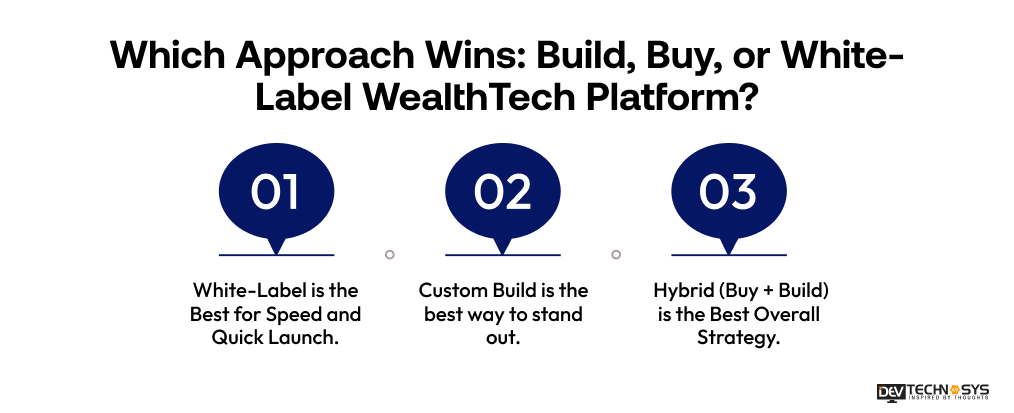
1. White-Label is the Best for Speed and Quick Launch.
White-label platforms are the fastest and most useful way for new businesses, startups, or standard financial firms to go digital quickly.
Why it’s the best:
- Short launch times (often within weeks)
- Not as much money up front as with custom builds
- Compliance tools like KYC and AML that are already built in
- Low growth risk and little technical difficulty
You should use this service if you want to focus on your business, getting new customers, and the user experience instead of building your infrastructure from scratch.
2. Custom Build is the Best Way to Stand Out.
When technology is key to your business plan and gives you a competitive edge, it’s best to start from scratch when building a WealthTech platform.

Why it’s the best:
- Full control over the design and features of the platform
- Being able to make very personalized customer experiences
- having the freedom to use your own investment methods and tools
It works best for big businesses or well-funded startups that want to make new, unique financial goods.
3. Hybrid (Buy + Build) is the Best Overall Strategy.
Many WealthTech companies these days prefer the hybrid method, which can be summed up as “Buy for parity, Build for advantage.”
Why it’s the best:
- Using pre-built parts speeds up entry into the market
- The ability to change and improve equipment that is already in place
- Costs, freedom, and scalability are all in balance.
Businesses that want to get up and running quickly and offer unique, useful features that make them stand out in the market should use this.
How to Effectively Monetize WealthTech Platforms?
Monetization is a crucial aspect for businesses. There are various strategies businesses can implement to make money from WealthTech platforms. Here are some of the top monetization methods used by the top WealthTech app and website development company.
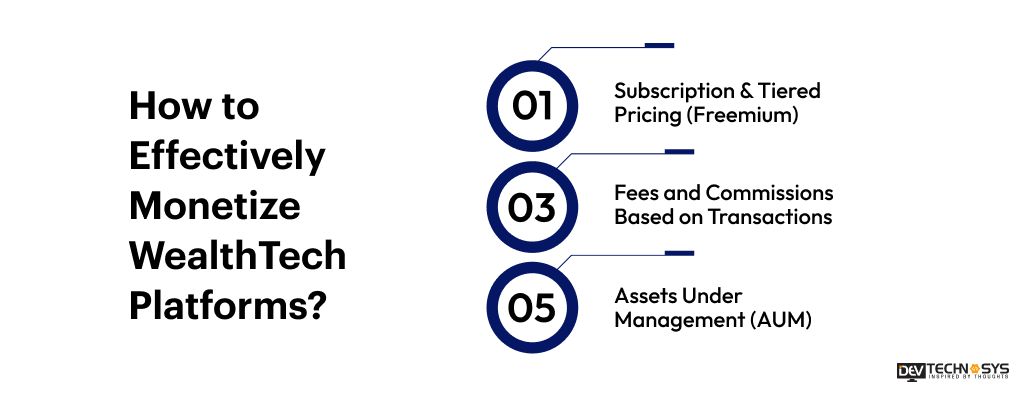
1. Subscription & Tiered Pricing (Freemium)
Users can get the most basic tools for free, but they have to pay for using advanced analytics, personalized financial advice, and 24/7 support. It helps get a lot of people to use it and makes a steady, ongoing income from people who upgrade to better plans.
2. Fees and Commissions Based on Transactions
Platforms take a small fee from users for every trade, investment, or financial deal they make. A commission-based model grows with user activity, which makes it perfect for platforms with lots of transactions and busy traders. It makes sure that the platform keeps earning revenue with the growth of users .
3. Assets Under Management (AUM)
WealthTech sites get paid a fee based on the total amount of money their users have in their accounts. This model is popular with robo-advisors and long-term investment management platforms because it guarantees stable and scalable income. Earnings grow along with user investments.
Top 10 WealthTech Platforms to Consider in 2026
It is important to choose the right WealthTech platform to provide seamless investment experiences to users. Here are the top 10 WealthTech platforms in 2026 that stand out because of their innovation, scalability, and advanced financial capabilities.
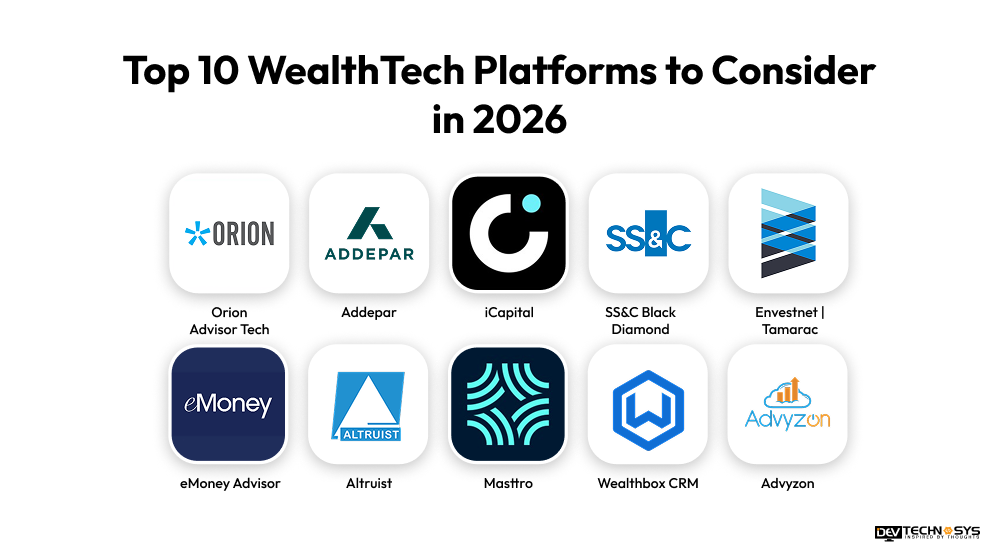
Platform |
Launch Year |
Platform Availability |
Core Focus |
Best For |
| Addepar | 2009 | Web, Cloud, Mobile | Data analytics & reporting | Large institutions |
| Orion Advisor Tech | 1999 | Web, Cloud | All-in-one wealth platform | RIAs & advisors |
| iCapital | 2013 | Web, Cloud | Alternative investments | HNW investors |
| SS&C Black Diamond | 2003* | Web, Cloud | Portfolio management | Enterprises & advisors |
| Envestnet | Tamarac | 2000* | Web, Cloud | Integrated advisor tools | Mid-large RIAs |
| Altruist | 2018 | Web, Mobile | Custodian + trading | Modern advisors |
| eMoney Advisor | 2000 | Web, Cloud | Financial planning | Financial planners |
| Masttro | 2010 | Web, Cloud | Wealth aggregation | Family offices |
| Wealthbox CRM | 2014 | Web, Mobile | CRM platform | Small advisory firms |
| Advyzon | 2012 | Web, Cloud | All-in-one solution | Growing RIAs |
1. Addepar
Addepar is one of the best WealthTech platforms for collecting data, analyzing it, and reporting on complicated investment portfolios. It helps institutions easily handle portfolios with more than one asset. Companies looking for wealth management app development like Addepar should pay attention to real-time data, the ability to grow, and advanced reporting tools.
2. Orion Advisor Tech
Orion Advisor Tech has a wealth management system that includes trading, portfolio management, and reporting tools all in one package. It makes it easier for advisors to manage clients and do their job. If you want to make an app like Orion, you should focus on making it easy for advisors to use screens, integrate with other apps, and automate tasks.
3. iCapital
Access to private equity, structured products, and hedge funds is what iCapital does best when it comes to alternative investing. It makes investing easier for companies and advisors. It’s important to have good data security, investment management tools, and easy onboarding for high-net-worth users when making an app like iCapital.
4. The SS&C Black Diamond
For financial advisors and businesses, SS&C Black Diamond is a powerful tool for managing portfolios and making reports. WealthTech platform features client dashboards, tools for rebalancing, and ways to track performance. When considering investment management platform development, you should focus on features like accurate reporting, portfolio analytics, and safe client contact.
5. Tamarac/Envestnet
There are integrated wealth management options from Envestnet | Tamarac, such as CRM, portfolio management, trading, and billing tools. It helps counselors improve the customer experience and streamline their work. For growing advisory companies, making an app like Tamarac requires strong integration, automation, and infrastructure that can be expanded.
3 Mistakes That Kill WealthTech Startups Early
WealthTech startups usually fail early because they build goods without knowing if the market wants them, run out of money, or don’t know how to comply with regulations. These three mistakes can kill WealthTech startups early on:
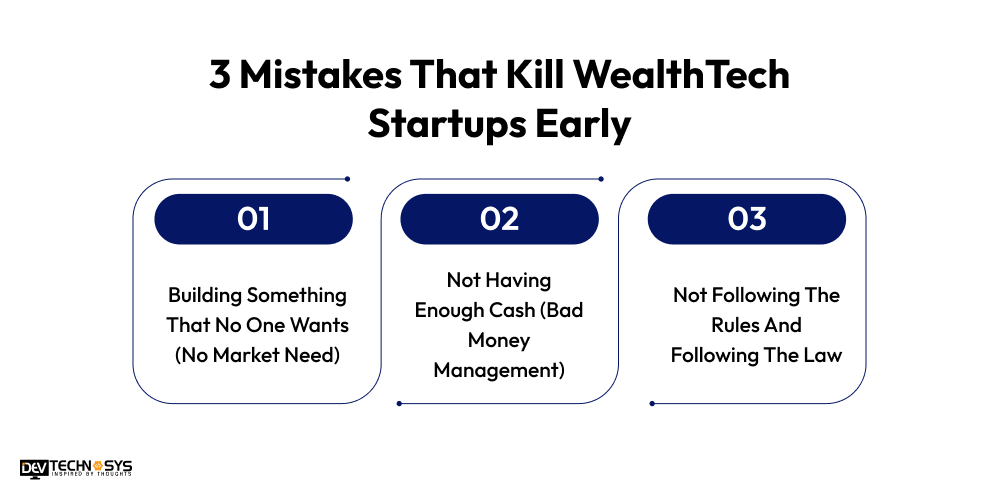
1. Building Something That No One Wants (No Market Need):
Putting out a product without making sure it solves a real problem for people is the main reason why it fails (42%). It’s common for WealthTech founders to fall in love with their product (like an AI robo-advisor) before they check to see if advisers or clients will reimburse them.
2. Not Having Enough Cash (Bad Money Management):
As a result of having a short runway, many startups fail because they overestimate their income and underestimate their costs. Two-fifths of startups fail because they hire people or advertise their products too quickly, without first making sure they work.
3. Not Following The Rules And Following The Law:
WealthTech, on the other hand, is closely monitiored. Not doing enough study on the rules early on can lead to expensive fines, launch delays, or shutting down right away. It is essential to work with legal experts and compliance specialists from the start to ensure smooth operations.
You can reach out anytime; we are available 24/7. Our team provides a quick response.

Technology Architecture Behind WealthTech Platforms
A WealthTech platform relies on a scalable, secure, and API-driven architecture to handle real-time financial data, transactions, and user interactions. It typically follows a layered or microservices-based structure, ensuring flexibility, high performance, and seamless integration with third-party financial services.
Layer |
Technologies / Components |
| Frontend Layer | React, Flutter, Swift, Kotlin |
| Backend Layer | Node.js, Django, Spring Boot |
| API Layer | REST APIs, GraphQL |
| Database Layer | PostgreSQL, MongoDB, Redis |
| Cloud Infrastructure | AWS, Azure, Google Cloud |
| Security Layer | OAuth 2.0, MFA, Encryption |
| Integration Layer | Payment APIs, KYC/AML services, Market Data APIs |
Conclusion
In 2026, making a WealthTech platform is more than just making a financial app. It means developing a safe, scalable, and user-centered environment that helps businesses scale in the competitive market. Whether you build, buy, or use a hybrid approach, the important thing is to find a good balance between speed, new ideas, and long-term growth.
If you are a business looking to build a WealthTech Platform, then contact Dev Technosys. A leading mobile application development company. With 15+ years of expertise in creating welathtech platforms and 30+ core technology practices, we deliver scalable, secure, and high-performing solutions according to your business needs.
Frequently Asked Questions
Find answers to the most common questions related to this article.
A wealthTech platform is a computer program that uses AI, automation, and data analytics to help people handle their investments, keep track of their portfolios, and make better money choices in a smooth and easy way.
Depending on the features, platform type, integrations, location of the development team, and compliance standards needed to make a safe and scalable financial solution, building a WealthTech platform can cost anywhere from $8,000 to $30,000 or more.
Depending on how complicated it is, building a WealthTech platform usually takes between 8 and 20 weeks. More complex systems with AI, integrations, and compliance features take longer to build and test than simple MVPs.
Key features include confirming the user's identity and knowledge (KYC), portfolio management dashboards, real-time market data merging, AI-based investment suggestions, safe payment systems, and analytics tools that help users keep track of and make the most of their investments.
Subscription plans, transaction-based fees, assets under management (AUM) charges, affiliate partnerships, and data-driven insights are some of the ways that WealthTech platforms make money. They help businesses build multiple income streams while giving users value.