















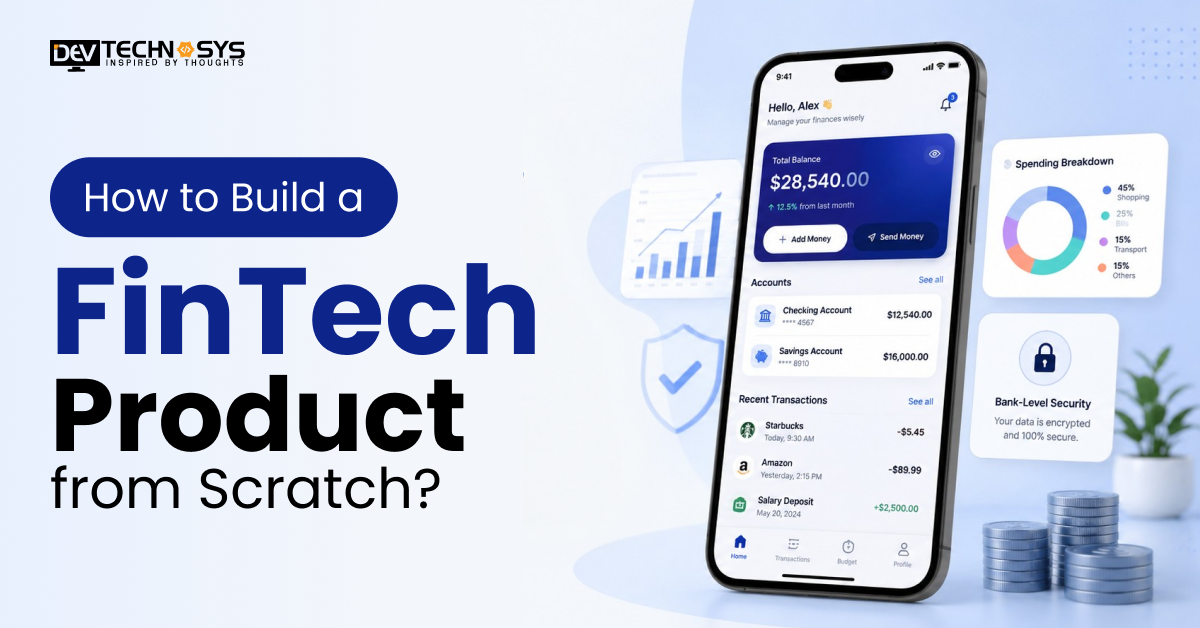
The FinTech market is moving at a breakneck speed, making 2026 the year of great opportunities or huge failures for companies that are planning to venture into this industry.
Market forecasts reveal that the global FinTech sector is set to go beyond $300 billion by 2026, courtesy of the continued digital payments expansion, the invention of AI-powered banking, and the use of blockchain technology in financial services.
This rapid expansion offers a remarkable chance for startups and companies to conceive, develop, and implement innovative financial products from the ground up. Yet, winning in the market calls for more than just brainstorming the product idea; it also requires a well-thought-out strategy, advanced technology, and flawless execution.
We will walk with you through this blog, step by step, illustrating how you can build a fintech product in 2026, covering the entire journey so that we can help you bring your idea to life as a profitable digital financial service.
What Is a FinTech Product?
A FinTech product is a convenient digital offering that enables users to perform different financial activities such as managing, transferring, investing, or borrowing money.
The category of such solutions varies from digital wallets, online banking systems, lending platforms, investment products, to blockchain-based financial services that are targeted to deliver faster and safer transactions.
Why FinTech Product Development Matters in 2026?
Focus on FinTech product innovation in 2026 as a major engine of business growth, which, among other things, is happening due to the global trend of digital finance acceptance, AI breakthroughs, and worldwide investment flows. These factors are significantly changing the methods of designing, expanding, and gaining revenues from financial products.
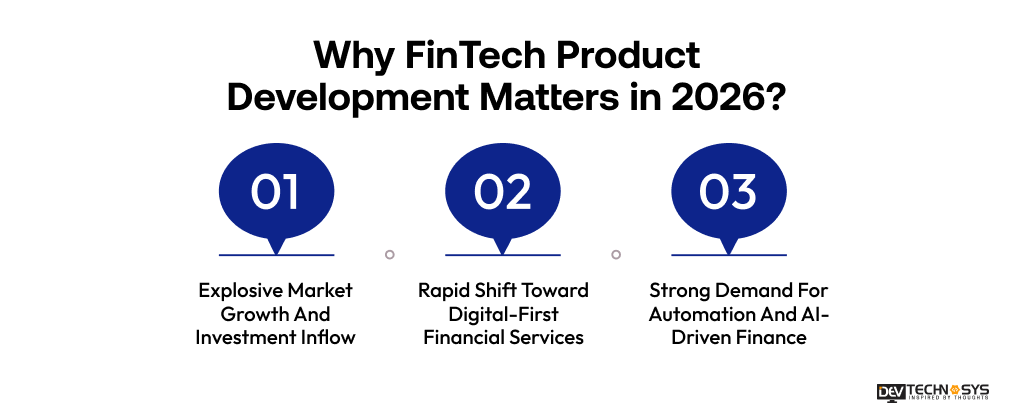
1. Explosive Market Growth And Investment Inflow
The global market for financial technologies is anticipated to exceed $300 billion in 2026. In particular, the adoption and growth of digital banking, payments, and lending have fueled this expansion.
It is expected that funding will continue to increase as venture capitalists invest in globally applicable technological financial services with clear potential for scaling.
2. Rapid Shift Toward Digital-First Financial Services
70 percent + consumers prefer to bank and make payments digitally, and this has forced businesses to create secure, fast, and user-friendly digital financial products to maintain market share.
3. Strong Demand For Automation And AI-Driven Finance
Almost 60 percent of financial institutions already leverage AI-driven solutions for fraud detection, scoring, and customer service, and it is expected that FinTech products developed in 2026 will need payment automation to improve efficiency and lower costs.
FinTech Industry Market Stats (2026)
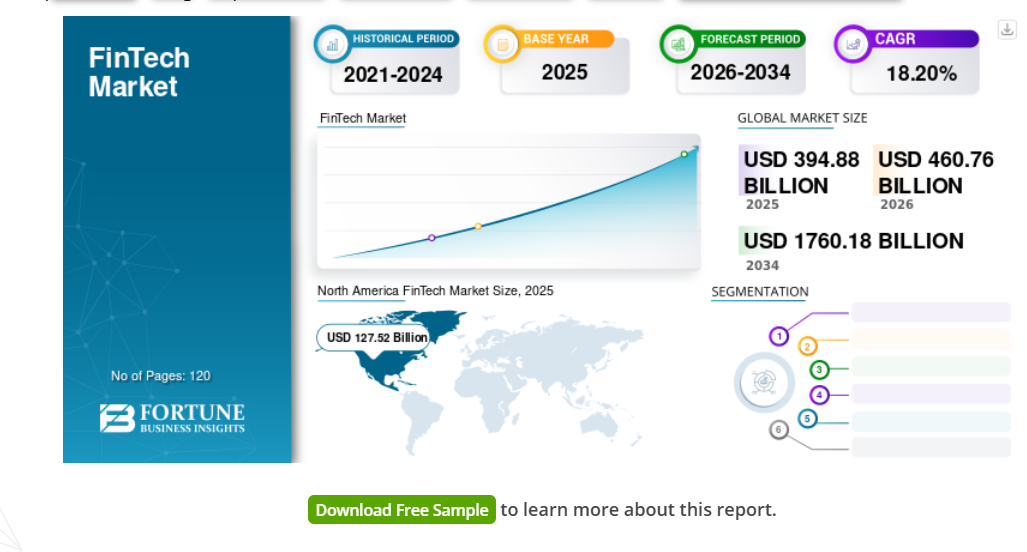
- According to Fortune Business Insight, the global FinTech market is estimated at $460.76 billion in 2026, with widespread adoption worldwide.
- The FinTech market is projected to almost triple, reaching $1.25 trillion by 2035, propelled by advances in AI, digital banking, and blockchain.
- There has been strong investor confidence, resulting in the FinTech market growing at a compound annual rate of 16-18%, highlighting increased investment in digital transformation.
- Almost 44% of the global FinTech market comes from Asia-Pacific. Asia is also a strong area, led by China, India, and Southeast Asia.
- Asia’s increased uptake of FinTech services, and 80% + global users already prefer digital payments to traditional methods, confirming a significant behavioral shift.
- The AI segment of the FinTech industry is also experiencing accelerated growth and is projected to be worth $66.5 billion by 2035, compared to $17.79 billion today.
Step-by-Step Process to Build a FinTech Product from Scratch
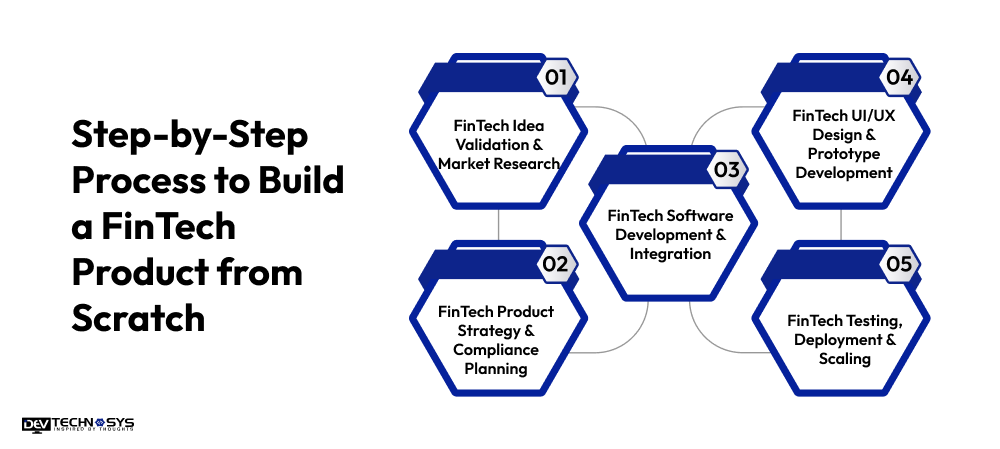
The Fintech software development process requires a unique set of skills and an in-depth knowledge of both the industry and compliance standards. A trusted fintech software development services provider can assist by accelerating time-to-market, reducing risk, and building a scalable product framework. Let’s explore the fintech software development steps:
1. FinTech Idea Validation & Market Research
It is crucial to test your FinTech idea with real potential users, analyze the competitive landscape, and define the target audience before development can even begin.
Your development partner can aid in identifying opportunities in the digital banking, payments, lending, and investment sectors and determining if your concept is truly viable, scalable, and compliant.
2. FinTech Product Strategy & Compliance Planning
Once the idea is validated, the next step is building a strong product strategy aligned with regulatory requirements like KYC, AML, PCI-DSS, and GDPR.
A fintech software development company defines product scope, features, monetization models, and ensures compliance planning to avoid legal and operational risks in future scaling.
3. FinTech UI/UX Design & Prototype Development
In this phase, designers create user-friendly interfaces that simplify intricate financial operations. The company will create wireframes and a clickable prototype for the mobile and web app.
The designs are focused on being secure, user-friendly, and conversion-driven, for higher user trust and engagement, making every financial transaction on all platforms seamless.
4. FinTech Software Development & Integration
In this fourth fintech product development process, where most of the actual building happens, all the backend systems, front-end applications, APIs, and databases are constructed.
Hire software developers to integrate payment gateways, banking APIs, AI-based fraud detection, a blockchain module, and a cloud-based infrastructure for high-performance, scalable, and real-time operation for the financial products.
5. FinTech Testing, Deployment & Scaling
Prior to the fintech product launch strategy, rigorous testing would be performed on the product, which includes security testing, performance testing, and validation of compliance before it is launched into the market.
After the product is deployed, the FinTech company would continue to monitor the systems, fix bugs, and help scale the product through cloud solutions to cope with higher user load.
Types of FinTech Products with Definition & Cost Breakdown
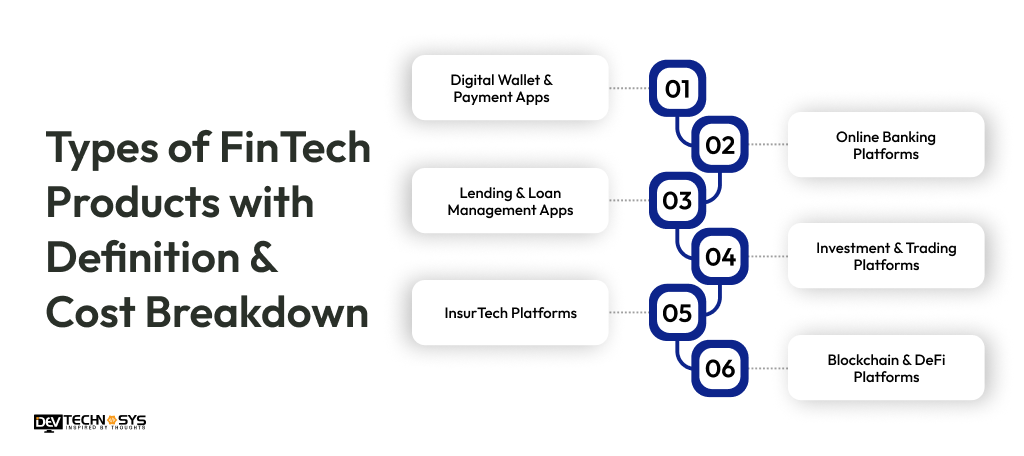
FinTech products can be of numerous types, each with its own distinct function when dealing with money transactions. It helps businesses, large or small, to determine the best-suited FinTech solution for business growth.
FinTech Product Type |
Cost |
Timeline |
Team Required |
| Digital Wallet & Payment Apps | $10,000 – $16,000 | 8–12 weeks | 5–7 experts (PM, 2 Developers, UI/UX Designer, QA Engineer, DevOps optional) |
| Online Banking Platforms | $16,000 – $22,000 | 12–18 weeks | 7–9 experts (PM, Backend Dev, Frontend Dev, UI/UX, QA, DevOps, Security Expert) |
| Lending & Loan Management Apps | $12,000 – $18,000 | 10–14 weeks | 6–8 experts (PM, Developers, UI/UX, QA, API Integration Specialist) |
| Investment & Trading Platforms | $20,000 – $29,999 | 16–24 weeks | 8–12 experts (PM, Full Stack Devs, UI/UX, QA, DevOps, Data/AI Expert) |
| InsurTech Platforms | $12,000 – $17,000 | 10–16 weeks | 6–8 experts (PM, Developers, UI/UX, QA, Integration Engineer) |
| Blockchain & DeFi Platforms | $22,000 – $29,999 | 18–26 weeks | 9–12 experts (PM, Blockchain Devs, Smart Contract Dev, UI/UX, QA, Security Expert, DevOps) |
1. Digital Wallet & Payment Apps
Digital wallet and payment applications let users hold their money in digital form, instantly sending and receiving money, paying bills, and transacting without needing physical cash or a debit/credit card, through a mobile or web app.
2. Online Banking Platforms
An online banking platform gives digital access to managing your bank accounts and services such as fund transfer, account deposit, applying for loans, and keeping a track of personal finance, all virtually, with no visit to a physical branch required.
3. Lending & Loan Management Apps
A lending and loan management app lets users apply for loans and also allows them to know about their credit limit, interest rates, and manage their repayment plan.
4. Investment & Trading Platforms
An investment and trading platform lets users invest in various financial assets like stocks, cryptocurrencies, and mutual funds, while providing up-to-date market information and an advanced analytics tool to assist financial decision-making.
5. Insurance Tech (InsurTech) Platforms
InsurTech platform automates all insurance services like policy purchase, renewal, claim submission, and tracking with an efficient, transparent, customer-friendly insurance management experience.
6. Blockchain & DeFi Platforms
Blockchain and DeFi platforms automate decentralized transactions such as trading, lending, borrowing of cryptocurrencies, and smart contracts to enable transactions with no intermediary, enhance user controls, and visibility in transactions.
Want a chatbot demo or pricing? Fill the form and talk to our experts today.
Pick what you need below — you can select more than one — then tap Get detail to continue.
-
Chatbot demo dashboard
-
Cost to develop an app
-
Industry report
-
Case study
Real-World Examples of FinTech Products
Real-world examples show FinTech pioneers shaping the global digital payments, lending, and investment space. The success of such products helps to better understand successful business models, market needs, and FinTech innovation strategies that are revenue-driven.
FinTech Product |
Category |
Success Metrics |
| Paytm | Digital Payments | 350M+ users, multi-billion transactions annually, $5–7B valuation |
| Revolut | Neobank | 50M+ users, high transaction volume, ~$45B valuation |
| LendingClub | Digital Lending | $10B+ loans originated, strong revenue model |
| Robinhood | Trading Platform | 20M+ users, ~$20–30B valuation |
| PolicyBazaar | Insurance Tech | 60M+ users, $5–6B valuation |
| Coinbase | Crypto Exchange | 100M+ users, $1T+ trading volume cycles |
1. Paytm
Paytm is a leading Indian digital payment platform that allows users to transfer money, pay bills, recharge their mobiles, and shop online through a secure mobile wallet and UPI-based solution.
2. Revolut
Revolut is a global digital neobank that allows users to perform digital banking, currency exchange, cross-border remittances, cryptocurrency trading, and access personal finance tools, with instant spending insights through a mobile platform.
3. LendingClub
LendingClub is a p2p lending platform that connects borrowers and lenders, allowing users to avail a personal loan, credit card debt consolidation, or simply obtain credit through an automated online finance CRM marketplace.
4. Robinhood
Robinhood is a commission-free stock trading application to invest in stock, ETFS, options, and cryptocurrency with a real-time market feed and an innovative, mobile-centric user experience.
5. PolicyBazaar
PolicyBazaar is an online insurance aggregator platform that allows customers to choose, purchase, and manage insurance plans like health insurance, life insurance, and car insurance transparently.
6. Coinbase
Coinbase is a cryptocurrency exchange where people can buy, sell, store, and transfer cryptocurrencies like Bitcoin and Ethereum in a secure, compliant manner.
Key Features Every Successful FinTech Product Must Have
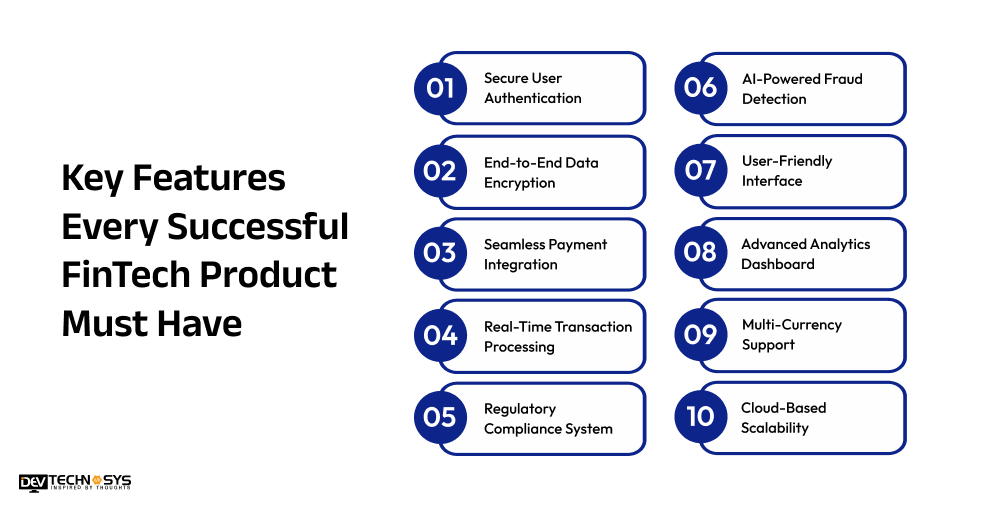
A great FinTech product usually has a strong backend with powerful features in fintech app ensuring the security and speed, boosting overall performance while improving customer trust, allowing for user adoption.
1. Secure User Authentication
Strong security through the use of OTP, biometric authentication, and multi-factor authentication ensures accounts stay safe from threats of hacking and fraudulent access.
2. End-to-End Data Encryption
For users’ security and protection from data theft, the entire user data and sensitive financial information should be encrypted during the process of storage and transmission.
3. Seamless Payment Integration
Multiple payment gateway integrations support transactions like instant, secure, reliable transfers through wallets, cards, UPI, bank transfer, etc.
4. Real-Time Transaction Processing
Instant update of transaction keeps users notified, and helps in building trust between the user and the FinTech product, and also provides accuracy about all financial updates instantly without sync time.
5. Regulatory Compliance System
Built in support of KYC, AML, and financial regulations adds to legal safety and secure operations throughout.
6. AI-Powered Fraud Detection
Real-time identification of unusual transactions, a fraud detection system using AI-powered risk assessment, helps the product stand out in terms of overall security and reliability.
7. User-Friendly Interface
Simple and well-structured UI enables the user to explore financial services without any confusion, thus increasing the engagement with the product.
8. Advanced Analytics Dashboard
Data-driven dashboards will offer real-time insights into the transaction and spending trends.
9. Multi-Currency Support
Support for multiple currencies allows global transactions, making FinTech platforms suitable for international users and cross-border payments.
10. Cloud-Based Scalability
Cloud-based technology ensures higher performance, reliability, and security even during high transaction traffic.
FinTech Product Development Cost Breakdown
The fintech app development cost depends upon multiple technical, design, and compliance factors and can be broadly categorized as $9,999 – $29,999 based on feature set and overall product complexity.
1. App Complexity & Feature Set
The complexity of a FinTech product dictates its development cost. Simple transaction-based FinTech products are relatively less expensive, while those requiring advanced features like artificial intelligence, trading, and lending services tend to incur higher costs to build a fintech product.
Complexity Level |
Cost Impact |
| Basic Features (MVP) | $2,000 – $4,000 |
| Mid-Level Features | $4,000 – $7,000 |
| Advanced Features (AI/Trading/DeFi) | $7,000 – $10,000 |
2. UI/UX Design Requirements
Customization and advanced level design contribute to the fintech MVP development cost as building engaging, interactive, and trustworthy FinTech applications necessitates robust design implementation, research and usability testing, which takes additional effort and fintech software development timeline.
Design Type |
Cost Impact |
| Basic UI Design | $1,000 – $2,000 |
| Custom UI/UX | $2,000 – $3,500 |
| Advanced User-Centric Design | $3,500 – $5,000 |

3. Security & Compliance Integration
Implementing sophisticated security features like KYC, AML and fraud detection engine is an integral part of any FinTech product. These compliance features can escalate the fintech software development pricing, due to the complexity of their integration and maintenance required for legal approval.
Security Level |
Cost Impact |
| Basic Security Setup | $1,000 – $2,500 |
| Standard Compliance (KYC/AML) | $2,500 – $4,000 |
| Advanced Security (Fraud AI, Encryption) | $4,000 – $6,000 |
4. Technology Stack & Integrations
Integrating advanced technologies such as AI, blockchain, or third party API’s, can contribute significantly to increasing the software development cost, such as connecting to banking APIs or payment gateways and integrating these with the overall architecture of the application.
Integration Level |
Cost Impact |
| Basic APIs | $1,000 – $2,000 |
| Payment & Banking APIs | $2,000 – $4,500 |
| Advanced Tech (AI/Blockchain/DeFi) | $4,500 – $7,000 |
5. Development Team & Location
It differs depending on the location and skills of the fintech app development firm. However, hire dedicated developers or an agency will definitely charge more, but they provide quality output, fast delivery and minimized risks.
Team Type |
Cost Impact |
| Freelancers | $1,000 – $3,000 |
| Mid-Level Agency | $3,000 – $6,000 |
| Expert FinTech Company | $6,000 – $10,000 |
Why Startups Fail in FinTech Product Development?
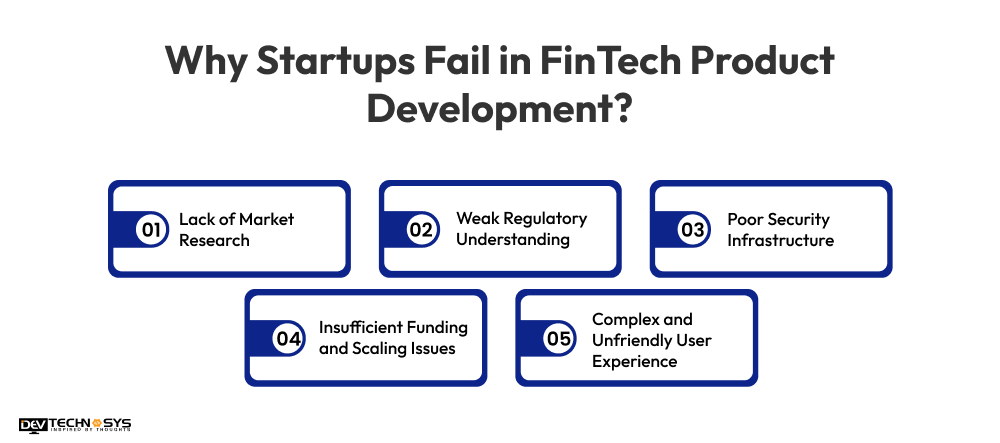
Startups commonly fail in the start a fintech company guide because of weak planning, weak compliance, and the scalability of the product. Knowledge of the aforementioned failures would assist businesses in developing more robust, secure, and market-ready financial solutions.
1. Lack of Market Research
There are numerous reasons why startups often fail while building FinTech products. The foremost reason is a lack of proper research or market surveys, leading startups to fail to analyze demand, gaps, competition, or user needs. This leads to poor product-market fit and, consequently, a very low adoption rate.
2. Weak Regulatory Understanding
One common mistake startups commit is that they fail to take financial compliance into consideration. Strict financial regulations (KYC, AML, licenses, etc.) make FinTech highly prone to compliance issues in a regulated environment, which can also lead to shutdown of a product or legal penalties.
3. Poor Security Infrastructure
When it comes to financial applications, security has always been the most important consideration. Startups often fail while developing a FinTech product, or the product failure might happen later on, if its security is weak. If a product cannot prevent data breach and fraud, it ultimately affects user trust, especially critical in finance.
4. Insufficient Funding and Scaling Issues
One of the most common reasons for the failure of startups is running out of finances before scaling the product. The high development, compliance, and scalable fintech infrastructure costs required to launch and scale a FinTech product are one major issue that leads to the depletion of capital before a product becomes sustainable and grows its operations well.
5. Complex and Unfriendly User Experience
When FinTech products become overly complicated, their user adoption rates are minimal. They are a failure on a user journey if their UI/UX design is difficult, causing high user drop-off rates in a competitive market.
Challenges in Building a FinTech Product (and How to Solve Them)
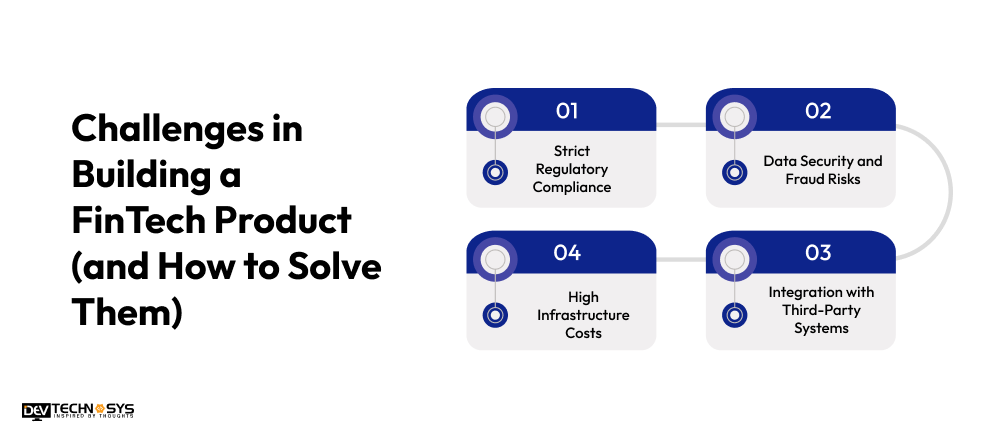
Build fintech software involves various challenges such as security risks, compliance pressure, scalability issues, and others. Understanding them and taking adequate measures is one of the keys to the successful development of a future-ready FinTech solution.
1. Strict Regulatory Compliance (KYC, AML, GDPR)
FinTech products must adhere to many financial regulations like KYC, AML, GDPR compliance, and country-specific banking laws. These regulations often vary significantly in each country and can increase the complexity of product development, documentation required, and the duration needed for the product launch.
Solution:
Appoint compliance professionals at an early stage of development. Strictly follow regulatory frameworks throughout the development process, or integrate a reliable KYC/AML integration to manage verification requirements and minimize legal risks.
2. Data Security and Fraud Risks
FinTech companies work with the most personal data, such as bank details, financial transactions, and identifying information, thus the platforms have become an appealing target to cyber-attacks and fraud. Even an error of a very small amount can damage user loyalty and may incur considerable financial and legal liability.
Solution: Apply strong encryption, two-factor authentication, biometric logins, real-time fraud detection and constant security audits for user data protection.
3. High Development and Infrastructure Costs
Skilled programmers, fintech software architectures, cloud storage, the need to integrate various services, and maintenance requirements all contribute to fintech application development being significantly more costly compared to typical applications.
The fintech platform development cost goes up even more if complex technologies like AI, blockchain, or real-time processing need to be applied.
Solution: To reduce development costs, build a minimal product (MVP) that contains only essential features, get market feedback, and then expand and scale the business.
4. Integration with Banks and Third-Party Systems
Integration with other financial institutions is one of the main factors making FinTech platforms work. Issues can arise due to inconsistencies between systems, documentation challenges, and varying compliance guidelines when integrating with payment gateways, banks, credit rating agencies, and other financial service providers.
Solution: Incorporate RESTful standardized APIs, choose reliable FinTech partners, and implement middleware solutions to ensure better compatibility.
Monetization Models for FinTech Products
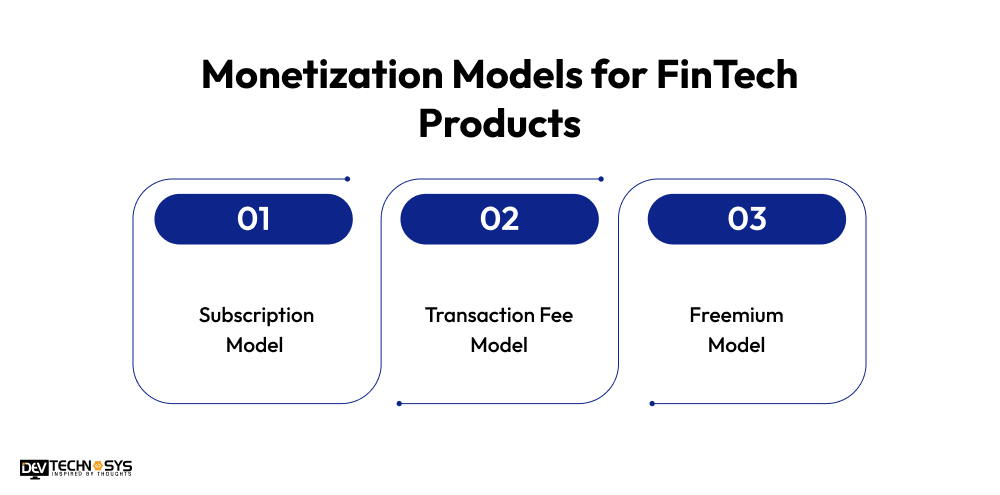
The way the FinTech business makes money through the sale of features/services is known as the Monetization model. Selecting the correct strategy is vital to ensuring stability, profitability, and long-term success in highly competitive marketplaces.
1. Subscription Model
Under this payment model, customers pay a monthly or annual recurring charge in order to access additional features on the fintech apps. Premium features could include more in-depth analytics or expedited transactions, and will offer the business a stable, reliable revenue stream and enhanced customer loyalty and retention.
2. Transaction Fee Model
Under this pricing structure, the FinTech platform development solutions charge the end user a minimal amount for each transaction carried out on the platform, such as payments, money transfers, trades, or loan payments. As more transactions are carried out on the platform, revenue streams increase.
3. Freemium Model
The freemium model offered free but more advanced features such as extra security, dedicated customer support, automated electronic payment processing or investment tools that require an additional fee. This attracts a large customer base and converts them into paying customers.
How Long Does It Really Take to Build a FinTech Product in 2026? (Full Timeline Breakdown Explained)
It usually takes between 4 and 9 months to develop a FinTech product, depending on the complexity, features, and number of functions to be developed, compliance standards, and the development team size.
While an MVP of a product can be developed more rapidly, complex platforms require additional time to address security, integrability, and testing of their core components.
Through adequate planning, Agile methodologies and proficient development teams, a feature-rich and secure financial product could be successfully brought to market on time and on budget.
Development Timeline by Stage:
Development Stage |
Time Required |
| Idea Validation & Research | 2 – 4 weeks |
| UI/UX Design & Prototyping | 3 – 6 weeks |
| Backend & Frontend Development | 8 – 16 weeks |
| Testing & Quality Assurance | 3 – 6 weeks |
| Deployment & Launch | 1 – 2 weeks |
| Maintenance & Scaling | Ongoing |
Best Practices to Build a Scalable FinTech Solution
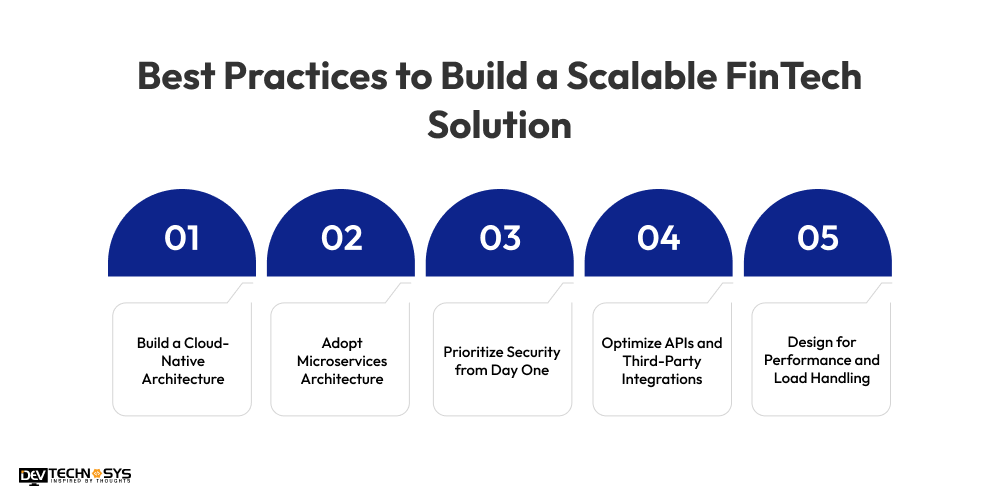
Designing enterprise fintech solutions needs a robust fintech app architecture and an intelligent design focusing on the long-term. Smart design ensures that the financial solution performs optimally even when the customer base grows and the transaction volumes escalate, with high-performance levels maintained and sustained growth achieved.
1. Build a Cloud-Native Architecture
Utilize scalable cloud platforms such as AWS, Azure or Google Cloud so that your FinTech solution will be able to scale automatically to meet customer and transaction growth, transaction volumes and data increase without any performance issues or downtime risks.
2. Adopt Microservices Architecture
Divide your application into independent microservices, for example, authentication, payments and analytics. The microservices approach allows easy scalability of independent units and easier and faster system updates without impacting the whole application.
3. Prioritize Security from Day One
Consider integrating robust security, multi-factor authentication and fraud detection mechanisms from the outset. This type of early integration in the system enables protection against risks such as financial data theft and building long-term credibility.
4. Optimize APIs and Third-Party Integrations
Develop lightweight and well-structured APIs for various financial services like banking, payment gateway, KYC, etc. An efficient system that enables faster transactions through integration with a wider range of payment gateways will always allow better transaction flow when customer numbers escalate.
5. Design for Performance and Load Handling
Use load balancing, caching strategies and database optimization techniques to ensure that your FinTech platform performs well during high transaction volumes and peaks without lag or system crashes.
Technology Stack for FinTech Product Development in 2026
The right choice of technology stack will serve as the bedrock for your FinTech product development in 2026, paving the way for scalability, security, efficiency and smooth integration.
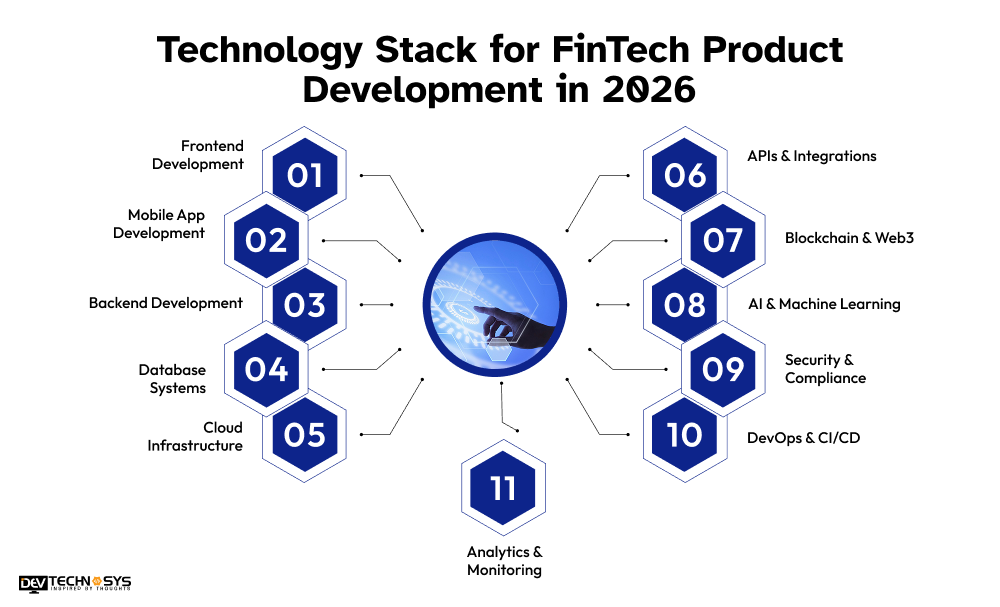
Layer |
Technologies |
| Frontend Development | React.js, Angular, Vue.js, Next.js |
| Mobile App Development | Flutter, React Native, Swift (iOS), Kotlin (Android) |
| Backend Development | Node.js, Java (Spring Boot), Python (Django/FastAPI), .NET Core |
| Database Systems | PostgreSQL, MySQL, MongoDB, Cassandra |
| Cloud Infrastructure | AWS, Microsoft Azure, Google Cloud Platform (GCP) |
| APIs & Integrations | REST APIs, GraphQL, Open Banking APIs, Payment Gateway APIs |
| Blockchain & Web3 | Ethereum, Hyperledger, Solana, Smart Contracts (Solidity) |
| AI & Machine Learning | TensorFlow, PyTorch, Scikit-learn, OpenAI APIs |
| Security & Compliance | OAuth 2.0, JWT, SSL/TLS, Biometric Authentication, PCI-DSS tools |
| DevOps & CI/CD | Docker, Kubernetes, Jenkins, GitHub Actions |
| Analytics & Monitoring | Google Analytics, Mixpanel, Power BI, Grafana, Prometheus |
Future Trends in FinTech Product Development (2026 & Beyond)
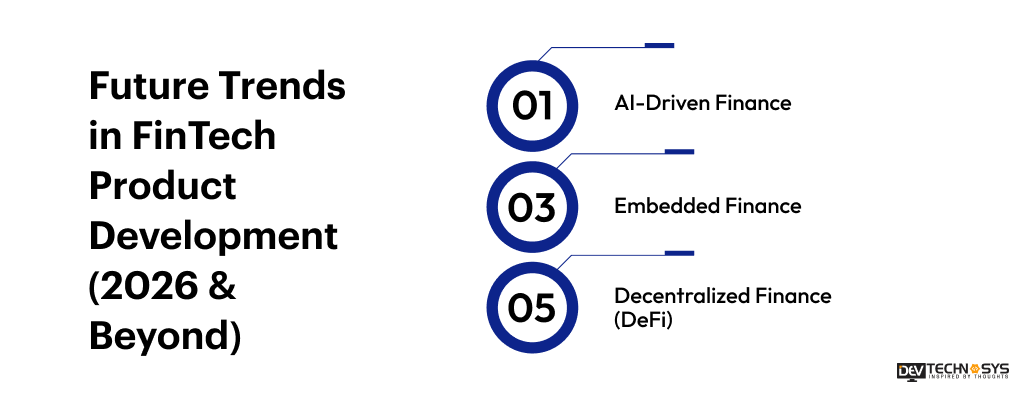
The future of FinTech is dynamic, with emerging technologies such as AI, blockchain, and embedded systems rapidly reshaping the way financial services are built, distributed ledger integration, and consumed, thereby enabling financial operations to be faster, smarter, and more accessible globally.
1. AI-Driven Finance
The integration of artificial intelligence in finance leverages Machine Learning and predictive analysis to automate financial processes, improve credit scores and detection of fraud, and enhance customer experiences with tailored banking products and services.
2. Embedded Finance
Integrated Finance (or embedded finance) allows seamless integration of financial services, such as payments, lending, or insurance products, into a user’s transaction experience within non-financial applications and websites, creating more efficient transactions without the need to switch to other payment systems.
3. Decentralized Finance (DeFi)
Decentralized Finance (DeFi) leverages blockchain to remove intermediaries and to enable P2P lending, borrowing, and exchange of assets without banks and other financial institutions with greater security and transparency.
You can reach out anytime; we are available 24/7. Our team provides a quick response.

Final Thoughts: Turning Your FinTech Idea into a Market-Ready Product
If you want to develop a fintech app like Wise, you must have a solid strategy, the right technical implementation, and an in-depth understanding of compliance issues and user expectations.
The first thing to do is build the MVP version of your idea, then check with real users to validate whether the MVP has the features and functionality they require, before finally moving to scale your idea gradually. Partner with fintech AI product developers with proven expertise to ensure security, scalability, and quick market entry for your innovation.
How Dev Technosys Can Help You Build Your FinTech Product with Experts?
With over 15 years of experience in software development, Dev Technosys is a premier mobile app development company dedicated to crafting secure, scalable, and innovative solutions. Our team of experts provides comprehensive services from product strategy and UI/UX design to development, API integration, and compliance-ready architecture.
Whether you need an MVP or a full-scale financial platform, we accelerate time-to-market, enhance security, and future-proof your technology to efficiently transform your FinTech idea into a thriving digital financial product.
Frequently Asked Questions
Find answers to the most common questions related to this article.
The cost to build a fintech product ranges from $10,000 to $30,000+ in 2026, depending on the sophistication of its features, security measures, the extent of integrations, scalability requirements, and overall complexity.
To create a fintech product, it takes between 4 and 9 months to complete from initial research, through design and development, to final testing and deployment. For a Minimum Viable Product (MVP), the development timeline is usually shorter, ranging from 8 to 12 weeks, depending on the project's scope, required features, and the technology stack chosen.
FinTech products have a high potential for ROI, with estimated returns of 2x to 5x within the first 1-3 years. This return depends heavily on the chosen monetization strategy (e.g., transaction fees, subscription models, interest on loans) and the product’s ability to scale its user base and generate recurring revenue streams effectively.
Yes, FinTech products are heavily regulated and must comply with standards like KYC, AML, and PCI-DSS, as well as specific country financial laws and regulations. Obtaining necessary approvals can be complex and often requires legal expertise before launching a financial platform.
A fintech product development company offers full-cycle expertise in strategy, design, development, security implementation, and compliance. Leveraging their specialized knowledge helps reduce project risks, expedite market launch, ensure scalability for future growth, and efficiently transform your FinTech idea into a secure, compliant, and revenue-generating product.