















Quick Summary:
-
- Blockchain enhances transparency, security, and trust in fintech by enabling decentralized, tamper-proof ledgers that reduce fraud and improve auditability.
- Key use cases include cross-border payments, smart contracts, identity verification, trade finance, and asset tokenization, improving efficiency and reducing intermediaries.
- Cryptocurrencies like Bitcoin and Ethereum enable peer-to-peer transactions without banks, lowering costs and increasing financial inclusion globally.
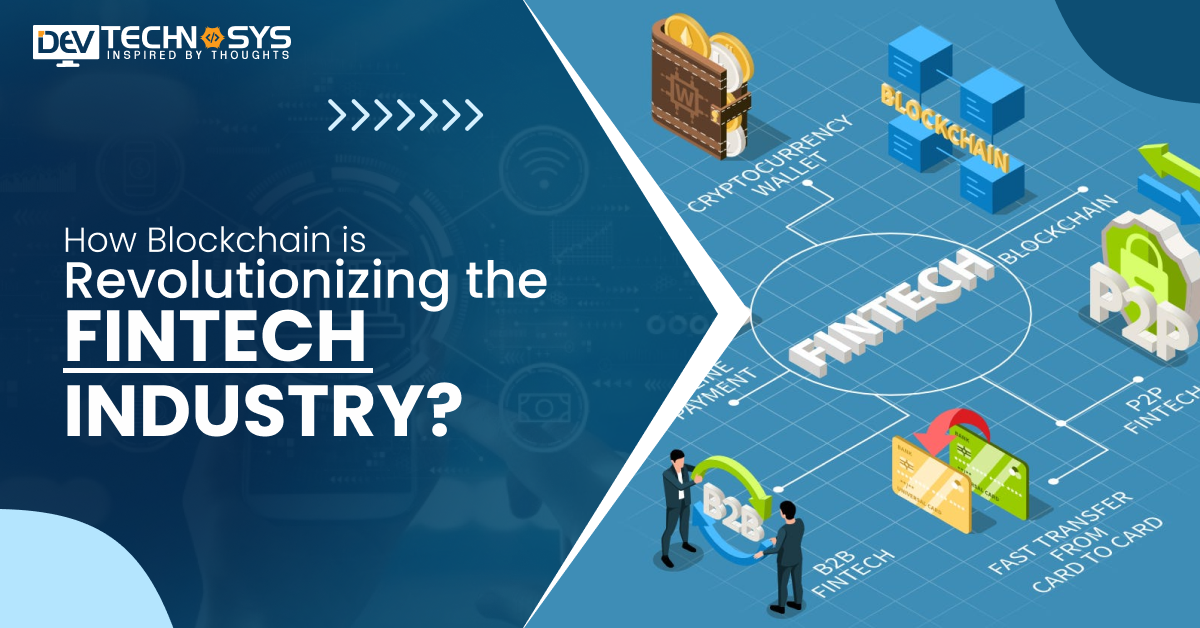
The fintech industry is being transformed by the emergence of blockchain technology, resulting in improved speed, security, and transparency for all types of financial transactions. This includes everything from international money transfers to digital contracts, as well as preventing fraud.
All industries are looking into how blockchain can help them save money, remove middlemen, and increase efficiency.
As per the market research future, the blockchain in the fintech market is valued at around 4.5 USD billion in 2025, and it is expected to grow to around 141.96 USD billion by 2035.
This above clearly indicates how blockchain transforms fintech industry operations and makes them streamlined.
In this blog, we will provide you with an overview of the primary ways in which blockchain can be used within the fintech space, and other related information.
What is Blockchain in Fintech?
In the financial technology industry, blockchain is a decentralized, distributed ledger technology that can securely store records and verify financial transactions. No intermediaries are required as part of this process, allowing for a much more cost-effective and faster transaction. Blockchain can be used to support many different applications within fintech: cross-border payments, smart contracts, fraud prevention, and digital identity verification.
What Is Blockchain? How Does It Work?
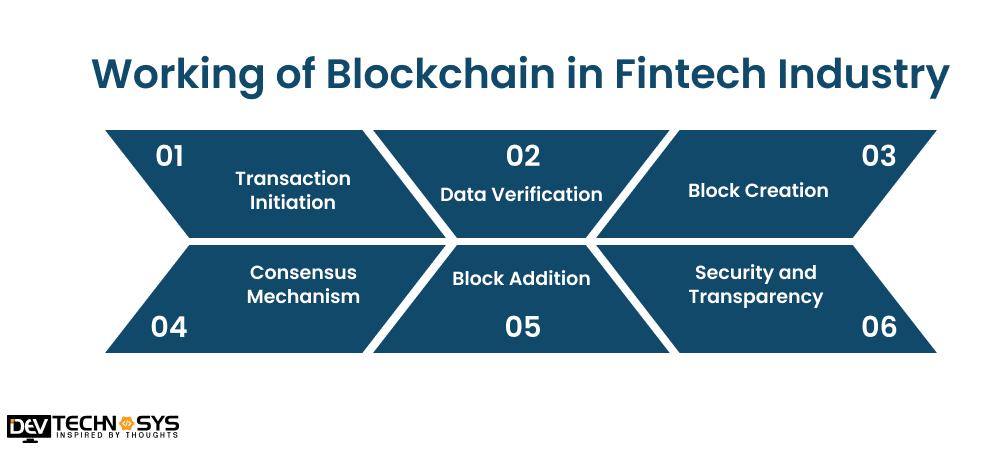
You might have learned what blockchain is in fintech industry. Now, with the following steps, let’s understand how does blockchain for fintech work:
- Transaction Initiation
- Data Verification
- Block Creation
- Consensus Mechanism
- Block Addition
- Security and Transparency
1. Transaction Initiation
First, users initiate a transaction, such as trading assets or sending money. Then, this transaction is digitally signed using the user’s private key to ensure authenticity.
2. Data Verification
Here, the transaction data is broadcast to a computer’s network. These computers verify the authenticity and validity of transactions by checking the user’s digital signature and ensuring there are enough funds.
3. Block Creation
After verifying the transaction, it is added to a new block. This new block contains transaction data a timestamp, and a cryptographic hash of the previous block that creates a secure link.
4. Consensus Mechanism
Now, a consensus mechanism ensures that all the computers agree on the blockchain’s state. For instance, Bitcoin uses proof-of-work, which requires computers to solve complex mathematical puzzles.
5. Block Addition
After reaching consensus, a new block is added to the blockchain that makes it immutable and permanent. This guarantees that the data can be deleted or changed once recorded to maintain the entire blockchain’s integrity.
6. Security and Transparency
The cryptographic security and decentralized nature of blockchain make it resistant to censorship and fraud. Moreover, the public ledger allows anyone to verify transactions to ensure transparency and trust between users and businesses.
How to Integrate Blockchain in Finance?
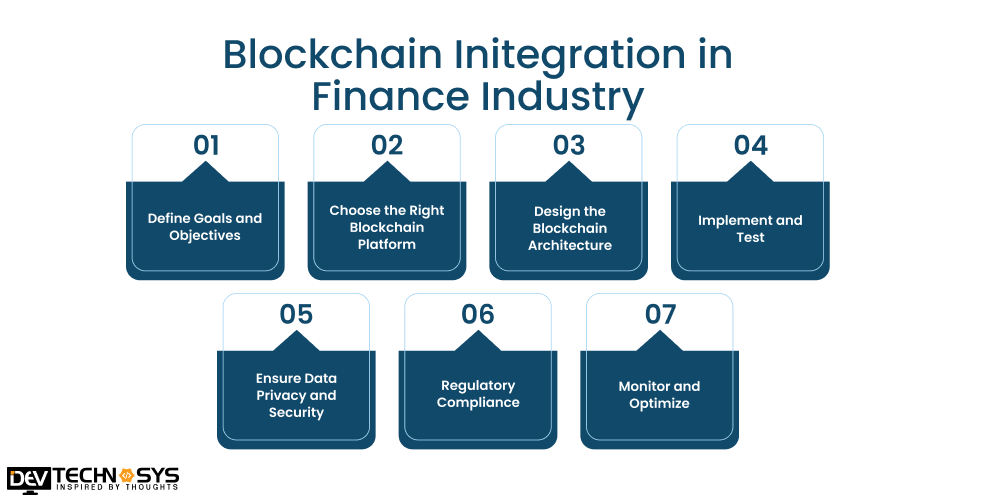
Now that you have learned about the integration of blockchain in fintech industry and how it can benefit a finance business, let’s understand how it can be implemented into finance. Well, it’s a straightforward process to integrate blockchain; however, for a successful integration, it requires to follow some critical steps, mentioned below:
- Define Goals and Objectives
- Choose the Right Blockchain Platform
- Design the Blockchain Architecture
- Implement and Test
- Ensure Data Privacy and Security
- Regulatory Compliance
- Monitor and Optimize
1. Define Goals and Objectives
Before you start the journey of blockchain integration in finance, determine the objectives behind this. What specific goals do you want to attain? Are you expecting to streamline transactions, enhance security, reduce costs, or do something else? A clear understanding of your goals and objectives will help you work accordingly.
2. Choose the Right Blockchain Platform
Choosing the right blockchain platform will likely increase the possibility of success for your finance business. Hire blockchain developers to choose the suitable blockchain platform and consider security, scalability, and compatibility with your existing system. Determine whether a public blockchain, like Ethereum or Bitcoin, is sufficient, or do you need the privacy of a private blockchain?
3. Design the Blockchain Architecture
Now, it’s time to create a detailed architecture outlining how blockchain will interact with your existing finance systems. Consider the type of smart contracts, the data stored on the blockchain system, and the consensus mechanisms governing the entire network. Designing blockchain technology is crucial for success, so pay close attention to this.
4. Implement and Test
Once you have designed your blockchain architecture, you can integrate it with your existing system. However, before this, testing must be conducted to ensure that all glitches and technical issues have been resolved.
Ask the fintech app development company to test the implementation to ensure it is financially well and addresses different vulnerabilities. After this, you can successfully integrate into your finance system to attain all your business goals.
5. Ensure Data Privacy and Security
Only a well-designed blockchain architecture is not enough; you must also ensure that your system guarantees data privacy and security. To this end, you must implement different robust security measures to protect sensitive financial data stored on the blockchain. These measures include encryption techniques, regular audits, and access control.
6. Regulatory Compliance
You are also responsible for complying with regulations and standards governing the use of blockchain technology in fintech industry. This includes KYC (know-your-customer) requirements and adhering to AML (anti-money laundering) laws.
You must adhere to all these laws to avoid penalties and fines. You must also stay up-to-date with the latest regulations and ensure your blockchain implementation complies with relevant standards.
7. Monitor and Optimize
As you know, the blockchain landscape is witnessing constant transformation, so you are advised to be adaptable. You must continuously monitor how your blockchain implementation is performing and identify areas for further improvements so that necessary adjustments can be made.
Take assistance from a blockchain development company to update your blockchain technology based on the new trends.
Pick what you need below — you can select more than one — then tap Get detail to continue.Want a chatbot demo or pricing? Fill the form and talk to our experts today.
Chatbot demo dashboard
Cost to develop an app
Industry report
Case study
What are the Challenges Faced During the Integration of Blockchain in Fintech?
Integrating blockchain in fintech presents challenges like scalability limitations, regulatory uncertainty, security vulnerabilities, complex system integration, and high implementation costs. Despite its transformative potential, businesses must address these barriers with strategic planning, advanced technologies, and compliance-focused approaches.
1. Scalability Problems
Often, much of the blockchain network’s throughput and speed are inadequate since high peak volumes create excessive delays and costs. Thus, this limitation restricts the ability to conduct financial transactions in real-time.
Solution: Utilizing a layer-2 scaling solution, sharding techniques, or hybrid blockchain architectures will help to increase performance. All three methods will improve transaction throughput capacity without compromising the blockchain security in finance or decentralization of the underlying blockchain itself and enable a smoother fintech operation overall.
2. Regulatory Ambiguity
As the regulations that govern fintech businesses around the world are constantly changing and differ greatly from country to country, compliance becomes a considerable challenge for fintech companies utilizing blockchain technology. Ambiguous regulatory environments slow down the rate of adoption of blockchain technology and result in an increased risk of legal liability.
Solution: Fintech companies should have a compliance-first approach and implement KYC and AML processes when interacting with consumers and businesses utilizing blockchain technologies. Also, collaborating with regulatory authorities to create an understanding of how they will ultimately regulate blockchain is mandated through this continuous evolution of the regulatory environment.
3. Security Threats
Blockchain by itself is a secure technology. However, vulnerabilities exist in smart contracts, wallets, and third-party connections that expose all three of these elements to cyberattacks and fraud.
Solution: Regular audits of smart contracts, formal verification processes, and multi-signature wallets should be considered. By increasing encryption protocols, monitoring solutions, and access controls. This will also increase the security of these elements and reduce the likelihood of them being compromised.
4. Complexity of Integration
Institutional financial organizations have a difficult time integrating blockchain technology with their pre-existing systems because of the long period of time for implementation and the expertise needed for the effort.
Solution: Use middleware, APIs, and blockchain service providers to ease the transition. By using a phased approach for the integration process, institutions can better prepare for potential failure, minimize disruption to their current environment, and ensure that communication between their legacy systems and the new blockchain networks is seamless and efficient.
5. Costly Implementation
Fintech firms, in particular those in a startup mode, may find that implementing blockchain technology is quite expensive. Infrastructure, software enhancements, and hiring skilled personnel contribute to the cost of implementing blockchain technology.
Solution: Start with a pilot project to assess feasibility and ROI. Use open source frameworks and cloud-based blockchain service providers to minimize up-front capital expenses, while expanding usage as growth occurs.
5 Ways Blockchain is Impacting the Fintech Industry
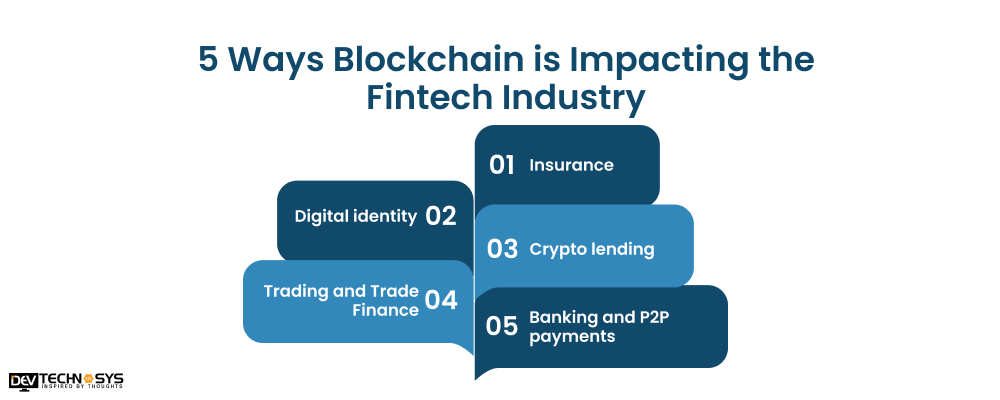
Blockchain technology is changing the financial landscape significantly, offering innovative solutions to overcome long-lasting issues. Specifically, AI in banking industry significantly changes how financial activities are conducted. If you are curious to know how blockchain technology is continuing in the evolving fintech industry, have a look at the following points:
- Insurance
- Digital identity
- Crypto lending
- Trading and Trade Finance
- Banking and P2P payments
1. Insurance
Blockchain’s immutability and transparency have vastly changed insurance. It records all policy information on a distributed ledger to eliminate the need for intermediates, reducing cost and improving efficiency. Moreover, smart contracts in fintech can automate claims processing, reduce fraud, and ensure faster payouts.
2. Digital Identity
Blockchain helps manage digital identity by offering decentralized and secure ways. By investing in blockchain development platforms, businesses can store valuable and sensitive data on their blockchain, allowing control over their records. Hence, this helps prevent identity theft and improves the efficiency of different processes, such as KYC verification.
3. Crypto Lending
Blockchain-based platforms are new avenues for borrowing and lending. Cryptocurrencies can serve as collateral that enables businesses to access loans without traditional credit checks. Hence, this can be specifically beneficial for businesses with limited access to radiation financial services.
4. Trading and Trade Finance
Smart documents can automate trade documents, reducing paperwork and speeding up the settlement process. This is less expensive and facilitates better supply chain visibility through more effective reader operations. Moreover, blockchain in fintech industry also helps reduce financial risk, including fraud.
5. Banking and P2P Payments
Blockchain brings various innovations to the traditional banking industry by enabling cheaper, faster, and more secure transactions. If you develop a banking website or platforms like Ethereum and Bitcoin, businesses can transfer money through intermediaries, reducing transaction fees while improving financial inclusion.
What Are The Advantages of Blockchain in Fintech Industry?
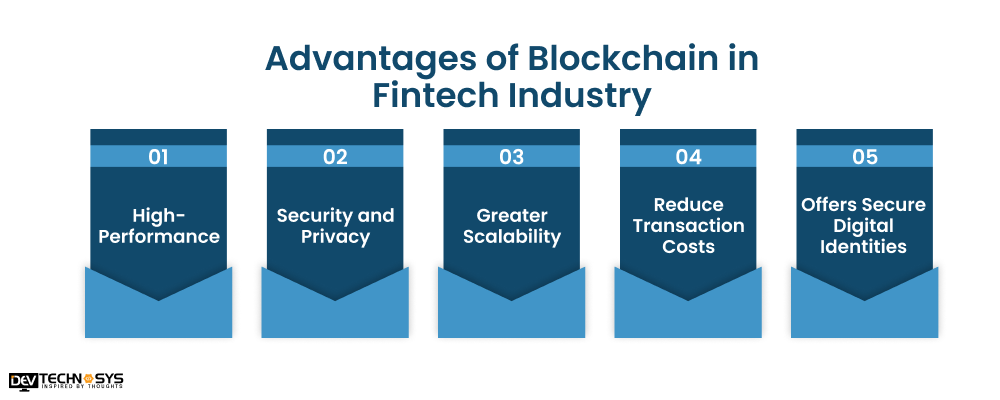
Do you know how digital banking blockchain industry benefits the business? The finance industry has witnessed major growth since the blockchain integration. However, if you want to know in detail, let’s know how the blockchain financing can benefit your business:
- High-Performance
- Security and Privacy
- Greater Scalability
- Reduce Transaction Costs
- Offers Secure Digital Identities
1. High-Performance
Blockchain transactions in finance are processed much faster than the traditional method, ensuring enhanced performance. This is possible because several nodes simultaneously validate and add them to the blockchain network, eliminating the need for intermediaries.
2. Security and Privacy
Using cryptographic techniques, blockchain secures valuable data and finance transactions. All the blocks in the chain are linked to the previous one, making an unchangeable record impossible to tamper with. Hence, blockchain protects sensitive financial data and enhances overall security.
3. Greater Scalability
As you know, there is a growing demand for blockchain financial services. As a result, technology can scale to accommodate the increasing workload. This can be attained through different techniques, such as sharing and dividing the blockchain into smaller segments to improve transaction throughput.
4. Reduce Transaction Costs
If you develop finance app like zogo using blockchain technology, this eliminates intermediaries and streamlines processes, reducing transaction costs. This benefits cross-border payments because traditional methods are time-consuming and involve high fees. If you also want to enjoy such benefits, integrate blockchain into the finance business.
5. Offers Secure Digital Identities
With blockchain-integrated fintech app development services, businesses can create secure digital identities. Other parties can verify and trust these identities to enable more secure and efficient interactions in different financial applications. Hence, these secure digital identities are a major reason for integrating blockchain.

7 Use Cases of Blockchain in Fintech
The use cases are being powered by blockchain in fintech. These use cases have improved the safety, visibility, efficiency, and costs of Financial Services and may dramatically transform the manner in which financial services will function in a digital-first economy.
1. International Payments
A Blockchain-based payment network eliminates the need for financial intermediaries when sending money over international borders, resulting in faster, cheaper, and more transparent international money transfers. Payments can be made in near real-time, and the transaction costs are significantly less than traditional wire transfer methods.
2. Smart Contracts
Smart contracts are computer programs that automatically execute certain conditions when they are met. For example, in the fintech sector, smart contracts can automate various processes such as loan approvals, insurance claims, and settlement of trade transactions by removing the need for manual intervention, reducing errors, and increasing transparency.
3. Preventing Fraud
The immutable and decentralized nature of the blockchain safeguards against fraudulent activity by ensuring that any change to the transaction record cannot be made. Each transaction is validated with a time stamp and transparency, which creates a clear audit trail. As a result, the potential for fraud in digital financial ecosystems has significantly diminished because of less potential for identity theft, double-spending, and unauthorized financial transactions.
4. Digital Identity Verification
Blockchain provides a safe, secure, and tamper-proof method of providing digital identity solutions to users, thereby giving users of blockchain systems control over their identity and allowing users to share their identity data in a secure manner. This feature is particularly advantageous to KYC processes, reducing identity theft, enhancing privacy, and expediting the process of onboarding customers.
5. Trade Financing
With blockchain technology, companies involved in international trade finance can digitize and automate previously paper-based documents such as letters of credit, invoices, and shipping documents. By providing transparency across all parties involved in an export transaction, blockchain reduces paperwork and delays while increasing the speed.
6. Asset Tokenization
Companies can use blockchain technology to create digital tokens representing real-world assets such as real estate, stocks, and commodities. Through fractional ownership, liquidity can be improved, and investment in these types of assets can be made accessible to more people. In addition, the tokenization of assets facilitates trading of equities and other assets.
7. Payment Processing
Blockchain payment systems provide faster, safer, and less expensive transactions than traditional payment methods. By removing intermediaries from the transaction process as well as eliminating all processing fees, blockchain permits the immediate settlement of payment transactions as long as both parties have digital wallets on a blockchain.
5 Popular Blockchain Solutions
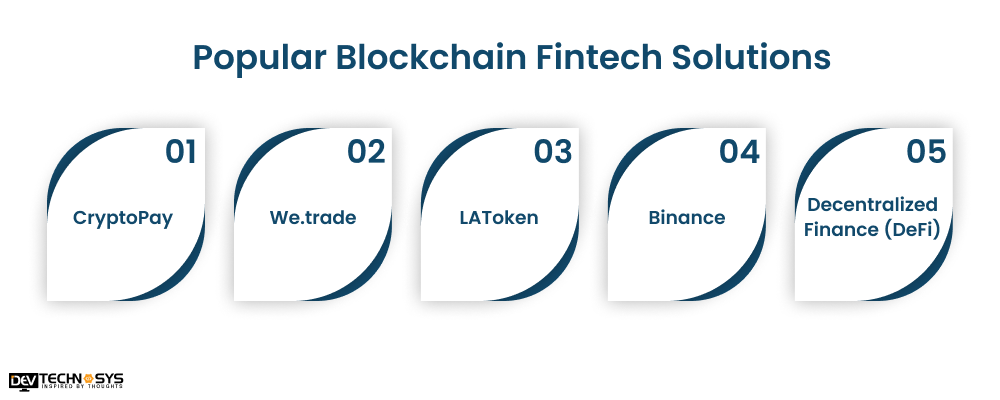
As you know, the world of finance is undergoing a major digital transformation, and blockchain is at the forefront. Hence, these fintech blockchain solutions are changing traditional finance services by facilitating greater security, efficiency, and transparency. If you are curious to know about some of the options, let’s understand them:
- CryptoPay
- trade
- LAToken
- Binance
- Decentralized Finance (DeFi)
1. CryptoPay
What if you could transfer money beyond national borders without heavy fees and long wait times? Well, using cryptocurrencies like Bitcoin CryptoPay ensures cheaper cross-border payments. This eliminates the intermediary’s needs, which saves money and time.
2. We.trade
We.trade streamlines trade finance, a complicated procedure that involves cross-border trade documents and crypto payment gateway. This digitizes the overall process, making it more secure, faster, and accessible for businesses of all sizes.
3. LAToken
This option focuses on security token offerings. LaToken represents ownership in real-world assets like real estate. This blockchain solution facilitates transparent and secure token issuance and trading, opening up new investment opportunities.
4. Binance
It’s one of the largest cryptocurrency exchanges, allowing users to sell, buy, and trade various digital currencies. Binance’s user-friendly platform and focus on innovation make it the first choice for both experienced and novice fintech crypto investors.
5. Decentralized Finance (DeFi)
Blockchain in banking industry disrupts old financial businesses. DeFi option uses blockchain technology to create peer-to-peer financial services that eliminate the bank’s needs. Decnetrizlied finance offers several services like borrowing, lending, and trading, all controlled by smart contracts on the blockchain.

Cost to Integrate Blockchain Into Financial Applications
You must understand that the cost to integrate blockchain into financial apps can differ based on the project’s complexity, development team, features, and others. The following table will help you to know the blockchain app development cost based on their complexity level:
Website Structure |
Estimated Cost |
Time Frame |
|
Simple Website |
$8000 – $15000 | 3 to 6 Months |
|
Medium-Complex Website |
$15000 – $20000 | 6 to 9 Months |
|
High-Complex Website |
$25000+ | 10+ Months |
Future of Blockchain in Fintech Industry
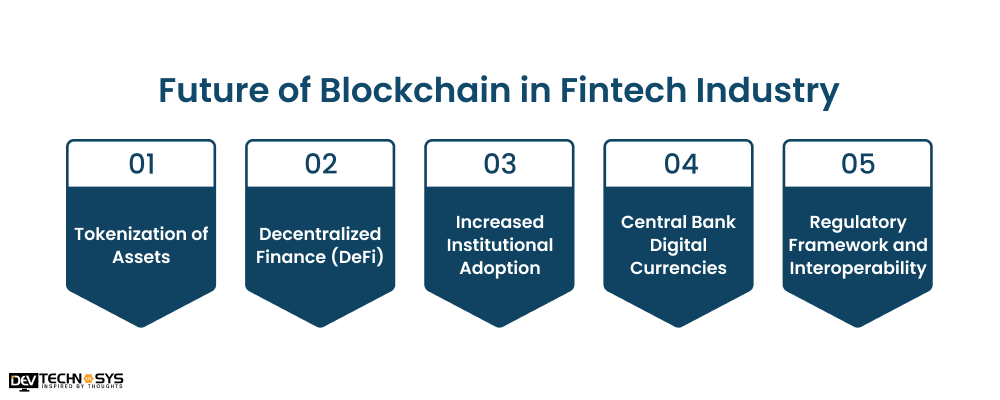
If you are considering blockchain integration into your finance business, you must first predict its future possibilities. If you are aware of it, then it’s good. However, if you are not familiar with this, let’s understand what will be the future of the blockchain financial industry:
- Tokenization of Assets
- Decentralized Finance (DeFi)
- Increased Institutional Adoption
- Central Bank Digital Currencies
- Regulatory Framework and Interoperability
1. Tokenization of Assets
Blockchain in fintech industry enables the tokenizing of different assets, from real estate and commodities to bonds and stock. This tokenization allows for fractional ownership, reduced transaction costs, and increased liquidity. So, you can expect this trend to disrupt old financial markets.
2. Decentralized Finance (DeFi)
Blockchain-integrated DeFi apps have become more popular. These platforms provide decentralized financial services without the need for intermediaries, including borrowing, lending, and trading. Specifically in underserved markets, DeFi has the potential to democratize access to financial services.
3. Increased Institutional Adoption
Financial businesses are rapidly leveraging blockchain. Insurance companies and asset managers are the keys to exploring its potential to streamline processes, enhance security, and reduce costs. For instance, the London Stock Exchange Group has explored blockchain for post-trade settlement.
4. Central Bank Digital Currencies
Various central banks are exploring the development of central bank digital currencies, digital versions of fiat currencies. As per the mobile banking application development company, blockchain, which has benefits including security, transparency, and efficiency, is a viable and promising candidate to power these virtual currencies. CBDCs are changing the way businesses store and exchange value.
5. Regulatory Framework and Interoperability
As new blockchain technology advances, regulatory frameworks dealing with consumer protection, security, and tax compliance are created. Furthermore, attempts are being made to enhance the interoperability of different blockchain networks to facilitate data transfer and smooth transactions. Hence, this will be significant for blockchain to be used in finance.

Conclusion
This blog has determined the impact of blockchain in fintech industry. Blockchain’s ability to improve security, efficiency, and transparency in financial transactions is changing how entrepreneurs do business.
As more financial businesses leverage blockchain technology, you can expect more future advances and changes in the sector. It’s the right time to integrate blockchain into your business, enabling you to stay ahead in today’s competitive market.
If you are also looking for assistance, get assistance from blockchain development services providers like Dev Technosys. Professionals will analyze your business requirements and successfully implement Blockchain into your business, ensuring success in the long run.
Frequently Asked Questions
Find answers to the most common questions related to this article.
Traditional Database
Centralized: A single entity controls the system
Modifiable: It's possible to change the data
Vulnerable: There is a possibility of hacking and data breaches
Blockchain
Decentralized: No single entity can control it
Modifiable” The recorded data cannot be changed
Secure: It’s highly resistant to change the data
On -average, the blockchain based fintech app development cost lies at $8000 to $25000. However, the cost can be changed based on your project’s complexity level, as increased complexity requires more effort and resources.
The time it takes to develop a blockchain-integrated app depends on various factors, such as additional features, the development team, the app's complexity, and the blockchain platform. However, it typically takes 3 to 7 months to complete.
For the financial service industry, the following blockchain platforms are the best based on specific requirements:
Ethereum for decentralized apps and smart contracts
Corda focuses on confidentiality and interoperability
Quorum emphasizing scalability and privacy
Hyperledger Fabric designed for enterprise-grade solutions
You should hire blockchain developers if you are considering blockchain in financial services. Hence, the cost to hire blockchain developers can range between $15 to $25, depending on their experience and your project requirements.