















Key takeaways:
-
- Starting a fintech company in 2026 with scalable technologies and API-driven platforms in global markets is a great opportunity.
- The average cost of fintech product development can range between $8,000 and $30,000. This development is affected by the platform’s complexity.
- With one-time transactional fees, subscription models, automated services, and other models, fintech companies can generate continuous revenue.
- The fintech market worldwide is witnessing a drastic expansion and is expected to reach USD 1,760.18 billion by 2034.
In this highly advanced world, the fintech industry has gone through a drastic transformation. Fintech companies are using the latest technologies to offer financial services to customers. From making payments, lending, banking, to wealth management, everything is digitalized in 2026.
The industry has revolutionized from basic mobile wallets to advanced solutions since 2015. These solutions are powered by artificial intelligence, blockchain, and open banking ecosystems. It enables quick transactions, supreme security, and an outstanding user experience.
By the end of 2026, fintech will become an essential part of the financial infrastructure globally. This leads to the rise of cashless economies, digital-first consumers, and supportive regulations. Therefore, it is the ideal time for an entrepreneur to invest in a fintech startup.
This guide covers important information that helps businesses and financial institutions start a fintech company in 2026.
What is a FinTech Company?
A fintech (Financial Technology) company is a business that utilizes mobile apps, software, cloud computing, and algorithms. The main purpose of these companies is to deliver and optimize financial services digitally.
Financial institutions that opt for fintech app development focus on modernizing traditional banking. They simplify investing, lending, sending or receiving money, and other services. It makes the financial process more accessible for both customers and businesses.
Fintech companies have eliminated the requirement of hectic paperwork, visits to banks in person, and long waiting times. It has transformed the global economy by allowing people to access financial services within a few taps from their smartphones.
Market Overview & FinTech Industry Trends 2026
The rising demand for custom fintech app development is the biggest reason for the expansion of fintech companies. This growth is also influenced by digital transformation and AI adoption. Here, we will understand the expansion of the fintech industry through an analysis by Fortune Business Insight.
- The global FinTech market was valued at USD 394.88 billion in 2025.
- It is projected to reach USD 460.76 billion in 2026 globally.
- By 2034, the fintech market is expected to hit USD 1,760.18 billion.
- The industry is growing at a CAGR of 18.20%, highlighting consistent and high growth momentum.
- North America led the market with a 32.30% share in 2025, dominating global FinTech adoption and innovation.
Major Types of FinTech Companies You Can Launch in 2026-2027
The fintech landscape is so vast and studded with multiple business models. Every model helps in resolving different financial challenges through technology. Be it digital payment or insurance solutions, each fintech category serves unique customer needs. It even creates significant growth opportunities for startups.
1. Payment FinTech
Payment fintech companies are widely popular worldwide as they simplify digital payments. Such companies enable individuals and businesses to send, receive, and process payments securely. With payment apps, people make payments through online platforms and mobile applications.
Subtypes:
- UPI apps
- Digital wallets
- Payment gateways
- Merchant payment solutions
- Contactless payment platforms
- QR code payment systems
- Cross-border payment services
- Peer-to-peer (P2P) payment apps
- Bill payment platforms
- Subscription payment management solutions
2. Lending FinTech
Lending fintech companies help customers and businesses get loans quickly and easily. These companies utilize advanced digital technologies and data-driven assessments. Lending fintech is a great option as it reduces the complexities of traditional banking.
Subtypes:
- Personal loan apps
- Business loan platforms
- Buy Now Pay Later (BNPL) services
- Peer-to-peer lending platforms
- Mortgage lending platforms
- Student loan platforms
- Invoice financing solutions
- Micro-lending applications
- Equipment financing platforms
- Credit line management solutions
3. Banking FinTech
The companies offering digital-first banking services are banking fintech firms. It helps users manage accounts, transfers, savings, and financial activities. These firms terminate the dependency of users on physical bank branches.
Subtypes:
- Digital banks
- Neobanks
- Online banking platforms
- Digital savings account platforms
- Business banking solutions
- Banking-as-a-Service (BaaS) platforms
- Mobile banking apps
- Virtual account management systems
- International banking platforms
- Embedded banking solutions
4. Investment FinTech
Investment fintech companies allow customers to invest, trade, and manage financial assets. They make investing simpler through portfolio management, automated insights, and performance tracking tools. With these firms, users can make informed investment decisions.
Subtypes:
- Stock trading apps
- Mutual fund platforms
- Robo-advisors
- Cryptocurrency investment platforms
- ETF investment platforms
- Fractional investing apps
- Alternative investment platforms
- Social trading platforms
- Algorithmic trading solutions
- Investment research and analytics platforms
5. Insurance FinTech (InsurTech)
InsurTech companies are another popular choice of entrepreneurs as they offer modernized insurance services. Such platforms digitalize policy management, underwriting, and claims processing. Insurance fintech companies also offer customer support through advanced technologies.
Subtypes:
- Online insurance platforms
- Claims management apps
- Health insurance platforms
- Auto insurance applications
- Life insurance platforms
- Usage-based insurance solutions
- Digital underwriting platforms
- Policy comparison websites
- Insurance aggregation platforms
- AI-powered risk assessment systems
6. Wealth Management FinTech
Wealth management fintech companies help businesses and individuals to manage their financial assets. It helps them make planned decisions and grow financial stability. This company offers automated and personalized advisory tools for managing wealth properly.
Subtypes:
- Financial planning tools
- Portfolio management platforms
- Retirement planning applications
- Tax optimization platforms
- Wealth advisory solutions
- Goal-based investment platforms
- Family office management software
- Estate planning platforms
- Personal finance management apps
- AI-powered wealth management solutions
7. RegTech (Regulatory Technology)
RegTech or Regulatory Technology companies are broadly helping financial institutions to comply with regulations. These firms help manage risk and automate compliance, bringing ease to banks. Regulatory technology firms also reduce operational expenses.
Subtypes:
- KYC verification platforms
- AML monitoring solutions
- Fraud detection systems
- Identity verification tools
- Compliance reporting software
- Transaction monitoring platforms
- Risk management solutions
- Regulatory reporting systems
- Data governance platforms
- Audit management tools
8. Blockchain & Crypto FinTech
Blockchain and crypto fintech firms extensively adopted decentralized technologies. These technologies provide users with secure, transparent, and efficient financial services. The services provided by blockchain and crypto fintech companies are beyond traditional banking systems.
Subtypes:
- Cryptocurrency exchanges
- Crypto wallets
- Stablecoin platforms
- Decentralized finance (DeFi) applications
- NFT marketplaces
- Tokenization platforms
- Smart contract solutions
- Crypto payment gateways
- Digital asset custody platforms
- Blockchain remittance services
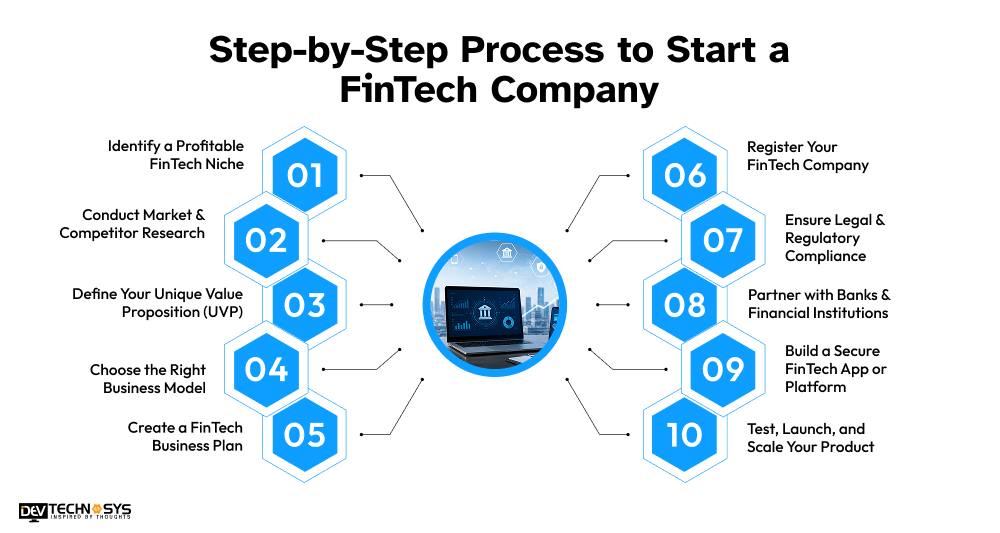
10 Step-by-Step Process to Start a FinTech Company
For a financial technology startup in 2026, a structured approach is required. It is something beyond just a great idea. This development must incorporate market insight, regulatory awareness, and the right technology. Have a look at the stepwise, strategic fintech app architecture to start a fintech company.
Step 1: Identify a Profitable FinTech Niche
The first step is to identify the exact problem customers face, be it related to payments, lending, or digital banking. Then select the niche that targets and solves the real finance-related problems of customers. Analyze the pain points creating issues in the market for users. When the entrepreneur is focused on a single niche, it helps the digital banking infrastructure stand out.
Step 2: Conduct Market & Competitor Research
Have a detailed analysis of the market by understanding the latest industry trends, customer expectations, and competitor strategies. Also, entrepreneurs should examine the top competitor fintech companies along with their unique fintech features, pricing, and weaknesses. After learning these aspects, entrepreneurs can refine their development strategy more skillfully. Entrepreneurs must go for more competitive fintech custom software development services.
Step 3: Define Your Unique Value Proposition (UVP)
The UVP (Unique Value Proposition) of the fintech app describes why people should pick your solution over others. Therefore, entrepreneurs must build a fintech company with uniqueness that makes the app different. The fintech solutions built have to be safer, faster, and more affordable. If the value proposition is clear, it strengthens the brand and improves customer acquisition. It even offers support for long-term business growth.
Step 4: Choose the Right Business Model
Choosing the right financial technology business model that corresponds to the target audience is extremely important. Some models that are common in fintech companies include subscription, transaction fees, and commission-based revenue. If the perfect model is chosen, it guarantees consistent income streams when entrepreneurs develop banking software. As the fintech business grows, these models also support scalability.
Step 5: Create a FinTech Business Plan
If the business plan of entrepreneurs is strong and promising, it can outline the objectives, target audience, and growth. A solid fintech business strategy also includes financial projections and operational plans. It is also important to attract investors, financial projections, market analysis, and operational planning. A fintech business plan is crucial for securing funding, aligning your team, and guiding long-term startup success.
Step 6: Register Your FinTech Company
Registering a fintech firm with the help of a fintech software development company involves:
- Selecting a legal structure
- Securing a business name
- Obtaining tax identification
- Opening a corporate bank account
If the registration is done properly, it ensures legal operations and builds credibility with stakeholders. It even generates a resilient and durable foundation for the business’s expansion in the long run.
Step 7: Ensure Legal & Regulatory Compliance
Fintech compliance and regulations include KYC, AML, and data protection laws to operate legally. It is mandatory for fintech firms to get in compliance with these regulations. It helps in reducing the risks, prevents penalties, and builds customer trust in the application. It is more helpful if entrepreneurs work with legal experts. They allow businesses to maintain smooth and streamlined operations with long-term business growth.

Step 8: Partner with Banks & Financial Institutions
It is time to get into a partnership with banks or financial institutions. They offer access to the core banking systems, payment processing, and financial infrastructure. When a startup collaborates with banks, it also decreases development complexity and enhances service reliability. Collaborating on fintech app development services lets startups deliver secure and scalable financial solutions, without building everything solely.
Step 9: Build a Secure FinTech App or Platform
Now, entrepreneurs can create a secure and scalable fintech or mobile banking app. It is built using the latest technologies and strong encryption protocols. At this stage, the focus should be on user-friendly design, real-time processing, and data protection. A fintech that is well-built enhances performance and guarantees compliance. A fully-functional fintech application delivers a seamless customer experience across devices.
Step 10: Test, Launch, and Scale Your Product
As the money transfer app development is done, it is mandatory to test its security, usability, and performance. It is important to launch a perfect product without any glitches to increase users’ trust. After deployment, marketing strategies should be implemented to reach the targeted audience and to gather their feedback. Continuously optimize features and scale infrastructure to support growth and maintain a competitive edge.
How Long Does It Take to Start a FinTech Company? Full Timeline Explained
Starting a FinTech company typically takes 4 to 7+ months, depending on compliance requirements, product complexity, and funding readiness. The process moves from idea validation to final launch, ensuring a secure and scalable financial product. We will now understand the development timeline intelligently.
| Phase | Timeline | Key Activity | Outcome (Snippet-Friendly) |
| Idea Validation | Month 1 | Research the market, identify the problem, and study competitors | Validated FinTech idea |
| Business Planning | Month 1–2 | Define model, revenue strategy, and compliance approach | Clear startup roadmap |
| Team Setup | Month 2–3 | Hire core team (CTO, product, compliance support) | Ready founding team |
| MVP Development | Month 3–5 | Build app, integrate APIs, design core features | Functional FinTech MVP |
| Compliance Setup | Month 4–6 | KYC/AML setup, legal structure, security planning | Regulation-ready system |
| Testing Phase | Month 5–6 | Beta testing, bug fixing, and user feedback | Stable product version |
| Launch & Funding | Month 6–7+ | Investor pitching, marketing, and product launch | Market-ready FinTech startup |
How to Fund Your FinTech Startup in 2026-2027?
Acquiring funds is the most vital step while starting a fintech firm. Founders must budget for regulatory compliance, cybersecurity, infrastructure, licensing, and customer acquisition. The startup’s stage, growth goals, and capital requirements decide the funding strategy for a fintech company setup. Have a look at the common and widely preferred dancing options implemented by companies starting a fintech.
1. Bootstrapping
Bootstrapping is one of the most common funding strategies. In this, fintech startups either use personal savings, business revenue, or contributions from friends and family. Generally, most founders use this approach during MVP development stages before looking for investment from outside.
Pros:
- Retain complete ownership and control
- No equity dilution
- Greater flexibility in decision-making
- Encourages efficient spending
Cons:
- Limited growth capital
- Higher personal financial risk
- Slower product development
- Difficult to scale rapidly
2. Angel Investors
Individuals with high net worth who offer initial capital while bartering equity are considered Angel investors. These investors typically invest in fintech industry startups with strong founding teams, innovative solutions, and clear market opportunities. Usually, the angel investors search for:
- Experienced founding team
- Regulatory awareness
- Scalable business model
- Large addressable market
- Early customer validation
Pros:
- Faster access to funding
- Industry expertise and mentorship
- Valuable networking opportunities
Cons:
- Equity dilution
- Investor expectations for growth
- Potential influence on strategic decisions
3. Venture Capital (VC)
Venture capital firms primarily invest in startups that show growth potential and scalable business models. Fintech startups usually secure venture financing after gaining product-market fit and validating strong customer growth. Some of the top leading and world-famous FinTech-focused VC firms are:
- Andreessen Horowitz (a16z)
- Ribbit Capital
- Accel
Pros:
- Access to substantial capital
- Strategic guidance from experienced investors
- Increased market credibility
- Faster scaling opportunities
Cons:
- Significant equity dilution
- Aggressive growth expectations
- Reduced founder control
4. Government Grants and Accelerators
Government grants and startup accelerator funds for fintech founders with mentorship, regulatory guidance, and access to industry networks. Grant programs offer a function where startups can secure capital without giving equity. Accelerators help founders in refining busines models, compliance strategies, and connecting with financial institutions. The most popular fintech programs are:
- FinTech Innovation Lab
- Y Combinator
- Visa Everywhere Initiative
Pros:
- Non-dilutive funding opportunities
- Expert mentorship
- Investor and partnership access
- Enhanced startup credibility
Cons:
- Competitive application processes
- Limited funding amounts
- Strict eligibility requirements
5. Revenue-Based Financing
Revenue-based financing is a new funding approach that provides capital to startups and is repaid from future monthly revenue. In this model, founders do not give up on their ownership stake. Sometimes, repayment increases or decreases according to monthly business performance. This is a flexible option for growing FinTech startups.
Pros:
- No equity dilution
- Retain business control
- Flexible repayments based on revenue
- Faster funding approval
Cons:
- Requires predictable revenue streams
- Can impact monthly cash flow
- Not suitable for pre-revenue startups
Industry Insight: At Dev Technosys, we have helped more than 40 fintech startups. We have examined that businesses should evaluate funding options as per their ownership goals, growth plans, and regulatory requirements.
Planning a Mobile App?
Get a tailored development cost estimate in 3 simple steps — app basics, features, timeline, and your contact details.
- 3 quick steps
- 100% free
- Reply in 1 business day
2 Minutes Read
FinTech Compliance and Regulations: What You Need in 2026-2027
Developing a fintech product is not merely about designing, features, and technology. Businesses also focus on following the right regulations properly. Compliance is important because fintech companies have to deal with money, personal data, payments, and lending. For startups, ignoring compliance can lead to heavy fines, blocked operations, or even shutdowns. Here we are discussing the country-wise compliance and regulations needed in 2026-2027.
1. 🇺🇸 United States Compliance Requirements
The USA is well-known for its highly regulated FinTech environment. However, the rules often differ from state to state, due to which scaling is more complex.
Key Requirements:
- Money Transmitter License (MTL): Needed if your app moves or stores money between users
- FinCEN Registration: Required for anti-money laundering (AML) monitoring and reporting
- State-Level Rules: Each state may have different licensing requirements, making expansion slower
- CFPB Oversight: Protects users in lending and financial services from unfair practices
Simple Insight:
In the US, FinTech startups must plan early for licensing because compliance changes from state to state.
2. 🇬🇧 UK & Europe Compliance Requirements
The main concentration of the UK and Europe remains generally on transparency, user protection, and data privacy.
Key Requirements:
- FCA Authorization: Required to legally offer financial services like payments or e-wallets
- PSD2 Regulation: Supports secure payments and allows safe third-party integrations
- GDPR Compliance: Protects user data and ensures privacy across digital platforms
Simple Insight:
In Europe, user data protection and licensing are just as important as the product itself.
3. 🇦🇪 UAE & Middle East Compliance Requirements
The UAE and Middle East are becoming fast-growing FinTech hubs with structured financial zones.
Key Requirements:
- CBUAE License: Required for payment and financial service providers
- ADGM & DIFC Frameworks: Special financial zones designed to support FinTech startups
- VARA Regulation: Governs crypto and blockchain-based financial services in Dubai
Simple Insight:
The region is startup-friendly, but financial licenses are still mandatory depending on your business model.
4. 🇮🇳 India Compliance Requirements
India’s FinTech market is growing rapidly, but it is tightly regulated by the Reserve Bank of India.
Key Requirements:
- RBI NBFC License: Required for lending and credit-based platforms
- PPI License: Needed for digital wallets and prepaid payment services
- UPI Integration: Essential for enabling fast and secure payments
Simple Insight:
In India, payment and lending apps must strictly follow RBI guidelines before launch.
5. Universal FinTech Compliance (Applies Everywhere)
No matter where you build your FinTech product, some rules always stay the same.
Key Tools & Standards:
- KYC Tools: Onfido, Jumio, Persona (for verifying user identity)
- AML Tools: ComplyAdvantage, Sardine (for fraud and risk detection)
- PCI DSS Compliance: Ensures safe handling of card and payment data
Simple Insight:
Every FinTech startup should build trust first—security and compliance cannot be added later.
Technologies Required to Start a Fintech Company: A Tech Stack Guide
Starting a fintech company in 2026 demands a secure, scalable, and high-performance tech stack. Each technology used in the development is really necessary to deliver financial services effortlessly. Here is a simplified breakdown of the fintech technology stack 2026 required to build a modern FinTech platform.
| Component | Best Technologies (2026) | Why It Matters in FinTech |
| Frontend (User Interface) | React.js, Vue.js | Creates fast, responsive, and user-friendly financial dashboards and apps |
| Mobile Apps | Flutter, React Native | Enables cost-effective cross-platform mobile banking app development |
| Backend (Server Logic) | Node.js, Django, Spring Boot | Manages transactions, APIs, and core business logic securely |
| Database | PostgreSQL, MongoDB | Stores sensitive financial data with high reliability and performance |
| Cloud Infrastructure | AWS, Azure, Google Cloud | Ensures scalability, uptime, and cloud-native FinTech operations |
| Payment Systems | Stripe, PayPal, Razorpay | Powers secure digital transactions and global payment processing |
| Security Layer | SSL/TLS, AES Encryption, OAuth 2.0 | Protects user data and ensures compliance with FinTech regulations |
| AI & Automation | TensorFlow, AI APIs | Enables fraud detection, personalization, and smart financial insights |
| Blockchain (Optional) | Ethereum, Hyperledger | Supports decentralized finance and transparent transactions |
| APIs & Integrations | Plaid, Yodlee | Connects with banks and financial services for real-time data access |
How Much Does it Cost to Start a Fintech Company?
The cost to develop a mobile app for a fintech startup is estimated at $8,000 to $30,000. The final development expenses are determined by the complexity, regulatory requirements, and development approach of the company.
- A basic fintech architecture follows an MVP development strategy, which gets developed between $30,000 and $70,000.
- A mid-level fintech startup business plan integrates basic and advanced development. It leads to a cost ranging from $70,000 to $1,10,000.
- A fully advanced fintech app development has higher complexity, which can make a fintech company cost between $1,10,000-$1,50,000+.
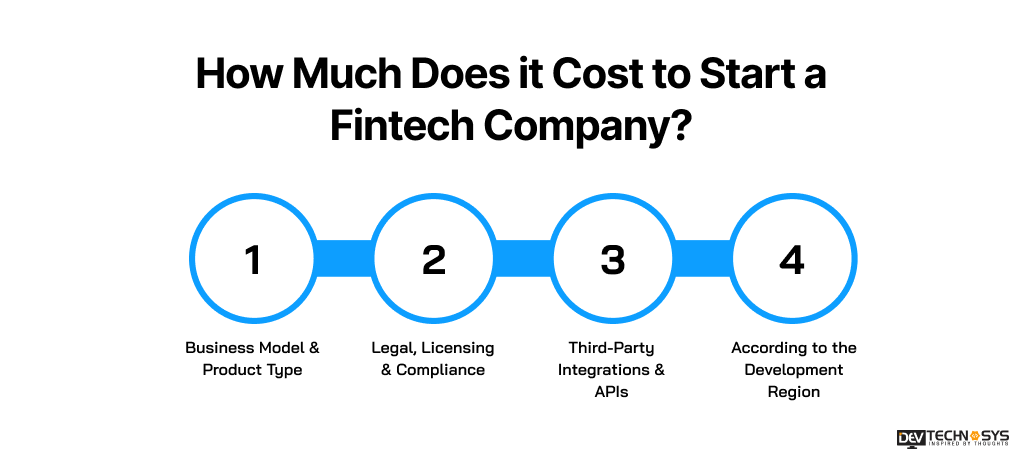
However, there are multiple factors that affect the fintech app development cost for financial companies. These factors include cost by region, product type, regulations & compliance, third-party APIs, and more. We will discuss some of these factors impacting the fintech company’s development cost.
1. Business Model & Product Type
Whether your fintech business model is a neobank, payment app, or lending platform, it directly affects the starting cost. Usually, the complex platform with advanced integrations like AI, blockchain, etc., can increase the overall cost of the best fintech apps. Although simpler solutions require a lower initial investment.
| FinTech Type | Cost Range | Complexity Level | Overview Insight |
| Payment FinTech | $10,000–$20,000 | Medium | Includes wallets, UPI apps, and payment gateways |
| Lending FinTech | $15,000–$28,000 | Medium–High | Loan processing, credit scoring, and BNPL systems |
| Banking FinTech | $20,000–$35,000 | High | Digital banking, accounts, and transaction systems |
| Investment FinTech | $25,000–$40,000 | Very High | Trading platforms, robo-advisors, real-time analytics |
| Insurance FinTech (InsurTech) | $18,000–$32,000 | High | Policy management, claims processing, risk evaluation |
| Wealth Management FinTech | $22,000–$38,000 | High | Portfolio tracking, financial planning, advisory tools |
| RegTech (Compliance Tech) | $15,000–$30,000 | High | KYC, AML, fraud detection, regulatory reporting |
| Blockchain & Crypto FinTech | $25,000–$40,000 | Very High | Crypto wallets, exchanges, DeFi, token systems |
2. Legal, Licensing & Compliance
Fintech startups should follow strict regulations such as KYC, AML, and data privacy laws. The legal processes and licensing fees are different according to regions. Starting a fintech company in Nigeria involves different regulatory costs compared to the US or Europe. It impacts the total development budget.
| Compliance Area | Cost Range | Requirement Level | Overview Insight |
| Basic Business Registration | $5,000–$8,000 | Low | Startup legal setup and documentation |
| KYC/AML Compliance Setup | $8,000–$15,000 | Medium | Mandatory for financial identity verification |
| Financial Licensing Support | $10,000–$20,000 | High | Required for regulated FinTech operations |
| Data Protection & GDPR Setup | $6,000–$12,000 | Medium | Ensures user data security and compliance |
3. Third-Party Integrations & APIs
Third-party tools like payment gateways, banking APIs, etc., are essential to offer real-time services to users. These integrations are important for better functionality, security, and user experience. But it can lead to an increased fintech company development budget. To streamline them, startups rely on mobile application development services.
| Integration Type | Cost Range | Complexity Level | Overview Insight |
| Payment Gateway APIs | $4,000–$8,000 | Medium | Enables secure online transactions |
| Banking APIs | $6,000–$10,000 | High | Connects with financial institutions |
| KYC Verification APIs | $3,000–$7,000 | Medium | Automates identity verification |
| Fraud Detection Tools | $5,000–$12,000 | High | Prevents financial fraud and risk |
4. According to the Development Region
Development costs vary depending on the team’s location. Hiring developers in North America, Western Europe, and Australia is more expensive. Many startups hire dedicated developers from cost-effective regions like Asia, Eastern Europe, and Latin America. It helps reduce the cost of starting a fintech company while maintaining quality and scalability.
| Region | Cost Range | Development Speed | Overview Insight |
| North America | $18,000–$23,000 | Fast | High-cost but premium expertise |
| Western Europe | $15,000–$20,000 | Fast | Strong compliance and quality focus |
| Eastern Europe | $12,000–$18,000 | Moderate | Balanced cost and skilled developers |
| Asia (India, SEA) | $10,000–$15,000 | High | Cost-effective with scalable talent |
Who Do You Need to Hire to Start a FinTech Company?
After a major question about how to start a fintech company, another question appears: who to hire to begin a fintech firm? After all, developing a successful fintech company is something beyond a great idea. Therefore, businesses need a highly specialized and capable team that manages financial operations. While starting a fintech company, here is who businesses need to hire.
1. Co-Founder with Finance or Compliance Expertise
In 2026-2027, many fintech startups fail because they fail and underestimate regulatory complexities. This is why having a co-founder who has experience in banking, finance, risk management, or compliance is necessary. A partner helps navigate licensing requirements, regulatory frameworks, and partnerships with financial institutions.
2. CTO or Lead Developer
Then the fintech companies usually search for a strong technical leader to develop secure and scalable platforms. Startups need highly proficient CTOs and lead developers, as fintech app development is different from other applications. So, look for professionals with experience in:
- Banking APIs
- Payment systems
- Cybersecurity
- Cloud architecture
- FinTech product development
3. Compliance Officer or Legal Counsel
Maintaining regulatory compliance is not an option in fintech but a necessity that can’t be ignored at any cost. Therefore, hiring a dedicated compliance expert helps ensure adherence to:
- KYC
- AML
- Data privacy regulations
- Consumer protection laws
- Financial reporting obligations
For fintech startups, it is a strategic move that helps in preventing legal penalties and operational disruptions later.
4. Product Manager
Fintech products need to be skillfully balanced between user experience, trust, security, and compliance. Qualified product managers identify what users want and struggle with, and convert those into features. Also, they guarantee regulatory requirements that remain integrated into the product roadmap. A product manager plays a vital role when the platform grows, and user expectations evolve.
5. Security Engineer
The financial sector not only keeps crucial user information but also maintains their financial data. It leads to increased cybersecurity threats, which demand a dedicated security engineer. Security developers help with:
- Protecting customer data
- Monitoring vulnerabilities
- Implementing encryption standards
- Conducting security audits
- Establishing incident response procedures
For FinTech startups, security is both a competitive advantage and a compliance requirement.
Look at the Hiring Roadmap for FinTech Startups
| Startup Stage | Key Hire | When to Hire |
| Idea Validation | Finance/Compliance Co-Founder | Before business registration and regulatory planning begin |
| Product Planning | CTO / Lead Developer | Before starting MVP architecture and technology selection |
| MVP Development | Product Manager | When product requirements, user flows, and feature prioritization are being defined |
| Pre-Launch | Compliance Officer | Before handling customer data, payments, or financial transactions |
| Public Launch | Legal Counsel | Before finalizing contracts, terms of service, and regulatory documentation |
| Early Growth | Security Engineer | As user adoption increases and sensitive financial data volume grows |
| Scaling Stage | Data Analyst / Growth Specialist | When optimizing customer acquisition, retention, and revenue growth |
| Expansion Stage | Operations Manager | When expanding into new markets, products, or customer segments |
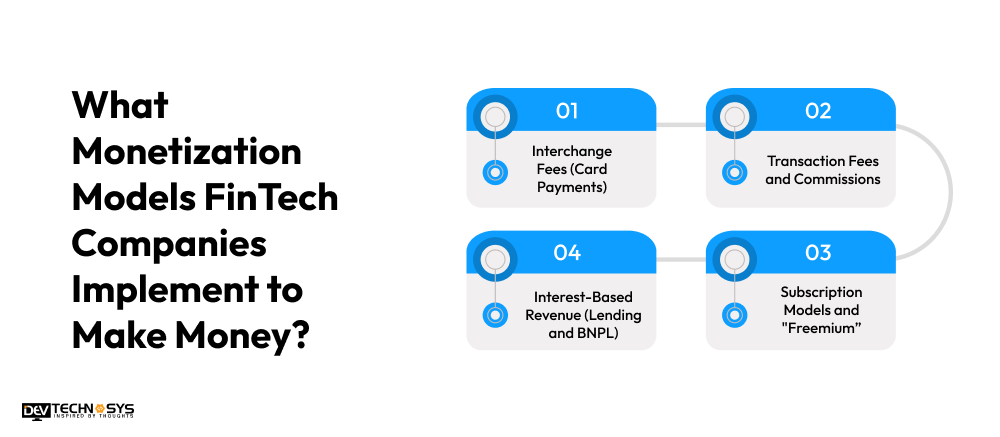
What Monetization Models FinTech Companies Implement to Make Money?
High-volume transactions, recurring subscriptions, and interest-based lending are some of the most common money-making models used by fintech companies. These models help companies drive profitability. We will discuss some of these fintech revenue models in detail.
1. Interchange Fees (Card Payments)
Interchange fees are one of the widely used revenue models for fintech hybrid app development services. It is earned when users make payments through debit and credit cards. This small percentage from each transaction makes a scalable and passive revenue stream.
2. Transaction Fees and Commissions
A fintech company can make great revenues by charging a small transaction fee or commission. It is charged on every successful payment, transfer, or financial service. This model is the most common among payment apps and trading platforms.
3. Interest-Based Revenue (Lending and BNPL)
Lending and BNPL platforms generate revenue by charging interest on loans or installment payments. Many fintech software development companies in USA suggest this model to multiple fintech firms. It is ideal to earn returns based on repayment terms and interest rates.
4. Subscription Models and “Freemium”
Another essential fintech monetization model is the subscription or freemium model. With this model, fintech apps offer basic services for free while charging users for premium services. It attracts a large user base and gradually converts free users into paying customers.
4 Potential Challenges Faced While Starting a Core Banking Platform
While starting a whole new core banking platform, every payment app development company faces some difficulties. These hurdles can be related to technology, regulatory requirements, and operational processes. In this section, we will understand the most crucial challenges that should be addressed properly to avoid further disruptions.
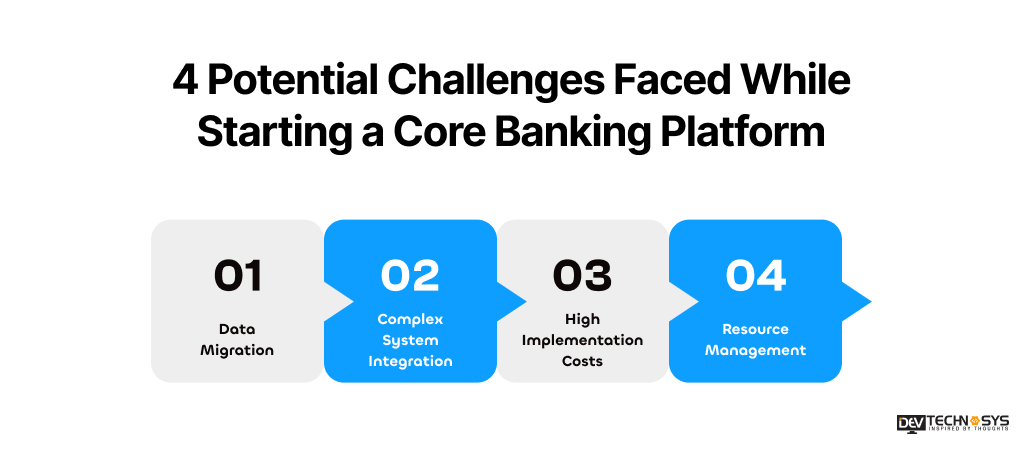
1. Data Migration
The complexity increases while migrating large financial data from a legacy banking system to a new platform. That’s why data accuracy, consistency, and security are really important. It helps in preventing errors, financial risks, and potential compliance issues.
Solution: To avoid this scenario, use automated migration tools, phased data transfers, and validate data via parallel systems.
2. Complex System Integration
Incorporating core banking platforms with pre-built systems like APIs, financial tools, and payment gateway integration is challenging. A perfect payment gateway software development ensures smooth data flow, real-time transactions, and consistent performance.
Solution: Implement API-first architecture, use middleware solutions, and conduct integration testing.
3. High Implementation Costs
Developing and deploying a core banking platform requires significant investment in technology, infrastructure, and skilled professionals. High implementation costs can impact budgets, making it essential for businesses to plan finances carefully.
Solution: Start with an MVP approach, prioritize essential features, and leverage cloud-based infrastructure.
4. Resource Management
When businesses develop a fintech app like Wise, the next major obstacle is resource management. It involves managing skilled developers, IT infrastructure, and operational resources properly. It helps enterprises maintain productivity and performance.
Solution: Hire skilled professionals, use agile project management, and outsource when needed.
3 Top FinTech Startup Examples: Real Case Studies & Insights
Arc, Qonto, Airbase, Expensify, and Meow are the top fintech startups that have gained the utmost popularity in 2026. These startups highlight key trends like digital banking, expense automation, alternative financing, and crypto-based financial services. Now, we will:
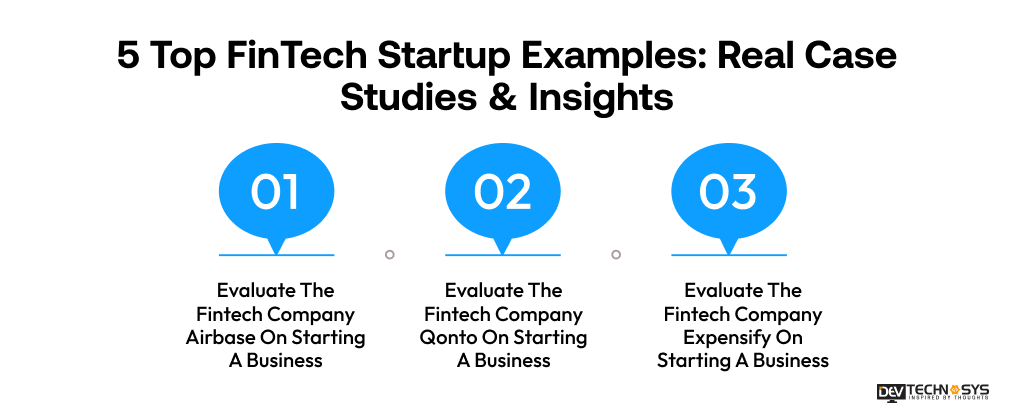
1. Evaluate The Fintech Company Airbase On Starting A Business
A modern fintech platform startup, “Airbase,” mainly focuses on financing and cash management. It is used by multiple fintech firms to manage cash flow efficiently without equity dilution. Airbase also provides revenue-based financing and capital optimization tools.
2. Evaluate The Fintech Company Qonto On Starting A Business
Qonto, a European neobanking software, is especially built for small enterprises and freelancers. It simplifies financial operations by offering seamless digital banking, expense management, and team collaboration tools. It is leading SME-focused banking solutions due to strong compliance.
3. Evaluate The Fintech Company Expensify On Starting A Business
Expensify is a well-known FinTech company specializing in expense management and receipt tracking. It automates reporting, reimbursements, and approvals using AI-powered tools. Expansify also helps businesses streamline accounting processes and reduce manual work.
Case Study: eToro – Social Trading & Investment Platform
The proficient and efficient developers at Dev Technosys have built a social trading and investment platform, eToro. The platform is developed to allow users to trade stocks, crypto, and ETFs while copying expert traders. Features like real-time trading, secure payments, and portfolio management are included in this project.
Challenge Faced: The main challenge was improving UI simplicity, enhancing app speed under peak load, and strengthening social feature integration. It also includes making onboarding smoother for new users while maintaining engagement.
- Project Name: eToro-Inspired Trading Platform
- About Client: Gary Chen
- Industry: Investment / FinTech
- Client Location: Canada
- Development Timeline: 34 weeks
- Team Size: 6 Developers
- Platform Type: Social Trading Application
Conclusion
Starting a fintech company in 2026 is a great option to enter this digitally advancing ecosystem. But making it successful demands so much more than just building. It requires the right niche, regulatory compliance, a scalable technology stack, and a strong business model.
From a fintech company to real-world examples, every piece of information plays a vital role in long-term sustainability. We have provided a structured approach that focuses on innovation, security, and user experience.
So, with an ideal strategy and company offering on-demand app development solutions, fintech startups can scale.
Frequently Asked Questions
Find answers to the most common questions related to this article.
The overall cost to start a fintech company can be somewhere between $8,000 and $30,000. The final cost is affected by the complexity, regulatory compliance, and development strategy. However, there are some factors that are also influencing the budget. These factors include:
Business Model & Product Type
Legal, Licensing & Compliance
Third-Party Integrations & APIs
According to the Development Region
Yes, fintech is surely a profitable option to invest in 2026. The fintech industry has transformed from "growth-at-all-costs" to a mature market. The main focus of these startups remains on unit economics. In 2026, a large number of scaled fintech startups are sustaining themselves. They are generating continuous cash flows and gaining generous profits as compared to traditional systems.
Whether you need a license solely depends on the services you provide through your fintech startup. If your app operates regulated activities like holding client funds, lending, issuing e-money, or executing payments, you need a proper license. Whereas if you are building a platform that does not handle money-related operations, a standard license is enough.
The potential challenges or risks that are majorly involved in starting a fintech company involve:
Data Migration
Complex System Integration
High Implementation Costs
Resource Management
To start a fintech company in Nigeria and other regions, entrepreneurs have to follow some steps. These steps are:
Identify a Profitable FinTech Niche
Conduct Market & Competitor Research
Define Your Unique Value Proposition (UVP)
Choose the Right Business Model
Create a FinTech Business Plan
Register Your FinTech Company
Ensure Legal & Regulatory Compliance
Partner with Banks & Financial Institutions
Build a Secure FinTech App or Platform
Test, Launch, and Scale Your Product
Usually, it takes 4 to 7+ months to start a fintech company in 2026-2027. The development timeline varies according to the product's complexity, compliance requirements, and team readiness. Startups handling payments, lending, or banking may take longer due to strict licensing and security requirements.
Yes, it is possible to start a fintech company with no technical background in 2026-2027. The entrepreneurs have to partner with a technical co-founder or hire an experienced development team. However, founders must have a great understanding of compliance, product flow, and customer needs.
Fintech startups get their first customer through promotional activities. These include digital marketing, referral programs, beta launches, and niche community outreach. Many founders opt for partnerships with businesses or influencers to build trust among the audience. Businesses can ensure that marketing is key to initial customer acquisition and retention.
FinTech startups often fail due to weak regulatory compliance, poor product-market fit, lack of funding, and inadequate security systems. Other common issues include high customer acquisition costs and complex user onboarding. Since FinTech involves sensitive financial data, even small compliance or trust issues can lead to failure.
You can find FinTech investors through angel networks, venture capital firms, startup accelerators, and fintech-focused events. Platforms like LinkedIn and pitch competitions also help connect with investors. Building a strong MVP, demonstrating traction, and showcasing regulatory readiness significantly improve your chances of securing funding.