















Key takeaways:
-
- Artificial intelligence is among the important fintech app trends that are becoming the backbone of modern fintech, powering automation, fraud detection, financial co-pilots, and personalized banking experiences.
- Embedded finance and banking as a service (BaaS) are integrating financial services directly into non-financial digital platforms.
- Real-time payments and stablecoin payment rails are enabling faster, low-cost, and borderless financial transactions.
- Emerging trends in fintech, like open finance ecosystems, are improving secure financial data sharing and creating highly personalized financial services.
The way people in the financial industry handle their money is changing because of new technologies, automation, and customer-first approaches. Digital payments and mobile banking aren’t the only things that make up fintech anymore. In 2026, AI, blockchain, integrated finance, decentralized platforms, and highly personalized services will also make up fintech.
Businesses and banks are quickly putting the latest trends in fintech industry to use to stay safe, improve the customer experience, make things run more easily, and keep up with new rules from the government.
World economies are changing at a speed that has never been seen before, thanks to FinTech trends. Among these trends are AI-powered banking helpers, real-time payments across borders, and long-term financial solutions. As the competition heats up, companies that keep up with these new fintech industry trends 2026 will be far ahead in the world of digital banking, which changes very quickly.
Top 15 Fintech Trends Defining the Industry’s Future in 2026
AI, automation, and next-generation digital payment systems are speeding up the changes in the FinTech business. These Trends are changing how money moves around the world. These are the 15 most important fintech trends 2026 that are making the financial world faster, smarter, and more connected.
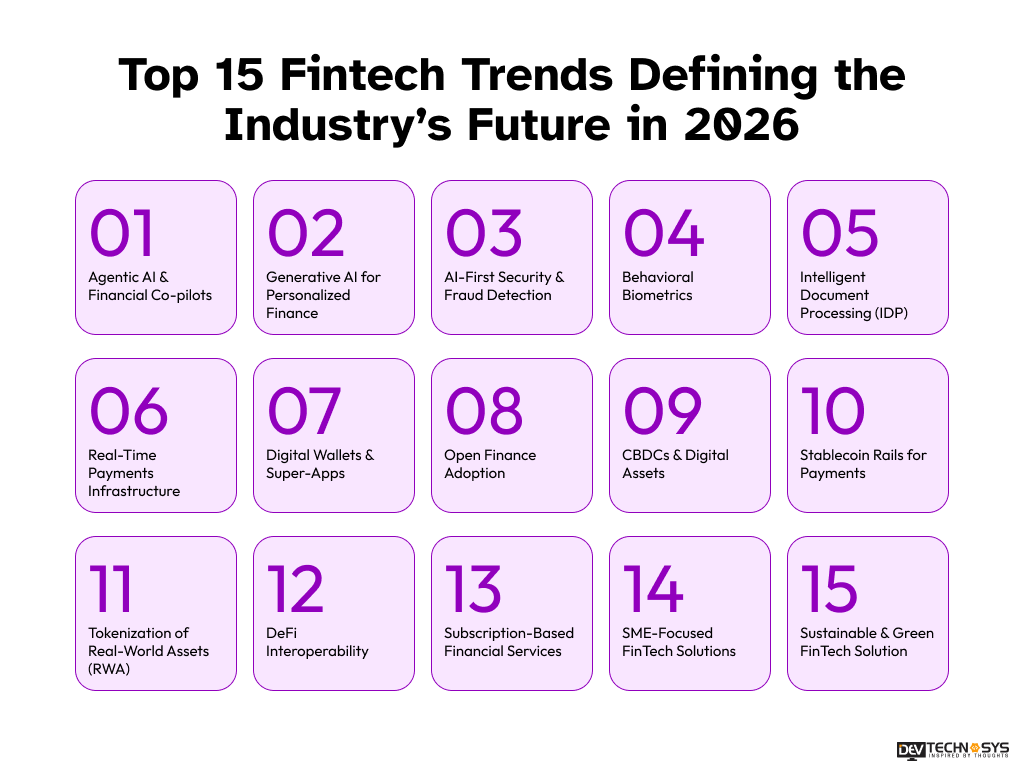
| FinTech Trend | Key Technology | Industry Impact |
| Agentic AI & Financial Co-pilots | AI & Machine Learning | Smarter banking and operations |
| Generative AI for Personalized Finance | Generative AI & LLMs | Better customer experiences |
| AI-First Security & Fraud Detection | AI & Predictive Analytics | Stronger cybersecurity |
| Behavioral Biometrics | Behavioral AI | Improved digital security |
| Intelligent Document Processing (IDP) | OCR & NLP | Faster workflows and compliance |
| Real-Time Payments Infrastructure | RTP Networks & APIs | Faster transactions |
| Digital Wallets & Super-Apps | Mobile & Cloud Technology | Seamless digital finance |
| Open Finance Adoption | Open APIs | Connected financial ecosystems |
| CBDCs & Digital Assets | Blockchain Technology | Modernized payment systems |
| Stablecoin Rails for Payments | Stablecoins & Smart Contracts | Low-cost global transfers |
| Tokenization of Real-World Assets (RWA) | Blockchain & Tokenization | Increased investment access |
| DeFi Interoperability | Cross-Chain Protocols | Better scalability and liquidity |
| Subscription-Based Financial Services | SaaS & Cloud Platforms | Stronger customer retention |
| SME-Focused FinTech Solutions | Cloud & AI Solutions | Improved business efficiency |
| Sustainable & Green FinTech Solutions | AI & Green Analytics | Eco-friendly financial growth |
1. Agentic AI & Financial Co-pilots
Agentic AI is one of the top FinTech Trends, and predictions are that by 2030, the market for it is expected to be worth more than $50 billion in the banking industry. As of 2026, 52% of people in the financial business who answered are actively using agentic AI. A passive AI tool gathers information, but an agentic AI handles complicated workflows with many steps.
With little supervision, these systems can make trades, run portfolios, and do compliance work. Agentic AI and financial co-pilots will be very important in making financial services smarter, faster, and more focused on customers around the world as financial environments become more digital.
Key Benefits of Agentic AI in FinTech:
- Hyper-personalized financial recommendations
- Automated customer service and virtual banking assistants
- Risk Management by Real-time fraud detection
- Faster loan approvals and underwriting
- Intelligent portfolio and wealth management
- Improved operational efficiency and cost reduction
- Enhanced regulatory compliance automation
2. Generative AI for Personalized Finance
As one of the top financial technology trends, Generative AI (GenAI) is quickly changing personalized finance by offering highly customized, natural, and proactive finance management that goes beyond standard fintech tools that are based on rules. GenAI analyzes the person’s spending patterns, past transactions, and current risk level to come up with the best financial plans and tips personalized for them.
Conversational AI Financial Advisors: Advanced AI assistants that look and act like people (like tools driven by ChatGPT) are taking the place of simple chatbots. They are available 24 hours a day, seven days a week, to answer questions about money and help with hard jobs like budgeting and making investment plans.
Key Applications of Generative AI in FinTech:
- Personal finance assistants driven by AI
- personalized suggestions for planning and savings
- Smart investing and robo-advisory services
- Automated credit and loan checks
- Using AI to find scams and improve security
- Smart customer support chatbots
- Automated financial reporting and analytics
3. AI-First Security & Fraud Detection
AI-first security and fraud detection has become a “strategic imperative” in fintech. Shifting from a passive, rule-based approach to an active, real-time defense against cyber threats. Utilizing AI to detect any fraudulent activity also improves customer authentication.
The AI-first security and AI fraud detection involves biometric verification technologies (voice recognition, fingerprint scanning, facial recognition, and behavioral biometrics). Additionally, FinTech businesses are combining predictive analytics and real-time monitoring tools to cut down on false positives, speed up threat reaction, and make sure they follow all regulations.
Key Benefits of AI-First Security in FinTech:
- Real-time fraud detection and prevention
- Advanced biometric authentication finance systems
- Reduced false positives in transaction monitoring
- Faster threat analysis and response
- Enhanced customer trust and data protection
- Automated anti-money laundering (AML) compliance
4. Behavioral Biometrics
Behavioral biometrics has become an important trend in fintech. It has gone from being a niche security tool to a standard for constant, passive authentication in banking, e-commerce, and stopping fraud. Keystroke dynamics, mouse/pointer movement, device interaction, and navigational patterns are some of the most important behavioral biometrics aspects.
Behavioral biometrics is an extra layer of defense against online threats and financial fraud because each person’s behavior patterns are very unique and hard to copy. Fintech emerging trends like this also make frictionless authentication possible, which lets people safely access banking services without having to log in and out of their accounts more than once.
Key Benefits of Behavioral Biometrics in FinTech:
- Real-time identification of users all the time
- Better ways to find and stop fraud
- Less chance of an account takeover
- Simple protection that doesn’t require a password
- Better trust and customer experience
- AI-driven discovery of anomalies and risks
5. Real-Time Payments Infrastructure
Real-time payments (RTP) infrastructure is one of the major fintech industry trends that are changing finance by letting money move instantly 24/7 and in a way that can’t be revoked. This means that standard batch processing (ACH) is giving way to instant settlement. The market is expected to grow a lot because people want faster cash flow and embedded finance.
To handle instant risks, AI-driven fraud detection and “smart routing” will become necessary. As the number of digital transfers grows, banks and FinTech companies are putting a lot of money into fintech banking trends like scalable RTP infrastructure to make financial services faster, more reliable, and focused on the customer.
Key Benefits of Real-Time Payments Infrastructure:
- Instant 24/7 payment processing and settlement
- Faster cash flow and embedded finance
- Improved customer payment experiences
- Reduced dependency on traditional batch processing systems
- AI helps find scams and manages risks
- Better cross-border payment options
6. Intelligent Document Processing (IDP)
Intelligent Document Processing (IDP) is one of the major Fintech trend does more than automating back-office tasks. It has now become a strategic tool. Banks and fintech companies use IDP to speed up loan applications, Know Your Customer (KYC) checks, insurance claims, invoice handling, compliance reporting, and opening new accounts like processes.
Systems that are powered by AI can quickly read documents, find important information, find mistakes, and automate workflows with little help from a person. It also improves compliance by making sure that all financial systems have correct paperwork and that data is checked in real time.
Key Benefits of Intelligent Document Processing in FinTech:
- InsurTech Trends like IDP ensure Faster document verification
- Reduced manual data entry and operational costs
- Better control of accuracy and compliance
- Automated processes for KYC, AML, and onboarding
- Better customer service and faster reviews
- AI-powered data extraction and validation
- Better scalability for high-volume financial operations
Pick what you need below — you can select more than one — then tap Get detail to continue.Want a chatbot demo or pricing? Fill the form and talk to our experts today.
Chatbot demo dashboard
Cost to develop an app
Industry report
Case study
7. Digital Wallets/Super-Apps
Digital wallets and “super-apps” are the top FinTech trends for 2026. With these tools, people can do all of their banking, investing, payments, and other financial tasks from one platform. Users don’t need to have multiple banking apps because these apps combine several services into one smooth experience. Super-apps are growing to offer more services besides just payments.
They are adding lending, insurance, ticketing, shopping, and even living services. At the same time, digital wallets speed up, simplify, and protect everyday activities. Together, they are making the banking environment fully mobile-first and connected to everything else.
Key Benefits of Super-Apps & Digital Wallet Trends:
- A platform that unifies many banking services
- Faster and contactless ways to pay
- Integration of banks, lending, and insurance without any problems
- Added more ease and engagement for users
- Strong safety thanks to fingerprints and encryption
- Enable transfers across platforms and services
8. Open Finance Adoption
Over 95 places are starting open banking trends, and many of them, like Brazil and the EU, are using regulation-led methods to make the process go more quickly. According to fintech software development experts, open finance makes it possible for people to get credit by using data from various sources, even if they do not have a traditional credit history.
Financial institutions and third-party service providers can take a look at the customer data to make financial services more tailored to each customer. This is possible with user approval and safe APIs. It also helps people come up with new ideas by making things easier and more competitive and by giving users more control over their financial information.
Key Benefits of Open Finance Adoption:
- Unified access to all financial data in one ecosystem
- More accurate credit scoring and lending decisions
- Personalized financial products and recommendations
- Increased transparency and customer control over data
- Enhanced competition among financial service providers
Industry Insights: According to JM Financial Services, more than 87% of global banks have already implemented open banking capabilities, accelerating the shift toward Open Finance ecosystems.
9. CBDCs & Digital Assets
Central Bank Digital Currencies (CBDCs) and digital assets will have a big impact on financial innovation in 2026, changing how businesses, governments, and people do digital trades. CBDCs are digital currencies backed by the government that are meant to make digital payment systems safe, controlled, and quick.
Digital assets include cryptocurrencies, tokenized assets, and stablecoins. CBDCs and digital assets should make it easier for more people to get money, lower the cost of transactions, and bring global payment systems up to date as they become more popular.
Key Benefits of CBDCs & Digital Assets:
- Faster and more secure digital transactions
- Reduced the cost of cross-border payment solutions
- Improved transparency through blockchain technology
- Government-backed digital currency stability
- Greater financial inclusion and accessibility
- Enhanced efficiency in payment processing
10. Stablecoin Rails for Payments
Stablecoin payment rails use assets like USDC or USDT on public blockchains to make fast, cheap cross-border transfers possible. However, they pose a high risk of fraud because transactions can’t be undone, money can be laundered across chains, and wallets can be anonymous. In contrast to traditional banking methods like ACH and Wires, once funds are sent on-chain, they can’t be taken back.
FinTech companies are starting to use digital banking trends like stablecoin infrastructure for cross-border payments, remittances, merchant deals, and real-time settlements, banks, and payment providers. These blockchain-powered rails make things run more smoothly and depend less on standard payment middlemen.
Key Benefits of Stablecoin Rails for Payments:
- Instant and 24/7 payment settlements
- Lower cross-border transaction costs
- Faster international money transfers
- Reduced reliance on traditional banking systems
- Improved payment transparency and traceability
11. Tokenization of Real-World Assets (RWA):
Tokenization of Real-World Assets (RWA) turns actual assets like real estate, bonds, and commodities into digital tokens that can be used on a blockchain. It will create a multi-billion-dollar industry by 2026. Tokenization makes asset management more open, clear, and efficient by using blockchain technology and smart contracts.
It also makes fractional ownership possible, which lets buyers buy smaller pieces of valuable assets that were hard to get to before. As more people use RWA tokenization, it changes the way financial industry technology and markets work by making trading assets faster, safer, and easier to do all over the world.
Key Benefits of RWA Tokenization:
- Fractional ownership of high-value assets
- Improved liquidity and faster asset trading
- Enhanced transparency through blockchain technology
- Reduced transaction and operational costs
- Increased accessibility for global investors

12. DeFi Interoperability
DeFi interoperability lets different decentralized apps (dApps) and blockchain networks talk to each other, share info, and move assets without any problems. As the industry moves away from separate (or “siloed”) blockchains, this is a very important step toward making capital more efficient and building a single financial ecosystem.
The DeFi community is getting better at scalability, liquidity, and user experience with the help of cross-chain bridges, interoperability protocols, and decentralized APIs. Interoperability is becoming more important for building a more connected, efficient, and scalable digital financial infrastructure as autonomous finance continues to grow.
Key Benefits of DeFi Interoperability:
- Seamless asset transfers across blockchain networks
- Improved liquidity within DeFi ecosystems
- Greater scalability and transaction efficiency
- Enhanced user access to decentralized finance services
- Reduced fragmentation between blockchain platforms
- Faster and more flexible cross-chain transactions
13. Subscription-Based Financial Services
In 2026, subscription-based financial services are becoming very popular as FinTech businesses move toward recurring revenue models and more personalized experiences for customers. Financial platforms no longer just make money from transaction fees.
They now offer paid subscription plans that give users access to more advanced banking, investment, budgeting, insurance, and wealth management services. As more people use digital banking, subscription-based financial environments are becoming a viable and expandable way for FinTech platforms to make money.
Key Benefits of Subscription-Based Financial Services:
- Predictable recurring revenue for FinTech businesses
- Personalized premium financial experiences
- Advanced tools for banking and investing
- Better involvement and retention of customers
- Flexible price and service plans
- Enhanced loyalty through value-added features
14. SME-Focused FinTech Solutions
Small and medium-sized businesses want faster, easier-to-reach, and tech-driven financial services in 2026, so FinTech solutions that focus on SME needs are becoming more and more important. FinTech platforms help small businesses get around the problems that come with traditional banks by providing digital lending, automated accounting, payment processing, payroll management, and cash flow tracking tools.
FinTech innovations are very important for helping small and medium-sized businesses grow, provide financial services to more people, and become more scalable as the digital revolution speeds up.
Key Benefits of SME-Focused FinTech Solutions:
- Faster access to business loans and credit
- Automated accounting and financial management
- Improved cash flow tracking and analytics
- Streamlined payment and payroll processing
- Reduced operational and banking costs
- Personalized financial products for SMEs
15. Sustainable & Green FinTech Solutions
Sustainable and Green FinTech solutions are digital financial technologies that use AI, blockchain, and data analytics to help the environment and people by lowering carbon pollution and making green investments possible. Some important sustainable fintech trends are digital platforms that cut down on paper waste, AI-powered carbon tracking, and automated ESG investment.
Digital platforms also encourage people to spend money in ways that are good for the environment and let people invest in green energy, carbon-neutral projects, and businesses that do good things for society. Sustainability is becoming more important around the world, and green FinTech is working to make the financial system more open, honest, and eco-friendly
Key Benefits of Sustainable & Green FinTech Solutions:
- Support for ESG-focused investments and banking
- Carbon footprint tracking and sustainability insights
- Increased transparency in sustainable finance
- Promotion of eco-friendly financial behaviors
- Improved access to green funding and investments
- AI-driven sustainability reporting and analytics
Industry Insights: According to Statista, the financial sector’s global AI spending is projected to surpass $35 billion.

Future Outlook of the FinTech Industry
The global FinTech industry is expected to grow very quickly, with nearly three times as much income growth as traditional banking through 2028. Experts who provide fintech software development services believe that this growth is the result of growing adoption of digital financial services and decreased use of traditional banking models. Future trends in fintech will be shaped by how quickly new technologies are developed, how banks and technology providers work together strategically, and how much people want their digital banking experiences to be smooth.
- Better financial advice, automated help, and predictive analytics in finance will be possible with personalization driven by AI. it will change the way banking is done.
- More and faster money will be sent around the world with real-time payment systems and trades based on stablecoins.
- Regulatory bodies all over the world will tighten up on compliance, cybersecurity, and fast payments to make financial safety better.
- It is important for businesses to have more B2B FinTech choices as they look for ways to automate tasks, make payments online, and improve the way their operations run.
- Emerging economies will grow a lot as more people use computers and pay for things online.
Conclusion
The fintech industry is changing at a speed that has never been seen before. One major reason being the progress in blockchain, real-time payments, artificial intelligence, and digital banking. As the competition heats up, companies that use digital solutions that are innovative, scalable, and focused on customers will have a big edge.
The future of fintech will be defined by seamless connectivity, intelligent automation, and secure financial ecosystems that transform how individuals and businesses manage money worldwide. With 15+ years of expertise in all these trends, Dev Technosys, a leading fintech software development company, helps businesses build innovative, scalable, and secure FinTech solutions tailored to evolving market demands.
Frequently Asked Questions
Find answers to the most common questions related to this article.
The biggest FinTech trends in 2026 include AI-powered banking, embedded finance, Open Finance ecosystems, real-time payments, stablecoin payment rails, digital wallets, tokenized assets, and AI-driven fraud detection. These innovations are reshaping how businesses and consumers access and manage financial services.
AI is transforming FinTech by automating customer service, improving fraud detection, personalizing financial recommendations, streamlining compliance, and enabling predictive analytics. Financial institutions are using AI to deliver faster, smarter, and more secure digital financial experiences for users worldwide.
Embedded finance allows non-financial platforms to integrate services such as payments, lending, insurance, and banking directly into their applications. This creates seamless customer experiences by enabling users to access financial services without leaving the platform they are using.
Real-time payments are becoming essential because they enable instant fund transfers, 24/7 transaction processing, and faster settlement times. Businesses and consumers benefit from improved cash flow, greater convenience, lower delays, and enhanced payment efficiency across digital ecosystems.
Blockchain technology enhances transparency, security, and efficiency in financial transactions. It supports digital assets, stablecoins, smart contracts, decentralized finance (DeFi), and tokenized investments while enabling faster, more secure, and tamper-resistant financial operations.