














Quick Summary:
-
- To build fintech software involves careful planning, collecting requirements, tech stacks, designing UI/UX, backend development, testing, deployment, and maintenance services.
- Integrating robust features in fintech software, such as security & encryption, real-time payment transactions, advanced analytics, cross-border payments, and many more.
- Building a fintech software can consist of various challenges, such as data security & privacy, regulatory compliance, scalability, and integration with existing systems.
Fintech software is changing how people make payments, save money, invest, and borrow money. Mobile banking, digital wallets, and payment gateway systems provide consumers with much faster and more efficient methods of accessing financial services than ever before.
Building fintech software does not only require that you write code for an app, it also requires careful consideration of security, design, regulatory compliance, data encryption, and API integration.
This blog will focus on build fintech software based on both the development cycle and the general financial software development cycle, and will cover the key features and estimated timelines associated with each of them.
In our competitive digital finance landscape, it’s imperative to know how to begin developing a digital banking platform, a lending application, or a new payment solution. This blog will also cover the planning, development, testing, and launch phases of fintech products.
Current & Future Market Statistics of Fintech Software
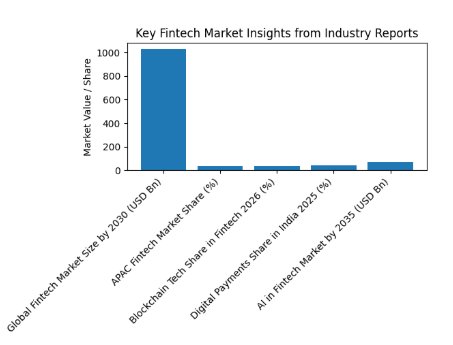
- According to Technavio, the fintech market is expected to grow to around USD 1,029.16 billion with a CAGR of 32.8% from 2025 to 2030.
- As per the reports of Technavio, the APAC region dominates the fintech market and records a share of around 39.1% during the forecast period.
- Get data from FortuneBusinessInsights, based on technology, the blockchain segment is expected to increase with a market share of around 38.40% in 2026.
- Mordor Intelligence says, in terms of service offerings, digital payments accounted for 42.87% of the fintech market share in India in 2025, while neobanking is expected to expand at a 19.64% CAGR from 2026 to 2031.
- According to Future Market Insights, the AI in fintech market is increasing at a faster speed around 68.5 billion by 2035, with a CAGR of 15.9 from 2025 to 2035.
What is Fintech Software?
Fintech software is technology that helps people and businesses manage financial services digitally. It includes applications like mobile banking, digital wallets, payment gateways, investment platforms, and lending systems. Fintech software development solutions use technologies such as APIs, cloud computing, blockchain, and data encryption to process transactions securely and quickly. These platforms improve speed, accessibility, and automation in financial operations, making services easier and more efficient for users.
What Benefits Do Businesses Gain from Investing in Fintech Software Development?
Fintech software is rapidly gaining traction among businesses as an effective means of providing quick, safe, and user-friendly financial services. Advances in technology, such as API’s, cloud computing, artificial intelligence (AI), and blockchain, are being used by many businesses to create innovative ways to process transactions faster.
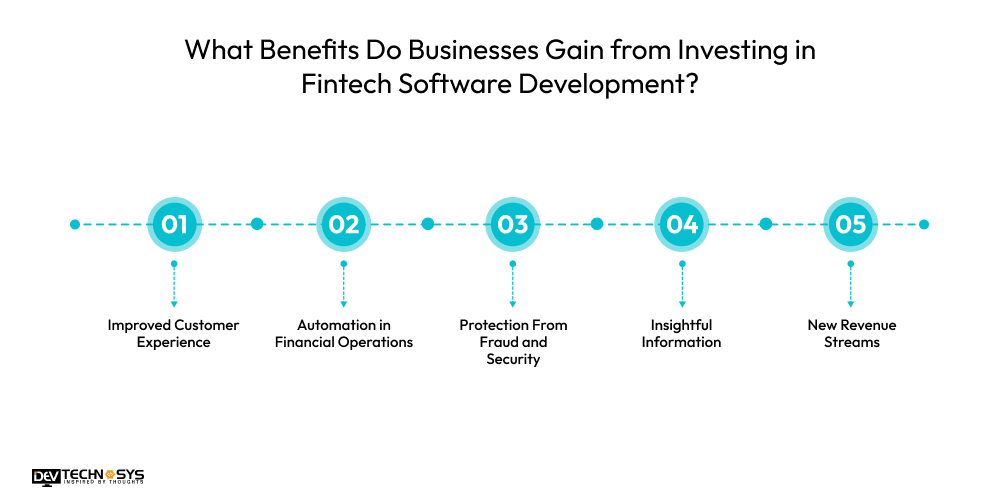
1. Improved Customer Experience
The fintech app like Revolut enable financial service providers to give customers financial services that are faster, easier, and more convenient. The user experience is improved with mobile payments, quick money transfers, AI chatbots, and personalized dashboards, thus allowing users to access and address their finances at any time and securely, through digital methods.
2. Automation in Financial Operations
Fintech solutions automate a variety of financial functions, including but not limited to payment processing, tracking transactions, detecting fraud, and producing financial reports. Companies will experience reduced human errors, increased productivity, and have the ability to process hundreds of financial transactions in seconds.
3. Protection From Fraud and Security
A foundational principle of every financial technology product is the use of significant resources to ensure safety. The use of cutting-edge technology examples, including encryption of sensitive data, multi-factor authentication, biometric verification, and an AI-powered fraud detection system, by fintech solutions enhances the protection of sensitive data and transactional activity.
4. Insightful Information
If businesses develop a fintech app like Wise, it can create and store large amounts of useful data related to customer financial activity, which can be analyzed for pattern recognition and/or identification of machine learning. Analyzing this data can provide businesses with insight into their customers’ spending, behavior, and general habits.
5. New Revenue Streams
Businesses are able to establish their own new business services. Including but not limited to digital lending systems, subscription payment services, investment platforms, and embedded finance solutions via fintech software. This gives businesses access to additional income streams and assists them in remaining competitive in the quick growth of the digital finance sector.
Industry Insights: According to The Economic Times, Generative AI adoption is rapidly increasing among financial institutions, acting as a core innovation driver.
What are the Major Steps to Build Fintech Software?
This step-by-step process to build fintech software makes it easy for businesses or developers to understand each development process in depth. From market analysis and gathering project requirements to post-launch maintenance services. Consider the fintech product development process one-by-one:
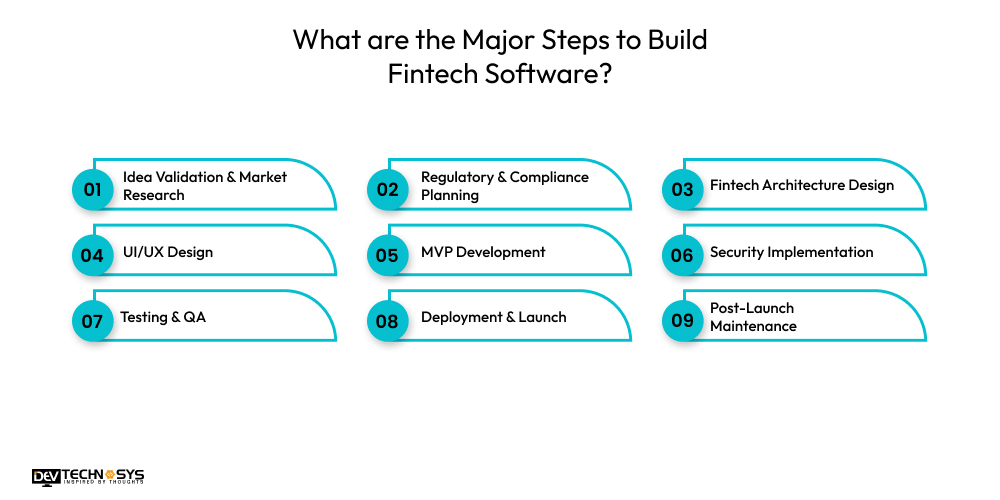
1. Idea Validation & Market Research
Identify a distinct financial issue your application will address prior to developing it, and analyze competitors, customer pain points, and sector trends. Hire software developers to test the viability of your concept, employ surveys, interviews, and focus groups; also specify your target market, provide a value proposition, and outline your revenue model. Completing the initial phase of the product development process will ensure that your final product meets a legitimate demand.
2. Regulatory & Compliance Planning
Businesses want to make sure you identify and integrate the applicable local rules, including KYC, AML, PSD2, and PCI DSS, into your system architecture in cooperation with legal and compliance experts. As part of the compliance planning process, you’ll also want to create data protection policies, audit trails, and user validation processes for the system. Completing the fintech software architecture planning phase will spare you the costs of legal penalties and provide users with confidence in your system to use it.
3. Fintech Architecture Design
In the third phase of the development process, you want to design your software’s architecture to be secure, scalable, and robust. Hire dedicated developers to determine whether to use a monolithic or microservices architecture for your application based on the complexity of the design. Also, choose which backend programming languages, cloud providers, database technologies, banking APIs, payment gateways, and fraud detection system integrations you would like to leverage in your architecture design.
4. UI/UX Design
Move to the fourth stage to create fintech software, visualize user interaction from the moment to register through to when they are completing a transaction with your application. Ensure that all aspects of a user’s experience are clear, straightforward, and able to instill a sense of confidence in your application. Produce wireframes, prototypes, and visual designs that incorporate high levels of accessibility, as well as intuitive navigation.
5. MVP Development
In this fintech solution development lifecycle, create an MVP with the core functions needed for user registration, KYC verification, account management, transaction processing, transaction processing and notification functions. Hire one of the top fintech software development companies to build the MVP using Agile sprints and iterative development processes so that you can continuously test functionality. Integrate with any necessary payment gateways or other banking APIs. Ensure that you are architecting for security and compliance from day one.

6. Security Implementation
Security forms a critical aspect of Fintech applications. Implement multi-factor authentication, encryption, tokenization, and fraud detection. Protect sensitive Customer and Financial Data while adhering to ISO 27001, SOC 2, and PCI DSS compliance standards. Perform penetration tests and vulnerability scans on a regular basis. Security design activities should run in parallel with application development activities to help mitigate the potential for breaches.
7. Testing & QA
In this fintech software development life cycle, several groups conduct testing at various levels, including unit, integration, performance, and penetration testing. As part of performing tests, the development teams will simulate a high volume of transactions. The software QA process consists of running automated and manual tests to confirm functionality works as intended, is free from defects, and identifies security vulnerabilities before release.
8. Deployment & Launch
After testing is successfully done, it’s time to deploy or launch the fintech software in the live phase. Before that, one must take care of a few things, such as servers, databases, monitoring tools, integrating APIs, mitigating, and ensuring that important data is successfully working or performing. Deployment must ensure minimal downtime and a smooth user experience. A structured launch establishes credibility, allows early user feedback, and sets the stage for ongoing updates and scaling.
9. Post-Launch Maintenance
Going live, conduct the post-launch maintenance and support services to keep the software up-to-date and maintain their actual performance. There are various maintenance services that include fixing bugs or glitches, regular updates, version updates, optimizing performance, adding enhancements, and more. Hire a software development company to make sure that the software remains secure and maintains the reliability and users’ trust.
Must-Have Features of Fintech Software for 2026 Users
The following features are necessary to integrate into fintech software to increase user engagement and gain a competitive advantage over others. Check out each fintech software feature in detail:
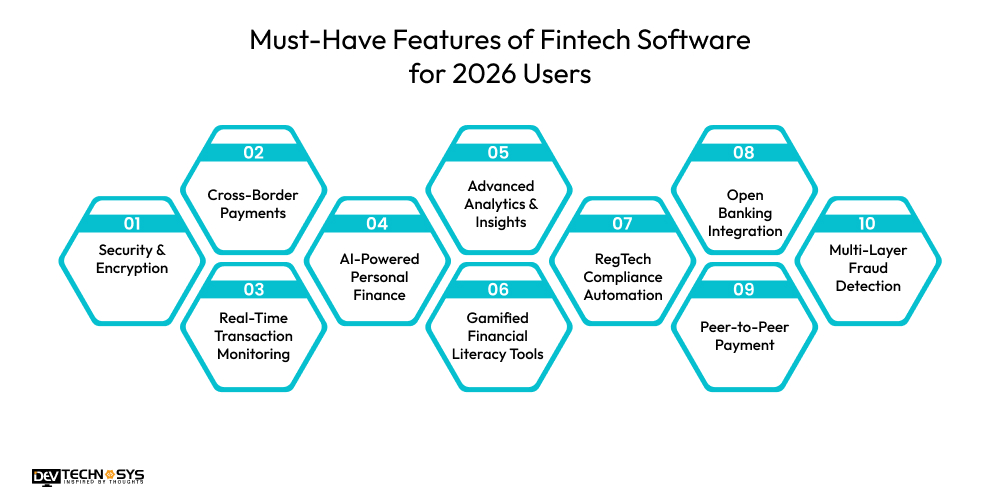
1. Security & Encryption
Fintech software must use strong security & encryption measures such as multi-factor authentication and end-to-end encryption techniques. Stripe also has these security measures for safer transactions.
2. Cross-Border Payments
Facilitates fast, low-fee international transfers with real-time currency conversions while following global and local payment networks compliance to make sure all payments are processed smoothly.
3. Real-Time Transaction Monitoring
Instantly tracks all transactions, providing immediate notifications for deposits, withdrawals, or uncharacteristic behaviors, giving users complete transparency into all that’s with their accounts.
4. AI-Powered Personal Finance
Utilizes artificial intelligence to analyze user spending, provide recommendations for budgeting, offer investment options, and help them build their savings.
5. Advanced Analytics & Insights
Enabled by predictive and trend analysis, tracks users’ spending patterns and forecasts future financial trends, and identifies potential investment opportunities.
6. Gamified Financial Literacy Tools
User interaction through tutorials, rewards, simulations, and challenges in educating a user on personal finance management will enhance user engagement with their financial habits.
7. RegTech Compliance Automation
Automatically handles KYC/AML/regulatory reporting updates to eliminate legal risk while streamlining operations and ensuring all financial transactions meet Regulatory Technology (RegTech).
8. Open Banking Integration
Links multiple bank services together into one interface to provide a single view of the user’s finances and provide insights into that user’s overall financial well-being.
9. Peer-to-Peer Payment
Allows users to immediately and securely send and receive money to/from family, friends, or businesses, including splitting bills, reminders for payments, and using social influences.
10. Multi-Layer Fraud Detection
Combines AI, behavioral analytics, and anomaly detection to identify fraud attempts, phishing, or identity theft before they affect user accounts.
Industry Insights: According to Credence Research, the integration of financial services into non‑financial platforms (e‑commerce, mobility apps) is accelerating demand for fintech development.
Who Are the Key Members of a Fintech Software Development Team?
For fintech software development services in UK, calls for skilled members of a team. Product managers, fintech developers, UI/UX designers, quality assurance engineers, security experts, DevOps engineers, and compliance experts will all need to work together to deliver secure, scalable, and user-friendly solutions.
| Team Member | Key Responsibilities | Technologies / Tools Used |
| Product Manager | Defines product vision, roadmap, and manages development priorities. | Jira, Trello, Confluence, Notion |
| Business Analyst | Analyzes business requirements and creates functional documentation. | Microsoft Visio, Lucidchart, Excel, Figma |
| UI/UX Designer | Designs user-friendly interfaces and creates prototypes. | Figma, Adobe XD, Sketch, InVision |
| Front-End Developer | Develops the app’s user interface and ensures responsive design. | React, Angular, Vue.js, HTML, CSS, JavaScript |
| Back-End Developer | Builds server-side logic, APIs, and system architecture. | Node.js, Java, Python, .NET, Spring Boot |
| QA / Test Engineer | Tests application performance, functionality, and security. | Selenium, Appium, Postman, JMeter |
| Compliance Specialist | Ensures fintech app meets regulatory standards like KYC and AML. | RegTech Tools, Compliance Management Systems |
| Data Scientist / AI Engineer | Builds predictive models and fraud detection systems. | Python, TensorFlow, PyTorch, Apache Spark |
What Challenges Are Faced in Custom Fintech Software Development?
There are many great opportunities in fintech custom software development ; however, there are also many technical and regulatory challenges that developers must contend with. Issues that developers face include managing secure data storage and transmission, complying with regulatory requirements, and designing scalable solutions.
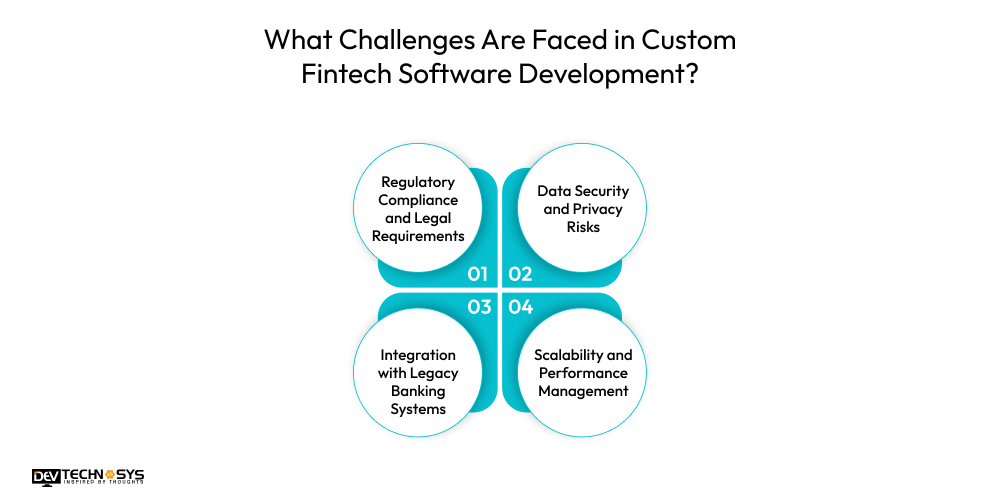
1. Regulatory Compliance and Legal Requirements
Fintech companies must adhere closely to the financial regulatory environment in order to operate legally, which complicates compliance as each country has its own respective regulatory standards. Therefore, developers must architect software to comply with applicable legal standards while also ensuring secure and transparent financial transactions occur.
2. Data Security and Privacy Risks
Mobile banking app development solutions process highly sensitive financial information. Therefore, strong data encryption, secure APIs, two-dactor authentication (2FA), and the implementation of cybersecurity best practices are necessary to prevent fintech platforms from being targeted by cyber-criminals and defrauded or breached by hackers.
3. Integration with Legacy Banking Systems
Many banks continue to rely on older layered infrastructure, making it difficult to integrate with newer technology applications. Integration through the use of APIs, payment gateways, and third-party services will be a challenge for fintech developers, who will need to undertake a diligence process regarding architectural efficiency and systems compatibility.
4. Scalability and Performance Management
Ewallet app development services will process thousands to millions of user requests at the same time through multiple users. Without an architecture that provides for high-performance backend capability using microservices architectures and cloud computing, as evidenced by database management and secured wireless access in a networked environment.
What is the Cost to Build Fintech Software in USA?
The cost to develop fintech software ranges from $8,000 to $25,000, depending on several crucial factors. It includes features, functions, size, project complexity, backend infrastructure, deployment platforms, development team, and many more. There are many additional factors that also impact the cost of custom software development, such as maintenance, testing techniques, designing tools, security, and more. Consider the detailed cost of fintech software in the table below:
| Fintech Software Type | Estimated Cost (USD) | Development Time |
| Basic Fintech App (MVP) | $8,000 – $12,000 | 2 – 4 months |
| Mid-Level Fintech App | $15,000 – $20,000 | 4 – 6 months |
| Advanced Fintech Platform | $20,000 – $25,000 | 6+ months |
Which Tech Stacks are Required to Build Fintech Software?
A fintech technology stack is one of the most important parts when beginning the development process, and selecting the best technologies can lead to a successful fintech platform development.
| Layer | Purpose | Technologies / Tools |
| Front-End | User interface for web and mobile apps | React, Angular, Vue.js, HTML5, CSS3, JavaScript, Flutter, React Native, Swift, Kotlin |
| Back-End | Server-side logic, APIs, and data processing | Node.js, Java (Spring Boot), Python (Django/Flask), .NET, Ruby on Rails |
| Database | Store and manage financial data securely | PostgreSQL, MySQL, MongoDB, Redis, Oracle DB |
| Cloud & Hosting | Scalable, secure infrastructure | AWS, Google Cloud Platform, Microsoft Azure, Docker, Kubernetes |
| Security | Protect user data and financial transactions | SSL/TLS, OAuth 2.0, JWT, Vault, OWASP, SIEM tools |
| Payment & Banking APIs | Integrate payment gateways and banking services | Stripe, PayPal, Plaid, Yodlee, Ripple, Mastercard APIs |
| Analytics & AI/ML | Fraud detection, predictive finance, personalized recommendations | Python, TensorFlow, PyTorch, Apache Spark, R, Power BI |
The Future Trends in Fintech Software
Learn how to build modern financial technology applications in today’s world. You will examine the full development cycle, each project’s time frames, overall project costs, team components, and current innovations, such as AI, decentralized finance (DeFi), and embedded financial services.
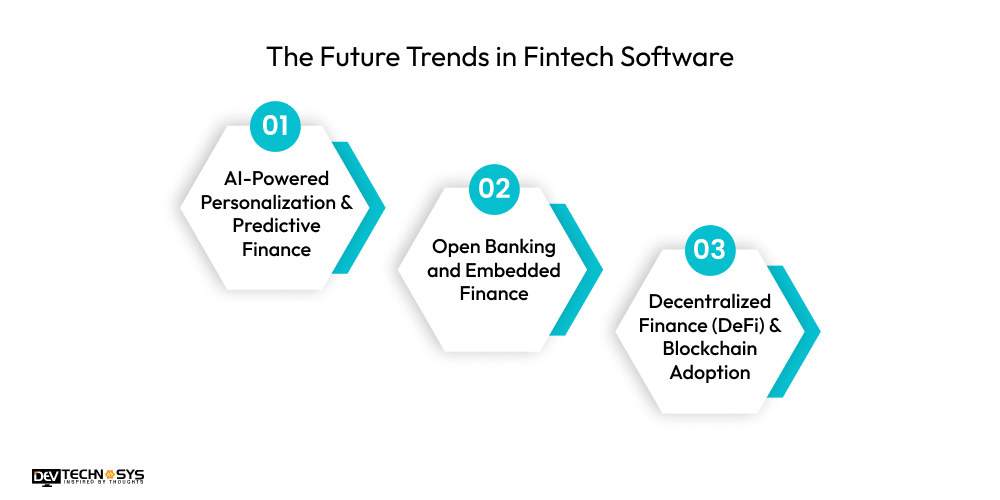
1. AI-Powered Personalization & Predictive Finance
The advancement of artificial intelligence and machine learning will allow for more intelligent fintech applications that provide personalized budgeting, investment advice, fraud detection and predictive financial analysis. These digital banking software development solutions will provide users with automated recommendations, real-time assessments of risk, and suggestions based on their behaviour.
2. Open Banking and Embedded Finance
Financial services are becoming increasingly integrated into non-financial platforms through open banking using APIs – two trends towards creating frictionless transactions for customers. Therefore, increasing the reach of fintechs and creating more opportunities for partnerships with traditional financial services, and developing new financial services.
3. Decentralized Finance (DeFi) & Blockchain Adoption
We will continue to see growth in the adoption of Decentralised Finance (DeFi) platforms that operate on blockchain. DeFi platforms provide P2P lending, secure payments, and decentralised exchanges. Users experience a high degree of transparency, control, and rapid cross-border transactions. Financial institutions may begin to use blockchain technology in their operations for settlements, compliance, and security.

Conclusion
This fintech software development guide requires careful preparation and strategic thinking. The steps involved in developing fintech software include defining user needs, designing a user-friendly and secure interface, and having a developer create the code and test it before launching the application to help users manage their finances safely. The entire project takes time, effort, and cooperation from your team, but watching your app help users manage their finances safely will be rewarding.
Do you want to create fintech software? Reach out to a fintech software development company to get affordable solutions with custom features.
Frequently Asked Questions
Find answers to the most common questions related to this article.
To develop a fintech software from Scratch, here is the list of steps:
Research & Define Requirements
Plan Features & Roadmap
Design UI/UX
Choose Tech Stack
Development & Integration
Testing & Quality Assurance
Launch & Maintenance
The fintech software development cost starts from $8,000 to $25,000 or depend on the software type or more. There are several factors that impact the total project budget, such as project complexity, size, backend infrastructure, development team, design UI/UX, and API integrations.
It includes various technologies that are used to make fintech software:
Java
Python
React Native
AngularJS
HTML
PHP
A neobank is a fully digital bank without physical branches, offering services through mobile apps. A digital bank is an online version of a traditional bank. A traditional bank operates through physical branches and offline services, along with digital banking options for customers.
To build fintech software with basic features and services, it usually takes around 2 to 4 months. And developing an AI-powered or complex fintech software can be completed within 6 months. The fintech software development timeline is based on the features, functions, project size, and backend processes.