

















Quick Summary:
-
- The global RegTech sector is on track to achieve a valuation of USD 116.7 billion by 2036.
- The cost to build RegTech platform ranges from $8,000 to $30,000+, depending on features, compliance scope, security requirements, and scalability.
- The process of building a RegTech platform in 2026 requires multiple stages to ensure accuracy, security, and adaptability in a constantly evolving regulatory landscape.
- Risk management platform involves tiered pricing (Basic, Pro, Enterprise) based on features, compliance checks, and usage. This ensures predictable recurring revenue and scalability.
What if we say compliance is your next big business opportunity? For entrepreneurs, the rise of RegTech is opening doors to the rapidly growing market driven by digital transformation and strict regulations.
According to the recent report by Future Market Insight, the global RegTech sector is expected to reach USD 116.7 billion by 2036, growing from USD 20.1 billion in 2026 at a CAGR of 19.2%. It indicates a huge revenue potential for startups.
Businesses are turning towards smart platforms backed by AI, real-time analytics, and RegTech automation, rather than manually handling the complex legal requirements. And that’s the opportunity businesses shouldn’t miss: building a data privacy compliance software that generates scalable revenue.
In this helpful guide, we will discuss how to build a RegTech platform, including all the essential factors like features, cost, development process, and more, to help businesses release a RegTech platform successfully.
What is RegTech?
RegTech or “regulatory technology,” refers to technologies that improve regulatory processes for financial services organizations. It helps by combining technology and finance. Regtech uses big data and machine learning (ML) to enable organizations to identify and tackle potential compliance risks in real time.
RegTech is the product of the post-2008 financial compliance technology explosion, working closely with regulators to provide cybersecurity services and regulatory compliance. Agility, speed, and the ability to integrate are the key attributes of RegTech that help it deal with complex data at pace.
RegTech Industry Statistics & Forecast (2026–2033)
- The global RegTech sector is on track to achieve a valuation of USD 116.7 billion by 2036, accelerating from USD 20.1 billion in 2026 at a CAGR of 19.2%.
- The United States holds a significant share of the global RegTech market by value, accounting for 64.2%
- In 2026, the software segment in the RegTech market accounts for a dominant 58.5% share.
- FMI analysts are of the opinion that combined UK RegTech funding exceeding GBP 100 million in early 2026 alone confirms London’s position as the global RegTech venture capital hub.
Why Businesses Should Invest in RegTech Platform Development?
Strict regulations and rising penalties have made it necessary for businesses to invest in RegTech platform development. Here are the reasons why businesses should invest in regtech platforms:
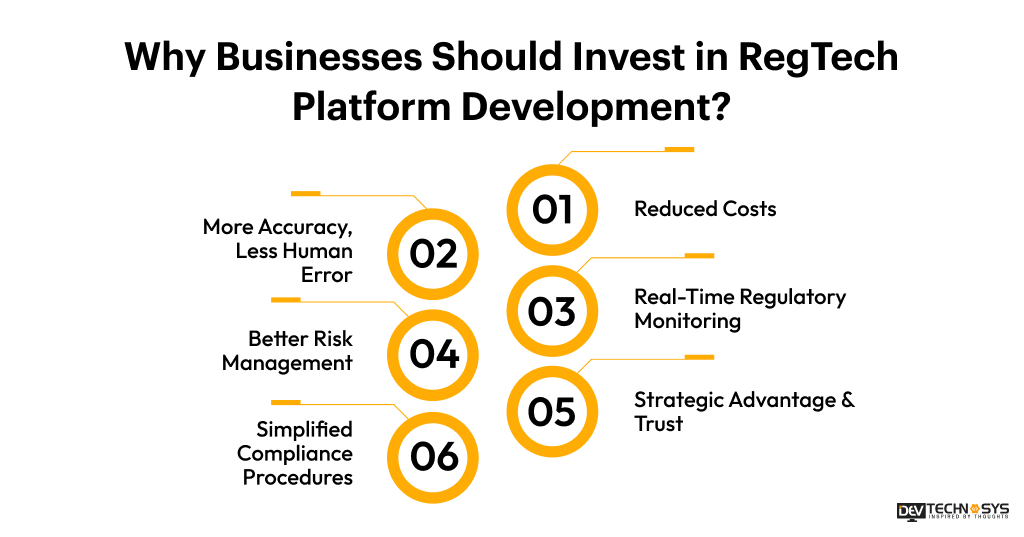
- Reduced Costs: Regtech platform helps businesses by lowering the operational expenses associated with manual labor, such as compliance monitoring, reporting, and data aggregation.
- More Accuracy, Less Human Error: Errors are bound to happen in manual processes; automated regtech solutions ensure better precision in risk management and regulatory reporting. Higher accuracy reduces the risk of errors and fines.
- Real-Time Regulatory Monitoring: Businesses can stay ahead of changing laws with tools that provide automated, real-time alerts on compliance updates, preventing penalties.
- Better Risk Management: RegTech can identify and control risks such as fraud, money laundering, and cybersecurity threats with the help of sophisticated data analytics.
- Simplified Compliance Procedures: Organizations are able to automate mundane activities to accelerate procedures such as customer onboarding, KYC (Know Your Customer), and AML (Anti-Money Laundering) checks.
- Strategic Advantage & Trust: Investing in insurance software development helps companies scale faster and helps build trust with stakeholders, customers, and regulators by demonstrating a commitment to safety and transparency.
When it comes to financial safety, regulatory reporting software is making things faster, smarter, and more efficient. ETL (Extract, Transform, Load) tools process large amounts of data in real time to quickly and accurately make the report. Due to RegTech’s flexible nature, businesses can adapt to new rules without having to completely rebuild their systems.
It also works well with current financial systems, so implementation goes smoothly. AI and advanced analytics help find scams, spot risks, and give useful information. This makes compliance a proactive, not a reactive, task.
Important ways that RegTech can be used are:
- Monitoring transactions in real time to find fraud
- Management and reporting of safety data automatically
- Watching workers to stop bad behavior and secret trading
- Audit records that are safe for openness and regulatory compliance
In the end, RegTech helps banks lower their risks, work more efficiently, and stay in line with regulations that are getting more complicated.
What are the Different Types of RegTech Solutions?
By automating compliance, risk management, and reporting, RegTech tools make it easier for businesses to follow the rules set by regulators. Here are some important types of RegTech:
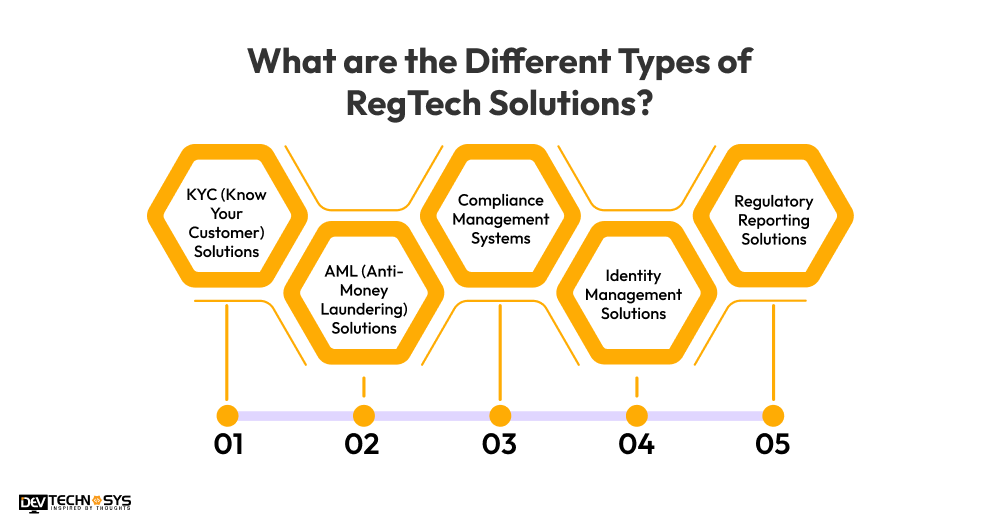
1. KYC (Know Your Customer) Solutions
As part of their KYC choices, businesses can use digital onboarding, biometric authentication, and document verification to keep people with unauthorized access away. KYC verification system helps by stopping identity theft, speed up the hiring process, and ensuring that rules are followed.
2. AML (Anti-Money Laundering) Solutions
AML compliance software keeps an eye on real-time financial transactions to find activities that seem odd. Experts who provide mobile banking app development services use advanced analytics and rule-based systems to send alerts. It helps businesses stop money laundering and follow financial rules.
3. Compliance Management Systems
You can speed up the compliance process by automating tasks like AML and Know Your Customer (KYC). Most CMS systems and compliance automation platforms have a lot of features that can be used to do things like add new customers, keep an eye on deals, and assess risks.
4. Identity Management Solutions
Identity management solutions help businesses confirm that the people they work with, hire, and do business with are genuine individuals, and not someone else. Some of the technologies that are used in these systems are biometrics, digital signatures, and two-factor identification.
5. Regulatory Reporting Solutions
Regulatory reporting options are made to help companies meet the rules for regulatory reporting. Data analytics and machine learning are used to make reports on a wide range of compliance-related topics.
Industry Insights: According to Grand View Research, Financial institutions face 300+ global regulatory frameworks, increasing demand for automated compliance solutions.
How to Build a RegTech Platform: A Complete Roadmap
The process of building a RegTech platform in 2026 requires multiple stages to ensure accuracy, security, and adaptability in a constantly evolving regulatory landscape. Here’s the financial fraud detection software development process, explained in simple steps:
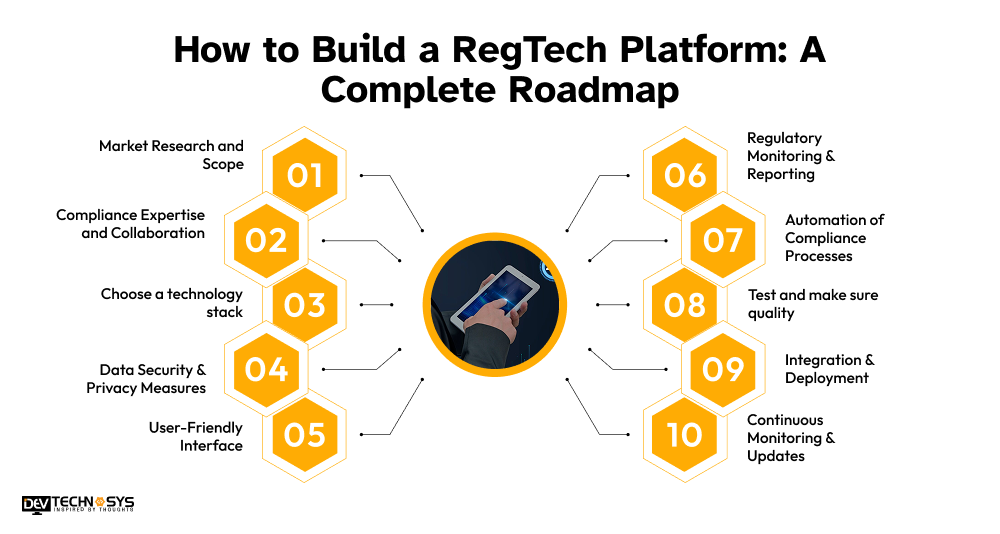
Step1. Market Research and Scope
Start the process to build a RegTech platform by doing a comprehensive market research. Understand the complex and important aspects of the regulatory landscapes within the financial industry. To create custom RegTech software solutions, it is important to identify the specific pain points and compliance challenges faced by institutions.
You must outline the scope and goals of your RegTech solution development. Whether you want it for automating compliance processes, monitoring regulatory changes, or improving reporting capabilities. A well-designed scope sets the foundation for targeted and effective development.
Step2. Compliance Expertise and Collaboration
Partner with a reputable mobile app development firm with expertise in regulatory compliance. It may include legal professionals, financial experts, and technology specialists. Collaborate with regulatory bodies, industry experts, and potential users to gain valuable insights into the intricate world of compliance.
Step 3: Choose A Technology Stack
Choosing a strong technology stack that guarantees protection, performance, and the ability to grow. To build a Regtech platform, use advanced technologies such as AI to find risks, machine learning for predictive analytics, blockchain technology for security, and big data tools for working with large datasets. Having the right tech stack makes the fraud detection system work better and helps the company grow over time.
Step 4: Data Security & Privacy Measures
The next step in RegTech MVP development services involves ensuring end-to-end encryption, multi-factor authentication (MFA), and role-based access controls. These security measures can be used to protect private financial data. Make sure that global data security laws like HIPAA and GDPR are in compliance. Putting data safety first builds trust and protects your platform from cyber threats and fines from the government.
Step 5: User-Friendly Interface
Make an interface that is clean, easy to understand, and fun to use so that complicated compliance processes are easier to handle. Keep an eye on dashboards that are easy to understand and feedback tools that are easy to get to. A well-thought-out user experience makes it easier for financial professionals to adopt the platform, cuts down on the need for training, and makes handling compliance tasks within the platform more efficient overall.

Step 6: Regulatory Monitoring & Reporting
Experts who provide AI development services will create tools that let you keep an eye on government updates and changes in real time. Add automated tools for reporting that make sure compliance records are correct, and audit trails are complete. This helps groups keep up with changing laws, be open, and be ready for audits without having to wait for people to do things or change things by hand.
Step 7:Automation of Compliance Processes
Use automation to do compliance jobs that need to be done over and over, like validating data, keeping an eye on transactions, and making reports. Use smart programs that can adapt to changes in the law and cut down on mistakes made by hand. Automation not only makes things more efficient, but it also frees up teams to work on things like risk management and making smart decisions.
Step 8: Test And Make Sure Quality
Hire dedicated developers who will make sure that the platform works correctly and test it thoroughly. This should include functional, performance, and security testing. Use real-life situations in compliance testing to make sure it is accurate and works. Finding and fixing problems before starting makes sure that end users have a stable, safe, and ready for regulation RegTech solution.
Step 9: Integration & Deployment
Set up the RegTech platform in stages to make sure the transfer goes smoothly, and there are as few problems as possible with operations. Work with current financial systems like payment gateways, CRM, and ERP without any problems. When API integration services are performed correctly, data is always the same, workflow is faster, and organizations can use the platform without having to make big changes to their systems.
Step 10: Continuous Monitoring & Updates
Keep an eye on regulatory changes and platform performance all the time. Update the answer often to meet new compliance standards, fix bugs, and add new features. By using user input, the platform stays useful, efficient, and able to adapt to changing business and regulatory environments.
Industry Insights: According to Mordor Intelligence, Compliance & risk management dominate application usage in RegTech platforms. Large enterprises hold the biggest market share due to strict regulatory obligations.
What are the Advanced Features Required to Build a RegTech Platform?
RegTech platforms are evolving rapidly, and advanced features are essential to handle complex compliance requirements with speed and accuracy. These features leverage AI, automation, and analytics to simplify regulatory processes and improve decision-making. Let’s take a look at some advanced features required to develop a RegTech platform:
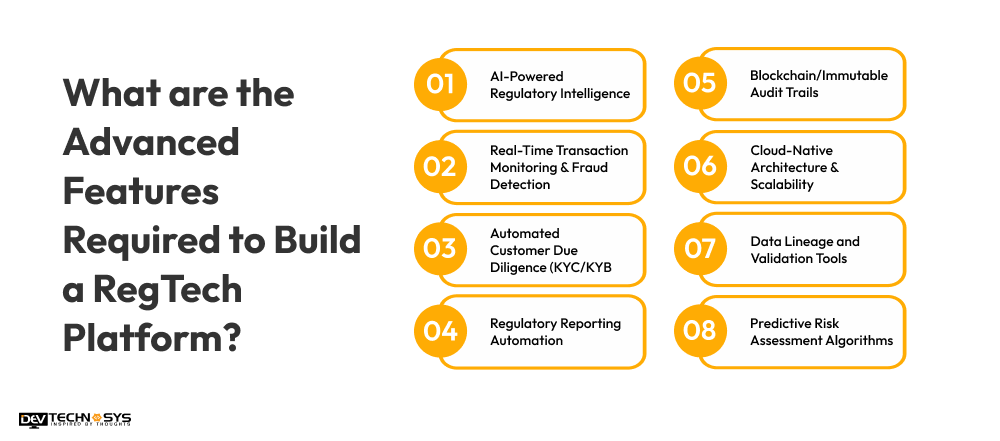
1. AI-Powered Regulatory Intelligence
Using Artificial Intelligence (AI) and Natural Language Processing (NLP), the platform can analyze and interpret regulatory updates from global regulatory bodies in real-time. This allows the platform to predict how changes will affect internal policies and alert compliance teams automatically.
2. Real-Time Transaction Monitoring & Fraud Detection
RegTech software development demands real-time transaction monitoring and fraud detection. The platform must detect suspicious activity immediately, rather than in batches, using behavioral analysis to identify fraud, anti-money laundering (AML), and counter-terrorism financing (CTF) risks.
3. Automated Customer Due Diligence (KYC/KYB)
Build RegTech Platform that uses artificial intelligence for instant Know Your Customer (KYC) or Know Your Business (KYB) checks, including document verification, biometric checks (face/iris scanning), and PEP/sanctions screening.
4. Regulatory Reporting Automation
Your Blockchain development company will use this feature to streamline the generation and submission of regulatory reports, converting raw data from various sources into the formats required by regulatory authorities. It reduces manual effort, minimizes errors, and ensures timely submission to avoid compliance penalties.
5. Cloud-Native Architecture & Scalability
To manage vast datasets efficiently, the platform should be cloud-based, allowing for high availability, flexibility, and easy scaling of infrastructure as regulatory demands grow. It also ensures faster deployment, cost efficiency, and seamless access across multiple locations.
6. Data Lineage and Validation Tools
Experts who offer software development services state that a Regtech platform must provide a complete, transparent, and audit-ready history of data, demonstrating where data came from and how it was processed, ensuring compliance with reporting accuracy requirements. It improves trust, accountability, and simplifies regulatory audits significantly.
7. Predictive Risk Assessment Algorithms
Using predictive analytics, the platform can scan for data anomalies and evaluate risk across different portfolios, offering predictive modeling to forecast potential compliance breaches. Software testing security testing help businesses proactively address risks before they escalate into regulatory violations.
8. Blockchain/Immutable Audit Trails
Using distributed ledger technology for keeping records creates an immutable log of compliance activities, ensuring that data cannot be altered after auditing, which is crucial for regulatory transparency. It enhances security and trust and ensures full accountability in compliance processes.
Top 10 RegTech Platforms to Explore in 2026
Here are the top RegTech platforms that you can explore in 2026. These platforms are widely used because they combine AI, automation, real-time monitoring, and global compliance coverage, helping financial institutions reduce risk and improve regulatory efficiency.
| Platform | Core Focus | Best For |
| ComplyAdvantage | AML & Risk Intelligence | Banks, Fintech, Enterprises |
| Chainalysis | Crypto Compliance | Crypto exchanges, Governments |
| Quantexa | Decision Intelligence | Large financial institutions |
| Fenergo | Client Lifecycle Management | Investment banks, Corporations |
| Sumsub | Identity Verification | Fintech, Digital platforms |
| Onfido (Entrust) | Digital Identity Verification | Fintech, E-commerce |
| Jumio | AI Identity Authentication | Financial services, Online platforms |
| SEON | Cybersecurity Services | E-commerce, Fintech |
| Sanction Scanner | AML Screening | Regulated financial firms |
| iDenfy | KYC & AML Automation | Startups, Fintech companies |
1. ComplyAdvantage
ComplyAdvantage is an AI-powered AML and risk intelligence platform that provides real-time sanctions screening, transaction monitoring, and financial crime detection. It helps global financial institutions identify risks quickly, ensure regulatory compliance, and reduce exposure to fraud and money laundering activities. If you want to build a platform like ComplyAdvantage, hire experts from a top RegTech development company.
2. Chainalysis
Chainalysis is a leading blockchain analytics platform specializing in cryptocurrency compliance and investigation. It enables transaction tracing, illicit activity detection, and risk assessment for governments, exchanges, and financial institutions, ensuring transparency and security in the rapidly growing digital asset ecosystem.
3. Quantexa
Quantexa is a decision intelligence platform that connects and analyzes fragmented data from multiple sources. It helps organizations detect fraud networks, uncover money laundering activities, and identify hidden financial relationships, enabling better risk management and smarter, data-driven compliance decisions.
4. Fenergo
Fenergo is a client lifecycle management (CLM) platform designed to automate KYC processes, client onboarding, and regulatory compliance. It streamlines documentation, reduces manual effort, and ensures financial institutions maintain consistent and efficient compliance across global regulatory frameworks. Thinking of building a similar platform? Contact the top mobile application development company.
5. Sumsub
Sumsub is an all-in-one identity verification platform that supports KYC, KYB, and AML compliance processes. It offers automated onboarding, fraud prevention, and real-time verification tools, helping businesses ensure secure user authentication and meet global regulatory standards efficiently.
Industry Insights: Future Market Insights states that Regulatory changes like the EU Digital Operational Resilience Act (DORA) are forcing businesses to digitize compliance systems.
What is the Cost to Build a RegTech Platform?
The cost to build a RegTech platform ranges from $8,000 to $30,000+, depending on features, compliance scope, security requirements, and scalability. Because RegTech solutions involve strict regulations (such as AML, KYC, and GDPR compliance), RegTech development costs are much higher.
The basic platform can cost around $8,000 to $15,000, whereas the cost of custom software development with advanced features may exceed $30,000. Now, let’s take a look at some of the major factors affecting the Regtech platform development cost:
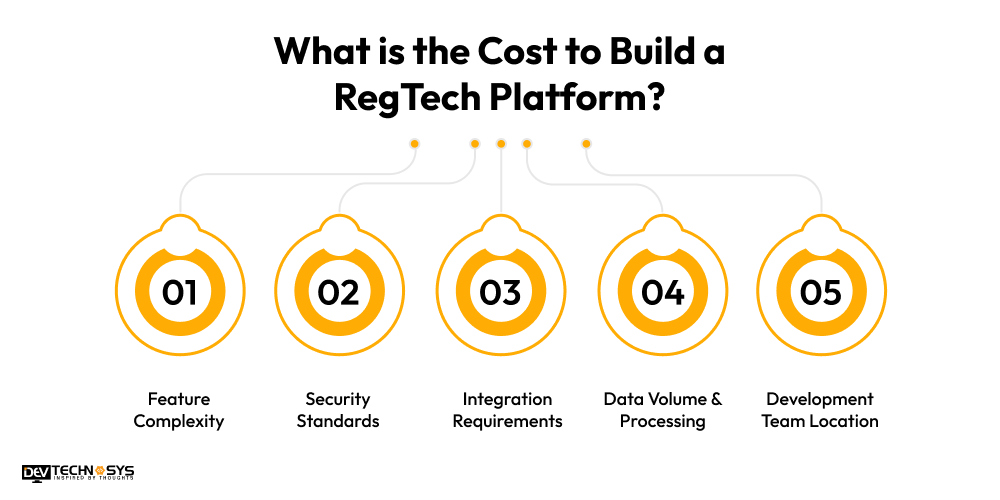
1. Feature Complexity
The total cost to develop a RegTech platform goes up a lot as the number of features it has grows. Advanced features like AML tracking, KYC automation, fraud detection, and predictive analytics need a lot of work to be put into development, testing, and integration. It makes the development more costly and requires more resources.
| Complexity Level | Estimated Cost | Development Timeline |
| Basic MVP | $3,000 – $6,000 | 2 – 4 weeks |
| Moderate | $6,000 – $8,000 | 4 – 8 weeks |
| Advanced MVP | $8,000 – $11,000 | 8 – 12 weeks |
2. Security Standards
Regtech platforms deal with sensitive financial data, so they need to have strong security standards in place. The features include a secure identity verification API, multi-factor authentication, and access controls, increasing the cost to develop a Regtech platform. However, adding these security features is important to stay compliant, stop cyber attacks and breaches, and keep users and lawmakers trusting your site.
| Security Level | Estimated Cost | Development Timeline |
| Basic Security | $4,000 – $7,000 | 1 – 2 weeks |
| Standard Compliance | $7,000 – $10,000 | 2 – 4 weeks |
| High-Security MVP | $10,000 – $17,000 | 4 – 6 weeks |
3. Integration Requirements
A lot of the time, banks, payment gateways, government records, and third-party compliance APIs need to be connected to RegTech platforms. For seamless data sharing, these integrations need more development time, API management, and testing work, which makes the project much more complicated and costs a lot more overall. Here’s the table highlighting the cost of digital wallet app development based on integration level
| Integration Level | Estimated Cost | Development Timeline |
| Low | $5,000 – $8,000 | 1 – 2 weeks |
| Medium | $8,000 – $11,000 | 3 – 6 weeks |
| High | $11,000 – $16,000 | 6 – 10 weeks |
4. Data Volume & Processing
Payment app development requires a strong cloud infrastructure and high-performance computing systems to process large amounts of financial and regulatory data. As data gets more complicated, it needs more advanced architecture. This causes a direct impact on the development and maintenance costs.
| Data Scale | Estimated Cost | Development Timeline |
| Low Volume | $8,000 – $11,000 | 1 – 3 weeks |
| Medium Volume | $11,000 – $15,000 | 3 – 6 weeks |
| High Volume | $15,000 – $20,000 | 6 – 10 weeks |
5. Development Team Location
For each development team, the cost to create a RegTech platform is different. It’s much more expensive to hire coders in the US or UK than to outsource to places like India or Eastern Europe, where the total cost to create a RegTech platform can be cut without sacrificing quality or technical know-how.
| Team Location | Estimated Cost | Development Timeline |
| India / South Asia | $8,000 – $15,000 | 10 – 16 weeks |
| Eastern Europe | $12,000 – $22,000 | 8 – 14 weeks |
| UK / Western Europe | $18,000 – $27,000 | 6 – 12 weeks |
| US / Canada | $22,000 – $30,000+ | 6 – 10 weeks |
Timeline to Develop a RegTech Platform
RegTech platform or software development life cycle typically takes 8-16 weeks to build a RegTech platform as an MVP. The development time usually depends on the complexity of the project, the number of links it needs, and the strictness of the compliance rules. The development process involves planning, UI/UX designing, backend programming, API integration for RegTech, testing, and deployment. It is easier to develop and test simpler solutions with basic compliance features than to develop and test platforms with AI-driven analytics, real-time tracking, and advanced security.
| Development Phase | Key Activities | Timeline |
| Planning & Research | Requirement analysis, compliance scope, tech stack selection | 1 – 2 weeks |
| UI/UX Design | Wireframing, prototyping, and user journey design | 1 – 3 weeks |
| Development | Backend, frontend, core compliance features | 4 – 8 weeks |
| Integrations | KYC/AML APIs, third-party services | 2 – 4 weeks |
| Testing & Deployment | QA testing, security checks, final launch | 1 – 2 weeks |
Technology Stack Needed For RegTech App Development
A robust RegTech platform needs a scalable and secure technology stack to manage compliance automation, real-time data processing, and sensitive financial information. Your SaaS application development services provider must choose a technology stack that involves modern frontend frameworks for user-friendly dashboards, strong backend technology for rule engines, cloud infrastructure for scaling, and APIs for KYC/AML integrations. Security, encryption, and data analytics tools are essential for risk management and regulatory compliance.
| Layer | Technologies | Purpose |
| Frontend | React.js, Angular, Vue.js | Build responsive dashboards and user interfaces |
| Backend | Node.js, Python (Django/Flask), Java (Spring Boot) | Develop APIs, compliance logic, and workflows |
| Database | PostgreSQL, MongoDB, MySQL | Store structured and unstructured compliance data |
| Cloud & DevOps | AWS, Microsoft Azure, Google Cloud, Docker, Kubernetes | Ensure scalability, deployment, and infrastructure management |
| Integrations | REST APIs, Plaid, Trulioo, and Onfido | Enable KYC, AML, and financial data connectivity |
| Security | SSL/TLS, OAuth 2.0, AES Encryption | Protect sensitive data and ensure secure access |
| Data Processing | Apache Kafka, Spark | Real-time data streaming and analytics |
| AI/ML (Optional) | TensorFlow, Scikit-learn | Risk scoring, fraud detection, predictive analytics |
What are the Top Monetization Strategies for RegTech Platforms?
RegTech platforms can generate sustainable revenue by leveraging flexible and scalable monetization models tailored to compliance-driven businesses. Here are some of the major ones:
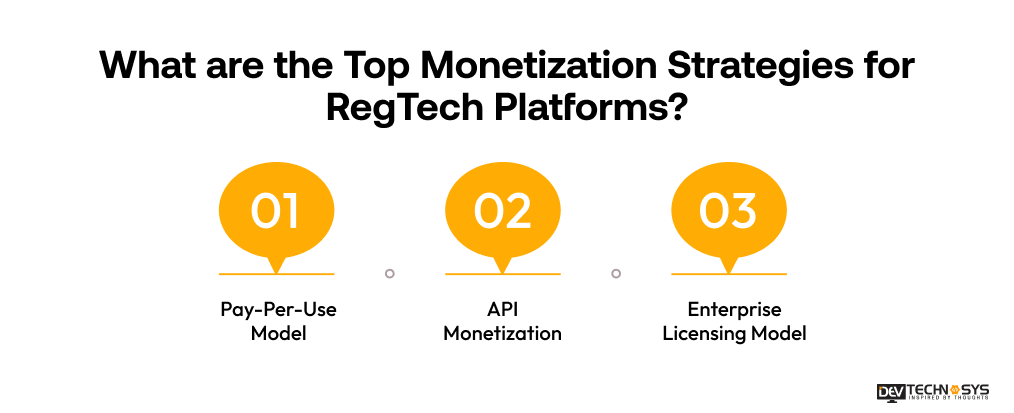
1. Pay-Per-Use Model
Charge customers based on the number of compliance checks, KYC verifications, or transactions processed. Flexible pricing appeals to startups and SMEs that prefer paying only for actual usage rather than committing to fixed subscriptions.
2. API Monetization
Provide compliance tools (KYC, AML, fraud detection) as APIs that third-party platforms can integrate. Charge per API call or usage volume, enabling fintech companies, banks, and startups to embed compliance features into their systems seamlessly.
3. Enterprise Licensing Model
RegTech platforms offer customized solutions to large enterprises with a one-time licensing fee or annual contract. It includes advanced features, dedicated support, and tailored compliance modules, making it ideal for banks and financial institutions with complex regulatory needs.
KPIs & Metrics to Measure RegTech Platform Success
Tracking the right KPIs helps evaluate how effectively your RegTech platform manages compliance, reduces risk, and delivers business value. These metrics focus on performance, accuracy, user adoption, and revenue growth.
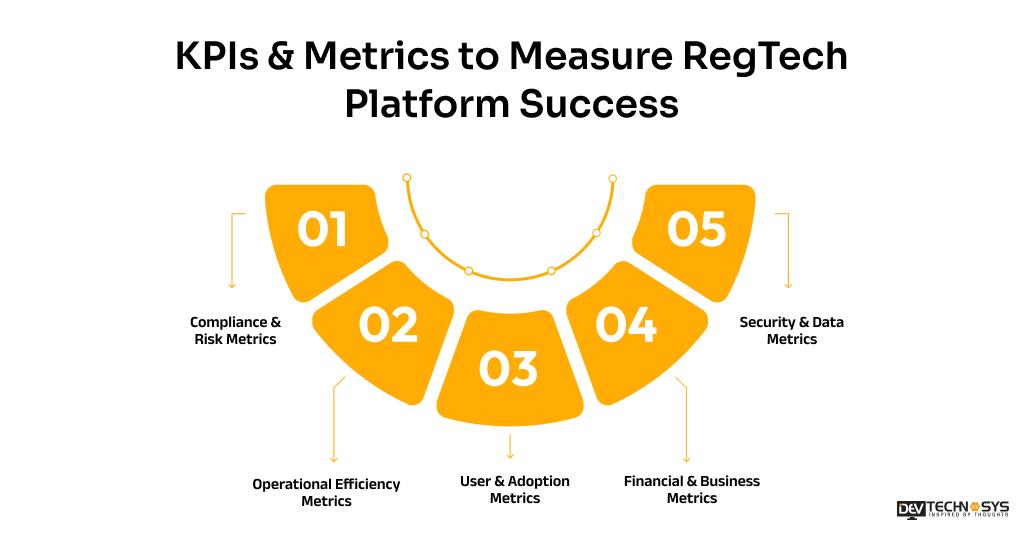
1. Compliance & Risk Metrics
- Compliance Accuracy Rate: Percentage of correctly processed compliance checks (KYC/AML).
- False Positive Rate: Frequency of incorrect alerts generated by the system.
- Regulatory Reporting Timeliness: Time taken to generate and submit reports.
- Risk Detection Rate: Ability to identify suspicious or non-compliant activities.
2. Operational Efficiency Metrics
- Processing Time per Check: Time required to complete a compliance verification.
- Automation Rate: Percentage of compliance tasks handled without manual intervention.
- System Uptime: Platform availability and reliability (target 99.9%+).
- Error Rate: Frequency of system or processing errors.
3. User & Adoption Metrics
- Active Users (DAU/MAU): Daily and monthly active users on the platform.
- Customer Retention Rate: Percentage of users continuing to use the platform.
- User Onboarding Time: Time taken for new users to start using compliance features.
- Churn Rate: Percentage of customers leaving the platform.
4. Financial & Business Metrics
- Monthly Recurring Revenue (MRR): Revenue generated from subscriptions.
- Customer Acquisition Cost (CAC): Cost to acquire a new customer.
- Customer Lifetime Value (CLV): Total revenue generated per customer.
- Revenue Growth Rate: Month-over-month or year-over-year revenue increase.
5. Security & Data Metrics
- Data Breach Incidents: Number of security breaches (should be zero).
- Encryption Coverage: Percentage of data secured with encryption.
- Audit Log Completeness: Accuracy and completeness of compliance logs.
Conclusion
Building a RegTech platform is a strategic investment for businesses aiming to streamline compliance, reduce operational risks, and improve regulatory reporting efficiency. As regulations continue to evolve, investing in RegTech ensures long-term compliance, operational efficiency, and competitive advantage in the fintech ecosystem.
If you are a business looking to build an amazing RegTech Platform, contact Dev Technosys, a leading Fintech app development company. With 15+ years of experience and 1000+ successful projects, we develop secure, scalable, and compliance-driven RegTech solutions tailored to your business needs.
Frequently Asked Questions
Find answers to the most common questions related to this article.
A RegTech platform typically takes 8 to 16 weeks to develop an MVP. The timeline depends on feature complexity, integrations, and security requirements. Advanced platforms with AI-driven compliance and real-time monitoring may take longer to build and deploy.
Key features include KYC verification, AML screening, compliance automation, real-time alerts, audit trails, and secure data management. These features help businesses maintain regulatory compliance while reducing manual efforts and operational risks.
The cost depends on feature complexity, security standards, third-party integrations, data processing needs, and development team location. More advanced features and higher compliance requirements significantly increase overall development costs.
Yes, startups can build a lean MVP RegTech platform with core compliance features within a limited budget. Starting small allows businesses to validate the idea and scale gradually by adding advanced features over time.
RegTech platforms generate revenue through subscription models, pay-per-use pricing, API monetization, enterprise licensing, and data analytics services. These models provide scalable and recurring income streams for long-term business growth.