















Key takeaways:
-
- To develop a mobile banking app like Chime consists of several steps, such as market analysis, gathering project requirements, selecting tech stacks, designing UI/UX, development, testing, quality assurance, launching, and post-maintenance.
- According to the EY, more than 70% of customers feel banks should understand their financial needs and provide tailored recommendations.
- The cost to build a mobile banking app like Chime is around $8,000 to $25,000, based on the project demands, number of integrations, tech stacks, design UI/UX, security, and privacy techniques.
- By using monetization techniques, earn money from mobile banking apps, such as subscription plans, freemium model, transaction fees, advertisements, in-app purchases, and more.
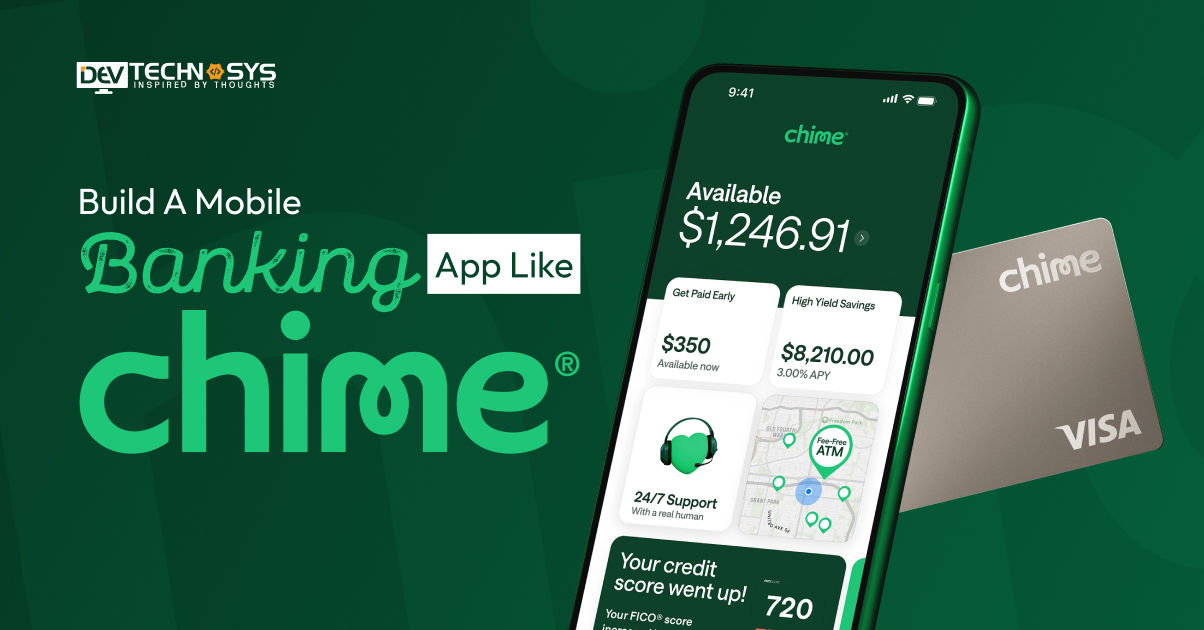
Have you tried Chime? Ever wondered how it was built? Creating a mobile bank app like Chime is like crafting a digital piggy bank that saves money, sends cash to friends, and lets you check your balance anytime and anywhere.
When build a mobile banking app like Chime, it is crucial to have a good idea along with a clean and functional design that is efficient and user-friendly.
Once completed, programmers write special code so the app functions correctly and the users have a smooth experience through the app that is smooth.
When it comes to mobile banking apps, user security is a highly prioritized concern, and so the banking apps have lots of security features to protect your banking secrets and money. Additionally, it is important to integrate bank systems into the app to facilitate the movement of money.
Virtual banking apps are highly intelligent and complex, like a robot built to help you manage money and finances daily.
Market Statistics of Global Mobile Banking Applications
Latest and future market analysis of mobile banking apps through Grand View Research:
- As per the global survey, the mobile banking platform market is around $37.49 billion in 2026, and is expected to grow to around $155.4 billion by 2033.
- Look at the deployment, the on-premise charging segment holds the highest revenue share, around 67.5% in 2026.
- Comparing regions, the Asia-specific region dominates the global mobile banking apps with the largest revenue share of around 32.5% in 2026.
- According to the market, the digital banking apps are projected to increase with a CAGR of 19.8% from 2026 to 2033.
- As per the mode-wise, the online banking segment held the highest revenue share of the banking industry in 2026.
What is Chime?
Chime is a US-based mobile finance app that enables users open and check their savings accounts and get a debit card. Users can receive money and directly deposit it.
Chime has no monthly or annual fee and no need to maintain a minimum balance. Users can track their spending, save money automatically, and manage other financial operations with their mobile device. Chime was founded by Chris Britt (CEO) and Ryan King (CTO) in 2012 in San Francisco, California.
Planning a Ewallet Project?
Get a tailored development cost estimate in a few simple steps.
- 3 quick steps
- 100% free
- Reply in 1 business day
2 Minutes Read
How Does the Chime App Work?
The steps below help users to understand the working of the Chime app, and make it easy for users to quickly interact with the app. Let’s take a look at the steps one by one:
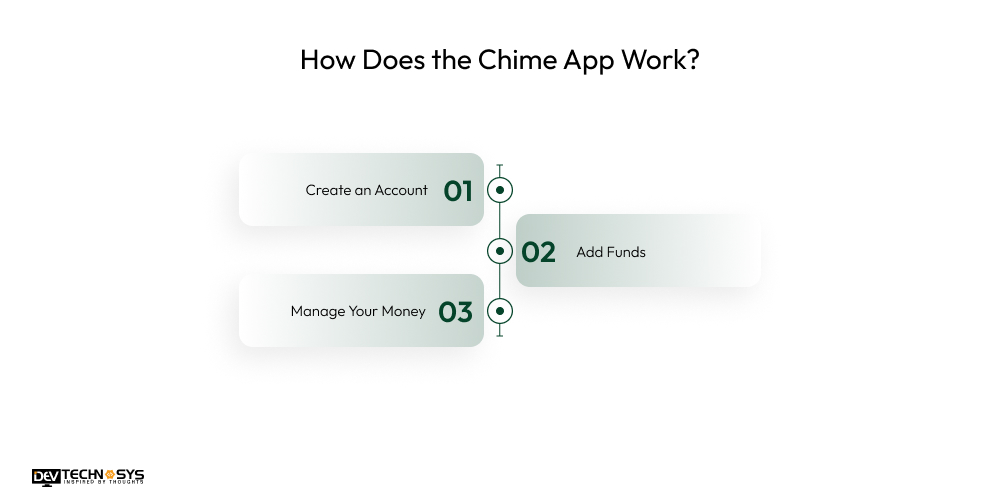
1. Create an Account
Download the application, register with your personal information, confirm your identity, and create a checking account so that you can receive a debit card by mail.
2. Add Funds
You can either set up direct deposit with your employer, transfer just as much money from another financial institution, or deposit cash at approved retailers around the country.
3. Manage Your Money
Use the debit card to make purchases, monitor your spending, save automatically through the application, receive alerts, and withdraw from no-fee ATMs.
Industry Insights:
According to LinkedIn, over 70% of customers prefer mobile banking for daily transactions. Younger demographics are driving this, with 57% of millennials and 64% of Gen Z preferring non‑traditional banking providers.
Why Businesses Want to Invest in Mobile Banking App Development?
Mobile banking development allows businesses to broaden their customer base, streamline user experience, broaden their bottom line, cut costs, and remain competitive. The role of mobile app development in banking has made digital banking a service that is not just convenient for the user but also grows the business.
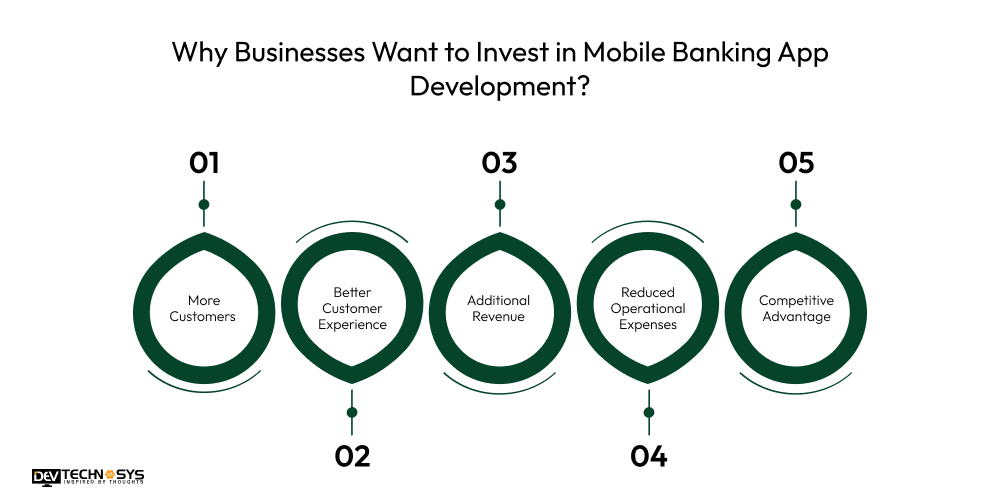
1. More Customers
Reaching customers is very easy with mobile banking apps. Banking uses a lot of different practices. Almost all customers use mobile banking apps to open accounts, send money, and check balances. With mobile banking apps, it is easier to get customers than using traditional banking practices.
2. Better Customer Experience
People appreciate services that are quick and simple. Managing finances using mobile banking on demand app development solutions can be completed from any location, at any time.
The simple and quick processes that mobile banking apps provide make people feel good. Customer loyalty is increased through trust developed by a quality banking experience.
3. Additional Revenue
From new opportunities created by mobile apps, businesses can offer value-added services. Premium features, instant loan offerings, credit cards, and investments can all be offered by businesses as new opportunities.
Additionally, businesses can offer services through collaboration with partner companies. Increased option features lead to increased value and profitability.
4. Reduced Operational Expenses
The expenses involved with physical bank branches are enormous. The need for bank branches and unnecessary paperwork is eliminated by mobile banking apps.
According to the hybrid app development company, automated services complete tasks without requiring staff and increase business efficiency. This helps to increase the bank’s profitability.
5. Competitive Advantage
The banking sector is extremely competitive. Companies that invest in mobile applications have an edge. A state-of-the-art and safe smartphone banking app serves as an indicator of innovation and future readiness to meet the needs of digital banking. Additionally, it appeals to tech-savvy customers.
Industry Insights:
According to Reuters, Chime went public on the Nasdaq in June 2025 under the ticker CHYM, raising $864 million at $27 per share.
What Are the Technical Steps to Create a Mobile Banking App Like Chime?
To build a mobile banking app like Chime, it involves various steps starts from market research to post-maintenance services. These steps help businesses or developers to analyze every step and easily integrate their specific functionalities. So, here is the mobile banking app development guide:
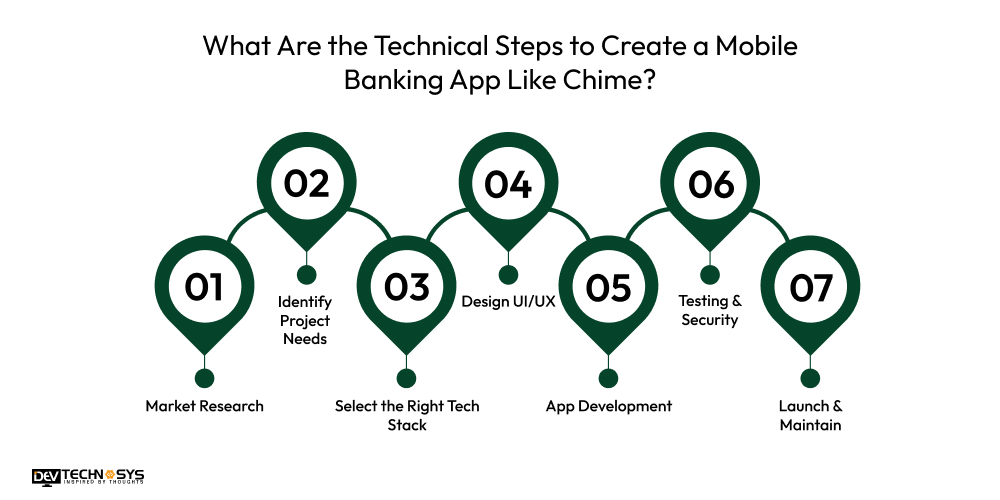
1. Market Research
Before build a mobile banking app like Chime, gather as much information as possible about your users and their needs. Look at trends in the digital banking space. Analyze your competitors’ user bases.
Look at the user demographics, your potential revenue models, and where you have feature gaps. Identify regulatory requirements related to your app’s functionality, and explore customer pain points.
2. Identify Project Needs
Start by defining your overall objectives as a business, the audience you will be targeting, the core features of your product, and what compliance regulations you will need to incorporate into your product.
Hire dedicated developers to integrate third parties into your mobile banking platform. Next, determine whether you will need partnerships with banks, payment processors, and KYC providers.
3. Select the Right Tech Stack
In this stage, to develop an app like monzo, for your frontend, backend, and database systems, choose technology platforms that are secure and scalable. For your native apps, you can use Swift or Kotlin, or you can use Flutter.
For your cloud infrastructure, use a provider such as AWS, and for your APIs, you can use secure APIs. In order for your tech stack to support encryption, building a microservices architecture, and managing large volumes of financial transactions.
4. Design UI/UX
Wireframe and prototype the user interface interactively. Hire a fintech app development company to create user-friendly dashboards and provide customers with seamless onboarding experiences.
Develop a consistent look-and-feel for the user interface and a mobile-responsive design for both iOS and Android-based digital banking apps. Create trust with customers by providing valid transaction details to them and notifying them of alerts.
5. App Development
Use an agile method to simultaneously develop front-end and back-end parts of the application by implementing core banking functions, such as creating an account, tracking transactions, managing debit cards, setting up push notifications, and automating deposits.
Get your payment gateway set up, integrate the appropriate APIs from banks, and integrate third-party verification services, while building a clean, scalable architecture.
6. Testing & Security
Perform extensive testing (unit, integration, performance, usability) to ensure that your app’s features and functions are working properly. Employ a mobile application development company to implement appropriate levels of security, such as two-factor authentication, encryption for data at rest and in transit, and secure storage of data. Complete vulnerabilities assessment and penetration testing for compliance with legal and financial regulations.
7. Launch & Maintain
Move to the last stage to build a Mobile Banking App Like Chase, and publish your app to both the App Store and Google Play. Monitor your app using analytics and crash reporting.
Regularly update your app with security patches and new features. Collect feedback from users on your apps and focus on scaling infrastructure to ensure reliability and a great user experience, and remain a contender in the market.
Want a chatbot demo or pricing? Fill the form and talk to our experts today.
Pick what you need below — you can select more than one — then tap Get detail to continue.
-
Chatbot demo dashboard
-
Cost to develop an app
-
Industry report
-
Case study
What Features Must Be Integrated in a Mobile Banking App Like Chime?
Integrating features in a mobile banking app like Chime, it can be a difficult task. There are many types of features available, both basic and advanced. Select the features that you want to integrate into your own mobile banking app:
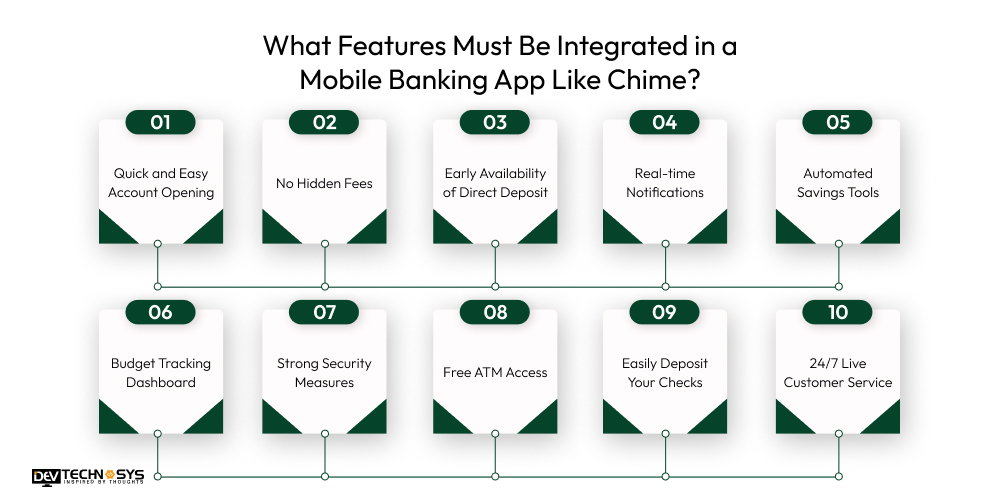
1. Quick and Easy Account Opening
Users can open an account in just a few minutes with our quick sign-up process, quick verification of identity, little to no documentation, and instant approval.
2. No Hidden Fees
One of the keys to building customer loyalty and trust is through transparency in our pricing model, such as no monthly account maintenance fees and no overdraft fees.
3. Early Availability of Direct Deposit
Users will have early availability on paychecks, which may be up to 2 days sooner than typically available, for improved cash flow and bill payment.
4. Real-time Notifications
The Klarna app allows users to receive instant notifications for transaction approvals and deposit/withdraw/yr transfers, as well as for attempted fraud and suspicious transactions.
5. Automated Savings Tools
Users are encouraged to develop good savings habits by providing tools to round purchases and automatically move small amounts to their savings account, and establish new savings habits.
6. Budget Tracking Dashboard
A comprehensive budget tracking dashboard provides visualizations of spending patterns and budgets, and gives users a summary of how much they spent monthly.
7. Strong Security Measures
Users are protected against unauthorized access using two-step authentication (2FA), biometric login, and encryption, as well as by monitoring for fraudulent transactions.
8. Free ATM Access
There are thousands of surcharge-free ATMs across the United States that allow users to withdraw cash without paying a fee.
9. Easily Deposit Your Checks
Instead of going to a banking branch to deposit paper checks, users can simply deposit their checks by taking a picture through the mobile banking app.
10. 24/7 Live Customer Service
Attentive, around-the-clock support is available through chat, email, and phone to help assist users quickly and efficiently with any concerns or issues that may arise.
10 Best Mobile Banking Apps Like Chime
Chime is not only one best preferences to build a mobile banking app. There are many Chime alternatives available that have gained huge popularity and success. Let’s observe the top mobile banking apps and select one as per your preference and requirement.
App Name |
Approx. Downloads |
User Rating |
Launch Year |
Platform Availability |
| MoneyLion | 5M+ | 4.2 | 2013 | iOS, Android |
| Dave | 5M+ | 4.5 | 2017 | iOS, Android |
| Cash App | 100M+ | 4.7 | 2013 | iOS, Android |
| Brigit | 1M+ | 4.3 | 2016 | iOS, Android |
| Varo Bank | 5M+ | 4.5 | 2015 | iOS, Android |
| Current | 1M+ | 4.6 | 2017 | iOS, Android |
| SoFi Money | 1M+ | 4.4 | 2011 | iOS, Android |
| N26 | 7M+ | 4.5 | 2013 | iOS, Android |
| Revolut | 20M+ | 4.4 | 2015 | iOS, Android |
| Ally Bank | 5M+ | 4.6 | 2009 | iOS, Android |
1. MoneyLion
MoneyLion is an app that combines the capabilities of mobile banking and financial wellness by providing checking accounts, credit-building loans, and investment opportunities.
Cash advance app like Moneylion provides budgeting tools, offers rewards for making purchases, and gives users access to their direct deposits before most people do.
2. Dave
Dave is a personal mobile finance app that was created to help individuals avoid overdrafts on their bank accounts and to provide them with small cash advances. If businesses build an app like Dave, it offers features like budgeting tools, the ability to receive your paychecks early, and reminders for upcoming payments.
3. Cash App
Cash App has become one of the leading applications to act as both a digital wallet and a payment processor. An app like Cash enables users to perform peer-to-peer payments, banking, and investing functions. Users can easily send money to someone else or receive money from someone else using the application and the Cash Card, which is free of charge.
Industry Insights:
According to the Yellow, by some industry estimates, Chime is one of the largest neobanks in the U.S. by user count and market penetration.
4. Brigit
Brigit is a smartphone banking app that offers users cash advances, budgeting help, and overdraft protection. Users can avoid late payment fees by using this app when they need cash quickly. If entrepreneurs build an app like Brigit, it allows users to keep track of their spending habits by providing tools to help lessen their financial stress.
5. Varo Bank
Varo Bank is an online-only bank that provides customers with no fees for both checking and savings accounts. Varo helps customers manage their money through early direct deposit, high-yield savings options, budgeting support, etc. With a focus on providing customers with digital tools that allow them to easily manage their finances.

How Much Does it Cost to Build a Mobile Banking App Like Chime?
The cost to develop a mobile banking app like Chime with simple features ranges from $8,000 to $15,000. The mid-complex digital banking app lies between $15,000 and $20,000.
Creating a fully-featured or AI-powered application takes around $25,000 or higher ewallet app development cost. It also includes key factors that can affect the cost, such as features, functions, project complexity, backend infrastructure, deployment platforms, and many more.
App Type |
Features Included |
Estimated Cost (USD) |
| Basic MVP Banking App | Login, account dashboard, transaction history, basic transfers | $8,000 – $12,000 |
| Standard Banking App | All MVP features + bill payments, push notifications, API integrations | $12,000 – $18,000 |
| Advanced Banking App | All standard features + card management, budgeting tools, enhanced security | $18,000 – $25,000 |
What Factors Can Affect the Mobile Banking App Development Cost?
Several key factors influence payment app development costs, including development location, type of developer, app complexity and features, platform choice, and security or regulatory compliance. Each factor affects time, resources, and technical requirements, shaping the overall project budget and delivery timeline.
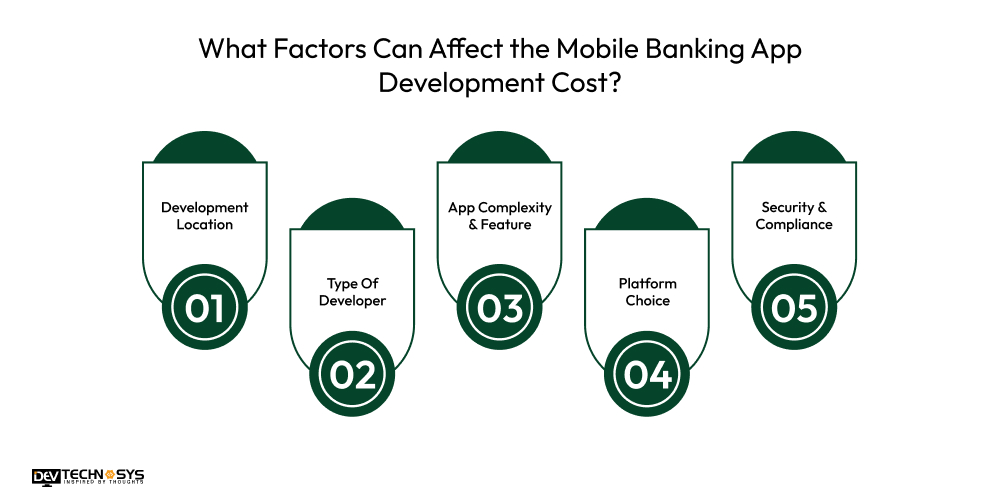
1. Development Location
The area where developers are based has an impact on the cost of money transfer app development . Developers in North American or Western European countries typically charge higher fees for their services than those from Asia or Eastern Europe. The overall cost to develop a mobile app may also be affected by the presence of local labour laws, taxation, and other operational costs.
Location |
Estimated Project Cost Impact |
Reason |
| North America | $10,000 – $15,000 | High labor cost |
| Eastern Europe | $8,000 – $14,000 | Moderate rates |
| Asia (India, Vietnam) | $5,000 – $8,000 | Low-cost development |
2. Type Of Developer
When you are trying to decide on a developer for your project, you may have to choose between a freelancer, an in-house team, or an app development agency.
Freelancers tend to be the cheapest alternative, but can require more management than an agency or an in-house team would. Agencies will provide more experience as well as have structured processes for developing apps, but charge correspondingly higher rates.
Developer Type |
Estimated Project Cost Impact |
Reason |
| Freelancers | $3,000 – $4,500 | Low overhead |
| Small Development Agency | $5,000 – $7,000 | Structured team |
| Established Agency | $7,000 – $8,500 | Full-service team |
3. App Complexity & Feature
The types of features and their complexity will directly impact the cost of development. Features such as core banking feature sets may require a significant amount of effort to complete due to the level of technical background required to implement those basic functionalities.
In addition, advanced features will increase the amount of time it takes to complete your project and therefore increase the overall mobile banking app development cost.
Complexity Level |
Estimated Project Cost Impact |
Reason |
| Basic | $4,000 – $5,000 | Simple features |
| Medium | $5,000 – $7,000 | Moderate features |
| Advanced | $7,000 – $9,000 | Complex features |
4. Platform Choice
If you choose to develop for either iOS or Android, there will be some cost differences. Developing for multiple platforms will result in an increase in the amount of code necessary, as well as an increase in the amount of testing and maintenance to meet all platforms’ requirements and support. In some instances, native apps may perform better, but will incur higher associated costs than hybrid applications.
Platform |
Estimated Project Cost Impact |
Reason |
| iOS Only | $5,000 – $7,000 | Single platform |
| Android Only | $4,000 – $6,000 | Single platform |
| Cross-Platform | $6,000 – $8,000 | Shared codebase |
5. Security & Compliance
All banking applications have to adhere to regulatory compliance, such as the local Financial Laws, the General Data Protection Regulation (GDPR), and the Payment Card Industry Data Security Standard (PCI DSS).
Thus, building in compliance features, implementing strong encryption/security, and secure authentication require higher levels of investment for development. These security measures can increase the total cost of banking Android app development services.
Security Level |
Estimated Project Cost Impact |
Reason |
| Basic | $0,00 – $1,000 | Standard security |
| Regulatory Compliance | $1,000 – $2,000 | Legal requirements |
| Advanced | $2,000 – $3,000+ | High-end security |
Mobile Banking App Compliance Checklist: GDPR, PCI DSS, BSA & AML Requirements
To ensure secure and proper financial procedures using a mobile banking application. It is necessary to comply with the GDPR, PCI-DSS, BSA, and AML regulations that protect user information from being disclosed or used unlawfully.
Secure user credit card data, allow users to verify their own identities, monitor for fraud, and maintain adequate encryption, access control, and auditing of transactions on the app.
1. GDPR (General Data Protection Regulation)
The General Data Protection Regulation (GDPR) is a European Union regulation that requires organizations to obtain user consent, only collect the minimum amount of personal data necessary, and provide users with access to their personal data, including the ability to delete or transfer it. Organizations must also encrypt personal data and notify users within 72 hours of a data breach.
2. PCI DSS
The Payment Card Industry Data Security Standards (PCI DSS) provide security measures for organizations that process and transmit cardholder data, including the creation of firewalls to limit network access, encryption of cardholder data, and the prohibition of the storage of sensitive authentication data.
According to the neobank app development company, access control measures include the enforcement of strong user access controls with MFA, maintenance of continuous logs, scanning for vulnerabilities, and conducting penetration tests.
3. BSA (Bank Secrecy Act)
The Bank Secrecy Act (BSA) outlines requirements for the reporting of currency transaction reports (CTRs) and suspicious activity reports (SARs). Organizations must have detailed records of transactions to support their regulatory reporting requirements.
It is also important that organizations have a robust KYC program, including identity verification and screening of customers. Organizations must also have an audit trail, risk-based internal controls, and retain records for a minimum period of time.
4. AML (Anti-Money Laundering)
Organizations must have a robust Anti-Money Laundering (AML) program to prevent and monitor financial crimes. This includes using KYC to identify new customers, conducting sanctions and politically exposed person (PEP) screening, and monitoring real-time transactions for suspicious activity. Organizations must identify suspicious activities, including structuring and the rapid movement of funds.
5. Cross-Cutting Security Controls
Implement MFA, use only the access required to perform a task, and use secure authentication methods. Data should be encrypted using strong key management while in transit and at rest. Centralize logging and maintain audit trails.
Ensure mobile app security through the following means: detecting jailbroken devices, using certificate pinning, implementing specific security measures on APIs, and using secure session handling techniques.
Neobank vs. Traditional Bank vs. Digital Bank: What Type of App Are You Actually Building?
Still confused? Many banking sources are available, and you need to find out which source is best suited to your needs and requirements. We provide the difference between Neobank, Traditional Bank, and Digital Bank. This comparison table helps to select the best app type for banking services.
Aspect |
Neobank |
Traditional Bank |
Digital Bank |
| Definition | Fully digital bank with no physical branches | Physical branch-based banking institution | Traditional bank with strong online/mobile services |
| Physical Presence | None | Extensive branch network | Limited or reduced branches |
| Technology | Cloud-native, API-first, mobile-first | Legacy core banking systems | Hybrid (legacy + modern digital layers) |
| User Experience | Fast, app-centric, seamless onboarding | Slower, paperwork-heavy processes | Improved digital UX but still partially legacy-driven |
| Product Offering | Focused (payments, accounts, cards) | Full suite (loans, deposits, wealth, etc.) | Full suite with improved digital access |
| Regulation | Operates via partner banks or its own license | Fully regulated financial institution | Fully regulated financial institution |
| Cost Structure | Low operational cost | High operational cost | Medium to high |
| Examples | Revolut, N26 | JPMorgan Chase, Bank of America | HSBC digital services, DBS digital banking |
| Innovation Speed | Very fast | Slow | Moderate |
How to Generate Money From Mobile Banking Apps Like Chime?
Mobile banking apps generate revenue through interchange fees, premium subscriptions, lending interest, partnerships, and service fees. Creating multiple income streams while offering convenient, digital-first financial services to users.
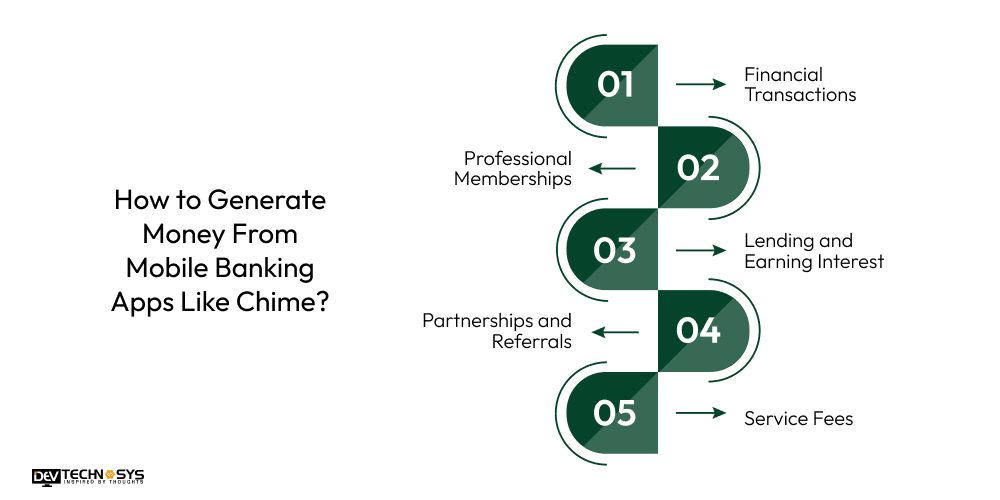
1. Financial Transactions
Mobile banking apps make a profit by collecting fees on debit transactions. When merchants process payments, there is usually a small percentage that is charged as a fee. And part of that fee is passed along to the app developer. Because millions of people use debit cards each day, the total of those fees adds up very quickly.
2. Professional Memberships
Many apps provide free standard membership and then provide a premium membership option for those who are willing to pay a monthly fee for added value.
Those individuals will have access to higher interest rates on savings accounts, receive cash back on purchases, and receive direct deposits earlier than standard members.
3. Lending and Earning Interest
Mobile banking apps can offer various lending programs such as personal loans, credit building, and overdraft protection. The apps charge a fee for the services provided that allows users to take advantage of these lending options while generating consistent income.
4. Partnerships and Referrals
Mobile banking apps can partner with financial institutions to provide their consumers a variety of additional products and services, such as insurance, investment tools, or credit card offerings. The app receives a referral payment when a customer registers with a partner company using the app. The app earns extra income through referrals.
5. Service Fees
While most of their services are free, financial app providers may have some small fees for using an out-of-network ATM or for using special services from an app provider.
These optional fees allow the financial app providers to create an additional source of revenue to keep their core banking features affordable and attractive for everyday consumers.
Conclusion
In this blog, we discussed in detail how to build a mobile banking app like Chime and what functionalities must be added. For businesses, it is a lucrative opportunity to expand their fintech business and reach a global audience. We hope that you got the clarify in building mobile wallet app and which type of features must be integrated.
Connect with a professional mobile banking app development company to develop a customized digital banking app at affordable budget.
Frequently Asked Questions
Find answers to the most common questions related to this article.
The cost to develop a mobile banking app like Chime lies between $8,000 to $25,000 or higher. It can fluctuate due to various factors such as project size, security measures, testing, design UI/UX, backend infrastructure, deployment platforms, and more.
To build an MVP-based banking app like Chime, it normally takes around 2 to 4 months. Building a fully advanced banking apps it takes 6 months or more, based on the factors. It includes features, third-party integrations, project complexity, and more.
To create an app like Chime, follow these development steps:
Market research
Project requirements
Tech stacks
Frontend development
Backend development
Testing
Publish & Maintenance
It includes many advanced tech stacks to make a mobile banking app like Chime:
Java
Python
C++
Ruby
PHP
AngularJS
It includes various core features of Chime alternatives:
Easy account opening
Budget tracking
Strong security measures
Automated savings tools
Free ATM access