

















Key takeaways:
-
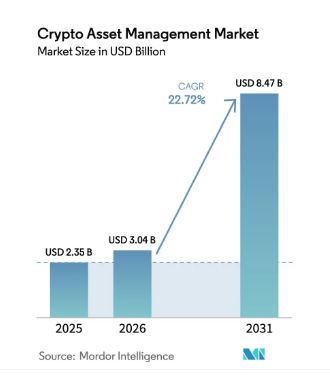
- The crypto asset management market is projected to reach USD 3.04 billion in 2026.
- The cost to develop a crypto asset management software is around $8,000 to $30,000+ dependiing on project complexity, platform type, blockchain architecture, API integration, security requirements, and developer expertise.
- Numerous revenue-generating options are provided by cryptocurrency asset management platforms, including subscription plans, transaction fees, and premium features.
- Strong security features such as encryption, multi-signature wallets, and two-factor authentication are essential for protecting user funds.
“Keep your business revenue on track by developing a crypto asset management software.”
Digital cryptocurrencies like various tokens and coins are extensively used at global level due to their high security. People require a management platform that easily holds these assets and delivers valuable interests. By looking at this scenario, businesses have started investing money to develop crypto asset management software for their audiences.
For small entrepreneurs, before starting the development, it is important to know what is digital asset management software. Once they have understood the concept deeply, then it will be easy for them to initiate the development process.
Let’s learn about this software in this blog along with its development process, cost, features, and other related factors.
What is Crypto Asset Management Software?
A digital tool called crypto asset management software helps users to safely monitor, control, and invest digital assets across several wallets and exchanges. It helps users to understand what is digital asset by providing tutorials.
Businesses must use smart contracts development services to offer functions like analytics, tax reporting, automated rebalancing, and real-time portfolio monitoring. These crypto investment platform serve individual investors looking to handle cryptocurrency assets in an intelligent, safe, and effective manner.
- The Crypto Asset Management Market size is projected to reach USD 3.04 billion in 2026, and USD 8.47 billion by 2031, growing at a CAGR of 22.72% from 2026 to 2031
- By type, services are forecast to expand at a 24.22% CAGR through 2031.
- By deployment mode, hybrid architectures are projected to grow at 23.83% CAGR through 2031.
- By end-user industry, healthcare is anticipated to rise at a 24.20% CAGR through 2031.
- By user type, corporate treasuries are set to climb at a 23.91% CAGR through 2031.
How Crypto Asset Management Software Works?
Users may track their bitcoin portfolios from a single platform with the aid of crypto asset management software. It provides financial reporting, automation, and real-time insights by integrating wallets:
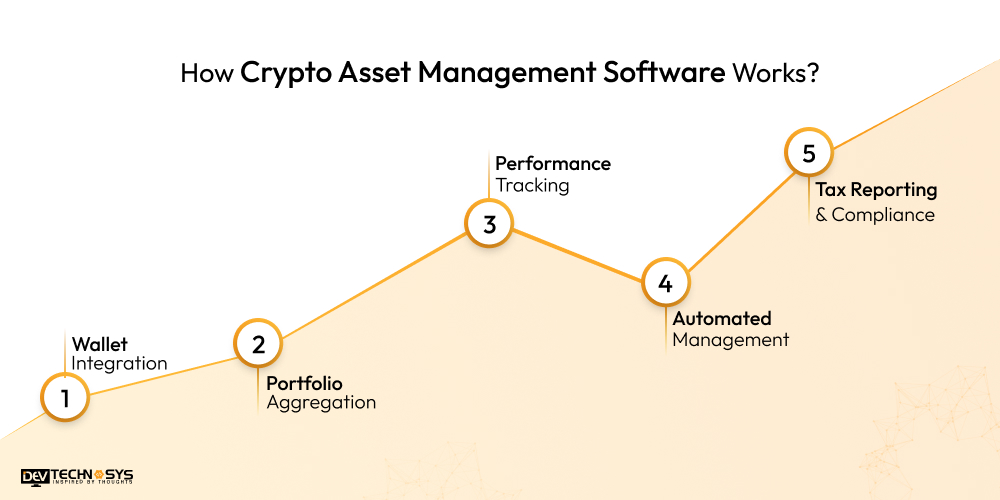
1. Wallet Integration
Through public APIs, crypto asset managers establish connections with numerous wallets and exchangers. This makes it possible for balances, transactions, and asset holdings to sync in real time across platforms.
2. Portfolio Aggregation
A cryptocurrency portfolio management system creates a single dashboard by combining data from all connected sources. Users may see the asset allocation, overall portfolio value, and past performance.
3. Performance Tracking
You can develop crypto wallet apps like Trust Wallet that monitors the growth of portfolios and the performance of individual assets. It provides price movement charts, ROI, and gains/losses as measures.

4. Automated Management
It is important to know how to hire a crypto trader that enables users to automate processes like staking, trading, and portfolio rebalancing. It helps to lessen manual labor and optimize asset allocation.
5. Tax Reporting & Compliance
Crypto finance software uses crypto financial services to analyze transaction history, earnings and losses, and staking rewards to produce tax returns. It facilitates yearly crypto tax filing and assures local tax regulations.
Why Invest in Crypto Asset Management Software Development?
There is a growing need to create crypto asset management software that is safe and interactive. As people are using multiple cryptocurrencies, investment is the best choice for businesses:
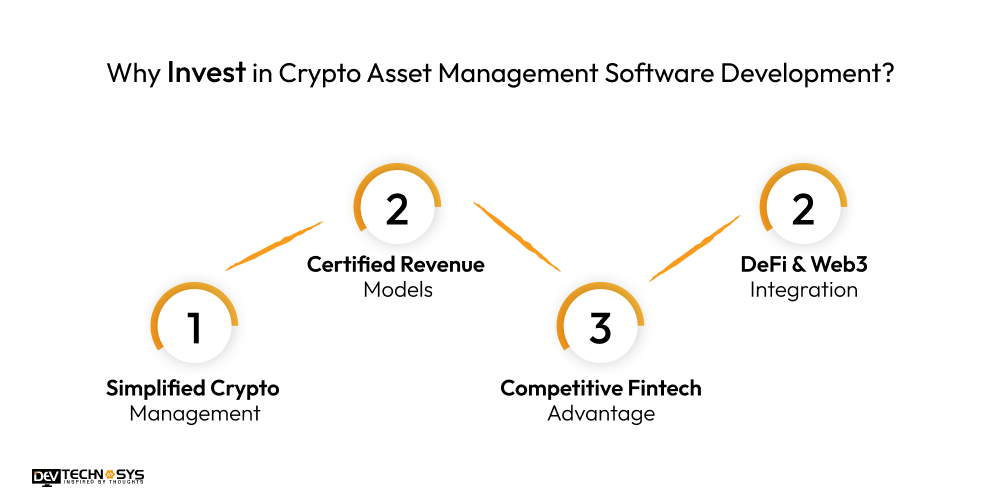
1. Simplified Crypto Management
Users can manage cryptocurrency holdings across several wallets and exchanges through crypto asset management services. Crypto is now available to both novices and experts with a centralized platform that makes tracking, investing, and monitoring easier.
2. Certified Revenue Models
Subscriptions, transaction fees, premium features, and licensing are all reliable ways for cryptocurrency management software to make money. A crypto exchange software development company helps to get steady revenue sources.
3. Competitive Fintech Advantage
A crypto fund management system provides a clever and safe crypto management solution that establishes businesses as a leader in the finance industry. It sets your company apart and attracts an increasing number of tech-savvy customers.
4. DeFi & Web3 Integration
The investment management software is future-proofed with the integration of DeFi protocols, staking, and NFT support. It optimizes long-term platform value while allowing users to engage in advanced financial ecosystems. So, you need to manage the cost to develop crypto asset management software.
Role of AI in Developing Crypto Asset Management Software
The functionality, security, and user experience of crypto asset management software are all improved by artificial intelligence. AI facilitates more intelligent decision-making and automation, from fraud detection to predictive analytics.
An assets tokenization development company helps to make the platform smarter and more competitive. It streamlines operations, lowering risks, and optimizing portfolios.
- Predictive Analytics: Forecasts market trends and asset performance using historical data.
- Portfolio Optimization: Crypto analytics platform suggests ideal asset allocations based on user goals and risk tolerance.
- Fraud Detection: Identifies suspicious activities and potential threats in real time.
- Trading Automation: Powers intelligent bots for executing trades based on AI strategies.
- Natural Language Processing: Enhances user support via AI-driven chatbots.
How to Create Crypto Asset Management Software?
In this section, we will understand the process to develop crypto asset management software. So, businesses can easily adjust their budget requirements without any delay:
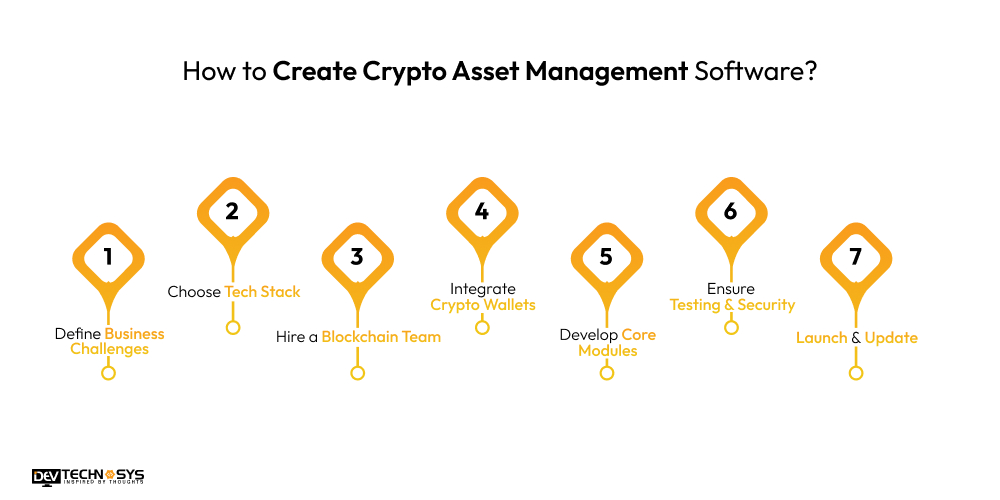
1. Define Business Challenges
Determine your target audience like asset managers, institutions, or individual investors to create crypto asset management software. Choose the issues that your program will address, such as incomplete portfolio tracking, a subpar user interface, or a lack of automation.
Describe revenue models, regulatory requirements, and features by availing trading platforms development services. Your product’s functional scope and vision are shaped at this stage.
2. Choose Tech Stack
Choose a tech stack to make crypto asset management software that facilitates security, high performance, and scalability. While Node.js or Python are good choices for backend APIs, frontend frameworks like React or Angular guarantee a responsive user interface.
When making crypto or blockchain asset management platform, take into consideration Solidity for smart contracts, Web3.js, and Ethers.js for blockchain connection. Depending on your data demands, pick a database such as PostgreSQL or MongoDB.
3. Hire a Blockchain Team
You can hire an asset tokenization platform development company with expertise in DeFi protocols, security best practices, and crypto development. DevOps, QA testers, blockchain engineers, and frontend and backend developers are required.
Hiring qualified experts guarantees regulatory compliance, wallet integration, and smart contract security. Depending on your budget, select between agency, freelance, or in-house developers.
4. Integrate Crypto Wallets
Permit users to link hardware wallets like Ledger or various wallets like MetaMask and Trust Wallet. To provide data sync and safe access, use proprietary APIs with crypto asset management services. Verify that both hot and cold wallet storage and connections are supported by the platform.
To avoid breaches, make sure that encryption and safe key management procedures are in place. Provide multi-wallet tracking to enhance portfolio visibility and user experience.
5. Develop Core Modules
You can contact a crypto management company to create the necessary components, like the trade interface, tax calculator, dashboard, portfolio tracker, and alerts. Analytics, real-time data feeds, and user-friendly design should all be supported by each module.
Use AI-powered solutions for implementing crypto management platform development services. Assure cross-platform and multi-currency compatibility.
6. Ensure Testing & Security
Perform thorough testing like end-to-end performance tests, integration tests, and unit tests. Data encryption, multi-factor authentication, and smart contract audits are all provided by a crypto management company. To find vulnerabilities, use penetration testing to mimic real-world attacks.
Make sure local crypto legislation and international requirements like GDPR are followed. Test the dependability of APIs and wallet integrations under varied load conditions.

7. Launch & Update
A smart contracts development company helps businesses to install the program on a scalable, safe cloud platform. Resolve issues, enhance functionality, and publish frequent updates in response to user demands and industry developments.
The cost to build crypto asset management software can be reduced by using analytics tools. Assure users of round-the-clock assistance and documentation.
Case Study: METACADE
The Metacade Web3 gaming platform project was delivered by a cross-functional team of approximately 12 skilled developers. The development lifecycle took around 4 to 6 months, covering ICO integration and gaming ecosystem development. During development, our team addressed challenges such as scalability issues and seamless integration of play-to-earn mechanics efficiently through rigorous security audits, iterative testing, and optimized smart contract architecture.
- Navneet Rajput (Delivery Manager)
Incredible Features of Crypto Asset Management Software
Software for managing cryptocurrency assets has strong features that make investing in digital assets safe. These tools are designed to benefit both individuals and organizations in an easy manner:
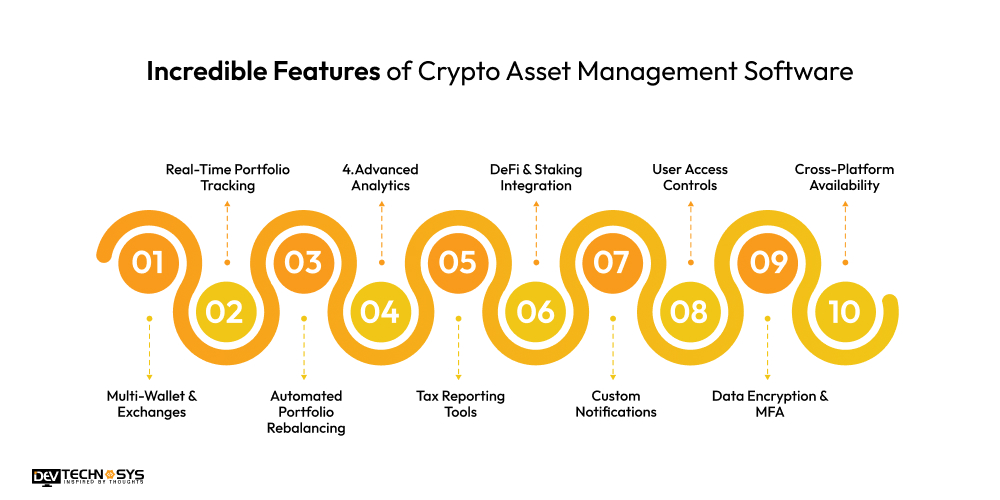
1. Multi-Wallet & Exchanges
A crypto wealth management system uses public keys to establish connections with several wallets. This makes managing all cryptocurrency assets easier by centralizing them into a single dashboard.
2. Real-Time Portfolio Tracking
Crypto portfolio management software keeps associated accounts’ prices, balances, and asset performance up to date. Crypto portfolio tracker enables consumers to make prompt judgments using precise, real-time data.
3. Automated Portfolio Rebalancing
There are most popular cryptocurrencies that automatically modify portfolio allocations in accordance with risk tolerance. This preserves the ideal allocation of investments while lowering physical labor.
4. Advanced Analytics
A crypto advisor app offers indicators like market comparisons, historical trends, asset volatility, and return on investment. This enables users to optimize their investing strategy and make proper decisions.
5. Tax Reporting Tools
A crypto fund management system keeps track of gains and losses, transaction history, and produces tax reports. It makes crypto tax filing easier and aids in preserving regulatory compliance.
6. DeFi & Staking Integration
Cryptocurrency asset management software facilitates staking from the platform and participation in DeFi protocols. It enables customers to manage their investments in one location and generate passive income.
7. Custom Notifications
Crypto trading platform notifies users when there are changes in the price, trade executions, balance, or portfolio. It keeps consumers informed and enables them to take prompt action in a dynamic market.
8. User Access Controls
Businesses can create a centralized crypto exchange like Bitstamp that gives groups in charge of shared portfolios. This guarantees authorization of trading and withdrawals by users.
9. Data Encryption & MFA
Users can hire crypto traders using multi-factor authentication and advanced encryption to safeguard user information and money. This increases protection against illegal access, phishing, and hacking.
10. Cross-Platform Availability
A digital assets cryptocurrency app is available on desktop and mobile for managing and monitoring a portfolio while on the road. It offers a smooth user experience across operating systems and devices.
Top Crypto Asset Management Software in the USA
Some of the best platforms for investing in tokenized assets are becoming popular in the USA. These systems provide robust financial management features, real-time tracking, and safe custody:
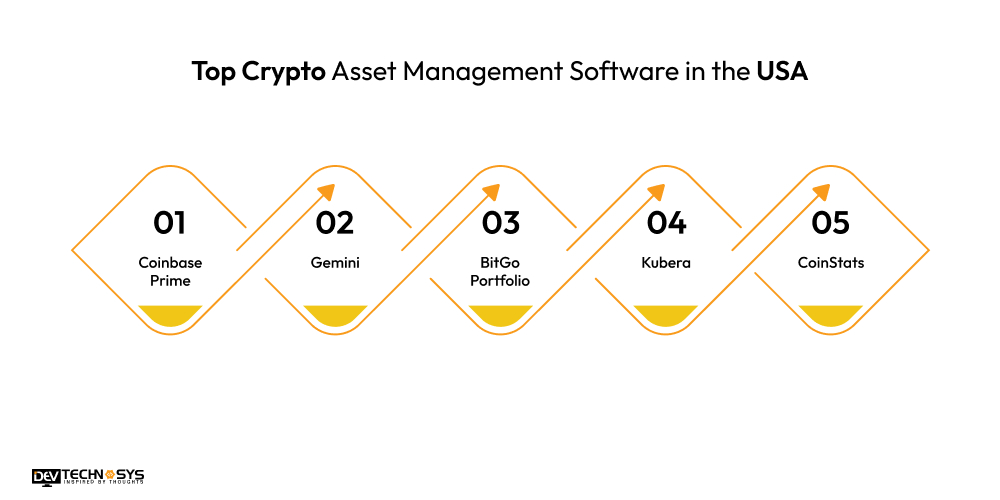
1. Coinbase Prime
Businesses can build cryptocurrency exchange apps like Coinbase that are developed for institutions for enhanced trading, analytics, and secure custody. It provides access to an OTC trading desk, substantial liquidity, and regulatory compliance.
- Offers secure cold storage.
- Provides algorithmic trading tools.
2. Gemini
Gemini is one of the best crypto asset managers that offers integrated trading, custody, and DeFi access services that are safe and regulated. With tools like ActiveTrader and Gemini Custody, it serves both individual and institutional clients.
- Licensed by the NYDFS for insurance protection.
- Users can earn interest with DeFi protocols.
3. BitGo Portfolio
BitGo provides enterprise-level asset management, including cold storage, multi-user access, and comprehensive portfolio reporting. It prioritizes security, insurance, and compliance while supporting more than 300 digital assets.
- Allows institutions to define permissions.
- Offers real-time tracking of digital assets.
4. Kubera
A personal finance dashboard called Kubera keeps track of traditional assets, DeFi, NFTs, and cryptocurrency. A crypto investment firm with high net worth that wants estate planning, privacy, and all-in-one portfolio visibility will find it suitable.
- Aggregates crypto, DeFi, NFTs, bank accounts, and stocks.
- Includes beneficiary settings to manage digital assets.
5. CoinStats
CoinStats is an asset management cryptocurrency platform allowing retail users to track their portfolios across more than 70 wallets and exchanges. Additionally, it provides in-app trading, tax filing, staking, and DeFi tracking.
- Automatically syncs with wallets and exchanges.
- Supports DeFi portfolio tracking.

Tech Stack Used to Develop Crypto Asset Management Software
A strong, safe, and expandable tech stack is necessary for creating crypto asset management software. A cloud computing software development company guarantees high user trust and smooth performance by using proper backend, frontend, blockchain, and security tool combination:
Technology |
Use in Development |
| React.js / Angular | Frontend frameworks used to build responsive and dynamic user interfaces. |
| Node.js | Backend runtime environment for handling real-time API calls and asynchronous tasks. |
| Python | Used for analytics, automation scripts, and integrating AI/ML features. |
| MongoDB / PostgreSQL | Databases for storing user data, transaction logs, and portfolio details. |
| Solidity | Programming language used to develop smart contracts on Ethereum or EVM chains. |
| Web3.js / Ethers.js | Libraries for interacting with blockchain wallets and smart contracts. |
| Firebase / AWS Cognito | User authentication, authorization, and secure identity management. |
| AWS / Google Cloud | Cloud infrastructure to deploy, scale, and manage backend services and data. |
| Stripe / Coinbase API | Used for payment processing and integrating crypto exchange functionalities. |
| Metamask / WalletConnect SDK | Enables wallet connectivity for users to link and manage their crypto assets. |
What is the Crypto Asset Management Software Development Cost?
The cost to develop crypto asset management software is determined by a number of technical and strategic factors. They have a significant impact on the final budget. Planning a scalable, economical development strategy is made easier with an understanding of these factors:
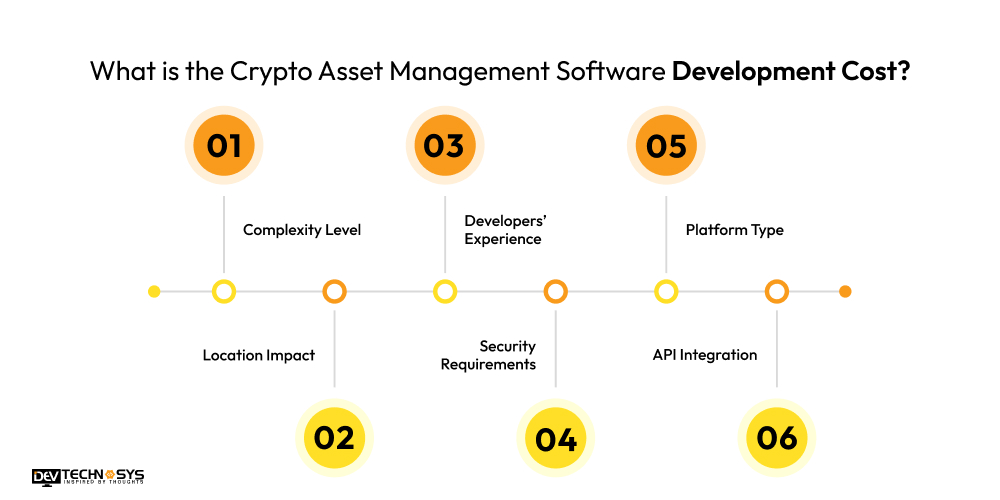
1. Complexity Level
Addition of features like tax automation, DeFi connectivity, and real-time tracking affects the cost to develop a crypto trading app. While full-featured apps with AI or analytics demand more time and resources, basic platforms are less expensive.
Software Complexity |
Development Time |
Estimated Cost |
| Simple | 2-5 months | $5000-$10000 |
| Moderate | 5-8 months | $10000-$15000 |
| Complex | 8-12 months | $15000-$20000 |
| Premium | More than 12 months | $20000-$25000 |
2. Location Impact
North America and Western Europe usually have the highest developer rates, whereas Eastern Europe and Asia have lower prices. But in Asian countries the cost to build crypto asset management software is less, but quality control becomes crucial. Hybrid teams provide a cost-quality balance.
Impact of Location |
Estimated Cost |
| USA | $25000-$30000 |
| Australia | $20000-$25000 |
| India | $5000-$12000 |
| UK | $15000-$20000 |
| UAE | $8000-$15000 |
| Brazil | $12000-$16000 |
3. Developers’ Experience
The assets tracking software development cost is affected due to the experience of developers in wallet integration, smart contracts, and crypto security. Hiring junior engineers could reduce money, but it could also lead to costly mistakes or longer timeframes.
Experience Level |
Cost Estimation |
| Junior/Entry-Level | $8000-$12000 |
| Mid-Level/Experienced | $12000-$16000 |
| Senior/Expert | $16000-$20000 |
| Professional | $20000-$24000 |
4. Security Requirements
In crypto software, security is a must and has a big impact on the overall crypto asset management software development cost. The development rate increases as the security layer increases with the number of compliance and protection layers you add.
Security Component |
Estimated Cost |
| End-to-End Data Encryption | $3,000 – $8,000 |
| Multi-Factor Authentication | $2,000 – $5,000 |
| Cold Wallet Integration | $5,000 – $10,000+ |
| Penetration Testing & Audits | $7,000 – $15,000+ |
5. Platform Type
The crypto wallet development cost is less for one platform as opposed to several platforms at once. They can save money, cross-platform solutions like Flutter or React Native may restrict advanced native features. Platform-specific differences in UI/UX design have an effect on the overall budget.
Platform Choice |
Estimated Cost |
| Web App | $10,000-$15,000 |
| Mobile App | $15,000-$18,000 |
| Desktop App | $18,000-$20,000 |
6. API Integration
Integration, testing, and maintenance take time for each API, particularly when synchronizing with real-time data. The crypto asset management software development cost and ongoing support is directly impacted by the quantity and kind of APIs used.
API Integration Component |
Estimated Cost |
| Exchange Integration (e.g., Binance) | $4,000 – $7,000 |
| Wallet Integration (e.g., MetaMask) | $3,000 – $5,000 |
| Price & Market Data Feeds | $2,000 – $4,000 |
| Tax/Accounting APIs (e.g., CoinTracking) | $3,000 – $6,000 |
How Long Does it Take to Develop Crypto Asset Management Software?
The development timeline for crypto asset management software varies based on feature depth, security requirements, third-party integrations, and scalability goals. Simple MVPs are faster to build, while advanced platforms require extensive development, testing, and compliance integration before launch.
| Complexity Level | Timeline | Key Features |
| MVP | 2 to 4 months | Basic portfolio tracking, wallet integration |
| Mid-Level | 4 to 7 months | Exchange APIs, analytics, alerts |
| Advanced | 7 to 12+ months | AI insights, Multi-signature wallets, DeFi support, enterprise security |
How to Monetize Crypto Asset Management Software?
Numerous revenue-generating options are provided by cryptocurrency asset management platforms. You may create a business strategy that is both scalable and sustainable by utilizing these techniques:
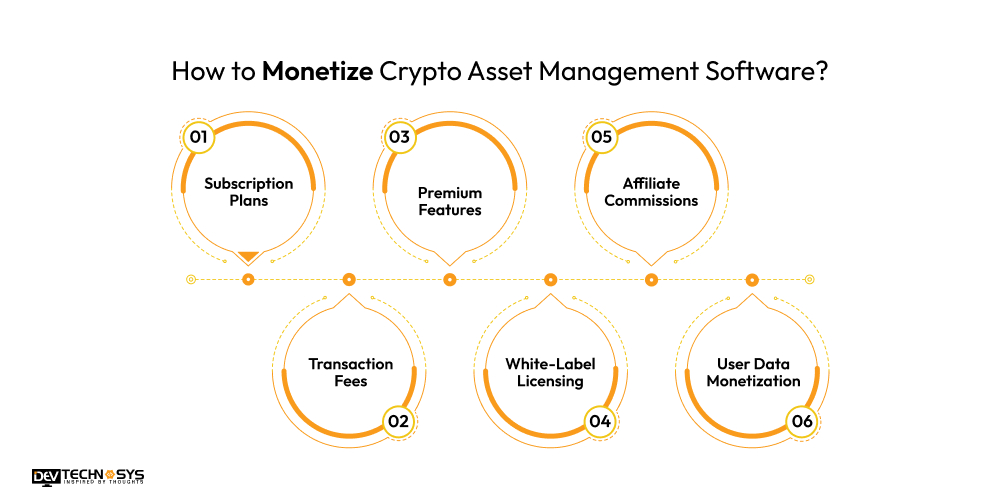
1. Subscription Plans
Crypto asset managers provide tier-based subscription plans that grant access to varying degrees of support and features. Based on the number of active users, this produces steady monthly or yearly revenue. As your user base expands, it also makes scaling simple.
2. Transaction Fees
For transactions, swaps, staking, and portfolio rebalancing charge users a fixed amount. You must target decentralized cryptocurrency exchange development solutions to generate income and promote engagement. This revenue stream can be automated with the aid of exchange API integration.
3. Premium Features
You can balance the cost to develop crypto asset management software by offering advanced features like tax reporting, DeFi dashboards, automated rebalancing, and NFT tracking. Users can utilize these functions helping businesses to increase average revenue per user.
4. White-Label Licensing
Give other fintechs, brokerages, or cryptocurrency companies that wish to start under their brands a license to use your software. High upfront or ongoing license costs are produced by this model. You can make crypto asset management software to increase the product reach through new users.
5. Affiliate Commissions
Earn commissions for each referral or transaction by partnering with a cryptocurrency development company. Use exchanges, wallet services, or tax tools by incorporating this model. You can improve your product and get passive money. Additionally, it creates a network of supplementary sources of income.
6. User Data Monetization
User data may be sold for analytics, market insights, or API access to outside financial products with user permission. You can build crypto asset management software to generate revenue without compromising user experience. Ethical implementation requires adherence to privacy laws.

Let’s Summarize!!
It is a rising moment for businesses to develop crypto asset management software and start a popular brand in the market. There are several things that entrepreneurs need to understand before making investment in the development of crypto exchange software:
- The first thing is to manage the cost to build crypto asset management software.
- Target suitable blockchain solutions for software development.
- Approach the best asset tracking software development company in your region.
- Ensure monetization after launching the platform.
These points will help you to get certified business growth and assure smooth development of asset management software.
Frequently Asked Questions
1. Are Crypto Asset Management Software Popular in the USA?
Crypto asset management software is becoming more and more popular in the United States. As the use of cryptocurrencies grows, users are looking for safer and easier solutions to manage their diverse portfolios. The leading platforms in the U.S. market are Coinbase Prime, Gemini, and BitGo.
2. How Long Does it Take to Develop Crypto Asset Management Software?
Usually lasting between 4 to 9 months, development duration varies according to complexity. While additional features can add several months, a basic MVP with tracking and wallet integration might take 3 to 4 months.
3. What is the rate of Hiring Crypto Exchange Developers?
Depending on their geography and level of experience, cryptocurrency exchange developers usually charge between $10 and $80 per hour. While overseas teams may provide reduced rates, top-tier blockchain developers headquartered in the US or the EU may charge even more.
4. How Maintenance is Ensured for Crypto Asset Management Software?
- Regular Updates: Provide updates for new blockchain integrations.
- Security Monitoring: It helps to detect vulnerabilities and security patches.
- API & Exchange Syncing: Ensures compatibility with APIs and wallet protocols.
5. Is it Safe to Use Crypto Asset Management Software?
Yes, the platform uses robust security measures like encryption, multi-factor authentication, and cold storage for security. Reputable software companies also carry out third-party audits and adhere to standards. Users should still investigate and adhere to crypto security best practices, nevertheless.
6. How to Reduce the Crypto Asset Management Software Development Cost?
- MVP Development: Focus on core features and add advanced tools.
- Use Open-Source APIs: Leverage existing tools for wallet integration.
- Outsource Smartly: Hire experienced blockchain developers from affordable regions.