
















Key Takeways:
The cost to develop a DEX platform is around $8,000 to $25,000, which basically depends on the backend processes, blockchain networks, features, functions, project size & complexity, and more.
Cost Influenced by DEX Development Complexity:
-
- Starter/MVP DEX Platforms ($8,000 – $13,000): Includes wallet connectivity, token swapping, liquidity pool setup, smart contract deployment, and a basic governance dashboard.
- Intermediate DEX Platforms ($13,000 – $20,000): Comes with yield farming, staking modules, token listing systems, analytics dashboards, liquidity aggregation, and improved UI/UX optimization.
- Enterprise-Scale DEX Platforms ($25,000+): Supports cross-chain interoperability, DAO governance, perpetual trading, automated market maker (AMM) customization, AI-powered insights, and institutional liquidity management.
Cost Based on DEX Models:
-
- AMM-Based DEX Development: $18,000 to $25,000
- Order Book DEX Development: $15,000 to $20,000
- Cross-Chain DEX Platform: $20,000 to $25,000
- Aggregator DEX Development: $14,000 to $22,000
- Perpetual & Derivatives DEX: $16,000 to $23,000
Cost Based on Development Regions:
-
- North America: $20,000 to $30,000, depending on security and compliance standards
- Europe: $18,000 to $24,000 based on protocol complexity and legal structure
- Asia: $8,000 to $23,000, depending on blockchain stack and development expertise
Additional Expenses:
- Ongoing Maintenance: Usually 10% – 20% of the total basic decentralized exchange development cost annually.
- Smart Contract Audits & Security: Budget may increase due to penetration testing, bug bounty programs, liquidity protection mechanisms, multi-signature wallet integration, and external smart contract audits.
In 2026, decentralized exchanges (DEXs) will no longer be created only by big companies in the blockchain industry; startups, fintechs, and Web3 founders are actively building DEX platforms to meet the increased need for secure, open access to decentralized crypto marketplaces.
Still, many businesses continue to ask the same question about white-label DEX development costs:
There is no single answer to this question because many different factors will shape the total custom DEX development cost. These include platform architecture, blockchain type, security characteristics, development of smart contracts, UI/UX, integration of liquidity sources, and ongoing support and maintenance.
Therefore, a simple DEX with basic trading features may cost a fraction of the amount for a sophisticated exchange that supports cross-chain integration, supports staking, has AI-powered analytics, and includes enterprise-class security solutions.
In this blog, we will provide detailed information about how much DEX development costs and what factors can highly impact it, and much more.
Let’s Go!
What is a Decentralized Exchange?
A decentralized exchange is a peer-to-peer cryptocurrency marketplace that enables users to trade digital assets directly without any central authority or intermediaries. Mainly, DEXs are non-custodial, which allows users to retain control over their funds and private keys.
It includes many advanced features, such as smart contract-driven, non-custodial, no KYC, liquidity pools, and more. The most popular DEX platforms support token swaps, staking, decentralized finance (DeFi), and liquidity pools across multiple blockchain networks.
Planning a Dex Project?
Get a tailored development cost estimate in a few simple steps.
- 3 quick steps
- 100% free
- Reply in 1 business day
2 Minutes Read
What Makes Decentralized Exchange Development a Smart Investment?
Investing in DEX development services would be wise, considering how quickly decentralized finance (DeFi) is growing. They’ll be entering the marketplace through DEXs that deliver a variety of secure, transparent, and scalable solutions for trading. A DEX also eliminates middlemen, minimizes operational costs, and gives consumers full ownership over their digital tokens.
DeFi offers users the benefits of global accessibility, rapid transaction speeds, and increased anonymity while utilizing DEXs for transactions. Companies that offer decentralized financial services will see an increase in demand, which means that they’re likely to build their business and generate additional long-term revenues via trading fees, liquidity offerings, and staking models.
What Is The Cost To Develop A Decentralized Exchange Platform?
The cost to build a DEX platform is around $8,000 to $25,000, which is a higher cost. There are various factors that can impact the total budget, such as blockchain networks, project size, development team, backend infrastructure, security audits, UI/UX design, and more. The main cost-affecting factor is the type of DEX platforms, because every type has different services and functionality.
It also involves many additional factors, such as maintenance services, tech stacks, third-party integrations, and many more to affect the cost of decentralized exchange development services.
DEX Development Type |
Estimated Cost (USD) |
Key Inclusions |
| Basic / MVP DEX | $8,000 – $13,000 | Crypto token exchange, wallet integration, basic smart contracts, liquidity pools, simple UI |
| Mid-Level DEX | $13,000 – $20,000 | Advanced trading features, staking, yield farming, analytics dashboard, improved UX/UI |
| Enterprise DEX | $25,000+ | Cross-chain support, DAO governance, perpetual trading, AMM customization, scalability tools |
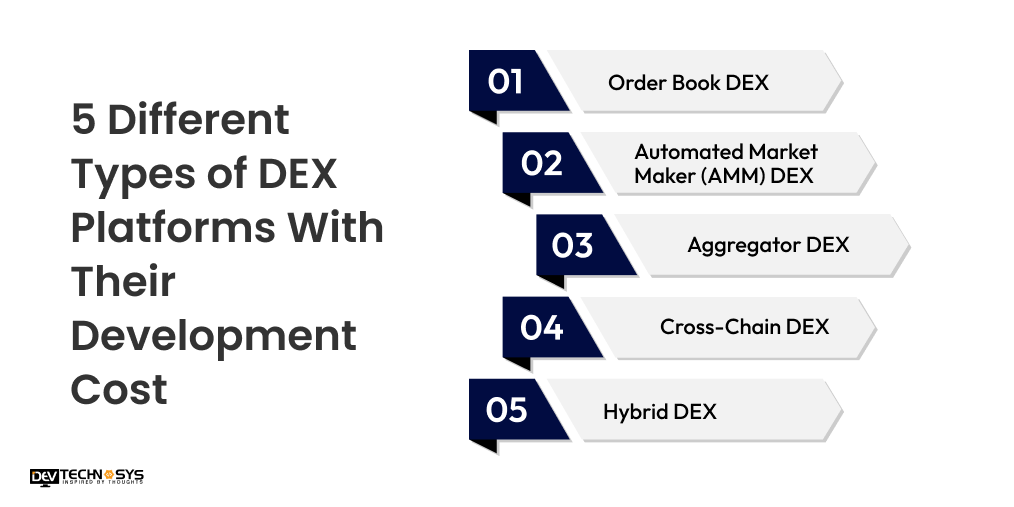
5 Different Types of DEX Platforms With Their Development Cost
Discover the 5 main types of decentralized exchange platforms, which are Order Book, AMM, Aggregator, Cross-Chain, and Hybrid DEXs. The different types of DEXs offer various means of trading and provide different models of liquidity and blockchain functions that aim to enhance the security, transparency, interoperability, and overall experience for users within the fast-changing decentralized finance market.
1. Order Book DEX
The DEXs with an order book have a way to match buyers and sellers using smart contracts that are responsible for managing a Real-time Trading System. Order book DEXs provide the opportunity to use advanced trading features, such as limit orders and market orders, and are able to provide users with detailed analytics regarding their trades.
2. Automated Market Maker (AMM) DEX
AMM DEXs operate using decentralized liquidity pools as opposed to order books and facilitate the swapping of tokens through smart contracts. This automatically calculates the price of the tokens that are being transacted by evaluating the supply and demand of said tokens. As a result, AMM protocol DEXs are frequently utilized by defi ecosystems for their ease of trading & seamless transaction processes.
3. Aggregator DEX
Aggregator decentralized exchanges connect various DEX platforms to provide maximum efficiency when trading assets and lower transaction costs. By using a multi-source analysis of liquidity providers across all networks to intelligently route an optimized order, it allows for the best possible pricing and lowest possible slippage that a user would incur on an individual exchange platform.
4. Cross-Chain DEX
Cross-chain decentralized exchanges allow for the trading of digital assets across different blockchain networks without requiring the use of centralized intermediaries.
This type of exchange promotes the use of interoperability within the entire blockchain ecosystem and improves access to tokens from different chains, enabling the transfer of digital assets to each other seamlessly.
5. Hybrid DEX
Hybrid decentralized exchanges combine the best features of both centralized types of exchanges with the characteristics of a decentralized type of exchange. More specifically, hybrid decentralized exchanges allow for faster transaction processing than decentralized exchanges, provide users with better liquidity management than both centralized and decentralized exchanges, and provide users with greater control over their digital assets.
DEX Platform Type |
Estimated Development Cost |
Key Features Included |
| Order Book DEX | $10,000 – $20,000 | Real-time trading engine, limit orders, liquidity management, advanced on chain trading tools |
| AMM DEX | $14,000 – $24,000 | Liquidity pools, token swaps, yield farming, automated pricing mechanisms |
| Aggregator DEX | $15,000 – $27,000 | Multi-DEX liquidity aggregation, smart routing, reduced slippage, analytics dashboard |
| Cross-Chain DEX | $18,000 – $28,000 | Blockchain interoperability, bridge integration, and multi-network trading support |
| Hybrid DEX | $20,000 – $30,000 | Centralized speed with decentralized security, high scalability, and enhanced trading performance |
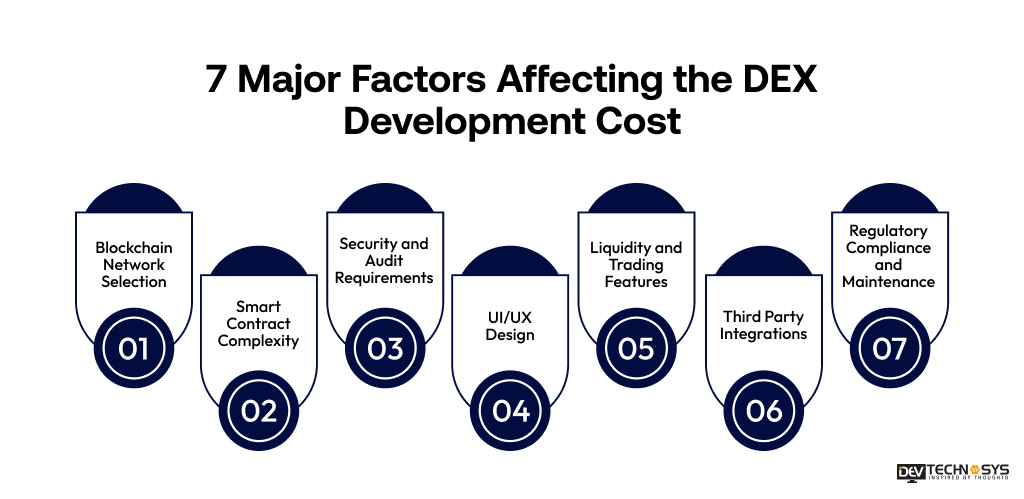
7 Major Factors Affecting the DEX Development Cost
Do you want to build a Dex platform within a fixed budget? Then you must be aware of crucial factors that can highly impact the overall multi-chain Dex development cost. It includes blockchain networks, smart contract complexity, UI/UX design, third-party integrations, and post-launch maintenance services.
1. Blockchain Network Selection
The blockchain you select can greatly affect the cost of DeFi development services. Ethereum tends to have higher gas fees and requires more secure resources for transaction activity as compared to other blockchains like Polygon and Solana, which will help to lower the operational costs of your DEX. Other factors that can impact the complete budget and complexity to create the DEX are scalability.
Network Choice |
Cost Impact |
Estimated Affected Cost |
| Basic blockchain integration | Lower development complexity | $1,000 – $3,000 |
| Multi-chain compatibility | Additional integration effort | $3,000 – $6,000 |
| Cross-chain interoperability | Advanced infrastructure requirements | $6,000 – $8,000 |
2. Smart Contract Complexity
The complexity of the smart contract you create plays an important role in the cost to develop the DEX. If your smart contract has complex features such as automated market makers, staking, yield farming, liquidity pools, and governance systems, the DEX project will require considerably more coding, auditing, and testing. Additionally, more complex logic within the smart contract will result in longer development times.
Smart Contract Features |
Cost Impact |
Estimated Affected Cost |
| Basic token swap contracts | Minimal coding and testing | $1,500 – $3,500 |
| Liquidity pools and staking | Moderate development complexity | $3,500 – $6,000 |
| Advanced DeFi functionalities | High-level security and logic | $6,000 – $9,000 |
3. Security and Audit Requirements
One major factor that influences the overall cost of smart contract development services is the need to implement security measures. Professional audits, pen testing, bug bounty programs, and implementing a comprehensive security stack are all necessary for preventing security breaches and vulnerabilities on the exchange.
If high standards of security are required, the DEX developer must have access to highly skilled and experienced blockchain developers, as well as an independent auditing company.
Security Level |
Cost Impact |
Estimated Affected Cost |
| Basic security testing | Standard vulnerability checks | $1,000 – $2,500 |
| Smart contract audit | Third-party audit services | $2,500 – $5,000 |
| Enterprise-grade security | Comprehensive testing and monitoring | $5,000 – $8,000 |
4. UI/UX Design
The design of a reliable, simple, and attractive user interface can also significantly impact DEX user adoption and overall cost to create a decentralized exchange.
Aspects such as custom dashboards, responsive layout, wallet integration, trading charts, and ease of navigation all require skilled designers and Front-End Developers. While features that enhance the UI/UX experience can lead to greater user engagement, they also increase the amount of time.
UI/UX Scope |
Cost Impact |
Estimated Affected Cost |
| Basic user interface | Simple trading dashboard | $800 – $2,000 |
| Custom responsive design | Improved user interaction | $2,000 – $4,000 |
| Advanced trading experience | Interactive charts and animations | $4,000 – $6,500 |
5. Liquidity and Trading Features
Adding more complex and higher depth trading functionality to a DEX, such as liquidity pools, token swaps, order books, staking functionality, and cross-chain trading capabilities, increases the overall complexity of dApp development services.
Each of these features requires a more complicated backend architecture, as well as the seamless integration of the various blockchain swap protocols.
Trading Features |
Cost Impact |
Estimated Affected Cost |
| Basic token swapping | Standard exchange functions | $1,500 – $3,000 |
| Liquidity pool integration | Additional backend development | $3,000 – $5,500 |
| Advanced trading engine | Real-time and high-volume trading | $5,500 – $8,000 |
6. Third Party Integrations
Many DEX Platforms require integration with third parties, such as wallets, payment processors, analytics tools, APIs, and blockchain Oracles. By integrating services such as MetaMask into a DEX Platform, the overall functionality of the Platform is enhanced; however, this also creates an increased amount of development effort.
The cost to develop a DEX based on blockchain is associated with ongoing compatibility testing, API Management, and ongoing three-party updates over time.
Integration Type |
Cost Impact |
Estimated Affected Cost |
| Wallet integration | Basic external connectivity | $1,000 – $2,500 |
| Oracle and analytics APIs | Enhanced platform functionality | $2,500 – $4,500 |
| Multiple external services | Complex API management | $4,500 – $7,000 |
7. Regulatory Compliance and Maintenance
In order to meet regulatory guidelines in your region, as well as have continued infrastructure support for your DEX over a longer term. The crypto exchange stablecoin development cost will be affected by compliance with your region’s regulations, as well as by continued maintenance on your DEX after launch. For example, KYC, AML, trading volume monitoring, or access to an attorney may be required to comply with local regulations in some places.
Compliance & Maintenance |
Cost Impact |
Estimated Affected Cost |
| Basic maintenance support | Routine updates and fixes | $1,000 – $2,000 |
| Compliance implementation | AML and KYC integration | $2,000 – $4,500 |
| Ongoing enterprise maintenance | Monitoring and legal support | $4,500 – $7,000 |
Real Case Study: Metacade
We created a decentralized gaming platform that allows players to earn cryptocurrency through the mechanisms of GameFi, have wallets, and earn tokens while playing. There were increases in our costs as we were building the platform due to audits of our smart contracts, integration of multiple chains, and making sure we were set up for scaling out with many users on the platform at the same time.
We had to overcome significant challenges related to establishing liquidity, optimizing for gas fees, and testing for security-related issues prior to launching the platform. The platform launched successfully with stable performance, high engagement from users, and smooth play-to-earn experiences for players.
Client Name: Alex Thompson
Team Size: 10 People
Timeline: 32 Weeks
Navneet Rajpoot
– Project Manager
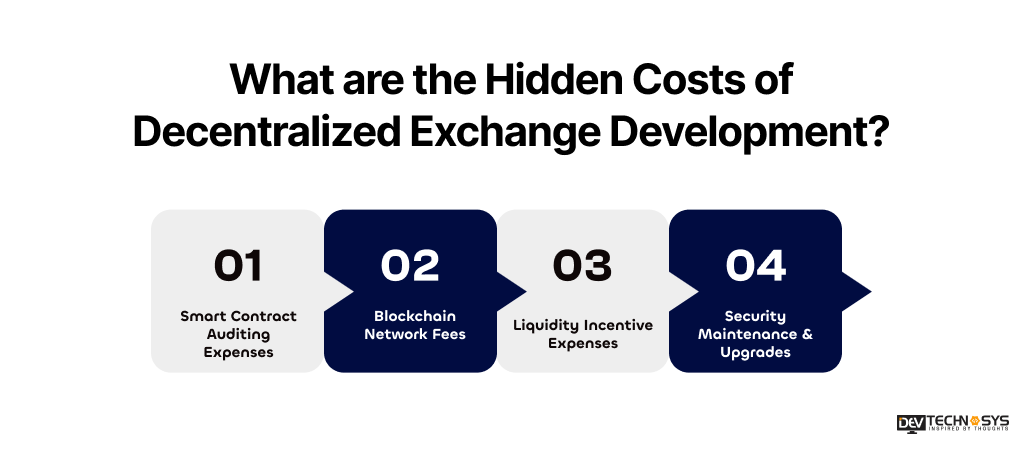
What are the Hidden Costs of Decentralized Exchange Development?
In decentralized exchanges (DEXs), there are often many hidden costs that can exceed what was originally anticipated. Some examples of these costs are: Smart Contract Audits, Gas Fees on the Blockchain, Liquidity Incentives, and Security Maintenance. So, here are the hidden costs in DEX development:
1. Smart Contract Auditing Expenses
Smart contract auditing is critical for protecting funds from hacking/exploitation and ensuring that the contract is safe for users. In addition, a comprehensive third-party auditor’s assessment can be very expensive, particularly when auditing highly technical DEX protocols. Additionally, multiple rounds of audits will substantially contribute to the overall cost of crypto wallet development services.
2. Blockchain Network Fees
When deploying smart contracts and interacting with them on a blockchain (e.g., Ethereum), it is necessary to pay gas fees to the blockchain provider. This can become extremely expensive depending on how busy the network is at the time of the transaction.
The cost associated with gas varies depending on the usage pattern of the network and how the developers designed the network for blockchain scalability.
3. Liquidity Incentive Expenses
To attract liquidity providers to a platform, liquidity provision incentives are often required, either by way of token rewards or by way of yield farming emissions. As such, liquidity provision incentives can create hidden costs of Binance Smart Chain development during the initial growth phase of a platform.
Liquidity provision is necessary in order for trading to be efficient. Therefore, platforms must allocate either budgets or the supply of tokens to maintain efficient trading pools.
4. Security Maintenance & Upgrades
Post-launch operational support for DEX platforms includes fixing vulnerabilities, creating new contracts, maintaining ongoing monitoring and detecting hacking attempts, upgrading existing security protocols, and implementing additional security measures.
Operating costs associated with ongoing security monitoring tools and developer involvement will be significant, as DEXs represent a prime target for cyberattacks.
Planning a Centralized Exchange Project?
Get a tailored development cost estimate in a few simple steps.
- 3 quick steps
- 100% free
- Reply in 1 business day
2 Minutes Read
Layer 2 vs. Ethereum Mainnet DEX: Cost Difference Breakdown
A decentralized exchange (DEX) can be built on the Ethereum Mainnet; doing so has the benefit of providing maximum security and liquidity, but it also has significantly higher transaction costs, deployment costs, and ongoing maintenance costs.
Layer 2 solutions dramatically decrease gas fees and increase scalability while lowering operational costs, providing a much lower cost option for startups that want to support faster transaction times and gain more users.
Cost Factor |
Ethereum Mainnet DEX |
Layer 2 DEX |
| Initial Development Cost | $100K–$150K+ | $50K–$100K+ |
| Smart Contract Deployment | High gas fees ($500–$10,000+) | Low fees ($10–$500+) |
| Transaction Fees for Users | Typically $1–$100+ per transaction | Usually <$0.01–$1 per transaction |
| Liquidity Provision Cost | Higher due to expensive transactions | Lower due to cheaper transactions |
| User Acquisition Cost | Higher friction from gas fees | Lower friction improves onboarding |
| Infrastructure & Operations | Higher node and monitoring costs | Lower operating expenses |
| Scalability | 15–30 TPS | Hundreds to thousands of TPS |
| Maintenance Cost | High due to network congestion considerations | Lower with more efficient transaction processing |
DEX Security and Compliance: What Affects Development Cost?
Ensuring security and compliance at a DEX is crucial for the protection of assets, as well as for smart contracts, transactions, and private data. In order for a DEX to be secured, it needs to do more than just attain security from blockchain technology. In a modern DEX, such elements as smart contract audits, wallet security, reliability of the oracle, compliance with guidelines, and constant supervision should be paid attention to.
1. Security of Smart Contracts
The smart contracts of decentralized exchanges (DEX) are responsible for managing swapping, liquidity pools, fees, and transactions involving tokens. Secure coding practices, as well as automated testing, access controls, vulnerability scans, and independent audits, can avert the possibility of exploits. High-level contract security protects the funds of users and can greatly contribute to the overall associated costs of development.
2. Security of Wallets and Transactions
Secure integration of wallets is beneficial to users when swapping tokens and making transactions on the blockchain. Developers need to perform transaction validation, proper signing, access control, and execution protection. The usage of multiple wallets requires more complicated development, thus increasing expenses.
3. Security of Oracles and Prices
Platforms running on DEXs require oracle infrastructure for price feeds from the outside world to avoid manipulation and fraud. Developers can use trusted data sources, validation methods, and backup processes for this purpose. The introduced measures help reduce the risks related to price formation, but at the same time increase expenses related to system integration, development, and infrastructure.
4. KYC/AML Compliance
The model on which a DEX operates, the types of services that it offers, and the jurisdictions in which it operates will influence whether KYC and AML processes will be needed. Expenses related to KYC and AML compliance may include identity verification, sanctions screening, transaction monitoring, and integration with compliance software. This means a careful assessment of the regulations ought to be conducted prior to finalizing the architecture of the platform.
5. Security Audits & Monitoring
The use of security methods goes beyond launch testing for most DEXs. There is a need for independent audits of smart contracts, penetration testing, vulnerability monitoring, incident response, bug bounty programs, and multiple security checks to assess potential risks. This means ongoing security should be in the budget for long-term security maintenance.
5 Best Decentralized Exchange Platforms: Cost Breakdown
Explore the top 5 decentralized exchange platforms with a clear cost breakdown of development, features, and complexity levels. Understand how leading DeFi protocols differ in architecture, scalability, and investment required to build modern AMM, staking, and multi-chain trading systems.
1. Uniswap
In order to develop a Uniswap type of spot DEX, you must have the smart contracts to perform automated market making, have liquidity pools, and have the swap routing system in place. The primary items to be developed are the front-end UI for the DEX, wallet integration for the DEX & developing the token listing systems.
2. PancakeSwap
DEX platforms like Pancakeswap require BEP-20 token swap contracts, staking contracts, and yield farming modules, as well as gamified features, for example, lottery systems.
Other items that are built into the PancakeSwap platform are dashboard UI, liquidity management tools & integration with the BNB chain infrastructure. The platform is focused on providing low fees for completing transactions.
3. Curve Finance
The development of a Curve Finance-type platform focuses on the creation of an Automated Market Maker Algorithm, with a minimum slippage rate for stablecoin to stablecoin transactions.
Engineering for Curve-type platforms includes developing precise mathematical models for liquidity pool balancing and developing stablecoin-specific smart contracts.
4. dYdX
An exchange that operates similarly to dYdX will require a complex order book architecture, perpetual futures contracts, and risk management engines. However, there are also development components that must be included, from layer-2 scaling integrations to margin trading logic and liquidation systems.
5. SushiSwap
Platforms that operate in a way that mimics SushiSwap’s use of AMM contracts, support for multi-chain deployments, staking and yield farming, and liquidity mining programs will be developed as well.
However, there are also additional components necessary for the development of cross-chain bridges, governance modules, and reward distribution systems.
DEX Type |
Example |
Key Features |
Development Cost Range |
| AMM Spot DEX | Uniswap | Token swaps, liquidity pools, AMM pricing, wallet integration | $15,000 – $23,000 |
| BNB Chain DEX | PancakeSwap | Swaps, staking, yield farming, lotteries, low-fee trading | $10,000 – $18,000 |
| Stablecoin DEX | Curve Finance | Stable asset swaps, low slippage pools, liquidity optimization | $13,000 – $21,000 |
| Derivatives DEX | dYdX | Perpetual contracts, margin trading, order book, and liquidation system | $20,000 – $28,000+ |
| Multi-chain DEX | SushiSwap | Cross-chain swaps, staking, governance, liquidity mining | $20,000 – $30,000+ |
How to Reduce the Decentralized Exchange Development Cost in 2026?
Reduce Ethereum DEX development costs in 2026 by leveraging white-label solutions, cross-chain infrastructure, smart contract automation, and modular architecture.
Optimize security audits, use open-source frameworks, and integrate scalable liquidity solutions to accelerate deployment, minimize operational expenses, and deliver a secure, high-performance decentralized exchange with faster time-to-market.
1. Start with an MVP Approach
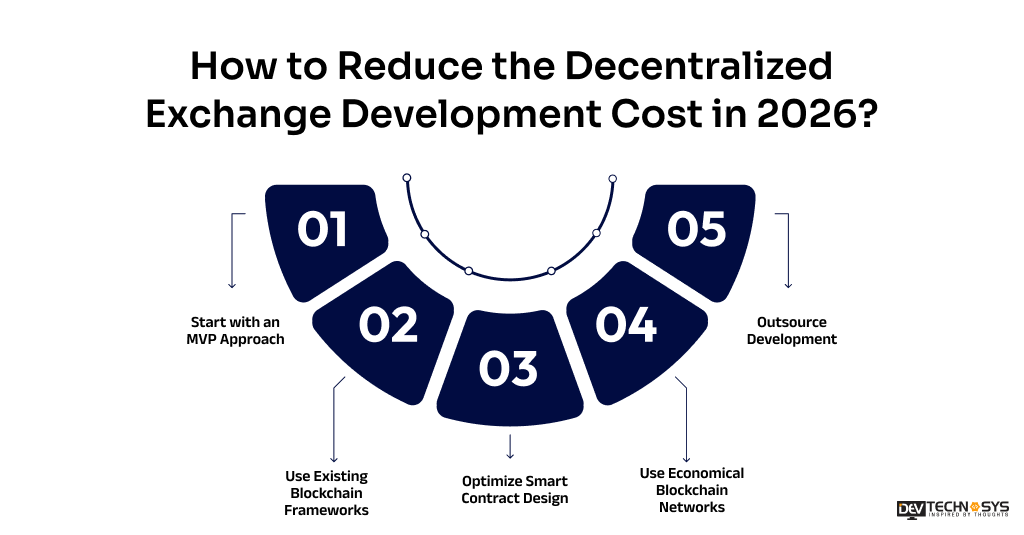
By starting off with a minimal viable product (MVP) approach, you can limit the initial OTC crypto exchange development costs associated with creating your DEX to just the fundamental features of token swap platform, the integration of a wallet, and the creation of liquidity pools. Developing in this manner enables you to avoid unnecessary complexity during the early stages of the project.
2. Use Existing Blockchain Frameworks
Using previously built frameworks on the blockchain and open-source decentralized finance (DeFi) protocols will reduce both the time and cost to develop a DEX platform.
By using existing smart contracts and libraries that have been built and proven, developers are able to modify existing code, reducing the effort associated with creating code and incurring risks associated with security issues.
3. Optimize Smart Contract Design
Designing smart contracts to be efficient will help reduce gas fees and the cost of deploying to the blockchain. Developers can reduce the transaction cost associated with deploying a DEX by limiting the required computations that are executed within the smart contract itself, as well as by using optimized logic structures.
Additionally, using previously audited, modular contracts will help to lower the costs of P2P crypto exchange development associated with ongoing maintenance.
4. Use Economical Blockchain Networks
Building and operating DEXs on low-cost or layer two blockchain networks will significantly lower the cost to build a decentralized exchange. Developing using networks with good scalability and lower gas fees will minimize costs for both developers and users, making it much cheaper to build, maintain, and operate DEXs at a larger scale.
5. Outsource Development
Employing an experienced cryptocurrency exchange development company to specialized agencies versus employing internal development teams will result in lower overall costs and development times. Experienced teams minimize development cost by avoiding development errors, delivering faster, and having previously developed reusable components, templates, frameworks, and security practices.

White-Label vs. Forked DEX vs. Custom DEX: Complete Comparison
White-label is basically for beginners to launch an instant DEX platform on a cheaper budget. Forked DEX uses existing open-source code with room for customization. Custom DEX is most expensive because of advanced functionalities, but it also offers flexibility, reliability, security, and more.
Feature |
White-Label DEX |
Forked DEX |
Custom DEX |
| Development Cost | $10K–$50K | $30K–$150K | $150K–$1M+ |
| Time to Launch | 2–6 Weeks | 1–4 Months | 4–12+ Months |
| Customization | Limited | Moderate to High | Unlimited |
| Code Ownership | Vendor-Controlled | Full Ownership of Modified Code | Complete Ownership |
| Security | Vendor-Tested | Requires New Audit | Built & Audited from Scratch |
| Scalability | Moderate | High | Very High |
| Maintenance Cost | Low | Medium | High |
| Best For | MVPs & Startups | Growing DeFi Projects | Enterprises & Innovative Protocols |
How Long Does it Take to Create a Decentralized Exchange Platform?
To develop a crypto trading app or decentralized exchange, it can take anywhere from 3 to 6 months, depending on how complicated your DEX will be. For example, an MVP, which would include basic functionalities like token swaps, liquidity pools, and wallet integration, DEX development timeline around 8-12 weeks.
A more advanced platform, such as Uniswap or PancakeSwap clones with additional functionality and multi-chain capabilities, could take anywhere from four to eight months to build. More sophisticated platforms like dYdX that include derivatives, risk management engines, and Layer 2 blockchain scaling could take up to 6 months to design, develop, test, audit, and deploy all parts of the system.
Complexity Level |
Development Time |
Key Build Scope |
| Medium | 8–12 weeks | Token swaps, liquidity pools, wallet integration, basic UI |
| Medium–High | 2–4 months | Swaps, staking, yield farming, lotteries, dashboards |
| High | 3–6 months | Stable asset swaps, low-slippage pools, liquidity optimization |
5 Monetization Models of Decentralized Exchange Platforms
Explore various monetization models utilized by decentralized exchanges (DEXs) in order to create a sustainable DEX revenue model and achieve long-term success.
Different types of monetization methods are all effective ways for DEXs to maintain high customer engagement through increased liquidity creation and support for custom blockchain development.
1. Trading Fees
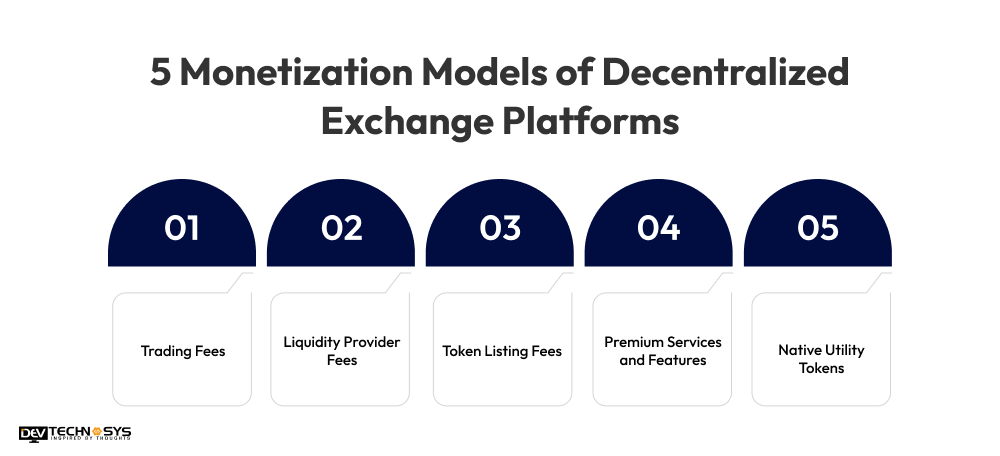
Decentralized Exchange (DEX) businesses create a consistent stream of income through a small percentage fee on every transaction that is processed. Through this fee model, DEXs are able to cover the ongoing costs of running an exchange, the cost of updating & maintaining their smart contracts, and expand their liquidity.
2. Liquidity Provider Fees
The DEX business model rewards liquidity providers in terms of transaction fees that would be paid for using a liquidity pool in exchange for paying the DEX provider a portion of the revenue generated from the transaction fee collection. The DEX providers will benefit afterward based on the total transaction fees collected when providing liquidity to the order book.
3. Token Listing Fees
Many DEX apps like Coinbase require a blockchain project to pay a listing fee for listing a project’s token to be used on their DEX. The addition of this fee will further increase the profitability of the DEX for the liquidity providers, as they will receive the benefit of increasing customer traffic for tokens. This will provide blockchain projects with greater visibility in order to attract investors and demonstrate.
4. Premium Services and Features
Some decentralized exchanges allow traders to use advanced trading tools, detailed analysis, asset tracking, and faster transaction processing via paid subscriptions.
According to the DEX development company, this subscription model enables the DEX to create a source of ongoing revenue while supplying the user with an enhanced trading experience.
5. Native Utility Tokens
After launching a native utility token, decentralized exchanges can use this token to provide governance rights, reward programs, staking, discounts on transaction fees, and interest for using the DEX.
The revenue generated from the token will come from token appreciation, staking rewards, and through the use of the token in the DEX’s ecosystem, which creates a long-term monetization strategy.
Why Every Business Needs a Solid Project Budget Plan?
Every organization must create a strong project budget plan that establishes financial control, limits excessive spending, and provides improved decision-making for its organization.
With a project budget, a business can allocate resources appropriately, establish a realistic timeline for completing the project, and prevent cost overruns from occurring during project execution.
A business’s project budget also enables it to track project performance, control its business risks, maintain a profitable operation, provide a basis for improved forecasting, and increase investor confidence about the organization’s ability to execute projects.
How Dev Technosys Will Help to Develop a DEX Platform?
Dev Technosys is a premier blockchain development company that has 15+ years of experience in creating blockchain-based applications and platforms like DeFi, DEX, DApps, and many more.
We have a team of experienced developers who have proper knowledge of blockchain networks and development frameworks. Dev Technosys provides an end-to-end development process with security and privacy measures.
Final Words!
In this informational blog, we discussed in detail the decentralized exchange development cost and what major factors can affect the overall cost. By reading this blog, entrepreneurs can get an idea of the estimated development cost and explore the various types of DEX platforms that they can build.
Investing in DEX development is a profitable opportunity for businesses that want to enter the blockchain industry and create their own kingdom.
Are you looking to hire developers for DEX development? Then you must connect with a professional decentralized exchange development company to get budget-friendly solutions.
Frequently Asked Questions
Find answers to the most common questions related to this article.
The cost to build a DEX platform is around $8,000 to $25,000, or greater. The actual cross-chain DEX development cost can go higher because of several elements, such as features, functions, services, project complexity, size, backend infrastructure, blockchain networks, blockchain development team, and tech stacks.
To create a DEX platform with simple features or services, it usually takes around 2 to 4 months. Developing a fully-functional or complex DEX platform takes around 3 to 6 months; it can go a bit longer. The total development time can be affected by various factors, such as the project complexity, the number of premium features, emerging technologies, and more.
The cost to hire decentralized exchange developers lies between $15 and $25 per hour or higher. The hiring cost can fluctuate due to various factors such as developers' experience level, blockchain technology expertise, skill set, onboarding cost, project complexity, and hiring model.
The maintenance cost of the DEX platform lies between 10% and 20% of the total BNB chain DEX development cost. It involves various types of maintenance services, such as upgrading versions, adding enhancements, fixing bugs or glitches, applying security patches, analytics, regular updates, and performance optimizations.
There are many different types of factors that can highly impact the overall cost to build a DEX platform:
Smart Contract Complexity
Blockchain Network Selection
UI/UX Design
Third-Party Integrations
Regulatory Compliance & Maintenance
Security & Audit Requirements