





Key takeaways:
-
- The quick answer to what AI security assessment tests is API vulnerabilities, prompt modifications, data pipelines, and context.
- Studies show that 24.7% of AI-generated code contains inherent security flaws.
- Studies show that the focus should be on tuning ML libraries.
- AI breaches cost businesses more; that’s why security matters.
- US businesses’ AI applications must comply with regulations, which is now mandatory. AI assessments should use NIST and other key regulatory frameworks.
AI applications no doubt attract vulnerabilities. They contain sensitive business and customer data. This includes bank details, addresses, and property information that attackers can exploit. Therefore, US businesses secure applications with preventive measures.
An AI assessment goes beyond checking whether the system has implemented authentication. Instead, it asks deeper questions. For example, can AI perform unauthorized actions, is sensitive business and customer data protected, can an attacker manipulate AI instructions, what happens if AI gives an incorrect answer, or are all the APIs secure?
These questions matter because businesses must secure their systems against potential risks. Because AI architecture includes multiple layers of LLMs, data pipelines, integrations, and APIs, AI application security assessment is essential. This examines how components behave under normal and malicious scenarios.
This guide explains what AI security testing services include, models used, API vulnerabilities, and unauthorized actions. By learning the content, businesses can decide whether to hire developers or partner with a company for AI application vulnerability assessment.
What AI Security Assessment Tests?
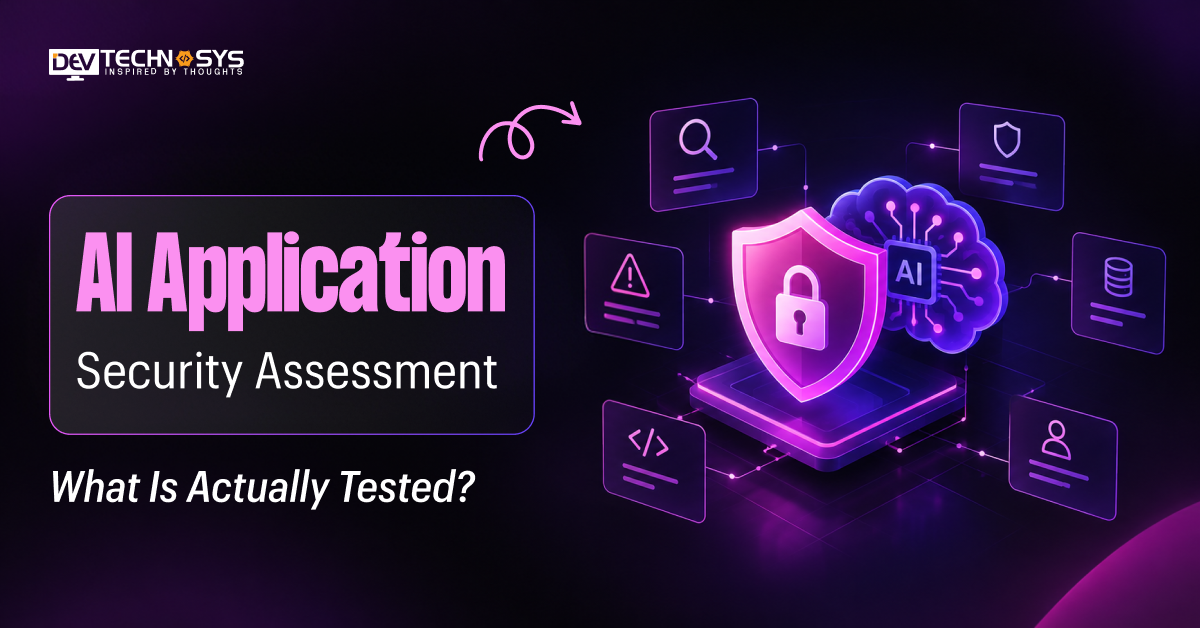
AI is now used at peak levels by almost all businesses across industries. Security teams need to evaluate how LLMs, RAG pipelines, AI agents, prompts, models, and associated components are giving a response when exposed to unexpected inputs. I used the OWASP article to understand the actual test cases. Typically, such tests include:
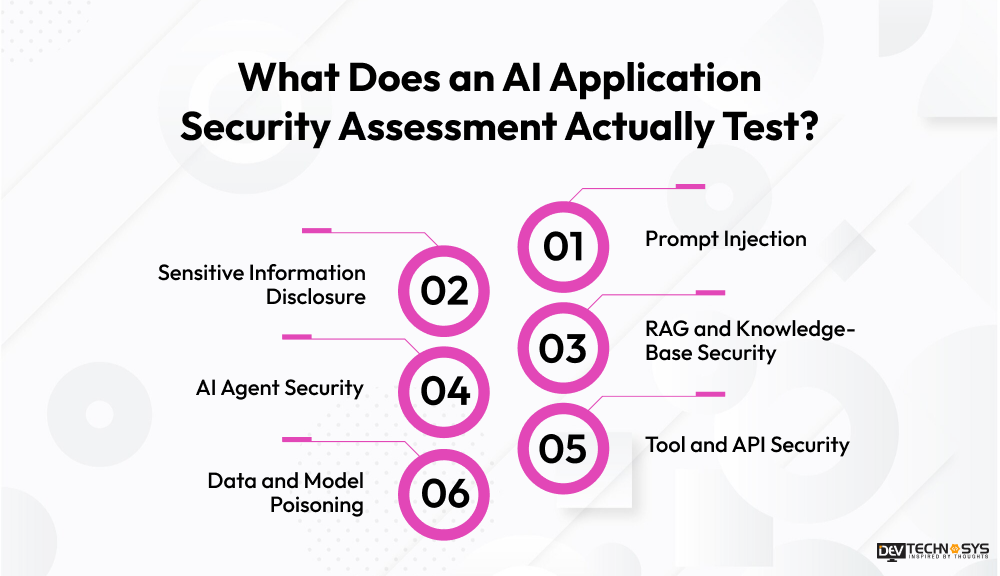
1. Prompt Injection
Can malicious instructions manipulate the AI into ignoring system rules, revealing information, or producing unintended responses?
2. Sensitive Information Disclosure
Can users or attackers retrieve confidential customer, business, financial, or system information through AI interactions?
3.RAG and Knowledge-Base Security
Can unauthorized documents, embeddings, or tenant data be retrieved through the application’s retrieval layer?
Industry Insight: According to Market.us, the total market share of AI-generated applications is approximately USD 14.79 billion in revenue. The market is projected to grow at a CAGR of 15.1% by 2035. This data highlights the importance of AI-powered applications and the need to secure them.
4. AI Agent Security
Can an AI agent perform actions beyond its intended scope, such as modifying records, accessing systems, sending messages, or executing transactions without proper authorization?
5. Tool and API Security
Can attackers manipulate AI-connected tools or APIs to access data or perform unauthorized operations?
6. Data and Model Poisoning
Can manipulated training, fine-tuning, retrieval, or embedding data influence the AI application’s behavior?
Planning to Build an AI Development Project?
Get a quick cost estimate based on your AI features, integrations, and development scope.
- 3 Quick Steps
- 100% FREE
- Hear Back Within 1 Business Day
2 Minutes Read
How Do You Know If Your AI Application Needs an Assessment?
After understanding what AI security assessment tests, consider an assessment if your application:
- Uses an LLM or generative AI
- Processes confidential information
- Connects to internal business systems
- Uses RAG or private knowledge bases
- Gives users access to business data
- Executes actions through AI agents
- Uses multiple third-party APIs
- Handles regulated or sensitive information
- Is preparing for production
- Has experienced unexpected AI behavior
- Is undergoing a security review
Top 7 Facts About AI Application Security Assessment
- Privacy should be a priority for all organizations to build trust with customers and potential clients.
- NIST’s AI RMF provides a framework that helps to check the AI lifecycle to identify risks such as model manipulation, unsafe AI behavior, and prompt injection.
- The framework is intended for voluntary use and is not mentioned as a mandatory compliance standard. Businesses may or may not utilize it. But according to our chief technology officer, Mohit Nag, the framework helps analyze security risks.
- Most businesses prefer to ask what AI security assessment tests from the experts to which a simple reply is it evaluates the entire system, including pre-trained models, model weights, and API integrations.
- Continuous monitoring of AI applications is essential to identify and address recurring issues. This might cost more for businesses, likely up to $30,000 per project, but the process is worth it.
- From retail to healthcare, fintech, and supply chain, almost all industries implement an AI Application Security Assessment to check for model attacks.
- An AI Application Security Assessment might fail because of a misunderstanding of a security audit. In that case, AI code audit services may be the best option for businesses.
Important: All these facts are taken from official sources to understand AI application security assessment in depth.
What Should You Ask Before Hiring an AI Security Assessment Company?
- Will you test both traditional application vulnerabilities and AI-specific risks?
- Will you test prompt injection and AI manipulation?
- What AI Security Assessment Tests and in How Many Sessions?
- Will you assess RAG, vector databases, and knowledge-base permissions?
- Will you test the APIs and third-party integrations connected to the AI?
- Will you test whether AI agents can perform unauthorized actions?
- Will you provide evidence for identified vulnerabilities?
- Will the report include practical remediation recommendations?
- Can you perform retesting after vulnerabilities are fixed?
What Does an AI Application Security Assessment Company Do?
AI architecture is complex enough that every layer comprises vital details. Experts at an AI application security assessment company evaluate LLMs and machine learning pipelines to identify vulnerabilities.
Their main purpose is to identify risks and threats, resolve them, and protect that part of the system. This helps businesses secure data, even when multiple users access the system or use multiple devices. Experts examine
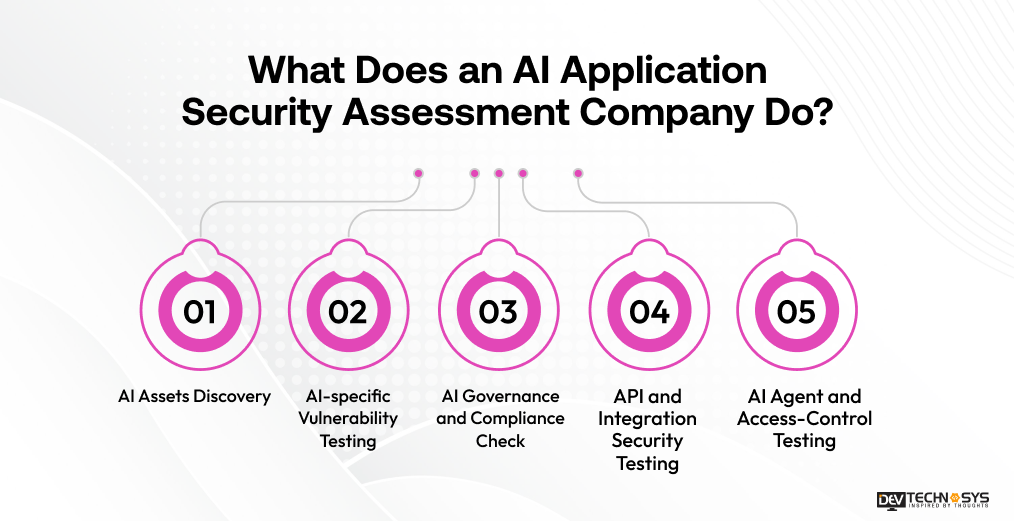
Core things that experts do:
1. AI Assets Discovery
AI customer service automation can affect a business system’s security protocols, so it is important to know what datasets the business uses. And where the data comes from. Data scientists use a dedicated tool to collect this information. They record the sources, what they do, and how they affect the existing system.
2. AI-specific Vulnerability Testing
Now that the information is gathered, specialized techniques such as data poisoning, prompt injection, and model evasion are used. The input and response are checked, along with RAG, to determine whether the malicious data has attacked the system.
3. AI Governance and Compliance Check
Check whether the AI application is built in accordance with the EU AI Act, ISO/IEC 42001, GDPR, or HIPAA, or if fewer updates are required. Most often, the licenses are outdated, which gives attackers an opportunity to retrieve information.
4. API and Integration Security Testing
Engineers at Dev Technosys check whether integrations are securely configured or vulnerable. The company is CMMI Level 3 certified and completes projects with 100% NDA protection. This step is important for businesses that perform regular operations through an AI agent.
5. AI Agent and Access-Control Testing
Experts usually evaluate whether the agent’s capabilities are properly restricted. Testing determines whether actions such as creating tickets, updating customer records, issuing refunds, and sending emails work correctly. If issues arise, the agent may require authentication, transaction limits, and human confirmation.
Industry Insight: The AI solutions market is reaching higher revenue due to increased cloud adoption and the need to provide a personalized user experience. According to Mordor Intelligence, AI cybersecurity solutions are projected to hit USD 86.34 billion by 2030.
What Happens After the AI Security Assessment?
Once they identify issues, AI app rescue services implement the necessary fixes. The experts create a strategic vulnerability treatment plan and establish scenarios for continuous solution monitoring. Some of the key activities performed are
1. Documentation of Security Findings
During the assessment, experts find out regarding vulnerabilities, their impact, and affected components. A security report includes an executive summary, key findings, assessment scope, risk rating, and expert recommendations. This detailed report is usually shared with the client.
2. Creation of a Remediation Plan
The security team plans whether to strengthen security, add more compliance, or improve input validation. In some scenarios, the whole security architecture needs to be modified.
This costs a bit more and also requires at least 6 months of development time. This is a crucial part of AI data engineering services that requires additional effort.
3. Validation of Security Controls
If you have finally found the answer to what AI security assessment tests from the previous sections, know that validation is quite important after testing. The solution implements continuous testing and validation procedures to detect and resolve threats. This helps businesses to access a secure system while performing regular operations. This process also saves experts time by reducing the need to check security threats frequently. This improves the system’s privacy and robustness.
4. Retesting of AI System
Businesses should know that just fixing a vulnerability does not mean the AI security assessment is complete. AI Operations Services also include repeated testing until the system is free of weaknesses. It may be low on performance, speed, or response accuracy; all of these need to be addressed.
When Should Your Business Conduct an AI Security Assessment?
Businesses don’t need to contact an AI development company only after the system shows vulnerabilities. A security assessment should happen when the architecture is being designed. To clearly understand when to take AI app vulnerability testing services, I have jotted down a few points:
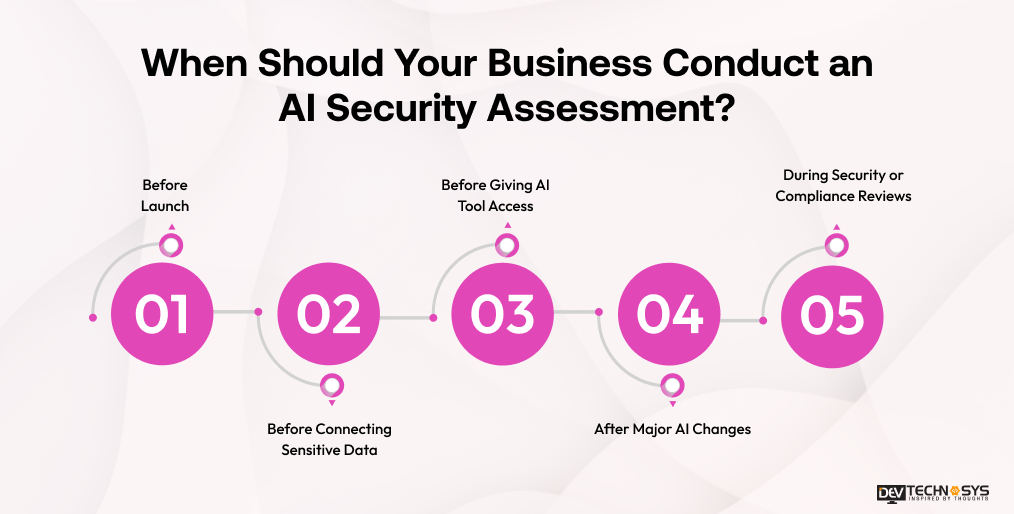
1. Before Launch
When the system is about to launch, businesses can ask the team to check for vulnerabilities. This will make the solution more efficient and secure. You can again ask the experts what AI security assessment tests to be assured of the solution you will be receiving.
2. Before Connecting Sensitive Data
Fintech, banking, real estate, or healthcare industries must ask for an AI security assessment when access to customer records, property listings, patient data, or internal documents is required.
3. Before Giving AI Tool Access
Businesses that want AI customer support services to accomplish regular operations beyond answering customer queries must choose a security assessment before assigning access to agents. This helps to restrict sensitive information before it reaches an attacker.
4. After Major AI Changes
Enterprises that need to scale AI systems or improve RAG architecture, APIs, or agent capabilities must choose AI security assessment services to identify and mitigate new risks.
5. During Security or Compliance Reviews
AI app vulnerability testing specifically tests whether the system is built with compliance and security protocols. Decision makers should plan out for an AI app security audit for internal risk management.
Industry Insight: Dev Technosys has been featured by Tech Bullion as one of the top artificial intelligence companies. Tech Bullion highlighted our capabilities in AI integration, consulting, and development.
AI Security Assessment Frameworks We Use
Experts are well-versed in creating a structured approach to identifying vulnerabilities across AI models and connected systems. They select security frameworks based on industry and business type.
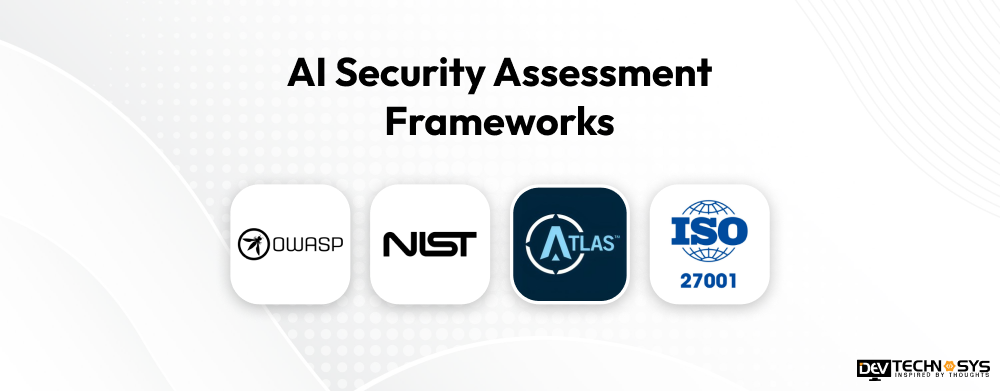
1. OWASP
OWASP guidance is used to assess application-level and AI-specific security risks. Testing covers RAG security, insecure APIs, and other vulnerabilities that affect the application. Experts not only learn but also implement the newer strategies to secure the AI system.
2. NIST Cybersecurity Framework
Security engineers use the NIST Cybersecurity Framework (CSF) to assess how security controls are working for a system. For example, whether role-based access control is implemented or not, specifying each user’s responsibilities. More importantly, this framework helps in the incident response and threat recovery process.
3. MITRE ATLAS
Experts use MITRE ATLAS to identify realistic attack paths against machine-learning and AI systems. This includes data poisoning, model manipulation, adversarial inputs, and AI-specific threats.
4. ISO/IEC 27001 (where relevant)
ISO standards are applied to ensure that the AI system is secured from vulnerabilities, whether it is accessed by international users. Usually, this standard is implemented during AI development to ensure security. But it can be implemented later as well once the experts acknowledge a particular threat.

How Much Does an AI Application Security Assessment Cost?
Businesses should also understand the cost of an AI security assessment. It depends on solution complexity, integrations, and models used.
AI Application Security Assessment by Solution Complexity |
Estimated Cost |
What it Includes? |
| Basic AI Security Assessment | $500 – $1000 | AI app security review, OWASP LLM Top 10, prompt injection, authentication |
| AI Fraud Detection / Risk Integration | $10,000 – $30,000+ | Real-time risk scoring, predictive analytics, compliance and Governance frameworks for security |
| Standard AI Application Security Assessment | $1,000–$2,500 | Full AI application + API + LLM/RAG security + vulnerability report |
| Enterprise AI Security Assessment | $5,000–$15,000+ | Multiple AI systems, APIs, cloud, compliance mapping, detailed security assessment |
Note: This is a cost estimate, as the final price depends on a final discussion with the project team.
Factors affecting AI application security assessment include:
- Application Complexity
- AI architecture
- Integrations
- Data Sensitivity
- User Roles
- AI Actions
- Infrastructure
- Compliance Requirements
Final Thoughts
In conclusion, the AI model, input/output validation, RAG pipeline, and architecture are checked for vulnerabilities. This helps build credibility and trustworthiness among users/custmers. AI application risk assessment identifies weaknesses and provides solutions before a business incurs higher costs.
Organizations can hire dedicated developers or partner with a top AI Development Company to check for issues. Decision makers receive detailed reports to understand issues and track project progress. However, businesses should continuously monitor AI systems to prevent vulnerabilities.
Frequently Asked Questions
Find answers to the most common questions related to this article.
AI Security Assessment project timeline depends on the solution complexity, AI architecture, and the AI model used. It might take from 4 weeks to 4 months depending on the security requirements of a business. If compliance is not applied or is outdated, then engineers require sufficient time to complete a task.
An AI solution must be checked for vulnerabilities monthly or quarterly for significant changes or updates. This helps to prevent attackers from fetching sensitive information. Continuous monitoring helps businesses to save costs and streamlines business operations.
AI chatbots, AI agents, RAG applications, generative AI platforms, AI-powered SaaS products, recommendation systems, LLM applications, and AI applications integrated with enterprise systems.
Businesses should look for AI development companies that have relevant industry experience, knowledge of testing, and AI architecture. Do not forget to check for reviews from official platforms such as Clutch. The best option is to talk to the experts to discuss your project. Proper communication will help you partner with the right firm.
This feature is tracked by giving inaccurate inputs to the solution to check where it redirects a user. If the architecture is correct, then the query will be transferred to a human; otherwise, it will give false information. Another way is to check whether the application is giving a context-based response or a random answer.