














Key Takeaways
- Traditional automation works on pre-defined, fixed rules. AI agents work by understanding the context.
- Creating traditional automation costs less, and custom AI agents are more expensive.
- Legacy automation provides full control and easy audits. Intelligent agents require guardrails, access limits, and human review.
- Businesses opt for rule-based automation for payroll, data sync, and other stable, high-volume tasks.
- Intelligent bots are selected for emails, documents, and changing processes.
Picture this: There are teams in the same firm working on streamlining and speeding up operations. The first team builds a rule-based bot that copies invoice data perfectly every day. In this case, a vendor changes the format of one invoice. The bot cannot read it or stop, so it must be fixed manually.
Meanwhile, the second team builds an AI agent that can read the same messy PDF seamlessly. It can even spot changes and still keep working while flagging odd reviews.
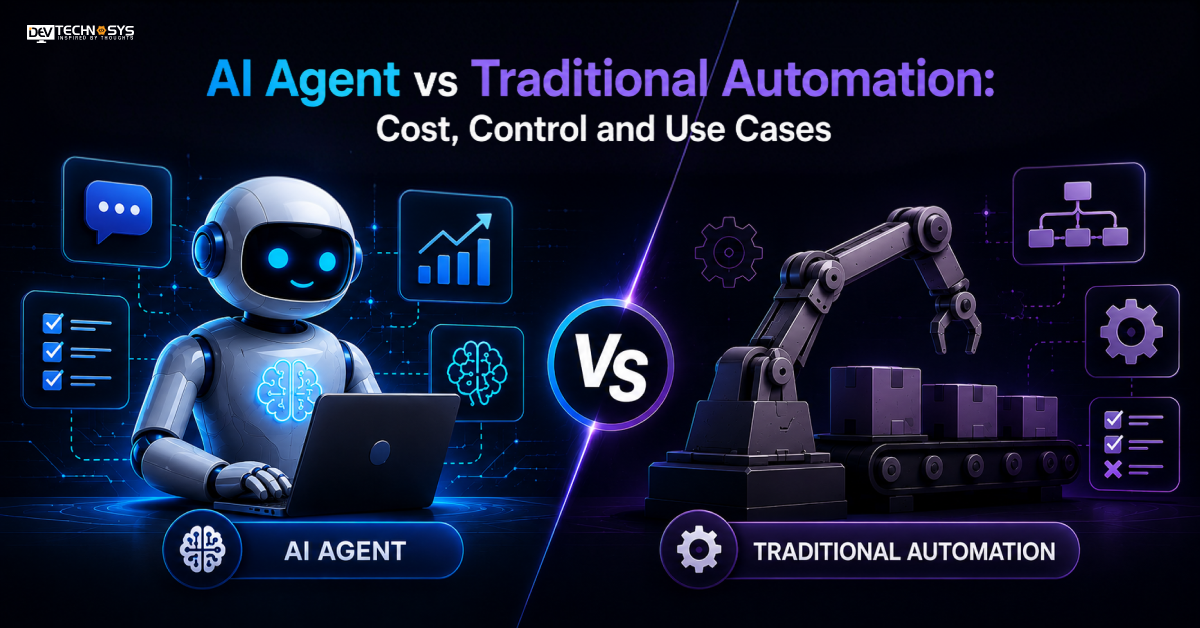
Basically, same goals but different results. This is the core of an AI agent vs. traditional automation, in which one follows rules and the other understands context. Both of them have separate costs, levels of control, and use cases. If a business chooses the wrong approach, it wastes money.
This guide explains the difference in plain words. You will see cost ranges, control trade-offs, and real use cases. By the end, you will know which option fits your business.
What is Traditional Automation?
Rule-based automation is well known for using hard-coded rules and performing repetitive actions. In order to perform a task correctly, it follows certain steps repeatedly. When input meets the rule, it executes the action; otherwise, it halts. Consequently, the traditional automation workflow becomes simple and predictable.
The most common types of traditional automation are RPA bots, workflow systems, scripts, and scheduled tasks. Enterprises use them for repetitive task automation such as invoicing, running payroll, synchronizing systems, and sending email notifications. Most business process automation starts here.
Strengths of traditional automation:
- Predictable output every time
- Lower build cost
- Easy to test and audit
- Fast to deploy for simple tasks
Limits of traditional automation:
- Breaks when a screen, format, or field changes
- Cannot read unstructured data like emails or PDFs well
- Needs manual updates for every new scenario
- Cannot make judgment calls
The best example to understand it is a train on a track. It is fast and reliable, but only on the route you built.
What is an AI Agent?
An AI agent is software that understands the goal first and then works according to it. Modern autonomous AI agents usually read data, pick actions, use tools, and learn from results. There is no need to have a fixed script for every use case.
They do not need a fixed script for every case.
This makes AI agent automation flexible. You can build an AI agent for one small task first.
Here is how a typical agent works:
- It receives a goal or a trigger.
- It reads the data and understands the context.
- It uses AI agent decision-making to choose the next step.
- It uses tools or APIs to act.
- It checks the result and adjusts.
Take a support example. A customer emails about a late order. The agent reads the message and checks the order status. It applies your refund policy and sends a reply. A human only steps in for unusual cases.
Most agents run on large language models (LLMs) connected to your tools, data, and memory. Many teams pick from proven AI agent platforms to save build time.
Strengths of AI agents:
- Handle emails, documents, chats, and voice
- Adapt to new situations without new rules
- Complete multi-step task automation from start to finish
- Work around the clock
Limits of AI agents:
- Higher build and running cost
- Outputs can vary between runs
- Need guardrails and monitoring
- Need clean data and clear goals
For example, take an AI agent as a driver with a map. If it sees a blocked road, it changes the route and gets you to the destination.
AI Agent vs Traditional Automation: Key Differences
The main difference between AI agents and automation depends on the way each one decides. Traditional automation follows rules you write. AI agents reason from context and choose their own steps. This changes cost, control, and the type of work each one handles.
Factor |
Traditional Automation |
AI Agents |
| Decision Making | Follows predefined rules and workflows | Interprets context and chooses actions within defined boundaries |
| Control | High; every action can be explicitly defined | Requires guardrails, permissions, and action limits |
| Data Handling | Works best with structured and predictable inputs | Handles structured, unstructured, and conversational data |
| Adaptability | Requires manual rule or workflow changes | Can respond to changing inputs and unfamiliar scenarios |
| Cost to Build | Usually lower for rule-based processes | Usually higher due to AI models, integrations, and testing |
| Operating Cost | Generally predictable and steady | Varies based on model usage, task volume, and complexity |
| Predictability | Highly predictable when rules and inputs are known | Less deterministic and requires monitoring |
| Speed of Execution | Very fast for predefined tasks | Can be slower when reasoning or multiple tool calls are required |
| Auditability | Easier to trace because rules and actions are predefined | Requires logs for prompts, outputs, tool calls, and actions |
| Maintenance | Mainly requires rule, workflow, and integration updates | Requires model, prompt, knowledge, integration, and performance monitoring |
| Human Oversight | Usually needed for exceptions or approvals | More important for high-risk, irreversible, or sensitive actions |
| Best Use Cases | Repetitive, stable, rule-based processes | Variable, context-heavy, multi-step processes |
Neither one is better in every case. The right pick between AI agents vs. traditional automation depends on the task, the risk, and the budget.
AI Agent vs Automation Cost: What Will You Actually Pay?
Traditional automation costs less to build. AI agents cost more upfront but can save more on complex work. The true price depends on scope, data quality, and integrations. Always compare cost per task, not just build cost.
Traditional Automation Cost:
- Traditional automation cost stays low when the task is simple, and the rules rarely change.
- Yearly maintenance is a small but steady expense. It grows when your systems change often.
- Every new scenario needs a new rule. This adds to the cost over time.
AI Agent Cost:
- The cost of AI agents is higher because the build is more complex. It involves models, data, testing, and integrations.
- Build time depends on scope. A small pilot is quicker than a full, multi-system agent.
- Running costs include model usage, cloud hosting, and monitoring. These add to your total AI automation cost.
Want a deeper breakdown? Read our guide on AI agent development cost.
Planning to Build an AI Development Project?
Get a quick cost estimate based on your AI features, integrations, and development scope.
- 3 Quick Steps
- 100% FREE
- Hear Back Within 1 Business Day
2 Minutes Read
What Drives AI Agent Cost Up:
- Number of systems the agent connects to
- Data cleanup and preparation
- Security and compliance needs
- Level of human review built in
- Volume of tasks handled each month
A rule-based bot may cost less, but it fails on messy tasks. The development team then fixes the errors by hand. An AI agent costs more, yet it can finish those tasks without help. This is where AI agent ROI starts to show.
Count how many tasks your team handles each month and multiply by the time each one takes. Then compare that number with both options over one to two years. Include the full automation implementation cost in that math.
AI Agents vs. Traditional Automation: Which Is Easier to Control?
Traditional automation gives you full control. Every step is written by you. AI agent control works differently. You set goals, limits, and approval rules. The agent then works inside those limits.
Control In Traditional Automation:
- Same input gives the same output
- Every step can be traced
- Testing is simple
- Audits are easy
Control In AI Agents:
- Outputs can differ slightly between runs
- You control the agent through guardrails
- Actions depend on the rules and data you give it
Strong AI automation control includes these safeguards:
- A human remains in the loop because they approve high-risk actions.
- Permission limits so that the agent only accesses what it needs.
- Audit logs to record every action that takes place.
- Approval thresholds in case of large refunds or payments need sign-off.
- Fallback rules so that the agent hands off to a human when unsure.
Control matters most in regulated fields. Healthcare teams must protect patient data under HIPAA. Fintech teams must follow strict financial rules. Many businesses use AI agents for support tasks. They keep final decisions with people or fixed rules.
Rules also change over time. Follow the AI trends that will impact businesses to keep your policies current.
AI Agents vs. Traditional Automation Use Cases: Where Does Each Work Best?
Traditional automation is highly recommended for stable, high-volume, rule-based work. In contrast, AI agents are used for business tasks that involve language, judgment, or changing inputs. Matching the ideal tool to the task is the biggest factor in getting a good return. Even large firms are now investing in enterprise AI automation at scale. Here, we will understand how agentic AI emerges as a game-changer in enterprise.
Best Traditional Automation Use Cases:
- Payroll processing
- Data transfer between two systems
- Scheduled report generation
- Invoice matching with fixed formats
- Rule-based compliance checks
- Backup and system alerts
Best AI Agent Use Cases:
- Customer support that reads and answers real questions
- Lead qualification and follow-up
- Document and claims review
- Fraud alert triage
- Patient scheduling and intake
- Sales research and outreach
These traditional automation use cases stay stable for years. The AI agent use cases above change often, which is why rules alone struggle.
AI Automation Use Cases by Industry:
1. Healthcare
Traditional automation handles billing code checks and appointment reminders. An agentic AI in healthcare can collect patient intake details and route requests to the right team.
2. Fintech
Traditional automation runs settlement reports and transaction matching. An agentic AI in fintech can review flagged transactions and summarize the risk for an analyst.
3. E-Commerce
Traditional automation updates stock counts. An agentic AI in eCommerce handles returns, order questions, and product help through chat.
4. Sales And Marketing
Traditional automation sends scheduled email sequences. An agentic AI in sales and marketing reads replies, scores leads, and books meetings. This makes it one of the top AI workflow use cases for lead generation.
5. Software Teams
Traditional automation executes predefined engineering workflows. AI agents can interpret context, investigate problems, and take multi-step actions within defined permissions.
Traditional Automation + AI Agents: Why a Hybrid Approach Works
Most businesses don’t choose one option over the other; they usually work with a hybrid model. In this model, traditional automation handles fixed steps, and AI agents handle workflow automation for tasks that need judgment. This keeps development within budget and adds smart decision-making where it matters.
Here is a simple example of a hybrid claims flow:
- An AI agent reads the claim form and supporting documents.
- It pulls out key details and flags missing items.
- A rule-based bot checks policy limits and eligibility.
- The bot posts the approved data into your core system.
- A human reviews any flagged or high-value claim.
This setup gives you speed, accuracy, and control. The agent handles messy inputs. The rules handle strict checks. The human handles exceptions. Strong AI integration services keep every handoff smooth.
Many teams start this way because the risk is lower. Over time, this mix grows into intelligent automation. With enough trust, it can move toward autonomous workflow automation.
Traditional Automation vs AI Agents: 5 Questions Before You Decide
Use 5 simple questions when deciding. The answers you get will help you determine if you need an AI agent vs. automation or a combination of both. This will help you focus your project and stay within budget.
- Does the task have a rule or a set of rules, and are the rules stable? If so, opt for traditional automation.
- Is it sending emails, documents, or free text? If so, then an AI agent is the right way to go.
- What will the cost of a wrong decision be? For a high risk, include human review or fixed rules.
- How many times does the process repeat? The more you change, the better it is for the AI agents.
- What number of tasks do you do each month? The higher agent cost is easier to justify when it’s working at high volume.
When the task you need to automate is more rule-based and stable, begin with conventional automation. If your answers relate to language and change, begin with an AI agent pilot.
Free App Idea Reality Check: Let's Stress-Test Your Concept
Share your app idea with us. Within 3 business days, we'll uncover UX gaps, feature opportunities, and potential development challenges, so you can build with confidence. No strings attached.
Traditional Automation vs AI Agents: Common Mistakes to Avoid
Most failed projects share the common causes that almost every business faces. These are definitely not technical problems, but problems related to planning. They are preparing for plans. By steering clear of these pitfalls, you can save time, money, and trust in the project.
- Creating an AI agent to perform a basic task. A simple rule bot is less expensive and more reliable.
- Skipping a pilot. Test with one workflow before scaling.
- Ignoring data quality. Bad data results in bad agent decisions.
- Early harvest of humans. Repeat review steps until the agent proves itself.
- Not tracking results. Calculate time saved, error rates, and cost per task.
- Forgetting security. Make sure to restrict access and document all that you do.
Conclusion
AI agent vs. traditional automation is not a fight. It is a fit question. Traditional automation gives you low cost, full control, and stable results for fixed tasks. AI agents give you flexibility and smart decisions for complex work.
Start by listing your tasks. Sort them into rule-based tasks and judgment-based AI agent business applications. Pilot one workflow, measure the result, and grow from there. A hybrid model often gives the best balance of cost and control.
Ready to automate the right way? Contact Dev Technosys today, or hire dedicated developers to start building.
Frequently Asked Questions
Find answers to the most common questions related to this article.
Businesses must begin with traditional automation, especially if your process is stable and rule-based. Opting for an AI agent is unstable when tasks involve emails, documents, or changing inputs. Many founders find it a great option because they get better results by piloting one workflow first.
First of all, count monthly task volume and time per task. Multiply them to find your current manual cost. Then compare that against build, running, and maintenance costs over one to two years. An AI agent pays off when it removes high-volume manual work that rule-based bots cannot handle.
Not safely at the start. AI agents can act on their own, but founders should set limits first. Use approval steps for high-risk actions, restrict system access, and keep audit logs. Reduce human review only after the agent proves accurate over several months of real use.
The biggest risks are poor data quality, unclear goals, and weak security. Agents built on messy data make poor decisions. Skipping a pilot wastes budget, and removing human review too soon can cause costly errors. Founders can avoid these by starting small, cleaning data first, and tracking results.
Yes, for most growing businesses, a hybrid is a better option. Use traditional automation for fixed, high-volume steps because it is cheaper and predictable. Add AI agents where judgment or unstructured data is involved. This balances cost, control, and speed. It lets you scale in stages without rebuilding everything you built.