














Key Takeaways
- Focus on fitness app integrations that correspond to your fitness app’s main features and your users’ needs.
- Integrate health platforms and wearables into your app to create individualized fitness experiences.
- Check API pricing, reliability, compatibility, and scalability before launching.
- Make sure sensitive health data is secure through access controls and user consent.
- Begin with the must-have integrations and add the others according to users’ feedback.
Creating an MVP for a fitness application entails more than just developing workout routines and tracking users’ progress with the app. Suitable fitness app integrations can connect wearables, health platforms, payment systems, and analytical tools to provide the user with a remarkable experience.
At the same time, the more additional services that are integrated, the higher the potential costs and complexity of development are. A more rational way is to determine which services will be useful for you – fitness app development integrations that fulfill the main goal of the application need to be carefully selected and evaluated beforehand.
In this blog, you will learn about some critical fitness app integrations with their pros and cons.
Why Fitness App Integrations Matter for Your MVP
Fitness app integrations allow startups to provide services effectively without the need to construct every service themselves. Allowing devices to integrate with nutrition databases and health apps creates a more personalized, accurate experience.
Payment services are good for profit, while analytics software offers information on user behavior, which helps founders in the retention process. If external services assist with functions compatible with your needs, their use will serve as a great improvement for speed of development.
Nevertheless, the help of integration brings additional complications such as dependencies on other products and additional mobile app development costs. When choosing integration, pay attention to your finances, market, and customer preferences.
Fitness App Market Growth
According to Sensor Tower’s State of Mobile report, global Health & Fitness app downloads reached 3.6 billion, increasing 6% year over year.
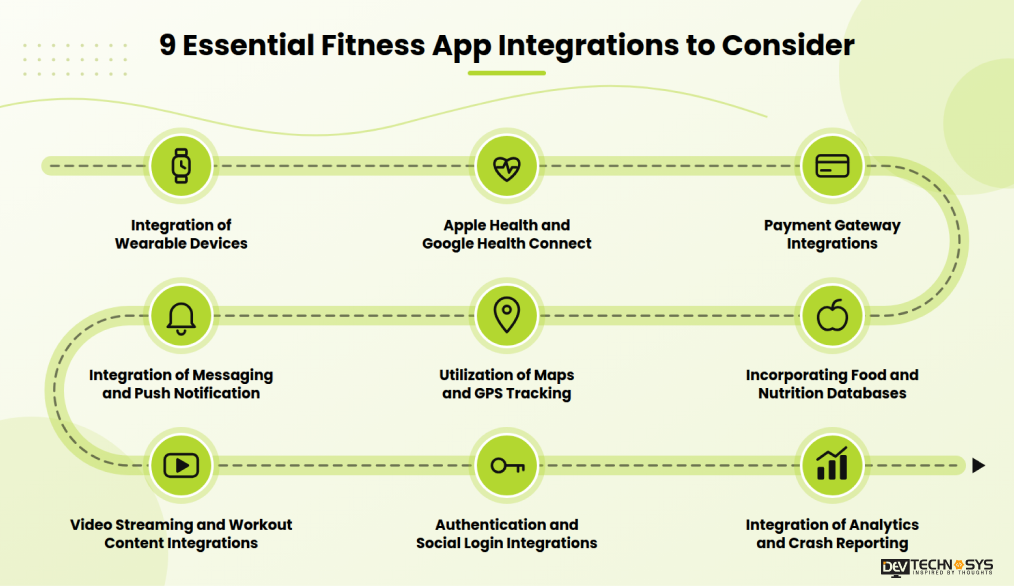
9 Essential Fitness App Integrations to Consider
Choosing integrations must take into account the intended users of the app, the features, and the business approach. The following are nine integrations to consider when getting your fitness app MVP started:
1. Integration of Wearable Devices
Wearable integration fitness apps gather activity data from wearable fitness trackers and smartwatches. Depending on the specific devices, available permissions give users an opportunity to track steps, calories burned, heart rate, as well as data about their sleep and workout activities. For wearable app development, you can visit the sites of Fitbit and Garmin to find the required development information.
In case of fitness app MVP development, it is essential to understand what metrics help your application achieve its main goal. For example, a running application will mostly rely on distance and pace metrics, while a wellness application will use metrics of activity tracking and sleep. Additionally, find out all restrictions concerning API synchronization frequency, as well as all necessary device compatibility.
2. Apple Health and Google Health Connect
Apple Health and Google’s Health Connect allow health and fitness apps to exchange authorized health and fitness information. These integrations can simplify the process of recording information in apps as well as improve the experience for users who already have access to multiple health-related apps.
Before you start to develop a fitness app, it’s essential to check what types of data you need, what platforms can provide you with such data, and what permissions you may need. Note that HealthKit and Health Connect have different requirements. Therefore, they cannot be treated as interchangeable APIs. For an initial version of the application, it is recommended to start with a simple set of parameters such as steps, workouts, or distances traveled by users.
3. Payment Gateway Integrations
Integrating payment gateways allows fitness apps to utilize various ways to earn money through subscription services, workout sessions, training, and one- time purchases. Payment gateways like Stripe or Razorpay, depending on your geographic location, what kind of app you’ve developed, and who your audience is, may support the necessary payment method flows required for your business and app.
There are a variety of methods available for paying, which are supported by different payment service providers. To learn what cost to expect from payment gateway integration services like Stripe or Razorpay, analyze their price lists, determine which methods of payment they support, and whether they allow recurring charges.
4. Incorporating Food and Nutrition Databases
By integrating nutrition capabilities, users can manage their food consumption, caloric intake, and macronutrient levels simultaneously with their exercise programs. A food database API enables users to find nutritional facts about ingredients and prepared food items, which takes much less effort than creating an entire food database.
The key areas to focus on when looking for a supplier include food variety, local cuisine availability, portion sizes, the accuracy of data provided, licensing issues, and limitations of the API. These aspects are particularly significant in case the target audience is made up of people following various diets.
Features like simple food search and logging are sufficient for an MVP; you can add complex meal ideas later. You can also add features like nutrition coaching or yoga app development services, but make sure they support the intended audience.
5. Utilization of Maps and GPS Tracking
Integration of GPS and Maps options is beneficial for fitness applications that are aligned with key functions like running, cycling, walking, hiking, or outdoor training. The role of GPS and Maps integration is vital in route visualization, distance calculations, pace tracking, and recording workout sessions with the help of location data.
Mapping vendors and built-in location capabilities offer various functionalities and methods of implementation in this sphere. An experienced IoT development company will help you integrate these features smoothly.
Before you choose the appropriate information, consider location accuracy, battery drain, operation without an internet connection, cost of maps used, and compatibility with the device. Besides, underlying location tracking may demand some additional permissions and possible adjustments on the specific platform.
Start with the minimal set of features for your pilot project, such as a recording session of a workout and its distance traveled. Moreover, it is important to make people aware when location data is collected, to safeguard the history of whereabouts, and give users possibilities of control over data sharing.
6. Integration of Messaging and Push Notification
Users can be informed about their fitness program utilizing push notifications. For example, they will be notified regarding their next workout or informed about updates in the improvement process. Tools like Apple Push Notification Service and Firebase Cloud Messaging will enable sending push notifications to appropriate devices, but keep in mind that requirements for the implementation differ according to the platform being used.
The aim is to create regular practices and not annoy users. Make sure you begin with a few straightforward notifications, i.e., workout reminders or a number of essential notifications that can be allowed by users. For top workout apps, monitor whether notifications are really useful for the users.
7. Video Streaming and Workout Content Integrations
Video streaming integrates fitness apps so that exercising is made easy via explanations, trainer-instructed classes, and workout regimes without necessarily developing an entire video-delivery system. Based on your needs, you can use any type of video-hosting and streaming company for storing, delivering, and playing video on devices.
Once you pick the streamer, take into account factors like how good the quality is of the video and audio that you plan to play and store, how much bandwidth you will need, and how much it will cost you to protect your content. Businesses exploring video streaming app development services should make sure to validate the content according to the audience’s preference. If you are creating an MVP, launch a limited set of workouts at first rather than introducing a live-streaming system at once.
8. Authentication and Social Login Integrations
With authentication integrations, the processes of registering, signing in, and recovering accounts are made straightforward. Depending on the target audience, methods of authentication can be via email or identity providers like Google and Apple. Use of managed authentication services in integrating login features is recommended.
It is important to look at the platforms supported, multi-factor authentication, methods of account recovery, cost, and ease of integration before proceeding with authentication services. Account security becomes more crucial when users are allowed to share health information or subscribe to services.
For an MVP, it is enough to keep the registration process simple and provide secure session management and access control. Also, the fitness app development cost for an MVP is lower, which is best for startups and small businesses.
9. Integration of Analytics and Crash Reporting
Thanks to the analytics and crash reporting capabilities, founders acquire a better understanding of user goals in the fitness application as well as identify technical issues. Solutions like Firebase Analytics and Sentry are used for event tracking, performance assessment, and ensuring customer flow.
Make sure to select a few valid KPI metrics, such as onboarding process completion, workout starts, workout completion, and subscription conversion whenever applicable. Crash reports will also allow developers to discover repeated issues taking place across devices.
When it comes to analytics events, avoid collecting health-related information unless there are valid reasons for this. Businesses should measure which fitness app features users actually value before investing in them.
How to Prioritize Integrations for Your Fitness App MVP
By carefully selecting integrations, you can manage development expenses and expedite market entry. Utilize the guidance below to determine the best integration choices for your MVP mobile app for fitness.
- Specify the core use case: Determine the key problem that your app will address. For example, if your app is related to fitness coaching, you may need to provide video content.
- Differentiate between the integrations: Write down all the integrations that you need for the app launch and ignore the ones that are not critical.
- Assess technical feasibility: Check the documentation from the providers regarding the API, compatibility with platforms, data synchronization, and limitations.
- Estimate your budget: Take into consideration the subscriptions, charges, development hours, maintenance, and vendor price increases.
- Check privacy and security issues: Make sure that you follow a fitness app security and privacy checklist covering permissions, storage, and consent for processing users’ data.
- Validate results with users: Get feedback regarding your integration choice after launch.
The objective is to build a useful product first, then expand its capabilities as your user base grows. You should follow a clear integration strategy to evaluate the cost to develop app like Fitbit.
Fitness API Integration Pitfalls That Can Cost Startups Time and Money
Third-party integrations can accelerate development, but poor planning can introduce avoidable technical and business risks.
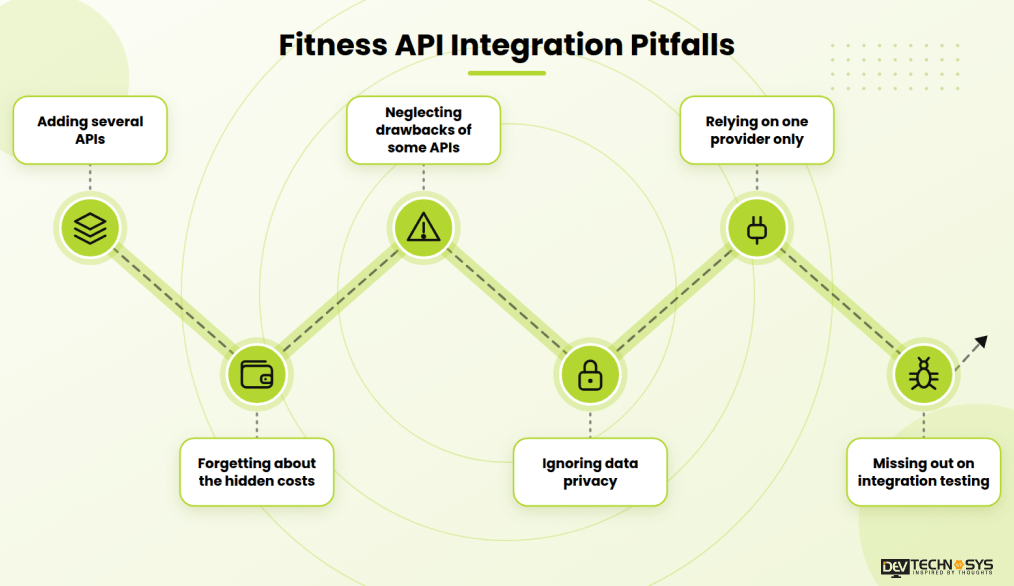
- Adding several APIs: Adding new APIs increases the complexity of integrating, testing, and maintaining them. Rather, start with those integrations that are essential to your MVP.
- Forgetting about the hidden costs: While free tiers might seem convenient, they do have some usage limits, which can incur additional costs. Thus, always make sure to check what fees you might be charged before using the service.
- Neglecting drawbacks of some APIs: Not every provider can interact with every type of device or data type. As such, do some research and verify the compatibility before starting to develop.
- Ignoring data privacy: Fitness apps manage sensitive health and location information. Thus, you need to minimize this data and store it securely.
- Relying on one provider only: Outages, changes in policies, or shutting down services disrupt the work of many applications.
- Missing out on integration testing: Testing should include things such as expired tokens, network downtime, duplicated records, and others.
These fitness app development challenges can increase the cost and delay releases. A well-planned integration strategy balances functionality with reliability, security, and long-term maintainability.
Planning a Fitness Project?
Get a tailored development cost estimate in a few simple steps.
- 3 quick steps
- 100% free
- Reply in 1 business day
2 Minutes Read
Conclusion
Planning the appropriate fitness app integrations is crucial for creating an MVP that provides value while avoiding unnecessary difficulty. Every integration, from wearables and health services to payments and analytics, must streamline the core functionalities of your project, be budget-compliant, and fit into your ultimate business objectives.
When testing your application with early users, remember to take into account security, scalability, and user experience. Dev Technosys, an experienced fitness app development company, will help you choose the most appropriate technologies and make a feature-packed, scalable fitness app that meets your business specifications.
Frequently Asked Questions
Find answers to the most common questions related to this article.
Required integrations will depend on your app’s goals. Workout-tracking applications may require health-related integrations and wearables, while subscription apps may require payments and analytics. Always start with integrations that are essential for the user experience.
Costs depend on the API price, configuration complexity, developer fees, and volume of use. Some APIs make free tiers available or charge for use, while others charge fixed, recurring fees. Always budget costs into your business plan for possible maintenance and testing fees.
Yes. The MVP can provide workout plans, manual workouts, exercise videos, and progress tracking without wearable devices. You can add wearables in the future if the need arises.
To protect health data, health and fitness apps must use encryption, ensure that authentication is secure, control access, limit data collection to the minimum necessary amount, and make sure that users are fully aware of the collection processes.
Usually, using ready-to-use APIs for MVP solutions is a good strategy. It has the potential to reduce development efforts. Custom integrations may be necessary when existing solutions are not able to deliver the needed functionality because of the cost and maintenance requirements.