






The digitalization process in the loan industry has made it possible for financial organizations to assess applications, verify borrowers, and grant loans in an entirely different manner. In order for lenders to operate efficiently, Loan Origination Systems were introduced, which automate processes, hence streamlining loan disposition. Thus, everything from filling in an online application to receiving the money is done effectively and quickly.
For banks, Non-Banking Financial Companies, and fintech firms, understanding what a Loan Origination process is vital in planning a digital loan platform. A correct solution allows you to enhance operational performance, enhance risk management, and ensure compliance with regulations.
This blog discusses the important stages of getting a loan through a Loan Origination System, necessary integrations, notable features, etc.
What Is a Loan Origination System (LOS)?
The loan origination system refers to the software that takes care of the loan application processing functions. Its functions include collecting information about the applicants, verifying documents, measuring creditworthiness, helping in approving a loan application, as well as disbursing loans.
Modern loan origination software includes API interfaces that enable a lender to connect the different platforms so as to send secure information to each other without using the old tools. This system can also be equipped with automated decision-making systems, monitoring systems, and communication features.
Organizations investing in fintech software development services can customize an LOS for personal loans, business loans, mortgages, and other lending products.
Why Do Lenders Need a Loan Origination System?
Conventional loan processes can result in tedious paperwork, siloed databases, and long check processes. An LOS solves these issues by allowing borrowers’ information to be centralized and standardizing simple processes in the loan cycle.
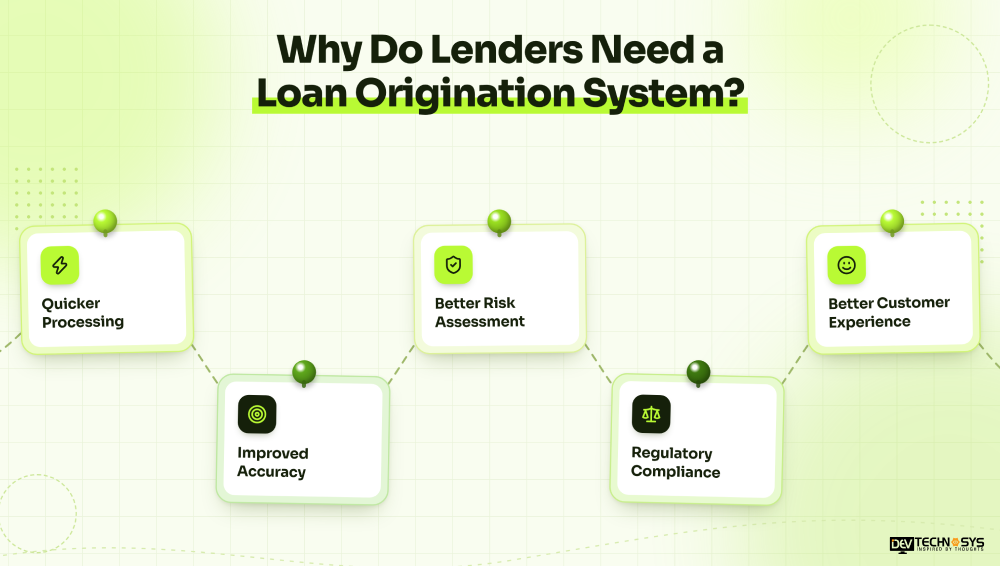
Major advantages include the following:
- Quicker processing: This allows automating paperwork collection, verification, and application routing.
- Improved accuracy: With no manual data input, it reduces human error.
- Better risk assessment: It can combine information from credit agencies and risk analysis areas.
- Regulatory compliance: This helps in tracing, identity verification, and meeting compliance requirements.
- Better customer experience: Borrowers can electronically apply for loans and find out the application status.
Companies working with a loan app building firm can include all these features in their digital lending odyssey through customized fintech app development services.
What Are the Key Loan Origination System Stages?
Understanding the loan origination system stages helps businesses design workflows that are efficient, transparent, and scalable.
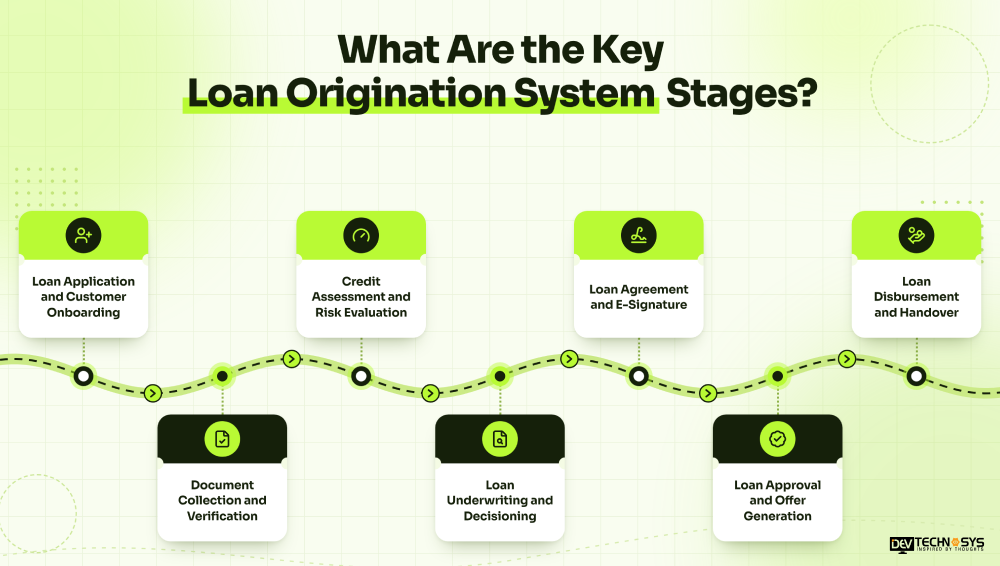
1. Loan Application and Customer Onboarding
The process starts when the borrowers send their personal, financial, or vocational details by using a website or a mobile app. The parameters such as the loan amount, repayment options, income information, and other necessary details are collected in the system.
Using digital onboarding facilitates the application process as it enables users to apply for loans without physical documentation. Developers offering banking IT solutions can introduce intuitive forms, instant validation, and application tracking.
2. Document Collection and Verification
Once the application is submitted, borrowers must send supporting documents like identification proof, proof of residence, bank statements, and proof of income. Then the system checks these documents for compliance with requirements.
Several technologies are employed to extract information from the documents. In particular, Optical Character Recognition and automated verification application programming interfaces can analyze the documents and detect discrepancies.
3. Credit Assessment and Risk Evaluation
Borrowers are assessed by the system with the help of records from credit bureaus, information about past payments, income, liabilities, and other indicators.
Lenders can use external credit bureaus and scoring models in order to provide an assessment of repayment capacity. Businesses planning to build a credit score check app can provide credit insights, eligibility estimates, and personalized financial recommendations.
4. Loan Underwriting and Decisioning
Underwriting is the process that assesses an applicant’s adherence to the requirements of the lender. Typically, underwriting is done through manual assessment, which may cause delays in decision-making.
For the sake of establishing an automated system of underwriting, it is necessary for organizations to apply configurable rules on business, risk models, and decision engines to assess applicants’ requests.
To develop a automated underwriting system, businesses can implement configurable rules, risk models, and decision engines.
5. Loan Agreement and E-Signature
Once an offer is accepted, borrowers go over their loan agreement and process all necessary paperwork. E-signature technology allows documents to be signed electronically, and document management services keep records accessible.
At this stage, there must be clear disclosures about fees, repayment obligations, and terms. Safe storage and timestamps of audit trails guarantee accountability and compliance.
6. Loan Approval and Offer Generation
After completing the underwriting process, qualifying applicants are given a decision as per the lender’s policy. Successful applicants would receive an offer including particulars about the loan amount, interest rate, tenure, fees, and repayment terms.
Nevertheless, instant approval is possible only after achieving verification and according to the applicable regulations and the lender’s risk policy. Businesses seeking to develop an instant loan approval app can automate eligibility checks, credit assessments, and decision-making.
7. Loan Disbursement and Handover
The lender disburses the approved loan once all agreements have been concluded and all final checks carried out.
The LOS sends the relevant details of the loan to downstream systems in charge of managing repayments and collections. The loan data transfer integrates process origination with the loan administration process, thereby eliminating the need for re-typing information already entered into the system
Essential Loan Origination System Integrations
Successful integration of a loan origination system links the platform to outside resources and inside financial systems. Integrations to plan for a digital lending platform should prioritize security, reliability, data consistency, and regulatory compliance.
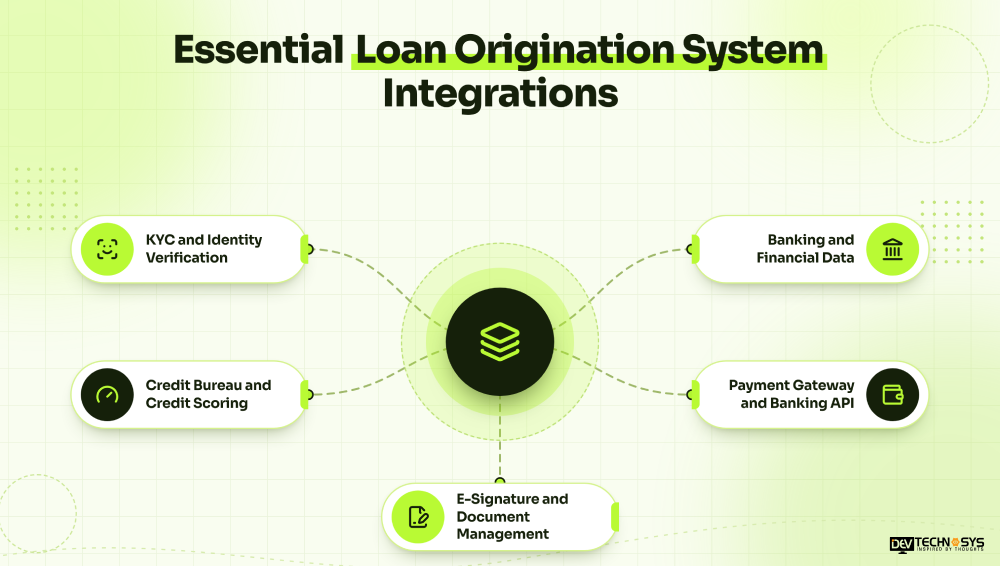
1. KYC and Identity Verification Integration
KYC integrations prove the identity of borrowers using due verification service providers and proper verification techniques. It allows lenders to identify incompatible data and prevent fraud.
2. Credit Bureau and Credit Scoring Integration
A credit bureau API allows lenders to get credit reports and all necessary data about borrowers without needing permission. This integration allows lenders to perform checks on eligibility and make risk assessment decisions.
3. Banking and Financial Data Integration
Banking API and authorized financial data services allow lenders to check income, account activity, cash flow, and obligations. Meanwhile, loan management software development supports repayment schedules, interest calculations, payment tracking, overdue accounts, and collections after origination.
4. Payment Gateway and Banking API Integration
Banking and payment solutions help to carry out lending processes from loan issuance to loan repayment, as well as transaction verification and reconciliation. It is advisable for lenders to provide for transaction tracking, failure resolution, and secure payment authorization.
5. E-Signature and Document Management Integration
E-signature APIs make signing contracts much easier, and document management systems ensure that records are kept in proper order,35 thus increasing processing efficiency and allowing loan providers to get necessary documents whenever they need them.
Key Features to Look for in Loan Origination Software
When assessing loan origination software, focus on features that correspond to your lending products, operational needs, and growth steps.
Critical features include:
- Data encryption, including encryption at rest.
- Configurable workflows and loan eligibility requirements.
- Automated verification of documents and underwriting.
- Credit rating and fraud prevention.
- Access control by roles as well as audit trails.
- API-based integration with banks and fintech services.
- Real-time tracking of applications and notifications.
- Analytics dashboards and reporting on application performance.
Companies wishing to build fintech software ought to think of scalability, maintainability, disaster recovery, and the possibility of launching new lending products
Conclusion
An efficient loan origination system can empower financial institutions to automate the whole process of application management, increase their risk assessment capabilities, and provide an innovative borrower experience. Applications consist of various phases that contribute to the overall improvement of the lending process, including onboarding, underwriting, disbursement, and systems integration.
Dev Technosys, an experienced loan lending app development company, can assist ventures in creating customized lending software and automated tools according to their business requirements. If you are interested in building a lending platform, you should turn to qualified fintech developers since experienced specialists can offer you a reliable solution that fully corresponds with your needs.
Frequently Asked Questions
Find answers to the most common questions related to this article.
A loan origination system is responsible for administering loan applications. It takes care of the borrower’s verification, credit evaluation, underwriting, approval, document preparation, and disbursement stage. Thus enabling lending organizations to reduce the workload and enhance efficiency.
An LOS covers all the main phases of the process: submitting the application, verification of documents, assessing credit history, underwriting, executing contracts, and loan disbursement
Examples of typical integrations include KYC services, credit institutions, banking APIs, payment methods, e-signature applications, fraud detection systems, Customer Relationship Management platforms, and loan management services.
An LOS handles the processes of loan application processing, whereas an LMS organizes loan servicing, repayment, etc.
The cost of an LOS depends on the features available, complexity of the platform, required third-party integrations, and security specifications. It is important to analyze the requirements in detail to have a precise quote.