







Key Takeaways:
-
- Plan your digital lending platform development based on your organization’s specific business process, security, and scalability needs
- Implement an integration checklist that encompasses such processes as payments, bank-related processes, KYC, credit analysis, and loan servicing.
- Integrate LOS and LMS systems for better data consistency and automatic lending transaction processing.
- Introduce ID verification, fraud detection, and risk assessment tools for informed lending practices.
- Research lender reliability, required compliance, and long-term operation before implementing it.
Digital lending has changed the way banks process applications, issue loans, and collect repayments. But creating a smooth borrowing process takes more than just an easy-to-use loan application. Companies should have reliable connections between their banking systems, payment systems, credit agencies, identity verification tools, and loan servicing platforms.
By planning the integration of digital lending platforms early, companies will be able to automate their workflows, improve their credit decisions, lower operational risks, and provide fast services. Lending platform integration also makes it easier for financial data and customer data to transfer smoothly from one system to another.
Knowing what key integrations to plan for a digital lending platform can help either to start a new lending product or to upgrade the existing one. Having a list of the important aspects of the digital lending platform integration will help with identifying the dependencies and planning the development process for the organization.
10 Integrations to Plan for a Digital Lending Platform
Here are ten essential integrations to plan for a digital lending platform when building a secure, scalable digital lending ecosystem:
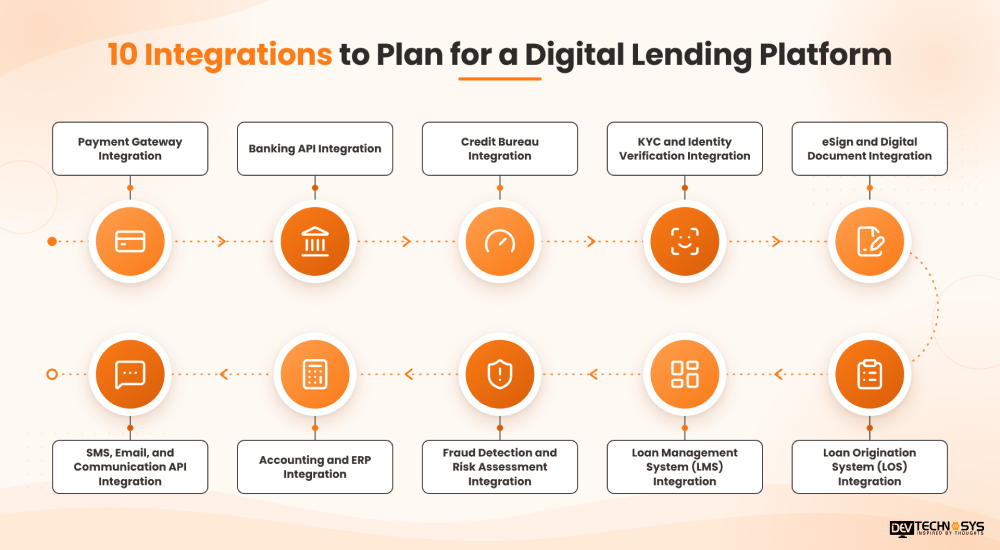
1. Payment Gateway Integration
Companies investing in the development of payment gateway solutions have to pay special attention to secure transactions and communication of the payment status to users. Adequately developed payment services can minimize the involvement of personnel in operations of the repayment process.
Payment gateways serve as facilitators for lending companies in obtaining payments, conducting payments through accepted cards, and performing any other payment-service activities. Effective integrations of payment gateways ensure that the lending service receives direct inquiries about payment options.
Depending on the type of service offered, the company may also need to obtain information about recurring payments and other relevant payment communication methods.
2. Banking API Integration
Companies may rely on the already existing banking IT solutions as a basis for connecting their lending processes with needed banking infrastructure. Due to the capabilities and permissions of the provider, such connections can also support functions such as tracking the status of the transaction, verifying the beneficiary, and providing services connected with the account.
Banking APIs facilitate the connection of loan-related applications to banks and financial institutions so that they can securely exchange financial data and instructions regarding financial transactions. Lending API integration allows banking institutions to connect relevant banking operations for fund transfers, validation of the bank account, and loan issuance.
To ensure stable communication between the lending system and third parties, companies should apply efficient API development. In particular, proper implementation of Secure authentication, data encryption, verification of the request, appropriate access management, and management of credentials are needed for API development.
3. Credit Bureau Integration
By integrating credit bureau services, lenders can easily obtain credit-related credentials and assess applications faster. Credit history checks and credit scoring provide information on repayment practices, ongoing obligations, and possible credit risks.
To build a credit score check app, businesses need to connect with integration partners and establish the required level of access and consent. After that, credit information can be used in the underwriting process in compliance with the law.
Automation of credit verification helps to do away with many time-consuming operations. Still, credit rates should not be the only thing to consider when making lending decisions. Income, debt burden, and other equally important factors should be taken into account when assessing applicants.
4. KYC and Identity Verification Integration
The process of Know Your Customer (KYC) integration enables lenders to check the authenticity of borrowers’ identities before accepting their applications or giving any financial service. KYC integration links the platform with providers of identity verification and those that validate the documents.
Automation has lowered the need for manual effort in this process, along with helping detect contradictions in the submitted data. It also enables effective customer onboarding by letting the client complete the required verification via a digital process. By using the services of Payment Gateway Integration companies, it will become easier to connect with payment processors for banks.
The issue of security and compliance is a crucial factor in the implementation. Companies need to apply all regulations regarding customer consent and its limitations in respect of the data and personal identification documents.
5. eSign and Digital Document Integration
Digital document integration facilitates lenders in the production, signing, arrangement, and retrieval of loan documents electronically. Among the documents are loan agreements, consent forms, disclosure forms, and repayment schedules.
Moreover, automation ensures document consistency. For instance, when loan applications are approved, the system creates an agreement based on verified borrower data and confirmed loan conditions. Then the document is signed and associated with the respective loan account.
Businesses need to verify the validity of signatures, document integrity, and the existence of access control mechanisms, audit trails, and retention obligations. Additionally, businesses should ensure their method of signing complies with necessary regulatory and legal requirements.
6. Loan Origination System (LOS) Integration
Companies that want to develop an instant loan approval app will benefit from incorporating integrated verification and underwriting processes, which significantly minimizes the time for processing eligible applications.
The Loan Origination System aids in processing applications by verifying eligibility, collecting necessary documentation, and managing approval workflows. When it is combined with other services offered at different stages of the lending process, it will allow transferring the application from the stage of eligibility verification to credit scoring and approval without the need to re-enter the data manually.
It is important to understand the difference between loan origination vs loan management software when planning the architecture of the platform. While Origination refers to the processing of the application and approving it, the Loan Management Software will deal with servicing after the lending product has been launched.
7. Loan Management System (LMS) Integration
A Loan Management System is a system for managing loans after they have been originated. It takes care of repayment plans, outstanding amounts, interest calculations, overdue accounts, and loan closures.
With the help of loan management software development, companies can set up automated workflows that will update loan data once payments are processed, repayment dates change, or accounts get overdue.
Connecting the LMS with payment gateways, banking APIs, accounting systems, and communication solutions will guarantee that every other system uses the same data on loans. For instance, loan repayment can reduce the outstanding amount and produce a confirmation notice sent to a borrower.
This integration will matter mostly for those companies that are working on loan lending app development, as borrowers want to be able to see their loan amounts and installments through the app.
8. Fraud Detection and Risk Assessment Integration
Financial companies may also create specialized software for AML purposes, or combine it with suitable third-party services for AML screening, monitoring of transactions, managing alerts, and investigation processes. The software should ensure compliance of the company’s activities with laws and at the same time fit the company’s risk profile.
Fraud detection software development companies can link risk scoring engines with tools for identifying the device, verifying the identity, and monitoring transactions. The purpose of these tools is to analyze various indicators of risk and point out the applications that need closer investigation.
Fraud detection tools should generate alerts that can be explained, as well as permit authorized teams to conduct investigations of unusual activities. If the rules are too rigid, then the operations of legitimate borrowers can be blocked; therefore, it is necessary to work on tuning monitoring thresholds for this purpose.
Using real-time fraud monitoring capabilities gives the platform a chance to detect criminal actions on the go. For instance, submitting applications that contain contradictory identity information or irregularities in transactions indicates the necessity of further verification.
9. Accounting and ERP Integration
Accounting and Enterprise Resource Planning (ERP) integrations link lending operations with financial data and reporting processes. These integrations enable lenders to manage disbursements, payments, interest income, charges, and balances.
Companies need to clarify how transactions are related to the accounts in the ledger and how adjustments, reversals, refunds, and failed payments are handled. Proper relationships are crucial when it comes to working with numerous transactions performed in the course of servicing different loan types.
Integration should provide all the necessary access restrictions, audit trails, reporting capabilities, and systems designed for discrepancy resolution. Financial departments should also be able to analyze exceptions instead of fully relying on automated postings.
10. SMS, Email, and Communication API Integration
Communication APIs provide an effective means for lending companies to address their borrowers through timely notifications and messages. Such messages may encompass one-time passwords (OTPs), application status updates, notifications regarding loan approval, reminders about payments, and all alerts related to users’ accounts.
Lenders must determine potential service providers based on the reliability of message delivery and technical capabilities, including channels and options to integrate API with current IT systems.
Security and consent play an essential role in the process, as OTP and sensitive messages must be secure and the legal statements for promotional messages should be respected.
Best Practices for Planning Digital Lending Platform Integrations
A good fintech app architecture has to outline how different internal systems work together with external services, what data systems rely on, and how to recover from failure. Additionally, businesses must have API agreements, as well as procedures for monitoring and upgrading versions in place.
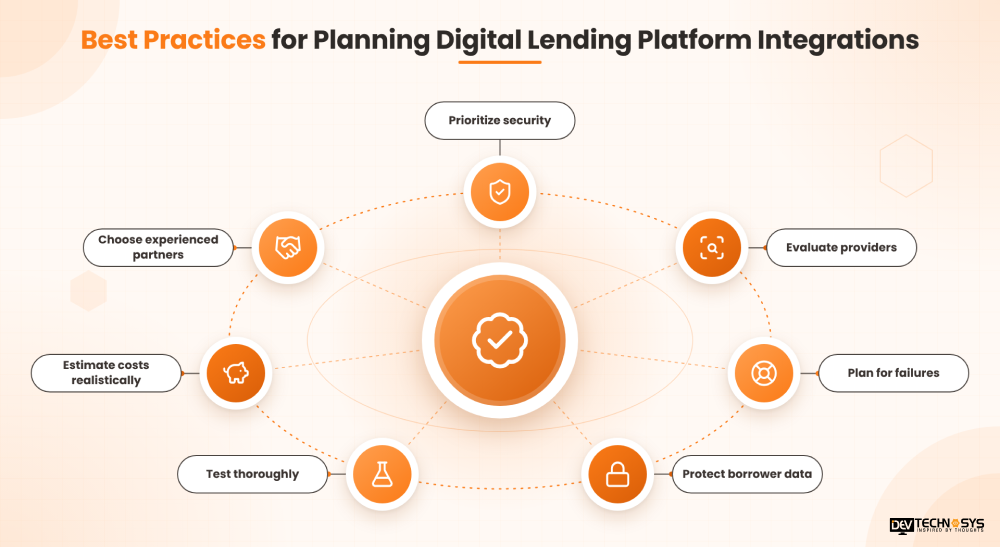
Businesses must assess their technology needs and rank their integration strategies according to their lending system before putting them in motion. Organizations that are planning to build fintech software should consider the following practices:
- Prioritize security: Use data encryption procedures, strong user authentication systems, and proper access control methods to satisfy customers.
- Evaluate providers: Investigate API documentation, availability guarantees, technical support, and other aspects in the documentation.
- Plan for failures: Prepare retries, timeouts, idempotent processes, and others beforehand.
- Protect borrower data: Use information minimization, consent management, or other data retention methods to ensure data safety.
- Test thoroughly: Ensure integrity of integration operations, correctness of transactions, performance of the application, and its error management.
- Estimate costs realistically: The loan lending app development cost depends upon different factors: complexity of integrations, license costs, transaction volume, security level, and support service.
- Choose experienced partners: Companies that have experience in fintech software development can help firms in creating secure integrations.
Conclusion
Effective digital lending platforms require safe, reliable, and properly thought-out connections. All integrations-from payment providers and banking APIs to credit checking, fraud detection, and loan servicing- aim to improve the lending process and make it more efficient.
Companies must make priorities among the connections with respect to their operational functions, legislative requirements, and development strategy instead of thoughtlessly employing available technologies. Utilizing modular architecture and investing in sufficient testing will allow preserving the platform’s capability to develop.
If you wish to create a safe and scalable lending platform, work with professionals at Dev Technosys for fintech software development services for proper integrations and to make your lending idea a reality.
Frequently Asked Questions
Find answers to the most common questions related to this article.
Key integrations usually consist of payment gateways, banking APIs, credit bureaus, Know Your Customer (KYC) services, electronic signature (eSign) solutions, loan origination and management tools, fraud detection, financial accounting, and communication APIs.
APIs link lending software packages with third-party financial providers, thus allowing secure data sharing and automation of processes. They also facilitate the process of minimizing manual operations, synchronizing information records, and speeding up application processing and return management.
The process of loan origination involves application distribution, verification, underwriting, and loan approval. The loan management process takes place after disbursement of the loan and involves repayment schedule determination, interest calculations, outstanding balance monitoring, overdue payment processes, and closure of the loan.
Development costs differ according to the complexity of the platform, integrations, requirements for security, compliance, third-party licensing charges, etc. A thorough analysis of the needs helps come up with a suitable budget and implementation period.
Secure integrations can integrate identity verification, credit history checks, fraud monitoring, and transaction screening. The need for encryption, access control, consent management, audit logs, and constant monitoring will help protect borrowers' sensitive information.