














Key takeaways:
-
- Businesses must evaluate loan origination vs loan management software to make an effective choice according to the workflow.
- Loan Origination Software manages the initial process when a customer applies for a loan. It reduces manual work, letting businesses focus on other priorities.
- In contrast, Loan Management Software helps managers track dues and other operations.
- Both systems need specific security and compliance to manage loan accounts efficiently.
- Businesses should evaluate the lending workflow when choosing software.
- If small lenders want to use integrations, then they must partner with a software development company.
Businesses that lend money to individuals are upgrading with technology. Previously, employees managed details manually, which often led to duplicate entries or missing information. This is a concern for large businesses that handle high volumes of data manually.
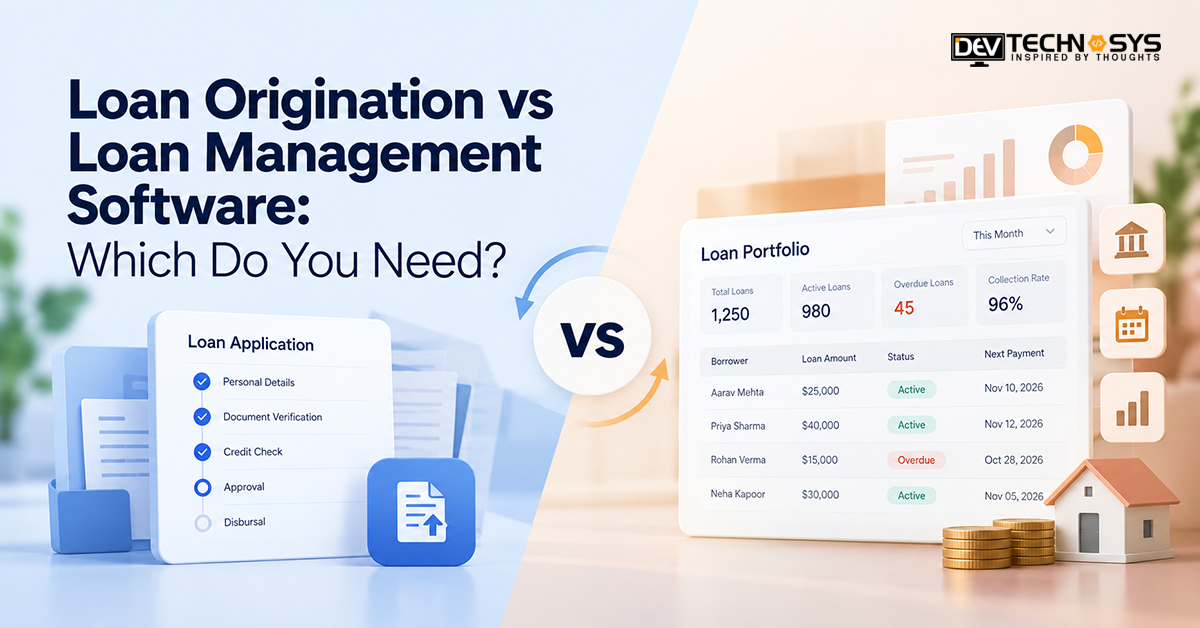
This is where loan origination software and loan management software help lenders streamline their operations. Although both solutions support the lending process, they serve different purposes. Loan origination software manages the process of acquiring, evaluating, and approving loan applications, whereas loan management software handles loans after approval and disbursement.
Before understanding loan origination vs loan management software, let’s learn about each of these.
What is Loan Origination?
It’s software banks or fintech companies use to provide loans to potential customers. The software helps to collect a customer’s information, approve/reject a loan application, assess credit score, and verify documents.
This reduces the manual work of loan officers who otherwise have to collect documents and verify each applicant manually. But businesses should be aware of loan lending app development cost before choosing a solution.
5 Key Features of Loan Origination Software
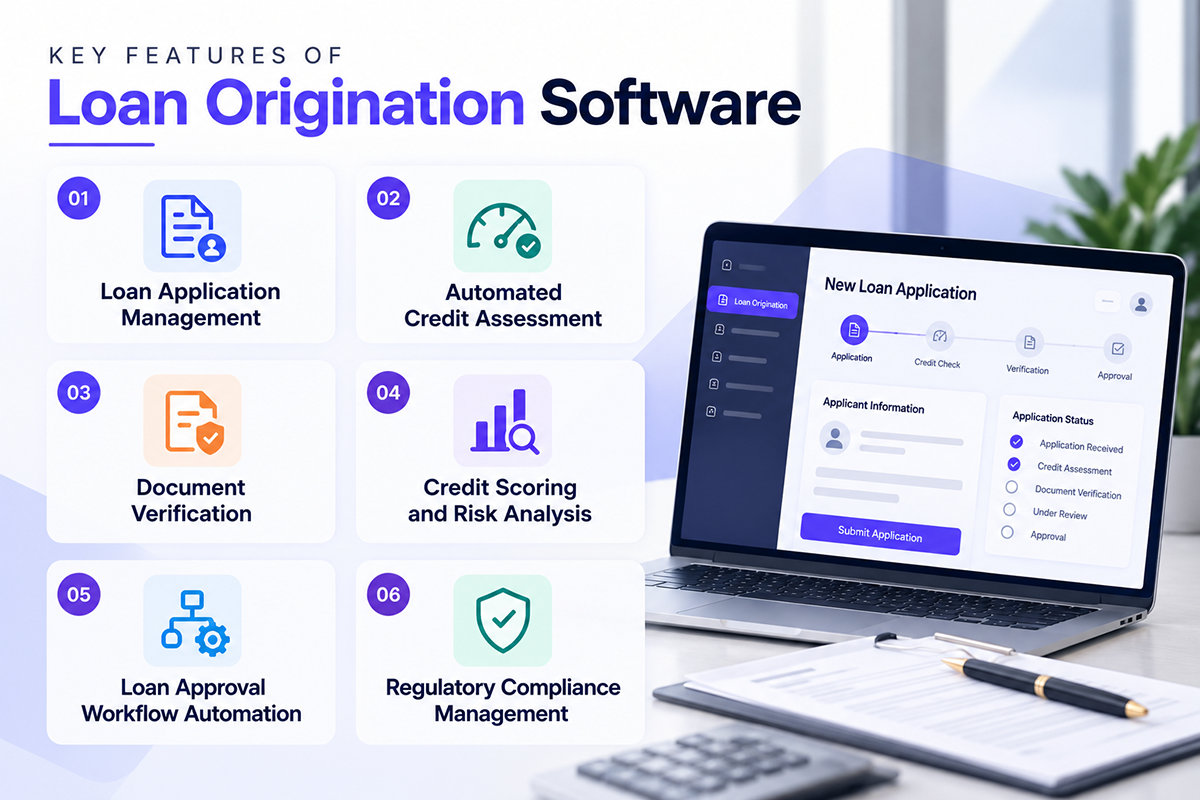
- Collects key borrower information through mobile apps and integrated partner platforms to start the digital loan application process.
- Organizes documents in a structured way, such as bank statements, Government IDs, and supporting documents.
- Loan origination software is integrated with credit bureaus to assess a borrower’s credit score and history.
- Routes loan applications to the officer for verification based on predefined business rules.
- Approves/rejects a loan request according to eligibility criteria and submission of required documents.
Industry Insight: According to Straits Research, the global loan origination software market size is expected to reach USD 16.21 billion by 2034. This highlights the growing importance of online loan applications.
Top 5 Benefits of Loan Origination Software
- Reduces delays in loan applications with the automation of repetitive tasks
- Helps lenders track loan activities
- Improves borrower experience by making the loan application process fast and convenient.
- Centralizes loan data without switching to multiple systems.
- Supports better loan decisions for borrowers.
Planning a Fintech App Project?
Get a tailored development cost estimate in a few simple steps.
- 3 quick steps
- 100% free
- Reply in 1 business day
2 Minutes Read
What is Loan Management Software?
Once a customer takes a loan, companies usually implement the software to track loan activities. Loan management software development tracks the EMI of a borrower, calculates outstanding balances, tracks overdue payments, and manages loan records.
A business can browse backend data to track installments, allocate payments between principal and interest, handle partial payments, calculate applicable charges, and manage changes to repayment terms.
Key Features of Loan Management Software
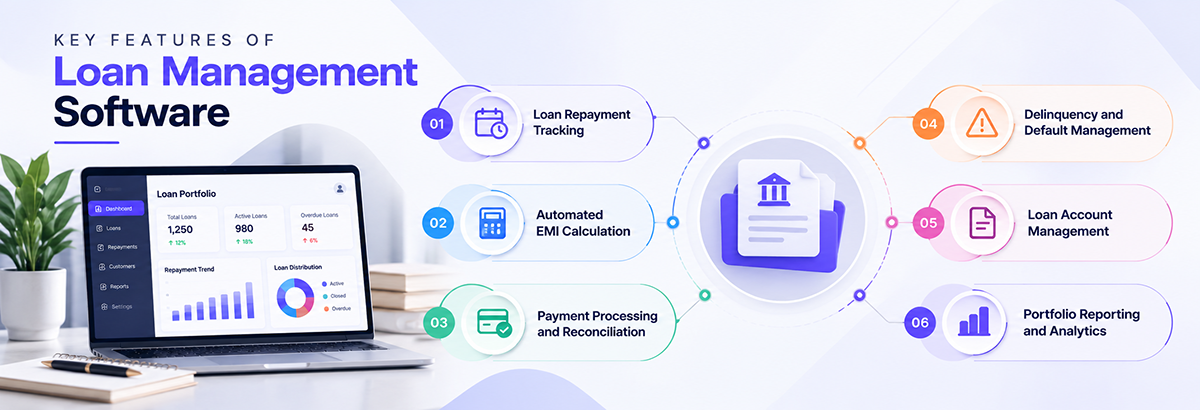
- Loan management software maintains records of repayment, interest rates, and the borrower’s account status.
- Using calculation rules, it generates installment amounts and due dates.
- Processes payments from the borrowers to the payment providers.
- Charges fees and interest after the loan repayment date.
- Generates reports and analytics of a loan application.
Benefits of Loan Management Software
- Helps lenders track loans for multiple borrowers.
- Automates repayment activities, reducing manual tracking efforts.
- Helps businesses to identify discrepancies between loan records and payment transactions.
- By automating tasks, the software reduces administrative work.
- Helps lenders manage thousands of loan applications at once.
Loan Origination vs Loan Management Software: Key Differences
If you are planning to build an instant loan app like CashNow then you have to evaluate the key differences first. This will help you to get a custom solution based on clear objectives.
Comparison factor |
Loan Origination Software (LOS) |
Loan Management Software (LMS) |
| Primary purpose | Process and approve loan applications | Manage active loans and repayments |
| Lifecycle stage | Application to approval and handoff for disbursement | Disbursement through repayment and closure |
| Core users | Loan officers, underwriters, verification teams | Loan servicing teams, accountants, collections teams |
| Data managed | Applications, borrower documents, credit information, underwriting decisions | Loan balances, transactions, repayment schedules, overdue accounts |
| Main workflows | Application review, identity verification, eligibility checks, underwriting | Payment allocation, interest calculation, reconciliation, collections |
| Key integrations | KYC, credit bureaus, e-signatures, document verification | Payment gateways, banking systems, accounting software, notification services |
| Performance indicators | Application processing time, approval turnaround, application completion rate | Repayment rates, delinquency rate, reconciliation accuracy, servicing cost |
| Primary business outcome | Faster and more consistent loan processing | More efficient loan servicing and repayment tracking |
How Do Both Systems Work Together?
Understanding loan origination vs loan management software is okay, but what if a business needs to use these software systems together? The quick answer is that both systems follow a typical workflow, such as checking a loan application, then KYC, approval, and payment processing. While LOS handles borrower onboarding, LMS manages repayments and interest calculations.
1. Loan Application Acceptance
Users apply for a loan either directly with the bank or through supporting platforms integrated by Fintech companies. The process begins when a borrower submits a loan application with essential details and documents.
These include personal details, employment information, loan amount, and supporting documents. The system automatically verifies the information and directs the user to the next step.
2. Loan Origination Software
Next, loan origination software verifies the borrower’s details against eligibility criteria and predefined rules. This phase involves credit checks, KYC verification, eligibility assessment, and income verification.
If information is missing or incorrect, the user must complete it to proceed to the next step. These processes are completed within a few seconds, allowing borrowers to receive the loan amount quickly.
3. Approval and Disbursement
Once the lender verifies the borrower, it approves the application by defining the loan terms. The details include the repayment start date, EMI amount, tenure, and interest rate.
The approved loan amount is transferred to the respective bank account. At this point, loan origination software shares the details with the loan management system so that lenders can access them via interactive dashboards.
4. Loan Management Software
In this phase, the software manages the loan repayment according to the loan tenure. The system shares reminders with borrowers, sets schedules, and manages overdue payments.
This stage includes payment reminders, tracking, EMI scheduling, and overdue management. The best part is that the lenders have to simply access the information from a dashboard without needing to manually connecting with a borrower.
5. Loan Closure
Loan management software completes the process by receiving the total dues, including interest, from the borrower. The system generates a final statement mentioning the date, loan amount, EMI, and more. It also contains a no-objection certificate with important details. The system also submits the record as a credit score for the borrower.
When Should You Choose Loan Origination Software?
Consider this solution if your business:
- Receives a high volume of loan applications through different channels.
- Relies on manual document collection and borrower verification.
- Needs to automate underwriting workflows and eligibility checks.
- Wants to integrate credit bureau, KYC, and e-signature services.
- Experiences delays because multiple teams review the same application.
- Needs better visibility into application status and approval bottlenecks.
When Should You Choose Loan Management Software?
Consider this solution if your business:
- Manages a large portfolio of active loans.
- Tracks repayments and outstanding balances using spreadsheets or disconnected tools.
- Needs accurate installment, interest, and fee calculations.
- Wants to automate payment reconciliation and overdue reminders.
- Needs better coordination between servicing and collections teams.
- Requires consolidated reports on repayment performance and portfolio health.
When Do You Need Both Loan Origination and Loan Management Software?
Businesses need loan lending app development services when they want to complete the entire loan lending cycle. An integrated solution helps organizations to reduce duplicate data entry, improve communication between accounting and other systems, and increase ROI.
The solution is relevant for fintech companies, banks, or credit unions that want to automate this critical process. Experts design and develop the system to meet security and compliance standards. These include GDPR, CCPA, and other data or industry-specific regulations.
You may need both systems when:
- You want a digital transformation for the loan process
- The existing system is outdated and incapable of processing applications
- You are planning for a business expansion for which automation is required
Custom Loan Software vs Ready-Made Solutions
After deciding which type of software you need, the next question is whether to buy an existing product or develop a custom solution. If you have money lending app ideas, then talk to our experts to design a feasible software.
Factor |
Ready-made software |
Custom loan software |
| Implementation | Often faster if requirements fit the product | Requires planning, development, and testing |
| Initial investment | May have lower upfront costs | Usually requires a larger initial investment |
| Customization | Limited by available configuration options | Can be designed around specific workflows |
| Integrations | Depends on supported APIs and vendor capabilities | Can be tailored to required third-party systems |
| Maintenance | Vendor may manage updates and infrastructure | Depends on the agreed development and support model |
| Best suited for | Standard lending processes | Specialized lending products or complex workflows |
Technical Considerations Before Developing Loan Software
To develop an instant loan approval app, businesses should have important technical considerations in mind. These include security, API integrations, compliance, and scalability. These directly affect cost and overall business operations.
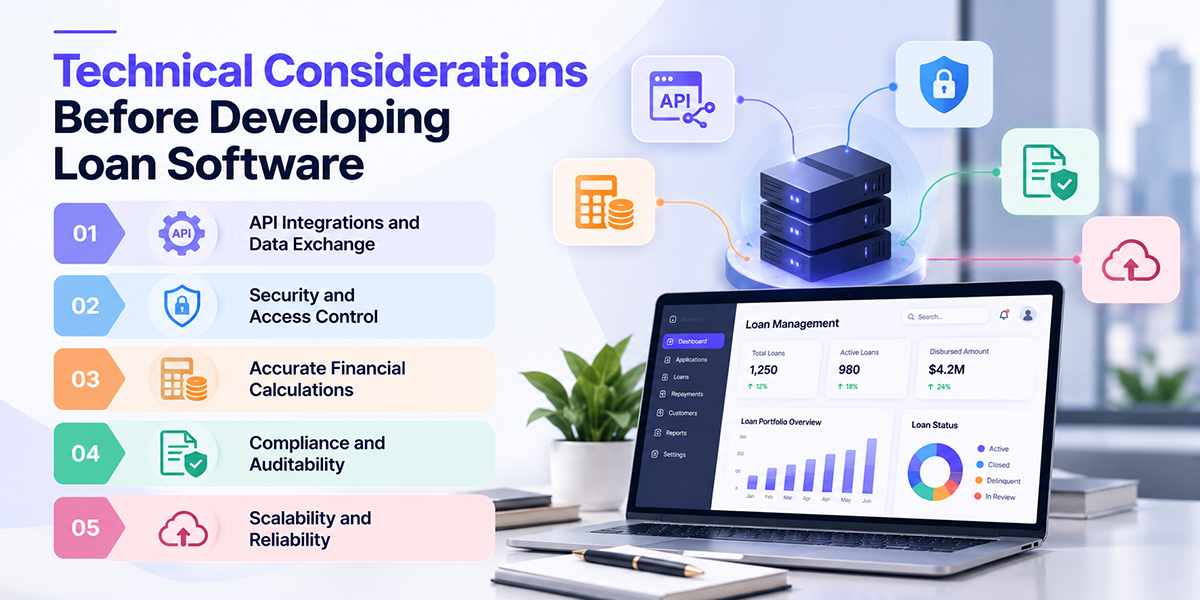
1. API Integrations and Data Exchange
Fintech organizations and credit unions need to be connected with KYC providers, credit bureaus, banking APIs, payment gateways, accounting tools, and notification services.
Experts use schema validation, clear error handling, and appropriate retry mechanisms for proper data exchange. This lets users interact with the software smoothly, without errors.
2. Security and Access Control
Before software development, engineers consider appropriate security measures to protect sensitive information. These include encryption in transit and at rest, role-based access control, multi-factor authentication where appropriate, and audit logs.
Access is provided only to admins, employees, and verified users. If a business uses an AI agent, the AI model is trained to restrict prompt responses.
3. Accurate Financial Calculations
If your business is growing and you are spending more on operations, choose one or more software systems to manage tasks. The solution will calculate late payments, partial payments, prepayments, and loan restructuring. Experts design the architecture technically so it can calculate amounts easily and accurately. But you must test the system multiple times before deploying it into your workspace.
4. Compliance and Auditability
When evaluating technical considerations, choose regulatory compliance according to your industry and business size. The system should support content deletion, user consent management, data privacy, borrower disclosures, record retention, lending practices, and reporting.
Experts must also consistently audit the system for bugs, errors, or vulnerabilities. Real-time fraud monitoring is also essential when considering compliance and auditability.
5. Scalability and Reliability
Whether it is loan origination or loan management software, always prioritize scalability and reliability. This helps businesses reduce operational costs and deliver a smooth user experience. Scalability allows developers to make suitable changes to the features/functionalities as the business expands.

How Do I Choose Between Loan Origination Software, Loan Management Software, and a Complete Lending Platform?
Businesses can choose an application based on the operational challenges they face. For example, if you still manage the loan application process manually, you need loan origination system. Explore the decision-based factors:
1. Choose loan origination software for application processing:
If your employees have to review loan applications manually. For example, jotting down the details while struggling to manage deadlines or needing to calculate amounts for multiple loan applications. Loan origination software helps you review each loan application carefully.
2. Choose loan management software for post-disbursement operations:
If your employees are experiencing repayment tracking as the primary concern or noticing errors while generating loan receipts, then implement loan management software. This works according to payment allocation rules to manage previous and existing loan applications.
3. Choose a complete lending platform for end-to-end operations:
If you have to write the entire loan application lifecycle manually, then your business needs integrated software. The system connects existing systems, helping employees complete loans faster and more accurately. This will also improve communication between different departments.
4. Evaluate integration capabilities:
Be it any software system, businesses should analyze the integration capabilities of the existing system. If the internal business system is outdated, then you might need to build a custom software application.
Experts then review the technology stack to replace it with the new system. You can even discuss integrations to plan for a digital lending platform with our experts to solve existing challenges or system limitations.
5. Verify financial calculation accuracy and security:
Decision makers should choose software that can solve financial problems. An AI integration may also help calculate repayment schedules, penalty rules, and applicable lending requirements.
But make sure to implement security and compliance measures. For example, if you want to build instant loan app like CashNow then create a list of financial transactions or features you need.
6. Compare scalability and total ownership costs:
Maybe your business is at a mid level but is experiencing a growing phase; then make sure to create a total cost of ownership plan. This will help to calculate additional expenses while emphasizing scalability.
Conclusion
Choose between loan origination software and loan management software based on the services your business provides. If you are a large enterprise that wants to provide both, then partner with a fintech software development company with clear business goals.
If you are a growing business, choose loan origination software to automate loan applications or loan management software if you need to manage loans after disbursement. Although they serve different purposes, both solutions help manage loan operations efficiently.
Frequently Asked Questions
Find answers to the most common questions related to this article.
Loan origination software manages loan activities when a borrower plans for it. These include approval of applications, borrower verification, and more. Loan management software manages loans after disbursement, including repayment schedules, interest calculations, outstanding balances, and collections.
Yes. Both systems can be connected through APIs or implemented as modules within a unified lending platform. Integration allows approved loan details to flow into the servicing system, reducing duplicate data entry and helping maintain consistent loan records.
Startups should use ready-made software to reduce initial development effort. This will help to save costs while giving better user benefits. The application comprises the necessary features to accept or decline loan applications and support post-loan activities such as EMI tracking. After a certain duration of time, a fintech startup can choose to build a custom software system.
APIs allow such systems to exchange data between customers, loan platforms, payment gateways, and external services. This ensures that users and businesses are in sync with the loan-related information.
Yes, artificial intelligence supports document extraction, application processing, fraud detection, and credit risk assessment. In loan management, it can help identify repayment patterns, prioritize collection activities, and forecast potential delinquencies. AI-generated recommendations should be validated, monitored, and subject to appropriate human oversight. Businesses can even integrate predictive analytics or AI customer support to provide personalized experience to the borrowers.