











Key Takeaways:
-
- Fleet software integrations let businesses track deliveries, driver location, and maintenance details more efficiently than manual processes.
- Decision makers must prioritize integrations based on operational goals and budget.
- Integrating AI-powered analytics and predictive analytics helps managers to identify operational patterns and forecast maintenance needs in real time.
- Partnering with a fleet management software development company helps select the right integration while reducing costs.
- Businesses can also integrate CRM, ERP, and accounting software with fleet management software to ensure smooth communication across departments.
Fleet managers often face challenges managing day-to-day operations because of outdated systems. They struggle to track deliveries and monitor vehicle and driver performance. Often, customer queries go unanswered, which affects a business’s competitive edge.
A modern fleet management app like Fleetio allows managers to keep track of everyday activities. Managers can identify communication gaps and improve overall business performance.
Businesses can also integrate customer relationship management, enterprise resource planning, accounting software, and other internal systems to streamline cross-department data exchange.
The fleet management integration checklist is tailored to your fleet size, workflows, existing technology, compliance requirements, and long-term growth plans.
This detailed guide is for businesses that are looking to simplify complex operations through fleet software integrations.
Fleet Management Statistics 2026 – 2030
- According to Mordor Intelligence, businesses are being aware of vehicle management, maintenance, and supply chain operations.
- Fleet management software is expected to grow at 15.32% by 2030. This highlights the solution’s impact on US businesses.
- North America accounts for the largest share of fleet management service usage.
- Transportation and logistics businesses account for around 42% of the fleet management software market, using it to manage day-to-day operations.
- Investing in cloud-based fleet software helps businesses work on scalable platforms.
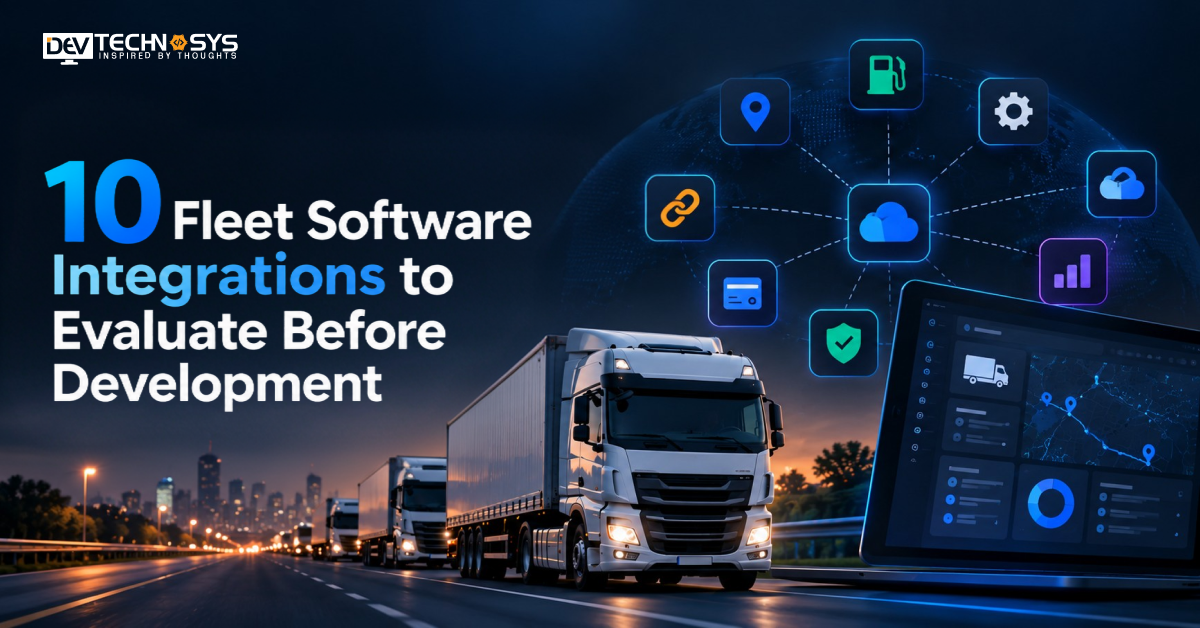
10 Essential Fleet Software Integrations to Consider
To streamline operations, businesses need targeted integrations to automate fleet management. Integrating fuel management, CRM, GPS tracking, and artificial intelligence helps fleet managers make informed decisions.
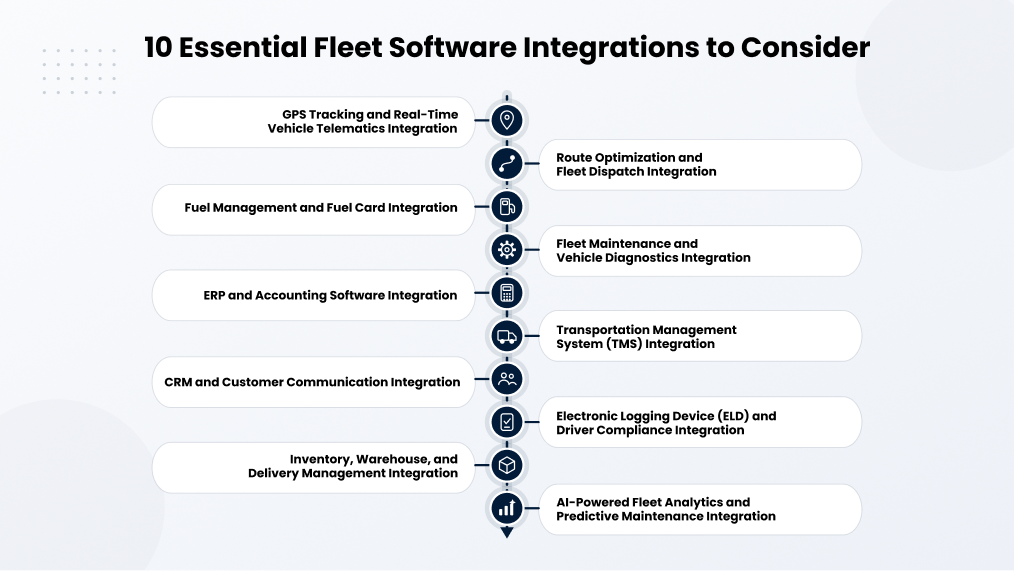
1. GPS Tracking and Real-Time Vehicle Telematics Integration
This integration shares real-time information on a vehicle, engine performance, speed, and mileage. This data helps fleet managers get accurate vehicle details without relying on driver reports. They can quickly identify and address operational inefficiencies. Experts choose a GPS and telematics provider with reliable APIs and webhooks for frequent location updates. GPS Tracking integration allows managers to track vehicle locations and movement in real time.
2. Route Optimization and Fleet Dispatch Integration
This integration helps drivers find the best route to complete deliveries. Fleet managers will be notified of schedule changes so they can reassign a driver. Key factors include traffic conditions, delivery windows, vehicle capacity, driver availability, and delivery priorities. Experts should plan this integration to support dynamic route adjustments when traffic congestion, vehicle breakdowns, cancellations, or urgent delivery requests occur. To build route optimization software, businesses need to assess fleet size, total drivers, and estimated deliveries.
3. Fuel Management and Fuel Card Integration
When this information connects to the existing system, managers can access data such as fuel consumption, associated costs, and overall fuel expenses. Managers can use this information to create a strategic investment plan. Engineers use a fuel management API that provides driver information, fuel consumption, and other relevant details.
4. Fleet Maintenance and Vehicle Diagnostics Integration
Businesses often spend a lot of time diagnosing vehicles, which delays deliveries and affects the customer experience. Fleet software integrations let businesses monitor vehicle health, schedule servicing, and respond to mechanical problems before they cause extended downtime. Key benefits include improved budgeting and vehicle availability.
5. ERP and Accounting Software Integration
ERP integration services let employees access finance and administrative processes easily. For example, a driver requests vehicle maintenance, and the expense is sent directly to the accounting team. The accounting team can also easily track fuel transactions, invoices, vendor payments, and other transactions.
This lets businesses align expenses with existing financial processes to improve investment decisions. This integration must include audit logs and access controls to protect sensitive information.
6. Transportation Management System (TMS) Integration
Large enterprises typically use a TMS to manage multiple shipments and broader transportation processes. Integrating a TMS with fleet management software means getting access to shipment allocation, carrier coordination, and freight movement. This streamlines workflows for managing vehicle and driver activities. This integration improves coordination and reduces transportation delays.
7. CRM and Customer Communication Integration
Scattered data in the system makes it harder for employees to maintain strong customer relationships. If a business chooses CRM integration services, employees can access customer records, delivery commitments, service requests, and communication histories. This simplifies logistics operations for distributors and businesses that manage recurring deliveries. Experts either integrate the functionalities in the existing system or provide a custom solution based on your specific business requirements.
8. Electronic Logging Device (ELD) and Driver Compliance Integration
ELDs help fleet managers check drivers’ duty status and availability for service. Electronic Logging Device (ELD) is for businesses that operate on an hourly basis to clear the dues easily. This integration also helps assign a different driver if the primary driver is unavailable. This integration allows businesses to maintain regulations while checking a driver’s duty-status information using a centralized dashboard. Businesses that are operating in the United States must comply with the Federal Motor Carrier Safety Administration (FMCSA) to avoid legal concerns.
9. Inventory, Warehouse, and Delivery Management Integration
With these integrations, fleet managers can easily check warehouse activities and last-mile delivery workflows. This integration benefits large businesses with multiple warehouses. You will receive frequent updates on delivery requests, vehicle allotment, and order dispatch. If you choose GPS tracking software development services, you can easily track incorrect vehicle locations and check delivery updates from the admin dashboard. Before selecting this integration, evaluate fleet requirements, total deliveries, and other factors.
10. AI-Powered Fleet Analytics and Predictive Maintenance Integration
Instead of relying on historical records, fleet managers receive insights into potential problems. This helps them to improve planning. These insights are usually based on data quality and model capability, prioritizing vehicle inspections to avoid delivery failures. A predictive maintenance model estimates when vehicle components may fail, reducing operational costs. Managers have detailed operational records, helping them solve complex business challenges.
Industry Insight:
According to The Business Research Company, the fleet management software market is expected to grow to $55.97 billion in 2030. Key drivers influencing this adoption include driver & vehicle management, GPS tracking, and automation of regular operations.
What APIs are Required for Fleet Software Integrations?
Fleet software integrations rely on APIs to exchange information and streamline workflows. Users can fetch real-time updates and exchange data securely with existing business applications. After integrating APIs, managers can avoid manual data entry when retrieving vehicle or delivery details.
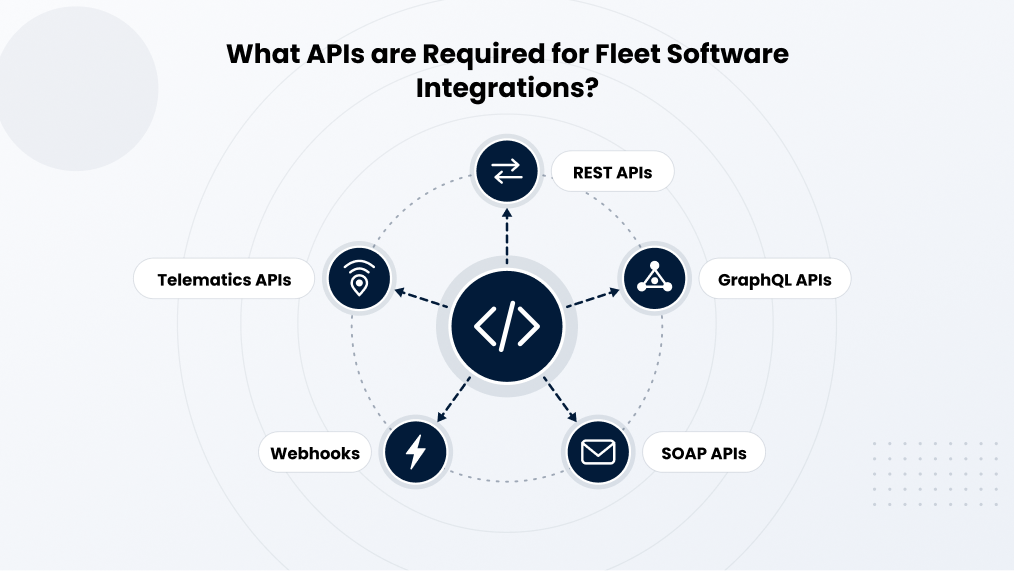
1. REST APIs
REST APIs enable fleet management automation between the hardware and software. They allow managers to check for records, vehicle locations, and fuel transactions. Experts use Representational State Transfer APIs to standardize HTTPS requests and JSON data formats that promote automation. Developers often configure error handling, authentication, and request validation to support reliable communication.
2. GraphQL APIs
A smooth workflow starts with correctly retrieving information from the data fields. GraphQL APIs easily fetch the information from complex fleet management systems. Rather than sharing a large pool of data with the user, they share only the specific information needed. For example, if a manager asks for a report on 100 drivers, the system displays only the associated information instead of all drivers’ details.
3. SOAP APIs
SOAP APIs support structured data exchange and may be required when integrating with legacy enterprise systems or platforms that use SOAP-based services. These APIs use XML for data transfer. This allows managers to retrieve older information in a readable messaging format. But developers need to assess previously used APIs and whether a SOAP API will be effective for the existing system or not. Most businesses choose this API for asset tracking software development to manage the records.
4. Webhooks
In simpler terms, Webhooks share communication of a particular event, for example, when a manager wants to track deliveries for a week. Notifications help the team stay on the same page, avoiding miscommunication. Developers implement secure webhooks for event logging and handling duplicate events. Webhooks are important APIs to maintain proper data exchange between CRM, ERP, and other internal business systems.
5. Telematics APIs
This is the core integration that most businesses prefer because it allows easy and quick coordination with the driver. Fleet managers can check GPS coordinates, vehicle diagnostics, mileage, and engine performance. Telematics APIs support regular tracking of driver duties and vehicle performance.
Industry Insight:
PACOTURF has highlighted the expertise of Dev Technosys in building a scalable fleet app with essential integrations. We also highlighted our attention to detail and commitment to long-term business goals.
How Do Security & Compliance Affect Fleet Software Integrations?
Businesses should consider specific security and compliance requirements before planning feature integrations. For example, region-specific compliance is needed to secure data for users accessing your services in California, Europe, and other locations.
Experts implement SOC 1 for financial reporting, SOC 2 to maintain confidentiality, and ISO standards to ensure data is protected from unauthorized access. Businesses can also implement security protocols such as data encryption and role-based access control to protect sensitive information.
How to Choose the Right Fleet Software Integrations Before Development?
This blog covers around ten fleet software integrations, but that doesn’t mean you need all of them. The right combination depends on long-term growth plans, existing tech stack, and operational requirements. Businesses should evaluate primary and secondary requirements before choosing an IoT fleet management solution. For example, one organization might want to track vehicle & driver performance, while another needs to improve customer communication.
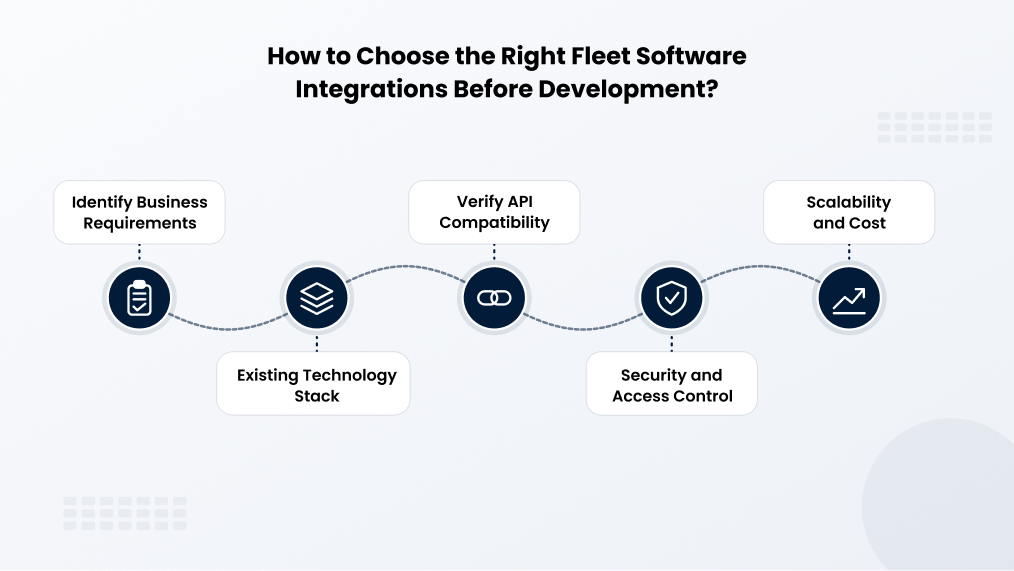
1. Identify Business Requirements
Not all integrations are made for your business. Maybe you are experiencing delivery delays and need telematics APIs to communicate smoothly with drivers. This is more necessary than selecting route optimization. What you have to do is create a list of essential features that could help your business grow. Businesses must conduct effective research for custom fleet management software vs ready-made platforms to match the brand goals.
2. Existing Technology Stack
Building an architecture from scratch will be expensive. The existing system may already integrate with internal business systems and require fewer improvements. Rather, hire dedicated developers or partner with a company whose experts can modify the existing tech stack with newer technologies. They will also integrate the business system with accounting, CRM, or ERP software.
3. Verify API Compatibility
This is a technical step where engineers verify API Compatibility to confirm API limits, webhooks, documentation, and data availability. They authenticate APIs to avoid any unauthorized access. Rather than evaluating this yourself, work with engineers to implement the right APIs. When you implement APIs, secure them with OAuth 2.0 or API keys to protect sensitive information.
4. Security and Access Control
Even if you are a small business, security is a primary consideration. A system is easily attacked when it lacks proper authentication. Once these are clear, experts can evaluate the security architecture and integrations and implement security protocols accordingly. Common measures include data encryption, role-based access control, and permissions when you plan to build delivery management software.
5. Scalability and Cost
Businesses need to calculate total cost of ownership based on fleet growth and data storage requirements. Choose an integration based on your business size. For example, if you are a growing business, you may need to implement cloud infrastructure to support APIs and other functionalities. If you are a large enterprise, evaluate your average applications before building an integration architecture.
Expert Insight:
I recommend that businesses prioritize fleet software integrations according to their operational requirements. This will reduce development costs and minimize integration risks.
Naveen Pareek, Supply Chain Expert, Dev Technosys
Conclusion
Fleet software integrations solve many business challenges, from vehicle management to delivery tracking and warehouse updates. Managers can skip manual data entry and achieve complete automation. This process saves time plus administrative costs. Most businesses have already completed an integration process to overcome limitations in the existing applications. However, a successful integration starts with decision-makers evaluating operational workflows and choosing between route optimization, ERP, CRM, fuel management, or AI-powered analytics. The best option is to partner with a fleet management app development company to address the existing system’s limitations.
Frequently Asked Questions
Find answers to the most common questions related to this article.
Developers can implement retry policies with exponential backoff, message queues, dead-letter queues, idempotency keys, and persistent event logs. These measures help prevent API failures in existing and new systems. Offline data buffering can store updates temporarily and synchronize them when connectivity returns, reducing data loss and duplicate transactions.
The database depends on data volume, query patterns, and consistency requirements. PostgreSQL or MySQL can manage vehicles, drivers, trips, and transactions, while time-series databases can efficiently store high-frequency GPS and telematics data. Businesses should choose the right database based on their regular data flow and fleet size
Although integrating with outdated systems is challenging, developers approach it by analyzing the tech stack and operational requirements. Legacy systems can connect through SOAP APIs, database connectors, file-based exchanges, middleware, or custom integration adapters, depending on their capabilities. An integration layer can transform legacy data into standardized formats without requiring a complete replacement of existing systems.
Testing should cover API authentication, data validation, end-to-end workflows, load handling, network interruptions, duplicate events, and recovery from failed synchronization. Developers should also test sandbox environments and verify integration behavior before enabling production data exchange.
Businesses can control integration costs by prioritizing essential connections, reusing existing APIs, selecting compatible providers, and automating repetitive data transfers. Evaluating API pricing, maintenance requirements, licensing fees, and future scaling needs before development can also prevent unexpected expenses.