
















Key Takeaways:
-
- Custom fleet management systems have specific functions, increased flexibility, and integrations that fit particular requirements of business needs.
- Ready-made fleet management software has quicker deployment, ready-made features, and lower capital requirements for typical fleet operations.
- Total cost of ownership accounts for development or subscription fees, maintenance, integrations, staffing, training, and future upgrades.
- Flexibility and integration features must be considered when selecting software available for fleet expansion and changing operations.
- The final choice of the right fleet management solution depends on finances, complexity of workflows, business target, and expectations.
Fleet management operations are not only about vehicle tracking. The management should take into account many different aspects, including driver coordination, route planning, maintaining the fleet, checking fuel consumption, compliance management, etc. There is a solution to integrate all these procedures, but it may be difficult to choose the appropriate one.
When it comes to the selection of fleet management software, work requires consideration of many factors, including the complexity of the organization’s operations, financial resources, integration capabilities, and business plans. Off-the-shelf solutions can be utilized quickly and effectively, while custom-designed software can meet organizations’ needs and requirements.
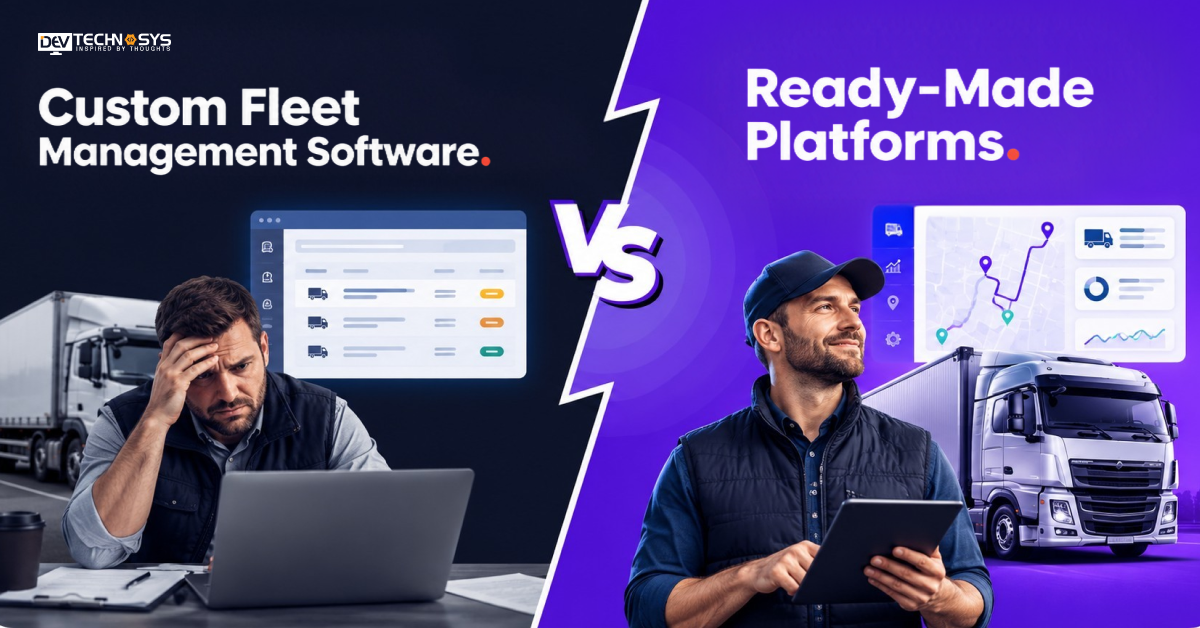
This blog considers key points related to both options and describes how to choose the right decision between custom fleet management software vs ready-made platforms. Having considered all pros and cons of the above-mentioned solutions, fleet managers will be able to make the right investment decision.
What Is Custom Fleet Management Software?
Custom fleet management software is a type of software that is designed and developed according to the needs of a company’s fleet management procedures, workflows, and reporting needs.
Instead of modifying pre-existing procedures so that they fit in with the nature of a certain software system, a company is allowed to define what kind of functionality, interfaces, integration, and automation logic has to be incorporated into the software.
A logistics organization might require an automatic allocation of deliveries based on the available space on a vehicle, availability of drivers, shipment priorities, and deadlines for delivery. A construction organization would, on the contrary, be focused on the effective use of the machinery and equipment, hours of operation, and various alerts related to maintenance issues.
Furthermore, a dedicated IoT fleet management solution may entail the use of GPS devices, sensors installed on vehicles, telematics systems, and accessible cloud-based dashboards.
Companies that have complicated workflows or reporting requirements will most likely find the solution to their problems in custom development.
Key Features of Custom Fleet Management Systems
Depending on business requirements, a custom solution may include:
- Real-time vehicle tracking and route optimization.
- Driver assignment, dispatch, and scheduling.
- Fuel consumption and expense monitoring.
- Preventive maintenance and repair management.
- Digital inspections and compliance documentation.
- Fleet performance dashboards and customized reports.
What Are Ready-Made Fleet Management Platforms?
Ready made fleet management software is defined as functional software that meets the basic needs of fleet management that many organizations require. Usually, application vendors sell this software on a paid subscription basis, and the features vary according to the chosen subscription plan.
Most companies start by signing up and creating an account, setting up the software by adding vehicles and users, connecting valid hardware, and deciding on how to manage work.
There are various payment arrangements offered by these platforms. Some of them charge by vehicle, while others use tiered subscription plans or charge enterprises based on negotiated rates. Standard fleet management applications may particularly serve those businesses that do not want to invest in a custom software development project.
Common Features of Off-the-Shelf Fleet Software
There are many vehicle tracking options, as well as other systems designed for fleet upkeep, with the content of each platform varying based on the type and cost of the service.
Fleetio, for example, offers fleet maintenance, expense tracking, asset management, and integration options. GPS Insight provides vehicle tracking, alerts, reports, and dispatching tools.
Motive blends fleet management with telematics, maintenance, compliance, and driver safety features.
Custom Fleet Management Software vs Ready-Made Platforms: Key Differences
A proper fleet management software comparison should consider the entire ownership experience, rather than focusing only on the initial price or feature list.
| Comparison factor | Custom software | Ready-made platform |
| Customization | Designed around specific workflows | Configuration and customization depend on the vendor |
| Implementation | Requires planning, development, and testing | Often faster to deploy |
| Initial investment | Generally higher | Usually lower upfront |
| Recurring costs | Hosting, maintenance, and support | Subscription, hardware, and additional module fees |
| Integrations | Can be built around required systems and APIs | Depends on available integrations and APIs |
| Scalability | Can evolve with business requirements | Depends on vendor architecture, plans, and limits |
| Maintenance | Business or development partner manages it | Vendor maintains the core product |
| Data control | Architecture and access can be tailored | Governed by vendor capabilities and contract terms |
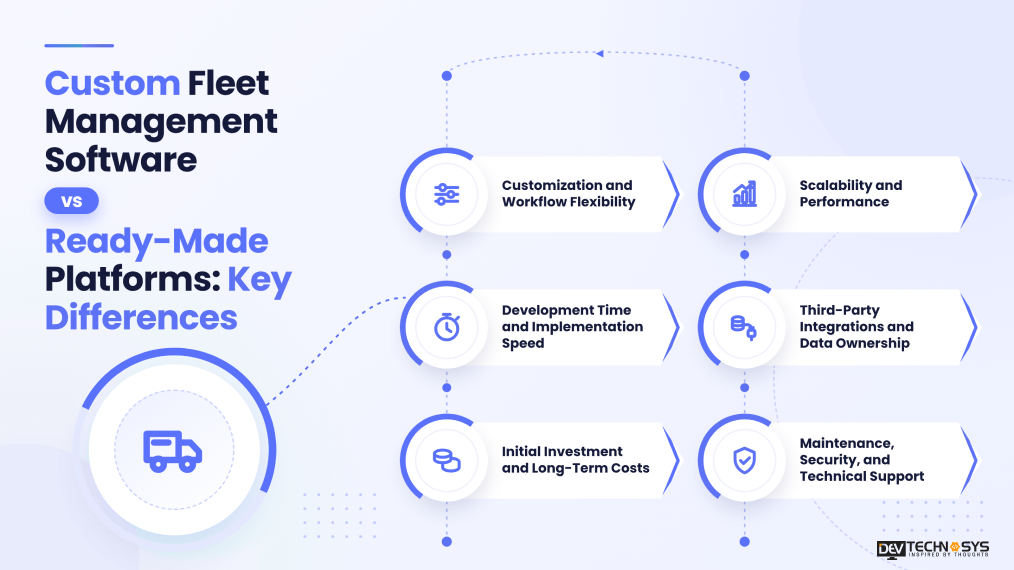
1. Customization and Workflow Flexibility
Custom solutions let customers choose their operational standards, auto-create status reports, and set dashboards according to user privileges. Off-the-shelf software may use pre-set templates as well, but not all demands will be addressed.
2. Development Time and Implementation Speed
Generic software can offer some advantage as the solution core already exists. Conversely, custom software entails several development phases: analysis, design, building, testing, and implementation. Yet complex integrations and migration processes will delay the full operational readiness of any solution.
3. Initial Investment and Long-Term Costs
In the long run, custom software might be more expensive to launch than a ready-to-use solution; however, total solution costs will depend on different aspects, like maintenance, infrastructure, and personnel costs, as well as future upgrades. Off-the-shelf solutions help to reduce development costs, but in the future, they will incur continuous expenses as the business expands.
4. Scalability and Performance
Both options are practically capable of supporting growing fleets. The main question is whether the architecture would be able to handle the increase in data volume, the number of concurrent users, the increase in the number of vehicles, and increasingly complex workflows, without high costs and performance bottlenecks.
5. Third-Party Integrations and Data Ownership
Integrating fleet software may allow you to connect GPS devices, accounting systems, fuel cards, ERP software, warehouse systems, and customer platforms. Custom software gives you more control over how integrations happen, while off-the-shelf versions can provide quicker access to supported connectors.
In both cases, review data export options, API limits, security controls, contractual ownership, and exit procedures before committing.
6. Maintenance, Security, and Technical Support
For custom solutions, there needs to be a clear plan in place for bug fixing, upgrades, backups, security updates, and technical support. Maintenance of the core platform for off-the-shelf solutions is handled by vendors, and companies have to manage user permissions, device security, and internal processes.
Pros and Cons of Custom Fleet Management Software
Here are some of the advantages and disadvantages of custom fleet management software:
Advantages of Building a Custom Fleet System
Custom software development allows companies to influence the functionality of their products, how they operate and integrate with other systems, as well as the customer experience.
Another big advantage is strategic flexibility. Companies can make informed choices regarding which functions to prioritize based on their operational data and add other capabilities in the future.
Challenges and Potential Risks of Custom Development
The major issues revolve around initial costs, long implementation phases, uncertainty regarding the project, and continuous support. Inadequate requirements gathering can result in costly modifications or useless features that do not tackle the real issues.
Companies should determine whether or not custom software is ideal to satisfy business operational needs before approving its development budget.
To support custom software development, create a custom software checklist that considers business objectives and core functionality, security, ownership, support, scalability, and budget. Phased deployment can reduce risk by validating key functionalities before releasing advanced ones.
Pros and Cons of Ready-Made Fleet Management Platforms
Here are some of the advantages and disadvantages of ready-made fleet management platforms:
Benefits of Using an Off-the-Shelf Solution
Off-the-shelf platforms provide ready-to-use functionalities, faster deployment, vendor support, and product updates. Companies may demo and trial solutions to make it easy for them to determine usability and feature appropriateness.
Some organizations that seek a Fleet Management app like Fleetio could consider looking into maintenance scheduling, work orders, expense reporting, and asset tracking. Companies looking for fleet software like GPS Insight may want to prioritize GPS visibility, alerts, historical trip data, and dispatch support. For a fleet app like Motive, could it be telematics, driver safety, compliance, and maintenance workflow?
These examples, however, exhibit different evaluation priorities, not interchangeable feature sets. Confirm any current capabilities with the vendor.
Limitations of Prebuilt Fleet Management Software
Preassembled systems may not be able to work with all business processes. Special integrations might incur additional costs, and some capabilities might only be present in more premium versions.
Companies may become reliant on what the supplier is doing with respect to pricing strategy, product development, and technical capability to export data. They may have to deal with transfer activities, training of the personnel, and changes in integrations if they decide to switch later.
How Much Does Fleet Management Software Cost?
The Cost to develop a fleet management app depends on your project’s traits. Pricing is influenced by user roles, functionalities (mobile), complexity levels, and scope, among others. Different vendors have different subscription costs based on plan, number of vehicles, and hardware.
Custom Fleet Management Software Development Costs
Custom development projects range from basic “apps” to complex and advanced platforms that utilize telematics, predictive maintenance, dispatch optimization, and analytics. The estimate can only be accurate if a clear list of features is available and technical research is performed.
The costs of development cover design, engineering, testing, cloud infrastructure utility, device connectivity, deployment, and after-launch support.
Ready-Made Software Subscription and Setup Fees
Custom solutions use a one-time payment model, but ready-made platforms charge a scheduled fee. In addition, remote tracking systems may have extra costs for installation, advanced setups, onboarding, or access.
Hidden Costs and Total Cost of Ownership
The fleet maintenance software cost should include more than the advertised subscription or development quote. Consider the following:
| Cost category | Custom solution | Ready-made platform |
| Initial setup | Discovery and development | Configuration and onboarding |
| Infrastructure | Hosting and monitoring | May be bundled or charged separately |
| Integrations | Development and API maintenance | Connector fees or customization |
| Ongoing support | Internal team or external partner | Vendor support and optional services |
| Expansion | New features and infrastructure | Additional users, vehicles, or modules |
Compare total cost of ownership over three to five years using realistic assumptions. Include the cost of staff time, downtime, training, and potential migration. Neither option is automatically cheaper over the long term.
When Should You Choose Custom Fleet Management Software vs Ready-Made Platforms?
The build vs buy fleet management software decision becomes easier when you connect the choice to your business priorities.
1. When Custom Fleet Management Software Makes Sense
Select tailored solutions when your fleet depends on exact requirements for dispatching, exclusive processes, customized data procedures, or integration that cannot be handled by existing systems. You may consider custom fleet solutions if fleet software is a component of the goods or service you provide.
Specialized fleet software integrations can help in estimating functionality, defining scope of implementation, and creating a phased approach. Make sure to check whether the contractors have skills in API, cloud computing, mobile apps, and industry-specific processes.
2. When a Ready-Made Platform Is the Better Choice
When you have standard requirements, and the speed of execution is crucial, a ready-made product becomes the best option, especially if it has features that can mostly meet your basic needs. It is also a good fit for businesses that would rather have the vendor do updates to the product than take care of a bespoke application.
3. When a Hybrid Approach Works Best
A hybrid model is the combination of an already known platform and some custom-made software, like an integrated accounting system. For example, a particular enterprise can use a ready-made maintenance product and create a bespoke dispatching system joined with its order processing.
This approach can balance implementation speed with specialized functionality, provided the integration architecture is reliable.
How to Choose the Right Fleet Management Solution
Identify the necessary integrations, including GPS tracking, fuel cards, accounting programs, ERP software, and customer applications. When hiring GPS tracking software development services, make sure to check the compatibility of devices, data frequency, geofencing, historical tracking, and offline operations.
Keep track of the type and quantity of vehicles, as well as the location and type of users. It’s essential to know how many vehicles are in operation, but details of the operational process are also required. Wider software development services can be beneficial for the app design process, cloud infrastructure, security, and integration. Conduct product demonstrations, obtain references, make sure that service level agreements are in order, and try prototyping system exports.
An experienced IoT development company can help with the evaluation of sensor connection and telematics structure. For custom development projects, it is important to evaluate technical aspects, phases of implementation, policies related to intellectual property, documentation, and support after launch.
Automation is another important topic. Fleet management automation can give service reminders, detect unusual fuel consumption, alert managers about expired documents, and create tasks according to some specified rules. One has to opt for automation that simplifies the work and makes it cost-effective. Companies that deal with complicated routing or dispatch issues might also ask for the help of a logistics software development services provider.
Conclusion
When deciding between custom fleet management software vs ready-made platforms, it is essential to take into account your business objectives, the complexity of your operations, budgetary considerations, and long-term strategic plans. While off-the-shelf software is easier to implement, custom systems can provide better flexibility, customized integration capabilities, and the capacity for future scaling. Make sure to determine your needs, compare the total cost of ownership, and focus on features that enhance fleet productivity and reduce operational costs.
If you are in need of a scalable fleet management software solution designed specifically for your business needs, look no further than Dev Technosys, a fleet management app development company that offers relief at every step of the customization process.
Frequently Asked Questions
Find answers to the most common questions related to this article.
Custom fleet management software is suited for those companies who have their own business processes and need to integrate them into the perfect software. Off-the-shelf solutions can be utilized by companies looking for simple functionalities, fast speed of implementation, and lower initial costs.
Custom fleet management software, as a rule, presupposes expensive development, testing, and implementation. But the long-run costs depend on the operation and integration of the software, subscription fees, and particular business requirements.
The development of custom fleet software may take anywhere from a few weeks to a couple of months and even longer depending on the complexity of the features, integration, mobility, testing, and other factors.
Indeed, a variety of commercially available fleet management applications can be tailored to one's unique requirements via the use of adjustable reports, integration capabilities, and dashboards. Nevertheless, it should also be noted that more advanced modifications are determined by the level of implementation and the available APIs.
Yes, firms can use commercially available fleet management systems alongside personalized modules and dashboards. The hybrid approach offers standard features while tackling some specific operational needs without building the full system from the ground up.