

















Key Takeaways:
-
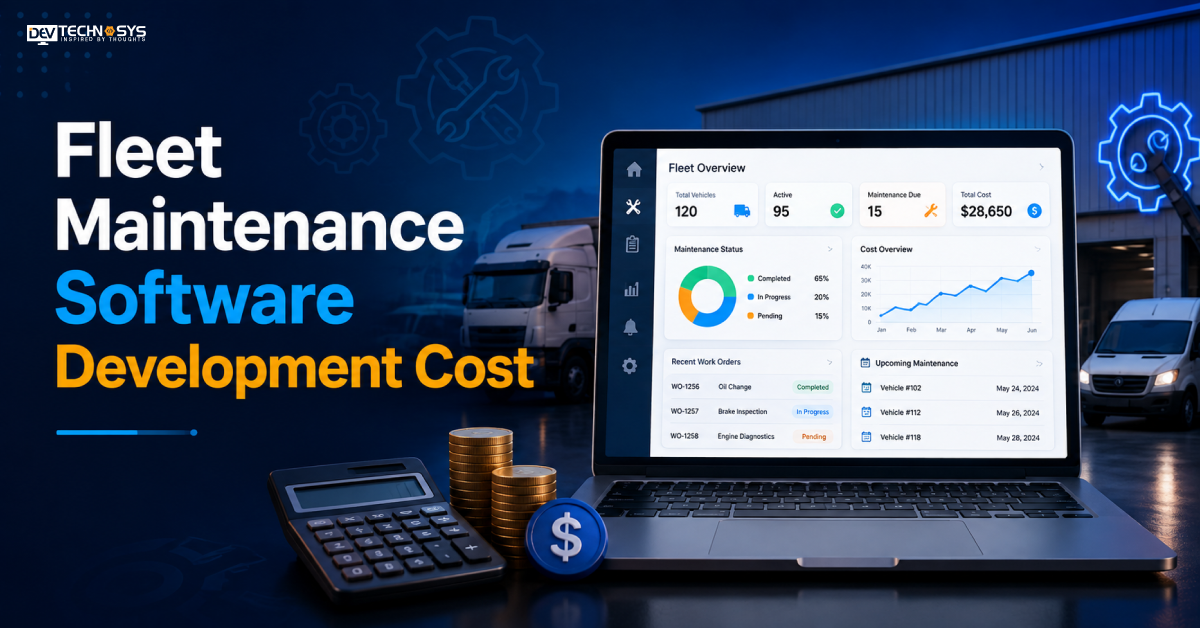
- Fleet maintenance software development cost typically ranges from $4,999 to $70,000+, depending on the software’s complexity, maintenance modules, integrations, security requirements, AI capabilities and scalability.
- Fleet maintenance software aims to keep vehicles operational while reducing unexpected breakdowns.
- Modern Fleet Maintenance Software can connect to GPS, telematics, fuel systems, accounting software, and IoT devices to provide accurate insights.
- Estimated fleet maintenance software development costs start at $4,999.
- According to The Research Company, the global fleet management software market is estimated at $32.79 billion in 2026 and is projected to reach $55.97 billion by 2030, representing a 14.3% CAGR during the forecast period.
- U.S. businesses must develop a secure, compliant software application to avoid legal issues.
Major Topics This Blog Covers:
- Cost to develop fleet maintenance software
- 6 Key Factors That Impact Fleet Maintenance Software Development Cost
- Hidden Costs Associated with Fleet Management App Development
- How Can You Estimate Your Fleet Maintenance Software Budget?
Fleet management mainly involves vehicle inspections, service schedules, and preventive maintenance. U.S. businesses must understand that maintenance software is crucial to managing overall operations. However, advanced fleet maintenance software connects with existing systems, GPS, IoT devices, and analytics tools to manage logistics operations digitally.
Fleet maintenance software development cost vary by business size and the number of GPS, third-party, and telematics Integrations. The starting price is $4,999, which covers the basic features and functionalities.
This detailed guide explains the factors affecting the cost of fleet management solutions, market statistics, hidden costs, and ways to reduce costs.
U.S. Market Statistics for Fleet Maintenance Software 2026 – 2030
To mention the exact cost of the solution, we have conducted research using Fortune Business Insights.
Some of our key findings include:
- The expected market size of fleet management software is expected to be USD 67.03 billion by 2030. This highlights the growing importance of fleets optimising routes, fuel consumption, and preventive maintenance.
- Fleet operators are increasingly adopting Generative AI to automate operational workflows, optimise route planning, improve driver safety, reduce fuel consumption, and maximise fleet utilisation.
- AI integration with existing fleet management systems helps owners monitor real-time telematics, vehicle diagnostics, traffic conditions, weather information, driver behaviour, and maintenance records for proactive decision-making.
What is Custom Fleet Maintenance Software Cost?
Fleet maintenance software development in the U.S. can cost $4,999 to $70,000+, depending on the software’s complexity, fleet size, integrations, automation requirements, and AI capabilities.
Software Complexity |
Typical Development Cost |
Suitable For |
Typical Scope |
| Basic Fleet Maintenance Software | 4,999–12,000 | Small fleets & startups | Vehicle records, service schedules, maintenance reminders, basic dashboards |
| Mid-Level Fleet Management Software | 12,000–30,000 | Growing U.S. fleets | Work orders, inventory, driver management, reporting, GPS/API integrations |
| Advanced Fleet Maintenance Platform | 30,000–50,000 | Large fleets & logistics companies | Predictive maintenance, advanced analytics, telematics, role-based access, automated workflows |
| Enterprise Fleet Management System | 50,000–70,000+ | Enterprise & multi-location fleets | Multi-fleet management, complex integrations, custom dashboards, advanced security, scalable cloud architecture |
| AI-Integrated Fleet Software | 40,000–70,000+ | Data-driven fleet operators | AI maintenance predictions, failure-risk detection, anomaly detection, intelligent alerts, AI analytics |
Note: These are estimated development ranges. Actual pricing depends on requirements, integrations, technology stack, data complexity, security requirements, and development team location.
6 Key Factors that Impact Fleet Maintenance Software Development Cost
After understanding the cost to develop a fleet management app, U.S. businesses must also evaluate the factors that drive this expense. Fleet size, telematics integrations, maintenance automation, and compliance are some of the top factors.
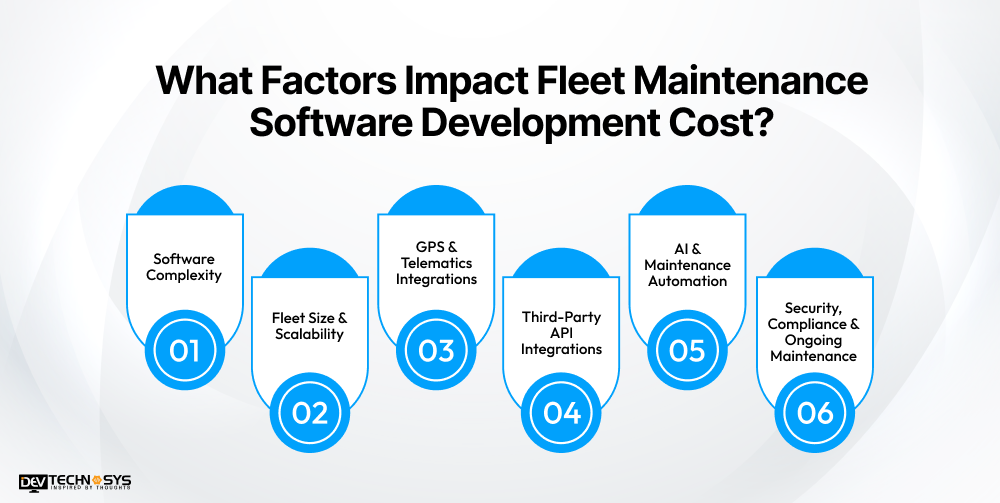
Key Factors that Impact Fleet Maintenance Software Development Cost |
What It Includes |
Estimated Cost |
| 1. Software Complexity | Number of modules, maintenance workflows, dashboards, user roles, work orders, service schedules, inspections, and automation | 4,999–30,000+ |
| 2. Fleet Size & Scalability | Number of vehicles, users, locations, data volume, multi-fleet support, database architecture, and scalability requirements | 5,000–20,000+ |
| 3. GPS & Telematics Integrations | GPS tracking, vehicle diagnostics, OBD data, IoT devices, fuel systems, vehicle health data, and real-time synchronization | 5,000–25,000+ |
| 4. Third-Party API Integrations | Accounting, ERP, CRM, mapping, fuel cards, payment gateways, parts suppliers, and other fleet management systems | 3,000–20,000+ |
| 5. AI & Maintenance Automation | Predictive maintenance, failure prediction, automated service reminders, anomaly detection, maintenance recommendations, and intelligent scheduling | 8,000–30,000+ |
| 6. Security, Compliance & Ongoing Maintenance | Authentication, role-based access, encryption, audit logs, security updates, cloud optimization, API updates, bug fixes, and ongoing support | 10–15% of development cost/year |
How Do Fleet Size and User Roles Affect Development Cost?
Fleet management app development is usually affected by the users who will be going to access the solution. A larger fleet size influences automation, infrastructure, and scalability. It directly affects development cost as the technical requirements may vary. For example, a business with 35 vehicles may have different requirements than one that supports thousands of trucks, vans, or specialized vehicles. The system may require a strong database architecture with important security protocols.
1. User Roles and Permissions
Multiple users handle logistics operations, including finance teams, drivers, administrators, managers, and external service providers. Each role needs separate permissions that can significantly impact cost. For example, an admin needs access to manage fleet operations, while a driver may need location and delivery details.
2. Multi-Location Fleet Management
U.S. logistics businesses that operate across multiple regions need multi-location functionality in the platform. The features include centralized dashboard to manage site activity and coordinate with other teams. GPS tracking software maintenance cost is usually 15% depending the solution complexity.
2. Scalability Requirements
Especially growing businesses face higher costs because their systems must scale with expansion. The datasets may require a better database and improved GPS tracking system to manage operations.
Industry Insight: Dev Technosys has been featured by PACOTURF for its expertise in developing feasible fleet management solutions. Applications are designed using AI, secure backend architecture and intuitive UI/UX.
How Do Telematics and Third-Party Integrations Impact Pricing?
Businesses need to purchase hardware/software systems with relevant API integrations that affect the total cost of enterprise fleet management software. The approximate cost is $600 per vehicle for advanced telematics. Logistics businesses are increasingly adopting telematics for real-time vehicle tracking, reducing fuel waste, and getting alerts for engine diagnostics issues.
1. GPS and Telematics Integration
Operators receive updates regarding vehicle location, mileage, engine data, fuel usage, diagnostic alerts, and other operational information. This increases costs because developers must add multiple error-handling capabilities.
2. Fleet Management Integrations
Fleet management solutions must share information across vehicle, driver, and maintenance operations. To manage overall operations, API integrations are required, which increases costs compared with a standalone maintenance system.
3. Accounting and ERP Integration
Businesses that choose custom fleet maintenance software may need it to connect to ERP or accounting systems, which increases costs because engineers must design the application around complex business rules.
4. API and Data Synchronization
Businesses must invest significantly to build reliable data transfer and validation mechanisms. This generally requires more infrastructure to manage periodic data and complex synchronization logic.
5. Hardware and Per-Vehicle Costs
Telematics-enabled fleet maintenance systems require BD devices, engine diagnostic hardware, sensors, or other connected-vehicle equipment to provide accurate information to users. Mid-level to advanced systems cost a lot to add these features. Businesses that want to build fleet scheduling software must factor these expenses into their budget.
How Does AI and Predictive Maintenance Affect Software Cost?
According to Fortune Business Insights, the predictive maintenance market is projected to reach 55.70% in 2026. This data shows that businesses are increasingly adopting the technology to improve business efficiency. The average cost is $50 per vehicle with custom fleet maintenance software. AI-enabled platform can analyze vehicle diagnostics, mileage, sensor readings, and repair history. That’s the reason businesses prefer predictive analytics services. This impacts cost based on the complexity of the software.
1. Predictive Maintenance
Predictive maintenance includes vehicle diagnostics, mileage, and sensor data checks to ensure vehicles are working properly. Costs increase when a business needs to collect data from the maximum number of vehicles or operates across multiple locations.
2. AI-Powered Alerts
AI-powered maintenance alerts are rule-based and provide information based on continuous telematics and monitoring. This directly impacts cost because businesses must check alerts to maintain consistency in logistics operations.
3. Failure Prediction
The technology can predict engine failure, battery risk, or other component risks. Analyzing failures requires operators to check historical datasets. Costs increase when software can’t predict outcomes from the data.
For suitable datasets, machine learning models can estimate the likelihood of specific maintenance events or component failures. Prediction accuracy depends heavily on the quality and quantity of historical data.
4. AI Fleet Analytics
AI integration with the existing fleet management system helps to identify recurring repair patterns or abnormal vehicle behavior. Basically, businesses can analyze any anomaly and resolve it at the earliest without affecting all operations.
5. AI Data and Model Infrastructure
Businesses may need to spend extra on this, depending on the use case. For example, a system may handle data pipelines, workflows, or storage. Model infrastructure requires frequent maintenance that adds to the total budget.
How Security and Compliance Requirements Affect Development Cost?
Security & compliance are the foundation of fleet vehicle management software that ensures data privacy. Although they directly impact cost, both are essential to restrict unauthorized access.
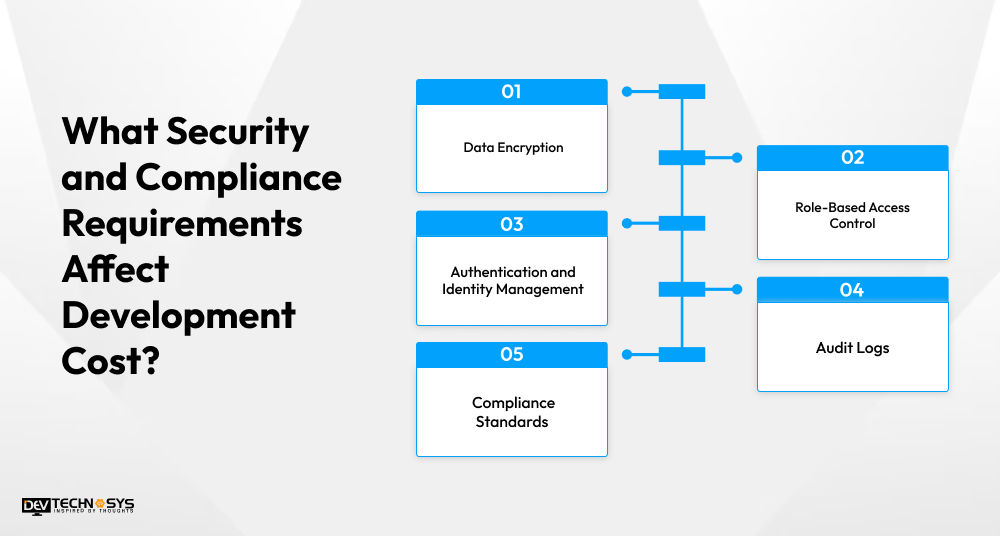
1. Data Encryption
Data encryption is a must-have security practice that gives a measurable value to a business. This secures sensitive information transferred between users and across departments, often costing up to $2100. Cloud infrastructure and databases are secured.
2. Role-Based Access Control
Fleet management access control restricts users to viewing, editing, deleting, or updating information. Creating specific roles for technician, driver, admin, or a manager can cost $2000 along with the test cases.
3. Authentication and Identity Management
Because fleet maintenance software contains sensitive data, it needs multi-factor authentication, password policies, and session controls. The average cost starts at $3,000, as the solution requires additional development and testing.
4. Audit Logs
Audit logging runs continuously to detect unauthorised access to the system. This impacts cost because the solution is designed according to administrative actions that require specific security protocols. Logs include AI decisions, work orders, security events, vehicle records, and user activity.
5. Compliance Standards
Businesses that are planning to develop an App Like Motive Fleet must include compliance standards such as ISO, SOC 1, SOC 2, GDPR, and CCPA to ensure data protection.
Security & Compliance Requirement |
Estimated Cost Impact |
| Data Encryption | 1,000–3,000+ |
| Role-Based Access Control | 1,500–4,000+ |
| Secure Authentication & SSO | 2,000–5,000+ |
| Audit Logs & Activity Monitoring | 2,000–5,000+ |
| API & Integration Security | 2,000–6,000+ |
| SOC 2 Readiness & Controls | 5,000–20,000+ |
| ISO 27001 Readiness & Controls | 7,000–25,000+ |
| GDPR Requirements | 3,000–12,000+ |
| CCPA/CPRA Requirements | 3,000–10,000+ |
| PCI DSS Requirements | 5,000–20,000+ |
| Industry-Specific Controls | 5,000–25,000+ |
| Compliance Testing & Security Assessment | 3,000–10,000+ |

What Hidden Costs Should You Consider Beyond Development?
The initial development quote doesn’t always cover the full cost of owning fleet maintenance software. U.S. businesses should also account for ongoing expenses related to infrastructure, integrations, security, and product improvements.
Hidden Cost |
What It Covers |
Estimated Cost |
| Cloud & Infrastructure | Servers, databases, storage, backups, monitoring, and data transfer | 200–2,000+/month |
| API & Third-Party Services | GPS, telematics, maps, communication, payment, and external data APIs | 100–3,000+/month |
| Maintenance & Updates | Bug fixes, OS/browser updates, performance improvements, and feature enhancements | 15%–25% of development cost/year |
| Security & Compliance | Security testing, vulnerability monitoring, audits, compliance updates, and incident preparedness | 3,000–15,000+/year |
| AI Model Usage | LLM/API usage, model hosting, data processing, monitoring, and retraining | 200–5,000+/month |
| Data Migration & Onboarding | Cleaning, transforming, importing, and validating existing fleet data | 2,000–10,000+ |
How Can You Estimate Your Fleet Maintenance Software Budget?
Estimating a fleet maintenance services budget involves users, mobile requirements, AI capabilities, security controls, and ongoing maintenance. U.S. businesses must create a realistic budget to help decision-makers decide whether to invest in building an application or improve a few features. This also helps calculate long-term total cost of ownership.
1. Define Your Required Features
Start by separating essential features from advanced capabilities. Core features are the basic things a user can do when accessing the software, while advanced features support better operation. For example, core features may include maintenance alerts, while advanced business requirements may include predictive maintenance.
2. Determine Fleet Size and User Requirements
The fleet maintenance software budget can be estimated by analyzing the total vehicles, managers, and resources that will be accessing the platform. A simple architecture for a limited team may cost $4,999 to $70,000, while a large team needs greater scalability and access-control capabilities.
3. Calculate Integration Requirements
Next, list APIs or external systems such as GPS and telematics providers, fuel management systems, accounting software, ERP platforms, or third-party fleet platforms. Each integration can add development, testing, and authentication.
4. Choose the Technology and Platforms
Before developing a fleet management system, decision makers need to choose a platform and the right technology stack. The choice of backend, frontend and security affects the cost. So, select these early to estimate an average cost.
5. Include Security and Compliance
Experts at a fleet management app development company implement SOC 2, ISO 27001, GDPR, CCPA/CPRA, PCI DSS, or industry-specific compliance and security protocols. This helps businesses to build credibility while securing the data processed on the system. These can cost from $18,000 to $45,000, depending on solution complexity.
6. Account for Post-Launch Maintenance
Post-launch support is a must when choosing logistics software development services. A practical rule of thumb is that the maintenance budget is usually 15% of the total cost. This covers bug fixes, security and infrastructure updates, and minor enhancements.
Free App Idea Reality Check: Let's Stress-Test Your Concept
Share your app idea with us. Within 3 business days, we'll uncover UX gaps, feature opportunities, and potential development challenges, so you can build with confidence. No strings attached.
Why Choose Dev Technosys for Fleet Maintenance Software Development?
Dev Technosys has more than 150 experts with deep technical knowledge to build fleet maintenance software. The company has achieved a 79% client retention rate through its unique, strategic phased development approach. Partnering with this firm means working with experts who can deliver custom fleet solutions. They can also integrate AI-powered capabilities into the existing system while maintaining scalability.
Conclusion & Next Steps
IoT fleet management solution helps businesses check vehicle information centrally, but these systems still need updates and bug fixes. The initial cost is $4,999, depending on AI capabilities, integrations, and solution complexity. Maintenance charges typically run up to 15% of the total fleet software development cost.
U.S. businesses must always consider multiple cost factors such as data security, cloud infrastructure, ongoing maintenance, software updates, and not just the initial build cost. This helps them develop software within a manageable budget. Once the requirements are clear, share them with an experienced software development company to partner with.
Frequently Asked Questions
Find answers to the most common questions related to this article.
A standard timeline is 3 to 4 months to build fleet maintenance software. If a business wants to build an MVP, then the project might be completed in a few weeks, while an enterprise platform can take several months or longer. The development timeline should be decided after a clear discussion with the project manager.
The first step is to define project goals, scope, required AI capabilities, and budget. This helps a US business create a long-term investment and TCO plan. Once the preliminary requirements are clear, contact an experienced fleet maintenance software development company to build a reliable solution.
Implementing artificial intelligence can automate repetitive tasks, answer user queries instantly, and manage operational workflows without human intervention. U.S. businesses can reduce costs, as early issue identification supports vehicle conditioning and lowers maintenance costs. Integrating AI into the solution helps prevent hidden costs while maintaining reliable business operations.
Predictive maintenance works based on accurate historical data. If datasets are unstructured, predictive models cannot provide accurate results. Fleet businesses need clear, concise information for the technology to work properly. Organisations can work with a fleet management app development company whose experts can explain how it works and how to improve data quality.
A fleet platform must include role-based access controls, data encryption, multi-factor authentication, audit logs, and secure APIs. These cybersecurity features, along with compliance standards, are vital for protecting data. Businesses that avoid these features may have to experience consequences such as unauthorised access to data.