

















Quick Custom CRM Software Development Cost Summary
CRM software development cost in 2026-2027 typically ranges from $4,999–$90,000, depending on features, customization, integrations, security, and scalability.
Cost by Complexity:
-
- Basic/MVP: $4,999–$7,999: Contact management, lead tracking, dashboards, and basic reporting.
- Mid-Level: $7,999–$9,999: Sales pipelines, workflow automation, analytics, integrations, and team management.
- Advanced: $9,999–$89,999: AI automation, advanced analytics, custom workflows, enterprise integrations, and scalable architecture.
Key Cost Factors:
-
- Features, UI/UX design, integrations, automation, AI capabilities, security, customization, and cloud infrastructure.
Development Timeline:
-
- A CRM typically takes 3–5+ months to develop, based on its complexity, integrations, platforms, and customization requirements.
Regional Cost Rates:
-
- Development rates vary by location. India can be 40–60% more cost-effective than the US or Western Europe, depending on the development team and project scope.
Additional Costs:
-
- Plan for maintenance, hosting, API usage, security monitoring, technical support, data backups, and future feature upgrades after launch.
According to Fortune Business Insights, the global CRM market is expected to reach $126.17 billion in 2026. Considering these numbers, it is clear that businesses are investing in a centralized system that manages:
- Customer data & interactions
- Leads & sales pipelines
- Marketing campaigns
- Customer service & support
- Tasks & team workflows
- Reports & business analytics
- Automation & follow-ups
- Third-party tools & integrations
Businesses investing in custom CRM are stuck with one question: How much does custom CRM development cost? The CRM development cost in 2026-2027 ranges between $4,999 and $89,999. The final development expense depends on the features, customization, integrations, automation, security, and scalability required.
Through this cost guide, we explain CRM software development pricing properly. It includes budget analysis by complexity, key features, development timeline, major cost factors, and ongoing expenses. This guide will help businesses plan CRM development budgets more accurately.
What is CRM Software and Why Does It Matter in 2026-2027?
CRM software manages the database, tracks leads, and automates sales and support operations. This gives all team members access to all customers from one interface. CRM software, such as HubSpot, lets users review past conversations, open deals, and actions in seconds for faster improvement. With CRM software, there is no need to analyze spreadsheets and old emails to find information.
Service Options
Who Can Benefit From Custom CRM Development?
Companies that are interested in enhancing customer service management and automating their processes.
Struggling to Track Customer Data?
Manage all customer records and sales activities on an all-in-one platform.
For business owners and sales teamsNeed More Than Basic CRM Features?
Enable sales process automation and create customized pipelines without limitations.
For sales managers and operational teamsWant Your Tools Working Together?
Link your CRM system with existing applications to automate work processes.
For IT managers and growing businesses
Why CRM is important in 2026-2027?
In 2026 and 2027, CRM software will be essential for businesses because customers expect quick, personalized service. CRM software development enables prompt replies and timely follow-ups without manual data entry, helping businesses focus on sales.
These are three CRM project trends that will determine future development:
- Embedded AI in the workflow: Businesses require lead scoring, email writing automation, and chatbot integration.
- Process-specific tools: Standard tools are not flexible enough. The team requires process-specific features.
- Data sovereignty and privacy protection: Requirements like GDPR will require businesses to own the customer data.
How Much Does It Cost To Build Custom CRM Software?
The average cost to build custom CRM software is estimated at $4,999 to $89,999. The overall CRM development expense is determined by the platform’s complexity. Complexity is estimated by the number of features, the level of integrations, security & compliance needs, and more. Let’s understand it like this:
- A basic CRM software with limited but core integrations and features, built with an MVP strategy, is less complex to build.
Cost Estimate: $4,999-$7,999
- A mid-level CRM software combines basic as well as high-level, advanced integrations, making it moderately complex to develop.
Cost Estimate: $7,999-$9,999
- Enterprise-level CRM software involves cutting-edge, modern technologies, features, integrations, and measures, which makes it difficult to build.
Cost Estimate: $9,999-$89,999
CRM Complexity |
Estimated Cost |
What You Get |
Best For |
| Basic / MVP CRM | $4,999–$9,999 | Core customer management, lead tracking, dashboards, basic reports, and limited integrations | Startups & small businesses |
| Mid-Level CRM | $9,999–$39,999 | Advanced sales workflows, automation, analytics, multiple integrations, and role-based access | Growing businesses |
| Advanced / Enterprise CRM | $39,999–$89,999 | AI capabilities, custom workflows, advanced analytics, extensive integrations, stronger security, and scalable architecture | Large enterprises & complex operations |
Planning a Banking Crm Software Project?
Get a tailored development cost estimate in a few simple steps.
- 3 quick steps
- 100% free
- Reply in 1 business day
2 Minutes Read
CRM Software Development Cost by Type
According to expert CRM development companies, cost varies on the basis of:
- How the software will be used
- Who will use it
- How much customization it requires
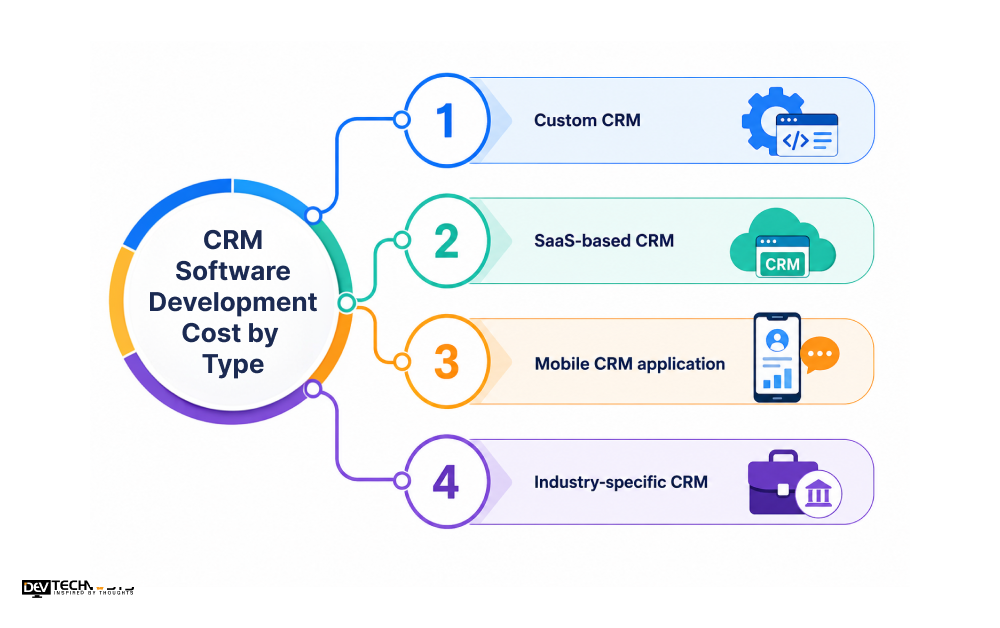
A single-business CRM may need fewer workflows than SaaS, mobile, or industry-specific platforms. They often require additional architecture, integrations, and security controls. Here, we have explained the types of CRM software with a practical cost breakdown:
1. Custom CRM
The custom CRM is developed according to your business process. The owner owns the software code and database. The CRM is more expensive initially; however, it often pays off in the long term.
2. SaaS-based CRM
It is a cloud-based CRM that is sold to multiple companies. Multi-tenant architecture, billing, and scalability are needed in this case. Therefore, it adds to expenses; however, at the same time, it becomes a new source of income.
3. Mobile CRM application
Mobile CRM allows field workers to manage their leads on-the-go. Features like offline mode and push notifications make the development more expensive. Creating an application for both Apple and Android operating systems will increase its price.
4. Industry-specific CRM
These are industries that require additional functionality and compliance with regulations:
- Healthcare industry: patient record management, patient consent management, HIPAA compliance.
- Financial services: KYC compliance, audit trail, payment processing integration.
- Real Estate industry: property listing management, lead distribution, scheduling site visits.
- Education: Student records, admissions tracking, communication, and enrollment workflows.
- Retail & E-commerce: Customer profiles, purchase history, loyalty management, and marketing automation.
- Logistics: Client management, shipment tracking, sales pipelines, and operational integrations.
CRM Software Type |
Development Cost |
Key Development Requirements |
Best For |
| Custom CRM | $20,000–$85,000 | Custom workflows, role-based access, dashboards, integrations, and scalable architecture | Businesses with unique processes |
| SaaS CRM | $25,000–$79,999 | Multi-tenant architecture, subscription billing, admin controls, APIs, and scalability | CRM companies & SaaS startups |
| Mobile CRM App | $15,000–$70,000 | Mobile dashboards, lead management, push notifications, offline access, and API synchronization | Sales & field teams |
| Industry-Specific CRM | $20,000–$89,999 | Specialized workflows, compliance controls, industry integrations, and custom reporting | Regulated & niche businesses |
CRM Software Features: Cost Breakdown by Feature
In 2026-2027, CRM development cost by features is estimated between $500 and $2,500. Core features include content, lead & pipeline management, basic reports, and email integration. Advanced features that are commonly available include workflow automation, advanced analytics, and support ticketing.
Service Options
What CRM Solution Fits Your Business Best?
Discuss how you want to achieve your business goals and which features you would like to have customized in your CRM.
CRM Development
Have your version of the CRM created according to your needs. The system can include modules such as lead tracking, management of sales pipelines, and reporting.
Create Your CRMCRM Workflow Optimization
Integrate your business solutions with each other, manage leads, and automate any repetitive daily tasks in order to achieve more with less effort.
Automate Your WorkflowCRM Upgrades & Smart Features
Improve the existing version of your CRM by adding modern design and providing advanced analytics, insights powered by AI technologies, and scalable capabilities.
Enhance Your CRM
Core CRM Software Development Features
Core Feature |
Estimated Development Cost |
What It Covers |
| Contact Management | 500–1,000 | Customer profiles, contact details, notes, and interaction history |
| Lead Management | 700–1,500 | Lead capture, qualification, assignment, and tracking |
| Sales Pipeline | 800–1,500 | Deal stages, opportunity tracking, and sales progress |
| Task & Activity Management | 500–1,000 | Tasks, reminders, calls, meetings, and follow-ups |
| Dashboard & Reporting | 1,000–2,000 | KPIs, sales reports, activity summaries, and visual dashboards |
| User & Role Management | 700–1,500 | User accounts, permissions, roles, and access controls |
| Email Integration | 800–1,500 | Email synchronization, templates, tracking, and notifications |
| Document Management | 700–1,500 | File uploads, document organization, sharing, and access control |
Advanced CRM Software Development Features
Advanced Feature |
Estimated Development Cost |
What It Covers |
| AI Sales Assistant | 1,500–2,500 | Lead insights, recommendations, summaries, and sales assistance |
| Workflow Automation | 1,000–2,500 | Automated tasks, triggers, approvals, and follow-ups |
| Predictive Analytics | 1,500–2,500 | Sales forecasting, lead scoring, and trend prediction |
| Omnichannel Communication | 1,500–2,500 | Email, SMS, chat, calls, and social communication |
| Marketing Automation | 1,000–2,500 | Campaigns, segmentation, customer journeys, and automated messaging |
| Third-Party Integrations | 800–2,500 | Payment, accounting, marketing, ERP, and other business APIs |
| Advanced Security | 1,000–2,500 | MFA, encryption, audit logs, SSO, and granular permissions |
| Custom Analytics | 1,500–2,500 | Real-time reports, custom dashboards, advanced KPIs, and data insights |
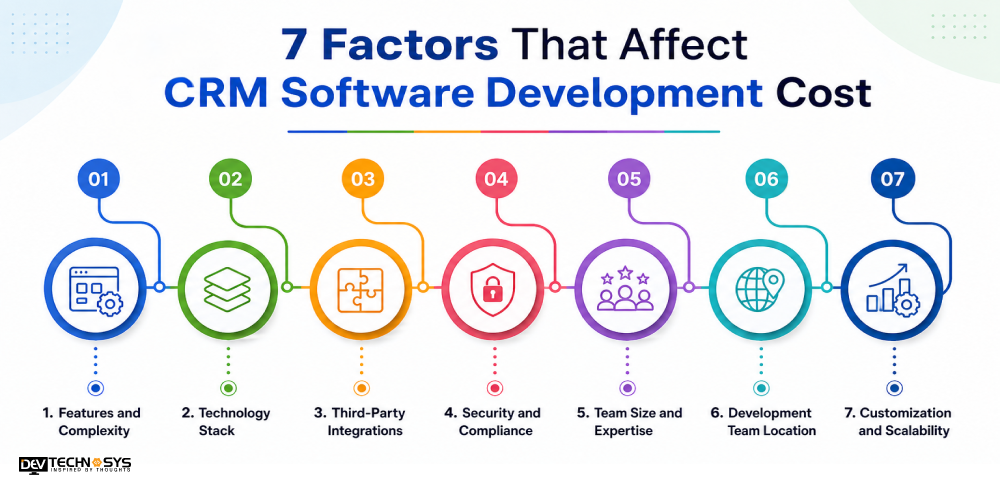
7 Factors That Affect CRM Software Development Cost
Several factors affect the final CRM development cost. The most expensive factors are feature complexity, technology selection, integrations, security, team organization, location, and customization needs. We will now understand how these factors influence the CRM development cost.
1. Features and Complexity
Every new CRM feature needs to be developed, designed, tested, and maintained. The core contact management capability comes at a lower cost. AI automation, predictive analysis, and advanced workflows increase the custom CRM development cost.
2. Technology Stack
The integrated technology stack will affect development time, scalability, performance, and maintenance. It includes React, Node.js, cloud services, databases, and other technologies. These technologies can elevate the custom CRM software cost but support future growth.
3. Third-Party Integrations
Third-party platforms like payment gateways, email services, accounting software, ERPs, communications APIs, and marketing platforms also integrate with CRM. According to a CRM software development company, these are quite demanding with regard to development and maintenance.
4. Security and Compliance
Security has a direct impact on CRM development costs. It involves encryption, MFA, SSO, access controls, audit logs, data protection, and industry-specific compliance features. These must be designed, developed, tested, and monitored to be available.
5. Team Size and Expertise
A CRM development team can vary and include a project manager, UI/UX designer, developers, QA engineers, and DevOps specialists. Larger teams can deliver faster, but they also increase monthly development costs, especially when you need highly skilled, experienced specialists.
6. Development Team Location
The CRM system development cost is different across regions from where you hire dedicated developers. Teams in the US, Australia, and Western Europe often charge higher hourly rates. Whereas Eastern Europe, Latin America, and India-based development teams charge lower rates.
7. Customization and Scalability
Custom CRMs include more business logic, workflows, dashboards, and integrations than standard CRMs. Thousands of users or growth also means the initial CRM application development cost will be higher.
Cost Factor |
Estimated Cost Impact |
Lower-Cost Approach |
Higher-Cost Approach |
Typical Cost Range |
| Technology & Architecture | Moderate–High | Standard tech stack | Cloud-native or microservices | 2,000–10,000 |
| Third-Party Integrations | Moderate–High | 1–2 standard APIs | Multiple custom integrations | 1,000–8,000 |
| Security & Compliance | Moderate–High | Basic security controls | MFA, SSO, audit logs, compliance | 2,000–12,000 |
| Team Size & Expertise | Moderate–High | Small development team | Senior multi-disciplinary team | 3,000–15,000 |
| Development Location | Moderate | Offshore/nearshore team | US/Western Europe team | 20–50% rate difference |
| Customization & Scalability | High | Standard workflows | Enterprise customization and scale | 3,000–15,000 |
| Maintenance & Infrastructure | Ongoing | Basic hosting and support | High-availability cloud and monitoring | 1,000–8,000/year |
How Security and Compliance Affect CRM Development Cost?
In the CRM development process, security and compliance should be planned separately. Security controls protect the CRM and its data. On the other hand, compliance requirements determine how customer data must be collected, stored, accessed, and processed. Together, they can add approximately $1,500–$3,500 to development, depending on the CRM’s data sensitivity and business requirements.
CRM Security Costs
Security Requirement |
Estimated Cost |
Purpose |
| Data Encryption | 1,500–2,000 | Protect customer data in transit and at rest |
| Role-Based Access & MFA | 1,500–2,500 | Control user permissions and strengthen authentication |
| Audit Logs | 1,500–2,500 | Track user activity and sensitive data access |
| Security Testing | 2,000–3,500 | Identify vulnerabilities and security weaknesses |
CRM Compliance Costs
Compliance / Standard |
Estimated Cost Impact |
When It May Matter |
| ISO 27001 | 2,000–3,500 | Organizations requiring a structured information security framework |
| SOC 1 | 2,000–3,500+ | CRM platforms handling data relevant to financial reporting |
| SOC 2 | 2,000–3,500+ | SaaS CRM platforms requiring strong security and trust controls |
| GDPR | 1,500–3,000 | CRMs processing personal data of people in the EU/EEA |
| CCPA/CPRA | 1,500–3,000 | CRMs handling personal information of California residents |
Expert Advice:
These are estimated development costs for implementing related controls, not the total cost of obtaining certification or completing an independent audit. Not every CRM needs every standard; the right requirements depend on the data, users, industry, and markets served.
Tarun Nagar (CEO at Dev Technosys)
Note: We design systems with compliance baked in, so data handling stays secure throughout the product lifecycle.
AI in CRM: How Much Does It Increase Development Cost?
AI adds $1,500 to $18,000 to CRM platform development cost. AI features like lead scoring and data cleanup are the cheapest, whereas predictive analytics and generative assistants cost more. These AI features also demand clean data and ongoing model tuning.
-
AI Lead Scoring: $1,500 – $6,000
It ranks leads by how likely they are to buy.
-
AI Data Enrichment and Cleanup: $1,500 – $5,000
It fixes duplicates and fills in missing contact details.
-
AI Chatbots: $2,500 – $8,000
They answer customer questions and book meetings.
-
Next Best Action Engine: $4,000 – $10,000
It suggests the right follow-up for each deal.
-
Predictive Analytics: $5,000 – $15,000
It forecasts sales and customer churn.
-
Call Transcription and Sentiment Analysis: $4,000 – $12,000
It turns calls into text and flags customer mood.
-
Generative AI Assistant: $6,000 – $18,000
It writes emails and summarizes calls.
Expert Advice
It is always recommended to start with one AI feature. Prove it saves time or earns money, and then add more. Keep in mind that AI has running costs. API usage, model hosting, and retraining all add up each month.
Mohit Nag (AI Expert at Dev Technosys)
CRM Software Development Timeline: Planning, Building & Launching
CRM software development process typically takes 3 to 5+ months. The CRM development timeline depends on the project scope, integrations, security requirements, customization, and testing needs. A clear process helps teams estimate delivery time and manage each CRM software development stages efficiently.
Development Stage |
Basic CRM |
Mid-Level CRM |
Advanced CRM |
| Requirement Analysis | 1–2 weeks | 2–3 weeks | 2–4 weeks |
| UI/UX Design | 2–3 weeks | 2–3 weeks | 3–5 weeks |
| Architecture & Tech Planning | 1–2 weeks | 1–2 weeks | 2–3 weeks |
| Backend Development | 3–4 weeks | 4–6 weeks | 6–9 weeks |
| Frontend Development | 3–4 weeks | 4–6 weeks | 6–9 weeks |
| API & Third-Party Integration | 1–2 weeks | 2–3 weeks | 3–5 weeks |
| Security & Compliance Testing | 1–2 weeks | 2–3 weeks | 3–4 weeks |
| QA, Deployment & Launch | 1–2 weeks | 2–3 weeks | 2–4 weeks |
| Total Timeline | 3–4 months | 4–5 months | 5+ months |
| Development Cost | 4,999–9,999 | 9,999–39,999 | 39,999–89,999 |
| Post-Launch Maintenance | 15–20% annually | 15–20% annually | 15–20% annually |
CRM Software Total Cost of Ownership: 3-Year Breakdown
The total cost of ownership (TCO) includes more than the initial CRM software development price. Businesses must also factor in maintenance, hosting, security, upgrades, and employee training. Because CRM development costs range from $4,999 to $89,999, 3 years of ownership costs vary by project.
What Should Be Included in CRM TCO
- Maintenance & Support: Fixes to bugs, technical support, security upgrades, and performance management.
- Hosting & Licensing: Cloud technology, databases, API, and paid third-party software.
- Upgrade & Training: System enhancements and training of employees.
Total Cost of Ownership Example
Cost Item |
Basic CRM |
Mid-Level CRM |
Advanced CRM |
| Initial Development | $7,000 | $9,000 | $50,000 |
| Maintenance (18% × 3 Years) | $3,780 | $4,860 | $27,000 |
| Hosting & Licenses | $3,000 | $5,000 | $10,000 |
| Upgrades & Training | $2,000 | $4,000 | $8,000 |
| Estimated 3-Year TCO | $15,780 | $22,860 | $95,000 |
CRM Software Development: Hidden Costs to Consider
Hidden costs are the expenses that might not appear in the CRM development cost estimate. However, these expenses can increase the overall development budget by 15%-25%. This especially happens when data, integrations, requirements, or user adoption are underestimated. Here, we explain the hidden enterprise CRM development cost that help businesses plan their budget well.
1. Data Migration and Cleaning:
In order to migrate data from old systems, it often needs to be cleaned, which includes removing duplicates, formatting, validating, and mapping. If data is not of high quality, this may lead to delays in migration, testing, and inefficiency in implementing CRM.
2. Third-Party API and Licensing Cost:
Integrating CRM may require paying for third-party APIs, licenses, communication services, payment service providers, and analytics platforms. Subscription, per-use, and per-user fees may become an ongoing post CRM implementation cost.
3. Change in Scope and Re-Work:
Integrating new workflows, dashboards, and any additional requirements specified during the development will involve additional development time and costs. Permanent change of scope can lead to complete redesign of the systems developed.
4. Lack of User Adoption:
If the high-quality CRM system is not used by the end users, then it will be useless. Therefore, more time needs to be spent on training users, explanation, adjustment, documentation, and support.
Build vs Buy vs Partner: Which CRM Development Approach Is Most Cost-Efficient?
When choosing a CRM development approach, businesses can build in-house, buy a ready-made solution, or partner with a CRM development company. In-house development offers maximum control but requires more resources and time.
Buying reduces upfront development effort but may limit customization. Partnering combines a custom CRM development process with specialized expertise and support. The right option depends on your budget, customization needs, scalability, ownership, and long-term business goals.
Comparison Factor |
Build In-House |
Buy Ready-Made CRM |
Partner With Dev Technosys |
| Initial Cost | High | Low–Medium | Medium |
| Typical Investment | 40,000–90,000+ | 5,000–30,000+ | 4,999–89,999 |
| Time to Market | 5–9+ months | 1–3 months | 3–5+ months |
| Customization | Complete | Limited–Moderate | High |
| Feature Control | Full control | Vendor-defined | Business-specific |
| Technical Expertise | Requires internal hiring | Usually included | Experienced CRM development team |
| Scalability | Managed internally | Depends on vendor | Planned around business growth |
| Security & Compliance | Internal responsibility | Provider-dependent | Built into development scope |
| Integrations | Fully customizable | Limited to supported options | Custom integrations available |
| Maintenance | Internal team | Usually vendor-managed | Development and ongoing support available |
| Product Ownership | Full ownership | Depends on licensing | Custom software ownership |
| Best For | Large businesses with technical teams | Businesses needing quick deployment | Startups, SMBs & enterprises needing custom CRM |
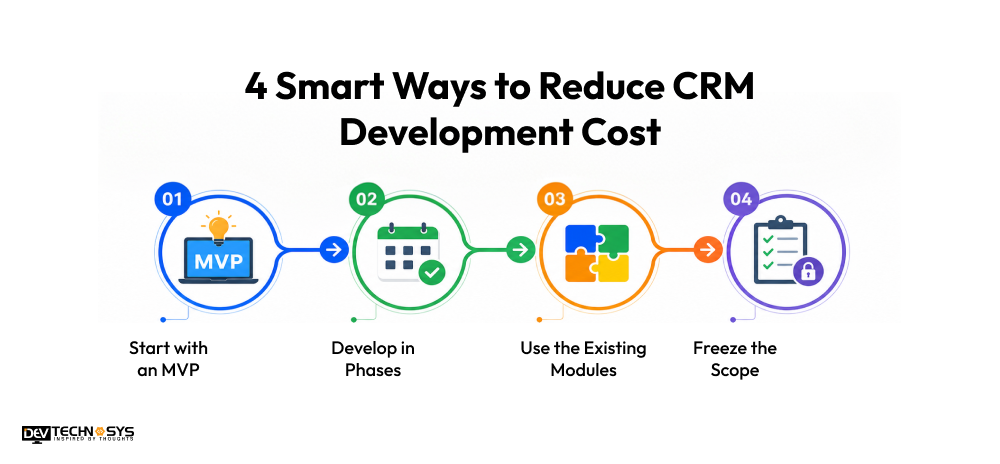
4 Smart Ways to Reduce CRM Development Cost
Companies can decrease the expenses of CRM development through:
- Concentrating on the crucial functionality
- Managing the scope of the project
- Employing resources for development wisely
Here are four recommendations to reduce unnecessary expenses and eliminate rework while maintaining the quality of the CRM.
1. Start with an MVP:
Use the basic features of the CRM like contact management, lead tracking, dashboards, and basic reporting. Using the MVP will let you test the processes during communication with the users before creating the advanced features.
2. Develop in Phases:
Rather than developing the entire CRM from the beginning at once, develop it in phases. This will allow businesses to receive feedback from users and make all the important changes based on their requirements.
3. Use the Existing Modules:
Employing already tested modules for notifications, reporting, dashboards, authentication, and integrations. This can help developers save time during the development stage and focus on creating special features of the CRM for the business.
4. Freeze the Scope:
Define features, workflows, integrations, and user requirements before development begins. A clear scope reduces frequent changes, redesigns, additional development hours, and testing effort that can quickly increase the overall CRM budget.
Final Words
CRM software development cost for small businesses, startups, and large enterprises depends on:
- Today’s business needs, and
- Where you expect it to go in the future
A lower initial investment is highly suitable for a simple CRM. On the other hand, a more customized solution is required for complex business operations.
Before development begins, look beyond the initial CRM software development cost. Consider the long-term financial impact of your choice with the help of a CRM development company. Businesses should compare development approaches, understand the ongoing & hidden expenses, and set a realistic budget.
The right CRM investment is not about choosing the cheapest option. It is about getting the functionality, flexibility, and business value you need at a cost your organization can sustain.
Frequently Asked Questions
Find answers to the most common questions related to this article.
Depending on the business requirements, a startup should budget $4,999-$89,999 for custom CRM development. The overall development investment is determined by the CRM’s:
- Business scope
- Integrations
- Security requirements
- Customization
- Scalability
A CRM that is MVP-focused requires a lower development budget. Whereas a highly customized enterprise CRM requires a relatively higher budget.
The cost to build a CRM system is primarily influenced by the level of feature complexity, types and extent of customization, integrations, technological stack, and where the development team is located. Besides these, security aspects, ability to handle growth, and UI/UX designing are major factors that affect not only the total budget but also the project timeline.
It is not necessary that building a custom CRM is less expensive than paying for a CRM subscription. A ready-made CRM generally costs less at the initial stage. Whereas custom development requires a larger upfront investment. Custom CRM software can become more cost-effective when a business needs specialized workflows and greater control. It helps avoid recurring per-user subscription costs at scale.
The biggest mistake a founder usually makes is to focus on the developer’s initial quote only. It is important to understand that CRM projects also involve:
- Data migration
- Integrations
- Infrastructure
- Training
- Maintenance
- Future modifications
Founders should calculate the expected total investment before development begins. They must keep a reasonable budget buffer for unexpected technical or business requirements.
Build from scratch when your business depends on unique workflows, specialized processes, or complete ownership. Customizing an existing platform may be more practical when your requirements closely match standard CRM functionality. Founders should compare customization limitations, recurring expenses, integration requirements, scalability, and long-term ownership before choosing either approach.
A realistic CRM budget should account for business requirements, users, integrations, security, technology, development resources, and future growth. Ask your development partner for a detailed cost estimate rather than a single figure. A clear breakdown of development, implementation, maintenance, and infrastructure expenses makes financial planning more reliable.