
















Quick Summary:
The cost to develop a fleet management app ranges from $4,999 to $29,999, depending on the app’s complexity, features, and technical requirements. Key factors affecting development costs include app complexity, platform selection, third-party integrations, UI/UX design, and data security and compliance.
Cost Based on Development Complexity
-
-
- Basic App ($4,999–$9,999): Includes essential features such as user registration and login, basic GPS vehicle tracking, trip history, and push notifications.
- Mid-Level App ($10,000–$19,999): Includes advanced features such as real-time GPS tracking, route optimization, driver behavior monitoring, fuel management, and analytics and reporting
- Advanced App ($20,000–$29,999): Includes AI-based route optimization, IoT integration with smart sensors, predictive maintenance alerts, geofencing, and multi-platform support (web and mobile).
-
Cost Based on Types of Fleet Management Apps:
-
- Telematics Apps: $17,999 (depending on tracking capabilities and IoT features)
- Fuel Management Apps: $19,499 (based on automation and analytics requirements)
- Maintenance Management Apps: $24,999 (depending on predictive maintenance features)
- Driver Management Apps: $18,999 (based on driver monitoring and AI-powered insights)
- Route Planning Apps: $27,999 (depending on route optimization and AI capabilities)
- Asset Tracking Apps: $22,499 (based on GPS, RFID, and IoT integration)
Cost of Popular Fleet Management Apps:
-
- Samsara-like App: $10,000 – $16,000 (focused on real-time tracking, IoT, and analytics)
- Motive-like App: $9,500 – $15,800 (driver safety, compliance, and monitoring features)
- Geotab-like App: $11,000 – $18,000 (advanced analytics and customization capabilities)
- Verizon Connect-like App: $12,000 – $18,500 (multi-platform with dispatch and tracking)
- Fleetio-like App: $10,500 – $16,500 (maintenance and operational management focus)
Wondering how much it would cost to develop a fleet management app? You have come to the right place. Building a fleet management app has become a necessity for delivery companies. Maintaining a large fleet, while taking care of all the vehicles and drivers, has become a huge task for them.
Fleet management apps assist businesses in maintaining vehicles, fuel usage, delivery schedules, their location, and maintenance schedules. These apps make it easier for delivery companies to manage their fleet and its operations.
The cost to build a fleet management app depends on several factors, which we will study in this blog. So take a seat as you experience the roller coaster of fleet management app development through our blog.
How Big is the Fleet Management App Market? Key Stats & Growth Trends
With the spreading of OEM-embedded telematics, the arrival of 5G, and electronic logging mandates in USA, the fleet management market has risen significantly. And now, businesses are integrating AI and cloud services to add advanced features such as predictive analysis. These additions of tools and technologies are helping the market grow into an enormous empire.
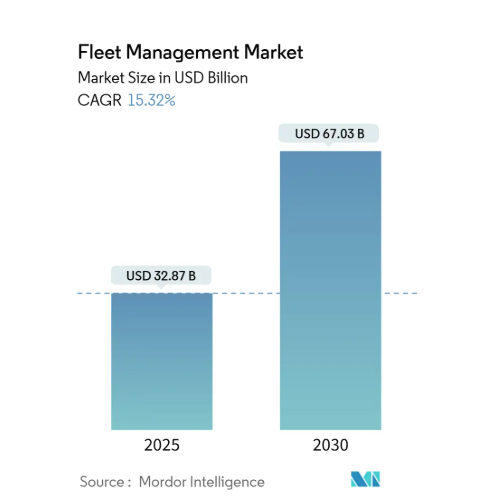
- As per the Mordor Intelligence, the fleet management market generated $32.87 billion in 2025 and is projected to reach $67.03 billion by 2030.
- The fleet management market is growing at a robust rate of 32% CAGR.
- Cloud-based softwares led with a staggering 63% revenue share in 2024.
- By geography, North America dominated the market by 36% share, followed by the Asia Pacific.
What is the Cost to Develop a Fleet Management App?
The average cost to develop a fleet management app in the USA ranges from $8,000 to $25,000. The cost of a GPS tracking app development is affected by several factors, such as the range of features, platform choice, third-party integrations, data security & compliance, UI/UX design, and maintenance. Apart from these costs, the integration of AI and applications significantly affects the overall cost of development, as it increases the development time and resources.
App Complexity |
Estimated Development Cost |
Key Features |
| Basic Fleet Management App | $4,999 – $9,999 | User registration, basic GPS tracking, trip history, push notifications |
| Mid-Level Fleet Management App | $10,000 – $19,999 | Real-time GPS tracking, route optimization, driver monitoring, fuel management, analytics |
| Advanced Fleet Management App | $20,000 – $29,999 | AI-powered route optimization, IoT integration, predictive maintenance, geofencing, web and mobile support |
Industry Insight
According to GlobeNewswire, cloud-based fleet management solutions dominate the market, accounting for over 68% share due to scalability and cost-efficiency.
Service Options
Who Can Benefit From Our Custom Fleet Management Software?
For organizations whose transportation operations, tracking systems, or logistics requirements are exceeding their current systems
Managing vehicles across multiple locations?
Observe your vehicles’ movements, maintenance tasks, and drivers’ activities in one central place
For fleet owners and transport managersIs existing fleet software slowing operations?
Automate dispatch planning, routing, and fleet operations without needing to do them manually.
For logistics teams and operations headsStruggling with disconnected fleet systems?
Merge GPS tracking, fuel monitoring, and telematics into one smooth fleet management system.
For fleet managers and IT decision-makers
What Factors Affect the Cost to Develop a Fleet Management App?
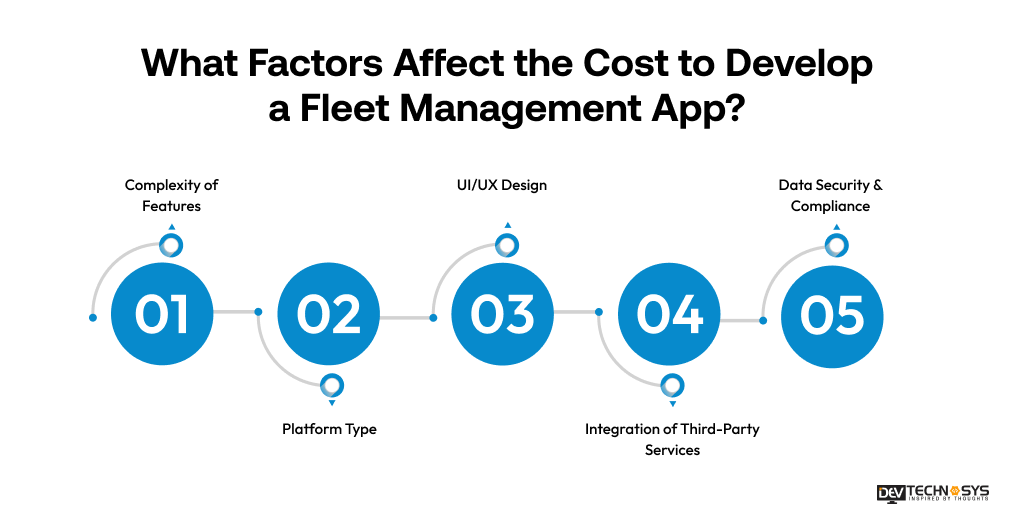
The cost to develop a fleet management app like Fleetio is affected by several factors, depending on what features you want in the app. Factors like app complexity, integrations, platform type, etc., affect the cost directly during development.
Factors like maintenance, data security & compliance affect the cost to build a fleet tracking system even after the launch. Below is the detailed information on how these factors affect the cost to develop a fleet management app.
1. Complexity of Features
Basic features such as user login, profiles, basic tracking, etc., take less development time and resources, hence the cost is lower. When moderate or advanced features are added, the cost to build a fleet management app increases. They require domain specialists, more development time, and effort.
| Feature Level | Feature Scope | Cost Contribution (USD) |
| Basic Features | User login, basic GPS tracking, simple dashboard, notifications | $2,500 – $3,500 |
| Moderate Features | Real-time tracking, route optimization, fuel monitoring, reports | $4,000 – $5,500 |
| Advanced Features | AI automation, predictive maintenance, IoT integration, smart analytics | $6,000 – $8,000 |
2. Platform Type
Developing for a single platform costs less but reaches fewer people, as it builds apps for only one, iOS or Android. Building a cross-platform for both Android and iOS costs a lot less in total, as both iOS and Android can be built at once.
But building for multi-platform, both mobile and web, costs a lot more because of increased development time and effort for both platforms. Hiring a hybrid app development company is recommended to build these types of apps.
| Platform Level | Platform Scope | Cost Contribution (USD) |
| Single Platform | Android or iOS app only | $1,500 – $2,500 |
| Cross-Platform | Android + iOS using frameworks like Flutter or React Native | $2,500 – $3,500 |
| Multi-Platform | Android + iOS + Web dashboard (admin panel) | $3,500 – $5,000 |
3. UI/UX Design
The cost of UI/UX design depends on the development hours taken to build it. Pre-built templates, simple layout, and minimal customization require very little development time and cost less. Whereas custom UI/UX with animations, interactive elements, and high-end user flows costs a lot more.
| Design Level | Design Scope | Cost Contribution (USD) |
| Basic Design | Standard templates, simple layouts, minimal customization | $800 – $1,200 |
| Custom Design | Branded UI, better user flows, interactive elements | $1,200 – $2,000 |
| Premium Design | Advanced UI/UX, animations, intuitive dashboards, high-end user experience | $2,000 – $3,000 |
4. Integration of Third-Party Services
Basic integrations, such as notifications, cloud services, etc., are relatively inexpensive. While integrations such as payment gateways, IoT devices, AI APIs, etc., require more effort and time to integrate and cost more. These costs also include configuration, testing, and ongoing management.
| Integration Level | Integration Scope | Cost Contribution (USD) |
| Basic Integrations | GPS/maps APIs, push notifications, basic cloud services | $800 – $1,500 |
| Standard Integrations | Payment gateways, advanced maps, analytics tools, and cloud storage APIs | $1,500 – $2,500 |
| Advanced Integrations | IoT devices, telematics systems, AI APIs, multiple external service connections | $2,500 – $3,500 |
5. Data Security & Compliance
The level of security you integrate affects the cost of GPS tracking app development. Basic security implementations include data encryption, and basic authentication can be built quickly and costs less. Advanced security protocols such as end-to-end encryption, multi-factor authentication, etc., sometimes require third-party services and more development time, which increases the cost.
| Security Level | Security Scope | Cost Contribution (USD) |
| Basic Security | Data encryption, secure login, basic authentication | $700 – $1,200 |
| Standard Security | Role-based access, secure APIs, GDPR/basic compliance | $1,200 – $2,000 |
| Advanced Security | End-to-end encryption, multi-factor authentication, compliance (HIPAA/GDPR), data monitoring | $2,000 – $3,000 |
What is the Cost of Different Types of Fleet Management Apps?
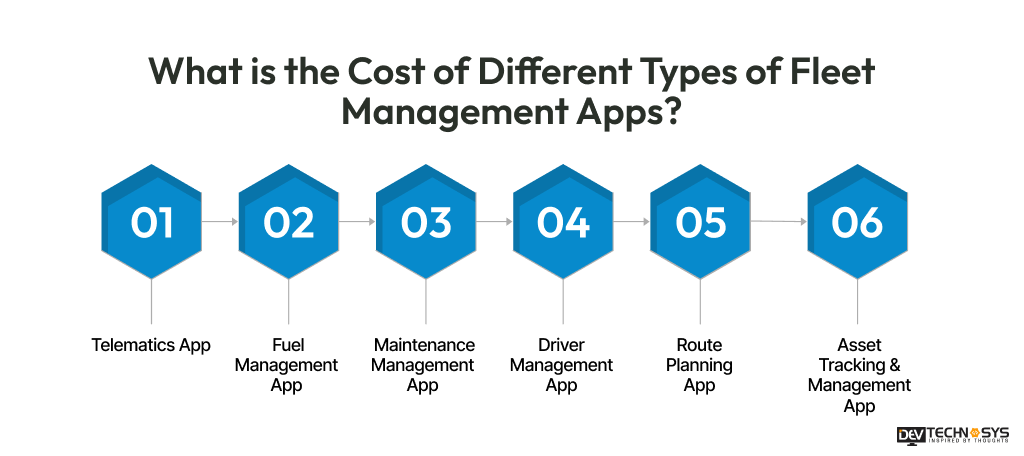
The cost to make a fleet management app highly depends on what type of fleet management app you want to build. These apps help assist businesses with their unique features, which can be built according to their requirements.
Some apps help in the management of drivers, while some apps help in managing the assets that are to be delivered. Making a hybrid with all features is quite costly, so making an app only with essential features is quite beneficial.
1. Telematics App
Telematics apps are enriched with features like real-time vehicle tracking and monitoring. Simple features, such as GPS tracking and telematics, such as speed and location, cost less with low development time. But with the coming of advanced features such as IoT integrations, the complexity of building these has increased. Hence, more development and effort increase the cost to create a fleet management app.
Listing |
Features |
Estimated Cost |
| Basic Telematics App | GPS tracking, trip history, vehicle location | $9,999 |
| Mid-Level Telematics App | Real-time tracking, vehicle diagnostics, driver monitoring | $13,999 |
| Advanced Telematics App | IoT integration, advanced analytics, live vehicle diagnostics | $17,999 |
2. Fuel Management App
As the name implies, fuel management apps help companies to monitor and optimize fuel consumption. Basic apps require manual logging, which works as a register, which is significantly cheaper. But the fleet management app development cost increases as you try to integrate advanced features. Features such as real-time fueling tracking, AI-based fuel analytics, and fraud detection cost more.
Listing |
Features |
Estimated Cost |
| Basic Fuel Management App | Fuel logs, consumption tracking, expense records | $9,999 |
| Mid-Level Fuel Management App | Fuel usage analytics, refueling records, fuel cost reports | $14,999 |
| Advanced Fuel Management App | Automated fuel monitoring, fuel fraud detection, predictive analytics | $19,499 |
3. Maintenance Management App
Maintenance management app tracks the condition of vehicles throughout the fleet. These apps help in maintaining the vehicles in optimal condition so that they can be used anytime without incurring losses. MVP apps come with features such as service schedules, manual log, and notification reminders.
Then there are predictive and automated maintenance apps, which track the condition of vehicles in real-time using sensors. These cost a lot more than the MVP app as they require extensive use of resources.
Listing |
Features |
Estimated Cost |
| Basic Maintenance App | Maintenance schedules, service history, reminders | $12,999 |
| Mid-Level Maintenance App | Repair tracking, work orders, maintenance cost reports | $18,999 |
| Advanced Maintenance App | Predictive maintenance, IoT sensor integration, automated alerts | $24,999 |
4. Driver Management App
Driver management apps monitor driver performance, safety, and compliance on a regular basis. This helps businesses to keep their drivers in the best condition to work. Basic apps store driver information, while advanced solutions provide behavior tracking and performance analytics.
While advanced apps provide AI-driven insights, safety scoring systems require more sophisticated development. This increases the cost to develop a fleet management app due to increased data processing needs.
Listing |
Features |
Estimated Cost |
| Basic Driver Management App | Driver profiles, document management, attendance | $9,999 |
| Mid-Level Driver Management App | Driver performance tracking, behavior monitoring, compliance reports | $14,999 |
| Advanced Driver Management App | AI-based driver scoring, risk analysis, real-time behavior insights | $18,999 |
5. Route Planning App
Route planning apps help in finding optimal delivery routes to improve operational efficiency. Basic apps offer simple mapping, while advanced versions use real-time traffic data and AI-based optimization. Features like multi-stop routing and predictive traffic analysis increase development complexity, and the fleet management app development cost increases significantly.
Listing |
Features |
Estimated Cost |
| Basic Route Planning App | Route creation, distance calculation, basic navigation | $12,999 |
| Mid-Level Route Planning App | Route optimization, traffic updates, multi-stop planning | $19,999 |
| Advanced Route Planning App | AI-powered optimization, dynamic rerouting, predictive traffic analysis | $27,999 |
6. Asset Tracking & Management App
Asset tracking apps allow businesses to monitor and manage physical assets in real time. These help businesses to take accountability for assets easily. Basic apps rely on manual tracking by registering apps manually using pictures.
At the same time, advanced apps use GPS, RFID, and IoT technologies to automate asset lifecycle management. This increases development effort and time taken to build on-demand app development solutions. This results in higher costs due to hardware and software integration.
Listing |
Features |
Estimated Cost |
| Basic Asset Tracking App | GPS tracking, asset registration, location history | $11,999 |
| Mid-Level Asset Tracking App | Real-time tracking, geofencing, asset utilization reports | $16,999 |
| Advanced Asset Tracking App | GPS and RFID integration, IoT sensors, automated alerts and analytics | $22,499 |
Industry Insight
According to Global Market Insights, fleet management software holds nearly 49% market share, highlighting the growing importance of analytics, dashboards, and decision-making tools over hardware.
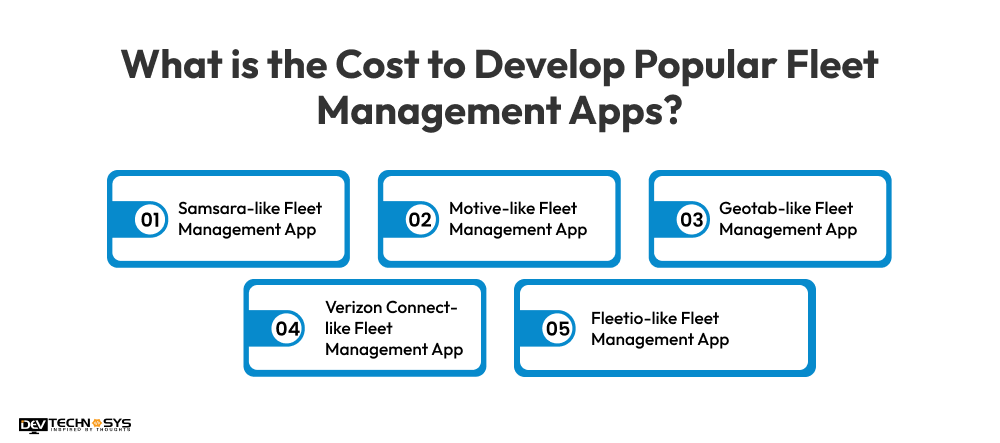
What is the Cost to Develop Popular Fleet Management Apps?
There are many popular apps that provide fleet management app development services. These apps differ in the features and services provided. Below is a detailed analysis of popular fleet management apps with the cost to develop them:
1. Samsara-like Fleet Management App
Fleet tracking app development cost for Samsara depends on what type of features you are going to integrate. Samsara provides features like real-time visibility through GPS and IoT applications. It is equipped with an analytics dashboard, from which enterprises can take over complete operations using insights. Samsara-like apps are best for full-scale fleet optimization.
Feature |
Development Time |
Affected Cost (USD) |
| Real-time GPS Tracking & Map View | 2 – 3 weeks | $2,000 – $3,000 |
| Vehicle Diagnostics & Telematics | 3 – 4 weeks | $3,000 – $4,500 |
| Driver Communication & Alerts | 1 – 2 weeks | $1,000 – $1,800 |
| Route Optimization & Dispatch | 2 – 3 weeks | $2,000 – $3,200 |
| Analytics Dashboard & Reports | 2 – 3 weeks | $2,000 – $3,500 |
2. Motive-like Fleet Management App
To develop an app like Motive fleet, you have to add features around drivers and their safety, following all the safety and regulatory compliance. Features like ELD compliance, driver logs, and safety monitoring play a role in making a Motive-like app. These apps are best suited for logistics companies that require heavy safety and legal adherence.
Feature |
Development Time |
Affected Cost (USD) |
| GPS Tracking & Fleet Visibility | 2 – 3 weeks | $1,800 – $2,800 |
| Driver Safety Monitoring | 2 – 3 weeks | $2,000 – $3,200 |
| Compliance Management (ELD, logs) | 2 – 3 weeks | $2,200 – $3,500 |
| Fuel & Expense Tracking | 1 – 2 weeks | $1,000 – $1,800 |
| Alerts & Notifications System | 1 – 2 weeks | $800 – $1,500 |
| Analytics & Reporting Dashboard | 2 – 3 weeks | $1,800 – $3,000 |
3. Geotab-like Fleet Management App
Geotab is a cloud-based fleet management app that offers features like advanced analytics and telematics using its deep analytics. Custom fleet management software cost for a Geotab-like app varies depending on scalability and modular architecture. It increases as development becomes complex and customization options grow.
Feature |
Development Time |
Affected Cost (USD) |
| Advanced GPS Tracking & Telematics | 3 – 4 weeks | $2,500 – $3,800 |
| Vehicle Health Diagnostics | 2 – 3 weeks | $2,000 – $3,200 |
| Fleet Performance Analytics | 2 – 3 weeks | $1,800 – $3,000 |
| Driver Behavior Monitoring | 2 – 3 weeks | $1,800 – $2,800 |
| API Integrations & Customization | 2 – 3 weeks | $2,000 – $3,200 |
| Compliance & Reporting Tools | 2 – 3 weeks | $1,800 – $2,800 |
4. Verizon Connect-like Fleet Management App
Verizon Connect provides an enterprise fleet solution with features like route planning, driver communication, and real-time tracking. They have accessibility for both mobile and web platforms. Due to this multi-platform approach, fleet management software development cost increases as it increases the development effort and testing requirements.
Feature |
Development Time |
Affected Cost (USD) |
| Real-time Fleet Tracking | 2 – 3 weeks | $2,000 – $3,000 |
| Route Planning & Dispatch | 2 – 3 weeks | $2,200 – $3,200 |
| Driver Management & Communication | 2 – 3 weeks | $1,800 – $2,800 |
| Fuel Management & Cost Tracking | 1 – 2 weeks | $1,200 – $2,000 |
| Mobile App + Web Dashboard | 3 – 4 weeks | $3,000 – $4,500 |
| Reporting & Analytics | 2 – 3 weeks | $2,000 – $3,200 |
5. Fleetio-like Fleet Management App
To develop an ERP system like Fleetio, you are required to build features related to fleet maintenance and operational management. A Fleetio-like fleet management app provides features like vehicle servicing, fuel tracking, and work order management. They require less integration and sensors, hence the cost to build a fleet management app decreases significantly.
Feature |
Development Time |
Affected Cost (USD) |
| Vehicle Servicing & Maintenance Scheduling | 2 – 3 weeks | $2,200 – $3,400 |
| Work Order Management | 2 – 3 weeks | $2,200 – $3,200 |
| Fuel Tracking & Expense Logging | 1 – 2 weeks | $1,200 – $2,000 |
| Inspection & Checklist Management | 1 – 2 weeks | $1,000 – $1,800 |
| Parts & Inventory Tracking | 2 weeks | $1,600 – $2,500 |
| Reporting & Analytics Dashboard | 2 – 3 weeks | $2,500 – $3,800 |
How to Reduce the Cost to Make a Fleet Management App?
To reduce the cost of creating a fleet management app, you can leverage several methods, such as building an MVP with essential features, ERP solutions for logistics, outsourcing the project to cost-effective regions, or using third-party integrations. These help in reducing the overall cost to build a fleet tracking system.
Service Options
What Can We Develop for Your Fleet Business?
Delve into your transportation systems and uncover better methods of supervision for every voyage.
Custom Fleet Management Software
A customized mobile or online software aimed at overseeing transportation means, motorists, routes, upkeep, and fleet documentation from one place.
Customized for Your FleetFleet Monitoring and Workflow Automation
Link GPS monitoring, scheduling systems, and motorist applications. Automate assignment of journeys, observation of the vehicles, and reminders for service.
Optimizine Daily OperationsFleet Improvement and Artificial Intelligence Systems
Modernize an existing fleet management system with predictive analytics techniques, more intelligent route plans, and AI-based intelligence in order to achieve better management of logistics processes.
Enhance Your Fleet Platform
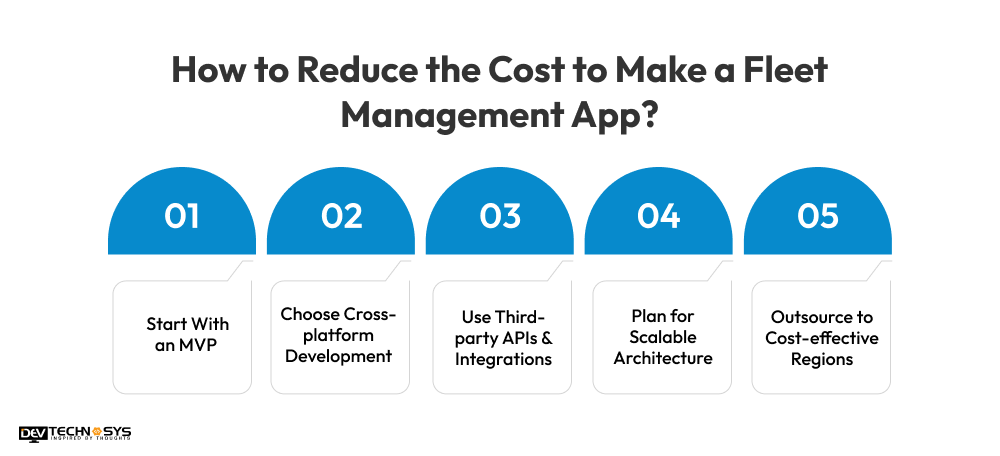
1. Start With an MVP
Launch an MVP app first with essential features like GPS tracking and basic reporting. This helps you test your app initially in the market for performance and user feedback. Once you get the user feedback, you can start developing upon the requirements and integrate advanced features. This reduces the cost of initial development and minimizes financial risks.
2. Choose Cross-platform Development
Choosing a cross-platform as your development choice can significantly reduce the logistics fleet management app cost. Cross-platform apps are built on frameworks like Flutter and React Native that help in developing apps on both Android and iOS with only a single codebase. Hiring a mobile app development service can help you reduce the development time and effort, and ultimately the overall cost.
3. Use Third-party APIs & Integrations
Integrating third-party APIs & services is much more cost-effective than building those services from scratch. Building features like maps, notifications, or analytics from scratch takes more development time and increases the complexity of the app. Third-party APIs reduce the development effort and quicken the development process.
4. Plan for Scalable Architecture
Planning for a scalable architecture initially helps in avoiding complete rework later, once you decide to upgrade. Strategic planning can help to avoid performance issues and costly redesigns. Robust backend system ensures smooth process and seamless future upgrades.
5. Outsource to Cost-effective Regions
Developers in the US and Europe cost significantly more than in regions like India due to high living costs and prices. Hiring a fleet management app development company from India helps you stay within your budget without compromising on the quality.
What Are Monetization Strategies for Fleet Management Apps in 2026?
The growing market of fleet management has shown how smart logistics and connected vehicles can help in managing businesses. It has become a powerful revenue-generating platform in 2026. Below are the prominent strategies that can be used to generate revenue from the fleet management app.
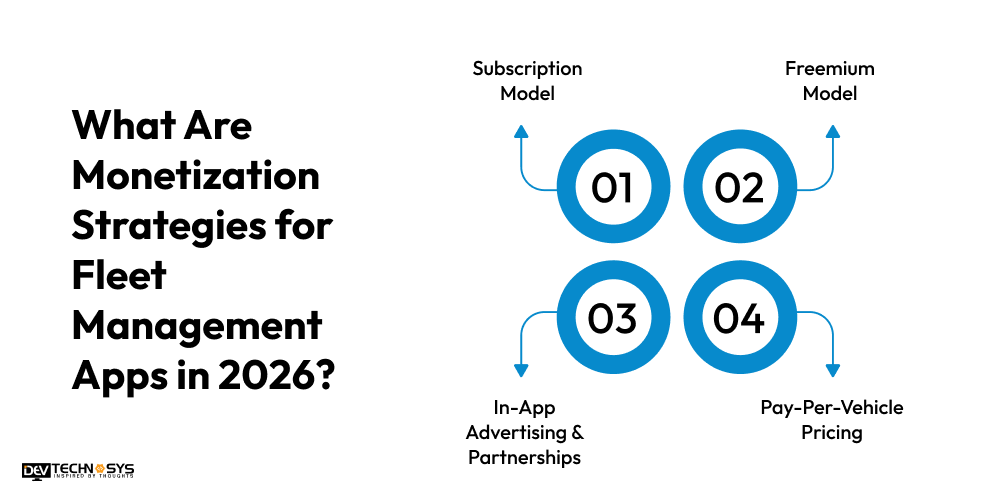
1. Subscription Model
This is a common monetization model based on recurring subscriptions. Money is charged monthly or yearly on the basis of services provided and depends on fleet size, features, or number of users. This builds long-term customer relationships, providing a constant revenue.
2. Freemium Model
The Freemium model works by providing limited features for free to attract startups and businesses to use our app. Once trust is built, they upgrade to premium plans and subscriptions. This model builds a large user base and paves the path for more success.
3. In-App Advertising & Partnerships
You can advertise for fuel companies, insurance providers, or vehicle service brands in your app and charge them for putting their apps on the app. This helps both parties, making it a high-value B2B monetization strategy. Companies pay a certain amount to put their ads on the app and acquire end-users.
4. Pay-Per-Vehicle Pricing
This model works by charging businesses based on the number of vehicles they manage using the app. By this model, businesses can use the app as their business grows; it is very effective for logistics companies with an expanding fleet. This model helps in gaining a large user base that wants to manage a limited number of vehicles.
Planning a Mobile App?
Get a tailored development cost estimate in 3 simple steps — app basics, features, timeline, and your contact details.
- 3 quick steps
- 100% free
- Reply in 1 business day
2 Minutes Read
Conclusion
Developing a fleet management app for a logistics company has become essential to streamline operations and increase service efficiency. Vital features like driver management, fuel management, GPS tracking, etc., are crucial for building a successful fleet management app.
The average cost to develop a fleet management app ranges from $8,000 to $25,000, depending on various factors such as app complexity, platform selection, design complexity, and third-party integrations. You can build popular fleet management app like Fleetio, Motive, and Geotab by hiring logistics software development services.
Frequently Asked Questions
Find answers to the most common questions related to this article.
The time taken to build a fleet management app is 2 to 6 months. Basic MVP apps with essential features take 2 to 3 months. While apps with more advanced features take 3 to 6 months, as more development time and effort are required.
Maintenance cost for fleet management app typically ranges from 15% to 20% annually of the total development cost. These include fixing security patches, performance optimization, adding new features, and bug fixes. Allocating maintenance budget initially helps to avoid unnecessary financial troubles in the future.
The cost to create a fleet management app is affected by factors such as
App Complexity
Platform Choice
UI/UX Design
Third-party Integrations
Data Security & Compliance
Essential features for building an MVP fleet management are real-time GPS tracking, driver management, fuel tracking, and reporting dashboards. These features will allow you to launch your app into the market with a small initial budget and build further upon that.
To develop a fleet management app, several technologies are used, such as GPS, IoT, and frameworks like Flutter or React Native. For the backend, Node.js or Python is used, along with several third-party integrations & AI tools.