













Key Takeaways
- There is flexibility for merchants in selecting the best BNPL integration option that fits their needs for payment processing and operating procedures.
- Quick integration of BNPL solutions with platforms like eCommerce, POS systems, and credit companies ensures that customers receive consistent user experiences.
- Reliable credit evaluation, fraud detection software development, and data security help manage lending risks.
- Simple processes for payments, refunds, and settlements help merchants and lenders in doing their business.
- Performance tracking is important for process optimization in terms of conversion, repayment, and profitability levels.
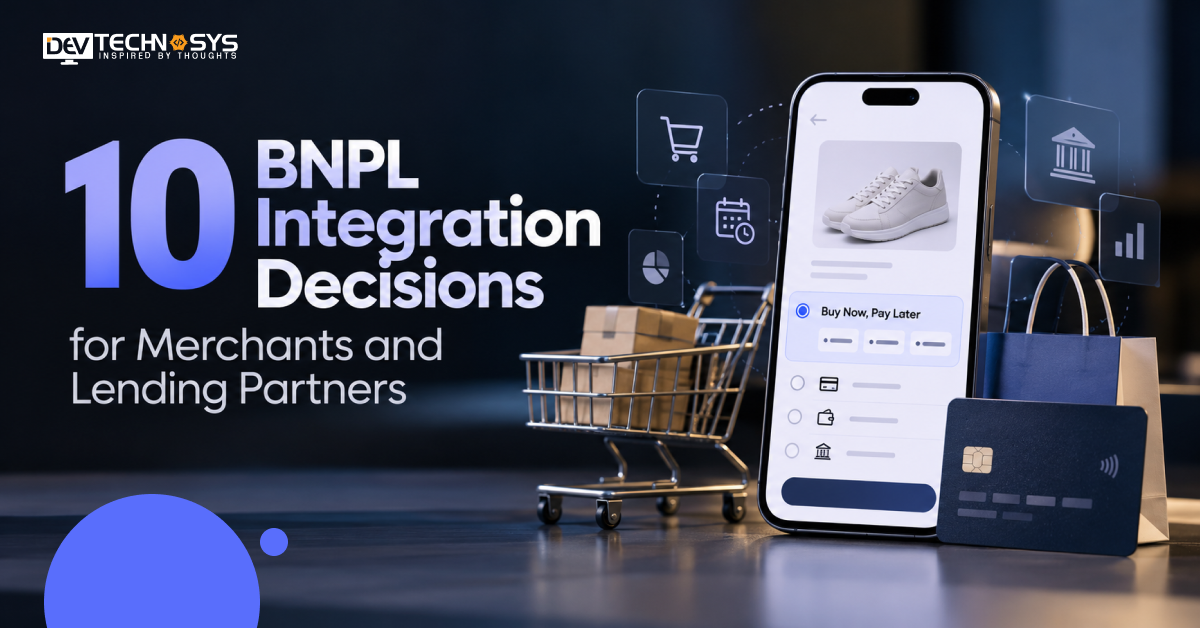
Buy Now, Pay Later (BNPL) is becoming an increasingly common payment method for businesses striving to offer more payment flexibility to customers. With BNPL, customers can make payments in installments, thus making the checkout process easier and allowing merchants to reach customers who otherwise would have chosen other payment methods.
However, it should be mentioned that simply adding this payment method to a website is not enough for a successful BNPL implementation. Businesses have to carefully research technical compatibility, credit assessment processes, legal requirements, security issues, and payment methods to be used for repaying the debt.
An effective BNPL integration for merchants allows companies to enhance the customer journey by implementing user-friendly payment options without unnecessary risks.
What Is BNPL Integration and Why Does It Matter for Merchants and Lending Partners?
BNPL is defined as the integration of the merchant’s checkout with the BNPL provider’s system. Through this process, customers get the chance to pay for the purchase in several installments, while the BNPL provider creates and manages transactions, sets customer qualifications, and controls installment payments according to the conditions of the plan.
For merchants, BNPL gives an additional possibility for processing money transactions, encouraging customers to buy more and giving the possibility to clients who want to buy goods but do not have enough funds at the moment to use installment payments. Through BNPL integration for lenders, providers can give money to customers and confirm their credentials, as well as ensure full payment according to the collected information.
For BNPL, it is necessary to keep in mind that integration provides certain advantages related to quick payments and opportunities for customers, but a lack of quality may cause errors and delays with refunds.
At the same time, a good example of BNPL payment gateway integration may clarify all the responsibilities of both sides, ensure data safety, and give customers a good shopping experience on any sales channel being used.
10 Critical BNPL Integration Decisions to Make
Successful BNPL integration decisions depend on the right technology, security, and payment workflows. Here are 10 key decisions to guide a smooth and scalable implementation.
1. Choose the Right BNPL Integration Model
Choose an integration model that matches your business needs, technical setup, and budget. Direct API integration allows for more customization; however, third-party platforms and payment processors are easier to implement. Make sure to check the BNPL app development cost and maintenance, the flexibility of the vendors, and the scalability of the solution.
2. Evaluate BNPL Provider Compatibility
Read their API documentation, check for any SDKs, look into their webhook options, and see if they offer any technical support. Good compatibility makes it easier for your developers, lowers the rate of transaction errors, and provides an effortless experience for customers across different sales channels. Make sure that your BNPL provider is compatible with your payment software solutions, POS system, mobile app, and online store.
3. Define Lending and Credit Eligibility Rules
Before putting BNPL into practice, it is necessary to ensure that the eligibility requirements, credit assessment process, and spending limits are clearly stipulated. The requirements for approval should be determined by the lending partners, while the merchants must know whether the agent in the checking process will be responsible for making the appropriate decisions. Businesses that provide loan lending app development services should make sure that their workflows are perfectly aligned with their lending model.
4. Select the Right Payment and Repayment Structure
Select repayment methods that are beneficial for your clients, product cost, and business design. Take into account factors such as installment frequency, repayment time frame, interest that applies, client charges, and merchant fees. Explain the terms of payment before purchase. A flexible payment schedule will enable merchants and lenders to organize cash flow properly.
5. Prioritize Security, Data Privacy, and Compliance
Use encryption techniques, secure authentication methods, access controls, and maintain information in accordance with the applicable laws to safeguard customer and transaction information. Assess the loan regulations, privacy laws, and payment regulations prior to implementation.
Merchant and lender partners should understand their compliance obligations, conduct security audits, and develop incident response plans to avoid regulatory and data protection violations. For a secure system architecture, you should consult a fintech software development company with years of experience.
6. Plan Real-Time Credit Approval and Transaction Processing
To establish effective transactional processes, it is crucial to bring together credit verification, payment confirmations, order confirmations, and updates into one coordinated effort. It is also necessary to consider possible mail delays, application rejection, and provider interruptions. Choose the right APIs, webhooks, and means of rejecting duplicated transactions. Effective payment gateway software development supports your dependable transaction workflows.
7. Integrate Fraud Detection and Risk Management
A combination of various fraud prevention mechanisms like identity verification, transaction monitoring, and risk-based authentication ought to be established. While lending partners assess credit risk, merchants monitor for signs of suspicious orders and fulfillment of unattended orders.
Correspondingly, designate the responsibility for fraud investigations, chargebacks, and any loss incurred. Real-time fraud monitoring can help businesses identify suspicious activities and increase transaction security.
8. Establish Clear Refunds, Cancellations, and Dispute Workflows
Establish protocols regarding how to deal with full refunds, partial refunds, cancellations, and payment disputes in merchant systems as well as in lending systems. Effective payment gateway integration with POS supports transaction records across physical retail channels.
It is essential that statuses of transactions and balances of installments are updated correctly when orders change. Establish clear deadlines as well as necessary responsibilities in order to avoid confusion and increase post-purchase service quality.
9. Optimize the Checkout Experience Across Channels
Ensure that BNPL is simple to find and utilize on websites, in mobile apps, and in physical retail locations. Provide customers with clear information about payment amounts, repayment plans, and associated fees before they make a purchase decision. Check the site for usability, accessibility, and payment method options. A simple checkout process will minimize problems and improve sales and customers’ experience.
10. Define Reporting, Reconciliation, and Performance Metrics
Set in place trustworthy reporting processes that will assist in monitoring transactions, fees charged by providers, refunds, settlement processes, and financial inaccuracies. Wherever possible, automate the process of reconciliation to avoid mistakes made by humans.
Keep track of conversion rates, average order value, credit approval rates, payment performance, and losses caused by fraud. These parameters allow the merchants and lenders to assess their profitability, discover problems in their operations, and improve the BNPL system’s effectiveness.

BNPL Integration Best Practices for Merchants and Lending Partners
Here are some of the best practices of Buy Now Pay Later (BNPL) for merchants and lending partners:
- Establish clear roles and responsibilities between merchants and BNPL providers as well as lending partners regarding credit approvals, payment processing, refunds, disputes, and compliance.
- Security and compliance should be given priority; the use of encryption, secure authentication, access control, and data protection measures should be done in compliance with various payment requirements in the lending process.
- Test the systems before launching; sandbox areas can be used for testing transactions of different types, such as successful transactions, declined applications, failed payments, refunds, and system crashes.
- Simplify the checkout process so that payment through BNPL would not cause difficulties for customers when making payments online.
- Use automated reconciliation whereby all transactions, settlements, refunds, and fees would be reconciled automatically between the merchant and lender’s systems. Make regular performance monitoring.
Common Integration Mistakes to Avoid For BNPL
Some integration problems arise because businesses focus too heavily on launching quickly and overlook the operational details. Common mistakes include:
- Ignoring regulations: It is dangerous to assume that the same criteria are valid for every entity, industry, or borrowing model.
- Ignoring indirect costs: Not including provider fees, return costs, and payment conditions can be harmful to profit.
- Forgetting testing: Testing payments only when they work properly keeps you away from some important cases of failure.
- Undervaluing scalability: While a solution can work with low numbers, it may not be successful at peak sales.
- Failing to define responsibilities: Lack of information about who should handle problems related to fraud, chargebacks, and disputes may lead to unnecessary disputes.
Addressing these risks during planning is generally easier than correcting them after customers and live transactions depend on the integration.
How to Choose the Right BNPL Integration Partner
The proper partner should provide more than just an operational API. Look into their history in your field, current technology stack, transaction processes, and corresponding payments or lending procedures.
Look at documentation, support availability, flexibility of integration, reliability of security rules, and agreements regarding maintenance. Find out how they cope with downtime, API modifications, dispute resolution, and constantly changing compliance.
You also have to analyze total acquisition cost, which comprises the costs associated with development, testing, operational costs, monitoring, and future updates. A BNPL app development company that guarantees high reliability of operations and clarity of duties and responsibilities may be much more beneficial in the long run.
Planning a Bnpl Project?
Get a tailored development cost estimate in a few simple steps.
- 3 quick steps
- 100% free
- Reply in 1 business day
2 Minutes Read
Conclusion
For successful integration of BNPL, merchants and lenders need to maintain a mix of convenience for the customer, reliability in the technology, payment risk, and compliance with regulations. The payment process begins with the integration model selection and goes through credit process creation, refund management, and tracking performance, so every step matters.
Therefore, organizations need to take care of proper compatibility, understanding of responsibilities, testing, and monitoring of the solution. Additionally, engaging a reliable software provider will also simplify the integration process and ongoing management of BNPL integration.
Dev Technosys provides businesses with an opportunity to find customized payments and fintech software solutions according to their needs regarding integration.
Frequently Asked Questions
Find answers to the most common questions related to this article.
The term BNPL integration refers to connecting a merchant's checkout or payment system with a BNPL provider or lending platform. With this integration, customers who qualify for BNPL will be able to pay for goods and services in installments. At the same time, integration will facilitate transaction processing and management of repayments.
The prices will differ based on the provider, complexity of integration, development costs, transaction fees, maintenance costs, and security measures.
Lending partners are able to integrate with the merchant's system through APIs, payment gateways, SDKs, or other integration platforms. During implementation, it is necessary to create workflows for credit assessment, transaction authorizations, data sharing, repayments, and customer support.
For adequate security and regulatory compliance, a business system can be set up utilizing mechanisms such as encryption, access control, secure API, monitoring, and well-thought-out data management processes. However, building compliant systems depends on the business model, jurisdiction, and responsibilities of the parties involved
The timeline is dependent on the method of integration chosen, the readiness of the systems in use, the complexity of the technology, as well as compliance verification requirements and testing needed. For instance, a plug-and-play integration would be faster than a custom API integration that requires the use of multiple systems.