

















Key Takeaways:
-
- Healthcare CRM: CRM for hospitals manages patient contacts, medical aid details, referral sources, patient journey mapping, communications, and appointment attendance
- EMR: Stores practice-level clinical records, including consultation notes, diagnoses, test results, and documents.
- EHR: An electronic health record system supports sharing patient records across providers. In South African private practice, many EHR products are EMRs with sharing features.
- Practice Management: Handles scheduling, invoicing, medical scheme claims, remittances, and reporting.
- Key Difference: CRM manages relationships, EMR stores clinical records, EHR enables record sharing, and practice management handles administrative and financial tasks.
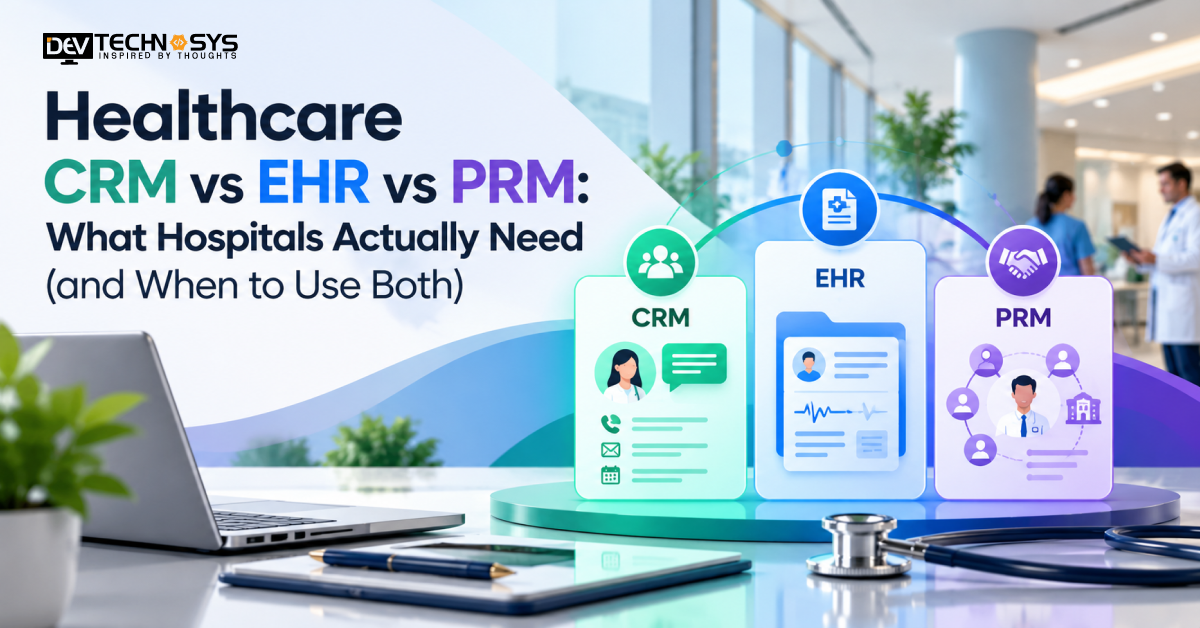
Missed appointments, disconnected records, and poor follow-ups can cost hospitals revenue and weaken patient relationships. According to Deloitte’s 2026 healthcare outlook, 64% of healthcare leaders who see technology as a major driver of impact expect automation and AI to improve workflows in 2026. However, just adding more software does not resolve these issues, and it’s important for hospitals to understand how healthcare CRM vs EHR, vs PRM systems differ.
While a CRM tracks people who are interested but not yet patients, a PRM manages communication with your existing patients, and an EMR holds the clinical record. These three systems differ, so knowing where patient health information lives in each one matters. So which one of the systems should your hospital be using, and when is it advisable to use all three systems at once? Read on.
Healthcare CRM vs EHR vs PRM: Key Differences at a Glance
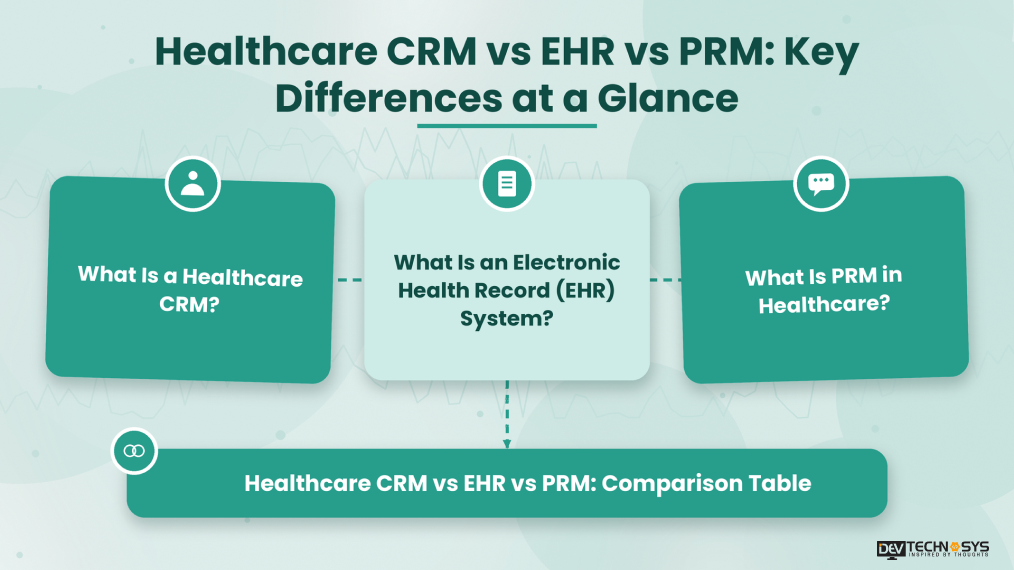
If you’re wondering about the differences in healthcare CRM vs EHR vs PRM systems, let us tell you that they all support different stages of a patient’s journey. A healthcare CRM is primarily aimed at patient acquisition and management, while EHR is focused on managing clinical data, and PRM is responsible for communicating with patients.
What Is a Healthcare CRM?
A healthcare CRM (Customer Relationship Management) is a specialized software platform that centralizes patient data, communications, and non-clinical interactions. Unlike an Electronic Health Record (EHR) or Electronic Medical Record (EMR), which focus strictly on clinical documentation and medical histories, a patient engagement CRM manages engagement, scheduling, outreach, and referral tracking to improve the patient experience.
What Is an Electronic Health Record (EHR) System?
An Electronic Health Record (EHR) is a digital version of a patient’s paper medical chart. This system supplies a real-time, comprehensive record of a patient’s health history, including treatments, diagnoses, lab results, medications, etc. The information is transferred securely across different clinics, hospitals, and physicians.
What is PRM in Healthcare?
A PRM (Patient Relationship Management) system in healthcare enables continuous communication with patients and appointment reminders. Depending on the platform, these functions may overlap with healthcare CRM software or patient engagement tools. When comparing PRM vs CRM healthcare, healthcare organizations should focus on the primary goals.
Healthcare CRM vs EHR vs PRM: Comparison Table
Feature |
Healthcare CRM |
EHR |
PRM |
| Primary purpose | Patient acquisition and retention | Clinical records and care delivery | Patient communication and engagement |
| Main users | Marketing, admissions, and outreach teams | Clinicians, nurses, and authorized staff | Patient experience and care coordination teams |
| Patient data | With AI in healthcare CRM, it improves Inquiries, referrals, preferences, and interactions | Diagnoses, medications, results, and treatment plans | Communication preferences, reminders, and engagement activities |
| Key functions | Lead tracking, segmentation, outreach | Clinical documentation, prescribing, results | Appointment reminders, follow-ups, care navigation |
| Business benefit | Improves conversion and retention | Supports informed clinical care | Improves engagement and continuity |
| Replaces clinical records? | No | EHR-CRM Integration serves as the clinical record system | No |
Note: Hospitals often benefit from integrating these healthcare and patient management software rather than choosing just one. The right setup depends on existing software, clinical workflows, and data-sharing requirements.
Market Insights:
Grand View Research estimates that the global healthcare CRM market will grow at a 6.2% CAGR from 2026 to 2033. This supports the growing demand for patient engagement, automation, and connected healthcare workflows.
What Does Each Healthcare System Actually Do?
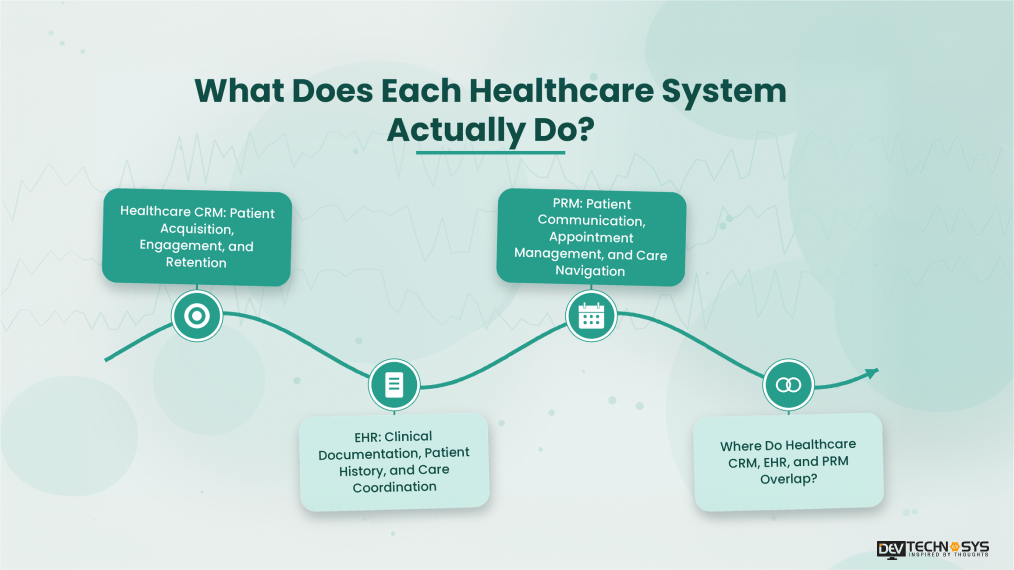
Healthcare CRM, EHR, and PRM are various healthcare software solutions that perform a range of hospital functions, such as managing patient relationships, electronic medical records, maintaining clinical records, and ensuring patient involvement.
1. Healthcare CRM: Patient Acquisition, Engagement, and Retention
A healthcare CRM system collects information on patient inquiries, sources of referrals, outreach campaigns, and follow-up procedures. One of the healthcare CRM benefits is that it can assist hospitals in managing new patients, as well as measuring the success of their campaigns.
Healthcare CRM examples: AI tracks campaign-driven bookings, personalizes appointment reminders, and identifies referral sources that lead to completed consultations.
2. EHR: Clinical Documentation, Patient History, and Care Coordination
Electronic health records (EHRs) store information about diagnoses, medications, allergies, laboratory results, and treatment methods. Healthcare providers utilize this data in their decision-making and for providing appropriate care.
Healthcare EHR Example: One of EHR integration benefits is that, through EHR, a doctor can access a patient’s EHR to review their medical history before offering treatment.
3. PRM: Patient Communication, Appointment Management, and Care Navigation
PRM software for clinics offers functions such as appointment reminders, follow-up messages, coordination of referrals, and planning of healthcare navigation.
Healthcare PRM Example: This hospital management software helps by sending appointment reminders and post-discharge follow-ups.
4. Where Do Healthcare CRM, EHR, and PRM Overlap?
CRM and PRM platforms may share patient profiles, messaging, and appointment workflows. But while CRM is more about acquisition, PRM is directed towards patient engagement. The EHR is synonymous with clinical documentation.
- CRM + PRM: When choosing CRM vs PRM, remember that a CRM serves acquisition and retention, and PRM is centered on patient engagement.
- PRM + EHR: PRM manages communication; EHR maintains clinical records. Contact a company that provides patient portal development services for seamless PRM integration
- CRM + EHR: Integrating EHR into a patient engagement platform provides relevant engagement information within clinical workflows.
Example: One key difference between CRM and EHR/PRM is that a CRM tracks how a patient was referred to a doctor, an EHR saves notes from a doctor’s consultation, and PRM sends appointment reminders.
What Do Hospitals Actually Need: CRM, EHR, PRM, or All Three?
Different types of healthcare software serve different purposes. When comparing healthcare CRM vs EHR vs PRM, Hospitals should decide based on operational gaps, existing systems, and patient care workflows. An EHR supports clinical care, a CRM manages patient acquisition and relationships, and a PRM supports ongoing patient engagement.
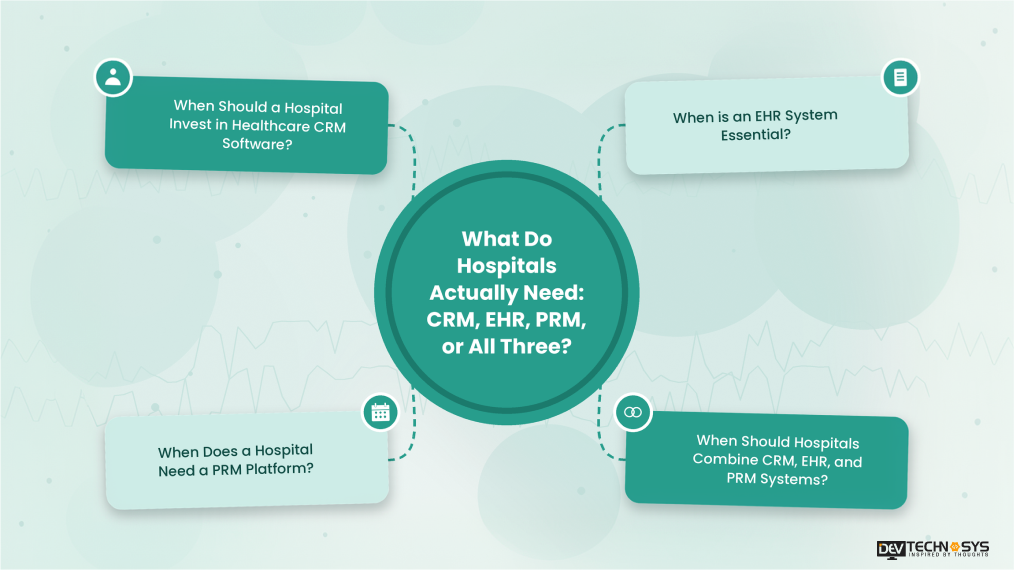
When Should a Hospital Invest in Healthcare CRM Software?
Hospitals need to think about the integration of all systems when the need arises due to distinct workflows in patient acquisition, clinical documentation, and constant engagement. Integration of these systems would be able to link referral tracking, clinical systems, and patient communication, saving the need to duplicate every function.
When is an EHR System Essential?
EHR integration services from a leading healthcare app development company are essential for hospitals and clinics to maintain medical records that include diagnoses, medications, test results, and treatment plans. EHR is essential for hospitals because it improves clinical decisions, documentation, and information sharing with authorized providers.
When Does a Hospital Need a PRM Platform?
PRM system comes into play when there is a need for hospitals to have proper appointment reminders, patient follow-up calls, care navigation, and communication throughout the patient journey. Most of the time, these capabilities may also be available through an existing CRM, EHR, or patient engagement system.
When Should Hospitals Combine CRM, EHR, and PRM Systems?
Are you a medical business wondering when to use crm and EHR together? Hospitals should consider integrating CRM and EHR, or all three, when patient acquisition, clinical documentation, and ongoing engagement require separate workflows. CRM development services can support contact and referral tracking, clinical systems, and patient communications without duplicating every function.
Hospital Need |
System |
Primary Benefit |
| Patient inquiries and referrals | Healthcare CRM | Patient portal integrations help track prospective patients, referral sources, outreach, and conversion rates. |
| Clinical records and treatment | EHR | Stores diagnoses, medications, and treatment plans. |
| Reminders and follow-ups | PRM | Coordinates reminders, follow-ups, and care navigation. |
| Connected patient workflows | CRM + EHR + PRM | Connects workflows across teams when separate systems are necessary. |
| Lower software costs | Existing integrated systems | Uses current CRM, EHR, or patient engagement capabilities before adding new software. |
Industry Insights
PwC’s 2026 healthcare cybersecurity outlook found that only 35% of surveyed healthcare organizations had implemented holistic data-risk controls across the data lifecycle.
Healthcare CRM vs EHR vs PRM: Real-World Hospital Use Cases
Hospitals can use healthcare CRM, EHR, and PRM systems together to address different operational challenges. The right combination depends on patient volume, care complexity, and existing patient engagement technology. Here are some of the healthcare CRM use cases you should know.
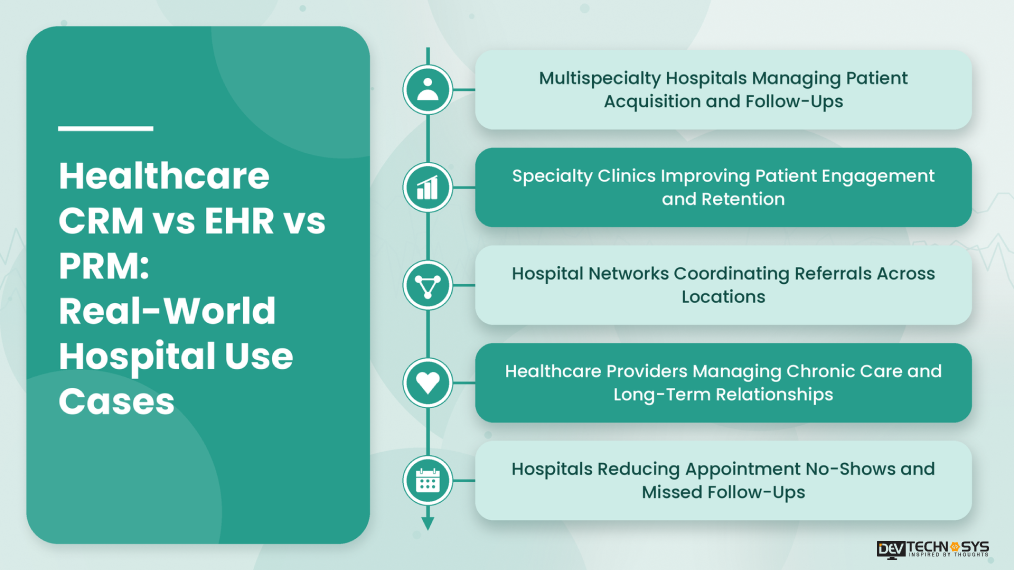
1. Multispecialty Hospitals Managing Patient Acquisition and Follow-Ups
Best fit: Healthcare CRM + EHR. A CRM tracks inquiries, referral sources, and prospective patients across departments, while the EHR stores clinical records. Add a PRM when the hospital needs dedicated patient communication and follow-up workflows.
2. Specialty Clinics Improving Patient Engagement and Retention
Best fit: PRM or healthcare CRM. A PRM supports appointment reminders and ongoing patient communication. A CRM is more useful when the clinic also needs referral tracking, patient acquisition, patient lifecycle management, and outreach campaigns. The EHR maintains clinical documentation.
3. Hospital Networks Coordinating Referrals Across Locations
Best fit: CRM + interoperable EHR. The CRM tracks referral status and patient movement between facilities, while interoperable EHR systems support authorized clinical information exchange. A PRM can coordinate patient updates across locations.
4. Healthcare Providers Managing Chronic Care and Long-Term Relationships
Best fit: EHR + PRM. The EHR maintains diagnoses, medications, and treatment plans. The PRM supports recurring reminders and follow-ups. A CRM may help manage broader engagement programs, but it does not replace clinical monitoring.
5. Hospitals Reducing Appointment No-Shows and Missed Follow-Ups
Best fit: PRM or CRM integrated with scheduling. Automated reminders, confirmations, and rescheduling messages help staff manage missed appointments. The hospital does not necessarily need both systems if its existing platform already supports these workflows.
How to Choose the Right System:
- Healthcare CRM: For patient acquisition, referral tracking, and relationship management.
- EHR: For clinical documentation, medical histories, and treatment records, all secured through HIPAA compliance and other security standards.
- PRM: For patient communication, appointment reminders, and follow-ups.
- Integration: Connect systems when existing tools cannot meet cross-department workflow needs.
Note: It is best to consult with your healthcare CRM provider regarding EMR and EHR software development cost, before hiring them for integration services.
How to Choose the Right Healthcare Software for Your Hospital?
Choosing healthcare software starts with identifying operational gaps, evaluating existing systems, and determining which workflows need improvement. According to a top EMR software development services provider, hospitals should prioritize interoperability, PHI data protection, data encryption, staff adoption, and measurable business outcomes.
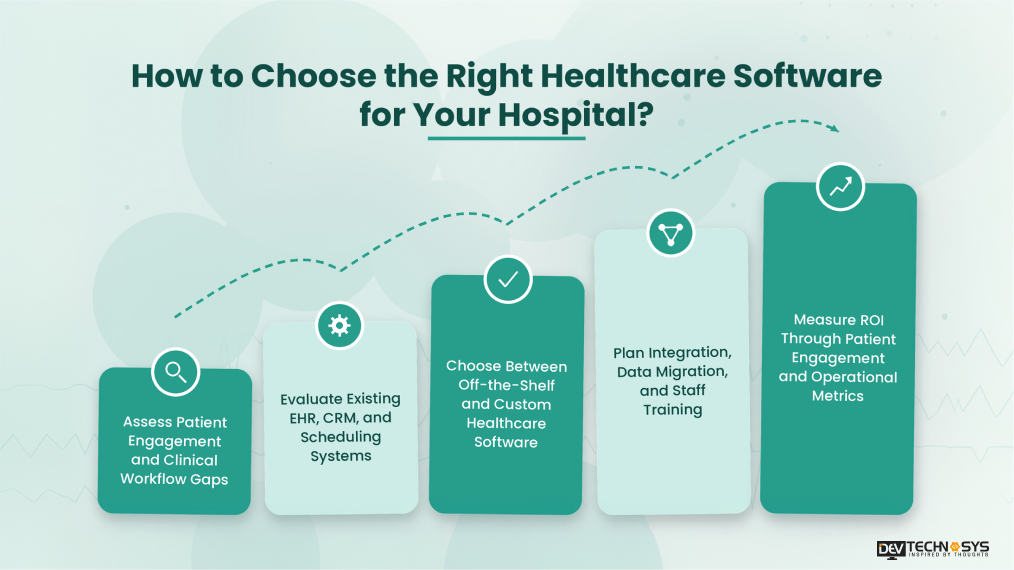
1. Assess Patient Engagement and Clinical Workflow Gaps
Identify problems such as missed appointments, referral delays, disconnected patient communication, or incomplete clinical records. Match each problem to the system that addresses it: CRM, EHR, or PRM.
2. Evaluate Existing EHR, CRM, and Scheduling Systems
Review current software capabilities, integration options, data ownership, and overlapping features. Avoid purchasing another platform if existing systems can meet the requirement through configuration or integration.
Industry Insights
KLAS Research’s Global HIT Trends 2026 surveyed 182 healthcare organizations across 43 countries outside the U.S. AI was the leading investment priority, while EHR modernization and cybersecurity remained important.
3. Choose Between Off-the-Shelf and Custom Healthcare Software
- Off-the-shelf software: Suitable when standard workflows, built-in features, and supported integrations meet hospital needs.
- Custom healthcare software: Better when specialized workflows, legacy systems, or unique integration requirements need tailored functionality.
4. Plan Integration, Data Migration, and Staff Training
EHR vs CRM vs PRM: Define which system owns each data type, map existing records, validate migrated data, and test integrations before launch. Train staff on role-specific workflows and role based access controls to support adoption and protect patient information.
5. Measure ROI Through Patient Engagement and Operational Metrics
Track appointment no-show rates, referral-to-appointment conversion, follow-up completion, administrative workload, and cost per appointment. Compare results against a pre-implementation baseline to assess whether the software delivers measurable improvements.
Conclusion
Healthcare CRM, EHR, and PRM serve different purposes, from patient acquisition to clinical documentation and ongoing engagement. Hospitals should assess their operational gaps before investing in new software. Integrating existing systems when necessary can reduce data silos, streamline workflows, improve patient experiences, and support sustainable growth. If you are a healthcare business looking for an experienced healthcare CRM software development company, then contact Dev Technosys. Stay tuned for more informative updates.
Frequently Asked Questions
Find answers to the most common questions related to this article.
Healthcare CRM manages patient acquisition and relationships, EHR maintains clinical records, and PRM supports patient communication, appointment reminders, and ongoing engagement throughout the care journey.
No. A healthcare CRM manages patient relationships and outreach, while an EHR stores clinical information, including diagnoses, medications, test results, and treatment plans for authorized providers.
No. Healthcare CRM typically focuses on patient acquisition, referrals, and retention, while PRM emphasizes ongoing communication and care engagement. However, their features may overlap across platforms.
Not always. Hospitals benefit from both when they need dedicated patient relationship management alongside clinical documentation. The decision depends on existing software, operational gaps, and patient engagement goals.
Yes. Healthcare CRM can integrate with compatible EHR systems through APIs, HL7, or FHIR interfaces, depending on vendor capabilities, interoperability requirements, and data-sharing permissions.
PRM supports appointment reminders, follow-ups, and care navigation, while healthcare CRM manages outreach, referrals, and patient relationships. The best choice depends on the hospital's engagement requirements
Custom healthcare CRM development can cost several thousand to over $100,000, depending on features, integrations, security requirements, and complexity. Accurate estimates require clearly defined project specifications.
Hospitals should implement role-based access, encryption, audit trails, and secure data transfers. They should also assess vendors, establish required Business Associate Agreements, and regularly review safeguards.