


















Quick Insight Into Fitness App Development Cost
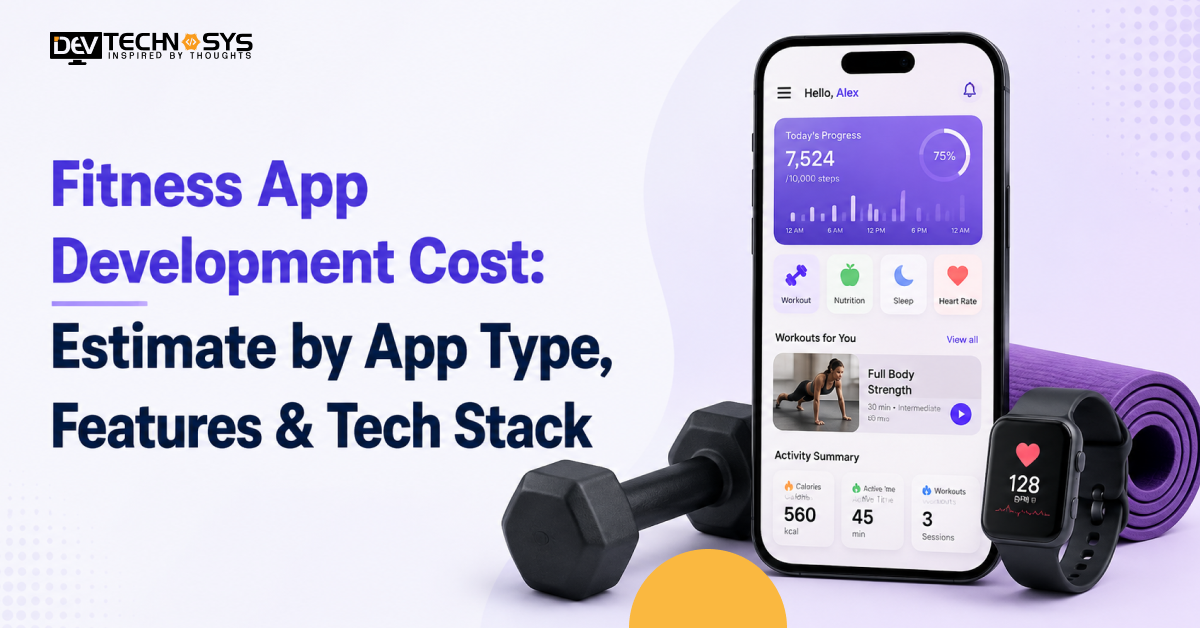
The cost to develop a fitness app in 2026 typically ranges from $30,000 to $150,000+, depending on features, complexity, integrations, and platform requirements.
Cost by Complexity:
-
- Basic Fitness App – $30,000–$50,000: Profiles, workout plans, exercise library, basic tracking, and notifications.
- Mid-Level Fitness App – $50,000–$90,000: Wearable integration, meal planning, progress tracking, subscriptions, and trainer features.
- Advanced Fitness App – $90,000–$150,000+: AI recommendations, live classes, wearable sync, advanced analytics, video streaming, and personalized coaching.
Key Cost Factors:
- Features, UI/UX, AI integration, wearable connectivity, third-party APIs, backend infrastructure, security, and platform choice.
Development Timeline:
- A fitness app generally takes 4–7+ months to develop, depending on customization and complexity.
Additional Costs:
- Plan for ongoing maintenance, cloud hosting, API charges, security updates, wearable integrations, and marketing after launch.
How about having a personal trainer, nutritionist, workout planner, and progress tracker in your pocket? That’s how fitness apps have evolved in 2026 and beyond, making personalized fitness more accessible.
Today’s fitness app offers AI-powered recommendations, wearable integration, nutrition tracking, virtual coaching, live workouts, and real-time analytics.
This has brought a rapid shift among entrepreneurs, gyms, startups, and fitness brands to build a fitness app. But the real question is: How much does it cost to build a fitness app in 2026-2027?
Generally, the fitness app development cost is estimated at $30,000-$1,50,000, depending on multiple factors. Through this guide, we will explain the costs, features, timelines, and key factors involved in fitness app development.
Fitness App Development Cost by Complexity, Business Model & Development Stage
The average cost to create a fitness app can range between $30,000 and $1,50,000. The final development expense depends on various considerations like:
- What type of application you want
- How you will make money from it
- At what point you are in the process of building it
Creating a simple fitness training application is less costly, but an AI-based platform with wearables, live sessions, and analysis is expensive. Below is an estimate of the average cost to make a fitness app depending on these considerations. Have a look at the fitness app development cost breakdown:
1. Fitness App Development Cost by Complexity
The complexity of the fitness application is determined by the number of features, integrations, security requirements, and other factors. A simple app created with an MVP structure has limited integrations, making it less complex to build. Whereas a highly advanced app includes modern technologies, the latest features, AI, and more, making it complex to develop.
| App Complexity | Best For | Cost Range |
| Basic / MVP | Workout tracking & simple plans | $30,000–$50,000 |
| Standard | Fitness brands & small gyms | $50,000–$90,000 |
| Advanced / AI-Driven | Scalable digital fitness platforms | $90,000–$150,000+ |
2. Fitness App Development Cost by Business Model
The feature requirements for user acquisition, engagement, subscriptions, and revenue generation depend on the business model. Fitness platforms have premium memberships, trainer marketplaces, or live coaching systems. These apps require additional payment gateways, dashboards, and user management modules. This is responsible for increasing the overall fitness app development pricing.
| Business Model | Revenue Source | Estimated Cost |
| Freemium App | Ads & premium upgrades | $30,000–$45,000 |
| Subscription Platform | Monthly/yearly memberships | $45,000–$75,000 |
| Nutrition & Meal Planner App | Premium diet plans & nutrition coaching | $40,000–$65,000 |
| Trainer Marketplace | Commission per booking | $70,000–$120,000 |
| Gym Management & Member App | Business subscriptions & member management | $60,000–$100,000 |
| Live Coaching Platform | Paid live sessions & coaching | $90,000–$150,000+ |
3. Fitness App Development Cost by Development Stage
The development phase is determined by how much of the product has already been decided or built. Creating a prototype or MVP fitness app requires less investment. Whereas scaling the app with enhanced functionality, analytical capability, and a multi-platform approach demands more financial resources.
| Development Stage | Typical Timeline | Budget Estimate |
| Discovery & Planning | 1–2 weeks | $3,000–$8,000 |
| Prototype / Wireframe | 1–3 weeks | $5,000–$12,000 |
| MVP Launch | 2–4 months | $30,000–$55,000 |
| Beta Testing & Refinement | 3–6 weeks | $8,000–$20,000 |
| Full Product Build | 4–7 months | $55,000–$110,000 |
| Scaling & Optimization | Ongoing | $110,000–$150,000+ |
How Much Does It Cost to Build Different Types of Fitness Apps?
Workout training, fitness training, diet & nutrition, and yoga & meditation are some of the important types of fitness apps. It is important to understand the fitness app development cost by app type before estimating your budget. Here, we will learn about the types, their essential features, and estimated development cost range.
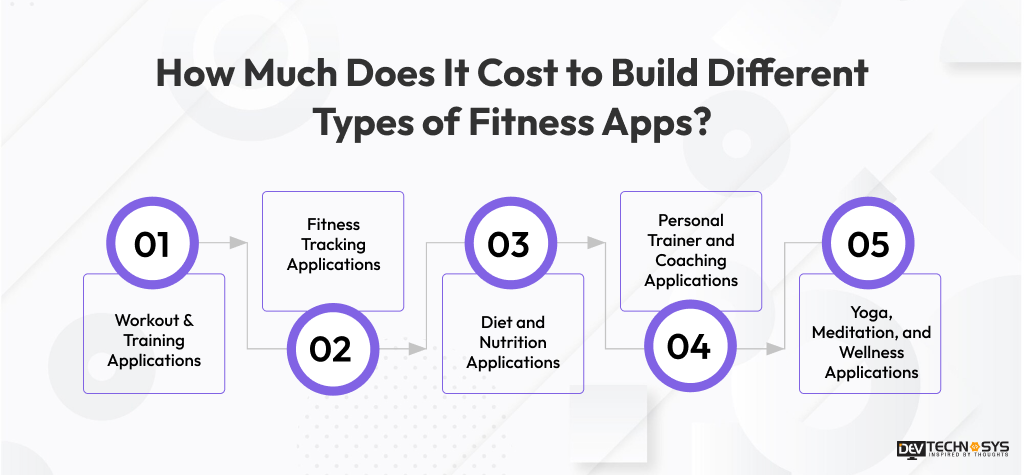
1. Workout & Training Applications
Exercise and training applications offer an exercise database, routines, performance analysis, reminders, and fitness tracking. They are best for users wanting an exercise regimen for building muscles, losing weight, and improving cardiovascular health, without trainers.
2. Fitness Tracking Applications
A fitness tracking platform is used to observe daily activities like steps, calories burned, heart rate, sleep schedule, and workouts. They often integrate with wearable devices and health platforms to deliver real-time insights and personalized activity recommendations.
3. Diet and Nutrition Applications
Diet and nutrition apps help users track calorie intake, develop meal plans, track macronutrients, and follow healthy eating tips. They are often used together with workout plans to achieve weight loss, muscle gain, and other health-related objectives.
4. Personal Trainer and Coaching Applications
Personal trainer and coaching applications allow users to connect with personal trainers for individualized workout plans and consultations. Personal trainers and coaching apps use a user management system and other features for communication, scheduling, and payments.
5. Yoga, Meditation, and Wellness Applications
Yoga, meditation, and wellness applications focus on yoga classes, breathing exercises, meditations, relaxation programs, and tracking wellness status. Video and audio streaming, progress tracking, subscriptions, and individual wellness tips are among the features of such applications.
| Fitness App Type | Core Features | Estimated Cost Range |
| Workout & Training App | Exercise library, workout plans, progress tracking, reminders | $30,000–$50,000 |
| Fitness Tracking App | Step tracking, GPS, calorie tracking, heart rate monitoring, wearable sync | $40,000–$70,000 |
| Diet & Nutrition App | Meal plans, calorie counter, nutrition database, health insights | $35,000–$60,000 |
| Personal Trainer & Coaching App | Trainer profiles, chat, video sessions, scheduling, payment integration | $60,000–$120,000 |
| Yoga, Meditation & Wellness App | Guided sessions, video/audio streaming, subscriptions, wellness tracking | $50,000–$90,000 |
| AI-Powered Fitness App | AI coaching, personalized recommendations, predictive analytics, wearable integration | $90,000–$150,000 |

Fitness App Development Features Cost Breakdown: Core, Advanced & AI-Powered
A modern fitness app comes with a combination of core features, advanced features, and AI capabilities. If the feature set is right, it directly influences development cost, user experience, scalability, and long-term retention. We have mentioned the fitness app development cost by features.
Fitness App Core Features
| Core Feature | Purpose | Cost Range |
| User Registration | Create user accounts | $2,000–$3,000 |
| Workout Library | Browse exercise routines | $2,500–$4,000 |
| Workout Tracking | Record workout activity | $2,500–$4,000 |
| Goal Setting | Set fitness targets | $2,000–$3,000 |
| Progress Tracking | Monitor fitness progress | $2,500–$4,000 |
| Exercise Search | Find relevant exercises | $2,000–$3,000 |
| Push Notifications | Send workout reminders | $2,000–$3,000 |
| Calorie Calculator | Calculate calorie needs | $2,000–$3,500 |
| Water Tracking | Track daily hydration | $2,000–$3,000 |
| Admin Dashboard | Manage users and content | $3,000–$5,000 |
Fitness App Advanced Features
| Advanced Feature | Purpose | Cost Range |
| Wearable Integration | Sync wearable data | $6,000–$9,000 |
| Nutrition Planning | Create meal plans | $6,000–$9,000 |
| Live Workout Classes | Stream instructor-led sessions | $8,000–$12,000 |
| Video Streaming | Access workout videos | $6,000–$10,000 |
| Trainer Marketplace | Book fitness trainers | $8,000–$12,000 |
| In-App Payments | Process digital payments | $6,000–$9,000 |
| Social Community | Connect fitness users | $6,000–$9,000 |
| Fitness Challenges | Run fitness competitions | $6,000–$9,000 |
| Advanced Analytics | Analyze user performance | $7,000–$11,000 |
| Multi-Device Sync | Synchronize fitness data | $7,000–$12,000 |
AI-Powered Fitness App Features
| AI Feature | Purpose | Cost Range |
| AI Workout Recommendations | Personalize workout plans | $8,000–$12,000 |
| AI Fitness Coach | Provide virtual coaching | $10,000–$15,000 |
| AI Nutrition Planner | Recommend personalized meals | $8,000–$13,000 |
| AI Form Correction | Detect exercise form issues | $10,000–$15,000 |
| Predictive Analytics | Predict fitness outcomes | $8,000–$12,000 |
| AI Fitness Chatbot | Answer fitness queries | $8,000–$12,000 |
| Adaptive Workout Plans | Adjust workouts automatically | $9,000–$14,000 |
| AI Goal Optimization | Optimize fitness goals | $8,000–$12,000 |
| Injury Risk Detection | Identify potential risks | $10,000–$15,000 |
| Personalized Health Insights | Generate user-specific insights | $9,000–$15,000 |
Fitness App Development Technologies That Impact Development Cost
Selecting the right tech stack is an essential task in fitness app development services. It even affects development cost, scalability, performance, security, and future integrations. Businesses select a fitness app development technology according to their platforms, real-time features, wearable connectivity, AI capabilities, and data volume. Have a look at the tech stack commonly used to build modern fitness applications.
| Technology Layer | Recommended Technologies | Estimated Cost |
| Mobile App | Swift, Kotlin, Flutter, React Native | $5,000–$12,000 |
| Frontend | React.js, Next.js | $5,000–$10,000 |
| Backend | Node.js, Python, Java | $7,000–$15,000 |
| Database | PostgreSQL, MongoDB, Redis | $5,000–$9,000 |
| Cloud Infrastructure | AWS, Azure, Google Cloud | $6,000–$12,000 |
| APIs | REST, GraphQL | $5,000–$8,000 |
| Wearable Integration | HealthKit, Health Connect, Fitbit APIs | $8,000–$15,000 |
| AI / ML | Python, TensorFlow, PyTorch, OpenAI APIs | $10,000–$15,000 |
| Real-Time Features | WebSockets, Firebase | $5,000–$9,000 |
| Payment Integration | Stripe, PayPal | $5,000–$8,000 |
| Analytics | Firebase Analytics, Mixpanel | $5,000–$7,000 |
| DevOps & Deployment | Docker, Kubernetes, Jenkins | $6,000–$12,000 |
| Security & Authentication | OAuth 2.0, Auth0, Okta | $6,000–$10,000 |
7 Key Factors That Influence Fitness App Development Cost
Despite complexity, business model, and development stage, several factors impact the fitness and healthcare app development cost. These include platform choice, UI/UX, security & compliance, tech stack, backend architecture, development team & location, and other factors. Have a look at the crucial factors affecting fitness app development expenses.
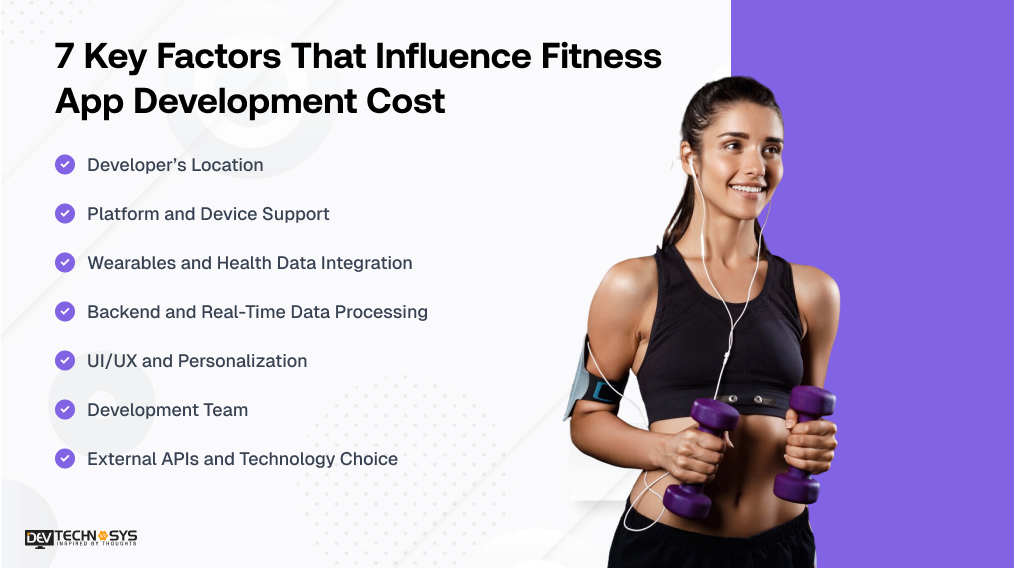
1. Developer’s Location
The developer’s rate varies from region to region due to various differences in salaries, expenses, and market demand. Hiring a developer from the USA or Western Europe would be more expensive. Whereas getting developers from India, Eastern Europe, or any other cheaper region would be less expensive.
2. Platform and Device Support
The cost to develop an app like Freeletics is affected by the platform choice for development, either Android, iOS, or cross-platform. The expenses increase due to development, testing, optimization, and support for all platforms. If there is no extensive platform-specific functionality, cross-platform tools can be used to avoid duplication.
3. Wearables and Health Data Integration
Integrate Apple Health, Health Connect, Fitbit, Garmin, or other wearables into the fitness app. It can add to the fitness app cost for API development, permissions, data synchronization, testing, and device-specific requirements. It also supports various devices that require additional engineering to process health and activity data.
4. Backend and Real-Time Data Processing
Fitness applications require a backend to maintain profiles, workouts, workout history, subscription management, analytics, and activity data synchronization. Live tracking, real-time workouts, wearables integration, and large user numbers require a more complex architecture. This raises fitness mobile app development expenses.
5. UI/UX and Personalization
In-app UI/UX, workout visualization, progress monitoring, personalized recommendations, and user journey are critical elements for any fitness application. Designing and developing custom interfaces and personalization features will take more time and resources. This leads to an increased fitness app development price.
6. Development Team
The choice of your development team will affect hourly rates and project management expenses. Freelancers will have lower starting prices; in-house developers will give you full control but require paying salaries and in-house expenses. While agencies will handle all aspects of development, from design to project management.
7. External APIs and Technology Choice
A fitness app integrates external payment gateways, a nutritional database, maps, analytics systems, AI services, video services, and communication services. The choice of programming language, framework, cloud technologies, and APIs is also used for development and maintenance. However, it also increases the fitness and healthcare app development budget.
| Factor | Cost Range | Budget Impact | Cost Level |
| Developer’s Location | $10,000–$23,000 | Can significantly change hourly development rates | High |
| Platform & Device Support | $10,000–$23,000 | Increases with every additional platform/device | High |
| Wearables & Health Data | $2,000–$8,000 | Rises with multiple wearable integrations | Medium |
| Backend & Real-Time Processing | $10,000–$30,000 | Highest when live data and high scalability are required | Very High |
| UI/UX & Personalization | $5,000–$20,000 | Increases with custom journeys and personalization | Medium–High |
| Development Team | $12,000–$25,000 | Depends on team size, expertise, and engagement model | High |
| External APIs & Technology | $4,000–$12,000 | Rises with premium APIs and complex integrations | Medium |
How Security & Compliance Impact Fitness App Development Cost?
Health metrics, activity records, location, biometrics, behavioral data, and other sensitive information are stored in a fitness app. Therefore, building appropriate security and compliance controls is essential. However, it adds approximately $6,000 to $18,000+ to the fitness mobile app development cost. It depends on the data handled, integrations, compliance scope, and security requirements.
Essential Security Features
Fitness apps protect users’ health-related data, whether collecting, transmitting, storing, or processing the data. Some common security measures include:
| Security Component | Implementation / Coverage | Estimated Cost |
| Data Encryption | Encryption of sensitive fitness and user data at rest and in transit | $2,000–$5,000 |
| End-to-End Encryption | Protected communication for sensitive user-to-user or app-to-server data | $2,000–$5,000 |
| SSL/TLS | Secure data transmission between apps, APIs, and servers | $1,000–$2,500 |
| Secure API & API Security | Authentication, authorization, token management, and protected API endpoints | $2,000–$5,000 |
| Two-Factor Authentication | Additional verification through OTP, authenticator apps, or other factors | $1,500–$3,500 |
| Biometric Authentication | Fingerprint, Face ID, or device-level biometric login | $1,500–$3,500 |
| Cloud Security | Secure cloud configuration, access controls, monitoring, and backups | $2,000–$6,000 |
| Performance & Scalability | App performance optimization and scalable architecture for secure growth | $2,000–$6,000 |
Privacy & Compliance Considerations
The compliance requirements depend on the location where the app is launched and operates. It also depends on what information it collects and who processes that information. Fitness businesses may need to consider:
| Compliance / Privacy Area | Implementation / Coverage | Estimated Cost |
| HIPAA Compliance | PHI safeguards, access controls, audit controls, and applicable security measures | $5,000–$15,000+ |
| GDPR Compliance | Consent, data access, deletion, privacy controls, and processing requirements | $3,000–$8,000 |
| Data Privacy | Privacy policies, consent management, data retention, access, and deletion workflows | $1,500–$4,000 |
| CCPA/CPRA | Consumer data access, deletion, correction, and opt-out mechanisms | $2,500–$7,000 |
| Compliance Auditing | Risk assessments, documentation, control reviews, and compliance testing | $3,000–$8,000 |
Custom vs White-Label Fitness App Development: Cost Comparison
Whether you choose custom or white-label fitness app development, it influences the development cost, timeline, customization, and ownership. Custom fitness app development is more expensive as it provides great control and scalability. Whereas white-label fitness app development includes predefined functionalities, making market entry easier and lowering development costs.
| Cost Factor | Custom Fitness App | White-Label Fitness App |
| Initial Development | $30,000–$150,000+ | $5,000–$30,000+ |
| Customization | Full customization | Limited customization |
| Feature Development | Fully custom | Pre-built features |
| Third-Party Integrations | Flexible | Platform-dependent |
| Source Code | Full ownership | Usually unavailable |
| Launch Timeline | 4–9 months | Few weeks–3 months |
| Annual Maintenance | $4,500–$30,000+ | Usually included or bundled |
| Hosting & Infrastructure | $1,000–$10,000+/year | Usually included |
| Platform Subscription | Not required | $1,000–$10,000+/year |
| Feature Updates | Additional development cost | Usually provider-managed |
| Long-Term Cost | Higher initial, greater control | Lower initial, recurring fees |
Best Fitness App Monetization Strategies to Increase Revenue in 2026-2027
A fitness app’s revenue potential depends on retention, engagement, and recurring usage, not just downloads. Subscription, freemium model, in-app advertising, trainer commission, corporate wellness, in-app purchases, and more are the best monetization strategies. We will understand some of the most commonly used money-making models in fitness apps for recurring revenue.
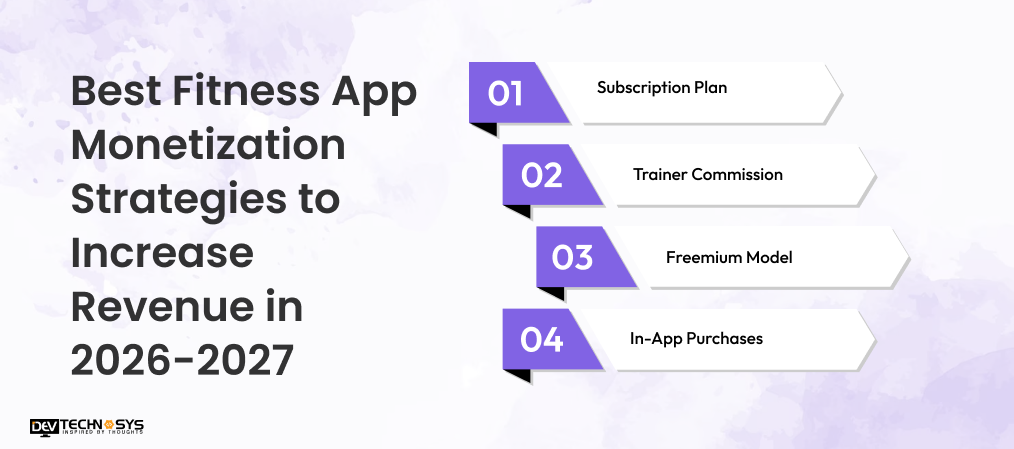
1. Subscription Plan
A subscription, monthly, quarterly, or annually, is considered the strongest revenue-generating strategy for fitness platforms. With a subscription, users can access premium workouts, personalized plans, nutrition tracking, live classes, and advanced analytics. It is a great strategy to create predictable, continuous income.
2. Trainer Commission
Fitness apps that connect users with trainers or coaches can earn revenue in the form of commission. It can generate income streams from session bookings, consultation packages, or subscription-based coaching programs. The platform generates income streams every time a user books a personal trainer.
3. Freemium Model
In a freemium model, users can get basic features like workout tracking and limited content for free. However, users have to pay for advanced services like advanced programs, coaching, and detailed progress insights. This approach helps acquire users quickly and convert engaged users into subscribers.
4. In-App Purchases
Fitness apps can generate additional revenue through specialized plans. This includes workout packs, meal plans, meditation programs, fitness challenges, or wearable-compatible training modules. This model works well when users want occasional upgrades without committing to a subscription.
Fitness App ROI Calculator: Estimate Your Potential Return
A fitness app’s ROI depends on its development cost, paying users, subscription revenue, operating expenses, and other income. You can estimate your potential return using two simple formulas:
ROI (%) = [(Revenue − Total Investment) ÷ Total Investment] × 100
Payback Period = Initial Development Investment ÷ Monthly Profit
We will understand it with an example using this fitness app development cost calculator:
You have invested $60,000 in development. You are generating $15,000 in monthly revenue with $5,000 in monthly operating costs. So your monthly profit is $10,000. The estimated payback period would be 6 months.
| ROI Variable | What to Enter |
| Development Cost | Initial app development investment |
| Monthly Active Users | Number of active monthly users |
| Paying-User Percentage | Percentage of users who pay |
| Average Subscription Price | Monthly price per paying user |
| Monthly Operating Cost | Hosting, maintenance, APIs, and support |
| Other Revenue | Ads, purchases, trainer commissions, etc. |
Hidden Costs of Fitness App Development to Consider
During fitness app development, hidden costs appear through maintenance, cloud infrastructure, third-party APIs, security, and ongoing support. These expenses should be included in your long-term fitness app development budget. After understanding these hidden expenses, you can plan your budget decisively to create an app like GymGennie.
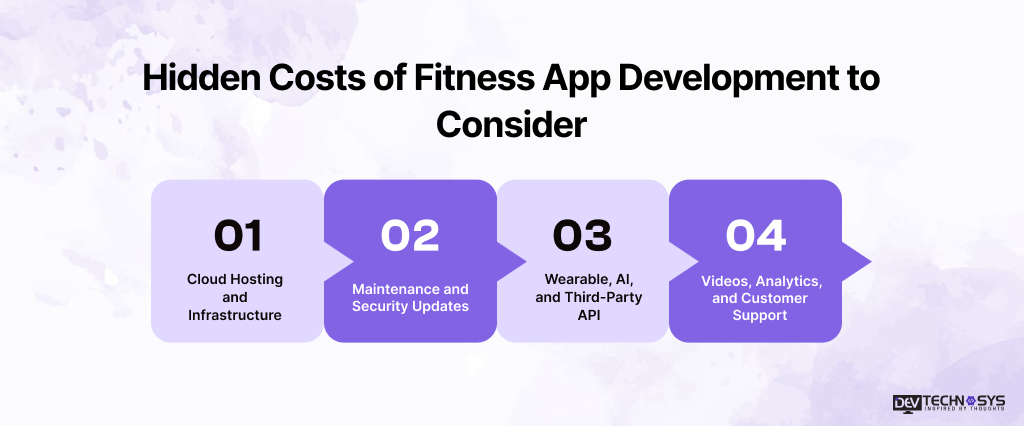
1. Cloud Hosting and Infrastructure
The cost of cloud hosting goes up with the number of your users, data storage, images, videos, and live activities. Services like AWS, Azure, or Google Cloud have prices depending on storage, computing, bandwidth, and database service usage.
2. Maintenance and Security Updates
Any fitness app requires ongoing maintenance to fix bugs, update the operating system, and support devices. Additionally, security updates and patches are another kind of maintenance and also incur ongoing costs, especially when working with users’ sensitive information.
3. Wearable, AI, and Third-Party API
A fitness app integrates wearables, AI services, payment gateways, nutritional databases, and other third-party services. It involves usage-based charges and fees that increase the fitness coaching app development cost. Thus, you should pay attention to API costs when calculating the expenses.
4. Videos, Analytics, and Customer Support
Videos for workout sessions, classes, analytics systems, and customer service can bring a considerable rise in fitness app development pricing model. The video streaming cost includes CDN and bandwidth charges. Similarly, analytics and customer service can have monthly user- or event-based charges.
Planning a Fitness Project?
Get a tailored development cost estimate in a few simple steps.
- 3 quick steps
- 100% free
- Reply in 1 business day
2 Minutes Read
What Is the Cost to Develop a Popular Fitness App in 2026-2027?
The cost to build a fitness app similar to leading platforms depends on:
- Core functionality
- Real-time features
- AI capabilities
- Video streaming
- Wearable integration
- Social engagement tools
Apps focused on nutrition tracking are generally less expensive than platforms offering live classes, GPS tracking, or AI-powered personalization.
| Famous App | Best Known For | Key Features | Estimated Build Cost |
| MyFitnessPal | Calorie & nutrition tracking | Food database, calorie counter, meal logging, macro tracking | $30,000–$70,000 |
| Strava | GPS running & cycling community | GPS tracking, route mapping, leaderboards, social sharing | $50,000–$120,000 |
| Peloton | Live & on-demand fitness classes | Live streaming, video workouts, subscriptions, performance tracking | $80,000–$150,000+ |
| Fitbod | AI-powered workout plans | AI workout generation, adaptive routines, recovery tracking | $60,000–$130,000 |
| Nike Training Club | Professional workout programs | Trainer-led workouts, fitness plans, progress tracking, reminders | $40,000–$90,000 |
| Centr | Fitness, nutrition & wellness coaching | Workout programs, meal plans, meditation, wellness coaching | $50,000–$110,000 |
Practical Strategies to Reduce the Cost To Develop a Fitness App
Businesses should start with essential features, use proven technologies, and scale gradually to reduce the cost of developing a fitness application. Careful planning can significantly lower both development expenses and long-term operational costs. We have mentioned some of the essential measures you should follow to reduce the fitness and workout app development cost.
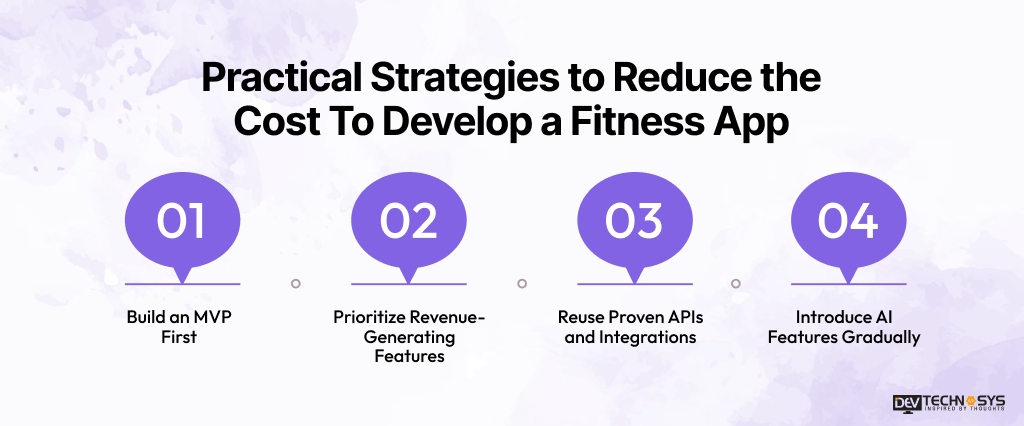
1. Build an MVP First
Use an MVP development strategy that involves the core features like user registration, progress tracking, and notifications. The advantage of an MVP build is to incur lower upfront costs for building the app. It also shortens the time to release and validate demand before adding additional features.
2. Prioritize Revenue-Generating Features
Allocate money to features that could earn you money from the app. This includes subscription fees, advanced workout plans, in-app purchases, trainer services, and virtual coaching membership. Allocating more funds towards monetization will help you earn money quickly after the launch of the app.
3. Reuse Proven APIs and Integrations
Integrate payment processing, authentication, push notifications, analytics, cloud storage, and connection with wearables. Add these through third-party APIs rather than creating them from scratch. By integrating third-party services, you reduce coding effort, testing time, associated risks, and future maintenance costs.
4. Introduce AI Features Gradually
Features like AI-driven workouts, nutrition recommendations, and coaching will increase development costs and the required infrastructure. Start with simple rule-based personalization and basic analytical tools before considering AI. You can upgrade the features later on according to user and market demand.

Final Words
In this blog, we have mentioned cost information that a business needs while investing in fitness app development. This information can motivate businesses to build something more meaningful than another workout tracker.
It is true that the real opportunity lies in creating an experience that understands users. It might be coaching, tracking, nutrition, or motivation, but the right elements can turn an ordinary fitness application into something interesting.
Are you also interested in developing something that people will want to use on a regular basis? With a proper vision, smart planning, and the right fitness app development company, it is possible.
Frequently Asked Questions
Find answers to the most common questions related to this article.
Usually, it takes approximately 4 to 7+ months to create a fitness app. The final development timeline is influenced by the platform’s complexity, number of features, integrations, and security requirements. A simple app that is built with an MVP strategy will take around 4 to 6 months to develop. Whereas an advanced app with AI capabilities, the latest technologies, and other modern innovations takes 7+ months to develop.
The average cost to develop a fitness app in 2026-2027 can range from $30,000 to $1,50,000. The overall development expense depends on the platform’s complexity and other factors. These factors include UI/UX, platform choice, security & compliance, tech stack, third-party APIs, backend infrastructure, and others. A basic app with limited but essential features and integrations is less expensive than a fully featured, advanced app.
Not at all. Integrating wearables can increase the development expenses, but it cannot double the total budget. The budget is determined by the number of devices, platforms, APIs, and health metrics you want to support. However, adding Apple HealthKit, Health Connect, Fitbit, Garmin, or other devices can be more costly. This is because these wearable integrations require additional development, testing, synchronization, and data security work.
The choice between a custom and white-label solution depends on your budget, target audience, customization requirements, and growth plans. Opt for custom development if you want unique features, complete control, stronger scalability, and long-term product ownership. Go for white-label solutions if you want to launch quickly with lower upfront costs and standard fitness features. White-label development is more budget-friendly, and custom development is expensive.
Fitness app maintenance cost is usually 15-20% of the total development cost annually. However, the actual amount depends on the app’s complexity and usage. Expenses can include bug fixes, operating system updates, cloud hosting, security patches, API charges, wearable compatibility, performance improvements, and customer support. Apps using AI, video streaming, or multiple integrations may require higher ongoing maintenance budgets.