









Key takeaways:
-
- Businesses can track sales and management payments, all from a single mPOS app after mobile POS QR payment integration.
- According to Pew, 74% of mobile users are Gen Z, who appreciate fast and secure payment processing through mPOS apps.
- Merchants and consumers should use digital payments to keep track of their expenses.
- Businesses are expected to improve mPOS apps with the integration of QR payments to ensure fast and secure transactions for consumers.
Customers prefer to complete the billing process fast rather than standing in queues to complete this payment. Instead, they expect a fast and secure payment that can be completed within seconds. Through mPOS apps, retailers manage transactions and sales. Customers can make on-the-go transactions simply by scanning a QR code.
Businesses integrate QR payments in mPOS apps to reduce manual efforts and quickly receive payments. This allows customers to directly pay a merchant without even adding the amount. The receipts are generated online and can be kept safe for future use. Many enterprises are adopting this technology to experience secure, fast, and contactless payment processing.
This guide focuses on sharing relevant information regarding QR Code Payment Integration in mPOS apps, benefits, features, cost, and how to develop it.
What is an mPOS App?
A mobile point of sale app is a replacement for traditional billing machines. An mPOS app is a mobile application that helps businesses accept payments and manage sales directly from a smartphone or tablet.
MPOS offers portability to businesses more than traditional POS systems. Customers need to make a queue at the billing counter to complete a transaction. Now, the merchants can directly receive amounts within seconds.
What are QR Payments and How Do They Work?
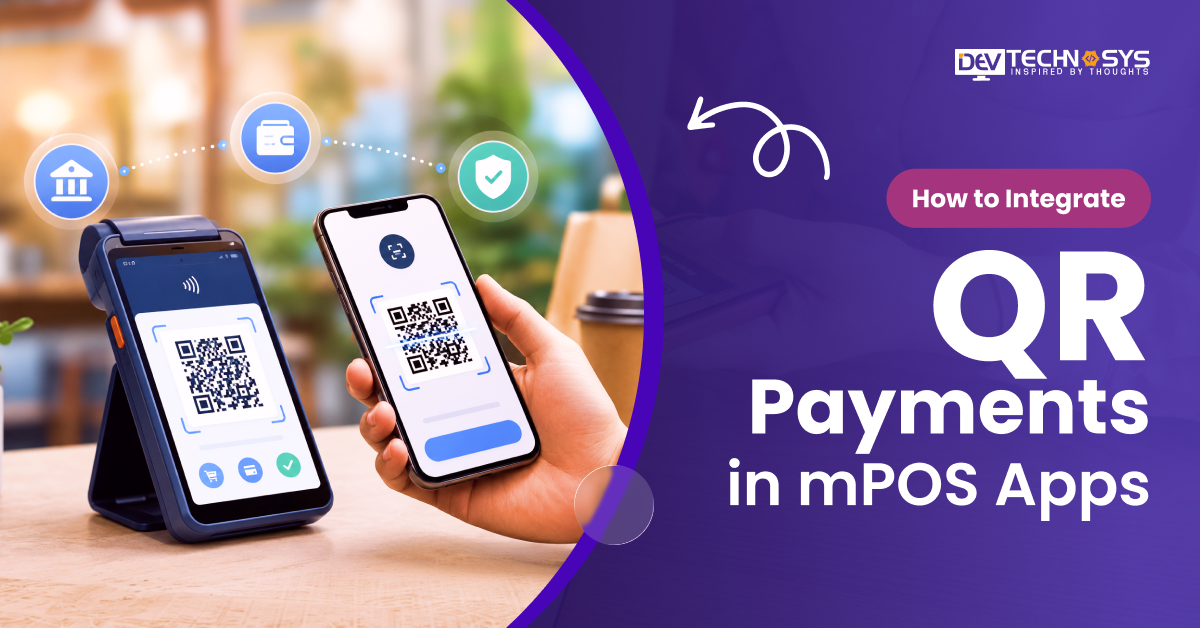
QR payments allow customers to directly pay the merchant without manually entering the bank details. The simple working is that the merchant shares a QR code, a user scans it, and confirms a payment. The amount is directly received in the account.
Let’s understand the working:
- A QR code is shared by the merchant.
- The customer has to scan the QR code using a payment application.
- In the backend, the merchant’s payment details are processed.
- The customer pays the amount, and the real-time data is shared with the merchant to confirm the payment.
Planning a Pos Project?
Get a tailored development cost estimate in a few simple steps.
- 3 quick steps
- 100% free
- Reply in 1 business day
2 Minutes Read
QR Payments in mPOS Apps: Market Overview
As per our research and findings from Mordor Intelligence, the market size of mPOS apps is increasing. The retail industry is adopting the technology at a faster pace. mPOS QR payment integration is secure, fast, and enables real-time analytics.
- According to Mordor Intelligence, the current QR code market size is USD 15.23 billion and is expected to grow at a CAGR of 16.82% by 2031.
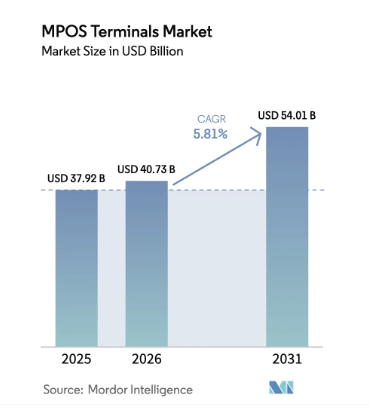
- The global mPOS terminals market is projected to expand from $37.92 billion in 2025 to $40.73 billion in 2026, reaching $54.01 billion by 2031 at a CAGR of 5.81%. The fastest growing market of mPOS is the Asia Pacific.
- Contactless payment modes are advancing at an 8.34% CAGR to 2031. This statistic is driving retailers to build POS software for small businesses to support digital wallets and QR payments.
- The study shows that the retail industry accounts for 43.92% share compared to hospitality and other industries. This is indirectly influencing the infrastructure cost of mPOS apps. Businesses have to invest less compared to the traditional system cost.
Why Businesses are Adopting QR Payments for Faster and Secure Transactions?
The shift towards QR payments is a structural change that most industries are adopting. Businesses increasingly integrate QR payments in mPOS apps due to their cost-effectiveness and efficiency. Where merchants can securely accept payments, customers are relieved of the worry about fraud.
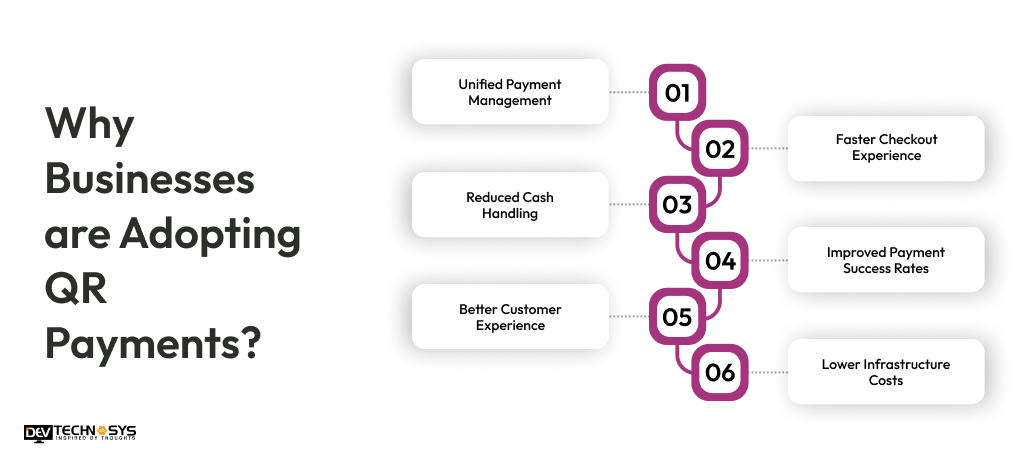
1. Unified Payment Management
A single QR code is used across the store, in the app/website, and pop-up environments. QR integration replaces the challenge of implementing a hardware system while providing real-time payment processing.
2. Faster Checkout Experience
QR payments allow customers to make a transaction within three simple steps: generate, scan, and confirm. This reduces the payment processing time, leading to shorter queues and a direct increase in sales. This feature allows businesses to serve more customers even during peak hours.
3. Reduced Cash Handling
Businesses that calculate large amounts of cash often experience counting errors and theft risks. QR payments reduce this risk by generating digital receipts. Merchants can now simplify accounting processes as the data is available in the app with accurate details. Also, consumers can carry minimal cash as they can pay digitally to the merchants.
4. Improved Payment Success Rates
Traditional payment methods often created conditions of declined authorizations and CVV failures. With the integration of QR payments, businesses receive instant confirmation. Though such payments require a stable internet connection, they have improved payment transparency for users and businesses.
5. Better Customer Experience
QR Payments in mPOS Apps offers multi-currency support, faster payment, secure gateways, and instant digital receipts. Customers who do not prefer to carry cash or a card can proceed with a digital payment. Consumers get multiple payment options with mobile wallet compatibility, receiving a good customer experience.
6. Lower Infrastructure Costs
mPOS applications eliminate the need for investing in additional hardware. However, the POS software development cost for traditional systems is higher than for modern systems. Adopting QR payments in mPOS is affordable for even small businesses.
How to Integrate QR Payments in mPOS Apps?
A successful QR payment integration in mPOS apps is done by configuring merchant credentials, complying with standard payment regulations, selecting a payment provider, and integrating essential APIs.
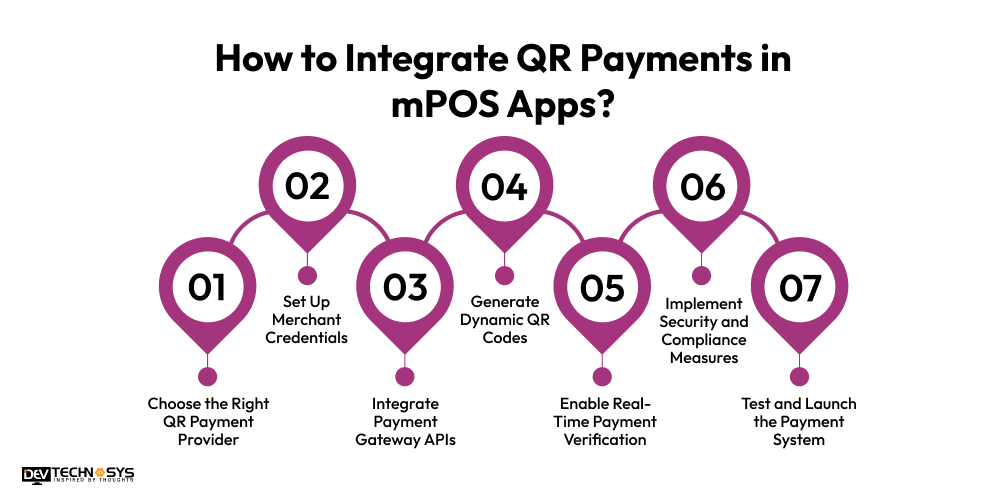
Step 1: Choose the Right QR Payment Provider
Initially, developers choose a provider to ensure API capabilities, payment security, and successful transaction rates. A payment provider should be selected according to the need for domestic, international, or both payments.
The selected provider should support real-time transaction processing and provide APIs that can easily integrate with the existing mPOS architecture. Key factors to evaluate include:
- QR payment support
- UPI compatibility
- API documentation
- Settlement cycle
- Refund support
- Transaction fees
- Sandbox environment
- Multi-store capabilities
- Technical support availability
Step 2: Set Up Merchant Credentials
The next step is to verify merchant credentials. In simple terms, businesses with multiple outlets need to confirm their identity to improve reporting accuracy. The onboarding process is incomplete until financial regulations are officially met.
Enterprises with multiple ventures can partner with a POS software development company to integrate QR payments easily into the existing application. Merchant Credentials include:
- Merchant ID
- API key
- Secret key
- Client ID
- Access tokens
- Store ID
- Sandbox credentials
- Production credentials
Step 3: Integrate Payment Gateway APIs
Backend-driven API integration is considered the preferred approach to minimize security risks for modern payment apps. Developers integrate APIs to help the backend server communicate with the user activity.
The payment details are successfully stored after the API integration. This ensures error handling, invalid responses, and network issues. Common payment APIs include:
- Create order API
- Generate QR API
- Payment status API
- Refund API
- Transaction history API
- Settlement API
- Webhook API
Step 4: Generate Dynamic QR Codes
Ecommerce and retail businesses must integrate a POS System to reduce payment errors. They can choose dynamic QR codes for mPOS apps to reduce payment errors. Such QR codes contain the entire payment details of a merchant. Through dynamic QR codes, users can directly enter their PIN and complete the payment without entering the significant amount. It contains:
- Transaction amount
- Merchant information
- Order ID
- Currency
- Store details
- Payment reference number
- Expiration time
Step 5: Enable Real-Time Payment Verification
Webhooks and payment status APIs are integrated so that both parties can receive a payment confirmation in real time. Accurate payment status helps users to take immediate action to complete or decline a transaction. Common statuses include:
- Successful
- Pending
- Failed
- Expired
- Cancelled
- Refunded
Industry Insight:
At Dev Technosys, we have worked on POS software, digital payments, and mPOS applications. Through our experience, we have learned that businesses cannot achieve success with a standalone application. They need to regularly update the systems with the latest technology to get a competitive edge.
Step 6: Implement Security and Compliance Measures
Financial transactions must be secured through robust compliance measures. Implementing fraud detection mechanisms at this step is essential for monitoring unusual transaction behavior. QR payment integration in mPOS applications must be done while following compliance measures. Important security measures include:
- HTTPS communication
- SSL encryption
- API authentication
- Access tokens
- Digital signatures
- Tokenization
- Secure credential storage
- Server-side validation
Step 7: Test and Launch the Payment System
An extensive test is required to check the functionality after the integration, security, and responsiveness issues. Developers have to test the entire payment workflow until they meet the specific requirements of the merchants. Testing scenarios should include:
- Successful payments
- Failed transactions
- Network interruptions
- Duplicate payments
- QR expiration
- Invalid credentials
- Refund requests
- Webhook failures
Want a chatbot demo or pricing? Fill the form and talk to our experts today.
Pick what you need below — you can select more than one — then tap Get detail to continue.
-
Chatbot demo dashboard
-
Cost to develop an app
-
Industry report
-
Case study
Who Should Integrate QR Payments?
OR payment integration is effective for the industries where transactions are made in large volumes. Key entities to include QR payments are the retail, ecommerce, and hospitality industries.
Industry |
Use Case |
Key Benefits |
| Food & Beverage | Order and pay at tables or counters | Faster service and reduced wait times |
| Retail Stores | Quick checkout and digital billing | Faster payments and shorter queues |
| E-commerce | Omnichannel payment support | Seamless online and offline payments |
| Hospitals & Clinics | Patient billing and consultations | Reduced billing time |
| Transportation | Taxi, metro, and ride payments | Cashless and faster transactions |
| Educational Institutions | Fee collection and payments | Simplified payment management |
| Delivery Services | On-delivery payments | Real-time payment confirmation |
| Hospitality | Hotel and travel payments | Improved guest experience |
| Fitness & Wellness | Membership and service fees | Convenient digital payments |
Industry Insight:
According to Federal Reserve data, a major change has been observed in payment behavior. Consumers are using digital payments and debit cards, reducing the use of cash. This change is a boon for enterprises that are planning to integrate QR payments in mPOS Apps.
QR Payment Integration Architecture for mPOS Apps
A strong payment architecture is essential when businesses integrate QR payments in mPOS Apps. It ensures security and a smooth checkout experience for both merchants and customers.
1. Mobile POS Application Layer
This layer is specifically for the merchants to generate QR codes, bills, or check transactions. Merchants can analyze payment records and check customer information.
2. QR Code Generation Module
This module supports dynamic QR code generation for each transaction. This is a crucial aspect of improving payment accuracy and maintaining security.
3. Payment Gateway and API Layer
This layer acts as a communication bridge between merchants, banks, and the mPOS application. This enables payment updates, refund settlement, and authorizes payments.
4. Customer and Banking Network Layer
This layer is integrated to ensure that customers scan the right QR code to initiate payment. The request is later sent to the banking network for authorization.
5. Security and Authentication Layer
Multiple protection mechanisms are used to encrypt data to protect sensitive customer information. This layer reduces threats for mPOS apps.
6. Real-Time Notifications and Analytics
Customers and merchants both prefer to view notifications to get transaction alerts or to check payment records. Businesses use this analytics to improve customer experience.
Technology Stack for QR Payment Integration in mPOS Apps
Businesses that are planning to integrate QR payments in mPOS apps require the right technologies that support real-time payment processing and allow a seamless user experience. The following technology stack helps developers build reliable QR payment systems.
Technology Layer |
Technologies |
Purpose in QR Payment Integration |
| Frontend Development | React Native, Flutter | Used to build cross-platform mobile applications |
| Backend Development | Node.js, Python, Java | Handles payment processing logic |
| Database Management | PostgreSQL, MongoDB | Stores and processes customer information securely. |
| Cloud Infrastructure | AWS, Azure | Provides scalable infrastructure to manage high-volume payment applications |
| Payment APIs | Stripe, Razorpay, PayPal | Enables secure payment processing |
| Security Technologies | SSL/TLS, Tokenization, OAuth | Protects sensitive payment data |
| Real-Time Communication | Webhooks, Payment Status APIs | Allows real-time updates for merchants and customers |
| Analytics & Reporting | Power BI, Google Analytics, Custom Dashboards | Helps merchants track transaction success and customer behavior. |
Industry Insight:
A recent news report published by Mastercard reported that mobile POS QR payment integration has been adopted by most businesses. It is because it allows customers to process transactions faster and securely. This indicates that there is definitely a future for QR payments when integrated with regulatory compliance.
signed NDA before kick off
Core Features Required for Successful QR Payment Integration in mPOS Apps
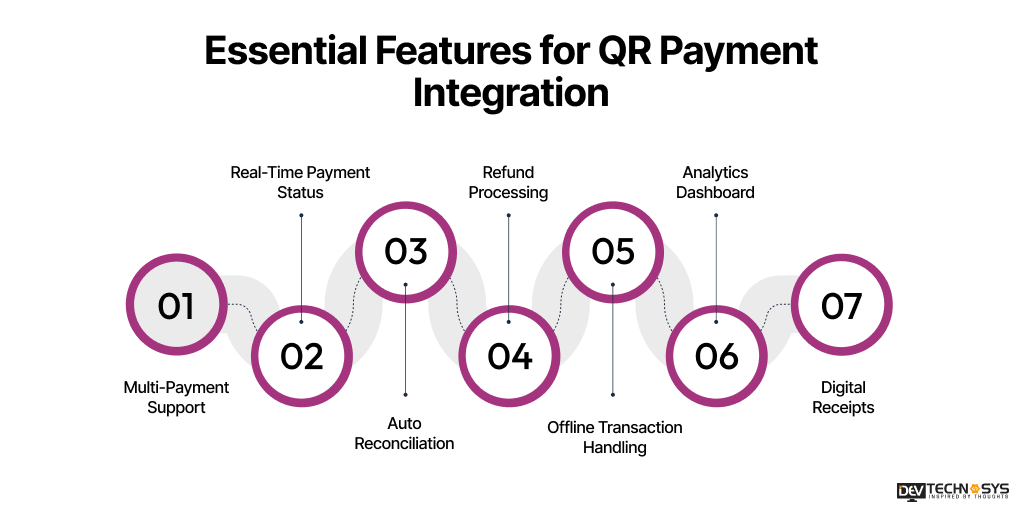
QR Payment Integration is a helpful solution for modern consumer queries. It simplifies transactions, making them more secure. For a mPOS QR payment system integration, businesses often hire software developers to include multiple foundational features to improve merchant operations and enhance customer experience.
-
Multi-Payment Support
A single dynamic QR code can be scanned at any merchant to pay instantly. This has facilitated customers and merchants to send and receive payments conveniently.
-
Real-Time Payment Status
Users (customers and merchants) can easily check the instant payment notifications. This has reduced the effort to manually verify transactions. Large organizations can use Payment status APIs and webhooks to get the real-time data.
-
Auto Reconciliation
This is helpful for the accounts team to manage transaction records from teh banking partners. They can extract the payment history from the app rather than checking the individual bank accounts.
-
Refund Processing
A seamless reverse pipeline is a must, as most customers request refunds. QR payments offer instant settlement networks that instantly refund the amount after deducting significant fees.
-
Offline Transaction Handling
Digital Payment Gateway Integration allows merchants to receive transactions even in offline mode. Transactions often fail due to network or unstable internet issues that can be easily solved with this feature.
-
Analytics Dashboard
An integrated analytics dashboard in the mPOS apps helps merchants to check success in real-time. They can evaluate transaction success rate, can check revenue reports, and manage refund requests. A reliable software development company can build such a dashboard to provide actionable insights.
-
Digital Receipts
Customers and merchants can now avoid keeping track of old receipts. Digital receipts are saved in their email, SMS, or in the app itself. This feature reduces paperwork and centralizes data to improve operational efficiency.
Best Security Practices for QR Payments in mPOS Apps
Due to the frequent adoption of the mPOS (Mobile Point of Sale) System and QR payments, security is a major concern for the merchants and customers. Implementing best practices ensures that the payment network is secured from vulnerabilities.
1. Token-Based Authentication
This security best practice helps to create temporary, unique access tokens for each transaction. This approach minimizes theft risk and protects sensitive financial information.
2. End-to-End Encryption
Data remains encrypted from the moment a user scans the QR code and until payment reaches the merchant. This security practice is specifically for developers to integrate QR payments in mPOS apps.
3. Secure API Communication
For all APIs, secure communication protocols (HTTPS) and encryption techniques should be used (SSL/TLS). Strong API & backend terms ensure that the data is securely exchanged between users, merchants, and respective banks.
4. Fraud Detection Mechanisms
AI-driven monitoring tools should be implemented to detect fraud in real-time. Early detection helps businesses to manage financial losses and to respond quickly to threats.
5. QR Expiry Management
Businesses should always integrate dynamic QR codes that have an expiration time. This management helps to ignore unauthorized payments. Static QR codes, on the other hand, have a high risk of fraud.

6. JSON-Based Payment Payload
This security practice verifies merchant identities, customer details, and payment amounts. This is an additional layer for secure payment authentication to protect financial data.
7. Secure Webhooks
Webhook Payment Confirmation allows businesses to receive an instant update regarding a payment. This includes successful, declined, refunded, pending, or failed transactions. But the webhook requests have to be secured using digital signatures or encrypted communication channels.
8. PCI DSS Compliance
The Payment Card Industry Data Security Standard is designed to protect the data of the cardholder. Developers can implement encryption techniques and secure modules to meet this standard.
Industry Insight:
According to Pew, about 30% of consumers avoid digital payments due to fraud risk. This highlights the importance of QR code payment integration in mPOS apps to ensure transaction security.
Case Study: Point of Sale (POS) System
At Dev Technosys, we developed a cloud-based POS system for retail businesses to simplify operations. Our experts had designed a centralized dashboard to help merchants track inventory, sales, and transactions. The client specified the need for scalability; thus, this aspect was prioritized. This POS system enabled businesses to monitor business performance while receiving digital payments.
Challenges Faced: Primary difficulty was ensuring security, and another was managing performance even during peak business hours. Both of these challenges were solved with the careful analysis of requirements.
Project Highlights
Project Name: POS System
About Client: Michael
Industry: Retail & Point of Sale Management
Client Location: United States
Development Timeline: 24 Weeks
Team Size: 10 Developers
Platform Type: Cloud-Based POS System with Multi-Payment Integration and Retail Management– Pramod Jangid (CTO)
Common QR Payment Integration Challenges and Solutions
Though mobile POS QR payment integration is beneficial, there are several technical challenges that businesses should be aware of. Payment failures, fraud risks, and complex regulatory compliance are some of these.
Challenge – 1: Delayed Payment Confirmation
Solution: Integration of Webhook Payment Confirmation, Payment Gateway APIs, and secure payment authentication ensures both consumers and merchants for accurate account processing.
Challenge – 2: Complex Regulatory Compliance
Solution: If organizations partner with a reliable software development company whose experts can maintain PCI DSS Compliance and meet other policies, then this issue can be resolved.
Challenge – 3: Compatibility with Existing POS Systems
Solution: Development of API-based integrations that connect QRpayments with the existing system is essential to resolve critical challenges associated with the old systems.
Challenge – 4: Refund Management
Solution: Customers request a refund due to incorrect orders, delays, duplicate transactions, or when they no longer require a product. Refund workflows have to be implemented within mPOS apps so that merchants can track refund status, check for approvals, and keep a record of transaction histories.
Challenge – 5: Fraud and Other Security Risks
Solution: Fake QR codes can be replaced with the real ones, leading to fraudulent activities. Developers should plan and implement encrypted payment channels and secure API communication protocols to maintain security.
Conclusion
Traditional POS systems are fixed hardware systems. mPOS, on the other hand, is a quick and easy solution for merchants. It can be implemented by organizations of any size to process payments easily.
The mPOS QR payment system integration allows merchants to build a reliable payment ecosystem. Modern businesses are adopting this technology to safeguard their payment systems and manage transactions efficiently. Enterprises can either hire dedicated developers or partner with a software development company to complete the successful integration.
Frequently Asked Questions
Find answers to the most common questions related to this article.
QR payment integration in mPOS apps usually takes up to 12 weeks. It can be more or less, depending on the app complexity and the type of QR payment required by the merchant.
With status OR payments, users have to scan the code, enter the amount, and their security PIN to complete the transaction. Whereas in dynamic QR payments, unique codes are generated for each transaction, providing better accuracy.
When QR payments are integrated, multiple security mechanisms are implemented. These include tokenization, encryption, API authentication, and other security features. This helps businesses to detect fraud. QR payments are secure and are the future of businesses that are directly dealing with customers. They can reduce transaction errors.
Modern payment gateways support APIs and SDKs. This has to be selected according to the business model and the target market. If multiple transactions are processed in a day, the mPOS app should support refunds, maintain security standards, and support settlement cycles.
Yes, existing mPOS applications can be upgraded through payment gateway APIs and QR code integration. Developers can improve functionality by adding dynamic QR codes and a payment verification process. Modern users require security, so payment APIs must be added.