












The digital age is continuously changing, leading to greater demands on corporations to create and implement superior ways for employees to learn about everything associated with their jobs, as well as how to properly manage and maintain all of the information contained in their company’s database.
SaaS has a significant impact on this trend and will also continue to play a vital role in helping companies develop as a learning organization and manage information sharing throughout the enterprise with their e-Learning solutions.
The role of SaaS in corporate e-learning will allow companies to develop a unique online delivery method for employee education, without requiring the installation of large files and complex installation processes on each company’s server.
In addition, the availability of SaaS will provide businesses with a method for simplifying the process of building, managing, and delivering content across numerous virtual private networks (VPNs).
The Evolution of Corporate E-Learning and Knowledge Management
In this phase, we will talk about the evolution of corporate e-learning and knowledge management and how it will be transformed in a digital way. Let’s explore the following points that help businesses to understand the evolution of corporate e-learning:
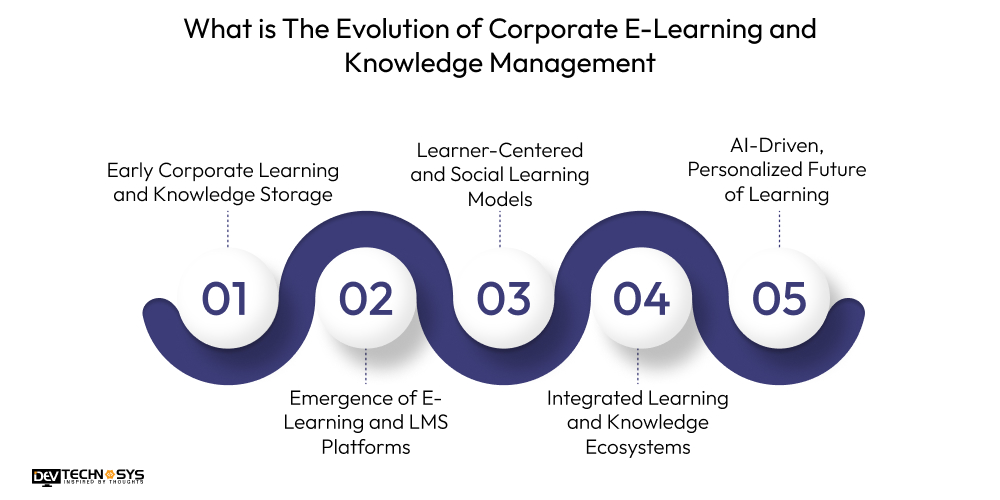
1. Early Corporate Learning and Knowledge Storage
The corporate learning mainly depends on the printed manuals, classroom instruction, offline classes, and many more that are related to physical learning.
Knowledge management basically focuses on the explicit storage in archives and files. The learning was costly, difficult to scale, gained limited knowledge, and depended on individual experience.
2. Emergence of E-Learning and LMS Platforms
The corporate learning welcomes education app development solutions and Learning Management Systems(LMS), and enables organizations to digitize employee training, track learners’ performance, and standardize content.
This phase of learning emphasized scalability, efficiency, and compliance. Knowledge management is improved through databases and intranets and does not depend on limited knowledge.
3. Learner-Centered and Social Learning Models
As work environments evolved, learning shifted toward flexibility and learner autonomy. Microlearning, multimedia content, and collaborative tools supported continuous development.
Knowledge management embraced social learning, communities of practice, and peer knowledge exchange, recognizing that learning occurs through interaction, experience, and shared problem-solving.
4. Integrated Learning and Knowledge Ecosystems
Organizations began integrating kids learning app development solutions with knowledge management systems into unified ecosystems. Learning became embedded in workflows through just-in-time resources and curated platforms.
User-generated content, analytics, and performance alignment transformed learning into a strategic process that directly supported productivity, innovation, and organizational goals.
5. AI-Driven, Personalized Future of Learning
Artificial intelligence and data analytics now enable personalized learning paths, intelligent content recommendations, and real-time knowledge capture. Corporate learning focuses on continuous upskilling and adaptability.
Future systems will integrate immersive technologies and cultivate strong learning cultures, ensuring organizations remain competitive in rapidly changing environments.
What is the Role of SaaS in Corporate E-Learning and Knowledge Management?
The role of SaaS in education app development and knowledge management can divide into various functionalities and services. Software as a Service(SaaS) transforms corporate e-learning and knowledge management into a digitized form and uses high-tech services. So, let’s take a look at the various types of role of SaaS in corporate e-learning:
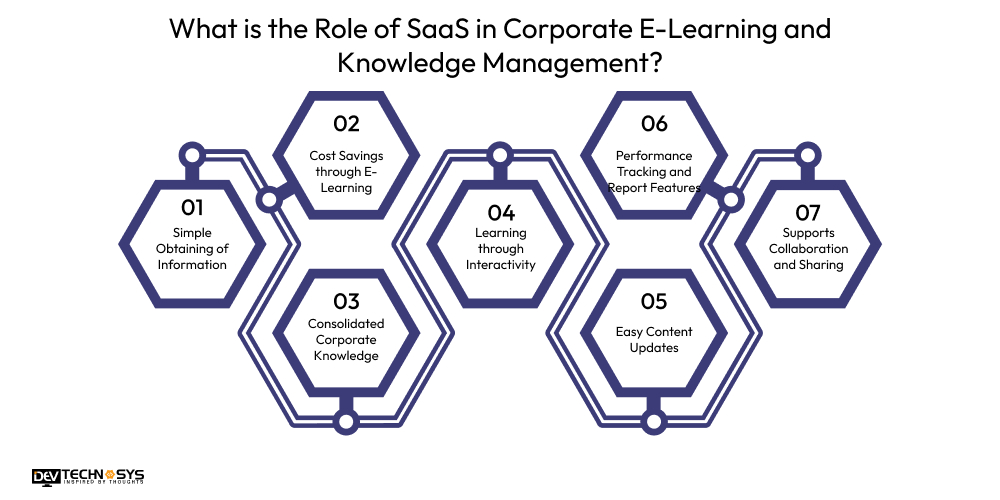
1. Simple Obtaining of Information
Access to educational content is provided by using an online system called Software as a Service (SaaS) through which users can learn whenever they wish, wherever they want.
Users do not need to download any software onto their computers; rather, they can quickly retrieve information related to their profession or job functions from any location in a matter of minutes. This convenience of learning through the internet allows for much greater flexibility for both employees and the employer.
2. Cost Savings through E-Learning
Education-on-demand app development solutions save money on training costs by leveraging SaaS. There is no upfront capital expenditure for purchasing expensive computer hardware and software to utilise for training purposes. Instead, businesses pay only for the amount of learning content and training resources that they use.
Therefore, SaaS has the ability to make E-Learning affordable for all employers regardless of size, while at the same time providing quality resources and tools for employee skill enhancement.
3. Consolidated Corporate Knowledge
A SaaS provider’s platform allows businesses to centralise all training content and organisational knowledge into one area. Employees can quickly search for training documents, various training videos, and/or specific company correspondence with a few clicks of their mouse.
The role of SaaS in corporate e-learning prevents the loss of training materials, ensures that employees have access to the latest knowledge across all departments, and enhances work efficiency.
4. Learning through Interactivity
E-learning MVP app development solutions delivered via SaaS utilize video clips, quizzes, games, and live interactive sessions to create a more fun and enjoyable learning experience.
Interactive content provides users with the opportunity to understand topics more easily than traditional forms of training because of the way the material has been presented. Furthermore, the opportunity for learners to engage actively in the training courses increases their ability.
5. Easy Content Updates
Content Updating has never been easier with the use of the SaaS model. As the company updates content, all users will receive the update simultaneously.
The role of SaaS in corporate e-learning and knowledge management allows employees to always have access to the most up-to-date information, which is crucial in an ever-evolving world of rules, technology, and skills.
6. Performance Tracking and Report Features
Employers can monitor how far along their employees are in terms of course completion, quiz scores, and skill development with the help of the built-in reports within the education hybrid app development solutions.
The role of SaaS in corporate e-learning and knowledge management will aid employers in determining what kind of training is required and allow for the improvement of future training programs to provide enhanced employee performance and productivity levels.
7. Supports Collaboration and Sharing
Collaboration and sharing come naturally with the use of SaaS applications. Collaborating through SaaS applications allows employees to communicate ideas and discuss issues while working on projects collaboratively, enabling knowledge exchange among the workforce.
The role of SaaS in corporate e-learning provides the organization with a healthy environment for training and encouraging growth through cooperation.
Want a chatbot demo or pricing? Fill the form and talk to our experts today.
Pick what you need below — you can select more than one — then tap Get detail to continue.
-
Chatbot demo dashboard
-
Cost to develop an app
-
Industry report
-
Case study
10 Key Features of SaaS-Powered Corporate E-Learning Platforms
There are various types of key features that must be integrated into SaaS-powered corporate e-learning platforms and knowledge management. So, let’s take a look at the core and advanced education app development features:
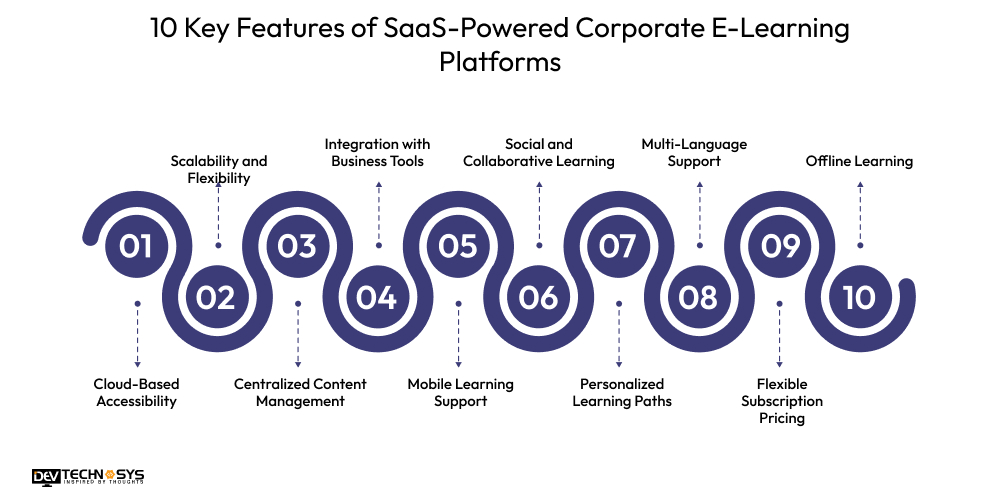
1. Cloud-Based Accessibility
The learners can access the training from anywhere and anytime through cloud-based platforms, which can reduce the geographical barriers and on-premise infrastructure.
2. Scalability and Flexibility
The SaaS-based corporate e-learning platforms can easily handle a high number of learners, courses, study materials, and modules, and allow organizations to expand their training programs.
3. Centralized Content Management
The SaaS corporate LMS software stores all learning material centrally, learners can easily access accurate and up-to-date information, and the data is distributed simply.
4. Integration with Business Tools
The enterprise knowledge management tools can easily integrate with many business tools, such as HR, CRM, and other collaboration platforms, and they can streamline the workflow and align learning with business processes.
5. Mobile Learning Support
The SaaS employee training platforms have responsive designs that enable learners to access the training via smartphones and tablets, which can increase the flexibility and promote microlearning.
6. Social and Collaborative Learning
The digital knowledge management SaaS offers social functionalities such as discussion forms, communities, peer reviews, and more, and it encourages knowledge sharing and teamwork.
7. Personalized Learning Paths
The AI in education app development solutions allow learners to follow the customized learning paths based on their roles, skills, preferences, and performance. This can increase user engagement.
8. Multi-Language Support
SaaS document management systems support multiple languages, increasing global accessibility and enabling easy access to content in their preferred language.
9. Flexible Subscription Pricing
The cloud-based corporate learning solutions provide subscription plans or pay-as-you-go to reduce the upfront investment and make these platforms cost-effective and accessible for all types of businesses.
10. Offline Learning
The corporate e-learning SaaS platforms enable learners to download the learning content and complete the classes in offline mode. It can sync progressively when it reconnects and reduce the interruption in low-internet connectivity areas.

Emerging Enterprise Education App Development Tools & Technologies in 2026
To enhance the educational learning experience, there are various types of tools and technologies that exist that help to make the learning experience richer and flexible. Here, we provide the education app development technologies 2026 that can enhance the learning experience:
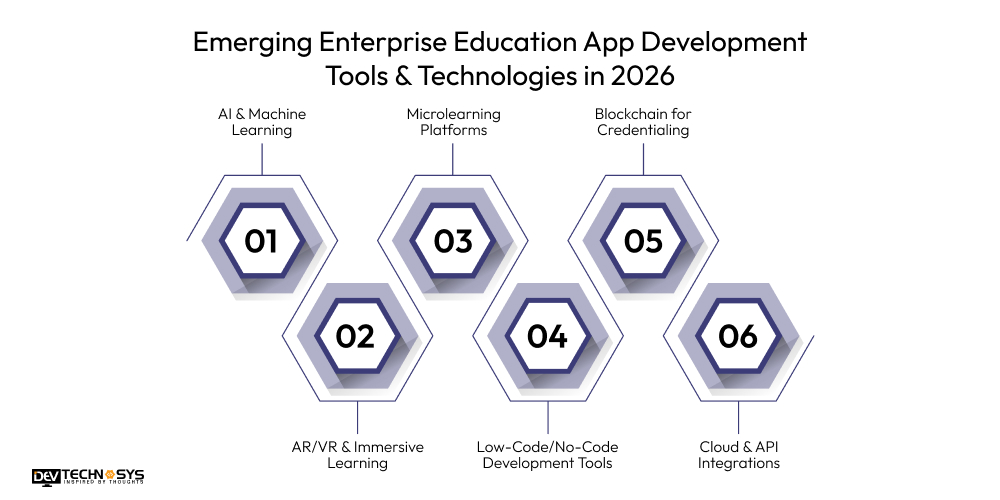
1. AI & Machine Learning
Artificial intelligence and machine learning are transforming the learning paths into a futuristic way by providing personalized recommendations, predictive analysis, and more.
With the help of an AI development company, they can assess the learners’ skills gap, daily learning performance, improve engagement, and suggest relevant courses. Artificial intelligence can automate administrative tasks such as grading, reporting, and many more, to reduce manual or human errors.
2. AR/VR & Immersive Learning
The Augmented Reality(AR) and Virtual Reality offer an immersive learning experience by providing real-world scenarios and showing practical skills. The AR/VR technologies enable interactive employee training for complex and simple tasks, such as soft skills and equipment training.
AR/VR fosters engagement and experiential learning, bridging the gap between theory and hands-on application within enterprise education platforms.
3. Microlearning Platforms
Microlearning platforms can transform e-learning ecosystems by providing short learning materials and highly focused learning modules. Employees can access bite-sized lessons anytime, anywhere, fostering continuous learning without disrupting workflow.
These platforms often include gamification, quizzes, and analytics to track progress and improve engagement. In 2026, microlearning is increasingly integrated with AI-driven personalization, and a custom software development company plays a key role in building adaptive, scalable solutions that ensure training content is relevant.
4. Low-Code/No-Code Development Tools
Low-code and no-code development tools empower enterprises to rapidly create and deploy educational applications with minimal coding expertise. They reduce development time, lower costs, and allow non-technical staff to contribute to app creation.
In 2026, these tools support drag-and-drop interfaces, prebuilt templates, and AI-assisted workflows, making it easier for organizations to customize learning experiences, integrate with existing systems, and scale training initiatives efficiently.
5. Blockchain for Credentialing
Blockchain technology is revolutionizing credentialing by providing secure, verifiable, and tamper-proof records of skills, certifications, and training achievements. Enterprises can issue digital credentials that are easily shared, validated, and stored on decentralized networks.
In 2026, blockchain ensures trust and transparency in professional learning, reduces fraud, and enables seamless recognition of micro-credentials, and a tutor app development company can leverage this technology to build reliable learning platforms.
6. Cloud & API Integrations
Cloud computing and API integrations allow enterprise education apps to connect seamlessly with other software, platforms, and data systems. They provide scalable storage, real-time collaboration, and centralized management of learning content.
In 2026, these technologies enable interoperability, personalized learning experiences, and analytics-driven insights. Enterprises can quickly integrate LMS, HR systems, and third-party tools, ensuring a smooth, efficient, and connected learning ecosystem.
You can reach out anytime; we are available 24/7. Our team provides a quick response.

Top Enterprise Education Apps and Platforms in 2026
Let’s explore a wide variety of enterprise education apps and platforms that make it easy for businesses or organizations to provide virtual training programs with unique functionalities. So, here we provide the various types of enterprise education apps and platforms in 2026:
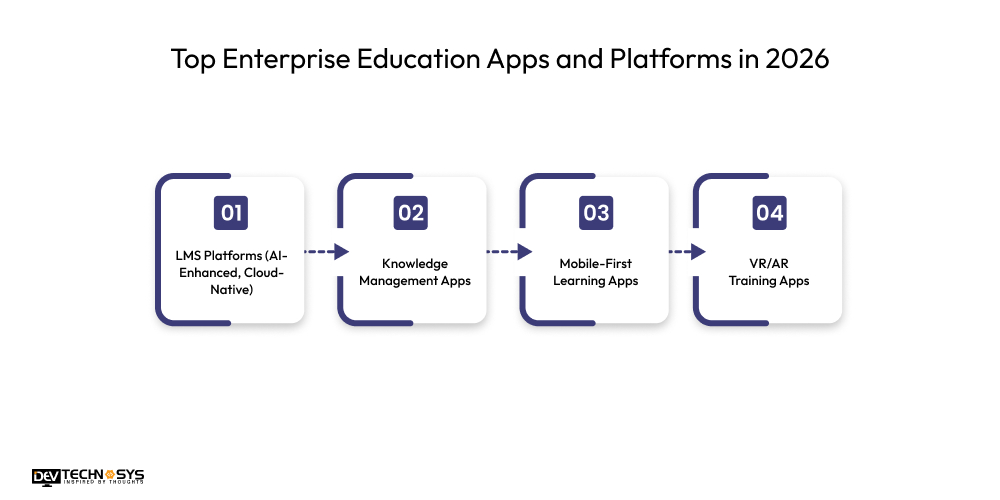
1. LMS Platforms (AI-Enhanced, Cloud-Native)
The Learning Management System(LMS) platforms integrate AI to provide advanced features such as personalized recommendations, predictive analysis, adaptive learning paths, and generative coaching.
These are also cloud-native platforms that allow users or employees to access the learning exercise from anywhere at any time with a stable internet connection. Integrate various business tools such as HRIS, CRM, and productivity suites to enable continuous and personalized learning at a global scale.
Example: Docebo, Cornerstone, SAP SuccessFactors, and Canvas.
2. Knowledge Management Apps
The knowledge management apps centralize and organize the enterprise’s knowledge, make it easy for content sharing, and promote easy access. It also includes artificial intelligence that helps employees or users to find curated or relevant data that employees can apply in real-time.
According to the mobile app development company, these applications foster collaboration and make informed decisions in real-time, and ensure that trusted or valuable expertise is not lost by an organization.
Example: Notion Enterprise, Confluence, Guru, Bloomfire, and SharePoint Syntex.
3. Mobile-First Learning Apps
The mobile-first learning apps are mainly for on-the-go learning, enabling employees to learn from anywhere and anytime. It enables employees to access the learning material from their mobile devices with a responsive interface, bite-sized content, and microlearning.
These mobile-first learning apps provide flexibility and convenience and cater to the modern workforce demand. It mainly enhances the learning experience and increases productivity and skills.
Example: Degreed, EdCast by Cornerstone, Coursera for Business, Udemy Business, and Axonify.
4. VR/AR Training Apps
Virtual and Augmented Reality training apps provide immersive learning experiences by simulating real-world scenarios for hands-on practice. These technologies are especially effective for complex, high-risk industries like healthcare or manufacturing, where safe and repeatable training in a virtual environment can lead to better performance and lower operational risks.
As an advancement in AR wearables and lightweight headsets enables scalable deployment and stronger ROI, a chatbot development company can further enhance these platforms by integrating intelligent virtual assistants.
Example: Strivr, Pixo VR, Talespin, Uptale, and Microsoft Dynamics Guides.
Best Practices for Implementing SaaS and Education Apps in Enterprises
Before starting to implement SaaS and education apps in enterprises, you must observe some of the best practices that help to implement them successfully. Begin by conducting an assessment to stay updated with emerging technologies. So, understand the implementation process step-by-step:
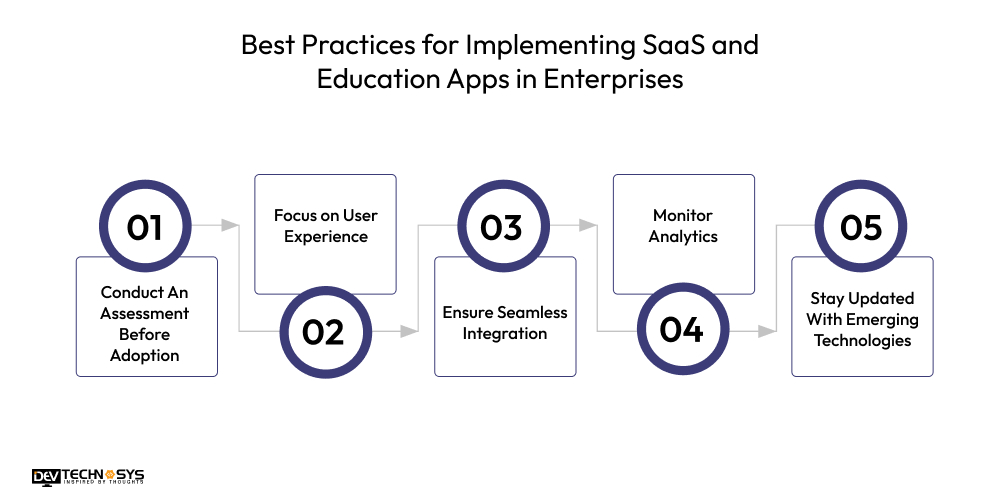
1. Conduct An Assessment Before Adoption
To successfully implement SaaS and educational apps into their operations, organisations must spend some time assessing their needs first. Hire a school management software development company to define business requirements and customer/user requirements, and evaluate whether they have the technical skills and resources needed to use SaaS or educational applications.
Careful evaluation of business needs not only provides guidance regarding which particular application is best suited to meet a business’s overall purpose or mission.
2. Focus on User Experience
User experience is critical for successful adoption, as users find it easier to use a product if it has an intuitive interface and accessibility features. Effective navigation, easy-to-understand instructional content, and modern, engaging design allow users to feel comfortable while they are using the application.
As a result, users are more likely to complete the required training and engage in learning activities when they find value in using the operational capabilities of the application.
3. Ensure Seamless Integration
As part of the process to build an education app from Scratch, organisations should evaluate how well SaaS products integrate on a technical level with the organisation’s existing IT systems. Effective integration enables seamless data transfer between SaaS products and other sets of organisational systems, which minimises unnecessary manual work.
4. Monitor Analytics
The monitoring of analytics related to learning applications enables a business to assess how effectively employees are utilising the application. Data, such as course completion rates, test scores, and user participation, provide organisations with important insights into training effectiveness. Using this information enables organisations to identify areas where employees may need further training.
5. Stay Updated With Emerging Technologies
Technology changes quickly, so enterprises must stay updated with new trends. Emerging technologies like artificial intelligence, mobile learning, and cloud advancements can improve SaaS-based education apps. Staying updated helps organizations enhance learning experiences, remain competitive, and provide employees with modern and effective training tools.
Conclusion
The role of SaaS in corporate e-learning and knowledge management provides scalable, flexible, and cloud-based solutions that enable continuous learning, collaboration, and efficient knowledge sharing. Organizations can deliver personalized learning experiences, track performance, and integrate seamlessly with existing systems, all without heavy IT overhead.
By partnering with a reliable SaaS development company, businesses can design tailored platforms that meet evolving workforce needs, enhance productivity, and foster a culture of innovation. SaaS empowers companies to transform training into a strategic, data-driven process that drives growth and competitive advantage.
Frequently Asked Questions
Find answers to the most common questions related to this article.
The Software as a Service(SaaS) provides the learning and knowledge management platform via cloud services. Users can access the various types of platforms or services, such as LMS, content library, analytics, and collaboration tools, with a stable internet connection.
The companies use SaaS-based learning platforms for faster deployment, scalability, lower upfront cost, continuous innovation, and quick accessibility. The SaaS enables remote and hybrid accessibility, integrates with HR and productivity systems, supports global teams, and ensures automatic upgrades.
Yes, most SaaS platforms offer APIs and built-in integration functionality with various enterprise systems such as ERP, CRM, HRIS, collaboration tools, and identity management. This integration provides seamless performance alignment, user provisioning, skill tracking, and more. These can enhance the learning experience and reduce administrative overhead.
SaaS platforms are accessible anytime, anywhere, on any device with internet access. Cloud delivery supports remote, hybrid, and frontline workers equally. Features like mobile access, offline learning, virtual classrooms, and collaboration tools ensure continuous learning regardless of location or work model.
Industries with distributed workforces and rapid change, such as IT, healthcare, manufacturing, retail, finance, and consulting, benefit greatly. SaaS supports continuous upskilling, compliance, and knowledge sharing at scale, making it suitable for both highly regulated and fast-moving sectors.