















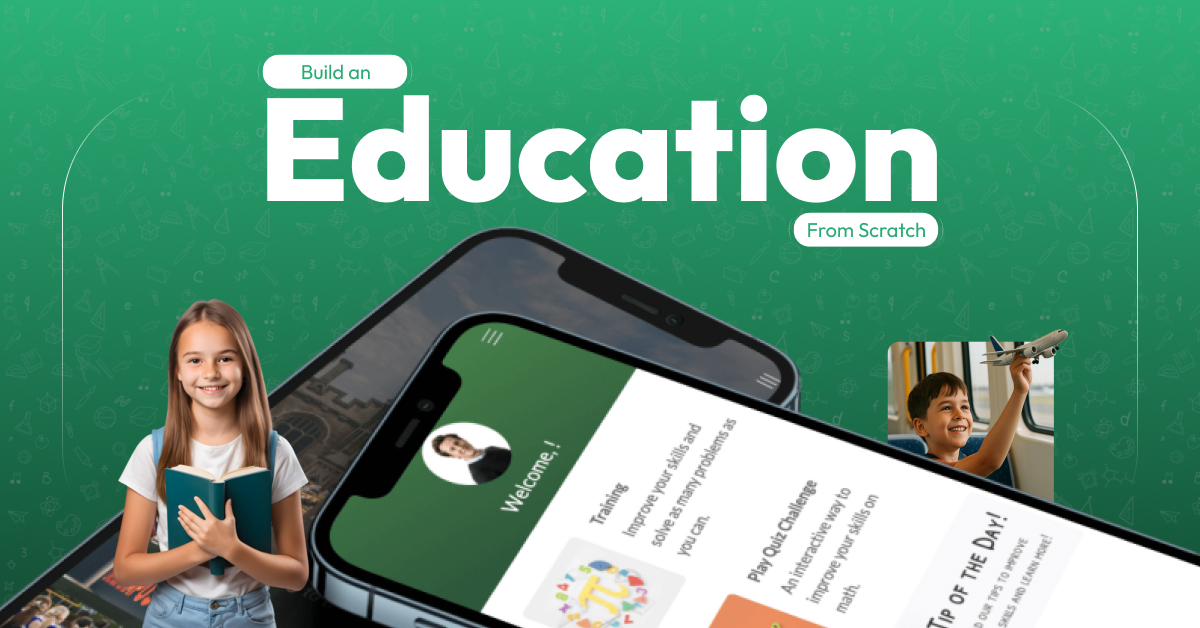
Developing an education app in 2026 may seem a bit intimidating, but it is doable. Students no longer rely solely on books, but learn from smart classrooms, tablets, and phones. With an education app, students are able to study in a variety of ways, anytime, and anywhere.
Learning apps are revolutionizing the study process by offering videos, quizzes, AI tutors, and even live classes.
In this guide, I will help you learn how to build an education app from scratch in simple steps. You will learn how to plan your app, select the right features, design the app, and make sure it is secure for students.
You do not need to be a coding wizard to understand this process. If you have a passion for education and technology, this guide will assist you to build an education app from Scratch that will help students learn in 2026.
What is an Education App?
An education app is an online platform where students or users can access study materials and join live classes. It provides various features such as recorded classes, online classes, lessons, interactive exercises, quizzes, and more.
Education apps are available on various devices such as tablets, smartphones, computers, and more. These education apps like Coursera are mainly used by students, teachers, and self-learners to study online from anywhere or anytime. Users can track their progress and improve learning outcomes.
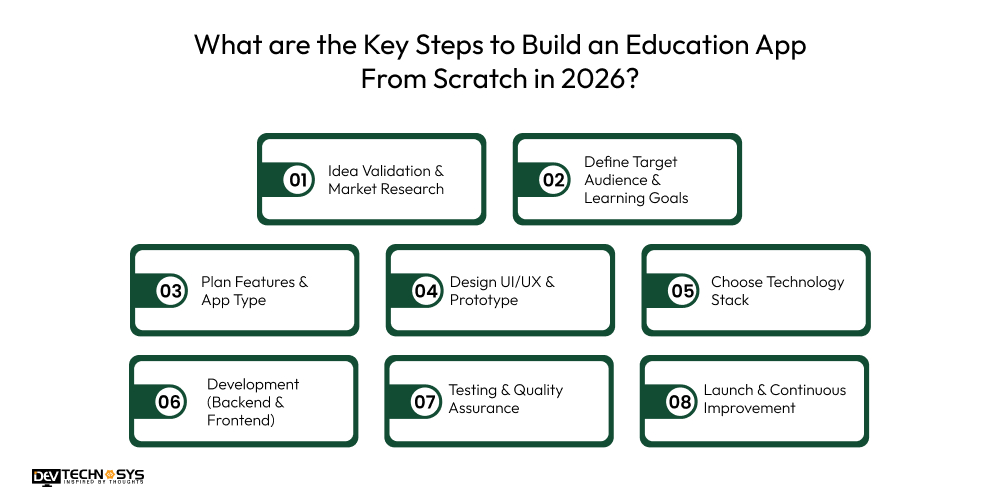
What are the Key Steps to Build an Education App From Scratch in 2026?
To create an education app from scratch in 2026 requires careful planning and following the various development steps that help businesses to understand each process.
From market research and gathering project requirements to testing and post-maintenance services. So, let’s explore the step-by-step education app development process:
1. Idea Validation & Market Research
In the first stage to develop an education app, research in this digital market about your project idea, latest trends, check competitors’ existing applications, observe what users actually want, and more.
If your project idea is validated based on market demands, then figure out what features must be integrated and what services you must offer. The step-by-step validation can reduce the risk and make sure that your app solves real-time issues and increases the chances of gaining higher success rates.
2. Define Target Audience & Learning Goals
Move to the second step to create a mobile app for education, identify the audience who are using these education apps, such as students, teachers, and self-learners. You will also need to understand their age, preferences, and learning habits.
After that, you need to set the learning objectives, such as exam preparation, professional certifications, language skills, and more. Define the audience’s clear requirements and demands, and make sure that the app delivers relevant content.
3. Plan Features & App Type
Let’s come to the third stage of the education app development cost roadmap 2026. Before starting to design an app, you must be clear about what type of education you want to build.
There are various types of education apps available, such as e-learning apps, exam prep apps, skill development apps, and language learning applications.
Create a clear outline of features that you must integrate. It includes various features such as live classes, progress tracking, quizzes, video lessons, notifications, offline access, and more.

4. Design UI/UX & Prototype
In this fourth stage of school management software development, hire professional designers who have the ability to design a unique and attractive user interface.
There are various types of UI elements that exist, such as layouts, templates, built-in plugins, fonts, styles, colors, textures, buttons, navigation bars, themes, and more.
You can also observe the existing app’s user interface, and you can get an idea of what type of design you must implement in your education app. Developers use various paid designing tools such as Sketch, Figma, Farmer, Zeplin, Adobe XD, Marvel, and more.
5. Choose Technology Stack
Move to the fifth step to make an education app. Choosing the right tech stacks is very important to develop a successful education application with customized features. It includes various types of tech stacks such as cloud storage, database, frontend and backend frameworks, testing, designing, and many more.
Layer |
Technology Stack |
| Frontend (Mobile) | Flutter, React Native |
| Frontend (Web) | React.js, Angular |
| Backend | Node.js, Python, Java |
| Database | PostgreSQL, MySQL, MongoDB |
| Cloud Hosting | AWS, Google Cloud, Azure |
| Video Streaming | WebRTC, AWS IVS |
| Analytics | Google Analytics, Firebase Analytics |
| Security | SSL/TLS, AES Encryption |
6. Development (Backend & Frontend)
Let’s enter the sixth stage of kids learning app development, hire full-stack developers to begin the real coding, and integrate the third-party tools and applications. It includes various backend processes such as creating APIs, managing server-side, database, authentication, data management, and security.
Developers integrate many third-party tools such as payment gateways, social media logins, ERP, CRM, analytics, reporting, and more. We also interlink the frontend and backend to streamline workflow and operations.
7. Testing & Quality Assurance
In the second last stage of education mobile app development, before publishing it in the live phase. Developers conduct the testing techniques to test the app under various conditions.
It involves different types of testing, such as unit, functional, integration, security, black-box testing, white-box testing, and user acceptance testing. If errors and bugs are found during testing, then solve them immediately. You will need to make sure that all the services and functionalities are working perfectly and running smoothly.
8. Launch & Continuous Improvement
Move to the final stage to build an education app from scratch, and launch the education app on the selected platform, such as Android, iOS, and web. Make sure that all phases are successfully deployed.
Hire an on-demand app development company to conduct the post-launch maintenance and support services, such as fixing bugs or glitches, performance optimization, regular backups, upgrading to the latest OS versions, applying security patches, adding design enhancements, and more. Handle the users’ raised queries and concerns, fix them as soon as possible to increase overall performance.
Want a chatbot demo or pricing? Fill the form and talk to our experts today.
Pick what you need below — you can select more than one — then tap Get detail to continue.
-
Chatbot demo dashboard
-
Cost to develop an app
-
Industry report
-
Case study
What Features Must Be Integrated in Education Applications?
Let’s explore the various types of features that must be integrated into education applications. Divide features into three main panels, such as the student panel, teacher panel, and admin panel. These education app development features help businesses to understand every feature and easily integrate them into their own education app:
Student Panel Features |
Teacher Panel Features |
Admin Panel Features |
| User Registration & Login | Teacher Registration | Admin Dashboard |
| Course Browsing & Enrollment | Course Creation & Management | User Management |
| Video Lessons & Tutorials | Upload Videos & Study Material | Course Approval |
| Quizzes & Assessments | Create Quizzes & Exams | Content Management |
| Progress Tracking | Student Performance Tracking | Analytics & Reports |
| Assignments Submission | Assignment Evaluation | Payment & Subscription Control |
| Live Classes & Webinars | Live Class Management | Platform Monitoring |
| Certificates & Badges | Certification Approval | Security & Access Control |
| Notifications & Reminders | Student Communication | Compliance & Data Management |
| Offline Content Access | Schedule Management | App Settings & Configuration |
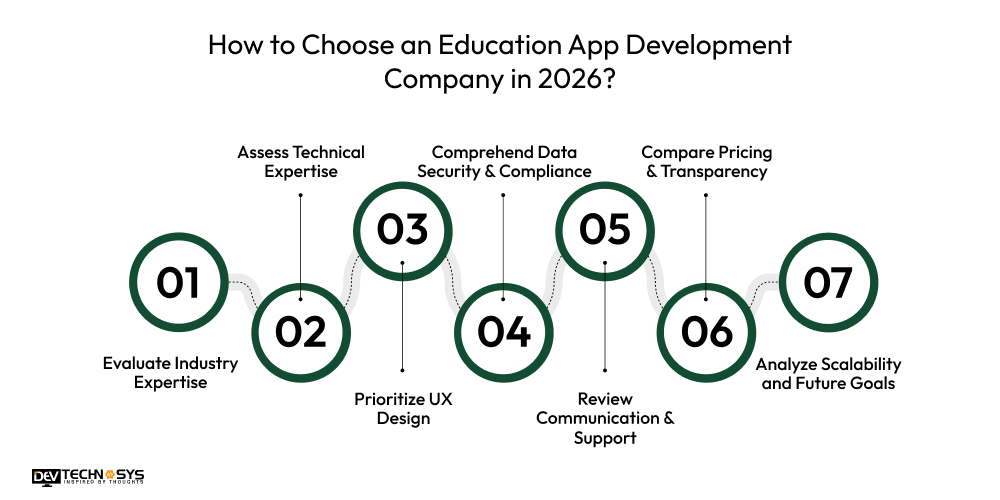
How to Choose an Education App Development Company in 2026?
Choosing the right custom education app development company in 2026 is crucial for success. The ideal partner understands modern learning trends, student needs, and advanced technologies.
They deliver secure, scalable, and user-friendly apps while offering clear communication, transparent pricing, and long-term support to help your education platform grow and stay competitive.
1. Evaluate Industry Expertise
Find a firm knowledgeable in creating education and eLearning applications. They need to know student behavior and teacher workflow, and learning trends like AI, gamification, and personalization.
Look closely at their portfolios, case studies, and client reviews. Genuine experience mitigates risk and increases the quality of the application and the likelihood of meeting educational objectives in today’s competitive market for modern classrooms and digital-first learners globally.
2. Assess Technical Expertise
Evaluate if the tutor app development firm employs current technologies that will be relevant in 2026. They should be able to effortlessly implement AI and work with cloud technologies, cross-platform frameworks, and integrations.
Excellent technical skill means your application will be fast, secure, and scalable. This will enable your application to keep pace with evolving educational needs across all devices and platforms globally. This will ensure that frequent updates and an expanded feature set won’t require rebuilding the application over time.
3. Prioritize UX Design
User experience in education applications is paramount. The edtech app development company should create simple, enticing, and easy-to-use interfaces for all ages.
Effective UI and UX should minimize distractions and post learning lag. Look for teams that go to the extent of ensuring their designs work with real customers so students and teachers can reliably use the application in and outside remote learning environments.
4. Comprehend Data Security & Compliance
Considering that edtech apps like Photomath address students, data safety is of utmost importance. Go for a company that is aware of the privacy laws, child protection, and compliance. The best education app development company in 2026 must provide secure login, encrypted data storage, and parental controls.
If safety is ensured, trust is built. Safety protects students, schools, and you from dangers. Safety also supports your long-term platform credibility and trust with the global education technology market regulators.
5. Review Communication & Support
Communication is key. A MVP app development services process is stress-free and smoother when the development company provides reports, timelines, and explainers. They also need to adjust to your feedback, and hence, responsiveness is essential.
Check if the education app development company for startups provides support, maintenance, and bug fixes to avoid your educational app from underperforming due to users’ needs, platforms’ scalability, and technological changes during the passing academic year and beyond.
6. Compare Pricing & Transparency
Cost is important, but so is transparency. Go for a company that gives you straight pricing, explicit contracts, and timelines. Steer clear of ambiguity. A trustworthy SaaS development company allows you to prioritize goals within the budget, providing quality development within a digitized educational market, and planning innovations and optimizing educational functionalities to ensure the long-term sustainability of the platform.
7. Analyze Scalability and Future Goals
An educational app should be designed to expand to users and technology. Work with a company that considers scalability and plans for future integrations and novel developments in learning. They should build a flexible architecture that can accommodate a growing number of students, expanding content, and additional functionality.
A custom education app development company for enterprises will equip your app to remain pertinent beyond 2026 and help steer your app through innovation, policy reforms, and shifting global educational standards.
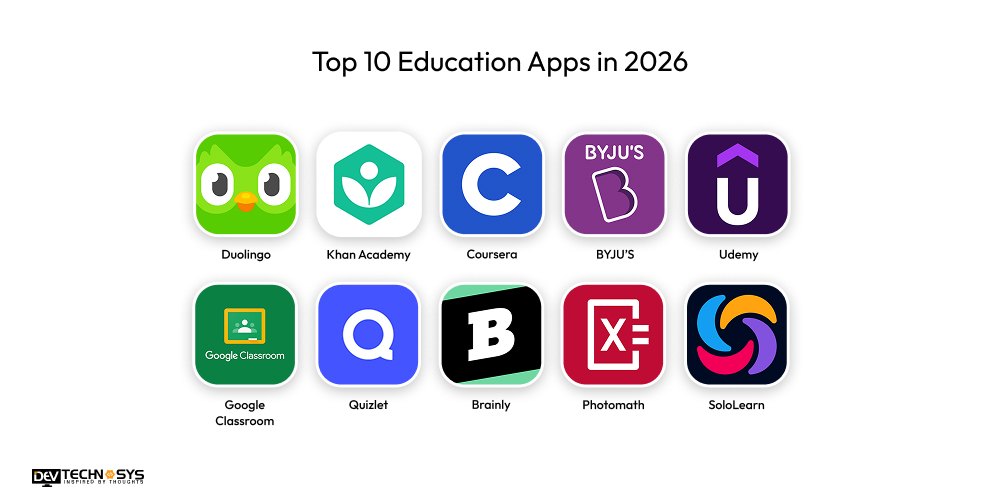
Top 10 Education Apps in 2026
Do you want to explore the best education apps in 2026? Here, we provide the various types of popular education apps like Udemy that have gained huge success rates and popularity. So, observe the education apps table in detail:
App Name |
Estimated Downloads |
Average Rating |
Launch Year |
Platform Availability |
| Duolingo | 500M+ | 4.6 | 2011 | Android, iOS, Web |
| Khan Academy | 150M+ | 4.7 | 2008 | Android, iOS, Web |
| Coursera | 100M+ | 4.3 | 2012 | Android, iOS, Web |
| BYJU’S | 120M+ | 4.2 | 2015 | Android, iOS |
| Udemy | 80M+ | 4.4 | 2010 | Android, iOS, Web |
| Google Classroom | 100M+ | 4.8 | 2014 | Android, iOS, Web |
| Quizlet | 70M+ | 4.5 | 2013 | Android, iOS, Web |
| Brainly | 90M+ | 4.4 | 2009 | Android, iOS, Web |
| Photomath | 60M+ | 4.6 | 2014 | Android, iOS |
| SoloLearn | 40M+ | 4.5 | 2015 | Android, iOS, Web |
How Dev Technosys Will Help to Build an Education App in 2026?
We hope that you got the answers to your raised questions and cleared all doubts regarding how to launch an e-learning app from Scratch in 2026. It involves various online learning app development steps such as idea validation, market research, gathering project requirements, identifying features and functions, tech stacks, designing UI/UX, app development, testing and QA, publishing, and post-launch maintenance services.
Do you want to build an education app from Scratch? Then, just directly connect with Dev Technosys, a mobile app development company that has 15+ years of experience in delivering scalable education applications.
Frequently Asked Questions
Find answers to the most common questions related to this article.
The cost to develop an education app with limited functionality is around $8,000 to $13,000. A fully-featured education app development cost ranges from $15,000 to $25,000, depending on the unique requirements. The cost can fluctuate due to various key factors such as features, project complexity, functions, backend infrastructure, development team, and platform choice.
To create a simple featured education app, it usually takes around 2 to 4 months. Building a mid-complex education app takes around 3 to 6 months, and a fully-complex education app takes around 6+ months. The development timeline is based on various elements like the number of premium features, developers' working hours, high-quality user interface, and project complexity.
There are various challenges that occurred during the education app development guide 2026. Here, we provide the list of points:
Higher development costs
Cross-platform compatibility
Live streaming integration
Performance optimization issues
Evolving education standards
Ongoing maintenance needs
Yes, these education app development companies provide post-launch maintenance and support services such as performance optimization, fixing bugs or glitches, regular updates, solving security problems, upgrading to the latest OS version, and more. These companies charge around 15% to 20% of the overall education app development cost.
There are many different types of tech stacks used to build an education app from Scratch in 2026. So, here we provide the list of technologies:
Java
Python
Ruby
C++
PHP
HTML5
There are various factors that need to be determined before choosing an MVP education app development company. Here is the list of key factors:
Education industry experience
Custom development expertise
Cross-platform capabilities
Content integration expertise
Transparent pricing model
Post-launch maintenance & support