














Quick Summary:
Education app development costs in 2026 typically range from $8,000 to $12,000+, depending on app complexity, features, and platform choice. Basic MVP apps start around $30,000 to $70,000+, mid-level apps range from $70,000 to $1,10,000+, and advanced, enterprise-grade platforms can exceed $1,10,000 to $1,50,000+. Costs are influenced by factors such as interactive features, multimedia content, AI/AR integration, and the development team’s expertise and location.
Cost Breakdown by Development Complexity
-
- Basic/MVP ($30,000 – $70,000+): Includes essential features like user registration, course listing, quizzes, and basic dashboards.
- Medium ($70,000 – $1,10,000+): Adds advanced features such as video streaming, interactive assignments, third-party integrations, custom UI/UX, and notifications.
- Complex ($1,10,000 – $1,50,000+): Incorporates AI-based learning recommendations, AR/VR modules, analytics dashboards, multi-language support, and real-time collaboration tools.
Key Cost Drivers
-
- App Type: Simple learning or tutoring apps cost less, while LMS or multi-user educational platforms are more expensive.
- Platform: Native apps for iOS and Android are costlier than cross-platform solutions like Flutter or React Native.
- Feature Complexity: AI, gamification, AR/VR, and real-time analytics significantly increase development costs.
- Maintenance: Annual maintenance typically adds 15 – 20% of the initial development cost.
- Content & Licensing: Multimedia resources, third-party content, or certifications may also increase overall costs.
Cost Variation by Country
-
- North America: $40 – $90/hr
- Western Europe: $35 – $60/hr
- Eastern Europe: $40 – $70/hr
- India/Southeast Asia: $15 – $25/hr
In 2026-2027, the education landscape is transformed and has established a strong digital hold. According to Imarc Group, the education app market was valued at USD 7.6 billion in 2025. These numbers are expected to reach USD 43.0 billion by 2034, growing at 21.29% during 2026-2034.
This has sparked interest among EdTech startups, schools, and universities in investing in adaptive learning app development. But the major question remains: what would be the cost to develop an education app in 2026-2027?
Usually, the estimated cost to build an educational app ranges from $30,000 to $1,50,000. Factors like complexity, platform choice, UI/UX, testing, backend, and others affect the overall AI education app development cost.
Through this blog, we will explain the clear breakdown of EdTech app development cost 2026-2027. It includes feature-wise and country-wise pricing, hidden expenses, timeline estimates, and so on, helping in efficient education mobile app development budget planning.
What is the Average Cost to Develop an MVP Education App for Your Startup in 2026?
It is difficult to pinpoint the exact education app development cost, as it depends on factors such as features, app complexity, developer expertise, the tech stack used, region, and design customizations.
On average, the cost of online iOS and Android education apps can range from $30,000 to $1,50,000. The basic eLearning app development cost with only essential features will be around $30,000 to $70,000.
Whereas the standard MVP education app development cost, containing more refined UI/UX, a simple admin panel, and initial analytics, may reach $70,000- $1,10,000. Whereas the advanced online learning app created by the best app development company, with a cross-platform build and multi-user roles, can range from $1,10,000 to $1, 50,000.
MVP Type |
Development Timeline |
Estimated Cost (USD) |
| Basic MVP | 6–8 weeks | $30,000 – $70,000 |
| Standard MVP | 8–12 weeks | $70,000 – $1,10,000 |
| Advanced MVP | 12–16 weeks | $1,10,000 – $1,50,000 |
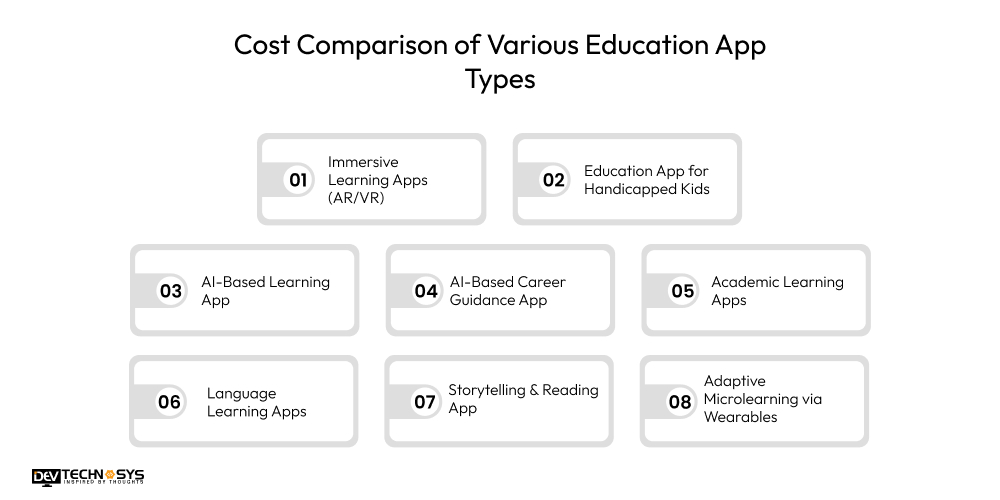
Cost Comparison of Various Education App Types
The cost for e-learning, virtual, or tutor app development services significantly varies depending on the type of education app you are developing. Let’s see how different kinds of apps impact the cost to build an MVP eLearning app in 2026.
1. Immersive Learning Apps (AR/VR)
Immersive learning apps using AR and VR typically cost $30,000 to $1,50,000 and take 4 to 6 months to develop. Costs for immersive learning apps like Duolingo are higher due to the addition of 3D modeling, simulations, device compatibility, and advanced interaction design that deliver realistic, hands-on learning experiences.
Complexity Level |
Development Timeline |
Estimated Cost (USD) |
| Basic AR modules | 4–5 months | $30,000 – $55,000 |
| Mid-level AR/VR experiences | 5–6 months | $55,000 – $95,000 |
| Advanced VR simulations | 6–8 months | $95,000 – $150,000 |
2. Education App for Handicapped Kids
The cost to build an education app for handicapped kids ranges from $30,000 to $1,40,000. The final cross-platform app development includes accessibility-focused UI/UX, voice assistance, screen readers, sign-language support, compliance standards, and usability testing for diverse learning needs. The cost table mentioned below highlights the cost variations based on complexity level.
Complexity Level |
Development Timeline |
Estimated Cost (USD) |
| Basic accessibility features | 3–4 months | $30,000 – $50,000 |
| Enhanced inclusive UI/UX | 4–5 months | $50,000 – $90,000 |
| Advanced assistive tech | 5–6 months | $90,000 – $140,000 |
3. AI-Based Learning App
AI-based learning apps created by a leading MVP app development company usually cost between $35,000 and $1,50,000 and take 3 to 5 months to develop.
Development costs depend on AI algorithms, personalized learning paths, smart assessments, real-time analytics, and continuous model training to adapt content based on learner behavior and performance.
Complexity Level |
Development Timeline |
Estimated Cost (USD) |
| AI-powered quizzes | 3–4 months | $35,000 – $60,000 |
| Personalized AI learning | 4–5 months | $60,000 – $100,000 |
| Predictive AI learning platform | 5–7 months | $100,000 – $150,000 |
4. AI-Based Career Guidance App
An AI-based career guidance app development costs around $30,000 to $1,45,000. Adding AI in education app development, career-mapping algorithms, AI-based assessments, and skill analysis influences the budget. Data integration, dashboards, and personalized suggestions on the basis of user profiles and goals can also contribute to the final cost.
Complexity Level |
Development Timeline |
Estimated Cost (USD) |
| Career quizzes | 3–4 months | $30,000 – $55,000 |
| AI career mapping | 4–5 months | $55,000 – $95,000 |
| Predictive career AI | 5–6 months | $95,000 – $145,000 |
5. Academic Learning Apps
Academic learning app development cost generally ranges from $30,000 to $1,30,000. The time taken to develop an academic learning app can exceed 2 to 3 months.
Also Read: What Is Education App Development?
The cost to create an education app depends on the structure of course modules, quizzes, exams, performance analytics, content management systems, and alignment with school or university curricula.
Complexity Level |
Development Timeline |
Estimated Cost (USD) |
| Basic LMS | 2–3 months | $30,000 – $50,000 |
| Standard academic app | 3–4 months | $50,000 – $85,000 |
| Advanced analytics platform | 4–6 months | $85,000 – $130,000 |
6. Language Learning Apps
Language-learning app development typically costs $30,000 to $1,40,000 and takes 2 to 4 months. The cost to build a language learning app depends on the education app development features, such as gamification, speech recognition, pronunciation analysis, and multilingual content. Adding interactive exercises and progress-tracking options also improves learner engagement.
Complexity Level |
Development Timeline |
Estimated Cost (USD) |
| Vocabulary-based app | 2–3 months | $30,000 – $50,000 |
| Gamified learning app | 3–4 months | $50,000 – $90,000 |
| Speech & AI practice app | 4–6 months | $90,000 – $140,000 |
7. Storytelling & Reading App
Storytelling and reading app development can cost around $30,000 to $120,000. The education app MVP cost in 2026 is influenced by interactive illustrations, audio narration, animations, child-friendly UI design, reading progress tracking, and parental control features.
Complexity Level |
Development Timeline |
Estimated Cost (USD) |
| Static reading app | 2–3 months | $30,000 – $45,000 |
| Interactive stories app | 3–4 months | $45,000 – $80,000 |
| Animated storytelling app | 4–5 months | $80,000 – $120,000 |
8. Adaptive Microlearning via Wearables
Developing an Adaptive microlearning app for wearables usually costs $35,000 to $1,50,000 and takes 3 to 4 months. Development includes adding bite-sized content delivery, wearable notifications, behavior tracking, AI-driven recommendations, device compatibility, and seamless synchronization with mobile platforms.
Complexity Level |
Development Timeline |
Estimated Cost (USD) |
| Wearable notifications | 3–4 months | $35,000 – $60,000 |
| Adaptive microlearning | 4–5 months | $60,000 – $100,000 |
| AI-driven wearable learning | 5–7 months | $100,000 – $150,000 |
Want a chatbot demo or pricing? Fill the form and talk to our experts today.
Pick what you need below — you can select more than one — then tap Get detail to continue.
-
Chatbot demo dashboard
-
Cost to develop an app
-
Industry report
-
Case study
Detailed Feature-Based Cost Analysis for Education App Development
The cost of education app development services heavily relies on its features. From basic LMS tools to an AI-powered learning system, each feature adds to the overall education platform development cost.
Along with the budget, features also impact scalability and performance directly. Here we have explained the cost structure of core and advanced features.
Core Features Cost Structure: $2,500–$8,000
Core Feature |
Estimated Cost |
| User Registration & Login | $300–$800 |
| User Profile Management | $250–$700 |
| Course Listing & Categories | $400–$900 |
| Video Content Integration | $500–$1,200 |
| Search & Filter Functionality | $300–$700 |
| Quizzes & Assessments | $500–$1,000 |
| Push Notifications | $250–$600 |
| Payment Gateway Integration | $400–$1,100 |
| Basic Admin Dashboard | $600–$1,500 |
| Progress Tracking | $300–$900 |
Advanced Features Cost Structure: $4,000–$14,000
Advanced Feature |
Estimated Cost |
| AI Recommendation Engine | $1,000–$3,000 |
| Adaptive Learning Systems | $1,500–$3,500 |
| Live Class Streaming | $800–$2,500 |
| Gamification Features | $700–$2,000 |
| Real-Time Chat & Collaboration | $600–$1,800 |
| Learning Analytics Dashboard | $1,000–$2,500 |
| Multilingual Support | $500–$1,500 |
| AR/VR Learning Modules | $2,000–$5,000 |
| AI Tutor Integration | $1,500–$4,000 |
| Cloud-Based Infrastructure |
$800–$2,500 |
Education App Build Time Explained: Full Development Stages Breakdown
The education app development timeline is mainly determined by the platform’s complexity, integrations, features, and scalability goals. Typically, it takes 3 to 6+ months for an education mobile app development.
A basic MVP app takes 4 months because of simple MVP development. While an advanced education app takes 7+ months due to modern integrations. Here we have explained the entire timeline of the development stages.
Development Stage |
Estimated Timeline |
Key Activities |
| Research & Planning | 2–3 Weeks | Market research, feature planning, competitor analysis, and business goals |
| UI/UX Design | 3–4 Weeks | Wireframes, prototypes, user journey mapping, interface design |
| Frontend Development | 4–6 Weeks | Student panel, teacher dashboard, mobile responsiveness, app interfaces |
| Backend Development | 5–8 Weeks | APIs, database setup, authentication, admin panel, server-side logic |
| Core Feature Integration | 3–5 Weeks | Video lessons, quizzes, payment gateway, notifications, LMS modules |
| Advanced Feature Development | 4–7 Weeks | AI recommendation engine, live streaming, gamification, analytics |
| Testing & Quality Assurance | 2–3 Weeks | Performance testing, security testing, bug fixing, optimization |
| Deployment & Launch | 1 Week | App Store deployment, cloud setup, and final release configuration |
Industry Insight:
We have worked on multiple education app development projects and have found that final development takes 4 to 7+ months.
How Much Does Education App Development Cost in All Regions?
The most common question for a businessman is “What is the cost to build an education app?” To resolve these issues, several education app development companies offer e-learning app development at an affordable cost. You can connect them and discuss your application ideas.
1. Education App Development Cost in USA
The cost of making an e-learning app in the USA depends on different factors such as location, team, project complexity, and many others. Developing education apps in modern USA cities like Washington, D.C., Los Angeles, Chicago, San Diego, and others is becoming more costly compared to local towns. Living expenses, traveling, and many other factors increase the overall application cost. Here are some estimated live class app development cost.
App Complexity |
Estimated Cost (USD) |
| Simple Education Apps | $30,000 – $60,000 |
| Mid-Level Education Apps | $60,000 – $100,000 |
| Complex Education Apps | $100,000 – $150,000 |
2. Education App Development Cost In Germany
The cost of education development in Germany depends on its complexity, location, and modern cities. Creating educational applications in modern German cities, such as Berlin, Hamburg, Frankfurt, Stuttgart, and others, has become more costly than in local towns.
Many kids learning app development company are offering to develop e-learning apps at an affordable cost in Germany. Here are some estimated AI online tutor app development costs.
App Complexity |
Estimated Cost (EUR) |
| Simple E-Learning Apps | €27,500 – €55,000 |
| Mid-Level E-Learning Apps | €55,000 – €92,000 |
| Complex E-Learning Apps | €92,000 – €138,000 |
3. Education App Development Cost in India
India is worldwide famous for providing development services at affordable prices. Make an education app in India profitable for business personnel. However, the cost of the project in modern cities in India, such as Mumbai, Bangalore, and others, is higher than in local towns. Here are some student learning app development cost estimations outlined below:
| App Complexity | Estimated Cost (INR) |
| Simple E-Learning Apps | ₹8,00,000 – ₹15,00,000 |
| Mid-Level E-Learning Apps | ₹15,00,000 – ₹22,00,000 |
| Complex E-Learning Apps | ₹22,00,000 – ₹30,00,000 |
4. Education App Development Cost in New Zealand
If you are planning to develop your project in New Zealand. The cost to build an e-learning app varies across modern towns such as Wellington, Auckland, and Christchurch, and it differs.
The cost in contemporary cities has become high compared to local areas. For school management software development with additional features in New Zealand, you can discuss this with a top education app development company.
App Complexity |
Estimated Cost (NZD) |
| Simple E-Learning Apps | NZD 50,000 – NZD 98,000 |
| Mid-Level E-Learning Apps | NZD 98,000 – NZD 164,000 |
| Complex E-Learning Apps | NZD 164,000 – NZD 246,000 |
5. Education App Development Cost in UK
In the UK, the cost of creating an education app like Gauth depends on its complexity (basic or advanced features), the platforms (iOS, Android, or both), the design (custom or template), and third-party services (payment gateways). An experienced developer and location also affect the cost. Here are some estimated costs that give you an idea of how to develop your project in UK.
App Complexity |
Estimated Cost (GBP) |
| Simple E-Learning Apps | £24,000 – £48,000 |
| Mid-Level E-Learning Apps | £48,000 – £80,000 |
| Complex E-Learning Apps | £80,000 – £120,000 |
6. Mobile Learning App Pricing in Australia
In Australia, the cost of making an educational app depends on how complicated it is (basic or advanced features), and which platform it’s made for (iOS, Android, or both). Whether it’s a custom design or a template, and whether it uses third-party services like payment gateways.
Creating an app in a modern Australian town is more expensive than in a local town. Here are some approximate prices to give you an idea of building your project in Australia.
App Complexity |
Estimated Cost (AUD) |
| Simple E-Learning Apps | AUD 46,000 – AUD 92,000 |
| Mid-Level E-Learning Apps | AUD 92,000 – AUD 153,000 |
| Complex E-Learning Apps | AUD 153,000 – AUD 230,000 |

7. Online Learning Platform Development Cost in France
The cost of education development in France varies depending on its complexity, location, and modern cities. Creating education applications in modern cities like Paris, Strasbourg, Lille, and others has become costly compared to the local towns.
Build your education apps through an on-demand app development company in France at affordable prices with advanced features. Some estimated costs of building education apps are outlined below.
App Complexity |
Estimated Cost (EUR) |
| Simple E-Learning Apps | €27,500 – €55,000 |
| Mid-Level E-Learning Apps | €55,000 – €92,000 |
| Complex E-Learning Apps | €92,000 – €138,000 |
Also read: Best Apps to Learn French
8. Education App Development Cost in Sweden
In Sweden, the cost of making an educational app varies with different factors. The budget is affected by the complexity of the app, including its features and functions. Choosing iOS, Android, or cross-platforms increases and decreases the cost of e-learning apps.
Also, choosing the custom UI/UX design makes the project more costly. It is necessary to keep users interested in the application. Here are some estimated costs of development education applications in Sweden.
App Complexity |
Estimated Cost (SEK) |
| Simple E-Learning Apps | SEK 320,000 – SEK 640,000 |
| Mid-Level E-Learning Apps | SEK 640,000 – SEK 1,070,000 |
| Complex E-Learning Apps | SEK 1,070,000 – SEK 1,600,000 |
9. Education App Development Cost in UAE
If you plan to develop education mobile apps for schools and colleges in the UAE, many development companies offer their services on an affordable budget.
If we analyze the total cost to make an e-learning application in UAE. It becomes costly compared to the local towns in hi-tech cities like Dubai, Abu Dhabi, and others. Here is an estimation of adaptive learning platform development cost outlined below in the UAE.
| App Complexity | Estimated Cost (AED) |
| Simple E-Learning Apps | AED 110,000 – AED 220,000 |
| Mid-Level E-Learning Apps | AED 220,000 – AED 367,000 |
| Complex E-Learning Apps | AED 367,000 – AED 550,000 |
10. E-learning Mobile App Development in Saudi Arabia
In Saudi Arabia, the cost of making an e-learning app varies on different factors. The cost is affected by complications of the app, including its features and functions.
Choosing a different device, like iOS, Android, or cross-platform, changes the amount. The cost is also affected by an app’s UI/UX and the location of the developers. The following are some estimates of the web-based education platform development costs.
App Complexity |
Estimated Cost (SAR) |
| Simple E-Learning Apps | SAR 112,000 – SAR 225,000 |
| Mid-Level E-Learning Apps | SAR 225,000 – SAR 375,000 |
| Complex E-Learning Apps | SAR 375,000 – SAR 562,000 |
11. Education App Development Cost in Qatar
The cost of developing an e-learning app in Qatar depends on factors such as app complexity, integration of advanced features with third-party APIs, and platform choice.
The cost affects design choices catered to Qatari consumers, language assistance (Arabic and English), and cultural concerns. Moreover, developer experience, testing requirements, and local rule compliance all significantly impact the cost. Here are some estimations of online course app development cost are mentioned below:
App Complexity |
Estimated Cost (QAR) |
| Simple E-Learning Apps | QAR 109,000 – QAR 218,000 |
| Mid-Level E-Learning Apps | QAR 218,000 – QAR 364,000 |
| Complex E-Learning Apps | QAR 364,000 – QAR 545,000 |
12. Educational Software Development Cost in Brazil
If you are planning to develop your e-learning apps within an affordable budget in Brazil, it will depend on the application complexity, location in Brazil, and developer team.
Additionally, they use custom UI/UX, advanced API integration, and launching platform, and regular maintenance or updation impacts the overall project cost.
Further, information consults with a mobile app development company that helps you build education apps at affordable prices with advanced features. Here are some ideal cost to make the education apps:
App Complexity |
Estimated Cost (BRL) |
| Simple E-Learning Apps | R$ 165,000 – R$ 330,000 |
| Mid-Level E-Learning Apps | R$ 330,000 – R$ 550,000 |
| Complex E-Learning Apps | R$ 550,000 – R$ 825,000 |
Security & Compliance Requirements Expenses for Education App Development
Every educational application handles sensitive student, payment, and institutional data. To secure the platform from cyber risks, it is important to make it secure and compliant.
It contributes 10% to 20% of the overall virtual classroom app development cost. Security and compliance make an educational app trustworthy and scalable. We are explaining how security and compliance reduce security breaches and improve enterprise credibility.
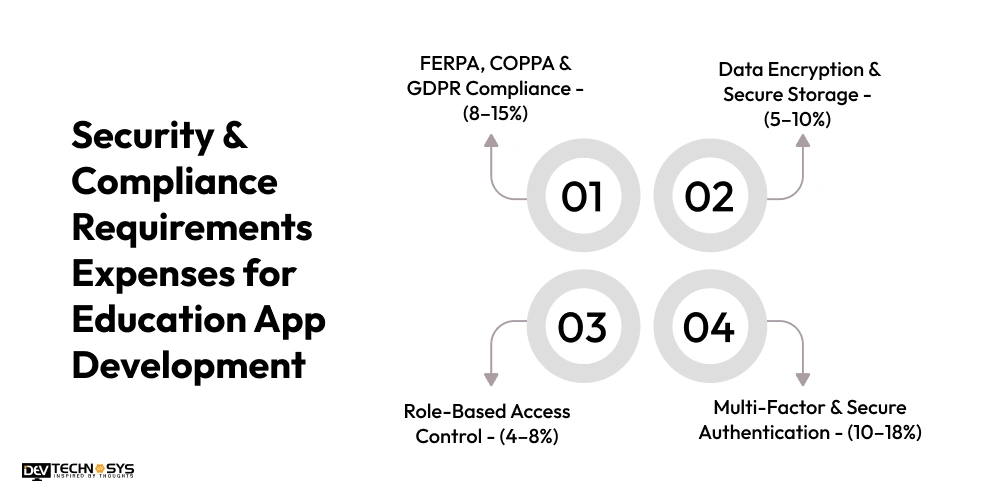
1. FERPA, COPPA & GDPR Compliance – (8–15%)
It is important for educational apps to comply with regulations like FERPA, COPPA, and GDPR. This will help protect the student’s privacy and data usage rights. Compliance helps businesses avoid legal penalties while improving trust and adoption among schools, universities, and global educational institutions.
2. Data Encryption & Secure Storage – (5–10%)
Protecting student records, login credentials, and payment details from unauthorized access is crucial for educational apps. For this, they integrate strong encryption protocols like SSL and AES. Secure cloud storage and encrypted communication are essential for maintaining data integrity in cloud-based learning platforms and LMS applications.
3. Role-Based Access Control – (4–8%)
Role-based access control (RBAC) limits platform access according to user roles such as students, teachers, parents, and administrators. It is mandatory to improve platform security and prevent unauthorized actions. It ensures safer management of educational content, assessments, and institutional data across learning environments.
4. Multi-Factor & Secure Authentication – (10–18%)
Education apps should implement secure authentication methods like OTP verification, biometric login, and multi-factor authentication. These systems are specially preferred to reduce account takeover risks and improve platform security. It creates safer digital learning experiences for students, educators, and institutional administrators.
What Factors Can Impact the Cost To Develop an Education App?
Now that we know the average cost to build an education app from scratch, let’s move on and discuss the key factors affecting the cost to develop an education app in the USA. Knowing about these cost-affecting education app development cost factors is crucial before starting your journey.
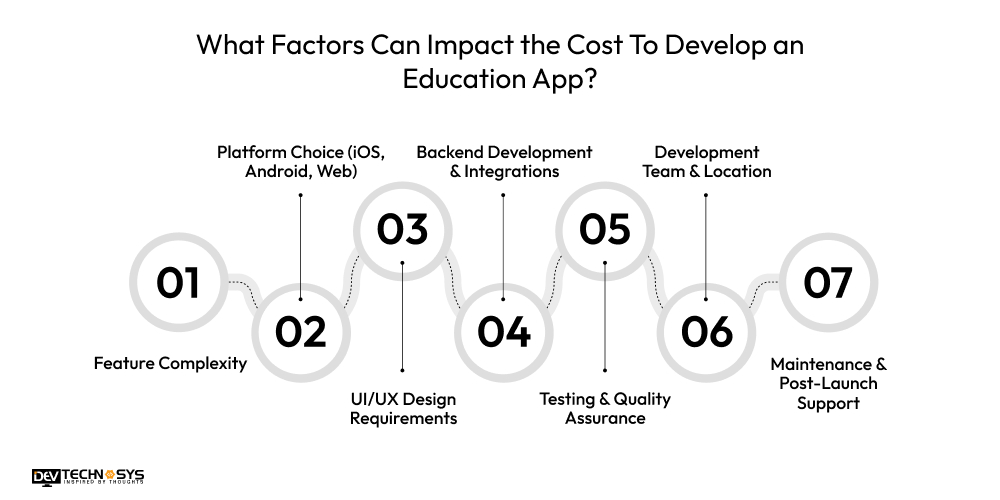
1. Feature Complexity
Features are among the major factors that affect the school & university app development cost in 2026. Developing an app with basic features is the more cost-saving option.
In comparison, the cost to build an education app using advanced features like AI and ML, live classes, and AR/VR modules significantly increases the resources and cost to develop an MVP education app.
Feature Level |
Timeline |
Cost Contribution (USD) |
| Basic | 4–6 weeks | $3,000 – $6,000 (10%–15%) |
| Moderate | 6–8 weeks | $6,000 – $10,000 (15%–25%) |
| Advanced | 8–12 weeks | $10,000 – $18,000 (25%–40%) |
2. Platform Choice (iOS, Android, Web)
The cost to build an eLearning MVP for a single platform will be less than building for multiple platforms. Cross platform app development with frameworks like Flutter or React Native can reduce the cost to develop an education app, while native apps increase development and maintenance expenses.
Platform Type |
Timeline |
Cost Contribution (USD) |
| Single Platform | 6–8 weeks | $4,000 – $7,000 (12%–18%) |
| Cross-Platform | 8–10 weeks | $6,000 – $10,000 (18%–25%) |
| Multi-Platform | 10–14 weeks | $10,000 – $13,000 (25%–30%) |
3. UI/UX Design Requirements
Adding custom, interactive, and user-friendly designs in an education app surely improves engagement and retention rate. However, the education app development services cost also increases with every design customization.
AR/VR in learning apps with animations, gamification elements, and accessibility-focused designs require additional effort, which ultimately increases the MVP eLearning app development cost.
Design Level |
Timeline |
Cost Contribution (USD) |
| Basic UI | 2–3 weeks | $1,000 – $2,000 (3%–5%) |
| Custom UI | 3–4 weeks | $2,000 – $4,000 (5%–10%) |
| Advanced UX (AR/Gamification) | 4–6 weeks | $4,000 – $7,000 (10%–15%) |
4. Backend Development & Integrations
According to a top web app development company, a strong backend is essential for content management, user data, analytics, and scalability. Third-party integrations, such as payment gateways, video streaming services, CRM systems, and LMS platforms, impact the overall education app development budget.
Backend Scope |
Timeline |
Cost Contribution (USD) |
| Basic Backend | 4–6 weeks | $3,000 – $6,000 (10%–15%) |
| Moderate Backend | 6–8 weeks | $6,000 – $10,000 (15%–25%) |
| Advanced Backend (APIs, LMS, CRM) | 8–12 weeks | $10,000 – $15,000 (25%–35%) |
5. Testing & Quality Assurance
The testing factor also impacts the cost to create an education app. The app is tested across different devices, operating systems, and user scenarios to ensure the stability and performance of the e-learning app. The more complex the app is, the extensive the testing it will require, increasing both the E-learning mobile app development estimate and timeline.
Testing Type |
Timeline |
Cost Contribution (USD) |
| Basic Testing | 2–3 weeks | $1,000 – $2,000 (3%–5%) |
| Standard QA | 3–4 weeks | $2,000 – $4,000 (5%–10%) |
| Advanced QA (multi-device, automation) | 4–6 weeks | $4,000 – $6,000 (10%–12%) |
6. Development Team & Location
Cloud-based student engagement apps development cost differ depending on whether you hire freelancers, an in-house team, or an app development company in USA. Development rates of skilled experts who provide mobile app development services also differ by region, with North America and Europe typically costing more than Asia.
Team Location |
Timeline |
Cost Contribution (USD) |
| Asia (India, SEA) | 2–4 months | $8,000 – $12,000 (25%–35%) |
| Eastern Europe | 2–4 months | $12,000 – $15,000 (35%–45%) |
| North America / Western Europe | 2–4 months | $16,000 – $21,000 (45%–60%) |
7. Maintenance & Post-Launch Support
Maintenance after launch is crucial for edtech app development, but it also impacts the language learning app development cost. Ongoing maintenance, updates, feature enhancements, bug fixes, and server costs are recurring expenses that must be considered in the total monetization education app cost. Here’s a table showing the cost to create an education app by maintenance service.
Maintenance Level |
Duration |
Cost Contribution (USD) |
| Basic | Monthly | $500 – $1,000 (2%–4%) |
| Standard | Monthly | $1,000 – $2,000 (4%–6%) |
| Advanced | Monthly | $2,000 – $4,000 (6%–10%) |
Education App Hidden Costs Explained: What Most Businesses Overlook
Even if entrepreneurs have planned the cost of scalable education app development, some extra expenses might appear unexpectedly. These expenses can increase the total eLearning app development by 20% to 35%. Here we will discuss these hidden costs, depending on scalability, integrations, and long-term usage.
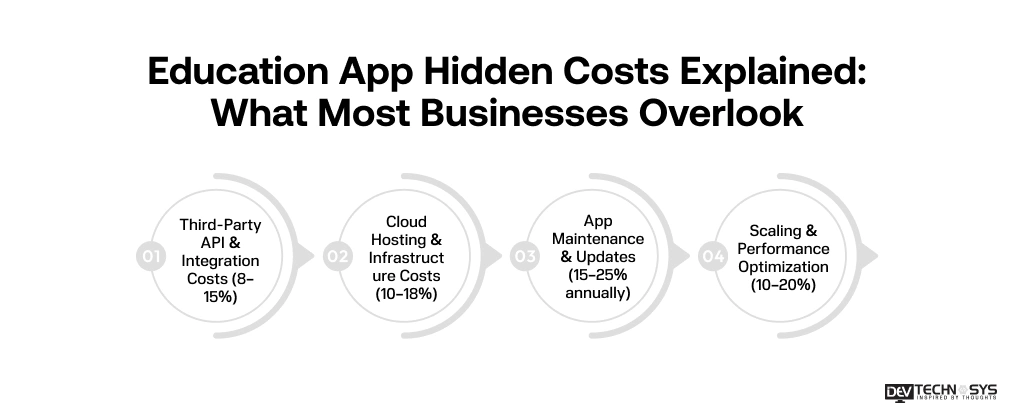
1. Third-Party API & Integration Costs (8–15%)
Education applications are usually dependent on pre-built services like video streaming, payment gateways, AI tools, and chat systems. Each API comes with usage fees and integration costs that grow with the expanding user base. This shows up as increased long-term operational expenses.
2. Cloud Hosting & Infrastructure Costs (10–18%)
Modern educational platforms largely demand cloud platforms like AWS or Google Cloud, live class streaming, and real-time access. With the growing number of users, server usage, bandwidth, and data storage costs also rise. This way, it becomes one of the largest hidden expenses.
3. App Maintenance & Updates (15–25% annually)
Maintaining the education app after launch includes bug fixes, OS updates, performance improvements, and new feature upgrades. It makes the app stable, secure, and compatible with modern devices and user expectations. However, it can lead to a continuous education app maintenance cost.
4. Scaling & Performance Optimization (10–20%)
Customer base on remote learning platforms always grows, which requires performance optimization, database scaling, and load balancing. Such upgrades guarantee a seamless and friendly real-time learning platform and user experience. However, it increases the engineering costs over time.
How Startups Can Build an Education App on a Low Budget?
Businesses or startups with a limited developemnt budget can still make an education app. All they have to do is reduce the cross-platform education app development cost by prioritizing cost-effective measures.
Lowering the cost of the multi-tenant education platform doesn’t mean the quality is sacrificed. Have a look at the cost-reducing methods to reduce development expenses:
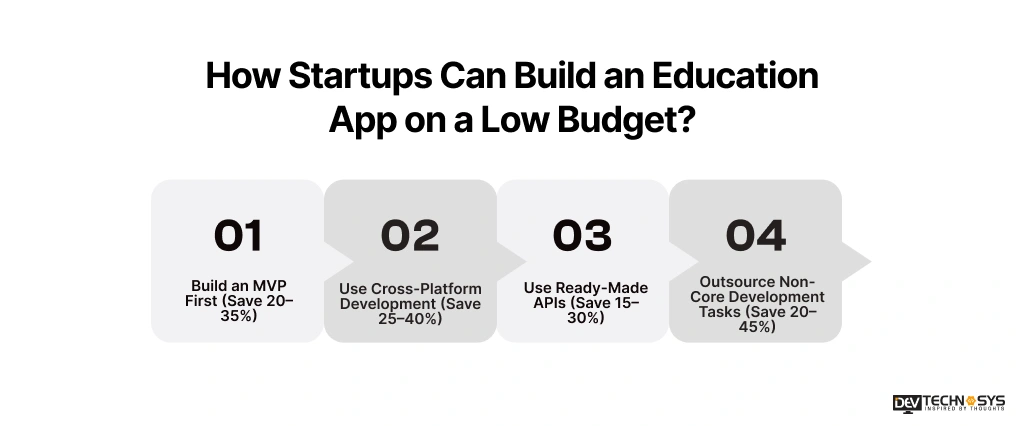
1. Build an MVP First (Save 20–35%)
Businesses should start with an MVP, where they have to focus on simple yet core features. It helps them reduce initial development effort and helps validate the idea quickly. This measure lowers overall cost to develop an eLearning platform for startups entering the EdTech market.
2. Use Cross-Platform Development (Save 25–40%)
Cross-platform development with Flutter or React Native lets startups build a single codebase for Android and iOS. This strategy helps reduce the online learning app development cost, efforts, and timeline. Cross-platform development offers consistent performance across devices and platforms.
3. Use Ready-Made APIs (Save 15–30%)
Businesses can avoid developing complex systems from scratch by incorporating pre-built APIs for payments, video streaming, and authentication. This approach reduces backend workload and mobile learning app development cost. It is ideal for startups with limited budgets and fast go-to-market goals.
4. Outsource Non-Core Development Tasks (Save 20–45%)
Startups can also decrease the LMS app development cost by outsourcing UI/UX design, testing, and backend modules. They can outsource these tasks to experienced vendors with a proven track record. It allows then control the expenses while keeping the core product logic in-house.
Real-World Examples of Education App Development with Cost Analysis
Some of the top real-world educational applications include platforms like Duolingo, Coursera, and Udemy. They explain how scalable learning platforms are built using AI, gamification, and cloud infrastructure. Here, we will examine their features, audience size, and technology complexity to understand how custom education app development cost varies.
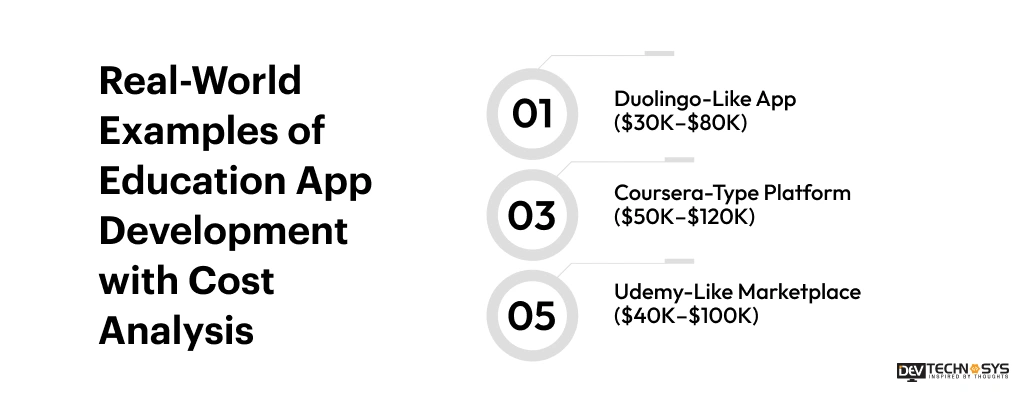
1. Duolingo-Like App ($30K–$80K)
Duolingo is an AI-powered learning app used by people of all ages. Here, users can clear their concept through gamification, adaptive learning systems, quizzes, and speech recognition.
An app like Duolingo offers personalization features, user engagement mechanics, and real-time learning capabilities. Enterprises can invest in such apps because AI-powered and gamified apps drive high user engagement and recurring revenue.
Feature/Module |
Estimated Cost |
| User Registration & Profiles | $2,000–$5,000 |
| Gamification System | $4,000–$10,000 |
| Interactive Quizzes & Assessments | $3,000–$7,000 |
| AI Recommendation Engine | $5,000–$12,000 |
| Speech Recognition Integration | $4,000–$10,000 |
| Progress Tracking Dashboard | $2,000–$5,000 |
| Push Notifications & Reminders | $1,000–$3,000 |
| Cloud Infrastructure Setup | $3,000–$8,000 |
| UI/UX Design | $3,000–$7,000 |
| Testing & Deployment | $3,000–$8,000 |
| Total Estimated Cost | $30,000–$80,000 |
2. Coursera-Type Platform ($50K–$120K)
Coursera is among the leading cloud-based learning platforms offering online courses, certifications, and enterprise training programs. These courses are accessible to learners throughout the world.
The common features of an app like Coursera include virtual classroom integration, live video streaming, and interactive assessment modules. Businesses investing in such apps can deliver digital education and monetize premium learning content.
Feature/Module |
Estimated Cost |
| User Authentication & Profiles | $3,000–$6,000 |
| Course Management System | $5,000–$12,000 |
| Live Video Streaming Integration | $6,000–$15,000 |
| Certification & Assessment Modules | $4,000–$10,000 |
| Instructor Dashboard | $3,000–$8,000 |
| Learning Analytics Dashboard | $5,000–$12,000 |
| Payment Gateway Integration | $2,000–$5,000 |
| Multi-language Support | $3,000–$7,000 |
| Cloud-Based Infrastructure | $6,000–$15,000 |
| UI/UX Design & Testing | $5,000–$10,000 |
| Total Estimated Cost | $50,000–$120,000 |
You can reach out anytime; we are available 24/7. Our team provides a quick response.

3. Udemy-Like Marketplace ($40K–$100K)
Udemy is an online learning marketplace where teachers can create, upload, and sell courses across multiple categories. Such platforms include features like course management systems, video hosting, payment gateway integration, ratings and reviews, and AI-based recommendation systems. Entrepreneurs should invest in Udemy-like apps because they create recurring revenue opportunities while connecting instructors and learners.
Feature/Module |
Estimated Cost |
| User Registration & Role Management | $3,000–$6,000 |
| Instructor Panel | $4,000–$10,000 |
| Course Upload & Management | $5,000–$12,000 |
| Video Hosting & Streaming | $4,000–$10,000 |
| Payment & Revenue Management | $3,000–$7,000 |
| Ratings & Reviews System | $2,000–$5,000 |
| Search & Recommendation System | $4,000–$9,000 |
| Admin Dashboard | $4,000–$8,000 |
| Cloud Infrastructure | $5,000–$12,000 |
| QA Testing & Deployment | $3,000–$8,000 |
| Total Estimated Cost |
$40,000–$100,000 |
How Do Education Apps Make Money?
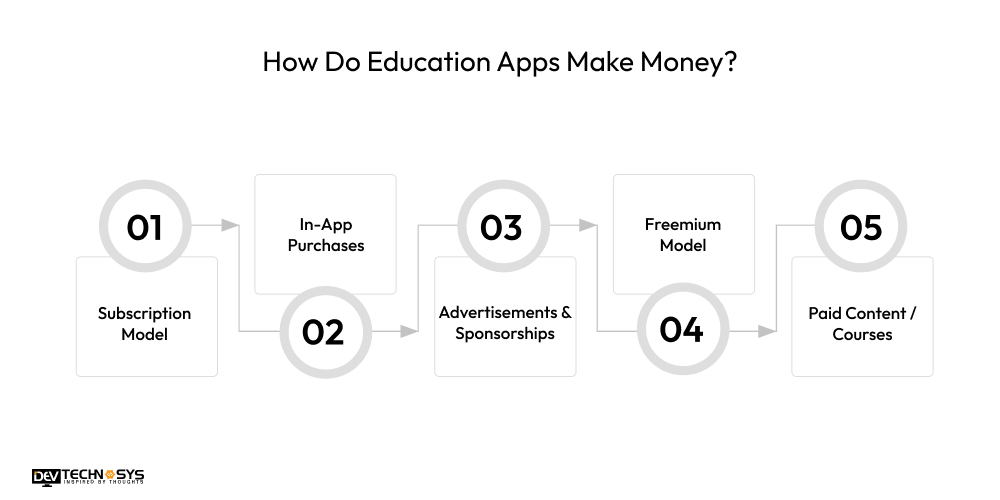
Education apps generate revenue by combining flexible monetization strategies with engaging learning experiences. Corporate learning platforms like LinkedIn and Docebo use these monetization models to balance user accessibility while ensuring sustainable, scalable business growth.
1. Subscription Model
AI/ML in education apps offers subscription plans (monthly, quarterly, or yearly). it is one of the most reliable ways to generate steady revenue. Users can access premium content, advanced features, or ad-free experiences by subscribing. Many different e-learning platforms like Coursera and Skillshare successfully use this model to attract paying users.
2. In-App Purchases
Selling digital products such as e-books, video lessons, quizzes, or exclusive study materials can be a great way to monetize the application. Users can buy individual courses and premium study materials. Allow to access advanced tools like AI-powered tutors, enhancing their learning experience while generating revenue for the app.
3. Advertisements & Sponsorships
These workforce upskilling platforms give ads inside the app that can help make money, especially for people who use it for free. It can also be profitable to work with educational brands or businesses on sponsored content, banner ads, or video ads. But it’s essential to make sure that ads don’t get in the way of learning. An unexpected number of ads can make people leave.
4. Freemium Model
In the freemium model, users access basic features for free, encouraging mass adoption. Advanced freemium education app features, premium courses, personalized learning paths, detailed analytics, or ad-free experiences are locked behind a paid annual learning plan. This model builds trust by offering real value upfront while converting engaged users into paying customers over time.
5. Paid Content / Courses
This monetization model focuses on selling individual courses or learning modules directly to users. Learners can choose between subscription plans for unlimited access, pay-per-course options for specific topics, or paid add-ons such as certifications, mentorship sessions, and advanced study materials. Tiered pricing provides flexibility for different learning needs.
Case Study: Tutorcity
At Dev Technosys, we have developed Tutorcity, a scalable e-learning and tutor booking platform. It is specially designed to connect students with tutors both online and offline. Initially, the project’s cost was standard, but after adding advanced features, the development cost increased.
The advanced features we added include secure payment integration, real-time video chat, quizzes, and session management modules. Our developers skillfully implemented cloud infrastructure, optimized API integrations, and interactive learning modules.
Challenge Faced: The biggest complication was ensuring data security, encrypted communication, and third-party API integration while maintaining platform performance and scalability.
Project Highlights
- Project Name: Tutorocity
- About Client: Ali Reza
- Industry: Education / eLearning
- Client Location: United Kingdom
- Development Timeline: 5 Months
- Team Size: 4 Developers
- Platform Type: Tutor Booking & Learning Platform
Who Needs an Education App? Industries That Benefit Most in 2026
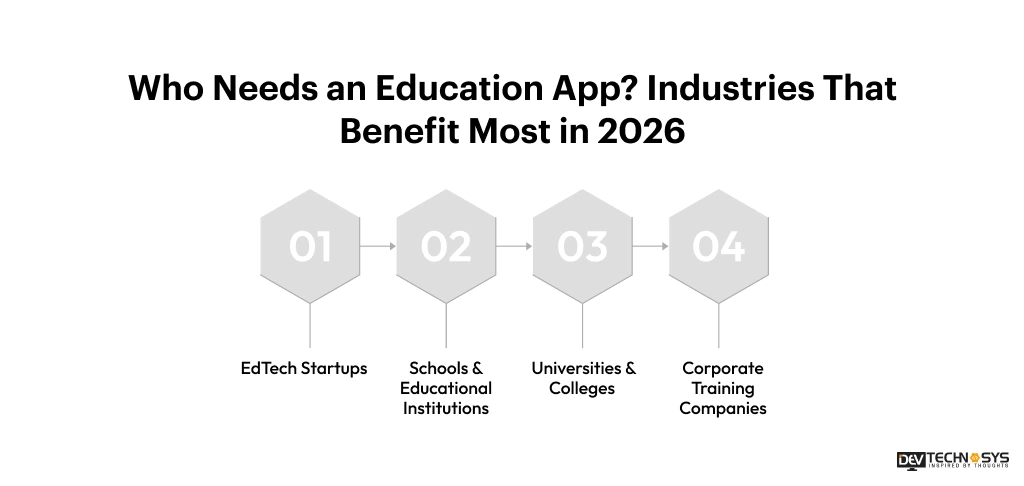
Scalable digital learning platforms are becoming popular and in demand rapidly in 2026-2027. From startups to established educational firms, investing in education app development is the new norm. And why not? It can improve accessibility, engagement, remote learning, and long-term revenue generation in the global EdTech market.
1. EdTech Startups
EdTech startups are widely investing in AI-powered Learning Management Systems (LMS). It is a great step to capture the growing demand for personalized and remote education. It has features like adaptive learning systems, gamification, and AI tutor integration that help startups to gain user retention.
2. Schools & Educational Institutions
In 2026-2027, schools are mainstreamly adopting digital classrooms and virtual learning platforms. It helps them improve accessibility, communication, and student engagement.
While educational institutions are integrating these apps to manage assignments, attendance, assessments, and live classes. Educational apps also support hybrid and remote learning environments efficiently.
3. Universities & Colleges
Colleges and universities are also opting for cloud-based learning platforms. Their motive is to offer online courses, certification programs, and virtual classroom experiences globally.
Advanced learning management systems enhance collaboration and automate administration. These platforms also support large-scale student management with secure and scalable infrastructure.
4. Corporate Training Companies
Another industry incorporating a Learning Management System (LMS) platform is enterprises and corporate training providers. They are adopting it to upskill employees and deliver real-time training programs.
Such apps integrate features like learning analytics dashboards, progress tracking, and personalized learning modules to improve workforce productivity.
Industry Insight:
According to Holon IQ, industry leaders like Google for Education and Microsoft Education are expanding cloud-based education ecosystems rapidly.
Conclusion
Education app development in 2026 remains a strategic investment, with costs influenced mainly by app type, feature complexity, platform choice, and technology adoption. Learning management system development costs varies on range of features, development teams, platform choice and many more.
If you are a business looking for a more accurate cost estimate for your education app development, contact Dev Technosys, a leading education app development company . With a team of 150+ experienced education app developers, they will help you build future-ready cloud-based e-learning solutions tailored to your business goals and budget.
Frequently Asked Questions
Find answers to the most common questions related to this article.
The average cost to develop an education app ranges from $8,000 to $25,000, depending on the type of app, the number of features, target platforms (iOS, Android, Web), and advanced technologies such as AI or AR/VR. MVP apps with basic functionality are cheaper, while fully featured, interactive apps require a higher investment.
Yes. Using cross-platform frameworks like Flutter or React Native allows developers to build one codebase for both iOS and Android, reducing development time and costs by 30% to 40% compared to developing separate native apps for each platform.
Post-launch maintenance usually costs around 15% to 25% of the initial development cost per year. This includes regular updates, bug fixes, security patches, performance optimization, feature enhancements, and ensuring the app remains compatible with new devices and OS versions.
Absolutely. Starting with an MVP, prioritizing essential features, using third-party APIs, choosing cross-platform development, and planning phased feature releases can significantly reduce costs while maintaining quality.
Yes, when aligned with your target audience and goals. AI enables personalized learning and analytics, while AR/VR enhances engagement. Though they increase initial costs, they often deliver higher long-term ROI.