

















2026 Stock Trading Software Cost Snapshot:
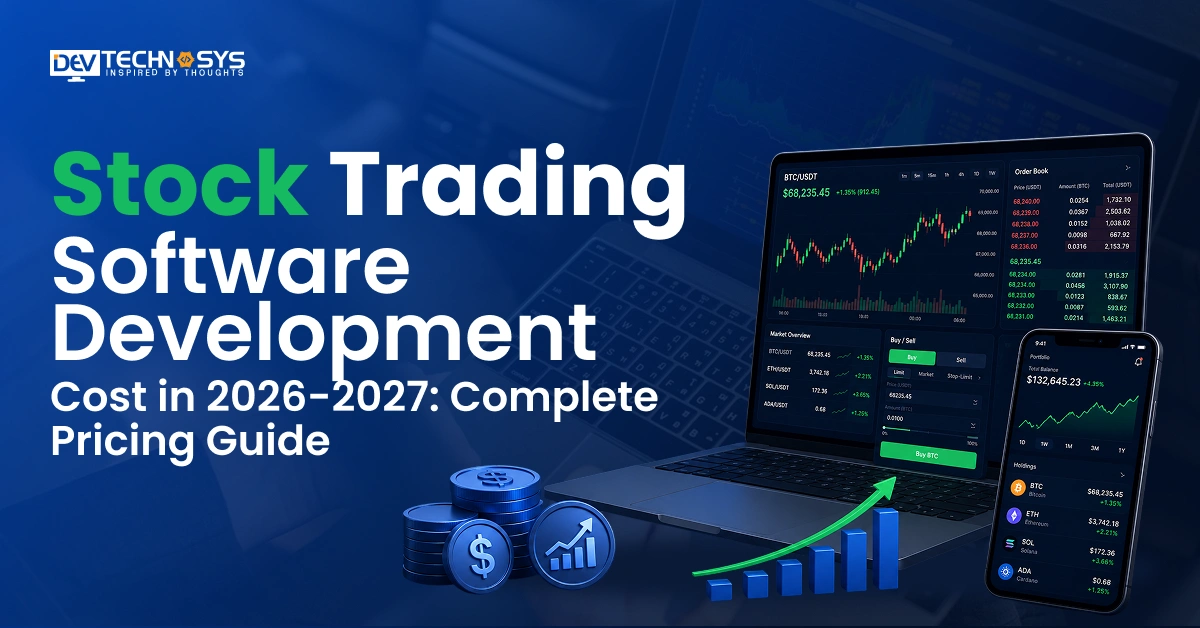
The cost to build stock trading software in 2026 typically ranges between $10,000 to $28,000+, depending on software complexity, security standards, trading features, real-time data integration, and regulatory compliance requirements.
Cost Breakdown by Complexity:
-
- Basic/MVP Stock Trading Software: $10,000 – $15,000 Core features include user registration, stock search, watchlist, portfolio tracking, and basic buy/sell functionality.
- Mid-Level Trading Software: $15,000 – $22,000 Includes real-time market data integration, payment gateway integration, analytics dashboard, notifications, and enhanced UI/UX design.
- Advanced Stock Trading Software: $22,000 – $28,000+ AI-powered trading insights, an algorithmic trading system, robo-advisory, predictive analytics, multi-asset trading, and advanced security integrations.
Key Cost Factors:
Software complexity, UI/UX design, real-time stock APIs, security implementation, KYC/AML compliance, cloud infrastructure, third-party integrations, AI features, and platform selection (iOS, Android, Web).
Development Timeline:
On average, it takes 4 to 10 months to develop a fully functional stock trading app, depending on customization level and feature requirements.
Regional Cost Rates:
Development in regions like India can be 40–60% more cost-effective compared to the US, UK, or Europe while maintaining enterprise-grade quality standards.
Additional Costs:
Ongoing expenses include maintenance (15–25% annually), cloud hosting, stock market data subscriptions, security updates, compliance upgrades, scalability enhancements, and marketing costs.
The stock trading industry in 2026-2027 is observing an immense digital transformation. Investors are widely depending on mobile-first and AI-powered crypto & stock trading platforms. These platforms offer faster, smarter, and more secure investing experiences.
This is what makes fintech startups and businesses invest in stock trading software development. In this digitalized world, it is a superb opportunity for them to tap into this rapidly growing market. But the question that remains important every time is what the stock trading software development cost is.
The standard cost to develop stock trading software is usually estimated at $10,000 to $28,000+. This price depends on software complexity, trading features, security standards, compliance requirements, and platform selection.
In this blog, we will cover everything related to the stock trading software development cost. It includes pricing factors, hidden expenses, and ways to reduce them for a budget-friendly mobile trading software development.
What are Stock Trading Platforms and Why Are They Booming in 2026-2027?
A stock trading platform is a mobile software where users can buy, sell, and manage stocks. It supports managing different types of stocks and financial tools within a few taps from a smartphone. Almost every enterprise trading software development project has built-in analysis tools. These tools help in comparing multiple stock prices in real time. Stock trading apps have eliminated the need to visit stock exchanges and trading websites.
A trading platform is widely trending in the stock market because it offers:
-
-
- Real-time trading access
- AI-powered insights
- Mobile-first convenience
- Faster portfolio management
- Lower dependency on brokers
- Increased market participation
-
Why Investing in Trading Software is a Smart Move in 2026-2027?
There is a rapid shift toward digital-first investing, making investing in trading software in 2026–2027 a strategic move. Entrepreneurs, startups, and financial businesses witness a global rise in retail investors, AI-driven trading tools, and real-time market access.
This worldwide expansion has generated a huge demand for smart, scalable custom trading software development. Also, it provides businesses with a chance to make recurring revenue through commissions, subscriptions, and premium features.
Investing in a multi-asset trading platform development requires less physical infrastructure. Integrating advanced technologies like AI, automation, and predictive analytics can enhance user retention and decision-making.
Building a trading software is no longer an option for fintech businesses, entrepreneurs, and startups. But it is a high-growth opportunity for long-term profitability and market leadership
What is the Average Cost to Develop Stock Trading Software in 2026–2027?
The average stock trading software development cost can range between $10,000 and $28,000+. The complexity of the platform mainly determines the final trading software development prices. Let’s understand:
-
-
- A basic software with limited integrations and following the MVP development structure has lower complexity. The simple stock market app development cost ranges from $10,000 to $15,000.
-
-
-
- A mid-level software with core and some high-level integrations has moderate development complexity. A mid-tier online trading platform development cost is between $15,000 and $22,000.
-
-
-
- A fully functional, advanced software has top-class, modern integrations, making it more complex to develop. An advanced trading software development cost 2026 can be estimated at $22,000-28,000+.
-
Trading Software Type |
Development Complexity |
Estimated Development Cost |
Best For |
| Basic/MVP Stock Trading App | Low Complexity | $10,000 – $15,000 | Startups & Early-Stage Businesses |
| Mid-Level Trading Platform | Moderate Complexity | $15,000 – $22,000 | Growing FinTech Companies |
| Advanced Stock Trading Software | High Complexity | $22,000 – $28,000+ | Enterprises & Large Trading Businesses |
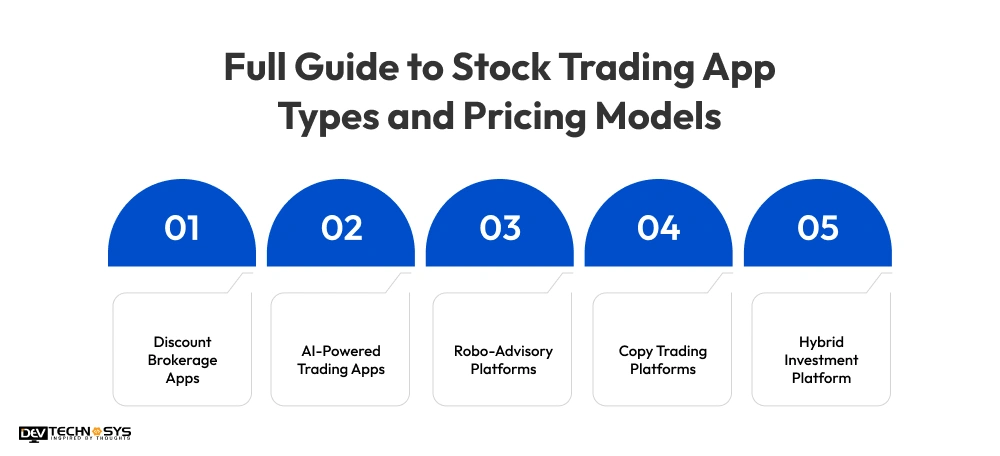
Full Guide to Stock Trading Software Types and Pricing Models
Robo-advisory, AI-integrated, hybrid investment, and discount brokerage are among the most trending types of stock trading apps. We will explain how these platforms help users and why it’s beneficial to invest in them. Even this section covers the costs involved in such real-time stock trading software development.
1. Discount Brokerage Software
Startups or businesses targeting high user acquisition and recurring revenue can invest in discount brokerage apps. These platforms help people trade stocks with minimal or zero commissions. Such platforms entice mass-market investors, making them a highly scalable and profitable opportunity.
Real-World Examples of Discount Brokerage Software:
-
-
- Robinhood
- Webull
- Public
- Moomoo
- SoFi
-
Discount Brokerage Software Development Cost:
Development Component |
What It Includes |
Estimated Cost (USD) |
| UI/UX Design | Trading dashboard, watchlist, portfolio UI | $1,500 – $3,000 |
| Core Trading Features | Buy/sell stocks, account setup, alerts | $4,000 – $7,000 |
| API Integrations | Market data, payment gateway, KYC | $2,000 – $4,000 |
| Backend & Security | User management, encrypted transactions | $2,500 – $5,000 |
| Testing & Deployment | QA testing, optimization, launch | $1,000 – $2,000 |
| Total Cost | $11,000 – $21,000 |
2. AI-Powered Trading Software
AI-powered trading software implement technologies like ML and predictive analytics. These technologies provide automated trading insights, risk analysis, and personalized investment recommendations. Entrepreneurs can get long-term customer retention and profits with AI stock trading software development.
Real-World Examples of AI-Powered Trading Software:
-
-
- Trade Ideas
- Tickeron
- TrendSpider
- Kavout
- Danelfin
-
AI-Powered Trading Software Development Cost:
Development Component |
What It Includes |
Estimated Cost (USD) |
| UI/UX Design | AI dashboard, predictive analytics UI | $2,000 – $4,000 |
| AI Trading Features | AI insights, smart recommendations | $5,000 – $9,000 |
| API & AI Integrations | Stock APIs, ML models, analytics tools | $3,000 – $5,000 |
| Backend Infrastructure | Real-time processing, cloud architecture | $4,000 – $6,000 |
| Testing & Deployment | AI testing, QA, deployment | $1,500 – $2,500 |
| Total Cost | $15,500 – $26,500 |
3. Robo-Advisory Software
A robo-advisory platform is an automated investment planning and portfolio management software. It offers suggestions according to the user’s goals, risk tolerance, and financial behavior. Businesses can invest in these platforms as it targets passive investors and reduce operational costs.
Real-World Examples of Robo-Advisory Software:
-
-
- Betterment
- Wealthfront
- Ellevest
- Schwab Intelligent Portfolios
- Fidelity Go
-
Robo-Advisory Software Development Cost:
Development Component |
What It Includes |
Estimated Cost (USD) |
| UI/UX Design | Investment dashboard, goal tracking UI | $1,500 – $3,000 |
| Core Advisory Features | Portfolio automation, risk analysis | $4,000 – $7,000 |
| API Integrations | Banking APIs, investment tools, and KYC | $2,500 – $4,000 |
| Backend & Security | Data encryption, portfolio engine | $3,000 – $5,000 |
| Testing & Deployment | QA testing, compliance checks | $1,000 – $2,000 |
| Total Cost | $12,000 – $21,000 |
4. Copy Trading Software
Copy trading apps allow users to replicate the trades made by professional investors. It is a widely preferred app among beginner traders and social investing communities. Developing a copy trading platform helps enterprises have strong engagement, viral growth potential, and high user retention opportunities.
Real-World Examples of Copy Trading Software:
-
-
- eToro
- ZuluTrade
- NAGA
- Covesting
- AvaTrade
-
Copy Trading Software Development Cost:
Development Component |
What It Includes |
Estimated Cost (USD) |
| UI/UX Design | Social feed, trader profile UI | $2,000 – $3,500 |
| Copy Trading Features | Trade mirroring, user engagement tools | $5,000 – $8,000 |
| API Integrations | Market APIs, payment systems, analytics | $2,500 – $4,500 |
| Backend Infrastructure | Real-time sync, social trading engine | $3,000 – $5,500 |
| Testing & Deployment | Performance testing, launch support | $1,000 – $2,000 |
| Total Cost | $13,500 – $23,500 |
5. Hybrid Investment Software
A single platform that combines stocks, ETFs, cryptocurrencies, mutual funds, and digital assets is a hybrid investment platform. Entrepreneurs attract a large number of investors by offering multiple services on a single platform. These platforms are known for creating strong revenue opportunities.
Real-World Examples of Hybrid Investment Software:
-
-
- Fidelity Investments
- Charles Schwab
- Interactive Brokers
- Ally Invest
- E*TRADE
-
Hybrid Investment Software Development Cost:
Development Component |
What It Includes |
Estimated Cost (USD) |
| UI/UX Design | Multi-asset investment dashboard | $2,000 – $4,000 |
| Core Investment Features | Stocks, ETFs, crypto, portfolio tools | $5,000 – $8,000 |
| API Integrations | Multi-asset market APIs, payments | $3,000 – $5,000 |
| Backend & Security | Asset management, transaction security | $4,000 – $6,000 |
| Testing & Deployment | QA, scalability testing, deployment | $1,500 – $2,500 |
| Total Cost | $15,500 – $28,000+ |
Cost Impact of Core and Advanced Features in Stock Trading Platforms
Developing a stock trading app, the focus of a software development company remains on the feature set. Features, either core or AI, are highly influential for the stock investment software development cost. However, basic trading functionalities demand lower development efforts and expenses. Whereas AI-powered and real-time trading applications significantly increase complexity and pricing.
1. Cost Structure of the Core Features of a Stock Trading Platform
Core or basic features are very important for a web-based trading platform development. These features emphasize enhancing and simplifying user accessibility, trading operations, and portfolio management.
| Core Features | Estimated Cost (USD) |
| User Registration & Login | $300 – $700 |
| User Profile Management | $200 – $500 |
| Stock Search Functionality | $300 – $600 |
| Watchlist Creation | $250 – $500 |
| Portfolio Management | $400 – $900 |
| Buy/Sell Trading Option | $500 – $1,200 |
| Payment Gateway Integration | $300 – $700 |
| Push Notifications | $200 – $500 |
| Transaction History | $300 – $600 |
| Basic Analytics Dashboard | $400 – $800 |
2. Cost Structure of the Advanced Features of a Stock Trading Platform
Advanced features are integrated to upgrade user engagement, automation, security, and real-time trading intelligence. These are the common functions that an enterprise-level software usually contains.
| Advanced Features | Estimated Cost (USD) |
| AI-Powered Trading Insights | $1,000 – $2,000 |
| Algorithmic Trading | $800 – $1,500 |
| Real-Time Market Analytics | $700 – $1,200 |
| Robo-Advisory System | $600 – $1,500 |
| Multi-Asset Trading Support | $500 – $1,000 |
| Advanced Fraud Detection | $700 – $1,500 |
| Predictive Market Analysis | $800 – $1,500 |
| Voice-Based Trading Commands | $500 – $1,000 |
| Social & Copy Trading Features | $700 – $1,300 |
| AI Chatbot Support | $400 – $900 |
Step-by-Step Stock Trading Software Development Cost Guide
A stock brokerage app development is a complete process involving multiple stages. From market research to after-launch support, each development phase impacts the overall budget of the project. The project’s budget affects the scalability, security, and platform performance. In this section, we will discuss the price structure of the secure stock trading app development across development stages.
Development Stage |
What It Includes |
Estimated Cost (USD) |
| Market Research & Planning | Business analysis, competitor research, feature planning | $500 – $1,500 |
| UI/UX Design | Software wireframes, trading dashboard, and user experience design | $1,500 – $3,000 |
| Frontend Development | User interface development for Android, iOS, or Web | $4,000 – $7,000 |
| Backend Development | Server architecture, databases, trading engine | $5,000 – $12,000 |
| API & Third-Party Integrations | Stock market APIs, payment gateways, and KYC systems | $1,500 – $4,000 |
| Security & Compliance Implementation | Data encryption, MFA, KYC/AML compliance | $1,500 – $3,500 |
| Testing & Quality Assurance | Performance testing, bug fixing, security testing | $1,000 – $2,500 |
| Deployment & Launch | App store deployment, cloud setup, launch support | $500 – $1,500 |
| Maintenance & Updates | Feature upgrades, monitoring, security patches | 10%–20% of annual development cost |
Once businesses understand the development phases properly, it helps them plan the stock trading software development cost estimation. If the trading software development process is well-planned, it reduces unnecessary expenses. Also, it guarantees faster launch, better scalability, stronger security, and long-term business profitability.
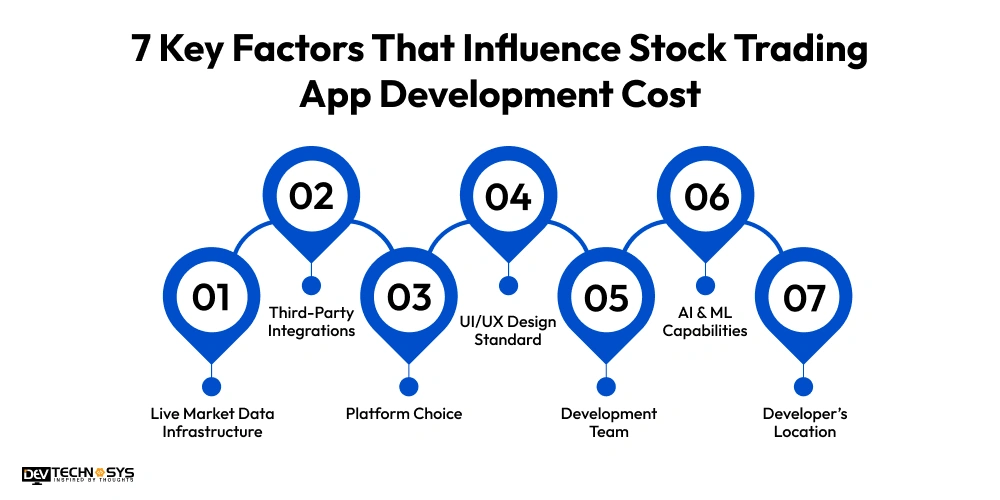
7 Key Factors That Influence Stock Trading Software Development Cost
Development team’s location & expertise, backend, design, and APIs are among the factors affecting stock trading software development cost. Once a business learns about these factors, it can make smart cost-related decisions.
1. Live Market Data Infrastructure
Real-time stock data infrastructure majorly affects the Robinhood clone app development cost. It is because trading apps work on:
-
-
- Low-latency data streaming
- Live price updates
- Reliable market feeds
-
It leads to faster and more accurate data delivery while increasing the crypto trading platform development cost.
Infrastructure Component |
Estimated Cost (USD) |
| Real-Time Market Data APIs | $500 – $2,000 |
| WebSocket Integration | $300 – $1,000 |
| Data Caching Systems | $200 – $500 |
| Cloud Data Processing | $500 – $1,500 |
| Total Cost | $1,000 – $4,000 |
2. Third-Party Integrations
Crypto and stock trading app development are highly reliant on third-party APIs for:
-
-
- Payments
- KYC Verification
- Stock Market Data
- Analytics
- Notifications
-
The cost to make stock trading software with APIs can increase due to development complexity, testing requirements, and maintenance effort.
| Integration Type | Estimated Cost (USD) |
| Payment Gateway Integration | $300 – $1,000 |
| KYC & AML Verification APIs | $500 – $1,200 |
| Push Notification Services | $200 – $500 |
| Analytics & Reporting Tools | $300 – $800 |
| Total Cost | $800 – $3,500 |
3. Platform Choice
Developing software on different platforms, like Android or iOS, can increase the overall cost to create stock trading software. Developing software on multiple platforms requires design, coding, testing, and deployment expenses individually. Therefore, multi-platform trading ecosystems require larger budgets and longer development timelines.
| Platform Type | Estimated Cost (USD) |
| Android Trading App | $10,000 – $18,000 |
| iOS Trading App | $10,000 – $20,000 |
| Web Trading Platform | $12,000 – $22,000 |
| Cross-Platform App | $15,000 – $28,000+ |
| Total Cost Range | $10,000 – $28,000+ |
4. UI/UX Design Standard
The cost to build trading platform like Robinhood is also impacted by modern and intuitive UI/UX design. Better designed means improved user engagement, retention, and trading efficiency. Additions like advanced dashboards, interactive charts, animations, and personalized interfaces. This increases the total algorithmic trading software development cost.
| Design Component | Estimated Cost (USD) |
| Wireframing & Prototyping | $500 – $2,000 |
| Trading Dashboard Design | $700 – $3,000 |
| Interactive Charts & Graphs | $500 – $2,500 |
| Custom UI Animations | $300 – $2,500 |
| Total Cost | $2,000 – $10,000 |
5. Development Team
The development team, either freelancers, in-house teams, or development companies, influences the multi-asset trading platform development cost.
-
-
- Freelancers are cost-efficient but are perfect for small projects and tasks.
- In-house teams offer full control over development but work on a salary basis for the long term.
- Development agencies provide experienced professionals, faster delivery, and end-to-end project management.
-
| Development Team Type | Estimated Cost (USD) |
| Freelancers | $2,500 – $6,000 |
| In-House Team | $8,000 – $14,000 |
| Development Agency | $6,000 – $14,000 |
| Total Cost Range | $2,500 – $14,000 |
6. AI & ML Capabilities
Advanced algorithms, data processing systems, and model training are required to integrate AI and ML features in trading apps. These features include:
-
-
- Predictive analytics
- Robo-advisory
- Automated trading insights
- Fraud detection
-
However, these capabilities make trading software development more complex and expensive.
| AI/ML Feature | Estimated Cost (USD) |
| AI Trading Insights | $700 – $2,000 |
| Predictive Analytics | $500 – $2,000 |
| Robo-Advisory Features | $400 – $1,500 |
| Fraud Detection Systems | $400 – $2,500 |
| Total Cost | $2,000 – $8,000 |
7. Developer’s Location
Development cost is significantly affected by the region from which you hire a dedicated developer for custom fintech software development. The cost to build stock trading software varies due to differing hourly hiring rates. Developers in the USA, UK, and Europe generally charge higher rates.
| Developer Location | Estimated Cost (USD) |
| India | $1,500 – $4,000 |
| Eastern Europe | $3,000 – $5,000 |
| USA & Canada | $5,000 – $6,000+ |
| Western Europe | $4,000 – $6,000 |
| Total Cost Range | $1,500 – $6,000 |
Compliance & Security Expenses Most Trading Software Businesses Overlook
Businesses investing in custom-built or white-label trading platform development in 2026-2027 must ensure compliance and security. It is because they manage sensitive financial data, real-time transactions, investment portfolios, and user authentication processes. Ignoring these security standards can lead to:
-
-
- Loss of user trust
- Legal penalties
- Financial fraud risks
- Data breaches
- Unauthorized account access
- Security vulnerabilities
- Business reputation damage
- Trading manipulation risks
-
The table below shows the trading platform security and compliance, with a cost breakdown. This helps businesses plan their development budget more effectively.
| Compliance & Security Factor | Why It Matters | Estimated Cost (USD) |
| KYC & AML Integration | Prevents fraud and verifies user identity | $1,000 – $3,000 |
| Data Encryption | Protects financial and personal user data | $800 – $2,000 |
| Multi-Factor Authentication (MFA) | Adds an extra layer of account security | $500 – $1,500 |
| Regulatory Compliance | Ensures compliance with SEC, FINRA, GDPR, or PCI DSS standards | $2,000 – $5,000 |
| Fraud Detection System | Identifies suspicious trading activities in real time | $1,500 – $4,000 |
| Secure Payment Integration | Protects transactions and fund transfers | $800 – $2,000 |
| Security Audits & Penetration Testing | Detects vulnerabilities before launch | $1,000 – $3,000 |
| Cloud Security & Backup | Prevents data loss and cyber threats | $700 – $2,500 |
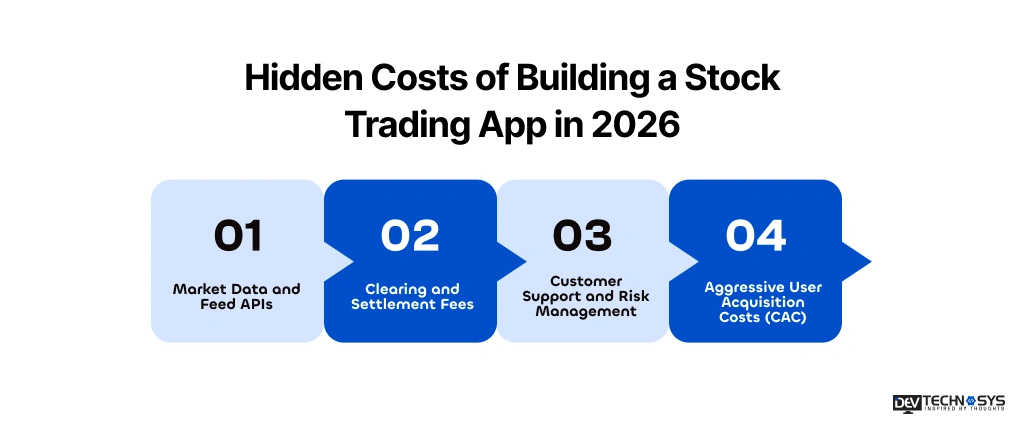
Hidden Costs of Building a Stock Trading Software in 2026
Market data, feed APIs, settlement charges, customer support, and CAC are some costs that appear unexpectedly. These sudden expenses are usually ignored at the beginning, but give more financial stress in the long run. Discussing these hidden costs can help businesses make secure financial decisions from the initial development stage.
1. Market Data and Feed APIs
Usually, stock trading applications demand real-time market data APIs. These APIs help in understanding live stock prices, charts, and trading insights. Such market data providers charge recurring subscription fees. This is one of the major hidden operational cost to develop stock trading software.
2. Clearing and Settlement Fees
Backend processing between brokers, exchanges, and financial institutions is involved in every trade. This requires clearance and settlement fees that every entrepreneur usually overlooks. This might become a major recurring expense for high-frequency trading software development.
3. Customer Support and Risk Management
Stock trading applications need customer support, fraud monitoring, and risk management systems 24/7. It is necessary to handle disputes, suspicious activities, and failed transactions. With growing traders, these operational costs also increase.
4. Aggressive User Acquisition Costs (CAC)
The highly competitive fintech market can make user acquisition expensive in 2026-2027. It will become important to spend on paid ads, influencer marketing, referral programs, and promotional offers. This increases the cost to make stock trading software.
Proven Methods to Reduce Trading Software Development Costs
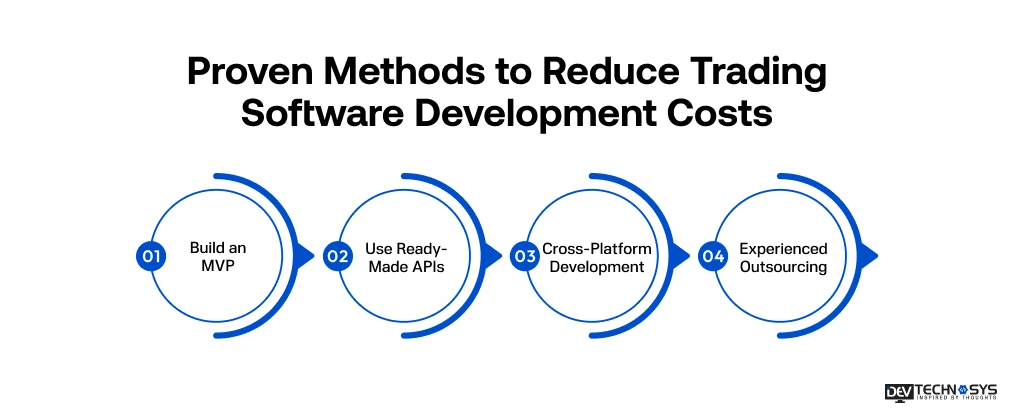
By building software with MVP, pre-built APIs, and cross-platform strategies, businesses can significantly reduce the cost to build stock trading software. In this section, we will learn about the measures a stock market software development company integrates to decrease development costs.
1. Build an MVP
Developing an MPV helps businesses in integrating basic yet core features first. It decreases the developemnt expenses while allowing companies to test user demand before investing heavily. This helps them make informed decisions according to the market demand.
2. Use-Ready-Made APIs
Pre-built APIs are especially used for payments, market data, authentication, and KYC verification. It reduces the requirement and cost for custom coding requirements. This can lower the development timeline and infrastructural costs.
3. Cross-Platform Development
Cross-platform development allows enterprises to build trading apps for Android or iOS through a single codebase. This measure can lower the development expenses while minimizing maintenance efforts at a quick development speed.
4. Experienced Outsourcing
Outsourcing automated trading platform development to experienced fintech developers can be a great option to reduce the development cost. Experienced developers avoid technical errors, security gaps, and costly delays. They are familiar with compliance requirements and trading system architecture.

Best Tech Stack for Stock Trading Software Development with Price Estimation
Choosing the right tech stack to build an AI stock prediction software is essential. It maintains the security, scalability, and performance of the trading platforms. Technologies used in trading apps’ front-end, back-end, database, cloud, and security infrastructure influence the overall development cost. The table below highlights the best technologies commonly used in stock trading software development, along with their cost contribution.
Technology Category |
Technology |
Estimated Cost Contribution (USD) |
Best Use Case |
| Frontend | React | $2,000 – $5,000 | Real-time web trading dashboards |
| Frontend | Flutter | $3,000 – $6,000 | Cross-platform trading apps |
| Frontend | Angular | $2,500 – $5,500 | Enterprise trading platforms |
| Backend | Node.js | $4,000 – $8,000 | Real-time APIs & live trading |
| Backend | Python | $5,000 – $9,000 | AI-powered trading analytics |
| Backend | Java | $6,000 – $10,000 | Secure enterprise trading systems |
| Database | PostgreSQL | $1,500 – $4,000 | Financial transaction management |
| Database | MongoDB | $2,000 – $4,500 | Scalable analytics storage |
| Cloud Infrastructure | AWS | $3,000 – $7,000 | Scalable cloud-based trading apps |
| Security | Firebase Authentication | $1,000 – $3,000 | User authentication & software security |
How Stock Trading Software Generates Long-Term Revenue?
Subscription, in-app advertisement, transaction fees, and asset management services are the ways trading businesses can make recurring revenue. Here we have discussed some of these measures that a business can implement.
1. Transaction and Brokerage Fees
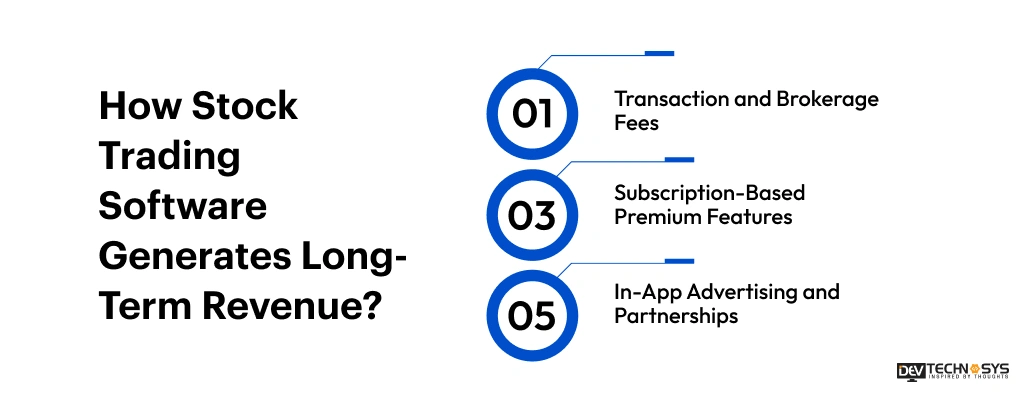
Stock trading software generates long-term revenue by charging brokerage or transaction fees on every trade. As user activity increases, platforms earn consistent recurring income from stock purchases, sales, margin trading, and other investment-related transactions.
2. Subscription-Based Premium Features
Many trading platforms offer premium subscriptions for advanced charting tools, AI insights, portfolio analytics, and real-time market data. These monthly or yearly plans create stable recurring revenue while improving user engagement and long-term customer retention.
3. In-App Advertising and Partnerships
Trading apps earn additional revenue through financial advertisements, sponsored investment products, and partnerships with banks or fintech companies. As the user base grows, these collaborations become valuable long-term monetization opportunities for trading software businesses.
Conclusion
Before investing in cloud-based trading platform development, it is always a good idea to understand its cost structure. Learning about the cost structure means understanding the key areas where the budget can be allocated.
From platform features to ongoing maintenance, a clear cost assessment helps businesses plan effectively and minimize unexpected expenses. With a strategic cost breakdown, building a scalable stock trading solution can deliver long-term value.
To maintain the app’s performance and user satisfaction while balancing the cost, a fintech app development company is really helpful.
Frequently Asked Questions
Find answers to the most common questions related to this article.
The average cost to build stock trading software can be valued between $10,000 and $28,000+. This cost is determined by the platform’s complexity and other factors, including security, backend, APIs, etc. A simple software built with an MVP structure is less expensive than a fully advanced application.
Advanced or AI-integrated features in a trading software are highly expensive as compared to the basic ones. It includes features like:
AI-Powered Trading Insights
Algorithmic Trading
Real-Time Market Analytics
Robo-Advisory System
Multi-Asset Trading Support
Advanced Fraud Detection
Predictive Market Analysis
Voice-Based Trading Commands
Social & Copy Trading Features
AI Chatbot Support
Implementing several monetization models, a trading software can make continuous income streams. The money-making models that are commonly used in trading applications include:
Transaction and Brokerage Fees
Subscription-Based Premium Features
In-App Advertising and Partnerships
These models help in maximizing user lifetime value and long-term business growth.
No, AI is not necessary for trading apps, but becoming an integral part of modern trading apps. AI-powered trading applications offer:
Personalized investment recommendations
Predictive analytics
Automated trading insights
Fraud detection
All these are improving user engagement, decision-making, and platform value in modern applications.
Yes, even startups can build a trading software like Robinhood on a budget using:
MVP strategy
Third-party APIs
Experienced developers
Cross-platform development
These money-saving measures can significantly reduce costs while accelerating time-to-market.