













In 2026, automotive software development is transforming the design and development process for automobiles. In today’s era, cars have become intelligent, software-driven systems capable of learning, communicating, and evolving, instead of mere mechanical machines. From advanced automotive embedded systems and autonomous driving to infotainment and electric vehicle management, the role of software in the automotive industry is massive.
Automotive software platforms allow vehicles to process real-time data and deliver safer, smarter, and more personalized driving experiences. As the automotive industry shifts toward electric, connected, and autonomous vehicles, automotive software development has become the driving force behind the cars.
Engineers merge embedded systems, cloud computing, artificial intelligence, and cybersecurity to create critical and reliable applications to meet the strict regulatory standards. With over-the-air updates and software-defined vehicles becoming the norm, automotive software is shaping the future of automotive software development. Now, without further delay, let’s dive into the world of automotive software development!
What is Automotive Software?
Automotive software, which includes firmware, apps, and embedded programs, is the digital “brain” of contemporary cars. And if you’re curious about the operation of automobile software? They regulate, keep an eye on, and improve everything from infotainment (basically, the music and navigation) to safety features and engine performance.
Advanced driver assistance systems (ADAS) for autonomous driving are also controlled by embedded software in automotive vehicles. An automotive software application is just as crucial to vehicle functionality and innovation as hardware, as it processes real-time data from sensors to control mechanical components, deliver over-the-air updates, maximize fuel efficiency, and deliver the entire driving experience.
Key Characteristics of Automotive Software:
- Safety-critical: Failures can result in loss of human life.
- Real-time & deterministic: Guaranteed response times
- Highly reliable: Built for long-term, consistent operation
- Fault-tolerant: Detects and handles failures safely.
- Hardware-dependent: Tightly integrated with ECUs and sensors
- Standards-driven: Governed by ISO 26262, AUTOSAR, UNECE
- Long lifecycle: Designed to last 10 to 15+ years
- Secure by design: Protection against cyber threats
Automotive Software Market Stats
- The global automotive software market size was estimated at USD 32,959.1 million in 2025 and is projected to reach USD 108,574.7 million by 2033, growing at a CAGR of 16.4% from 2026 to 2033.
- North America held a significant revenue share of over 34.62% in 2025 of the global automotive software market.
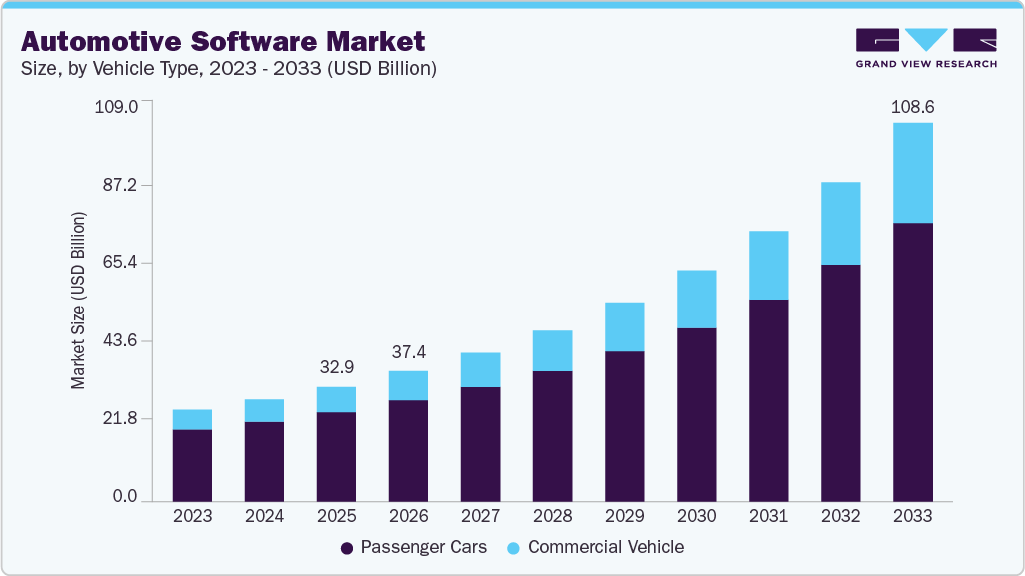
- By vehicle type, passenger cars led the market and held the largest revenue share of over 77% in 2025.
- The automotive software market in the U.S. led the North America region and held the largest revenue share in 2025.
- By product, the software application segment led the market and held the largest revenue share of over 56% in 2025.
Quick Introduction to Automotive Software Development
Automotive software development is the specialized field of creating software for vehicle functions, ranging from basic engine control (ECU) to complex features like autonomous driving, infotainment, and Advanced Driver-Assistance Systems (ADAS), managing electronic systems, ensuring safety, and enabling connectivity for a “software-defined vehicle” (SDV) era.
The procedure to build an Automotive Software involves adding embedded systems, cloud platforms, and rigorous standards for high performance, reliability, and cybersecurity, transforming vehicles into sophisticated, data-driven devices.
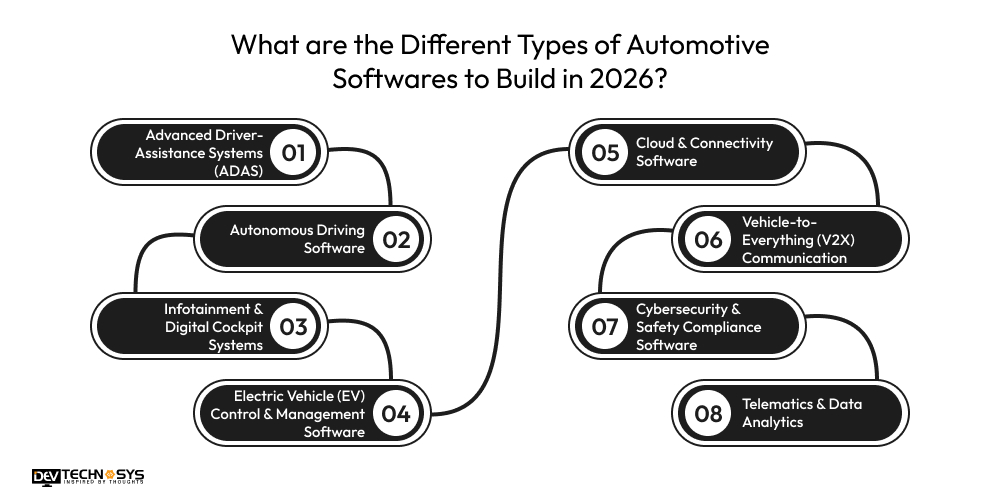
What are the Different Types of Automotive Softwares to Build in 2026?
Here are the key types of automotive softwares you’ll see being built and scaled in 2026 as vehicles continue their shift toward electrification, connectivity, and autonomy:
1. Advanced Driver-Assistance Systems (ADAS)
ADAS automotive software architecture enables advanced safety and semi-autonomous features such as adaptive cruise control, lane-keeping assist, collision detection, blind-spot monitoring, and automated parking.
AI development company creates these systems with sensor fusion, AI-driven algorithms, and real-time data processing to interpret road conditions, assist drivers, and significantly reduce accident risks.
Key Examples of ADAS Software:
- Mobileye EyeQ: Powers lane-keeping, collision avoidance, and adaptive cruise control
- Tesla Autopilot: It combines sensor fusion and AI for semi-autonomous driving assistance.
- Bosch ADAS Solutions: Used to build automotive garage software to enable automated parking, blind-spot detection, and emergency braking.
2. Autonomous Driving Software
Automotive embedded software supports Level 3 to Level 5 autonomy, allowing vehicles to perceive their environment. Self-driving car software development involves making driving decisions and operating independently.
Automotive software engineering incorporates artificial intelligence, LIDAR, radar, computer vision, and high-definition maps to safely navigate complex traffic scenarios with minimal or no human intervention.
Key Types of Autonomous Driving Software:
- Waymo Driver: Level-4 autonomous driving platform used in robotaxis
- Tesla Full Self-Driving (FSD): AI-based autonomous driving software
- NVIDIA DRIVE AV: Autonomous vehicle computing and software stack
3. Infotainment & Digital Cockpit Systems
Infotainment software developed by a custom software development company delivers rich in-car experiences through navigation, multimedia streaming, voice assistants, augmented reality dashboards, and seamless smartphone integration.
By 2026, infotainment software development with digital cockpits will prioritize personalization, intuitive user interfaces, real-time connectivity, and enhanced driver-passenger interaction.
Key Types of Infotainment & Digital Cockpit Systems:
- Android Automotive OS: Used by Volvo, Polestar, and General Motors
- Apple CarPlay: Smartphone-based infotainment integration
- Mercedes-Benz MBUX: AI-powered digital cockpit and voice assistant
4. Electric Vehicle (EV) Control & Management Software
EV control and management software oversees battery performance, thermal management, charging operations, power distribution, and energy optimization.
These systems in automotive application development improve driving range, extend battery life, ensure operational safety, and maximize efficiency across electric and hybrid vehicle platforms.
Key Types of Electric Vehicle (EV) Control & Management Software:
- Tesla Battery Management System (BMS): Optimizes battery health and range
- LG Energy Solution BMS: Used by multiple global EV manufacturers
- Bosch EV Powertrain Software: Controls charging, thermal systems, and energy flow
5. Cloud & Connectivity Software
Cloud and connectivity software enable seamless vehicle-to-cloud communication, supporting over-the-air (OTA) updates, real-time diagnostics, telemetry monitoring, remote feature activation, and continuous data synchronization. This allows automakers to enhance vehicle performance, deploy new features, and maintain software throughout the entire vehicle lifecycle.
Key Types of Cloud & Connectivity Software:
- Tesla OTA Update Platform: Enables remote feature upgrades and fixes
- BMW Remote Software Upgrade: Vehicle-to-cloud update system
- AWS for Automotive: Cloud infrastructure for connected vehicle services.
6. Vehicle-to-Everything (V2X) Communication
V2X automotive software development allows vehicles to communicate with other cars, traffic signals, roadside infrastructure, smart homes, and power grids.
According to an expert who develop an automotive website, this connectivity improves road safety, optimizes traffic flow, reduces congestion, and plays a key role in innovative city development and vehicle-to-grid (V2G) ecosystems.
Key Types of Vehicle-to-Everything (V2X) Communication:
- Qualcomm C-V2X Platform: Automotive navigation software enables vehicle-to-vehicle and infrastructure communication.
- Audi Traffic Light Information: Communicates with city traffic signals.
- Harman V2X Solutions: Supports smart city and connected mobility systems.
Want a chatbot demo or pricing? Fill the form and talk to our experts today.
Pick what you need below — you can select more than one — then tap Get detail to continue.
-
Chatbot demo dashboard
-
Cost to develop an app
-
Industry report
-
Case study
7. Cybersecurity & Safety Compliance Software
Cybersecurity and compliance software safeguard vehicles against cyberattacks, unauthorized access, and data breaches. These solutions ensure secure communication and compliance with critical automotive safety standards, including ISO 26262, AUTOSAR, and UNECE regulations, especially for connected and autonomous vehicles.
Key Types of Cybersecurity & Safety Compliance Software:
- Argus Cyber Security: Automotive cybersecurity and intrusion prevention.
- Upstream Security: Cloud-based vehicle security monitoring.
- Vector Informatik: ISO 26262 and AUTOSAR compliance tools.
8. Telematics & Data Analytics
Telematics software created by a top mobile app development company collects and analyzes real-time vehicle and driver data. These Software for automotive industry use this data for fleet management, predictive maintenance, usage-based insurance, and performance optimization. Telematics software development with data analytics enables data-driven decision-making across the automotive ecosystem.
Key Types of Telematics Software:
- GM OnStar: Vehicle diagnostics, emergency response, and tracking
- Geotab: Fleet telematics and predictive analytics
- Verizon Connect: Vehicle data analytics and fleet management.
Examples of Automotive Software Shaping the Industry
Automotive software has evolved dramatically over the decades. While groundbreaking at the time, these innovations laid the foundation for today’s software-driven vehicles. Modern automotive SaaS software for enterprises trends are far more transformative, redefining how vehicles operate, connect, and evolve.
1. Autonomous Vehicles
Autonomous driving is the most disruptive advancement in automotive software. Self-driving cars rely on AI, machine learning, computer vision, and sensor fusion to perceive their environment, make decisions, and control vehicle movement.
Although still evolving, this embedded automotive systems promises safer roads, improved traffic efficiency, and greater access to mobility. According to McKinsey, nearly 12% of vehicles on the road by 2030 are expected to be fully autonomous.
2. Electric Vehicles (EVs)
EVs are one of the top environmentally friendly automotive software development trends. EVs are highly software-dependent, relying on intelligent systems to manage batteries, motors, thermal control, and energy efficiency.
Software optimization directly impacts driving range and battery lifespan. With EVs projected to make up 40% of car sales by 2030, advanced battery management and charging software will play a central role.
3. Connectivity
Connected car software development enables vehicles to communicate with the cloud, other vehicles, and smart infrastructure. This connectivity supports real-time traffic updates, emergency services, remote monitoring, and immersive in-car entertainment, making driving safer and more intelligent.
What Core Features are Required to Develop an Automotive Software?
Fetaures plays a huge role in successful automotive software development lifecycle. Automotive software development requires the addition of an intricate set of features to ensure smooth performance, navigation, and user experience. Here are the core features for automotive software platforms that you must consider:
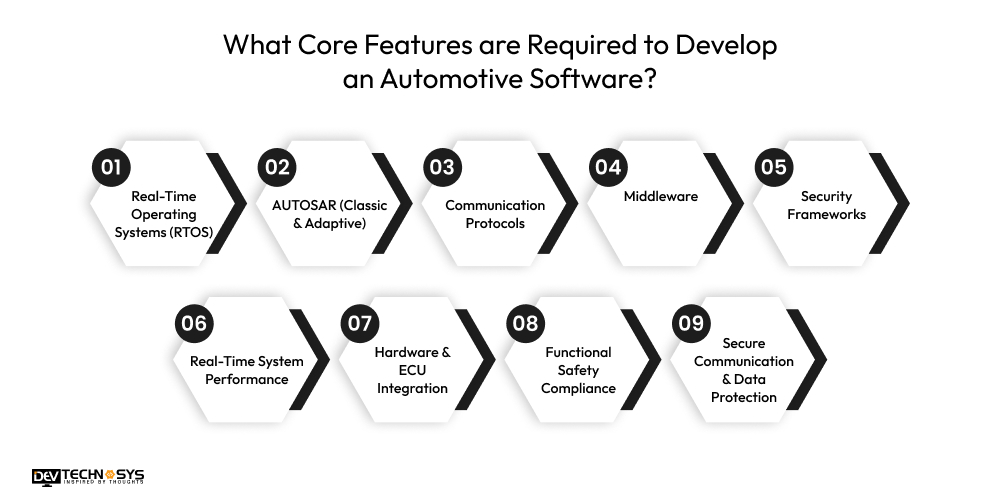
1. Real-Time Operating Systems (RTOS)
An automotive real-time operating system (RTOS) is essential for managing time-critical automotive functions such as braking systems, steering control, airbag deployment, and stability management.
RTOS ensures deterministic task execution, minimal latency, and predictable system behavior, which are vital for maintaining safety and reliability in mission-critical vehicle operations.
2. AUTOSAR (Classic & Adaptive)
AUTOSAR provides a standardized software architecture that enables modular development, scalability, and software reuse across different vehicle platforms.
Classic AUTOSAR Architecture supports real-time embedded ECUs, while Adaptive AUTOSAR is designed for high-performance computing, ADAS, autonomous driving, and service-oriented applications.
3. Communication Protocols
Automotive software must support communication protocols such as CAN, LIN, FlexRay, and Automotive Ethernet to enable seamless data exchange between ECUs, sensors, actuators, and control modules.
It is the main difference between automotive software and embedded software. These protocols ensure reliable, high-speed, and fault-tolerant communication across complex in-vehicle networks.

4. Middleware
Middleware serves as an abstraction layer between hardware and application software, simplifying communication, data exchange, and system interoperability. Automotive software technologies allows developers to manage complexity, integrate multiple software components, and ensure smooth interaction between diverse automotive subsystems.
5. Security Frameworks
Robust security frameworks are critical to protect vehicles from cyber threats and unauthorized access. Features such as encryption, secure boot, firewalls, intrusion detection systems, and secure coding practices ensure data integrity, system resilience, and compliance with automotive cybersecurity regulations.
6. Real-Time System Performance
Automotive software must process large volumes of data with extremely low latency to support safety-critical functions such as braking, steering, airbag activation, and collision avoidance.
AI in software development ensures consistent, real-time performance for faster system responses, reduces failure risk, and enhances overall vehicle safety.
7. Hardware & ECU Integration
Vehicle ECU software development requires seamless integration with electronic control units (ECUs), sensors, actuators, cameras, radar, and LIDAR for accurate data acquisition and coordinated system execution. Effective integration ensures reliable communication between hardware and software, enabling precise control and intelligent vehicle behavior.
8. Functional Safety Compliance
Auto repair shop management software development requires compliance with automotive safety standards, such as ISO 26262. It ensures systematic risk assessment, fault tolerance, redundancy, and safe failure mechanisms. These practices help minimize hazards, improve reliability, and provide the safe operation of safety-critical vehicle systems.
9. Secure Communication & Data Protection
Automotive software must implement secure communication channels using encryption, authentication, and access control mechanisms. These measures protect vehicle systems from cyberattacks, prevent data breaches, and ensure user privacy across connected and autonomous vehicle environments.
What Are The Advanced Features to Include in an Automotive Software?
Now that we have seen the core features of automotive software platforms, let’s discuss the advanced automotive software development features as well. These advanced features are integrated to enhance the software’s performance further.
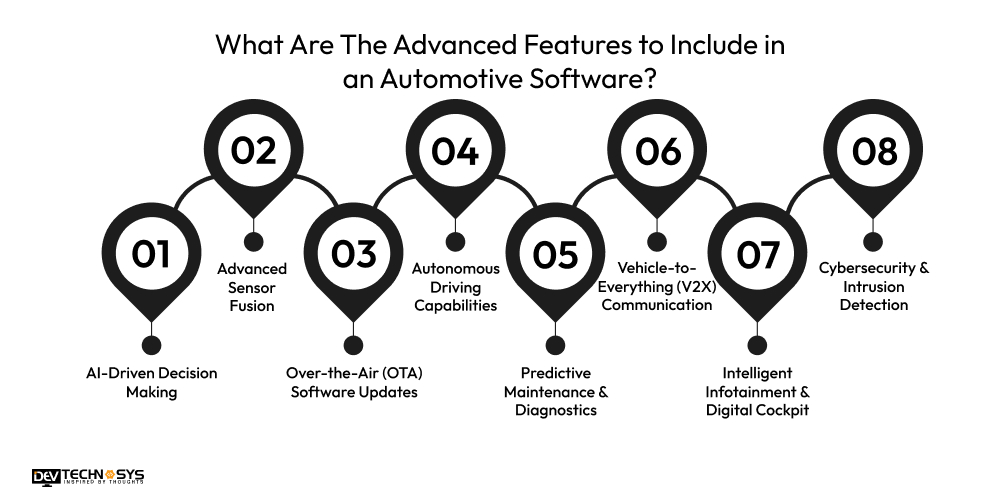
1. AI-Driven Decision Making
Artificial intelligence in autonomous vehicle software enables vehicles to make intelligent, real-time decisions for autonomous driving, ADAS functionalities, driver behavior analysis, and predictive vehicle responses. By analyzing road conditions, traffic patterns, and sensor data, AI improves safety, driving efficiency, and overall vehicle responsiveness.
2. Advanced Sensor Fusion
Advanced sensor fusion combines data from cameras, radar, LIDAR, ultrasonic sensors, and GPS to create an accurate and unified view of the vehicle’s surroundings. This integration improves object detection, depth perception, and reliable navigation in complex and dynamic driving environments.
3. Over-the-Air (OTA) Software Updates
OTA software updates allow automakers to remotely deploy bug fixes, security patches, feature enhancements, and performance improvements without requiring physical service visits.
According to a leading car service app development company, Over-the-Air (OTA) Software updates ensures vehicles remain secure, up to date, and continuously improved throughout their operational lifecycle.
4. Autonomous Driving Capabilities
Support for Level 3 to Level 5 autonomy enables hands-free or fully driverless operation using artificial intelligence, high-definition maps, and real-time environmental analysis. These capabilities significantly enhance road safety, traffic efficiency, and driving convenience.
5. Predictive Maintenance & Diagnostics
Predictive maintenance uses advanced analytics and machine learning to monitor vehicle health, detect early signs of component wear, and forecast potential failures.
Developers providing automotive software development services use this proactive approach to reduce unexpected breakdowns, lower repair costs, and minimize vehicle downtime.
6. Vehicle-to-Everything (V2X) Communication
V2X communication enables vehicles to exchange information with other vehicles, infrastructure, pedestrians, and power grids. This real-time interaction improves traffic flow, prevents collisions, enhances road safety, and supports smart-city and connected-mobility ecosystems.
7. Intelligent Infotainment & Digital Cockpit
Next-generation infotainment and digital cockpit systems deliver enhanced in-car experiences through voice assistants, gesture control, augmented reality dashboards, personalization, and seamless smartphone and cloud integration, improving comfort, usability, and driver engagement.
8. Cybersecurity & Intrusion Detection
Advanced automotive cybersecurity frameworks include encryption, secure boot mechanisms, intrusion detection systems, and real-time threat monitoring. These functional safety (ISO 26262) measures protect vehicles from cyberattacks, unauthorized access, and data breaches, ensuring system integrity and passenger safety.
Conclusion
The above-provided information helps us understand more about automotive software development. From the backbone of modern vehicles to intelligent, connected, and software-defined machines, automotive softwares has come a long way.
If you are a business looking for a top automotive software development company, then contact Dev Technosys. Their skilled automotive software developers create reliable, innovative softwares solutions tailored to your business requirements.
Frequently Asked Questions
Find answers to the most common questions related to this article.
Automotive software development involves creating, testing, and maintaining software systems that control vehicle operations. Examples include:
Safety systems (ADAS, airbags) or In-Vehicle Infotainment Systems (IVI).
Autonomous driving features
Infotainment and digital cockpits
EV battery and power management
Automotive software is different from regular software because of:
Safety-critical and real-time
Hardware-dependent, interacting with sensors, ECUs, and actuators.
Compliant with ISO 26262, AUTOSAR, and UNECE standards
Key technologies that are used in automotive softwares to enable safe, connected, and intelligent vehicles include:
Embedded systems and RTOS
AI and machine learning for decision-making
Cloud platforms and IoT integration
Cybersecurity frameworks and OTA update systems
It manages critical operations such as battery health, charging, and energy optimization; sensor data processing for autonomy; and real-time control of motors and safety systems. It also includes software that ensures efficiency, reliability, and safe autonomous operation.
The future of automotive softwares lies in software-defined vehicles, increased automation, AI-driven intelligence, enhanced connectivity, and continuous updates that evolve vehicles throughout their lifecycle.
Businesses can hire developers by:
Partnering with experienced software development companies
Looking for expertise in embedded systems, AI, and cloud platforms
Evaluating compliance knowledge (ISO 26262, AUTOSAR)
Ensuring experience in connected, autonomous, or EV platforms