















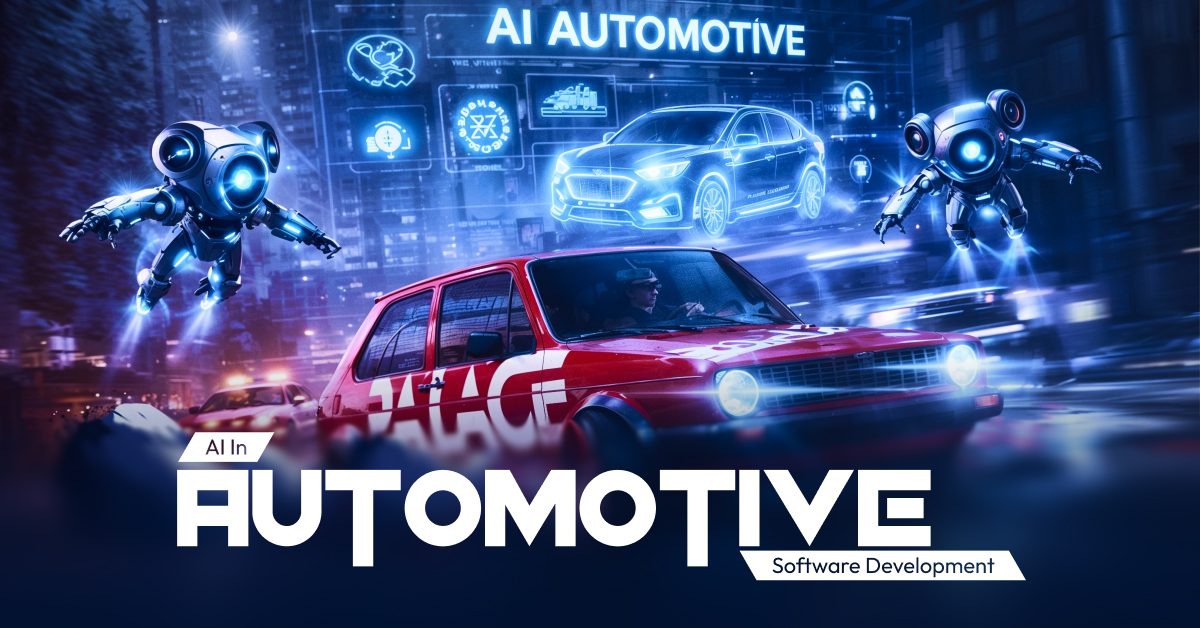
Artificial Intelligence is transforming the design, construction, and user experience of the automotive industry. In automotive software design, AI is a major driving force of innovation, moving beyond a mere predictive concept.
AI is enhancing vehicle functions, from predictive maintenance and autonomous driving to smart infotainment and ADAS (Advanced Driver-Assistance Systems). In conjunction with more sophisticated data analytics, automotive manufacturers can improve and refine safety, efficiency, and personalization on a more dramatic and expansive scale than ever.
This transformation is more than increased levels of automation, introducing adaptive technologies that learn from and through real-world interactions.
This blog will examine the incorporation of AI in automotive software development, explore real-life impactful examples of software, and describe some important design patterns that are helping to reshape the world of vehicles.
In whatever area AI is deployed, be it optimizing sensor fusion, improving manufacturing, or providing a better user experience, AI is driving the rapid advancement of software-defined, smart mobility.
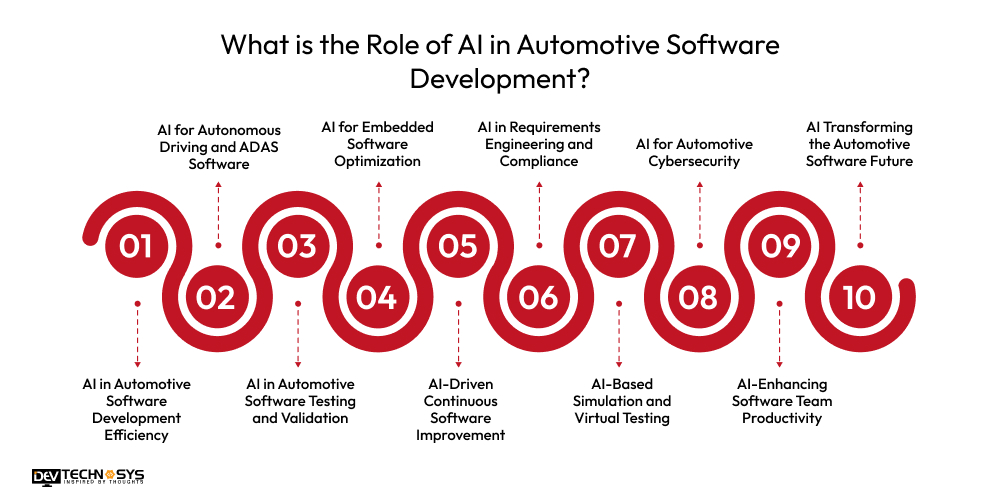
What is the Role of AI in Automotive Software Development?
AI transforms automotive software by enabling autonomous driving, predictive maintenance, and intelligent driver assistance. It accelerates development through automated testing, code optimization, and data-driven design, while enhancing vehicle safety, efficiency, personalization, and real-time decision-making across modern connected and electric vehicles.
1. AI in Automotive Software Development Efficiency
AI in software development increases the efficient creation of automotive software by assisting in code generation, testing, and debugging. It is used in optimizing the software development process and increasing reliability so engineers can concentrate on the intricate design of the systems, validation of safety, and integration of the different platforms in the vehicle (infotainment systems, ADAS, powertrain systems, and connectivity).
2. AI for Autonomous Driving and ADAS Software
AI is essential in the software of advanced driver assistance and autonomous driving. It is used in perception, sensor fusion, localization, prediction, and decision making in the data of the cameras, relying on the radar and lidar. In the world of automotive software, AI is used to develop and train models, simulate situations, validate safety, and improve driving through real-world feedback.
3. AI in Automotive Software Testing and Validation
AI in the software world of automotive increases the quality of testing through the generation of a smarter and efficient testing process, detection of anomalies, and predictive analysis of faults in a more efficacious way. AI in automotive software development increases coverage, decreases costs, and increases the overall quality of testing.
This is especially the case for compliance with the different regulations and standards in the world’s vehicles, automotive programs, and platforms regarding functional safety and cybersecurity in vehicles.
4. AI for Embedded Software Optimization
AI aids optimization of embedded automotive software, regarding performance, memory, and energy consumption. Through machine learning, the adjustment of algorithms to fulfill specific real-time constraints and hardware limitations is critical.
This is particularly important for software to be efficient in an electric vehicle as it will enhance battery life, thermal management, vehicle range, and, in production environments, fleets and markets, increasingly, today’s functionality and safety will be globally improved.

5. AI-Driven Continuous Software Improvement
AI drives automotive software improvement through data-informed continuous development. Vehicles create volumes of operational data. The AI in car rental app development solutions is utilized for operational data bug detection, performance issue detection, and user behavior detection. The insights, in turn, facilitate over-the-air updates and enhance features through personalization and in the brand’s responsiveness to the vehicle to be safer and more intelligent throughout.
6. AI in Requirements Engineering and Compliance
AI aids automotive teams in requirements engineering by analyzing specifications, regulations, and customer feedback. Using Natural Language Processing (NLP), requirements are extracted, and document changes, inconsistencies, and tracing are all cross-referenced.
This is particularly important for improving the alignment of software and hardware to compliance and decreasing rework and the risks of the complex automotive development programs.
7. AI-Based Simulation and Virtual Testing
Simulations powered by artificial intelligence have become important in the development of software for automotive systems, particularly for automation. Engineers rely on AI to facilitate the validation process, minimize the need for physical testing, and provide confirmation that the software is performing in a safe and predictable manner before deploying it on public roads.
AI in car service app development services are able to create millions of driving scenarios, including the uncommon and the potentially dangerous, which is the driving force behind this.
8. AI for Automotive Cybersecurity
AI enhances automotive software cybersecurity by identifying threats, anomalies, and weaknesses in the systems of connected vehicles. As vehicles become dependent on cloud computing, over-the-air updates, and V2X communications, this becomes increasingly relevant. AI is in the modern mobility ecosystems, vehicles, and services that connect the world.
9. AI-Enhancing Software Team Productivity
Artificial intelligence in automotive software development assists in collaboration and enhances the productivity of software development teams. Intelligent systems streamline project management, code reviewing, and documentation, and aid in the management of organizational knowledge.
If businesses build automotive garage software, it improves large-scale development projects around the world by collaborating with teams and learning organizational patterns and workflows in order to forecast delays and allocate resources.
10. AI Transforming the Automotive Software Future
Machine learning for automotive applications enabling smarter, faster, and safer innovation. It integrates data, automation, and intelligence across the development lifecycle. As vehicles become software-defined, AI becomes essential for managing complexity, ensuring quality, accelerating delivery, and creating competitive differentiation in the global automotive industry amid electrification, autonomy, connectivity, regulation, sustainability, competition, and disruption worldwide.
What are the Use Cases of AI in Automotive Software Development?
Let’s explore the type of use cases involved when integrating artificial intelligence in automotive software development. It includes predictive maintenance, an autonomous driving system, in-vehicle personalization, manufacturing control software, traffic and route optimization, and more. So, take a look at the AI use cases in automotive software:
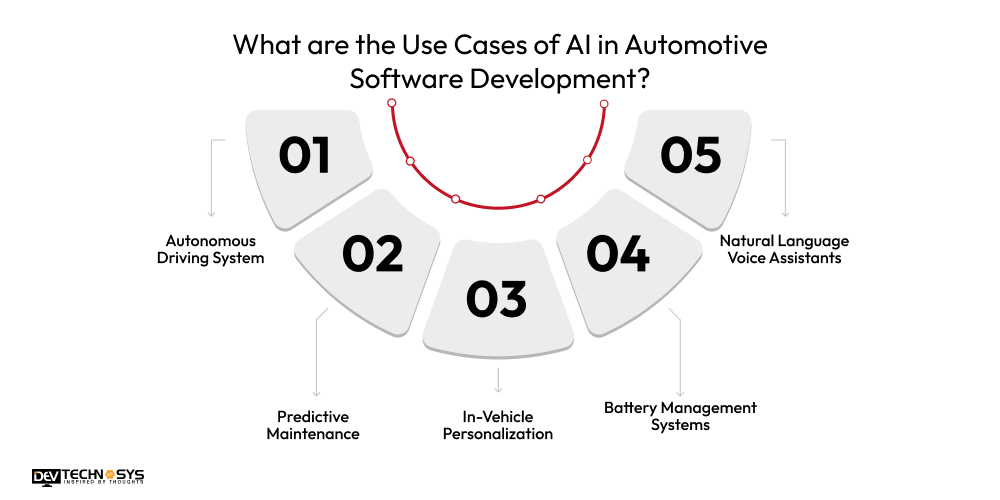
1. Autonomous Driving System
The artificial intelligence in automotive software application development provides a decision-making process and control in self-driving vehicles. AI for autonomous vehicles includes machine learning models that process the data from cameras, radar, sensors, and LiDAR to find objects, plan optimized routes, and predict behavior to execute safe driving. With these capabilities, it can easily handle the complex road environments and focus on real-time inference.
2. Predictive Maintenance
AI-driven automotive solutions observes or analyzes the vehicle’s sensor data to predict maintenance based on component failure. The AI-powered automotive software uses machine learning to identify abnormal patterns in the transmission system, brakes, engine performance, and battery health. These maintenance predictions reduce the maintenance cost, downtime, improve reliability and scalability, and users can schedule the services as per the maintenance time.
3. In-Vehicle Personalization
Automotive software development with AI personalizes infotainment, climate control, seating, and driving preferences based on user behavior. Machine learning models learn driver habits, preferred routes, music choices, and comfort settings. AI-powered infotainment systems enhance user experience, support multi-driver vehicles, and enable seamless personalization across connected vehicles and mobile ecosystems.
4. Battery Management Systems
AI-powered on-demand app development solutions optimize battery performance in electric vehicles by predicting state of charge, state of health, and remaining range. Intelligent vehicle software uses machine learning to model battery degradation, optimize charging strategies, and manage thermal conditions. This improves efficiency, extends battery life, and enhances overall EV reliability.
5. Natural Language Voice Assistants
Automotive AI software solutions enable conversational voice interfaces for navigation, media control, vehicle settings, and customer support. Automotive software integrates speech recognition, natural language understanding, and intent detection. AI in ADAS systems reduces driver distraction, supports hands-free interaction, and continuously improves through learning from user interactions and contextual awareness.
Which AI Technologies are Used in Automotive Software Development?
Do you want to know which AI technologies are used in automotive software development? There are various types of AI technologies that are leveraged to give enhancement to automotive software and streamline their operations. Let’s take a look at the different AI technologies that are used in auto repair shop management software development:
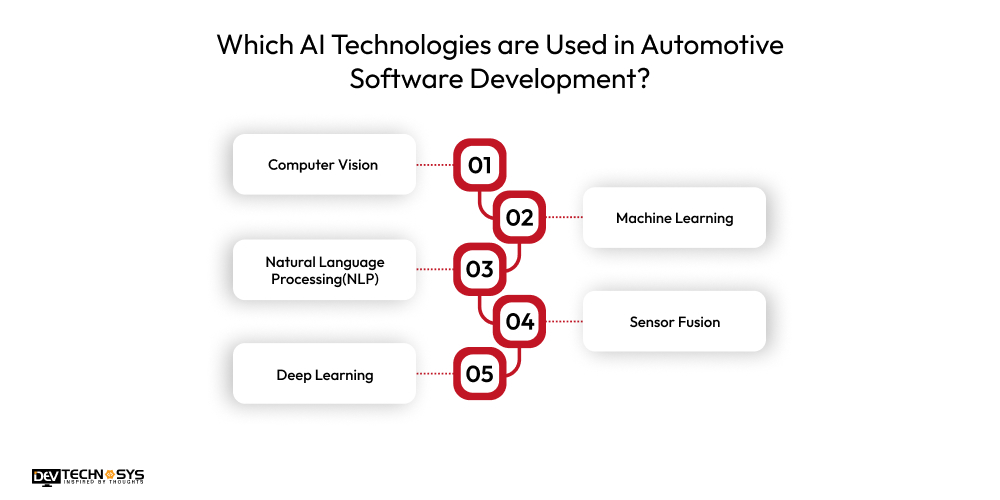
1. Computer Vision
Computer Vision in automotive software allows vehicles to explain visual data through cameras. The automotive software uses computer vision for various operations and tasks such as lane detection, driver monitoring, pedestrian detection, and traffic sign recognition. By using this real-time video data, computer vision enhances the complex road environment, increases safety features, and improves awareness.
2. Machine Learning
Machine learning models for automotive software allow to learn from the data to make informed decisions, and they can also improve performance over time. It is used for various operations and tasks such as personalized recommendations, fault detection, driver behaviour analysis, and predictive maintenance. There are various models of machine learning, such as supervised, unsupervised, and reinforcement help vehicles adapt to real-world conditions and optimize decision-making.
3. Natural Language Processing(NLP)
NLP allows vehicles to understand and respond to human language. Automotive software integrates NLP for voice assistants, navigation commands, infotainment control, and customer support systems.
Integrating NLP when develop an automotive website enables conversational interaction, intent recognition, and contextual understanding, reducing driver distraction and improving user experience through hands-free and intuitive communication. So, it is one of the most used AI technologies in automotive software development.
4. Sensor Fusion
The sensor fusion technology has the ability to combine data from multiple sensors, such as cameras, radars, LiDAR, ultrasonic sensors, and GPS. The sensor fusion AI architecture integrates this data to create an understanding data as per behalf on the vehicle’s surroundings. These automotive sensors depend on sensor fusions to reduce the uncertainty and improve perception accuracy.
5. Deep Learning
Deep learning is a subset of machine learning that uses neural networks to process complex and high-quality data. In automotive software, deep learning uses image recognition, lane tracking, or detection, speech processing, and object detection.
Many of the software development company use deep learning to analyze or observe the large volume of data through ultrasonic sensors, cameras, LiDAR, radars, and more. Deep learning in automotive systems enables vehicle autonomous and ADAS systems.
What is AI Architecture in Automotive Systems?
Automotive AI platforms mainly designs the whole system structure that enables vehicles to collect data, process intelligence, and make informed decisions in real-time. AI architecture mainly defines how software, hardware, data pipelines, and AI models work together and what they provide as a result. So, let’s explore the various smart car software systems architecture:
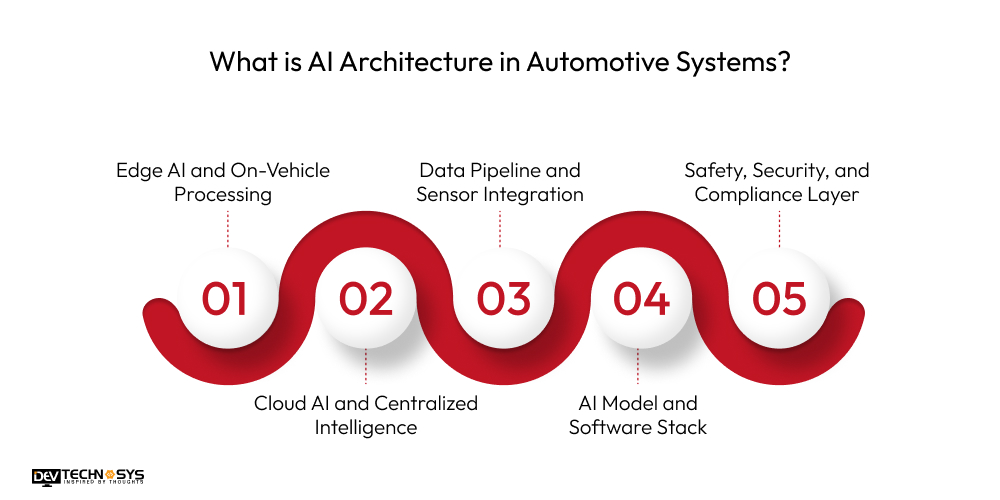
1. Edge AI and On-Vehicle Processing
Edge AI in automotive applications enables real-time decision-making by processing data directly within the vehicle using ECUs, SoCs, GPUs, or NPUs. This approach minimizes latency, reduces dependency on cloud connectivity, and enhances safety for time-critical applications like braking, collision avoidance, and driver monitoring.
Edge processing is essential for autonomous driving and ADAS, where millisecond-level responses and high reliability are required under varying road and environmental conditions.
2. Cloud AI and Centralized Intelligence
Cloud-based AI automotive platforms support large-scale data storage, model training, fleet learning, and analytics across multiple vehicles. High-performance cloud platforms process vast datasets collected from sensors, user interactions, and vehicle telemetry.
Trained models are then deployed back to vehicles via OTA updates. Cloud intelligence enables continuous improvement, predictive maintenance, and cross-vehicle insights while offloading heavy computation from onboard systems.
Want a chatbot demo or pricing? Fill the form and talk to our experts today.
Pick what you need below — you can select more than one — then tap Get detail to continue.
-
Chatbot demo dashboard
-
Cost to develop an app
-
Industry report
-
Case study
3. Data Pipeline and Sensor Integration
The data pipeline connects diverse sensor inputs such as cameras, LiDAR, radar, GPS, and CAN bus data into a unified processing framework. AI data pipelines in automotive software include data ingestion, synchronization, preprocessing, labeling, and storage.
Efficient data pipelines ensure high-quality datasets for AI model training and inference. Proper sensor fusion enhances perception accuracy, environmental understanding, and decision-making reliability in complex driving scenarios.
4. AI Model and Software Stack
The AI model stack consists of machine learning, deep learning, and reinforcement learning models deployed within automotive software frameworks. These models handle perception, prediction, planning, and control tasks.
The software stack integrates middleware, real-time operating systems, AUTOSAR, and ROS2 to ensure deterministic behavior. Optimized inference engines balance performance, power efficiency, and safety constraints across different vehicle platforms.
5. Safety, Security, and Compliance Layer
This layer ensures AI systems meet stringent automotive safety and cybersecurity standards. It includes functional safety (ISO 26262), SOTIF compliance, secure boot, encryption, and intrusion detection.
AI validation, redundancy, and fail-safe mechanisms are critical for risk mitigation. Explainable AI and continuous monitoring help ensure predictable behavior, regulatory compliance, and trustworthiness in safety-critical automotive applications.
7 Real World Examples: AI-Powered Automotive Software
Do you still think that it is imaginary to integrate artificial intelligence in vehicle systems development? To wake you up in reality, there are various real-world examples that already integrate AI in their automotive software and streamline their daily operations. So, let’s take a look at the existing AI-based driver monitoring systems:
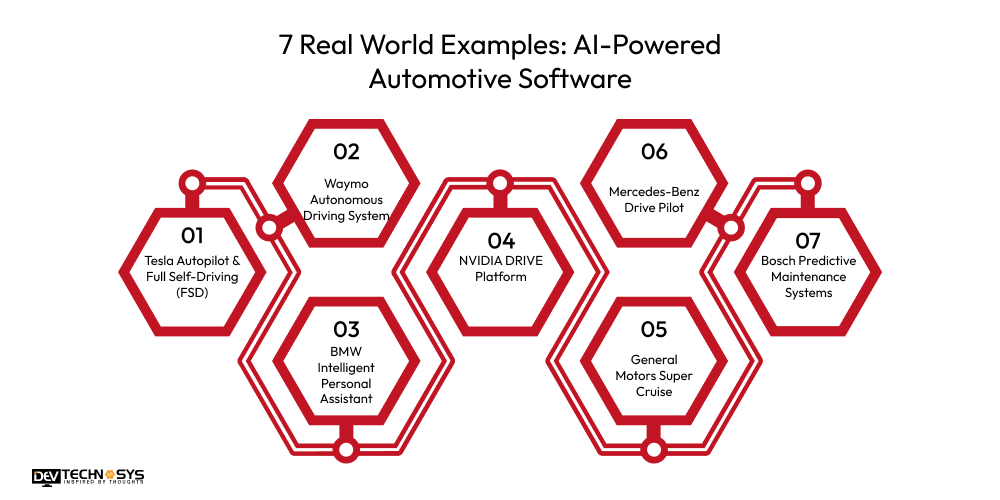
1. Tesla Autopilot & Full Self-Driving (FSD)
Tesla’s AI Neural Networks power the processing of data collected from cameras and sensors on-board vehicles to create an AI system that is able to provide recommendations about what action(s) the car should take when it comes to driving (e.g., lane-keeping, adaptive cruise control,/change lanes, park) while driving. With every new vehicle manufactured and sold, Tesla continues to gather data and improve the safety, accuracy, and performance.
2. Waymo Autonomous Driving System
Waymo’s AI software uses Machine Learning and Computer Vision technologies along with Sensor Fusion to create a 100% autonomous vehicle. Waymo’s AI software can interpret traffic signals/stop signs; understand/detect pedestrians, cyclists, and other environmental obstacles; and determine available/optimal path options in real-time. If businesses build an automotive software scratch like Waymo, it operates a Robotaxi service that uses this AI software and successfully demonstrates the ability of such vehicles to drive.
3. BMW Intelligent Personal Assistant
The BMW Group uses Artificial Intelligence-based Voice Assistants (AIVAs) to better interact with drivers. BMW’s AIVAs apply Natural Language Processing (NLP) to understand spoken commands from drivers in order to control a variety of vehicle functions (e.g., navigation systems, climate control systems, infotainment systems, and vehicle settings) in a way similar to how humans would interact with one another. As BMW continues to develop these AIVAs, they will become increasingly sophisticated, delivering responses.
4. NVIDIA DRIVE Platform
NVIDIA DRIVE is an AI computing platform that automotive manufacturers utilize to develop automobiles capable of implementing autonomous or semi-autonomous driving functions.
This AI platform supports Perception (the ability to understand and interpret the environment), Localization (the ability to know precisely where the vehicle is located), and Path Planning (the process of choosing the best route from point A to point B) by utilizing Deep Learning models.
5. General Motors Super Cruise
GM uses an advanced version of its Super Cruise technology that is built on LiDAR-based highway mapping and integrates cameras, sensors, and AI to create the environment for hands-free driving.
The system utilizes infrared cameras to monitor the driver’s level of attention and adjusts the vehicle’s behavior based on this information. Automotive SaaS software for enterprises facilitates the safe centering of lanes, adaptive speed control, and the transition from manual to automated driving.
6. Mercedes-Benz Drive Pilot
Mercedes-Benz developed a Drive Pilot system that provides Level 3 autonomy using AI in specific situations. It processes data collected from various sensors, including those used to steer, brake, and accelerate. Utilizing the AI platform, redundancy systems increase safety by allowing the driver to take control of their vehicle during heavy traffic while still adhering to governmental regulations.
7. Bosch Predictive Maintenance Systems
Bosch developed a predictive maintenance system using AI to ascertain that components are failing before they actually fail. It does this by monitoring driving behavior and vehicle diagnostics in conjunction with sensor data to determine the maintenance requirements of a vehicle prior to it breaking down. As such, the number of breakdowns is decreased, and repair costs are lessened, while the ability to use a vehicle as part of a fleet increases the reliability of that vehicle.
What Challenges Are Faced When AI is Integrated in Automotive Software Development?
There are a higher number of challenges faced when AI is integrated into automotive software development. It involves higher development and operation costs, continuous OTA updates, data privacy risks, functional safety, real-time performance constraints, and more. Let’s observe the challenges one by one:
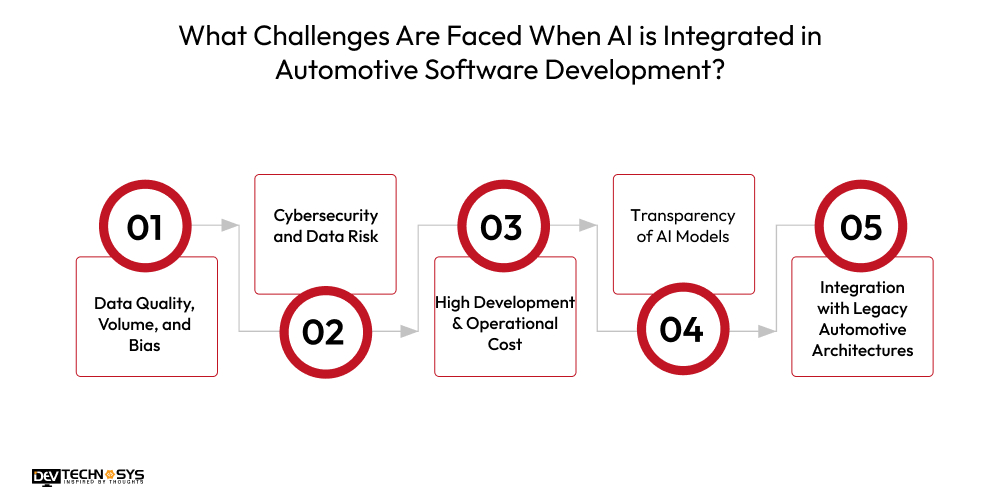
1. Data Quality, Volume, and Bias
The AI systems require a vast amount of quality and labelled data from various driving conditions. To collect clean and annotated data, it is very expensive and time-consuming.
The biased and incomplete data can lead to wrong and unsafe decisions, such as varying weather conditions, poor object detection in rare cases, and predicting wrong driver behaviours.
2. Cybersecurity and Data Risk
Move to the second challenge, most of the cognitive computing in vehicles collect sensitive information such as location, driver behaviour, and sensor feeds. It increases the cyber threats of various types, such as data manipulation, data poisoning, and unauthorized accessibility.
According to the automotive software development company, these automotive software implement strong security and privacy measures such as ISO/SAE 21434 or many more.
3. High Development & Operational Cost
In this third challenge, when integrating artificial intelligence in automotive industry, there are various AI models implemented, such as data collection, labelling, specialized hardware, skilled talent, and compute infrastructure.
There are also ongoing AI models costs such as training, validation, deployment, and maintenance. It can be challenging for small manufacturers or organizations to handle the higher development and operational costs.
4. Transparency of AI Models
Many autonomous vehicle AI, especially deep neural networks, act as “black boxes,” making it hard to understand or explain their decisions. This lack of transparency complicates debugging, safety validation, and regulatory approval.
Hiring an experienced artificial intelligence development company to integrate Explainable AI (XAI) for building trust among regulators, engineers, and end users, but it remains a technical challenge.
5. Integration with Legacy Automotive Architectures
Automotive software intelligence often rely on legacy ECUs, AUTOSAR-based platforms, and distributed architectures not designed for AI workloads. Integrating AI software into these environments requires significant re-engineering. Compatibility issues, limited computing resources, and communication bottlenecks increase complexity and development time, especially during transitions to centralized or software-defined vehicle architectures.
How Dev Technosys Will Help You?
In this blog, we explored artificial intelligence in automotive software development and what is the main roles. We hope that you got the answers to your raised questions and why it is beneficial to integrate AI in a specific industry for your businesses. This blog covered various related terms, such as key use cases, AI technologies that are used in automotive software development, AI-powered real-world automotive software, challenges faced when integrating AI, and more.
Do you also want to integrate AI in your existing platform or new ones? Then connect with Dev Technosys as an AI development company that provides affordable development and integration services.