



















Building automotive software from scratch in 2026 requires a perfect combination of advanced tools and technical expertise, awareness of regulations, and user-centric design. With vehicles rapidly evolving into software-defined, connected, and autonomous systems, automotive software now drives safety, performance, infotainment, and real-time decision-making.
This automotive software development guide will introduce you to the crucial technologies and architectural considerations needed to build a scalable, future-ready solution. Whether it’s embedded systems and AI-powered driver assistance, to cloud connectivity and cybersecurity. Developers must also account for strict automotive standards, interoperability, and long-term maintainability.
In this blog, we will learn the vehicle software development process step by step. So, if you are someone looking to understand how to build an automotive software in 2026, then you have landed on the right place. Now, without waiting further, let’s dive in!
What is Automotive Software?
Automotive software comprises embedded programs, applications, and digital systems that control, monitor, and enhance vehicle functionality. It plays a critical role in managing core operations, including engine control, braking, steering, infotainment, navigation, connectivity, diagnostics, ADAS, and autonomous driving.
In modern automotive software development, vehicle softwares enables real-time data processing, vehicle-to-vehicle (V2V) and vehicle-to-infrastructure (V2I) communication, predictive maintenance, and over-the-air (OTA) updates. As vehicles evolve into software-defined platforms, vehicle software development becomes essential for improving safety, performance, user experience, and regulatory compliance.
What Are The Top Automotive Softwares and Tools to Consider?
Before diving into the on demand app development of automotive softwares, let’s first take a look at these top 10 automotive softwares and tools to consider. All these softwares help automotive businesses accelerate development, ensure compliance, and deliver smarter, software-defined vehicles.
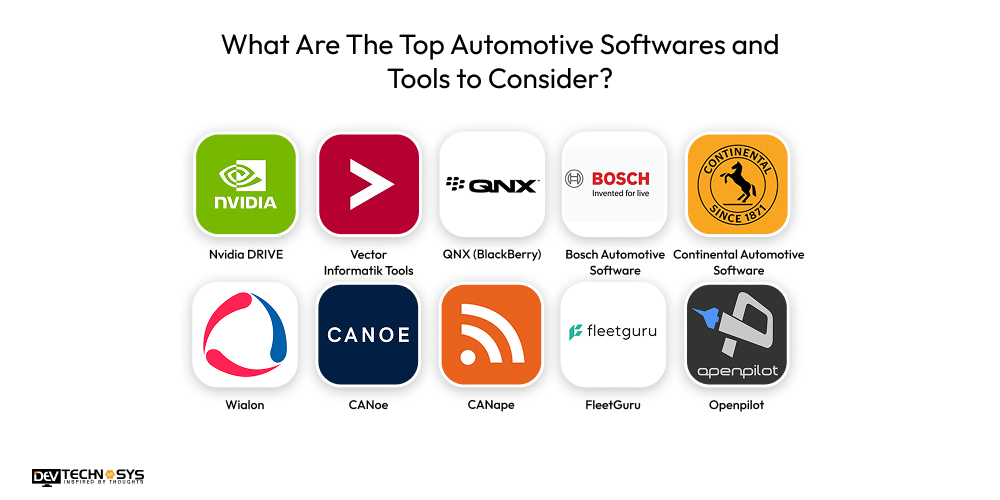
| Software / Tool | Launch Year | Rating (Out of 5) | Platform Availability |
| Nvidia DRIVE | 2015 | 4.3/5 | Linux, NVIDIA Automotive SoCs |
| Vector Informatik Tools | 1988 | 4.0/5 | Windows |
| QNX (BlackBerry) | 1982 | 4.6/5 | Embedded (ARM, x86) |
| Bosch Automotive Software | 2000s | 4.0/5 | Embedded, Cloud |
| Continental Automotive Software | 2000s | 4.0/5 | Embedded, Telematics |
| Wialon | 2007 | 4.0/5 | Web, Mobile |
| CANoe | 1996 | 4.2/5 | Windows |
| CANape | 1990s | 4.0/5 | Windows |
| FleetGuru | 2010s | 3.8/5 | Web, Cloud |
| Openpilot | 2016 | 4.1/5 | AGNOS |
How to Develop an Automotive Software From Scratch?
Before reaching out to an artificial intelligence development company to build an automotive software, it’s crucial to understand the autonomous vehicle software development process a bit. Here we present the simple steps to help you better understand the process to build an automotive software.
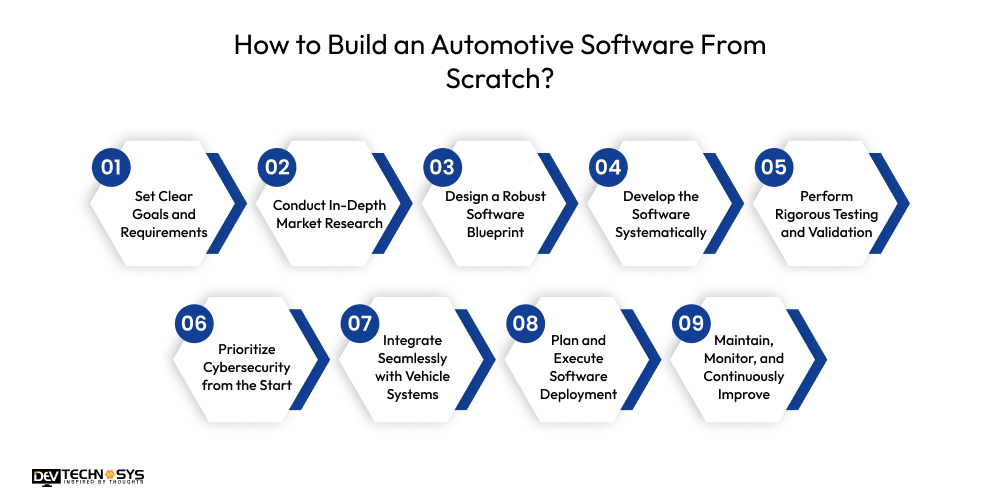
1. Set Clear Goals and Requirements
The foundation of successful automotive mobile app development solutions begins with clearly defining goals, objectives, and functional requirements. Engage with key stakeholders such as vehicle manufacturers, OEMs, auto repair shops, fleet operators, and end users to gather diverse perspectives.
Identify core business goals, technical constraints, compliance requirements, and user expectations. This stage to make an automotive software also involves finalizing essential features, performance benchmarks, and safety considerations to ensure alignment throughout the development lifecycle.
2. Conduct In-Depth Market Research
To develop an automotive software, conduct in-depth market research. Thorough market research helps you understand industry trends, customer preferences, and competitor strategies.
Experts who provide car service app development services analyze the existing automotive software platforms to evaluate their strengths, weaknesses, pricing models, and user experience.
Collect direct feedback through surveys, interviews, and focus groups to identify unmet needs and feature gaps. These insights help you design a solution that delivers unique value and meets real-world demands.
3. Design a Robust Software Blueprint
Develop an automotive software with a robust software blueprint to ensure scalability and reliability. To build automotive software, create detailed system architecture diagrams that outline software components, data flows, integrations, and communication protocols.
Select appropriate programming languages, automotive software frameworks, operating systems, and cloud platforms that support performance, modularity, and future upgrades. If you want to build automotive garage software, ensure your design supports OTA updates, third-party integrations, and regulatory compliance.
| Layer | Technology Stack |
| Programming Languages | C, C++, Python, Java |
| Embedded Systems & OS | AUTOSAR, QNX, Android Automotive |
| Frontend / UI | Qt, Flutter, React Native |
| Automotive Backend Software | Node.js, Java Spring Boot, Django |
| Communication Protocols | CAN, LIN, Ethernet, MQTT |
| Cloud Platforms | AWS, Azure, Google Cloud |
| Databases | PostgreSQL, MongoDB, Redis |
| AI & Computer Vision | TensorFlow, PyTorch, OpenCV |
| Cybersecurity | TLS/SSL, PKI, Secure Boot |
| DevOps & OTA update automotive software | Docker, Kubernetes, Jenkins, OTA Tools |
4. Develop the Software Systematically
Once the architecture is defined, initiate development of the car rental app development solutions using a structured, methodical approach. Break the system into manageable modules and build each component in accordance with design specifics and automotive coding standards.
Add agile automotive middleware software development practices to enable iterative releases, continuous integration, and frequent feedback loops. Developing cloud-based automotive software systematically enables early defect identification and improves overall software quality.
5. Perform Rigorous Testing and Validation
Testing is a critical phase to ensure software functionality, performance, and safety. Conduct unit testing, integration testing, system testing, and user acceptance testing across various scenarios and environments.
Give special attention to safety-critical features and compliance with automotive standards. Automated testing tools can increase coverage, reduce errors, and accelerate validation. Take a look at this testing table to understand the process clearly:
| Testing Type | Purpose |
| Unit Testing | Validate individual modules |
| Integration Testing | Check module interactions |
| System Testing | Test the complete system |
| Performance Testing | Measure speed and stability |
| Security Testing | Detect vulnerabilities |
| Compliance Testing | Meet industry standards |
| UAT | Validate user requirements |

6. Prioritize Cybersecurity from the Start
As vehicles are becoming more and more connected, cybersecurity has become a major concern. So, if you want to build an automotive software, ensure you add robust cybersecurity measures.
Implement robust security measures, including encryption, secure boot mechanisms, access controls, and intrusion detection systems. Regular security audits, vulnerability assessments, and penetration testing help identify risks early and protect sensitive vehicle and user data from cyber threats.
7. Integrate Seamlessly with Vehicle Systems
Integrating automotive software with vehicle hardware and electronic control units (ECUs) is both complex and essential. Ensure that your automotive SaaS Software for Enterprises communicates effectively with vehicle systems using standardized protocols and interfaces.
Continuous testing during integration ensures stability, improves performance, and guarantees that the software operates reliably within the vehicle’s real-world environment.
8. Plan and Execute Software Deployment
Automotive software deployment requires careful coordination among development teams, service providers, and stakeholders. Prepare detailed deployment strategies, including installation methods, OTA delivery, rollback plans, and monitoring processes. Provide comprehensive documentation and training materials for technicians and end users to support smooth adoption and minimize operational disruptions.
9. Maintain, Monitor, and Continuously Improve
According to a software development company, post-deployment maintenance is crucial for long-term success. Plan for regular updates, bug fixes, security patches, and feature enhancements. Continuously monitor software performance, system logs, and user feedback to identify improvement opportunities. Ongoing maintenance ensures compatibility with evolving vehicle technologies, regulatory updates, and changing user expectations.
What are the Key Features that Can be Included in the Automotive Software?
To build an automotive software in U.S, you need to add a set of features and functionalities. Here are some of the user, manufacturer, and system features to incorporate to create an automotive software. Whether you want telematics software development or IoT automotive software development too.
| User Features | Admin Features | System Features |
| Vehicle Dashboard | Vehicle Management | Telematics Engine |
| ADAS & Safety | Fleet Monitoring | AI & Analytics |
| Navigation & Routing | OTA Management | Cybersecurity |
| Infotainment | Diagnostics | Cloud Infrastructure |
| Remote Vehicle Control | Compliance & Reports | API Integrations |
| OTA Updates | Subscription Management | System Monitoring |
| User Personalization | Predictive Maintenance | Data Management |
How to Choose the Best Automotive Software Development Company?
Do you want to develop automotive software but are confused which company to approach? To make the process of selecting the right development partner easier, we’ve compiled a list of key factors to consider before choosing the best automotive software developer for your project. Take a look:
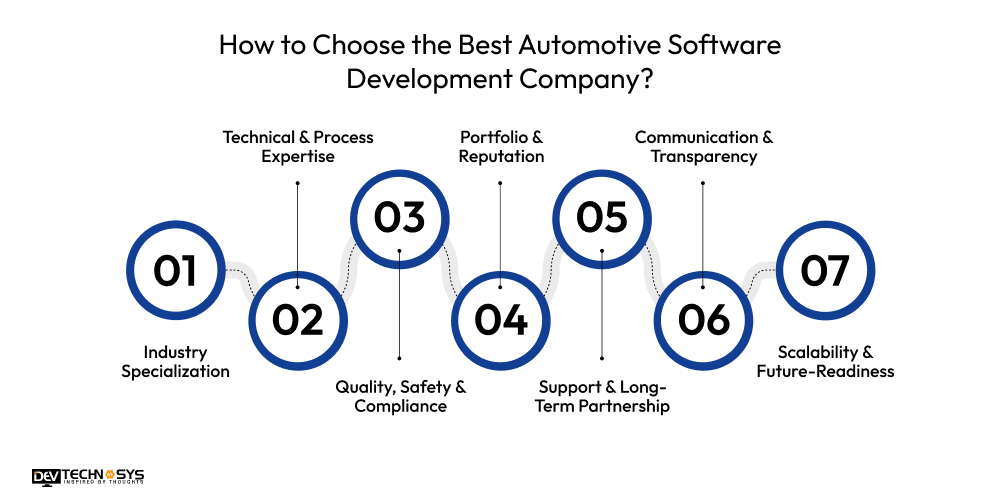
1. Industry Specialization
Selecting an AI development company with strong automotive industry specialization is critical to project success. Look for teams experienced in developing software for connected vehicles, electric vehicles (EVs), ADAS, infotainment systems, or fleet management platforms.
Industry-focused companies understand vehicle architectures, ECU integration, communication protocols, and real-world automotive challenges, thereby reducing risks and development time.
2. Technical & Process Expertise
A reliable automotive software development company should demonstrate deep technical expertise across embedded systems, cloud infrastructure, AI, data analytics, and mobile platforms. Businesses should select a provider with an in-depth understanding of automotive software development trends.
Additionally, the type of development process used is equally important. See if they utilize agile methodologies, continuous integration, and clear documentation, which ensure transparency, faster iterations, and consistent software quality throughout the project lifecycle.
3. Quality, Safety & Compliance
Automotive software must adhere to strict safety, performance, and regulatory requirements. Ensure the connected car software development company adheres to industry standards, including ISO 26262, AUTOSAR, ASPICE, and cybersecurity regulations. Strong QA practices, automated testing, and security audits help deliver reliable, safe, and compliant automotive solutions.
Want a chatbot demo or pricing? Fill the form and talk to our experts today.
Pick what you need below — you can select more than one — then tap Get detail to continue.
-
Chatbot demo dashboard
-
Cost to develop an app
-
Industry report
-
Case study
4. Portfolio & Reputation
Review the portfolio of the providers who create an automotive software to assess the complexity and scale of the projects they have delivered. Case studies, client testimonials, and industry recognition provide insight into their technical capabilities, problem-solving approach, and reliability. A strong reputation reflects consistent performance and long-term client trust.
5. Support & Long-Term Partnership
ADAS software development requires ongoing updates, maintenance, and enhancements. Choose a company that offers long-term support, proactive monitoring, and post-deployment services. A true Auto repair shop management software development partner will create an automotive software that adapts to evolving technologies, regulatory changes, and business goals, ensuring sustained success beyond launch.
6. Communication & Transparency
Clear and consistent communication is essential for the success of any automotive software development project. Choose a company that maintains transparency in project planning, timelines, progress updates, and cost structures. Regular reporting, dedicated project managers, and collaborative tools help ensure alignment, reduce misunderstandings, and keep stakeholders informed throughout the development lifecycle.
7. Scalability & Future-Readiness
Automotive software must be built with future growth in mind. Select a development company that designs scalable architectures capable of supporting new features, integrations, and emerging technologies such as autonomous driving, AI enhancements, and electric vehicle advancements. A future-ready approach ensures your software remains competitive, adaptable, and relevant as the automotive industry continues to evolve.
Conclusion
We hope this blog helped resolve your queries regarding automotive software development. Through this blog, we explained the car software development lifecycle in detail.
Understanding each stage of the process is essential for building secure, scalable, and future-ready automotive solutions. If you are a business looking for a leading automotive software development company for your project, then contact Dev Technosys. Their 150+ qualified automotive software developers deliver high-performing automotive solutions as per your business needs.
Frequently Asked Questions
Find answers to the most common questions related to this article.
Automotive software development focuses on building digital systems that control, monitor, and enhance vehicle operations, including safety, navigation, infotainment, connectivity, and performance, using embedded software, cloud platforms, and AI-driven technologies.
Development timelines vary based on features and complexity. A basic automotive software solution typically takes four to six months, while advanced systems with ADAS, AI, cloud integration, and testing can require nine to eighteen months.
Automotive software in 2026 uses technologies like C/C++, Python, AUTOSAR, QNX, Embedded Linux, cloud platforms, AI frameworks, vehicle communication protocols, cybersecurity tools, and DevOps pipelines for scalable, secure development.
As vehicles become highly connected, cybersecurity protects onboard systems, communication networks, and user data from hacking, unauthorized access, and safety risks, ensuring secure operations and compliance with global automotive regulations.
Automotive software must comply with standards like ISO 26262, AUTOSAR, ASPICE, and UNECE regulations to ensure functional safety, reliability, cybersecurity compliance, and alignment with global automotive industry requirements.
Choose a company with automotive domain expertise, strong technical capabilities, proven compliance knowledge, a solid portfolio, and long-term support services to ensure scalable, secure, and future-ready automotive software development.
Yes, modern automotive software supports over-the-air updates, enabling manufacturers to deploy new features, performance improvements, bug fixes, and security patches remotely without requiring physical service center visits.