




















Fueled by advanced technologies, the software industry has undergone a drastic revolution in recent years. In Japan, the rise of electric vehicles will significantly benefit the expanding auto industry. And it has taken the importance of automotive software development to greater heights. From engine control to autonomous driving, automotive software is the backbone of modern vehicles.
However, understanding and determining the automotive software development cost in Japan can be challenging. But have no worries, we’re here to help you. This blog will walk you through the market analysis, typical costs, factors impacting it, and everything you need to know about automotive software development.
Overview of the Automotive Software Market in Japan
The automotive software market in Japan is led by diversification and innovation. The manufacturers are constantly reinventing and offering high-end and dependable automotive software systems.
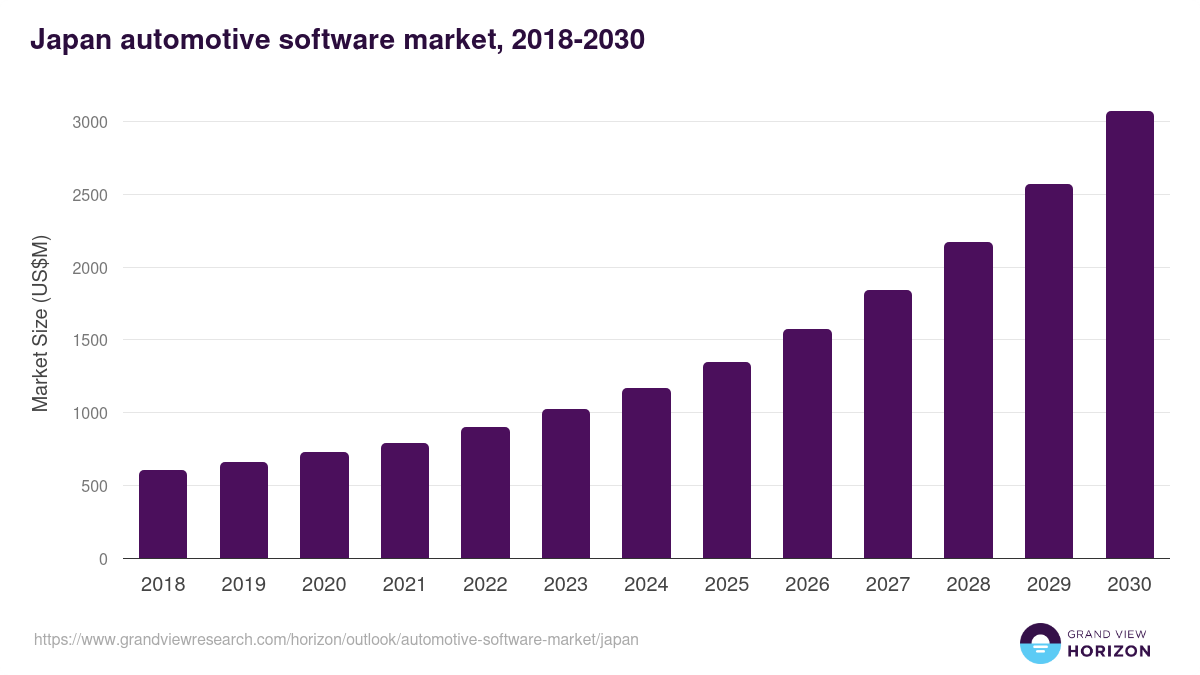
- From 2025 to 2030, the automotive software market in Japan is estimated to grow at a 17.9% CAGR.
- It is projected to generate revenue of USD 3,072.1 million by 2030.
- In 2024, it generated a revenue of USD 1,169.2 million.
- In-car voice assistant is the most lucrative and fast-growing segment.
- In 2024, Japan accounted for 4.0% of the global automotive software market.
What is the Cost to Develop Automotive Software in Japan?
The cost of automotive software development Japan varies depending on multiple factors. So if you’re planning to build automotive garage software, understanding the cost implications clearly is vital for effective budgeting. The average automotive software development cost in Japan ranges from ¥1,246,400 to ¥3,895,000. In the table below, we provide you with a detailed breakdown of developing automotive software in Japan.
| Software Complexity | Key Features | Estimated Development Time | Cost Range (JPY) |
| Basic | Diagnostics, sensor monitoring, basic UI | 2–3 months | ¥1,246,400 – ¥1,800,000 |
| Mid-Level | Infotainment, navigation, OTA updates | 4–6 months | ¥1,800,000 – ¥2,800,000 |
| Advanced | ADAS, AI/ML, cloud integration, cybersecurity | 6–9 months | ¥2,800,000 – ¥3,895,000 |
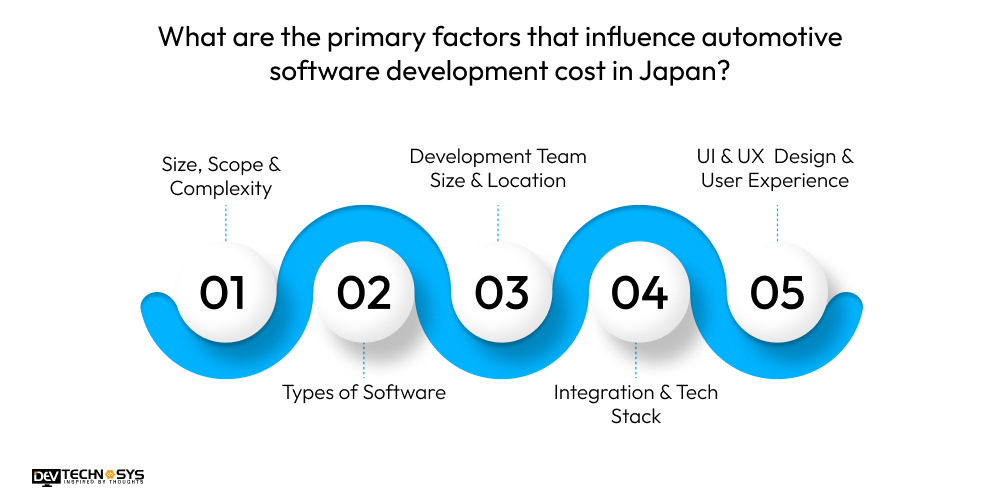
What are the primary factors that influence automotive software development cost in Japan?
The nature of automotive software development is dynamic. Making an investment in Japan’s automotive software development varies depending on plenty of factors. Understanding of these factors is critical for planning an adequate and better budget for the automotive app development. So let’s dive into these factors that you must consider.
1. Size, Scope & Complexity
The most significant factor that affects automotive software development cost and its scope and complexity. More complex projects will require a higher workforce, resources, time, and expenses. The scope involves features and functionalities that the software wil deliver.
| Level | % of Overall Cost | Estimated Cost (JPY) |
| Low | 30% | ¥372,000 |
| Typical | 37.5% | ¥959,000 |
| High | 45% | ¥1,743,750 |
2. Types of Software
Different types of software have varying levels of complexity, with different demands and require different levels of expertise and technical architecture. ADAS modules, Infotainment systems, and BMS are some of the major softwares that influence Japan automotive software development pricing.
| Level | % of Overall Cost | Estimated Cost (JPY) |
| Low | 20% | ¥248,000 |
| Typical | 27.5% | ¥703,000 |
| High | 35% | ¥1,356,250 |
3. Development Team Size & Location
Whether it’s in-house, offshore, or hybrid, the geographic location of your software development company will vastly affect the development cost. The professionalism, cost of living, and competition levels vary per region. And these variations will have a direct impact on your final price.
| Level | % of Overall Cost | Estimated Cost (JPY) |
| Low | 10% | ¥124,000 |
| Typical | 17.5% | ¥447,500 |
| High | 25% | ¥968,750 |
4. Integration & Tech Stack
The choice of technology stack will overall determine your vehicle software development cost Japan. The impact on the cost will be through the choice of frameworks, programming language, developer availability, licensing fee, and integration complexity.
| Level | % of Overall Cost | Estimated Cost (JPY) |
| Low | 10% | ¥124,000 |
| Typical | 15.5% | ¥383,500 |
| High | 20% | ¥775,000 |
5. UI & UX Design & User Experience
User interface and experience are another key factor that influences the cost of automotive software development Japan. It includes user journey, visual elements, interaction complexity, and general usability optimization. A custom UI & UX design will consume more money, time, and effort.
| Level | % of Overall Cost | Estimated Cost (JPY) |
| Low | 5% | ¥62,000 |
| Typical | 10% | ¥255,750 |
| High | 15% | ¥581,250 |
Pricing Examples / Case Studies
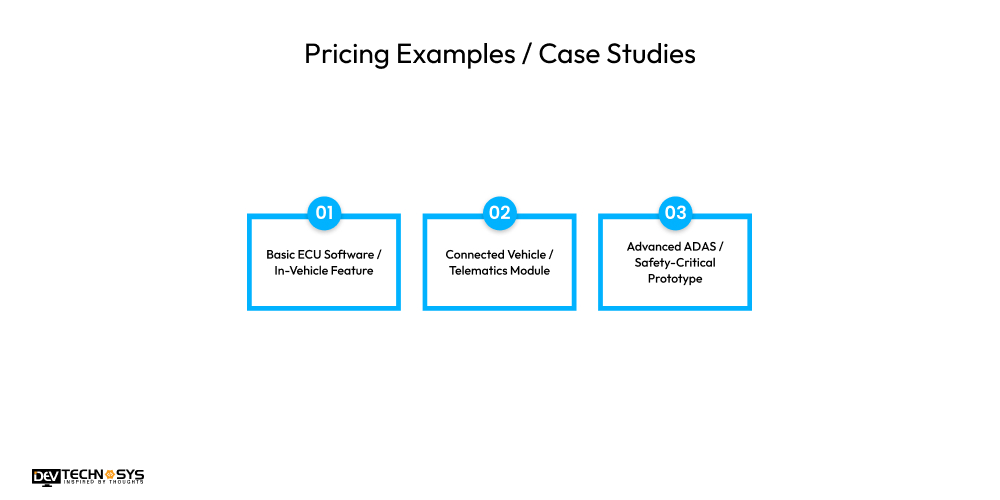
Automotive custom software development Japan requires long-term maintainability, structured development, and rigorous validation. Japan’s realm of automotive software development is shaped by its strong safety culture and high engineering standards. Below are three case studies that represent realistic aspects of the sector.
1. Basic ECU Software / In-Vehicle Feature
This case study deals with a single in-vehicle feature that runs on the ECU. It usually operates within an existing car architecture. Automotive software developers Japan use an established automotive framework to develop this software.
| Cost Component | Estimated Cost (JPY) |
| Core Development | ¥623,200 |
| Testing & Validation | ¥249,280 |
| Project Management | ¥124,640 |
| Tools & Environment Setup | ¥124,640 |
| Buffer / Risk Margin | ¥124,640 |
| Total | ¥1,246,400 |
2. Connected Vehicle / Telematics Module
By keeping future scalability in mind, the second case study involves creating a connected vehicle software module. It supports OTA readiness, APIs integrations, and cybersecurity practices. Testing includes network reliability checks and system integration testing.
| Cost Component | Estimated Cost (JPY) |
| Development (Embedded + Backend) | ¥1,156,815 |
| Testing & QA | ¥514,140 |
| Project Management | ¥308,484 |
| System Integration | ¥334,191 |
| UI / Dashboard (Basic) | ¥128,535 |
| Buffer / Risk Margin | ¥128,535 |
| Total | ¥2,570,700 |
3. Advanced ADAS / Safety-Critical Prototype
With a major focus on ADAS, this case study involves a highly complex automotive software development. It includes reliability, deterministic behavior, and traceability. Testing is extensive with SIL/HIL validation and performance benchmarking.
| Cost Component | Estimated Cost (JPY) |
| Core Development | ¥1,558,000 |
| Testing & Validation | ¥973,750 |
| Project Management | ¥389,500 |
| Backend & Data Handling | ¥467,400 |
| Safety & Compliance Preparation | ¥311,600 |
| Buffer / Risk Margin | ¥194,750 |
| Total | ¥3,895,000 |
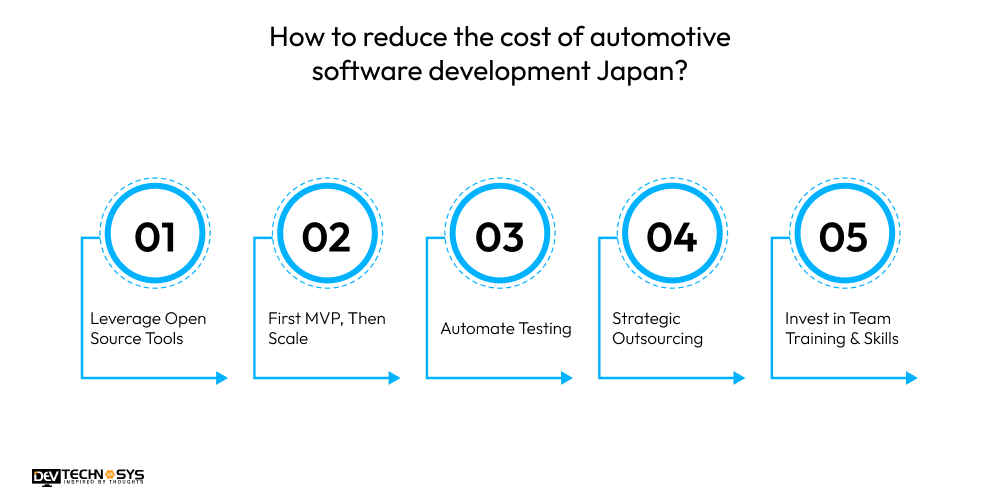
How to reduce the cost of automotive software development Japan?
Understanding the market analysis and factors affecting the cost is just the start of your journey into automotive software development cost in Japan. The real deal is to optimize your automotive software development budget effectively by delivering a strong product. So we gathered some of the tested tips to make the
automotive custom software development Japan more predictable, affordable, and impactful without compromising the quality factor.
1. Leverage Open Source Tools
One of the ways to reduce the automotive software development cost is to use open-source frameworks, libraries, and tools. This can reduce the licensing and development costs by a huge margin (20-40%). It also shortens the time to market, offering flexibility.
| Aspect | Estimated Cost Reduction |
| Open-source frameworks | 10% – 18% |
| Community-supported libraries | 5% – 10% |
| Avoidance of vendor lock-in | 4% – 7% |
| Reusable open-source components | 6% – 10% |
2. First MVP, Then Scale
Building everything all at once is a major budget killer. By adopting the MVP approach, you can validate your vision without a full-scale investment. It prevents you from spending on unnecessary features and ensures that you build what the user actually wants.
| Aspect | Estimated Cost Reduction |
| Limited initial feature scope (MVP) | 8% – 12% |
| Early user and stakeholder validation | 5% – 8% |
| Phased development approach | 4% – 7% |
| Faster time-to-market | 3% – 5% |
2. Automate Testing
Automated testing reduces repetitive manual work by catching bugs immediately after the launch. It prevents expensive fixes in the later development process and enables faster and smoother delivery. It is proven to be both efficient and cost-effective.
| Aspect | Estimated Cost Reduction |
| Automated unit & integration testing | 6% – 10% |
| CI/CD pipelines | 4% – 7% |
| Automated regression testing | 5% – 8% |
| Automated compliance & validation testing | 3% – 6% |
3. Strategic Outsourcing
Automotive app development cost varies by region. Outsourcing gives you access to some of the specialized skills without any long-term expenditure. It reduces the overall project cost without sacrificing the quality aspect. The key is to choose the right automotive software development company in Japan.
| Aspect | Estimated Cost Reduction |
| Offshore development teams | 10% – 18% |
| Hybrid onshore–offshore model | 6% – 10% |
| Specialized outsourcing partners | 4% – 7% |
| Reduced recruitment & infrastructure cost | 3% – 5% |
4. Invest in Team Training & Skills
Hire skilled automotive software developers Japan who work faster with fewer bugs. Training and upskilling your team will improve productivity, better code quality, reduce dependency, and minimize errors. With best practices, they will deliver high-quality products faster.
| Aspect | Estimated Cost Reduction |
| Training on automotive standards | 4% – 7% |
| Advanced toolchain and platform training | 5% – 8% |
| Cross-functional skill development | 4% – 6% |
| Improved code quality and maintainability | 3% – 5% |
Conclusion!
The current transition in automotive software development requires sophisticated control. So hire dedicated developers and be a part of transforming the future of automobiles. The answer to how much the automotive software development cost in Japan depends on your unique requirements. However, save this blog for real cost ranges, factors affecting, and actionable strategies to reduce the cost.
Frequently Asked Questions
Find answers to the most common questions related to this article.
The development timeline ranges from 3 to 18 months, and the development of basic automotive software takes 2-3 months. The timeline depends on complexity, validation cycles, multiple testing, and regulatory approvals.
The average automotive software development cost ranges from ¥1,246,400 to ¥3,895,000, depending on multiple factors that influence the overall budget. Complex projects with an ADAS system or ECU software will increase the price range.
Factors like size, scope, complexity, team size, software type, integration, tech stack, and UI AND UX design affect automotive software development costs in Japan. Safety and compliance requirements also influence the cost in the development process.
Some of the common risks include technical debts, scope creep, poor project management, budget overrun, and security vulnerabilities. You need to address these issues with careful planning and a skilled development team.
A few cost reduction tips are:
MVP Approach
Automate Testing
Using Open Sources
Team Training & Skills.