












We are living in a digitalized, technological world, and now cars are no longer just machines but smart, connected companions. They have now started understanding humans and their habits, just like a smartphone.
It is true to say this because cars are now coming with AI and can communicate with everything around them. This is shaped only because of none other than automotive software trends 2026. With this, modern vehicles are redefining themselves in terms of performance, safety, comfort, and innovation.
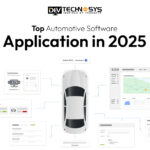
The future of automotive software is extremely vast due to the integration of digital intelligence that is becoming core in modern vehicles. From software in electric vehicles, autonomous driving, cloud connectivity, to cybersecurity, automotive trends 2026 are transforming how cars are built and experienced.
The future of automotive software is much more than just coding. It is about developing smarter, safer, and personalized mobility solutions. In this guide, we will learn about the software-defined vehicles trends that are driving a new era of vehicles.
What Are The Market Stats For Automotive Software?
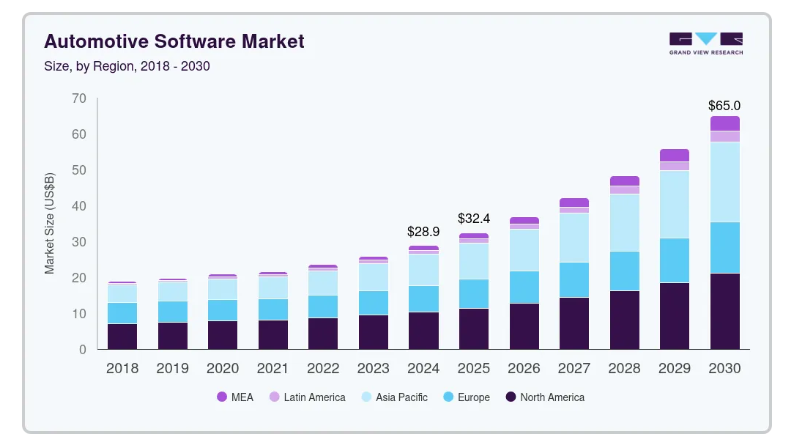
As the market of automotive software is successfully booming at a rapid pace, it is time to know the statistical data of the market. Have a look at the market estimations analyzed by the Grand View Research on Automotive software.
- The automotive software market was estimated at USD 29.32 billion globally in 2024 and USD 32.96 billion in 2025.
- These numbers are projected to reach USD 66.18 billion by 2030, growing at a CAGR of 15% during the forecast period from 2025 to 2030.
- In 2025, the automotive software market of North America led the global industry with a revenue share of more than 34.62%.
- In 2025, according to the application, the ADAS & safety segment held the global industry and earned a revenue share of over 20.0%.
What Are The Market Analysis Of Tekmetric Automotive Software?
Tekmetric is a cloud-based automotive software application, especially designed for auto repair businesses. It comes with multiple features, such as digital inspections (DVI), integrated payments, real-time reporting, and inventory management. It helps auto repair shops in managing operations, customers, finances, and other work related to vehicles.
Tekmetric is a one-stop solution for multiple tasks, including digital inspections, repair orders, invoicing, and customer communication for vehicle owners. It improves the profitability and efficiency of small repair businesses.
Here, we will understand the market analysis of Tekmetric automotive software, among the on-demand app development solutions:
- According to sources, Temetric has made a total revenue of $2.9 million in 2021, $7.2 million in 2023, and $15 million in 2024.
- This reflects a compound annual growth rate (CAGR) of 12–14% over the next several years.
- The company has also processed more than $900 million of transactions through its platform.
- Techmetric is also renowned for a year-over-year growth of 43%.
- Around 60–70% of independent auto repair shops in developed markets now use some form of digital shop management software.
What Are The Latest Trends For Automotive Software Development?
ADAS, SDV, connected vehicle, IoT, OTA software, and ECU architecture are some of the latest automotive software development trends that are also the future of connected cars. In this section, we are going to understand the importance and working of these trends elaborately.
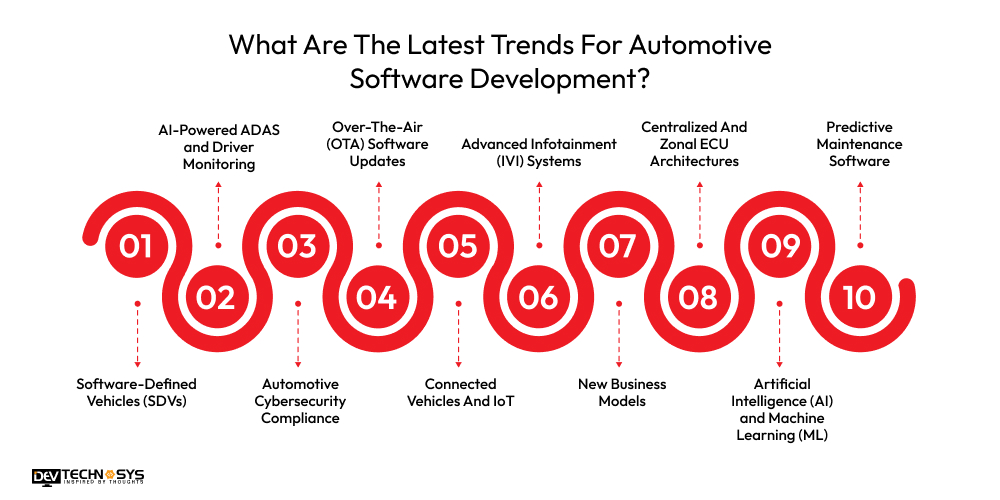
1. Software-Defined Vehicles (SDVs)
Software-Defined Vehicles (SDV) architecture seamlessly switch functionalities from hardware to software. With this, the features can be developed, updated, and monetized digitally. It is one of the most preferred automotive embedded software trends that helps control a vehicle’s behaviour through centralized software platforms.
2. AI-Powered ADAS and Driver Monitoring
Automotive AI technology incorporates ADAS software development and driver monitoring, the most popular automotive technology trends 2026. They use the fusion of computer vision, machine learning, and sensors. This helps the software to detect surroundings, predict hazards, and track driver behaviour. These automotive software development services enhance safety.
3. Automotive Cybersecurity Compliance
The real-time automotive operating systems generally have to work strongly on cloud, data & cybersecurity. The automotive cybersecurity compliance focuses on and addresses the rising risks from connected and software-driven vehicles. Automotive cybersecurity trends is an amazing connected car technology, that involves standards like ISO/SAE 21434 and UNECE R155, along with secure architectures, threat monitoring, and encryption.
4. Over-The-Air (OTA) Software Updates
Nowadays, when businesses build an automotive software for vehicles, they integrate over-the-air vehicle updates. This trend allows automakers to remotely deploy fixes, enhancements, and new features to vehicles. This reduces recalls and lowers maintenance costs, while improving security. It keeps vehicles up to date by updating ECUs without requiring dealership visits.
5. Connected Vehicles And IoT
To communicate with cloud platforms, infrastructure, and other vehicles, connected vehicles utilize IoT in automotive industry. These technologies allow real-time navigation, remote diagnostics, traffic optimization, fleet management, and personalized services. IoT automotive software also supports the combination of smart city integration and data-driven mobility ecosystems.
Want a chatbot demo or pricing? Fill the form and talk to our experts today.
Pick what you need below — you can select more than one — then tap Get detail to continue.
-
Chatbot demo dashboard
-
Cost to develop an app
-
Industry report
-
Case study
6. Advanced Infotainment (IVI) Systems
When businesses develop an automotive website with an advanced IVI system, it provides a rich digital experience to users. This automotive operating system provides touchscreens, voice assistants, and overall app ecosystems, including navigation, media, smartphone mirroring, and cloud services. It eases the interaction between drivers, passengers, and vehicles.
7. New Business Models
Automotive development uses new business models, such as Everything-as-a-Service (XaaS) and mobility as a service (MaaS) software. These models provide subscription-based features, on-demand services, shared mobility, and pay-per-use options. They also help automakers generate recurring revenue beyond the sales of connected & smart vehicles.
8. Centralized And Zonal ECU Architectures
The centralized and zonal ECU architectures are widely used in automotive software development trends. It helps in replacing multiple distributed controllers with fewer, powerful computing units. Now, every car service app development company works on ECU software development to reduce complexity, cost, latency, and power consumption while improving scalability.
9. Artificial Intelligence (AI) and Machine Learning (ML)
Machine Learning and AI in autonomous vehicles lets the vehicle examine real-time data for smarter decision-making. It empowers features such as advanced driver assistance, predictive maintenance, and personalized in-car experiences. Artificial Intelligence and machine learning in automotive industry improve safety through pattern recognition and continuous system learning.
10. Predictive Maintenance Software
The predictive maintenance software for vehicles is really necessary as it detects data using analytics. It also utilizes AI in software development to forecast component failures. The predictive maintenance software minimizes downtime, reduces repair costs, improves reliability, and supports fleet operators. It schedules maintenance as per the actual vehicle condition instead of fixed service intervals.
What Are The Future Trends For Automotive Software Development?
Apart from the latest trends we have learnt above, there are numerous trends that we will see in the future. Here, we will know about future automotive software development trends that transform the vehicle more dynamically.
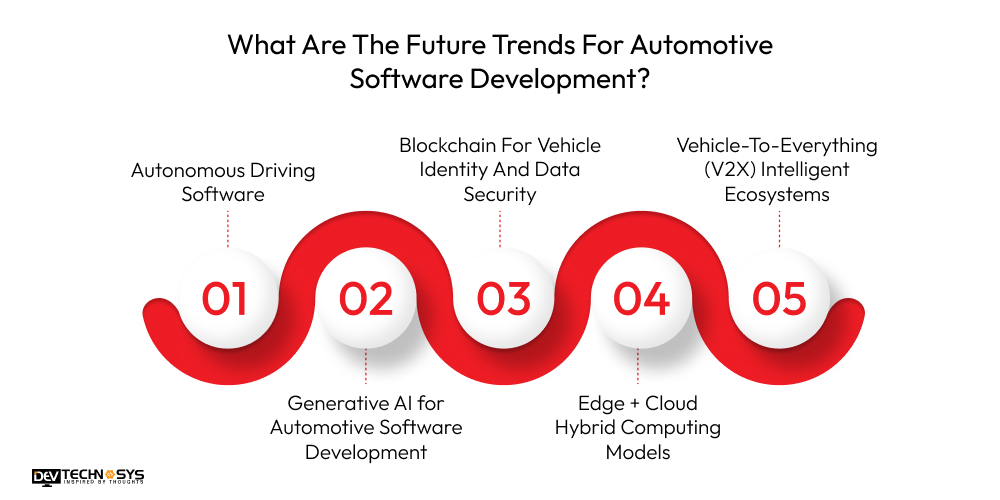
1. Autonomous Driving Software
Autonomous driving software is going to be used predominantly in the future in almost every car. A mobile application development company will make apps that utilize sensors broadly to help drivers stay safe while driving on their own.
Vehicles in the future can easily detect lanes, signs, and people with computer vision in automotive. This led to less chances of accidents and improved comfort. Such connected car software trends also support future self-driving features in modern cars.
2. Generative AI for Automotive Software Development
As generative AI is transforming every industry, it will definitely enhance smart vehicle software solutions in the future. Generative AI will help developers in writing, testing, and updating EV battery management software, digital cockpit software, in-vehicle data security software, and more.
AI in automotive software development helps in reducing errors, personalizing features, speeding innovation, and supporting smarter designs. It focuses on safety systems and vehicle updates for changing customer needs across global markets.

3. Blockchain For Vehicle Identity And Data Security
Blockchain will be used in the future for developing secure digital identities for electric & Software-Defined Vehicles and protecting shared data. It even supports vehicle lifecycle management software with a trusted ownership record, safe payment, and secure updates.
To build automotive garage software using vehicle telematics software, embedded & system Software, and automotive ERP software integrating blockchain, to gain better privacy and transparency. It even controls vehicle information in worldwide ecosystems.
4. Edge + Cloud Hybrid Computing Models
Edge and cloud hybrid computing will be used widley because it can divide the processing between the car and remote servers. This will also help in enhancing speed, reducing costs, and enabling real-time features.
An artificial intelligence development company builds softwares with vehicle cloud platforms that manage updates, data storage, analytics, and services.
5. Vehicle-To-Everything (V2X) Intelligent Ecosystems
Vehicle-to-Everything (V2X) communication is among the intelligent automotive software development trends that will become common in future vehicles. It lets the vehicles talk with roads, traffic lights, and other cars while fostering safety, traffic flow, and driving comfort.
Using V2X communication software, cities and automakers build smarter, connected transport systems. These systems will work reliably and efficiently for the future of urban mobility worldwide networks.
Final Words
As we move ahead into 2026, automotive software development will become more in demand as the industry transforms. Vehicles are evolving into next-gen automotive software that combines both coding and hardware.
The rising demand for AI & intelligent vehicles, OTA automotive software updates, and cloud-based automotive software shows how driving experience is being revolutionized. These trends are improving the vehicle’s performance and efficiency.
Above all, these autonomous vehicle software trends are redefining the way people interact with their vehicles. So basically, the future of mobility relies on secure, scalable, and intelligent software development solutions for the automotive industry.
Last but not least, in this rapidly changing digital world, welcoming these automotive software development trends will be essential for more connected vehicles.