










Key Takeaway
-
- According to Grand View Research, the global online laundry service market is estimated to reach $58.9 billion in 2026 and $221 billion by 2030.
- The cost to develop an app like Cleanly ranges from $30,000 to $150,000+, depending on the platforms, features, app complexity, integrations, and backend infrastructure.
- The successful platform should have features including pickup scheduling, service selection, order tracking, secure payments, GPS tracking, notifications, and dedicated customer, provider, delivery, and admin panels.
- The startups should begin with an MVP and launch their app with core features. They should validate the market before investing in advanced features
In today’s world, where convenience is the most important part of people’s lives, on-demand services have completely changed the way things are getting done. Laundry is the sector that is affected most by such changes. Laundry apps like Cleanly have changed the way cleaning chores are done.
If you are a businessperson who invests in various opportunities or you own a laundry business and just want to broaden your services, it is most probable that you have already considered having a laundry app. The question that is bothering many entrepreneurs is how much it costs to develop a laundry app. If you are among them, this is the right site for you.
This blog will explore the ways you can build a laundry app like Cleanly. We have also mentioned the features that should be integrated and the development costs for such apps.
What Is a Laundry App Like Cleanly?
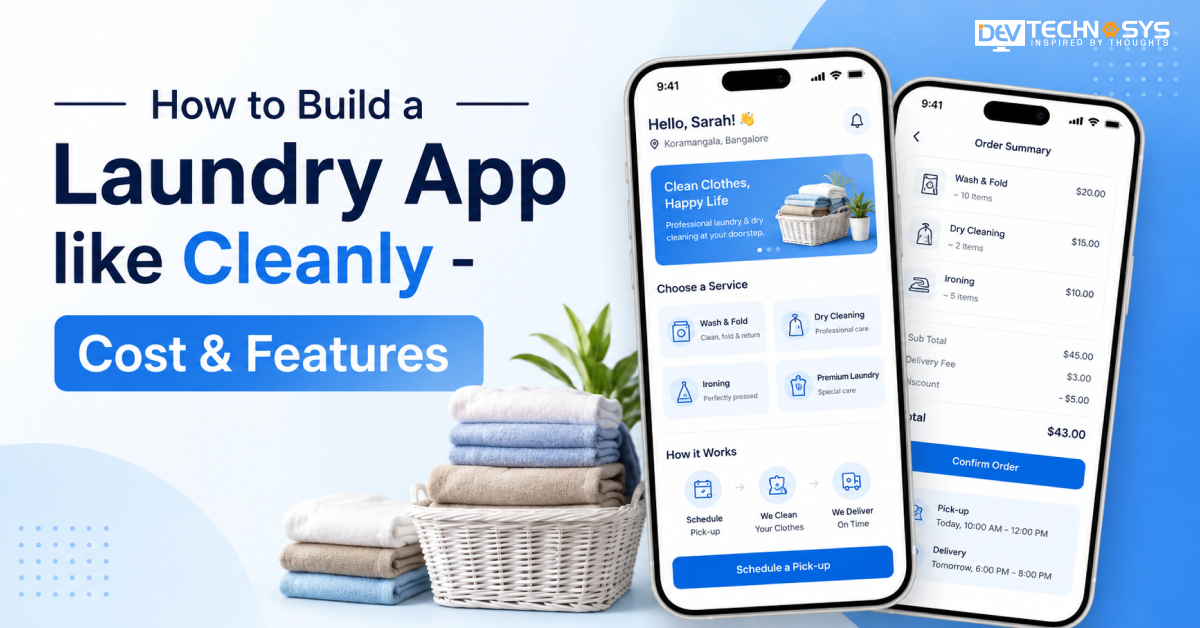
Cleanly is a mobile application that lets customers get laundry services and dry cleaning whenever they want. Customers can book laundry pickups, choose the service they want, pay, track their orders, and get their cleaned clothes delivered to any location they wish.
The mobile application acts as a front-end app, whereas the back-end system manages functions like order booking, pickup, cleaning, inspection, packing, and delivery. For building a good laundry service booking app, hiring a laundry app development company is the best option.
This centralized model also provides more convenience for laundry services and makes it possible to manage invoices, delivery, and customer interactions from one place.
Market Statistics for Laundry App Development
The demand for comfortable, app-based pickup and delivery services is growing day by day. It also makes the laundry industry a good opportunity for startups. Here are some of the market statistics that can prove the claims:
Market Statistic |
Key Insight |
Source |
| Global Online Laundry Market | Fortune Business Insights estimates the global online laundry services market will grow from $73.01 billion in 2026 to $898.61 billion by 2034, at a 36.86% CAGR. | Fortune Business Insights Report |
| Global Laundry Services Market | The global dry-cleaning and laundry services market is estimated at $89.0 billion in 2026 and is projected to reach $150.9 billion by 2033, growing at a 7.8% CAGR. | Grand View Research Report |
| Online Laundry Growth | Grand View Research projects the global online laundry service market to reach $221.05 billion by 2030, with strong growth driven by busy lifestyles and demand for convenient services. | Grand View Research Online Laundry Report |
| U.S. Market Opportunity | The U.S. online laundry services market was estimated at $8.28 billion in 2023 and is expected to grow at a 33.4% CAGR from 2024 to 2030. | U.S. Online Laundry Services Report |
| Residential Demand | The residential segment accounted for 59.7% of the global dry-cleaning and laundry services market in 2025, highlighting strong consumer demand for convenient professional laundry solutions. | Grand View Research Market Analysis |
NOTE: Market estimates vary between research firms because they use different definitions and methodologies for terms such as online laundry, on-demand laundry, and the broader laundry services market. For a 2026-focused blog, clearly mention the research source alongside every statistic.
Planning a Mobile App?
Get a tailored development cost estimate in 3 simple steps — app basics, features, timeline, and your contact details.
- 3 quick steps
- 100% free
- Reply in 1 business day
2 Minutes Read
How Does a Cleanly-Like Laundry App Work?
An app like Cleanly can manage the complete laundry process through a connected digital workflow:
- Customer places an order: The customer chooses laundry or dry-cleaning services, then adds preferences, enters a pickup address, and chooses a perfect time slot.
- Pickup gets scheduled: Then the system assigns your order to an available delivery partner according to your location, availability, and delivery capacity.
- Clothes are collected: The delivery partner collects your clothes and then updates the order status in the app.
- Laundry processing starts: The laundry provider gets the order, sorts your clothes, processes them based on the service you have selected, and updates the status.
- Quality check and packaging: Then the cleaned clothes are checked, packaged, and prepared for delivery.
- Delivery is completed: A delivery partner collects your completed order and then returns it to the customer’s given address of the customer.
- Payment and Feedback: Lastly, the customer gets the final invoice, completes the payment if required, and can also rate the service.
You can customize this workflow depending on whether you operate your own laundry facilities or work with third-party laundry providers.
Key Features to Build a Laundry App like Cleanly
A laundry app like Cleanly should have different features for customers, delivery partners, laundry service providers, and administrators. Here are the most important features that are required for each panel in trending laundry service apps:
Customer App |
Delivery Partner App |
Laundry Provider Panel |
Admin Panel |
| User Registration & Login | Driver Registration & Verification | Provider Registration | Admin Dashboard |
| Profile Management | Driver Profile Management | Provider Profile Management | Customer Management |
| Service Selection | Order Assignment | Order Management | Provider Management |
| Service Customization | Pickup & Delivery Details | Service Management | Delivery Partner Management |
| Pickup & Delivery Scheduling | GPS Navigation | Garment Tracking | Order Management |
| Address Management | Route Optimization | Order Status Management | Service & Pricing Management |
| Price Calculator | Order Status Updates | Pickup Management | Commission Management |
| Order Placement | QR/Barcode Scanning | Inventory Management | Payment Management |
| Real-Time Order Tracking | Customer Communication | Staff Management | Refund Management |
| Payment Gateway Integration | Pickup Confirmation | Quality Control | Coupon & Offer Management |
| Order History | Delivery Confirmation | Revenue Dashboard | Location & Zone Management |
| In-App Notifications | Earnings Dashboard | Reports & Analytics | Analytics & Reports |
| Coupons & Discounts | Delivery History | Notifications | Notification Management |
| Ratings & Reviews | Availability Management | Customer Management | Customer Support Management |
| Customer Support | Push Notifications | Payment Management | Content Management |
Product Strategy Insight
“Start with a simple MVP that solves booking and pickup challenges first. Add advanced features only after validating customer demand and operational efficiency.”
Advanced Features to Build a Laundry App Like Cleanly
Let’s explore some of the advanced features that we can integrate into our Cleanly clone app:

1. AI-Powered Laundry Recommendations
AI has the ability to recommend appropriate laundry services by analyzing customers’ order history, preferred fabrics, types of garments, and cleaning choices. The system can suggest dry cleaning, stain removal, delicate wash, or special treatments, creating a more personalized experience and increasing relevant service purchases.
2. Smart Route Optimization
Smart route optimization automatically calculates the best pickup and delivery routes based on driver location, traffic conditions, order priorities, and delivery time slots. It reduces the time and cost of travel and delivery. It also allows businesses to process more orders with fewer delivery resources.
3. Real-Time Order Tracking
Customers can track their laundry in the process, from pickup to washing, quality inspection, packaging, and final delivery. This provides real-time status updates, GPS tracking, and estimated arrival times, which enhance transparency and decrease customer support inquiries regarding order progress.
4. Dynamic Pricing
Dynamic pricing means charges for laundry are based on variables like type of service, number of garments, location, demand, turnaround time, and distance to deliver. Businesses can charge high prices during periods of high demand, with specific reductions at times of low demand to keep the number of orders coming in.
5. AI Chatbot & Virtual Assistant
An AI-powered chatbot can provide instant answers to questions about pricing, services, order status, pickup schedules, payments, and delivery. It can also help customers with booking and support queries, taking the pressure off customer service teams and offering help 24/7.
6. Automated Quality Control
With automated quality control, laundry providers can spot potential problems before the orders reach the customers. Utilizing electronic checklists, barcode scanning, garment records, and image-based AI inspection, the system can identify missing items, incorrect processing, packaging problems, or quality issues.
How to Build a Laundry App Like Cleanly: Step-by-Step
Here are the steps that you can follow to build a laundry mobile app like Laundryheap and Cleanly:

1. Define Your Business Strategy
You need to decide the business model for your app first. Choose whether you will run your own laundry facilities or build a marketplace that connects customers with third-party integrations. This decision will affect your provider panel, app architecture, commissions, and operational workflow.
2. Research Your Target Market
You should research the target market first. You need to identify your target customers, competitors, service areas, pricing, etc. Choose a defined area that makes management easy, and the pickup & delivery logistics become easier.
3. Choose the Feature Set
You have to separate the features into MVP, standard, and advanced categories. The features that you should start with are laundry booking app features, payments, scheduling, order management, notifications, and tracking, instead of building all the Cleanly-like app features at once.
4. Design the UI/UX
Businesses should hire dedicated developers to create the various user journeys and wireframes for customers, drivers, laundry staff, and administrators. It will keep the booking process simple so that a customer can schedule pickup easily.
5. Select the Technology Stack
It is very important to choose the right technology stack to develop your app. Here is what a usual stack would look like:
Technology Area |
Options |
| Mobile App | Flutter / React Native / Swift / Kotlin |
| Backend | Node.js / Python / Laravel |
| Database | PostgreSQL / MySQL / MongoDB |
| Cloud | AWS / Google Cloud / Azure |
| Maps | Google Maps Platform |
| Payments | Stripe / PayPal / regional gateways |
| Notifications | Firebase Cloud Messaging |
| Real-Time Tracking | WebSockets / Firebase |
| Analytics | Firebase Analytics / Mixpanel |
Technology Insight
“A scalable backend, real-time tracking, secure payments, and integrated notifications are essential technology foundations for managing growing order volumes without disrupting service quality.”
– Tech Head: Pramod Jangid, Dev Technosys
6. Develop the MVP
You should build the customer application, admin panel, backend, and other necessary delivery functionalities first. Your MVP should contain all the basic features, such as choosing a service, scheduling a pickup, making a payment, tracking the order, and receiving the cleaned items.
7. Integrate Logistics
You should connect the drivers, pickup locations, delivery zones, laundry facilities, and order statuses. You can also integrate other features, such as barcode- or QR-code-based identification of orders, as this can help reduce the issue of garment and order mix-ups.
8. Add Payment & Notification Systems
Then, you need to integrate the payment gateways and a system for automated notifications for the confirmation of bookings, processing updates, pickup reminders, delivery completion, and payment receipts.
9. Test the Application
After you build a laundry app like Poplin, test the application properly before launching it. There are different tests you can perform, such as usability tests, API, payment, security, GPS, device compatibility, and performance testing.
10. Launch and Improve
First, deploy the app with the basic features, such as customer behavior, monitor performance, collect reviews, then validate the market, and gradually integrate the advanced features, including subscription management, AI, loyalty programs, etc., for developing an app like Cleanly.
How Much Does It Cost to Build a Laundry App Like Cleanly?
There are many factors on which the cost to create an app like Cleanly depends. It includes Cleanly app features, technology, number of panels, and level of customization required. The cost of a basic MVP is less than that of an advanced laundry platform that includes various features.
Here is the cost estimate for developing a laundry app like Cleanly:
App Complexity |
Estimated Cost |
Timeline |
| Basic/MVP Laundry App | $25,000-$45,000 | 3-4 months |
| Standard Laundry App | $45,000-$80,000 | 4-6 months |
| Advanced Cleanly-like App | $80,000-$150,000+ | 6-9 months |
Major Factors Affecting Laundry App Development Cost
In this section, we have mentioned some of the major factors that affect the overall Cleanly app development cost:

1. App Complexity
The laundry app development cost depends on the complexity of features that you have integrated into the app. The basic MVP with features like payments, booking, and complexity costs way less than an advanced platform that contains laundry app features like Cleanly, including route optimization, real-time tracking, AI recommendations, subscriptions, automated pricing, and complete logistics.
2. App Platform
One of the main elements influencing the cost of creating a laundry-on-demand app is the platform. The cost of a mobile app can vary if you choose an Android platform or an iOS platform. The first thing you should do is make an app that works on just one platform. You may then transition to a multi-platform software once it becomes popular in the market.
3. Location of Development Team
The amount of time required to write the code has an impact on the cost to develop a laundry app like Cleany. The hourly pricing is also influenced by the Android or iPhone mobile app development team’s location.
4. UI/UX Design
A further factor that affects the price is the application’s UI/UX. It often takes several testing iterations to get a visually beautiful, user-friendly design that provides a seamless experience. This raises the mobile app development cost. An interactive interface is typically recommended since it promotes user engagement and retention.
5. Third-Party Integrations
The overall development cost of the laundry app also depends on the third-party integrations. It includes payment gateways, Google Maps, push notifications, analytics, CRM, accounting systems, SMS/OTP services, and customer-support tools. They can affect the development and operational costs.
6. Maintenance
Maintenance has an impact on the cost to make an app like Cleanly available on demand as well. When an app has to be updated or enhanced to comply with industry requirements, maintenance expenses may increase.
Depending on whether the app is maintained by a particular on demand app development company or if it must adhere to new industry standards and criteria, the maintenance fees may vary.
Factor |
Estimated Cost Impact |
Approx. Share of Development Cost |
| App Complexity | $10,000-$50,000 | 20-35% |
| App Platform | $5,000-$30,000 | 10-20% |
| Development Team Location | Varies by hourly rate | 15-30% |
| UI/UX Design | $4,000-$15,000 | 8-15% |
| Third-Party Integrations | $3,000-$15,000 | 5-15% |
| Maintenance & Updates | $5,000-$20,000/year | 15-25% annually |
Free App Idea Reality Check: Let's Stress-Test Your Concept
Share your app idea with us. Within 3 business days, we'll uncover UX gaps, feature opportunities, and potential development challenges, so you can build with confidence. No strings attached.
Security and Compliance Guidelines We Follow for Laundry App Development
When developing a laundry app for the U.S. market, it is important to pay close attention to customer privacy, application and payment security, and state-level regulations.
Here are some of the security and compliance considerations that we incorporate into the development process based on the app’s features, data, target market, and payment flows:

1. PCI DSS-Aligned Payment Security
Secure payment workflows are required to process card payments for laundry apps. We incorporate various third-party payment integrations that align with PCI DSS requirements. We work with trusted payment providers and reduce the direct handling of cardholder data. This helps protect payment information, transactions, and customers.
2. CCPA/CPRA Privacy Requirements
We support privacy practices that align with CCPA/CPRA requirements for apps that are for California consumers. Our data flows support transparency and accurate control over the private information collected by the laundry application.
3. Data Encryption and Access Control
For sensitive customer information and operational data, strong protection is necessary. We integrate security practices such as encrypted data transmission, role-based access, controlled permissions, multi-factor authentication, and audit logging to reduce the risk of unauthorized access.
4. FTC-Aligned Security-First Development
We take security very seriously from our end and implement it from the early stages of development. We evaluate the collected data, the integrations used, and all risks associated with the app. Our approach aligns with FTC guidance encouraging developers to integrate data security into applications from the outset.
5. Secure Application Development and OWASP Practices
We apply development practices and OWASP-related engineering principles to identify common application weaknesses. Security integrations include API protection, input validation, authentication, secure coding reviews, and penetration testing before applications are released to production.
Expert Insight
“At Dev Technosys, we follow PCI DSS, CCPA, OWASP, ISO 27001, GDPR, SOC 1, SOC 2, and other privacy standards throughout the entire development process.“
How to Monetize a Laundry App Like Cleanly?
We can generate revenue through various models from a laundry platform. The right combination completely depends on whether you operate your own laundry facilities or just act as a marketplace.
Here are some of the models by which apps like these can make money:

1. Commission Scheme
Charge laundry vendors a specific portion of every transaction processed through your platform. This method is suited for laundry marketplace applications as the revenues will also increase with increasing transaction volume. The commission can be adjusted according to factors like service categories, service providers, locations, and the number of orders placed every month.
2. Delivery Charges
Charge your customers a separate fee for pickup and delivery depending on the distance, location, size of the order, and delivery speed. You may also provide free delivery for orders having a minimum value, which adds to the average order value and opens up another source of income.
3. Membership Plans
Make available monthly, quarterly, and yearly subscription plans providing customers with great benefits like free delivery service, reduced prices for laundry, priority pickups, and many others. Subscription plans help ensure a steady income stream each month and prompt customers to utilize the laundry service more frequently.
4. Premium Services
Provide premium services for added income such as quick laundry, same-day delivery services, gentle care of garments, stain removal, special dry cleaning, and special textile treatment. Customers who prefer quick and convenient services can be charged extra for the provision of these services.
5. Business Accounts
Provide special packages to businesses such as hotels, restaurants, beauty salons, gym facilities, hospitals, and other organizations with the regular need for laundry services. Custom discount prices, regular pick-up services, bulk purchase discounts, management, and long-term contracts may be offered for a regular income from the mentioned companies.
Why Choose Dev Technosys for Laundry App Development?
Businesses always prefer to hire mobile app developers who help them to build customized, user-friendly, and scalable laundry applications, and we provide exactly that! We create apps that are designed around their operational requirements and unique business models. Our experts develop a complete digital ecosystem, including delivery partner apps, customer apps, centralized admin dashboards, and laundry provider panels.
We provide end-to-end laundry app development services that include business analysis, UI UX design, development, deployment, testing, and post-launch support. The apps that are built by our expert developers are integrated with essential capabilities, including GPS navigation, secure payment gateways, push notifications, analytics, and more.
Dev Technosys strictly follows all the security and compliance regulations and demonstrates a strong focus on performance and efficiency. In past projects, we have also achieved 98% fraud-detection accuracy, 99.50% transaction uptime, and reduced operational costs by up to 30%. For all your laundry app development requirements, we can help you build a secure and scalable solution that supports your business growth.
Conclusion
Creating a laundry app like Cleanly is not only about developing a simple booking app. One must also create an interconnected network that connects customers, laundry service providers, delivery partners, order status tracking, payments, and management processes.
The cost to build an app like Cleanly may range from as low as $30,000 (for a simple MVP) to over $150,000 (for a high-end service), depending on the features and complexity of the app. By going forward with an MVP, the user gets the chance to test the app and the thinking process behind it, as well as improve over time.
If you want to build a laundry app like Cleanly, then you should connect with a mobile app development company, such as Dev Technosys. They can help you build a safe, versatile, visually powerful platform for a laundry service business.
Cue Laundry
Built an On-Demand Laundry & Delivery Platform in 18 Weeks
In this case study, we have mentioned how we partnered with Cue Laundry to build a convenient digital laundry platform. With this, we have simplified service booking, pickup, delivery, multi-city laundry operations, payments, and order tracking.
Cue Laundry
On-Demand Laundry & Delivery Platform
18 Weeks
Challenge
We required a scalable laundry app that could support flexible pickup scheduling and delivery, on-demand bookings, various payment options, real-time tracking, dynamic pricing, and operations across different cities.
Solution
We developed a platform with various features such as flexible scheduling, online laundry booking, real-time order tracking, multiple payment gateways, dynamic pricing, vendor management, location-based services, notifications, and dedicated admin features.
Results
- We developed the entire laundry platform in 18 weeks
- It enabled multi-city laundry operations
- Supported both B2C and B2B service models
- Streamlined booking, payment, tracking, and delivery scheduling management
Frequently Asked Questions
Find answers to the most common questions related to this article.
The cost to build a laundry app like Cleanly usually ranges from $30,000 to $150,000+. It depends on the complexity of the app, platforms, user panels, features, integrations, technology stack, security requirements, and the location of the development team
To build a basic laundry app, it takes around 3-4 months, while a standard laundry app can take around 4-6 months. For an advanced laundry app platform including multiple panels, it takes around 6-12 months with complex logistics
To build a complete platform, it generally requires a delivery partner app, customer app, laundry provider panel, and admin panel. The exact structure of the app completely depends on your operational workflow and business model
Yes, you can build an app using AI. You can integrate AI for personalized recommendations, customer support, route optimization, demand forecasting, dynamic pricing, predictive delivery estimates, and other automation use cases.
You should start with an MVP that contains only essential features, use third-party APIs, select a perfect cross-platform technology, and launch in a limited service area. You should add advanced features only after validating your business model in the market.