



















Key Takeways:
The web3 development cost in 2026 typically ranges from $30,000 to $150,000+, depending on platform complexity, blockchain choice, security requirements, smart contract functionality, and development expertise. While web3 MVP development cost falls at the lower end of the spectrum. Web3 enterprise blockchain solution costs with advanced DeFi, DAO, NFT, and multi-chain platforms require significantly higher investment.
Web3 App Development Cost Breakdown Based on Complexity
-
- Basic Web3 MVP ($30,000 – $60,000+):A basic Web3 MVP typically includes wallet connectivity, simple smart contracts, user authentication, ERC-20 token integration, and a basic frontend interface. These projects are ideal for startups validating a concept before investing.
- Mid-Level Web3 Platform ($60,000 – $110,000+):Mid-level Web3 applications often include NFT functionality, staking systems, DAO features, and enhanced security measures. These platforms require more development effort and testing.
- Enterprise Web3 Solution ($110,000 – $150,000+):Enterprise-grade web3 app development cost impacts due to multi-chain support, advanced DeFi protocols, governance systems, cross-chain interoperability, and scalable infrastructure designed for high transaction volumes.
Key Factors Affecting Web3 Development Costs
-
- 1. Type of Web3 Platform: The platform type, such as a wallet, NFT marketplace, DeFi app, DAO, or GameFi platform, directly affects development complexity and overall cost.
- 2. Blockchain Network Selection: The choice of blockchain, including Ethereum, Polygon, Solana, Layer 2 scaling solutions, or BNB Chain, impacts development effort, scalability, and transaction-related costs.Technology stack (AI, cloud, blockchain costs more)
- 3. Smart Contract Complexity: Advanced smart contract features like staking, metadata storage, IPFS storage, governance, lending, and liquidity management require more development, QA testing, and security audits.City of hiring (Tier-1 vs Tier-2 hubs)
- 4. UI/UX & Frontend Development: Building a seamless user experience with wallet connect integration, dashboards, and responsive interfaces increases design and frontend development costs.
- Hiring model (freelancer vs dedicated team)
- Demand for specialized skills
Web3 Development Cost Breakdown by Region
-
- North America: $50 to $150/hr
- Western Europe: $40 – $120/hr
- Eastern Europe: $30 – $80/h
- India & Southeast Asia: $15 – $50/hr
Web3 is a rapidly growing ecosystem that has changed the ways of building, scaling, and generating revenue from digital products for businesses. The potential of Web 3 is limitless, be it decentralized apps (dApps), Defi platforms, or smart contracts to NFTs. However, one factor that constantly bugs businesses, especially startups, is the COST.
If you are a new business waiting to set foot in the Web3 space, then understanding what drives the development cost is highly crucial. Understanding Web3 development cost variables will help them overcome unforeseen challenges and crypto project budget overruns.
In this blog, we will provide a complete Web3 project cost breakdown, including the factors that impact your final investment, like feature complexity, security requirements, and integration needs. Whether you are creating a simple MVP or a full-scale dApp platform, knowing these Web3 app development budget influencing factors can help you make smarter and more strategic decisions.
What is Web3 Development?
Web3 development is the process of building decentralized applications (dApps) that run on blockchain networks. The core component of Web3 includes blockchain, smart contracts, and cryptocurrency and token standard (ERC-20 / ERC-721 / ERC-1155). Web3 uses peer-to-peer networks and smart contracts to provide users ownership of their data and digital assets, unlike traditional web development.
Industry Insights:
According to Fortune Business Insights, the global Web3 market is projected to reach $6.94 billion in 2026 and expand at a near 50 % CAGR through 2034, showing how infrastructure choice scales with adoption.
Why Budgeting is Crucial in Web 3 Development?
Web3 app development budgeting is important because it helps businesses manage costs, prioritize features, and avoid unexpected additions in web3 dApp development costs. Since Web3 projects involve smart contracts, blockchain integrations, blockchain supply chain, identity management, on-chain governance, security audits, and ongoing maintenance, a clear budget ensures efficient resource allocation and smoother project execution.
A well-planned budget also helps:
- Prevent cost overruns and delays
- Prioritize MVP and core features
- Cover security audits and compliance requirements
- Support future scalability and maintenance
- Maximize return on investment (ROI)
In short, effective budgeting reduces financial risks and increases the chances to develop a web3 application.
How Much Does Web3 Development Cost in 2026?
Stating the actual web3 development cost can be difficult, as it depends on multiple factors. Still, to give you a generic idea, the web3 software development cost can range from $30,000 to $1,50,000. Let’s understand it like this:
The web3 app development cost for startups with basic features and functionalities like wallet integration and simple app contracts lies between $30,000 to $70,000.
For mid-level Web3 app development with multi-wallet support, APIs, and enhanced security protocols, expect the cost to be around $70000 to $100,000.
The cost to build Web3 application with complex features, multi-chain support, EVM compatibility, custom smart contracts, and high-end security ranges from $100,000 to $1,50,000 or higher. The blockchain app development cost 2026 also depends on the maintenance required after the launch.
Development Level |
Estimated Cost |
Development Timeline |
| Basic Web3 Application | $30,000 – $60,000 | 4 to 8 Weeks |
| Mid-Level Web3 Platform | $60,000 – $100,000 | 8 to 16 Weeks |
| Advanced Web3 Solution | $100,000 – $150,000+ | 16 to 32 Weeks |
Planning a Mobile App?
Get a tailored development cost estimate in 3 simple steps — app basics, features, timeline, and your contact details.
- 3 quick steps
- 100% free
- Reply in 1 business day
2 Minutes Read
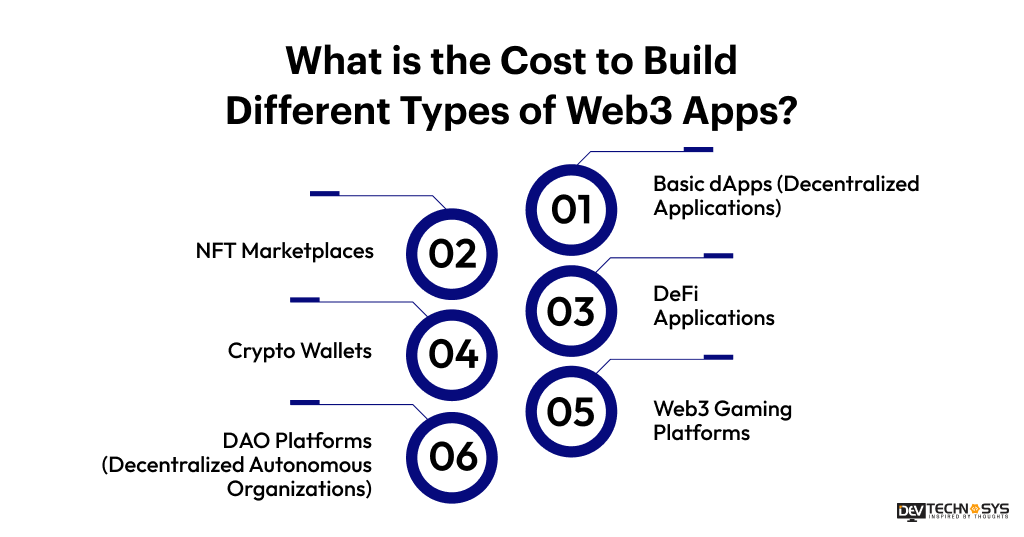
What is the Cost to Build Different Types of Web3 Apps?
According to top Web3 development companies, the type of Web3 platform you choose directly impacts the overall Web3 development pricing, as each platform comes with different levels of complexity, features, and technical requirements. From simple dApps to advanced DeFi or gaming platforms, the scope significantly influences time, resources, and budget. Here are the types of Web3 apps with their development costs.
1. Basic dApps (Decentralized Applications)
Basic dApps are relatively simple Web3 solutions with limited functionalities such as wallet integration, user authentication, and basic smart contracts. According to a top Web3 development agency, these platforms require minimal backend infrastructure and fewer integrations, so dapp development cost and timeline remain low, making them ideal for startups building MVPs or testing concepts.
- Examples: Voting apps, simple token dashboards, IPFS / Arweave storage, staking calculators, identity verification apps
- Best For: Startups validating blockchain ideas, MVP development, Proof-of-concept blockchain products.
- Complexity: Low
- Estimated Cost to Develop a dApp on Ethereum: $30,000 to $60,000
2. NFT Marketplaces
NFT marketplaces involve more complex features like asset minting, bidding systems, auctions, and metadata storage. Integration with IPFS / Arweave storage and secure smart contracts increases development effort. NFT marketplace development cost differ due to factors like smart contracts for minting, trading, royalties, and wallet integration, which increase development effort.
- Examples: OpenSea-like platforms, Digital art marketplaces, Gaming NFT stores
- Best For: Digital creators, Gaming ecosystems, Asset tokenization businesses
- Complexity: Medium
- Estimated Cost: $40,000 to $100,000
3. DeFi Applications
DeFi platforms are among the most complex Web3 applications created by a top Defi development company in USA. They make Defi apps for lending, borrowing, staking, liquidity pools, and yield farming.
Defi development company require advanced smart contracts, real-time financial calculations, and strong security mechanisms to create Defi platforms. These complexities significantly increase DeFi development cost, testing efforts, and ongoing maintenance requirements.
- Examples: Lending platforms, staking protocols, yield farming apps, decentralized exchanges (DEX)
- Best For: Financial startups, Crypto investment platforms, Institutional DeFi solutions
- Complexity: High
- Estimated Cost: $60,000 to $150,000+
Industry Insight: Statista
Ethereum continues to dominate DeFi and remains the leading blockchain for lending, staking, and decentralized trading protocols.
4. Crypto Wallets
Crypto wallets demand highly secure environments with private key management, encryption, and multi-currency support. Wallets require strong encryption, private key management, multi-chain support, and often advanced features like Account Abstraction. Due to the critical need for security and compliance, wallet development costs are higher than those of basic applications and require extensive testing.
- Examples: MetaMask-like wallets, multi-chain wallets, custodial/non-custodial wallets
- Best For: Crypto exchanges, Web3 fintech apps, Payment platforms
- Complexity: Medium to High
- Estimated Cost: $40,000 to $120,000
Industry Insights:
According to CoinLaw, more than 560 million people globally own cryptocurrency, creating massive demand for Web3 wallets and self-custody solutions.
5. Web3 Gaming Platforms
Web3 gaming platforms combine blockchain with immersive gaming experiences, including NFTs, token economy, and real-time interactions. Integration with game engines, 3D assets, and backend infrastructure increases development complexity. The cost of building web3 gaming platform is higher due to design, performance, and scalability demands.
- Examples: Play-to-earn games, token minting, NFT-based gaming ecosystems, blockchain metaverse games
- Best For: Gaming startups, Metaverse projects, NFT game economies
- Complexity: Very High
- Estimated Cost: $80,000 to $150,000+
- Key Cost Drivers: In-game NFT assets, Token-based reward systems, Smart contract game logic, 3D/game engine integration (Unity/Unreal)
6. DAO Platforms (Decentralized Autonomous Organizations)
DAO platforms require governance systems, voting mechanisms, and token-based decision-making processes. Experts who provide Daap development services will implement transparent, tamper-proof logic through smart contracts, which adds technical complexity.
The need for secure governance frameworks and community management tools increases development time and overall blockchain development cost per hour compared to simpler Web3 applications.
- Examples: Governance platforms, voting DAOs, community treasury management systems
- Best For: Community-driven organizations, Investment DAOs, Protocol governance systems
- Complexity: High
- Estimated Cost: $50,000 – $130,000
- Key Cost Drivers: Governance token design, Voting smart contracts, Proposal lifecycle systems, Treasury & multi-sig integration
Web3 Platform Type |
Complexity |
Estimated Cost |
Development Timeline |
| Basic dApps | Low | $30K – $60K | 4 – 8 weeks |
| NFT Marketplaces | Medium | $40K – $100K | 8 – 14 weeks |
| DeFi Applications | High | $60K – $150K+ | 12 – 24 weeks |
| Crypto Wallets | Medium–High | $40K – $120K | 10 – 18 weeks |
| Web3 Gaming Platforms | Very High | $80K – $150K+ | 16 – 32 weeks |
| DAO Platforms | High | $50K – $130K | 10 – 20 weeks |
Well, now that we know how much does it cost to build a web3 app, let’s move further and see how the cost is calculated.
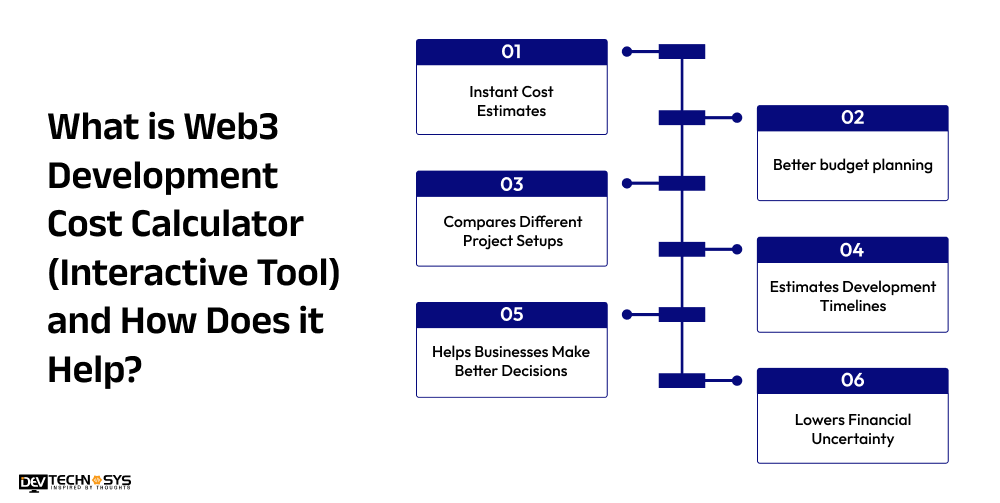
What is Web3 Development Cost Calculator (Interactive Tool) and How Does it Help?
A Web3 development cost calculator is an interactive tool designed to estimate the budget and timeline required to build a Web3 application. It calculates projected development costs based on factors such as platform type, blockchain network, smart contract complexity, security requirements, wallet integrations, and third-party services.
Instead of relying on generic cost estimates, businesses can use the calculator to get a more personalized budget range for their specific project requirements.
How Does a Web3 Cost Calculator Help?
- Instant Cost Estimates: This feature helps businesses figure out how much money they will need to spend on their Web3 project.
- Better budget planning: Startups and businesses can use their resources wisely before they start building things.
- Compares Different Project Setups: Displays how choices about blockchains, the depth of smart contracts, and security checks affect web3 development cost USA.
- Estimates Development Timelines: Gives a rough project timeline based on the features and level of difficulty that were chosen.
- Helps Businesses Make Better Decisions: It helps them decide which features are most important and which development method will save them the most money.
- Lowers Financial Uncertainty: This feature gives everyone involved a clear picture of how much the project might cost before they agree to it.
A Web3 development cost calculator is a useful planning tool that helps companies figure out the actual Web3 project cost, learn about the main factors that affect prices, and make smart choices before spending money on Web3 development. While it gives you a rough idea, talking to experienced blockchain developers is the best way to get a full and true picture of the project.
Web3 Development Cost Calculator Example:
NFT Marketplace + Multi-Chain Support + Advanced Smart Contracts + Security Audit
= $30,000 + $15,000 + $20,000 + $25,000 + $20,000
Estimated Cost: $110,000
Web3 Architecture Choices and Their Impact on Development Cost
The architecture of a Web3 application plays a significant role in determining the web3 app development cost for startups and enterprises. It is also crucial for scalability, performance, and long-term maintenance expenses. Choosing the right architecture early in the development process can help businesses optimize their budget while ensuring future growth and flexibility.
Different Web3 architectures come with varying levels of complexity, infrastructure requirements, and integration efforts, all of which directly affect the overall project cost.
Architecture Type |
Description |
Development Cost |
Timeline |
Scalability |
Best For |
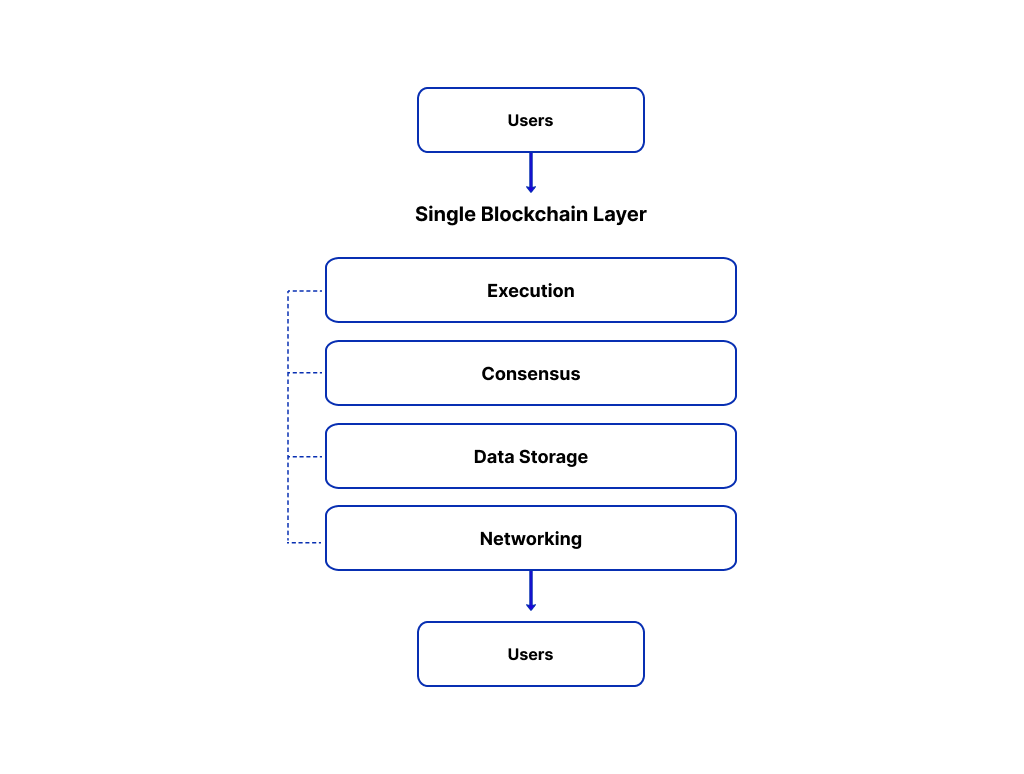
| Monolithic Architecture | Execution, consensus, and data availability are handled within a single blockchain layer. | $30,000 – $60,000 | 4–8 Weeks | Moderate | MVPs, Basic dApps, Startups |
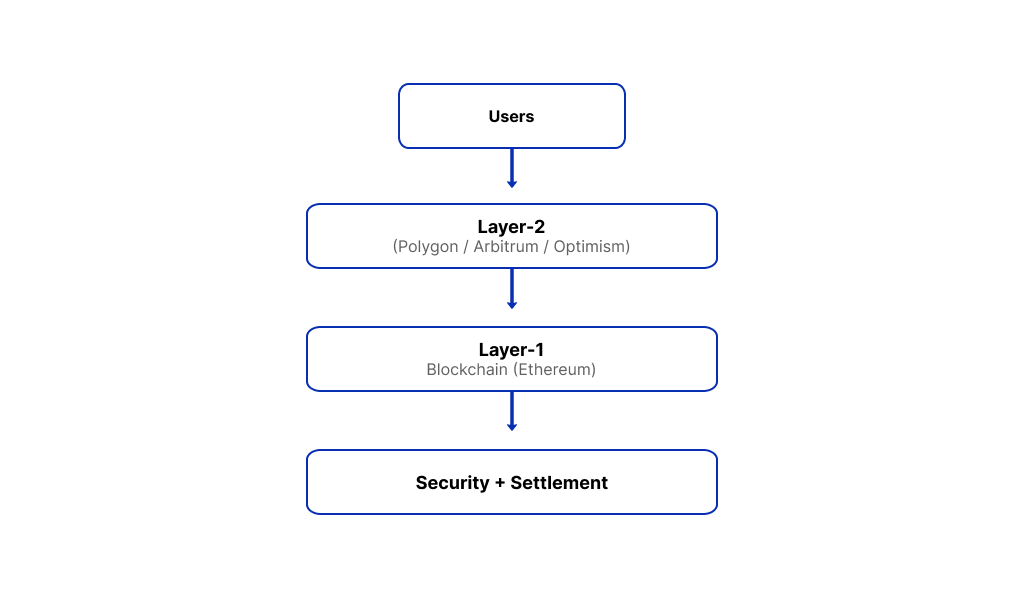
| Layer-2 Architecture | Built on top of Layer-1 blockchains to improve speed and reduce transaction fees. | $50,000 – $100,000 | 8–16 Weeks | High | NFT Marketplaces, Wallets, Consumer Apps |
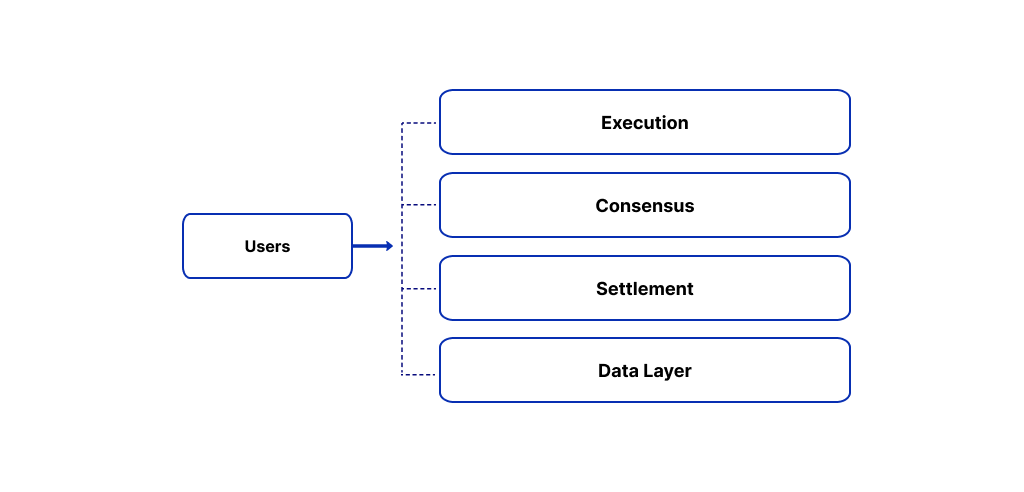
| Modular Architecture | Separates execution, settlement, consensus, and data availability into different layers. | $80,000 – $150,000+ | 12–24 Weeks | Very High | DeFi Platforms, Enterprise Web3 Solutions |
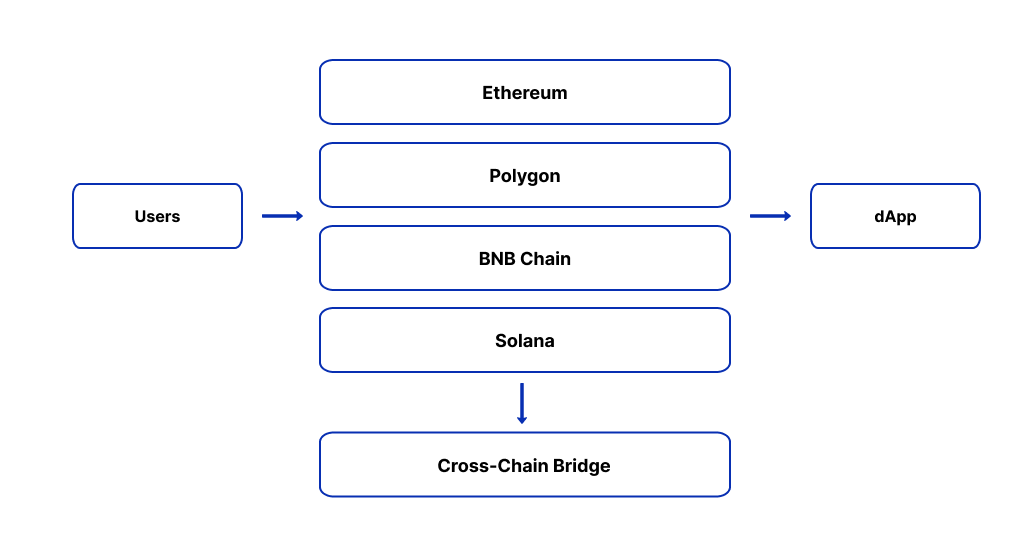
| Multi-Chain Architecture | Supports multiple blockchain networks for broader interoperability. | $100,000 – $150,000+ | 16–32 Weeks | Very High | Enterprise Applications, Large Web3 Ecosystems |
1. Monolithic Architecture
Monolithic blockchains manage all operations within a single layer, making them easier and faster to develop.
Cost Benefits:
- Lower initial development cost
- Faster deployment
- Simpler infrastructure management
Challenges:
- Limited scalability
- Higher transaction costs during congestion
Best For: MVPs, startup projects, and basic decentralized applications.
2. Layer-2 Architecture
Layer 2 solutions such as Polygon, Arbitrum, and Optimism process transactions off the main blockchain, reducing costs and improving speed.
Cost Benefits:
- Lower gas fees
- Better user experience
- Improved transaction throughput
Challenges:
- Additional integration requirements
- Bridge and interoperability complexity
Best For: NFT platforms, crypto wallets, and high-traffic Web3 applications.

3. Modular Architecture
Modular blockchain architectures separate core blockchain functions into independent layers, enabling greater scalability and customization.
Cost Benefits:
- Easier future upgrades
- Better scalability
- Reduced long-term infrastructure costs
Challenges:
- Higher upfront development expenses
- More complex integrations
Best For: DeFi ecosystems, tokenization platforms, and enterprise-grade Web3 solutions.
4. Multi-Chain Architecture
Multi-chain architectures allow applications to operate across multiple blockchain networks simultaneously.
Cost Benefits:
- Greater interoperability
- Access to broader user communities
- Reduced dependency on a single blockchain
Challenges:
- Complex development process
- Additional security considerations
- Higher testing and maintenance costs
Best For: Large-scale Web3 ecosystems, enterprise platforms, and applications requiring cross-chain functionality.
Cost Impact by Architecture Layer
Architecture Choice |
Cost Impact |
Long-Term ROI |
| Monolithic | Low | Moderate |
| Layer-2 | Medium | High |
| Modular | High | Very High |
| Multi-Chain | Very High | Very High |
10 Key Factors That Affect the Web3 Development Cost
There are various factors that can impact the cost to build a web3 platform. If you are a business wanting to develop a web3 platform, then you must consider these factors before planning the dApp development budget.
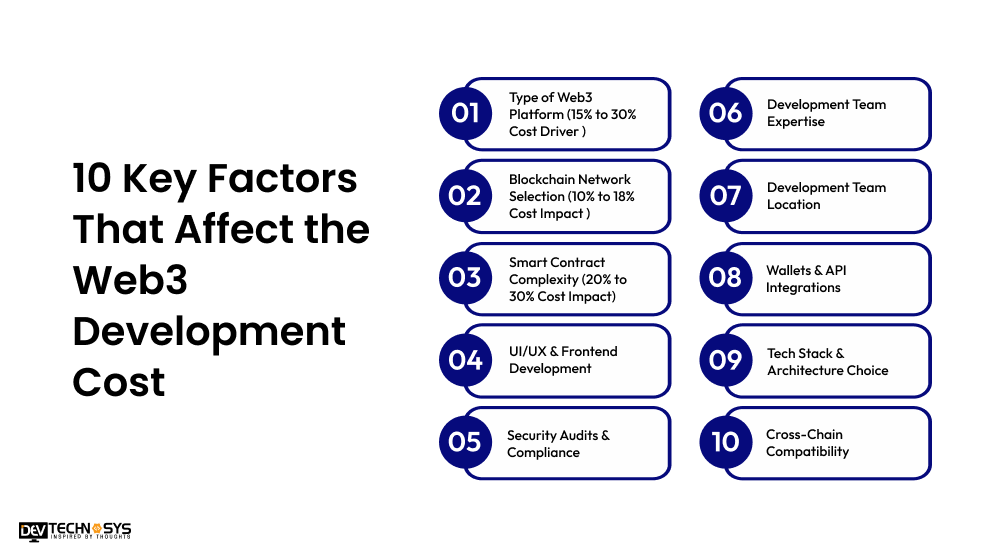
1. Type of Web3 Platform (15% to 30% Cost Driver )
The cost to build web3 application largely depends on the platform choice ( NFT marketplace, DAO, DeFi app, or Web3 gaming platform. For each category your Web3 development services providers will create separate architectures, development efforts, and integrations, which impacts the total Web3 app development budget and timeline.
Level |
Cost Impact |
Cost Range |
Timeline |
| Simple NFT / Basic dApp | 15% | $4,500 – $22,500 | 2 to 4 weeks |
| DeFi / DAO Platform | 22% | $6,600 – $33,000 | 4 to 8 weeks |
| GameFi / Advanced Ecosystem | 30% | $9,000 – $45,000 | 8 to 12 weeks |
2. Blockchain Network Selection (10% to 18% Cost Impact )
Another factors affecting Web3 development cost is blockchain. Selecting the right blockchain network (Ethereum, Polygon, or Solana) is necessary for the performance of the Wb3.
Factors like gas fees, scalability, ecosystem growth, and developer tools vary on different networks. It affects the initial cost to create Web3 applications as well as the long-term operational cost.
Cost Breakdown by Blockchain Network
Blockchain |
Cost Impact % |
Cost Range (USD) |
Typical Timeline |
| Ethereum | 18% (Highest) | $5,400 – $27,000 | 3 – 6 weeks |
| Solana | 14% (Medium) | $4,200 – $21,000 | 3 – 5 weeks |
| Polygon | 10% (Lower) | $3,000 – $15,000 | 2 – 4 weeks |
| BNB Chain | 10% (Lower) | $3,000 – $15,000 | 2 – 4 weeks |
| Avalanche | 14% (Medium) | $4,200 – $21,000 | 3 – 5 weeks |
| Base | 14% (Medium) | $4,200 – $21,000 | 3 – 5 weeks |
| Arbitrum | 14% (Medium) | $4,200 – $21,000 | 3 – 5 weeks |
3. Smart Contract Complexity (20% to 30% Cost Impact)
Smart contract development services can significantly affect the cost to develop Web3 applications. Smart contracts are the biggest cost drivers in Web3 Development. The price for simple smart contracts with limited logic will be less than that of the ones with complex logic, automation, and third-party audits. So, we suggest clearly stating your requirements and starting with a scalable smart contract architecture to reduce development costs.
Simple tokenomics: lower smart contract development cost
DeFi, staking, lending, DAO logic: highly complex
Here’s the table showing how much does smart contract development costs based on complexity level:
Complexity Level |
Cost Impact % |
Cost Range (USD) |
Development Effort |
Timeline |
| Basic Token / NFT Contract | 20% | $6,000 – $30,000 | Low complexity, standard logic | 2 – 4 weeks |
| Standard NFT Marketplace / Utility Token System | 22% – 25% | $6,600 – $37,500 | Medium complexity, multiple contract interactions | 4 – 6 weeks |
| DeFi Protocol (Staking / Swaps / Lending) | 25% | $7,500 – $37,500 | High complexity, financial-grade logic | 4 – 8 weeks |
| Advanced DeFi System (Multi-Protocol Integration) | 27% – 28% | $8,100 – $42,000 | Very high complexity, multi-contract architecture | 6 – 10 weeks |
| Advanced Protocol / DAO Governance Layer | 30% | $9,000 – $45,000 | Extremely high complexity, security-critical | 8 – 12 weeks |
| Enterprise-Grade Blockchain Ecosystem | 30% (upper) | $9,000 – $45,000+ | Expert-level engineering, audit-heavy | 10 – 14 weeks |
4. UI/UX & Frontend Development (10% to 18% cost Impact)
User interface and experience design is very crucial for Web3 adoption. Web3 apps still require strong Web2-like interfaces.
- Wallet integration (MetaMask, WalletConnect)
- Transaction flow handling
- Dashboard design for DeFi/NFT apps
A simple UI costs less, but creating an intuitive, responsive, and visually appealing design with smooth navigation, animations, and user-friendly dashboards requires additional design effort and increases Web3 development pricing.
Level |
Cost Impact |
Cost Range |
Timeline |
| Basic dashboard UI | 10% | $3,000 – $15,000 | 2 – 3 weeks |
| Interactive dApp UI | 14% | $4,200 – $21,000 | 3 – 6 weeks |
| Advanced DeFi/NFT UI | 18% | $5,400 – $27,000 | 4 – 8 weeks |
5. Security Audits & Compliance (15% to 25% Cost Impact)
Security is critical in Web3 development due to the involvement of digital assets and decentralized systems. If your blockchain development company will add advanced security measures, encryption, penetration testing, and smart contract audits, along with regulatory compliance, then it will increase the total cost of decentralized app development. Here’s the table highlighting smart contract audit cost with development timeline.
Industry Insights
Business Insider reports that the security remains a critical concern, with crypto-related thefts exceeding $2.2 billion annually in recent years, driving higher demand for audits and penetration testing.
Audit Level |
Cost Impact |
Cost Range |
Timeline |
| Single audit (basic app) | 15% | $4,500 – $22,500 | 1 – 2 weeks |
| Multi-stage audit (DeFi apps) | 20% | $6,000 – $30,000 | 2 – 4 weeks |
| High-security financial protocols | 25% | $7,500 – $37,500 | 3 – 6 weeks |
6. Development Team Expertise (20% to 35% Cost Impact)
The development team’s experience level is one of the most influential cost drivers in Web3 projects. The web3 developer cost directly affects both development speed and code quality.
- Senior blockchain engineers: Higher hourly rates but fewer errors
- Junior developers: Cheaper but longer development cycles
- Specialized DeFi/NFT engineers: Premium cost bracket
More expertise = Higher upfront cost but lower long-term risk
Industry Insights
According to TechRadar, security has become a top priority for Web3 projects. In 2025 alone, more than 29 million secrets and credentials were exposed on GitHub repositories.
Team Level |
Cost Impact |
Cost Range |
Timeline |
| Junior + Mid-level team | 20% | $6,000 – $30,000 | 6 – 10 weeks |
| Balanced senior team | 28% | $8,400 – $42,000 | 5 – 9 weeks |
| Senior + protocol specialists | 35% | $10,500 – $52,500 | 4 – 8 weeks |
7. Development Team Location (15% to 30% Cost Impact)
The Web3 software development pricing also varies depending on the geographical location of the development team. Location impacts Web3 app development cost: because
- Hourly rate differences across regions
- Availability of senior blockchain engineers
- Time zone collaboration efficiency
If you hire experienced blockchain developers from regions like the US or Europe, the cost to build a web3 app will be higher compared to outsourcing to countries like India, which offer cost-effective yet skilled resources.
Region |
Cost Impact |
Cost Range |
Timeline |
| India / SEA | 15% | $4,500 – $22,500 | 6 – 10 weeks |
| Eastern Europe | 22% | $6,600 – $33,000 | 5 – 9 weeks |
| USA / Western Europe | 30% | $9,000 – $45,000 | 4 – 8 weeks |
8. Wallets & API Integrations (8% to 15% Cost Impact)
Wallet and API integrations play a crucial role in Web3 applications because they connect the platform with external blockchain services and user wallets. This includes integrating crypto wallets such as MetaMask and WalletConnect for secure user authentication and transactions. It impacts blockchain development cost to a significant level.
Integration Level |
Cost Impact |
Cost Range |
Timeline |
| Basic wallet connect | 8% | $2,400 – $12,000 | 1 – 2 weeks |
| Multi-wallet + APIs | 12% | $3,600 – $18,000 | 2 – 4 weeks |
| Cross-chain + oracle integration | 15% | $4,500 – $22,500 | 3 – 5 weeks |
9. Tech Stack & Architecture Choice ( 12% to 22% Cost Impact )
Tech stack and architecture significantly influence Web3 development cost. A monolithic architecture is cheaper and faster to build, while microservices offer better scalability but increase complexity and cost. The choice of frameworks like Hardhat, Truffle, or Foundry, along with frontend stacks such as React or Next.js with Web3 libraries, also impacts development speed and expertise requirements
Architecture Type |
Cost Impact |
Cost Range |
Timeline |
| Monolithic dApp | 12% | $3,600 – $18,000 | 2 – 4 weeks |
| Hybrid architecture | 17% | $5,100 – $25,500 | 4 – 7 weeks |
| Microservices + scalable Web3 infra | 22% | $6,600 – $33,000 | 6 – 10 weeks |
10. Cross-Chain Compatibility (10%–25%)
Cross-chain compatibility lets assets and users connect with each other across different blockchain networks, like BNB Chain, Polygon, Ethereum, and Polygon. It makes interoperability better and lets more people use it, but it needs to be integrated with a bridge, tested more, maintained regularly, and costs a lot more to build.
Cross-Chain Scope |
Cost Impact |
Cost Range (Based on $30K–$150K Budget) |
Timeline |
| Single Blockchain | 10% | $3,000 – $15,000 | 1 – 2 weeks |
| Dual-Chain Integration | 15% | $4,500 – $22,500 | 2 – 4 weeks |
| Multi-Chain Support (3–4 Chains) | 20% | $6,000 – $30,000 | 4 – 6 weeks |
| Advanced Cross-Chain Ecosystem | 25% | $7,500 – $37,500 | 6 – 10 weeks |
What are the Hidden Costs of Web3 Development?
Web3 projects often exceed budgets due to hidden costs beyond core development, including infrastructure, security, compliance, and maintenance expenses that are not included in initial estimates but significantly impact total project cost.
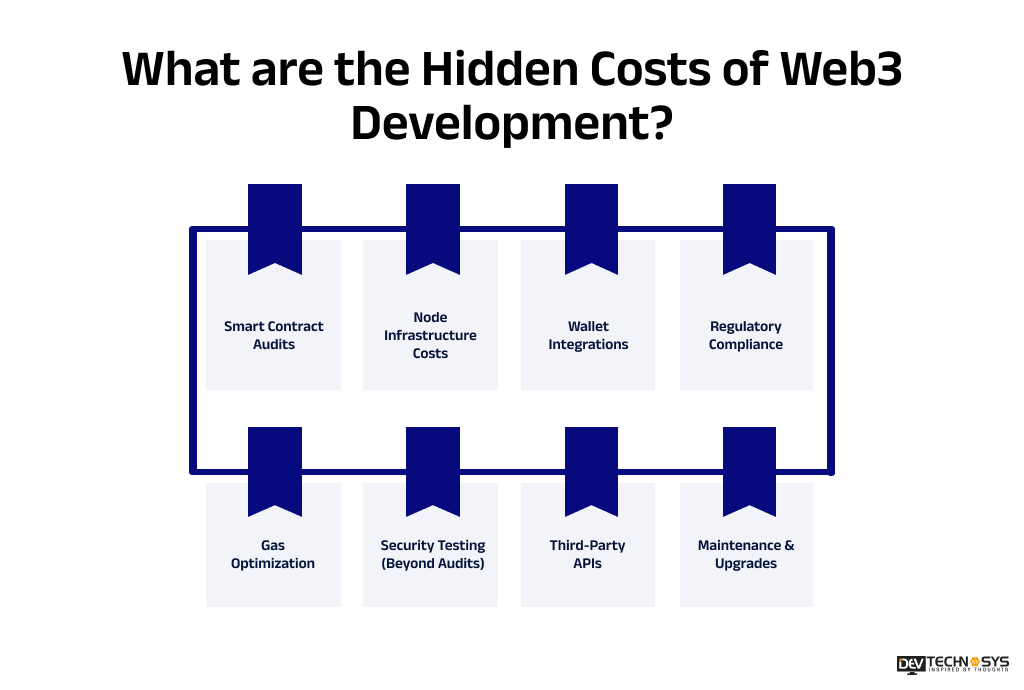
1. Smart Contract Audits
Smart contract audits are essential for security and investor trust. They involve third-party review, multiple audit cycles, and post-audit fixes, especially for DeFi systems, making them one of the most expensive hidden costs.
2. Node Infrastructure Costs
Node infrastructure supports blockchain connectivity through full nodes, RPC services, and data indexing. These systems require continuous maintenance and scaling, making them an ongoing operational cost for decentralized applications.
3. Wallet Integrations
Wallet integration enables user interaction with blockchain apps through MetaMask, WalletConnect, and multi-wallet support. It also includes transaction handling and error management, increasing both development time and backend complexity.
4. Regulatory Compliance
Regulatory compliance includes KYC/AML systems, token classification, and legal structuring across jurisdictions. These requirements vary by region and significantly increase cost for financial and DeFi-based Web3 platforms.
5. Gas Optimization
Gas optimization reduces transaction fees by improving smart contract efficiency, batch processing, and Layer-2 adjustments. It requires advanced engineering effort to ensure cost-effective and scalable blockchain performance.
6. Security Testing (Beyond Audits)
Security testing includes penetration testing, stress testing, and attack simulations beyond formal audits. It ensures system resilience, identifies vulnerabilities early, and adds additional cost to ensure robust Web3 application security.
7. Third-Party APIs
Third-party APIs such as oracles, NFT metadata services, and blockchain indexers are widely used in Web3 applications. These integrations involve subscription fees and continuous maintenance for reliable external data access.
8. Maintenance & Upgrades
Maintenance includes smart contract upgrades, bug fixes, and protocol improvements. It is an ongoing cost typically representing 15%–25% of the total development budget annually for sustaining Web3 applications.
Hidden Cost Factor |
Cost Impact (USD) |
% of Total Budget ($30K–$150K) |
Timeline |
| Smart Contract Audits | $15,000 – $40,000 | 15% – 25% | 1 to 4 weeks |
| Node Infrastructure | $2,000 – $20,000 | 8% – 15% | Ongoing |
| Wallet Integrations | $1,500 – $10,000 | 5% – 10% | 1 to 3 weeks |
| Regulatory Compliance | $3,000 – $25,000 | 10% – 20% | 2 to 6 weeks |
| Gas Optimization | $2,000 – $15,000 | 5% – 12% | 1 to 3 weeks |
| Security Testing (Beyond Audits) | $2,500 – $18,000 | 8% – 15% | 2 to 4 weeks |
| Third-Party APIs | $1,000 – $12,000 | 3% – 10% | Continuous |
| Maintenance & Upgrades | 15% – 25% of the total project cost annually | 15% – 25% | Ongoing |
Security and Compliance for Web3 Development
The aspect of security and compliance is expected to have a significant impact on the cost of Web3 development in the year 2026. To secure a good product, it is necessary to have a protection system in place encompassing smart contracts, wallets, blockchain infrastructure, user data, and transactions, while also fulfilling necessary regulatory requirements.
1. Security of Decentralized Identity
Utilize decentralized identity solutions that include verifiable credentials, reliable authentication, and privacy-protecting verification processes. This helps to eliminate reliance on common identity repositories and allows users to have better control over their personal details while providing Web3 solutions with the ability to securely interact in decentralized environments without risk.
2. Security and Governance of Tokens
Offering security token protocols is essential for token-driven platforms, which should also offer minting control, open governance policies, and safeguards that make it impossible to perform any unauthorized transfers. Having clear permission definitions and voting schemes can make it more difficult to perform any type of governance-related manipulation, as well as keep supply-related vulnerabilities and unauthorized changes in vital token parameters away.
3. Security of Oracle
It is advisable for Web3 solutions depending on outside data to implement reliable oracle systems that rely on numerous data sources and verification procedures. Such a robust system of oracle security may prevent price manipulations, misleading market information, and faulty decisions based on compromised data.
4. Security In Bridges And Cross-Chain
Transferring assets and messages in multi-chain and blockchain bridges requires additional precautions. Measures such as multi-signature verification, transaction authentication, rate limiting, monitoring, and independent security checks can help mitigate the risk of blocking the operations of bridges and transferring money fraudulently.
5. Government And Access Management
In administrative duties, the use of multi-signature approval, time locks, and a clearly defined governance process is significant. The division of important access among different players decreases the risk of insider attacks and limits the effect of one stolen account.
6. Frontend And Dapps Security
Frontend Web3 applications have to ensure the following: validate wallet actions, secure communication through APIs, and keep authentication sessions from being compromised. Prevent the work of malicious scripts using such practices as the implementation of content security policies, monitor dependencies and code inputs, and follow the best practices for wallet connection.
Web3 Development vs Traditional Web Development: A Detailed Cost Comparison
There are different levels of development needed for Web3 and standard web apps. For Web3 projects, there are extra steps like integrating blockchain, creating smart contracts, connecting wallets, decentralizing storage, and doing security audits. We3 development usually costs more and takes longer than regular web development because of this.
Development Aspect |
Traditional Web Development |
Web3 Development |
| Average Project Cost | $10,000 – $80,000 | $30,000 – $150,000+ |
| Development Timeline | 4 – 12 weeks | 6 – 24+ weeks |
| Backend Infrastructure | Standard databases and servers | Blockchain networks, nodes, and decentralized storage |
| Security Requirements | Standard security practices | Smart contract audits, penetration testing, and blockchain security |
| Authentication | Email, phone, social login | Crypto wallets and decentralized identity |
| Third-Party Integrations | APIs, payment gateways | Wallets, oracles, blockchain APIs, and bridges |
| Compliance Costs | Moderate | High, especially for DeFi and tokenized platforms |
| Maintenance Costs | 10% – 15% annually | 15% to 25% annually |
| Scalability Complexity | Medium | High, especially for multi-chain applications |
| Hidden Costs | Relatively low | Audits, gas optimization, node infrastructure, and bridge integrations |
Case Study: PAYCOINZ
Paycoinz is a blockchain-based crypto payment gateway developed by Dev Technosys for a U.S.-based fintech entrepreneur in the FinTech industry. the clients reviwewd our portfolio and selected the services they wanted. this project was built over 32 weeks by a 12-member development team, the platform enables secure and fast digital transactions.
It is designed as a scalable blockchain payment solution supporting global cryptocurrency adoption and payments. Clients can contact us for further expert guidance regarding the maintenance of their project.
- Project Name: Paycoinz – Crypto Payment Gateway Platform
- About Client: Robert, fintech entrepreneur focused on global crypto transactions
- Industry: FinTech / Cryptocurrency Payments
- Client Location: United States
- Development Timeline: 32 Weeks
- Team Size: 12 Members
How Long Does It Take to Build a Web 3 Platform?
Are you a business wondering how long does web3 development take? The development timeline of a Web3 platform depends on complexity, blockchain selection, smart contract design, and security requirements. On average, a complete Web3 project takes 6 to 16 weeks, but advanced DeFi or multi-chain systems can take longer.
Platform Type |
Complexity Level |
Estimated Timeline |
Key Components |
| Basic Web3 App (NFT minting, simple dApp) | Low | 4 – 6 weeks | Wallet integration, simple smart contracts, basic UI |
| NFT Marketplace / Token Platform | Medium | 6 – 10 weeks | Listings, auctions, metadata, backend APIs |
| DeFi Platform (staking, swaps, lending) | High | 10 – 16 weeks | Complex smart contracts, audits, liquidity logic |
| Advanced Web3 Ecosystem (DAO, GameFi, multi-chain) | Very High | 16 – 24+ weeks | Cross-chain integration, governance, scaling systems |
Top 5 Popular Web3 Apps and Their Development Costs
Web3 applications are rapidly transforming how users interact with decentralized finance, NFTs, and blockchain-based services. Choosing the right platform can help developers, investors, and users engage with secure, scalable, and innovative Web3 ecosystems in 2026.
1. Uniswap V3 ( $30K to $78K)
Uniswap V3 is a decentralized exchange (DEX) enabling users to swap cryptocurrencies directly from their wallets without intermediaries. Its automated market maker (AMM) model, concentrated liquidity, and advanced trading features make it a cornerstone in the DeFi ecosystem, attracting millions of users daily.
2. MetaMask ($45K to $95K)
MetaMask is a widely used Web3 wallet and gateway that allows users to manage crypto assets, sign transactions, and interact with decentralized applications across multiple blockchains.
Hire web3 developers to create platforms like this with seamless browser integration, mobile app, and ease of use, making it essential for everyday Web3 engagement.
Industry Inights:
According to ConsenSys, MetaMask surpassed 100 million annual users in 2025, highlighting the growing demand for self-custody wallets and access to decentralized applications.
3. Chainlink ($ 45K to $100K)
Chainlink is a decentralized oracle network that securely connects smart contracts with real-world data, APIs, and off-chain information. By providing reliable data feeds for DeFi protocols, NFT platforms, and other decentralized applications, Chainlink ensures trust and accuracy, making it a critical infrastructure for Web3 projects.
Industry Insights:
Sherlock states that Chainlink secures over $93 B in on‑chain value and dominates the Oracle market share.
4. Filecoin ( $35K to $95K)
Filecoin is a decentralized storage network that allows users to store, retrieve, and share data securely without relying on centralized servers. Its blockchain-based incentive system encourages efficient storage, ensuring reliability, redundancy, and privacy for applications that require distributed file storage solutions.
5. The Graph ($50K to $120K)
The Graph is a decentralized indexing protocol that enables developers to query blockchain data efficiently. By providing a reliable and fast way to access on-chain data, it supports complex decentralized applications, NFT marketplace development, and DeFi platforms, improving scalability and reducing development complexity.
Web3 App |
Category |
Estimated Development Cost |
Estimated Timeline |
Complexity Level |
| Uniswap V3 | DeFi Exchange | $30,000 – $78,000 | 8 to 16 weeks | High |
| MetaMask | Crypto Wallet | $45,000 – $95,000 | 10 to 18 weeks | High |
| Chainlink | Oracle Network | $45,000 – $100,000 | 12 to 20 weeks | Very High |
| Filecoin | Decentralized Storage | $35,000 – $95,000 | 10 to 18 weeks | High |
| The Graph | Data Indexing | $50,000 – $120,000 | 12 to 24 weeks | Very High |
Build vs Buy vs Development Partner: Which Option is More Cost-Effective for Startups?
One of the most important choices startups have to make when planning a Web3 project is whether to build the platform themselves, buy a ready-made one, or work with a Web3 development company. When it comes to cost, speed of development, customization, scalability, and long-term upkeep, each method has its own benefits.
- Build: Building the platform from scratch provides businesses the most freedom, but it usually costs a lot of money and technical knowledge.
- Buy: Ready-made options, on the other hand, are the faster method to reach the end goal and cost less money, but they lack in the freedom and innovation aspect.
- Development Partner: Working with a professional Web3 development company strikes a perfect balance between cost, flexibility, and speed. This is the most cost efficient option for new businesses that want to get up and running quickly without sacrificing quality.
Factor |
Build In-House |
Buy Ready-Made Solution |
Development Partner |
| Initial Cost | $80,000 – $300,000+ | $5,000 – $50,000 | $30,000 – $150,000 |
| Development Timeline | 4 – 12 months | 1 – 4 weeks | 2 – 6 months |
| Customization | Very High | Low–Medium | High |
| Scalability | Very High | Limited | High |
| Blockchain Expertise Required | High | Very Low | Not Required |
| Hiring Cost | High | None | None |
| Maintenance Cost | High | Medium | Medium |
| Security & Audit Control | Full Control | Limited | High |
| Time-to-Market | Slow | Very Fast | Moderate |
| Long-Term Flexibility | Excellent | Limited | High |
| Risk Level | High | Low | Medium |
| Best For | Enterprises & Large Startups | MVPs & Validation | Startups & SMBs |
For most startups, partnering with a Web3 development company is the most cost-effective approach. It eliminates the challenges of hiring and managing an internal blockchain team while providing access to experienced developers, security experts, and proven development processes.
You can reach out anytime; we are available 24/7. Our team provides a quick response.

Common Mistakes That Increase Web3 Development Costs
Many Web3 projects exceed their budgets not because of technology limitations, but due to poor planning, unclear requirements, and underestimated complexity. These mistakes often lead to rework, delays, and higher audit and infrastructure costs.
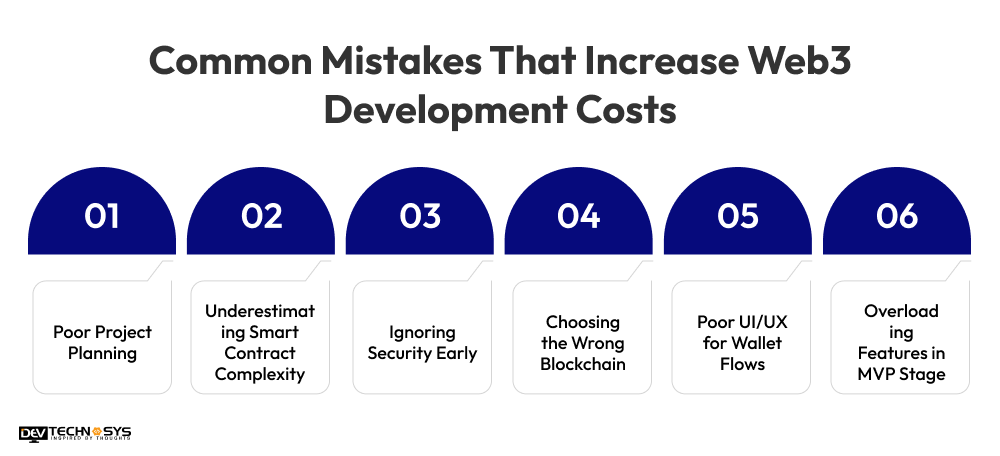
1. Poor Project Planning
Skipping proper requirement analysis leads to unclear scope, frequent changes, and redesigns. This increases development cycles and forces teams to rebuild smart contracts or application logic multiple times.
Cost Impact: 10% to 20% ($3,000–$20,000)
Hear from Experts:
According to our CTO Mohit Nag, Web3 projects with poorly defined requirements can experience 10% to 20% budget overruns due to scope creep and repeated development efforts.
2. Underestimating Smart Contract Complexity
Many teams assume smart contracts are simple, but DeFi logic, staking systems, and governance models require advanced architecture, testing, and optimization, which significantly increases cost and time.
Cost Impact: 15% to 30% ($4,500–$30,000)
3. Ignoring Security Early
Delaying security considerations leads to expensive fixes later. Lack of early audits and testing increases vulnerability risks and results in costly rework after external audit failures.
Cost Impact: 15% to 25% ($4,500–$37,500)
4. Choosing the Wrong Blockchain
Selecting a high-cost or complex blockchain like Ethereum without necessity increases gas fees, development effort, and integration complexity, impacting blockchain application development cost and scalability.
Cost Impact: 10% to 20% ($2,000 to $20,000)
5. Poor UI/UX for Wallet Flows
Ignoring user experience for wallet connections and transactions leads to user drop-off and redesign efforts. Fixing UX issues later increases frontend development costs significantly.
Cost Impact: 5% to 15% ($1,500 to $12,500)
6. Overloading Features in MVP Stage
Adding advanced features like cross-chain support or governance in early stages increases complexity and delays launch, making MVP development much more expensive than planned.
Cost Impact: 20% to 40% ($6,000–$40,000)
Key Strategies to Reduce the Web 3 Development Cost
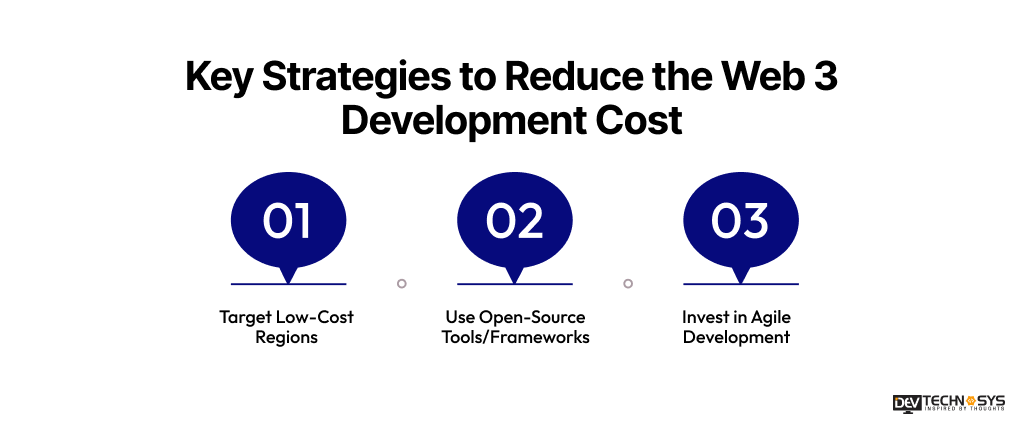
1. Target Low-Cost Regions
The total cost of building Web3 platforms can be significantly reduced by outsourcing development to countries like India or Eastern Europe, where labor costs are lower.
You can hire qualified developers at a much lower price by reaching out to an international dApps development company. Just make sure to manage quality control and keep lines of communication open.
- Why: Lower labor costs in certain regions can reduce overall development expenses.
- How: Outsource development to countries with skilled developers at competitive rates, such as India or Eastern Europe.
2. Use Open-Source Tools/Frameworks
Development time and expenses can be significantly reduced by utilizing open-source tools, libraries, and frameworks (such as Truffle, Hardhat, or OpenZeppelin).
Since these resources are frequently already constructed and tested, developers can concentrate on personalizing features rather than creating them from scratch. Additionally, this lessens the requirement for substantial internal development.
- Why: Open-source resources help speed up development and reduce the need for custom-built solutions.
- How: Leverage well-established libraries and frameworks like OpenZeppelin or Hardhat to build faster and cheaper.
3. Invest in Agile Development
Hire dedicated developers in USA who use agile development techniques. It makes it easier to divide big projects into smaller, easier-to-manage the cost to develop a Web3 application.
This results in smoother project management, quicker delivery, and more effective use of resources. Additionally, it provides flexibility, allowing teams to change course or scale without incurring large costs.
- Why: Agile methods allow for flexible, incremental development, reducing risk and cost.
- How: Break the project into smaller sprints, enabling quicker adjustments, early testing, and faster delivery.
Conclusion
Web3 development costs are influenced by multiple interrelated factors, from platform type to security, integrations, and maintenance. Understanding these factors helps businesses plan budgets effectively, select the right tech stack, and build scalable, secure, and user-friendly decentralized applications. If you are a business looking to build a top Web 3 platform, turn to Dev Technosys, a leading Web3 development company in USA.
Frequently Asked Questions
Find answers to the most common questions related to this article.
The answer to how much does web3 development cost depends on the platform, blockchain network, smart contract design, security checks, integrations, and scalability needs, Web3 development can cost anywhere from $30,000 to $150,000 or more. MVPs that are simple cost less, while DeFi and multi-chain platforms cost more.
AI won't take the place of Web3 workers, but it will help them a lot with things like coding, testing, debugging, and automating. But system architecture, smart contract security, blockchain logic, and making difficult choices about how to design a decentralized app still need human input.
Because blockchain, DeFi, NFTs, and corporate Web3 solutions are becoming more popular so quickly, there is a big need for Web3 developers. Due to a lack of skilled workers and rising global usage, salaries are still high, and hiring is very competitive in the industry.
It can cost anywhere from $10,000 to $100,000 or more to make a cryptocurrency, based on whether it's a simple token or a complex blockchain ecosystem with governance, staking mechanisms, security audits, and advanced tokenomics and infrastructure.
In crypto, the "1% rule" tells buyers that they should only put 1% of their entire portfolio at risk on a single trade or investment. This method helps lower the risk of instability and limits the amount of money that could be lost.