
















Key Takeaways:
- Smart contracts are written in Solidity or similar languages, defining rules and logic for automated execution on blockchain networks.
- Developers choose a blockchain like Ethereum or Polygon and set up tools such as Remix, Hardhat, and MetaMask for development.
- Contracts are compiled, tested thoroughly using test networks, and debugged to ensure secure and correct functionality before deployment.
- Finally, the smart contract is deployed on blockchain and interacted with via wallets or applications using Web3 integration tools.
A smart contract allows users to give their blockchain application the ability to autonomously carry out tasks via a smart contract.
Automate your payments or take a shot at Web3 innovation to create a smart contract. This route is designed for the beginner blockchain developer and breaks down the process into understandable, usable tools and software to help populate your ideas into reality.
“Smart contracts give us a new paradigm where code becomes the final arbiter of truth.” – Gavin Wood
As per the global market, the smart contract market was valued at around $684 million in 2022; it is projected to grow to around $73,773.0 million in 2030.
This above data highlights that investing in smart contract development is a profitable opportunity for entrepreneurs or businesses.
In this blog, we will explore how to create a smart contact on Blockahin and how businesses can make a profit from this and other useful information.
Digital Automation, Here We Go!
Market Statistics of Global Smart Contracts
- According to the worldwide market, the smart contracts market is expected to increase with a CAGR of 82.2% during the forecast period from 2026 to 2030.
- Based on blockchain type, the public segment holds the highest revenue share, around 60.0% in 2026.
- The region-wise, North America dominates the smart contract industry and is expected to generate the highest revenue and account for around 31.0% in 2026.
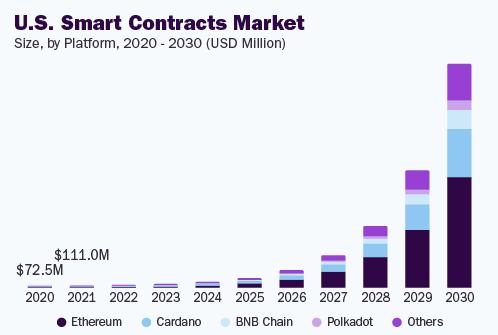
- The recent study found that the Ethereum segment dominates the market and holds the market revenue share of around 49.0% in 2026.
- As we look at enterprise-size, the enterprise segment is one of the largest revenue-generating segments and grabs the revenue share of around 67.0%.
What is a Smart Contract?
A smart contract is a self-executing program that controls the transfer of digital assets between the parties when certain conditions are met. Smart contracts simply eliminate the intermediaries and automatically enforce the contract.

It offers premium features such as security, trust, efficiency, autonomy, decentralization, self-executing, and more. Smart contracts are used in various industries like real estate, insurance, supply chain management, and decentralized finance.
How Smart Contracts Work?
Smart contracts are self-executing programs on blockchain that automatically run when conditions are met. They eliminate intermediaries, ensure transparency, reduce costs, and enable secure, trustless transactions for applications like finance, NFTs, and digital agreements.
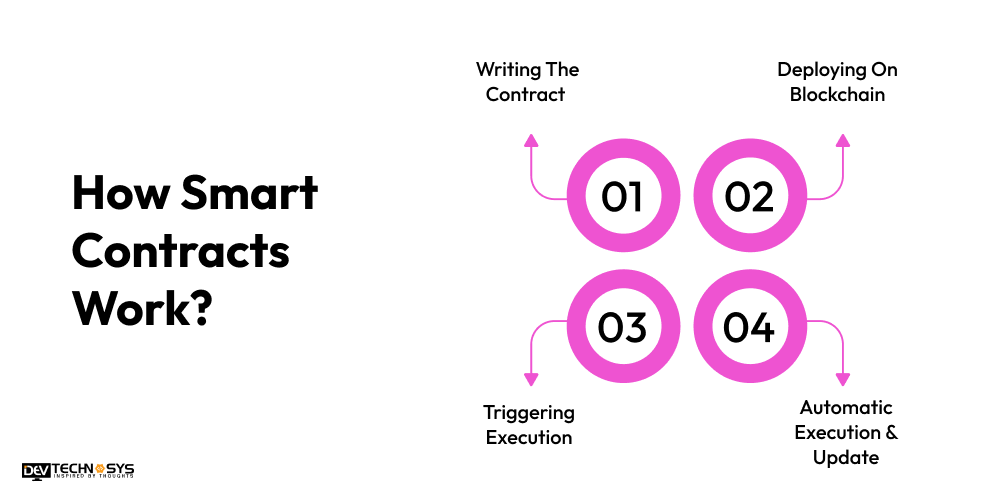
1. Writing The Contract
Developers will design smart contracts by dictating predetermined rules, conditions, and actions as written in programming languages primarily, such as Solidity. Developers will be responsible for documenting all the parameters around how each asset should be controlled.
2. Deploying On Blockchain
Smart contracts must first be deployed onto a blockchain network where each contract gets a unique identifier. Upon deployment, smart contracts can not be changed and, due to the blockchain’s public nature, can be transacted with by anyone.
3. Triggering Execution
Once deployed on the blockchain, users can perform transactions against smart contracts. If the conditions specified in the smart contract have been satisfied, then specific functions within that smart contract will automatically activate.
4. Automatic Execution & Update
Once transactions have been processed by the blockchain nodes, the smart contract logic is executed. Depending on the conditions set out in the smart contract, there can be many different possible outcomes of transactions executed against a smart contract.
Why Businesses Want to Invest in Smart Contract Development?
Businesses want to reduce third-party interference, and this can also eliminate extra expenses. Investing in smart contract development is the best opportunity to streamline, automate execution, and minimize manual errors. Here we provide the list of benefits:
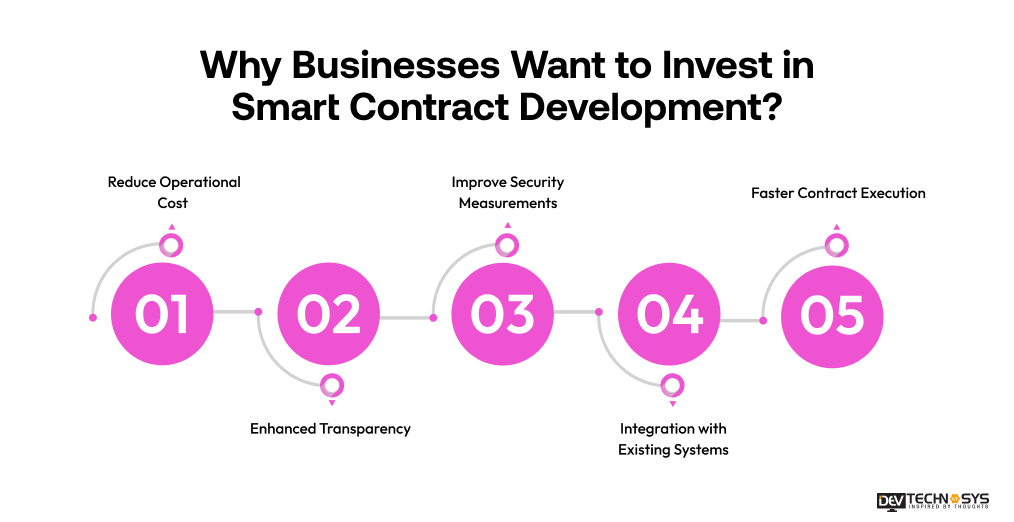
1. Reduce Operational Cost
Automating contracts eliminates intermediaries and reduces manual processing by allowing businesses to use smart contract technology to verify, enforce, and settle all activities themselves, which results in dramatic savings on administrative costs. Companies will spend less on legal costs, third-party services, and repetitive back-office functions.
2. Enhanced Transparency
Smart contracts also provide complete visibility for companies on how their agreements are executed through the use of blockchain technology. An immutable ledger of all transactions records every transaction with unalterable information that cannot be altered in any way.
This means that all parties to an agreement will have access to the same immutably-recorded information and, therefore, the same information about any transaction.
3. Improve Security Measurements
The single point of cryptographic security associated with smart contracts through the blockchain will make it virtually impossible to make any changes without being detected and, therefore, virtually eliminate fraud risk.
Due to every transaction being validated at the point of origin and permanently recorded, fraud risk drops dramatically. Companies will have a higher level of protection against tampering, fraud, and manipulation from within.
4. Integration with Existing Systems
Furthermore, as all smart contracts are integrated into the Internet of Things (IoT), payment processors, supply-chain management systems, and enterprise management systems are involved.
With the help of Solidity development services provider, businesses are able to automatically execute complete workflows that have been activated based on real-time data, including inventory updates, confirmations of delivery, and sensor data.
5. Faster Contract Execution
Traditional contracts involve lengthy approval cycles, manual signatures, and slow settlements. Smart contracts automate these steps, executing instantly once predefined conditions are met.
This speed improves cash flow, accelerates deal closures, and enhances customer satisfaction. Businesses gain a clear competitive edge by reducing waiting times and minimizing administrative delays.
7 Key Steps to Create a Smart Contract on Blockchain
To develop a smart contract on Blockchain with customized functionalities, you will need to follow these development steps to gain a detailed description of each process. These steps start from the project requirements to post-launch maintenance services. So, let’s begin the smart contract development process:
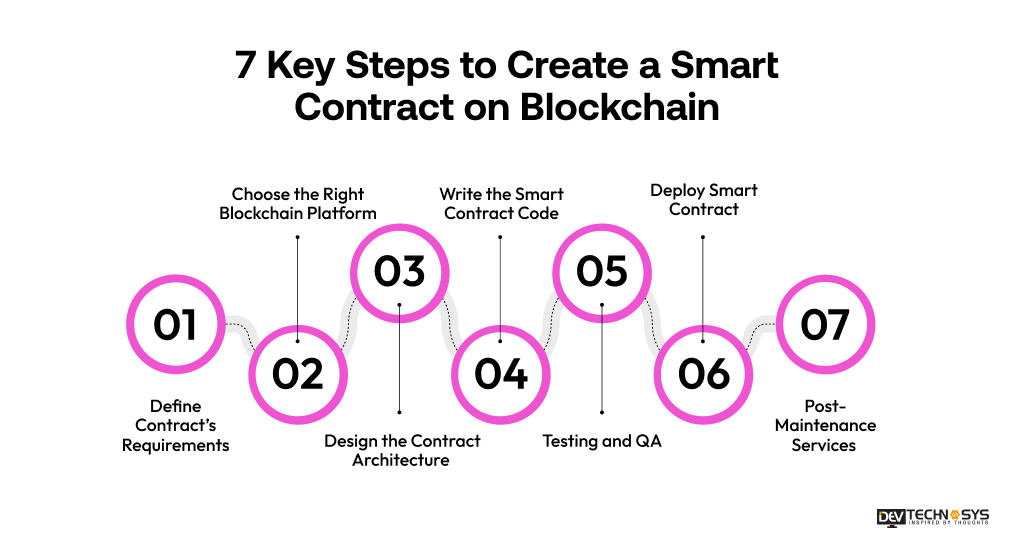
1. Define Contract’s Requirements
In the first stage to create a smart contract, make a structure outline of smart contract requirements, such as features, functions, conditions, outcomes, and participants.
Businesses can also look at the existing smart contract and identify the project scope and long-term business value. Create a clear draft of business rules to prevent ambiguity and misunderstandings.
2. Choose the Right Blockchain Platform
Moving to another step to launch a smart contract. Hiring an Ethereum development company to choose the right blockchain platform is very important, and make sure that the selected platform meets your business requirements.
There are various types of blockchain platforms, such as Ethereum, BNB Chain, Polygon, Hyperledger, and many more. The selected blockchain platform directly impacts on the performance, scalability, and development cost.
3. Design the Contract Architecture
Create a structured outline detailing variables, functions, workflows, permissions, and event triggers. Proper architecture design ensures modular, efficient, and secure coding.
This planning stage highlights potential vulnerabilities or logic gaps before development begins. A clear blueprint helps developers build a contract that is easy to maintain, upgrade, and integrate with external applications or systems.
4. Write the Smart Contract Code
Let’s come to the fourth stage to build a smart contract, and hire skilled developers from a blockchain development company to write smart contract code. Use languages like Solidity and Rust, or based on the project requirements.
Developers need to write clean and optimized code for cost-effective execution. It includes various activities such as implementing logic, security measurements, and defining conditions.
Code: Use Solidity
pragma solidity ^0.8.20;
contract PaymentContract {
address public payer;
address public payee;
constructor(address _payee) {
payer = msg.sender;
payee = _payee;
}
function sendPayment() external payable {
require(msg.sender == payer, “Only payer can send funds”);
require(msg.value > 0, “No amount sent”);
payable(payee).transfer(msg.value);
}
}
5. Testing and QA
Before publish smart contracts, you will need to test them under various conditions to make sure all services and functions are working perfectly. It includes functional testing, security audits, integration testing, user acceptance testing, and more. Fix all the bugs, glitches, and vulnerabilities that are found during testing. Ensure that smart contracts are working at their peak.
6. Deploy Smart Contract
In the second last step to develop a smart contract, after successfully testing. Deploy smart contracts on the selected blockchain platforms using Hardhat, Truffle, and Remix.
Deployment assigns a contract address and makes the code immutable. Developers must ensure proper configuration of gas fees and transaction parameters. After deployment, the contract becomes publicly accessible and can interact with users or external systems.
7. Post-Maintenance Services
Post-deployment, continuously monitor contract performance, activity logs, and security indicators. While smart contracts are immutable, developers can use proxy patterns or upgradeable architectures to implement improvements.
Hire a professional mobile app development company to offer Regular maintenance, ensure smooth operation, prevent exploitation, and support long-term adaptability. Monitoring also helps track usage trends and optimize future contract versions or integrated applications.
You can reach out anytime; we are available 24/7. Our team provides a quick response.

Case Study: Smart Contract Development
“At Dev Technosys, we developed a secure and scalable Smart Contract solution to automate digital agreements with full transparency. Our goal was to help businesses eliminate intermediaries, reduce costs, and ensure trust through blockchain-backed execution.
Key challenges included optimizing gas fees, ensuring cross-chain compatibility, and preventing security vulnerabilities. We introduced features like automated audits, role-based permissions, Oracle integration, and upgradeable modules.
Designed for industries such as fintech, supply chain, and digital assets, this solution enables seamless Web3 adoption with enterprise-grade security and reliability.”
Narayan Das – Delivery Manager
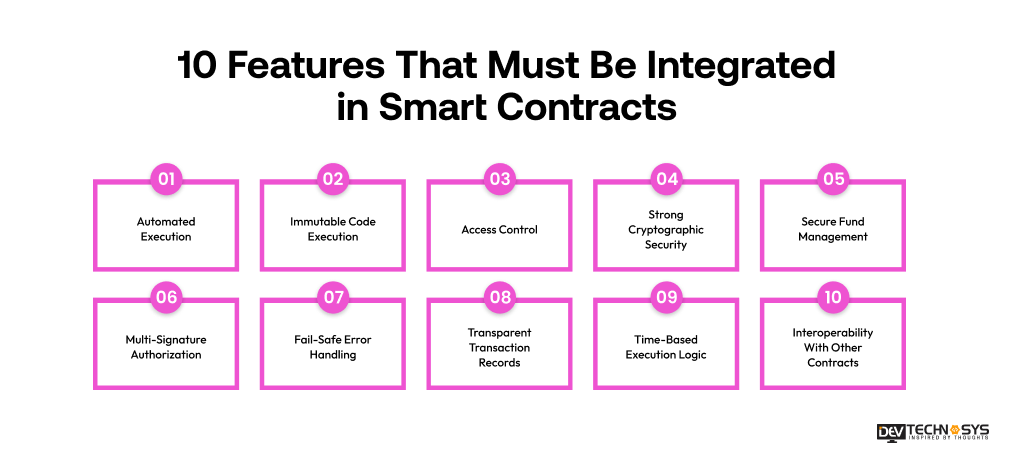
10 Features That Must Be Integrated in Smart Contracts
Features are important in every type of development. There are various kinds of features that must be integrated into a smart contract. So, here we provide the list of smart contract features:
-
Automated Execution
The automated execution triggers contracts instantly when certain conditions are met, this can reduce the manual processing and intermediaries.
-
Immutable Code Execution
The smart contract executes the same code that is written and no one can change the execution after the deployment, which can prevent manipulation.
-
Access Control
The smart contract defines the specific roles with restricted access. It offers permission-based accessibility, this can ensure that only authorized users can access the sensitive functions.
-
Strong Cryptographic Security
Solidity smart contracts have strong cryptographic security measures such as hashing, encryption, and signature verification to protect identities and prevent tampering.
-
Secure Fund Management
The smart contract has the ability to manage the funds securly, such as balance checks, withdrawals, and safer transfer logic.
-
Multi-Signature Authorization
The multi-signature authorization requires multiple approvals before executing a sensitive operation or function. This can reduce risk and enhance accountability.
-
Fail-Safe Error Handling
Proper error management prevents unexpected behaviors, reverses faulty transactions, and ensures funds remain secure. Structured error handling safeguards the system from invalid inputs or malicious attempts.
-
Transparent Transaction Records
The smart contract transactions are clearly visible on the blockchain. It can build trust, enhance accountability, and businesses can see the real-time activity.
-
Time-Based Execution Logic
Time locks, block timestamps, and scheduled triggers ensure operations occur only at specific intervals. This feature supports vesting, auctions, delayed payouts, and structured release mechanisms.
-
Interoperability With Other Contracts
Smart contracts should communicate with external contracts via interfaces. Interoperability supports modular systems, token standards, cross-protocol integrations, and more complex decentralized ecosystems.
What is the Cost to Create a Smart Contract on Blockchain?
The cost to develop a smart contract on blockchain is around $8,000 to $25,000 or depending on the personalized requirements. There are various key factors that can affect the smart contract app development cost, such as premium features, blockchain platforms, complexity, size, code infrastructure, and many more.
Additional factors can also affect the cost to deploy a smart contract, such as deployment fees, gas fees, transaction fees, auditing, testing, security measurements, and more.
Smart Contract Type / Complexity Level |
Estimated Cost Range |
| Basic Token Contract (ERC-20 style) | $8,000 – $10,000 |
| Simple NFT Contract (ERC-721) | $9,000 – $12,000 |
| Multi-Function Token Contract | $10,000 – $14,000 |
| NFT Marketplace Contract Logic | $12,000 – $17,000 |
| DeFi Staking / Farming Contract | $14,000 – $20,000 |
| Smart Contract with Custom Logic | $16,000 – $22,000 |
| Complex DeFi / dApp Contract Suite | $18,000 – $25,000 |
What Factors Can Affect the Smart Contract Development Cost?
Smart contract development costs depend on contract complexity, chosen blockchain platform, required security audits, development time, integration needs, testing efforts, and developer expertise.
Additional factors include gas optimization, regulatory compliance, project scope, and ongoing maintenance, all of which impact the overall budget.
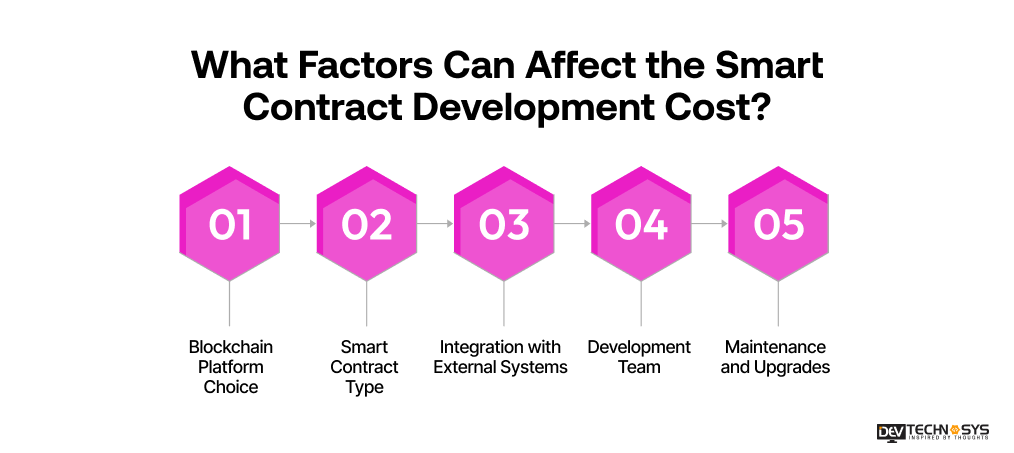
1. Blockchain Platform Choice
Moving to the first cost-affecting factor, there are various blockchain platforms such as Polygon, Hyperledger, Solana, Ethereum, and more. Each platform has different costs of deployment, gas fees, ecosystem maturity, and more.
Platform-specific constraints, compliance requirements, and optimization for lower gas consumption can further influence the overall blockchain app development cost.
Factor |
Impact on Cost |
Notes |
Estimated Cost Range Contribution |
| Ethereum | High gas fees and a popular platform | Most widely used, many tools available | $10,000–$25,000 |
| Binance Smart Chain | Lower fees than Ethereum | Compatible with EVM, good for cost saving | $8,500–$20,000 |
| Solana | High performance but newer | Requires specialized developer skills | $12,000–$22,000 |
| Polygon | Low transaction fees, scalable | Good for DeFi projects | $9,000–$18,000 |
2. Smart Contract Type
The cost to create a smart contract also depends on the type of smart contract you want to build. There are various types of smart contracts available, such as NFT marketplace, token issuance, DeFi Protocol, DAO governance, game logic, and supply chain automation.
Different contract types require unique features, integrations, and testing procedures. It can affect the total cost to create a smart contract with Ethereum.
Factor |
Impact on Cost |
Notes |
Estimated Cost Range Contribution |
| Token Creation (ERC-20, BEP-20) | Low to medium | Standardized contracts are cheaper | $8,000–$12,000 |
| NFT Marketplace | Medium to high | Requires complex logic, metadata storage | $12,000–$20,000 |
| DeFi Contracts | High | Requires audits and security checks | $15,000–$25,000 |
| DAO Governance | Medium | Logic for voting, treasury management | $10,000–$18,000 |
3. Integration with External Systems
Smart contracts sometimes need to interact with off-chain services, centralized databases, oracles, APIs, and external applications. Building these integrations adds complexity and smart contract audit cost.
Developers must ensure reliable data flows, maintain synchronization, handle failures gracefully, and secure communication channels. Integration testing, debugging, and long-term maintenance also contribute to additional expenses.
Factor |
Impact on Cost |
Notes |
Estimated Cost Range Contribution |
| Oracle Integration | Medium | Fetches off-chain data | $10,000–$18,000 |
| Wallet & Payment Integration | Medium | Requires secure API connections | $9,000–$16,000 |
| Third-party APIs | Medium | Adds complexity and testing | $8,500–$15,000 |
| Cross-chain Integration | High | Complex bridging logic | $15,000–$25,000 |

4. Development Team
In the fourth cost-affecting factor, the development team is one of the most common factors that can highly impact the cost. Blockchain-experienced developers demand a higher cost as compared to average experienced developers.
And developers’ living location can be another factor because every region’s living cost is different from each other. So, this can mainly affect the Binance Smart Chain development cost.
Factor |
Impact on Cost |
Notes |
Estimated Cost Range Contribution |
| Freelance Developers | Low to medium | Cheaper but slower | $8,000–$15,000 |
| Specialized Smart Contract Devs | Medium to high | Experienced, more secure code | $12,000–$20,000 |
| Full-stack Blockchain Team | High | Covers frontend, backend, blockchain | $15,000–$25,000 |
| Outsourcing Companies | Medium | Fixed cost, often higher quality | $10,000–$20,000 |
5. Maintenance and Upgrades
Let’s move to the last key factor, maintenance and upgrades are an important part of every app after it the launched. It includes various types of maintenance services such as updating the outdated features, upgrading OS versions, adding new enhancements, fixing bugs or errors, performance optimization, regular backups, and more.
These services take more time, and this can significantly impact the total smart contract development cost.
Factor |
Impact on Cost |
Notes |
Estimated Cost Range Contribution |
| Bug Fixes | Low | Routine maintenance | $8,000–$12,000 |
| Security Audits | High | Critical for DeFi and NFT projects | $12,000–$20,000 |
| Feature Upgrades | Medium | Adding new functionality | $10,000–$18,000 |
| Network Upgrades | Medium | Adapting to blockchain updates | $9,000–$16,000 |
Security Best Practices of Smart Contracts
Smart contract security best practices include writing simple and clean code, enforcing strict access control, preventing reentrancy attacks, using trusted audited libraries, and conducting thorough testing and professional audits. These measures help protect blockchain applications from vulnerabilities, exploits, and financial or data loss risks.
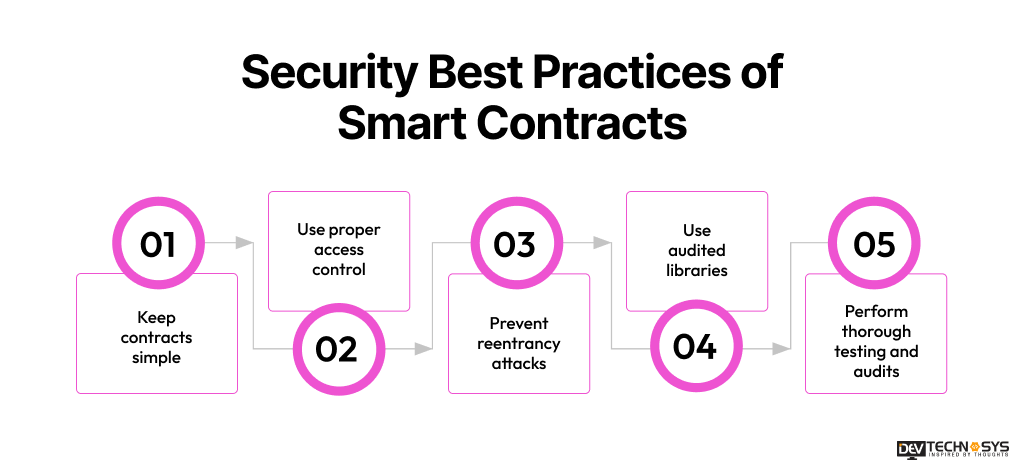
1. Keep contracts simple
Developing smart contracts with simple code will help reduce the likelihood of bugs and other vulnerabilities. Avoid using unnecessarily complex logic and functionality. Smart contracts written with clear and minimal code are much easier to audit, test, and secure, and have a much lower likelihood of being exploited.
2. Use proper access control
Always protect sensitive functions with role-based access control, such as owner or administrator access. Make sure that only authorized users can perform things like withdrawing funds or modifying parameters. Proper access control will protect your smart contract’s integrity by preventing unauthorized manipulation.
3. Prevent reentrancy attacks
A re-entrancy attack occurs when a malicious smart contract invokes a function before the smart contract’s state is updated. Always use the checks-effects-interactions pattern and security tools such as OpenZeppelin’s ReentrancyGuard. This will ensure that the smart contract’s state is changed before calling any external contracts.
4. Use audited libraries
Use a well-reviewed and tested library such as OpenZeppelin instead of creating your own security code. Such libraries are usually reviewed by many different people, and decrease your risk of inheriting known vulnerability risks. You’ll end up with a more reliable contract and save time while following Security Best Practices within your industry.
5. Perform thorough testing and audits
Make sure you perform every possible test case, including unit tests and edge case testing, prior to deploying your contract, and have a trusted third-party conduct a security review of the final product prior to finalization. Combining thorough testing and having an outside, professional security expert review vulnerability management makes your contract much more reliable.
Smart Contract Use Cases
Smart contracts enable secure, automated, and transparent transactions across industries. They power decentralized finance, tokenized assets, supply-chain tracking, automated insurance claims, real-estate transactions, identity verification, and cross-border payments.
By removing intermediaries and enforcing rules programmatically, smart contracts reduce costs, increase trust, and streamline complex digital agreements.
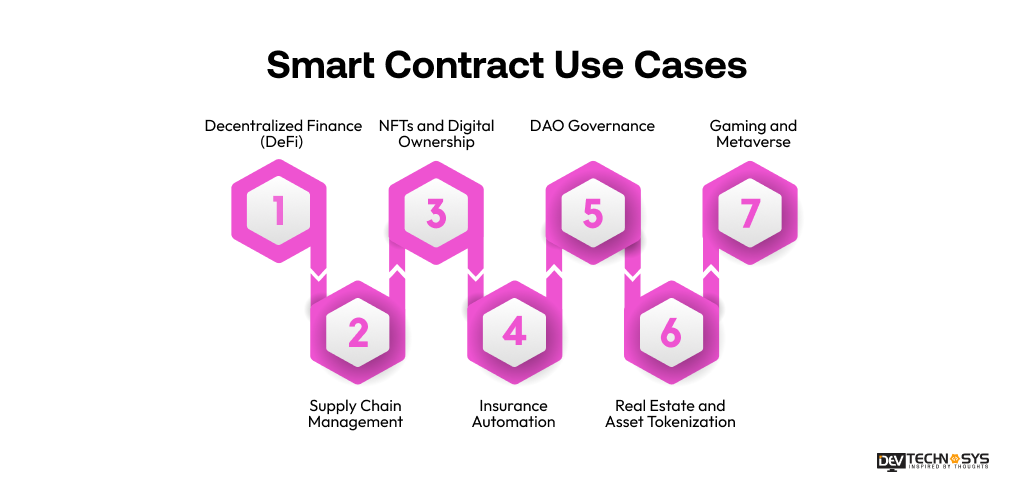
1. Decentralized Finance (DeFi)
Smart contracts automate lending, borrowing, staking, trading, yield farming, and liquidity pools without intermediaries. They ensure transparent, trustless financial interactions, enabling instant settlements and programmable interest models.
2. Supply Chain Management
Smart contracts track product movement, verify authenticity, and automate payments once goods reach checkpoints. They improve transparency, reduce fraud, and help companies manage logistics efficiently using real-time, immutable data.
3. NFTs and Digital Ownership
Smart contracts power NFT creation, transfers, royalties, and marketplaces. They enable provable digital ownership for art, collectibles, virtual land, music, and in-game items while ensuring creators automatically receive royalties on secondary sales.
4. Insurance Automation
Insurance claims can be processed automatically using predefined conditions. Smart contracts verify claim validity, trigger payouts instantly, and reduce manual errors. According to the smart contract development services provider, this enhances efficiency, prevents fraud, and speeds up customer settlements.
5. DAO Governance
Smart contracts enable decentralized autonomous organizations where decisions are made through transparent, on-chain voting. They automate proposal execution, fund allocation, and community governance without centralized control.
6. Real Estate and Asset Tokenization
Smart contracts simplify buying, renting, selling, and fractionalizing real estate. Tokenized ownership lowers entry barriers, enhances liquidity, and enables automated agreements such as leases, escrow, and property transfers.
7. Gaming and Metaverse
Smart contracts enable play-to-earn models, verifiable ownership of in-game assets, decentralized economies, and secure item trading. They support interoperability across platforms, enhancing user control over digital assets.
5 Real-World Applications of Smart Contracts
Smart contracts are widely used in DeFi for banking-free finance, NFTs for digital ownership, supply chain tracking for transparency, insurance automation for instant claims, and gaming/metaverse platforms for secure asset ownership and play-to-earn ecosystems.
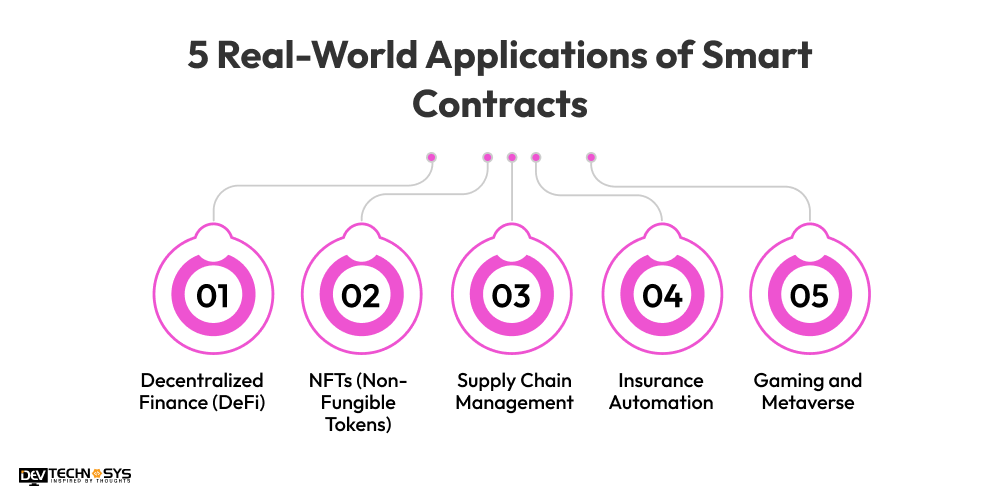
1. Decentralized Finance (DeFi)
DeFi platforms use smart contracts to facilitate lending, borrowing, and trading of money without needing banks. The smart contracts implement financial agreements automatically, figure out how much interest there should be, and look after collateral to ensure that there is a transparent, trustless, and efficient way of providing people with financial services.
2. NFTs (Non-Fungible Tokens)
The use of smart contracts to create and manage NFTs allows for the definition of ownership, authenticity, and terms of transferring or selling digital assets like artwork, music, and collectibles. They allow creators of NFTs to receive royalties whenever an NFT they created is sold on a secondary market.
3. Supply Chain Management
Smart contracts manage the movement of goods through supply chain management by providing visibility of records from production to delivery at every step of the way. They provide increased transparency, reduce the potential for fraud, and also allow for legitimate goods by updating the status of the product automatically.
4. Insurance Automation
Smart contracts will handle the claims and payouts associated with the insurance business automatically based on pre-determined criteria. An example of this kind of automation would be if a flight had been delayed and there was flight delay insurance related to this flight; once the data that proves a flight is delayed has been verified, the smart contract would trigger payment.
5. Gaming and Metaverse
Smart Contracts provide an authentic digital ownership of virtual goods and allow players the ability to buy, sell, and trade their items securely. Also, Smart Contracts will support Play-To-Earn models, providing certainty with the distribution of rewards and interoperability of assets across multiple gaming platforms and within the metaverse.
Required Tech Stacks to Build a Smart Contract on Blockchain
Before starting to develop a smart contract, you must know what types of technologies are used in smart contract development. So, here we provide the detailed tech stacks table:
Category |
Tools / Technologies |
Purpose |
| Blockchain Platforms | Ethereum, Polygon, Binance Smart Chain, Avalanche, Solana, Hyperledger Fabric, Cardano | Base networks where smart contracts are deployed |
| Programming Languages | Solidity, Vyper (EVM) • Rust (Solana, NEAR) • Go/Java (Hyperledger) • Plutus (Cardano) | Used to write smart contract logic |
| Development Frameworks | Hardhat, Truffle, Foundry, Anchor (Solana), Brownie | Provides an environment for building, testing, and deploying smart contracts |
| IDEs & Code Editors | Remix IDE, VS Code, IntelliJ | Used for writing and debugging contract code |
| Testing Tools | Chai, Mocha, Jest, Foundry Forge tests | Automated testing of smart contract functions |
| Smart Contract Auditing Tools | MythX, Slither, Echidna, Certora | Used for static analysis, vulnerability detection, and security auditing |
| Wallet Integrations | MetaMask, Phantom, WalletConnect | Enables users to interact with deployed smart contracts |
| DevOps & Deployment | Docker, GitHub Actions, CI/CD pipelines | Automate deployments, version control, and environment setup |
| Databases (optional for off-chain data) | IPFS, Filecoin, MongoDB, PostgreSQL | Store metadata or off-chain application data |

Conclusion
It’s time to finish the blog. We covered all the important sections on how to create a smart contract on Blockchain and offered every step with a detailed explanation. It includes market research, an outline of key functions, a select blockchain platform, writing smart contract code, testing and security implementations, deployment, and post-launch maintenance services.
Are you ready to launch a smart contract on blockchain? You must connect with a smart contract development company to receive a smart contract with a selected blockchain platform.
Frequently Asked Questions
Find answers to the most common questions related to this article.
The cost to develop a smart contract on blockchain ranges from $8,000 to $25,000 or depending on the customized requirements and demand. The project budget can be changed due to various key factors such as blockchain platforms, features, functions, integration with existing systems, smart contract type, and more.
To launch a smart contract on blockchain, it normally takes around 5 to 18 weeks, and it can take longer due to specific requirements. It includes various factors such as project complexity, integrating a higher number of features, and more.
There are various problems or challenges occur during the smart contract development process:
Security Vulnerabilities
Immutable Code
Complex Logic
Regulatory Compliance
Testing Limitations
Gas Optimization
Once deployed, smart contracts generally cannot be changed because their code becomes permanent on the blockchain. However, developers can use upgradeable contract patterns, proxies, or versioned architectures to modify functionality, though these approaches must be designed to maintain security trust.
Ethereum is the most popular blockchain for smart contracts due to its robust ecosystem, widespread developer support, and mature tools. Alternatives like Binance Smart Chain, Solana, and Cardano offer lower fees, faster transactions, and scalability advantages.
Yes, you can create your own smart contract by learning a blockchain language like Solidity, setting up a development environment, writing and testing the code, and deploying it to a network such as Ethereum using tools like Remix or Hardhat.