













Key takeaways:
-
- Businesses can create and use blockchain apps with BaaS without having to deal with complicated technology. This cuts down on cloud blockchain platform development time and costs.
- It has scalable cloud-based solutions with security built in, support for smart contracts, and simple API interfaces for business systems.
- Public, private, and hybrid BaaS models give businesses the freedom to choose the level of privacy, control, and transparency that works best for them.
- By making setup and upkeep easier, BaaS speeds up the adoption of blockchain in fields like banking, supply chain, healthcare, and gaming.
Every business starts with two clear agendas: driving growth in a competitive market and bringing in more revenue. But there are certain aspects that businesses are unable to manage. The “ as-a-service” model targets both consumers and businesses and provides agility in business operations by catering to on-demand BaaS development services.
Building and managing blockchain as a Service solutions is a complex, costly, and time-consuming task for businesses. This is where Blockchain as a Service (BaaS) comes in.
BaaS lets companies use blockchain technology without handling the technical burden of infrastructure management, scalability, security, or maintenance. BaaS helps businesses develop, host, and deploy Enterprise BaaS solutions and applications with more efficiency.
From smart contracts and decentralized apps (dApps) to enterprise-grade blockchain network management, BaaS is accelerating digital transformation worldwide. In this guide, we’ll explore everything about Blockchain as a Service, including its benefits, market trends, challenges, and future opportunities for businesses and startups.
What is Blockchain as a Service?
Blockchain as a service (BaaS), at its core, is an enterprise-level software service. BaaS allows businesses to build, host, and run their own blockchain apps, smart contracts, and functions on a vendor-developed blockchain infrastructure by integrating cloud-based solutions. BaaS functions similarly to web hosting, allowing businesses to focus on more crucial activities while outsourcing technical backend operations.
Bonus Read: Blockchain App Development Cost
BaaS is being used across industries, eliminating barriers of costs and complexities in blockchain deployment. The BaaS provider handles all the important operations to keep the blockchain well-functioning, including infrastructure setup, security, and ongoing maintenance.
Market Analyses of Blockchain as a Service
- The Blockchain-as-a-Service market size is expected to reach USD 2.06 billion in 2026 and is forecast to reach USD 4.58 billion by 2031 at 17.28% CAGR over 2026–2031.
- By component, Managed Services is forecast to expand at a 19.25% CAGR through 2031.
- By deployment model, Hybrid Cloud is projected to rise at a 21.35% CAGR to 2031.
- By organization size, Large Enterprises accounted for 60.60% of the Blockchain-as-a-Service market size, while Small and Medium Enterprises recorded the quickest growth at 23.90% CAGR.
- By application, Digital Identity and KYC are poised for a 24.70% CAGR through 2031.
What are the Core Components of a BaaS?
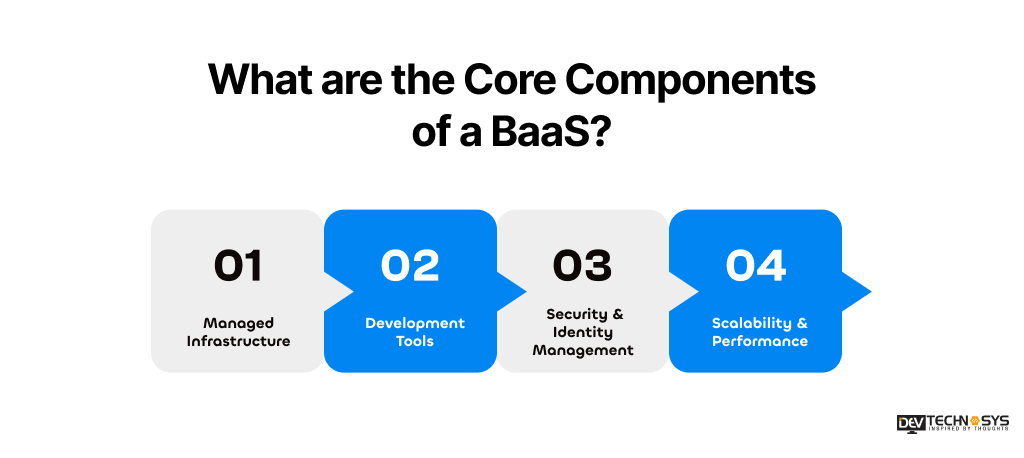
As a business, before venturing into Blockchain development, you need to know about the core components of BaaS. BaaS for enterprises comprises four major components: managed infrastructure, security and identity management, development tools, and scalability and performance. Let’s read about them in detail:
1. Managed Infrastructure
The provider delivers and manages all required resources in hardware, software, servers, nodes, and networking. It ensures errorless operations while eliminating complex setup and maintenance tasks. BaaS allows businesses to concentrate entirely on building robust BaaS solutions.
2. Development Tools
BaaS integration with existing systems provides access to ready-made development tools, SDKs, and APIs, making development, testing, and deployment of smart contracts and applications way easier. These tools facilitate workflows, support fast integration, and enhance developer productivity.
3. Security & Identity Management
Robust encryption, access controls, monitoring systems, and identity management services protect your blockchain network from unauthorized access and cyber threats, ensuring secure data handling, verified user interactions, and substantial compliance with industry-standard security requirements.
4. Scalability & Performance
The blockchain as a service platform enables quick scaling of nodes and resources based on demand, preventing performance bottlenecks and over-provisioning. An enterprise blockchain app on BaaS ensures consistent performance, high availability, and smooth handling of growing transaction volume or user activity.
Benefits and Challenges for Businesses in BaaS Adoption
For businesses, investing in private blockchain development and adopting Banking-as-a-Service (BaaS) presents significant opportunities in innovation and efficiency, but also brings challenges primarily around regulatory compliance, data security, and technical integration. Here are the BaaS benefits and challenges for businesses:
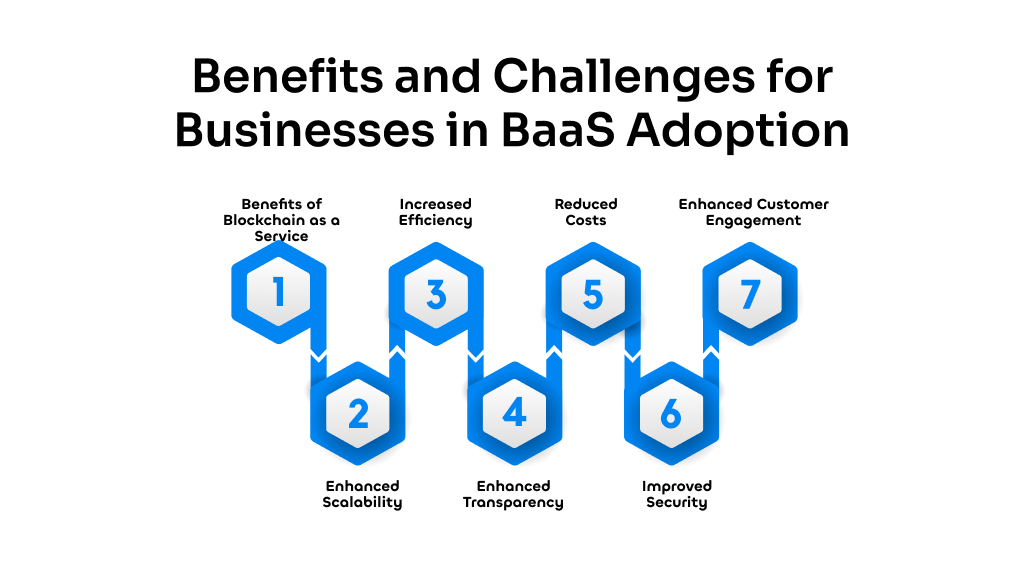
1. Benefits of Blockchain as a Service:
i. Enhanced Scalability
One of the most prominent benefits of blockchain as a service for businesses is the ability to quickly scale their blockchain networks as needs grow, ensuring consistent performance, accommodating higher workloads, and maintaining smooth operations without straining existing resources.
ii. Increased Efficiency
By removing intermediaries and automating processes, blockchain automation solutions streamlines transactions, reduces delays, minimizes manual work, and boosts overall operational productivity across various business functions.
iii. Enhanced Transparency
Wondering what are the benefits of BaaS? Enhanced Transparency! Immutable, tamper-proof records provide complete visibility into every transaction, strengthening trust, supporting accurate audits, and ensuring full accountability throughout the entire network.
iv. Reduced Costs
Adopting BaaS platforms for development is a lucrative decision for businesses, as A pay-as-you-go model eliminates the need for large upfront investments. It enables enterprises to adopt blockchain affordably while paying only for the resources they actively use.
v. Improved Security
Top Blockchain as a Service companies are working to enhance security, which benefits businesses. Secure blockchain ecosystem, encryption protocols, and strict identity controls help protect sensitive data, prevent unauthorized access, and ensure safe, reliable transaction processing.
vi. Enhanced Customer Engagement
Investing in blockchain development services is beneficial for businesses because BaaS helps businesses bring customer engagement. Transparent and secure interactions that BaaS brings will build trust, improve satisfaction, and encourage long-term loyalty. But how? Easy, by offering clarity, fairness, and confidence in every digital exchange.
2. Challenges and Limitations of Adopting BaaS for Businesses
Despite the undeniable potential of blockchain technology, businesses face several significant challenges when contemplating its adoption. In this section we will see what challenges BaaS brings for businesses:
i. Limited Internal Expertise:
According to a top Solana blockchain development company, building and maintaining a private blockchain network demands specialized skills and deep technical knowledge. Many organizations lack in-house providers, making adopting BaaS difficult and increasing reliance on external developers or consultants.
ii. High Cost:
BaaS architecture, advanced hardware, and constant maintenance can go beyond budget. Adopting BaaS means committing to these expenses, which can increase budgets, especially for small or medium-sized businesses looking for budget-friendly digital transformation solutions.
iii. Integration Complexities:
It’s adding to add blockton with pre-existing enterprise systems. It takes a lot of careful planning, technical expertise, and seamless system coordination to ensure smooth data flow, compatibility, and minimal disruption.
You can reach out anytime; we are available 24/7. Our team provides a quick response.

Who are the Major BaaS Providers in the Market?
Knowing the major providers of BaaS is crucial for many reasons; it simplifies the process of choosing the best provider. If you are a business and want to know how to choose the best BaaS provider, keep an eye on which companies are leading the market as the best and most popular Blockchain as a Service providers. Here are some of the best BaaS providers:
1. Microsoft:
Microsoft is a leading mobile app development company that collaborated with ConsenSys to launch Ethereum Blockchain-as-a-Service on Azure in 2015, enabling developers who provide BaaS for enterprises to quickly deploy, test, and manage blockchain networks using Microsoft’s cloud infrastructure.
2. Amazon:
Amazon introduced Amazon Managed Blockchain, a fully managed BaaS for enterprises that simplifies the creation and operation of scalable blockchain networks, blockchain API integration with BaaS, and more, using popular open-source frameworks such as Ethereum and Hyperledger Fabric.
3. Hyperledger Foundation:
The Hyperledger Foundation supports multiple open-source blockchain frameworks and multi-cloud blockchain deployment, including Hyperledger Fabric, providing customizable, enterprise-grade distributed ledger technology for diverse business and industry use cases. To build a similar platform, contact a top Hyperledger blockchain development provider.
4. IBM:
As one of the top blockchain as a service companies, IBM built the IBM Blockchain Platform using Hyperledger Fabric, offering a secure, scalable, and enterprise-focused Blockchain-as-a-Service solution for developing and managing blockchain networks on the IBM Cloud.
Industry Insights: According to Maximize Market Research, the market is expected to expand from USD 2.11 billion (2023) to nearly USD 56.97 billion by 2030, driven by cloud-based blockchain services and digital transformation.
How does the Blockchain as a Service Model Work?
Blockchain as a Service (BaaS) makes the complex process to build and deploy applications simple. BaaS platforms for development empower businesses to make use of blockchain with no complexities of managing the underlying infrastructure.
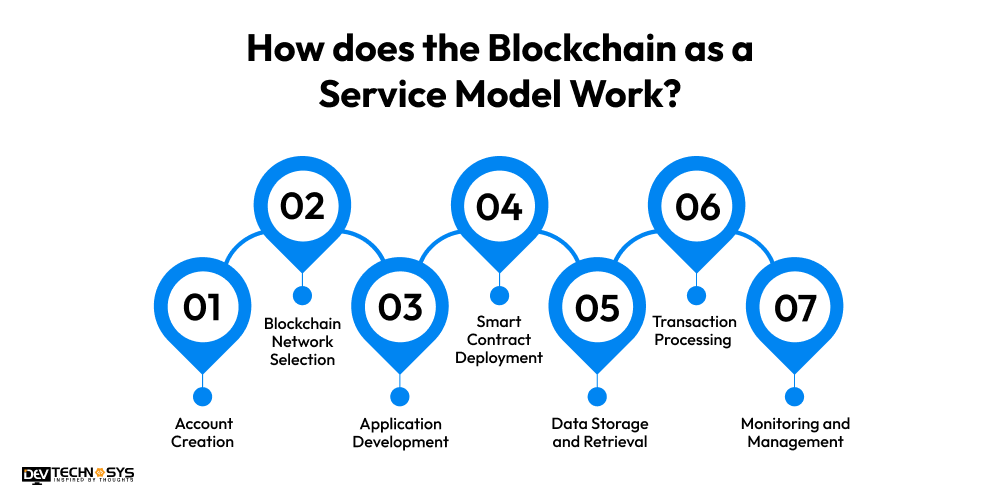
1. Account Creation
This is the first step to build a blockchain app using BaaS: users sign up on the BaaS platform, provide the required details, and verify their identity. Once the account is created, they gain access to a dashboard that allows them to view and manage all blockchain-related resources.
2. Blockchain Network Selection
The next stage is choosing the network for blockchain. Businesses should employ a suitable blockchain framework depending on what their app needs. When choosing a blockchain network, think of factors such as scalability, security, transaction speed, and the solution’s purpose. Common network options include Ethereum, Hyperledger Fabric, and Corda.
3. Application Development
During application development, developers use the tools provided by the BaaS platform, such as SDKs, APIs, templates, and libraries, to create their blockchain application.
Bonus Read: Blockchain Technology in Mobile App
These tools simplify development by providing prebuilt components and user-friendly interfaces, reducing the time and complexity required to build both the frontend and backend.
4. Smart Contract Deployment
After the BaaS development process is done, the focus shifts to smart contract deployment. BaaS deployment models, mainly smart contracts, are written, tested, and deployed onto the selected blockchain network.
The BaaS smart contract deployment step is crucial, as smart contracts automate business logic and transactions, making applications more efficient and reliable.

5. Data Storage and Retrieval
After you launch a blockchain app with BaaS, it’s time to explore the data storage and retrieval step. BaaS stores hybrid store models to securely store information.
Smart contracts control the way of accessing the data and who can view it. It ensures the integrity and privacy of the application. Users get the power to view or retrieve data when they require. It ensures it stays reliable and transparent.
6. Transaction Processing
In the transaction processing stage, providers ensure that transactions are submitted to he blockchain network. The validation process is done through the consensus method. After validation, blockchain is used to record the transaction, making an immutable, tamper-proof ledger.
7. Monitoring and Management
Finally, in the monitoring and management stage, the blockchain app runs with ease over time. Businesses can track performance metrics, monitor network activity, manage user permissions, identify potential issues, and apply updates as required. It is an ongoing theme that helps maintain security and reliability.
What are the Types of Blockchain as a Service Platforms?
There are different types of Blockchain as a Service (BaaS) platforms based on how they use blockchain technology, how easy they are to use, and what the business needs. Each type gives businesses and startups different levels of protection, scalability, transparency, and control. For businesses and startups, each type provides a different amount of security, scalability, openness, and control.
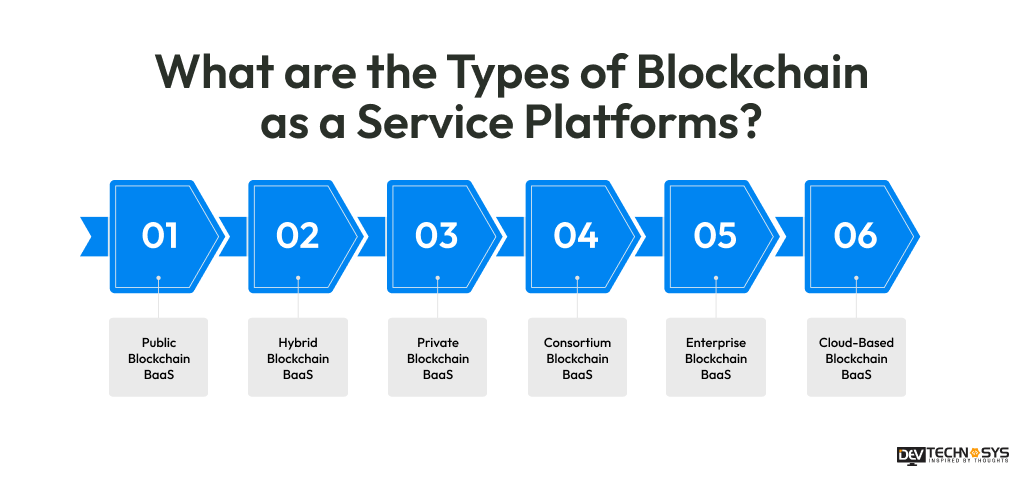
1. Public Blockchain BaaS
Public Blockchain BaaS platforms are built on open decentralized networks, which are accessible, validated, and participatory by anyone. According to DApp development experts, these platforms are perfect for transparency applications, DeFi, NFT ecosystems, and public blockchain solutions that require transparency and accessibility.
2. Hybrid Blockchain BaaS
Hybrid Blockchain BaaS combines the best aspects of public and private blockchains and puts them together in one system. Businesses can store private, confidential data safely while also sharing some information with the public. This protects both practical privacy and the ability to check transactions clearly.
3. Private Blockchain BaaS
Private Blockchain BaaS platforms are owned and run by one organization, and only authorized users can access the platform. Experts who provide Ethereum development services use private blockchain BaaS to offer better privacy, security, and operational control. They are suitable for enterprises handling sensitive business data and internal workflow management systems.
4. Consortium Blockchain BaaS
Instead of having one central authority, Consortium Blockchain BaaS platforms are run by a group of different companies. A lot of people use these tools in fields that need to share data collaboratively and trust each other, like banking, healthcare, insurance, and supply chain management.
5. Enterprise Blockchain BaaS
Business as a Service (BaaS) options for blockchain are made for big businesses that need scalable infrastructure, automated workflows, compliance management, and safe data handling. Enterprise blockchain solutions are able to handle a lot of transactions at once and are easy to connect to other business tools and operational systems.
6. Cloud-Based Blockchain BaaS
Cloud platforms such as AWS, Azure, or Google Cloud offer blockchain technology through blockchain-based BaaS platforms. Businesses can use Blockchain cloud services without worrying about managing hardware, servers, or upkeep. It makes infrastructure much simpler and lowers the costs of running it.
Industry Insights: According to Gartner.com, Around 70% of enterprise blockchain pilots fail to scale without BaaS support, highlighting the importance of managed blockchain platforms for successful deployment and long-term adoption.
Public vs Private vs Hybrid Blockchain in BaaS
Public, private, and hybrid blockchains are the three main types of blockchains that Blockchain as a Service (BaaS) platforms use. Depending on the business goals and requirements, each of these models offers a different amount of security, scalability, decentralization, and openness.
- When it comes to decentralization and transparency, public blockchains are the best choice.
- Private blockchains are used for business protection and controlling access.
- Hybrid blockchains are used by the cryptocurrency exchange development company to build modern and enterprise grade great BaaS solutions because they offer both privacy and transparency.
| Factor | Public Blockchain | Private Blockchain | Hybrid Blockchain |
| Access Control | Open to everyone | Restricted to authorized users | A combination of public and private access |
| Transparency | Fully transparent | Limited transparency | Selective transparency |
| Decentralization | Highly decentralized | Centrally controlled | Partially decentralized |
| Security Level | High-throughput distributed nodes | High with controlled access | Balanced security and privacy |
| Transaction Speed | Slower due to public validation | Faster transactions | Moderate to high speed |
| Scalability | Limited scalability | Highly scalable | Flexible scalability |
| Cost of Deployment | Lower initial setup cost | Higher infrastructure cost | Moderate development cost |
| Best For | DeFi development services, NFTs, crypto platforms | Enterprises, banking, and healthcare | Supply chain, government, enterprise solutions |
| Examples | Ethereum, Bitcoin | Hyperledger Fabric | XinFin, Dragonchain |
Real-World Use Cases of BaaS
The true power of BaaS is tested and validated in real-world applications. With blockchain accessibility, BaaS is expanding innovation for a multitude of sectors. Here are a few powerful BaaS use cases and examples:
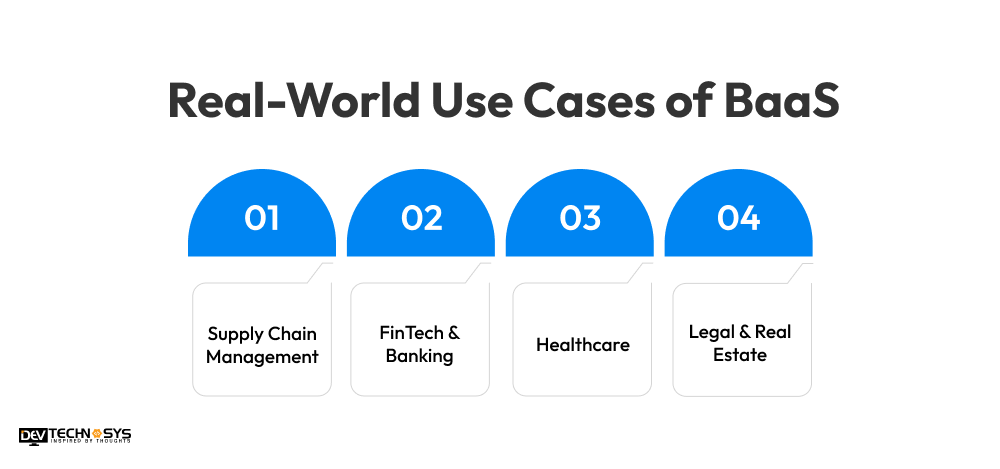
1. Supply Chain Management:
Perhaps the most talked-about use case is supply chain management. BaaS lets businesses create immutable records of the journey the product goes through. It ensures clarity, reduces fraud, and improves efficiency. All this is achieved by real-time product tracking, from company to consumer.
2. FinTech & Banking:
BaaS is making financial processes easier by facilitating safer and faster cross-border payments. BaaS also simplifies trade finance documentation and helps in developing efficient systems for regulatory compliance.
3. Healthcare:
Managing sensitive patient data is a critical challenge. BaaS provides a secure and interoperable way to manage electronic health records, ensuring patient privacy while allowing authorized providers to access critical information seamlessly.
4. Legal & Real Estate:
With BaaS platforms, creating smart contracts is a piece of cake!. You can also automate and secure complex agreements. This is transforming everything from property title transfers to contract execution, reducing paperwork and the need for intermediaries.
How Can Blockchain-As-A-Service Reduce Business Costs?
By eliminating the need to build and maintain blockchain networks from scratch, Blockchain-as-a-Service (BaaS) helps businesses reduce operational and infrastructure expenses. It provides ready-to-use blockchain infrastructure, security, scalability, and maintenance through cloud-based service providers.
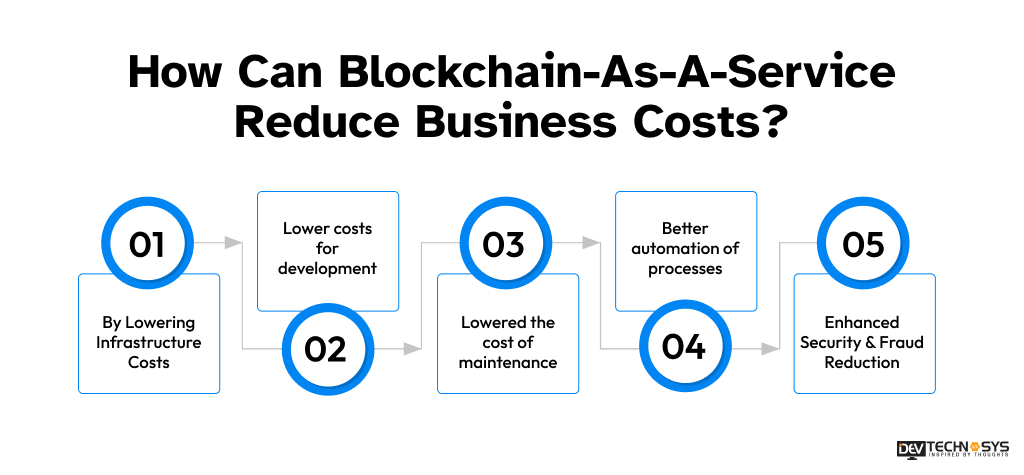
1. By Lowering Infrastructure Costs
Businesses don’t have to spend a vast amount on computers, hardware, networking systems, or managing blockchain nodes. BaaS companies take care of the infrastructure, which lowers the costs of setting up and running the business by a large amount.
2. Lower Costs for Development
There are already built blockchain systems, APIs, and smart contract tools on BaaS platforms. Because of this, custom Web3 development services take less time and cost less money. This helps businesses start blockchain apps faster and for less money. In this way, businesses can set up blockchain apps more quickly and for less money.
3. Lowered the Cost of Maintenance
Service companies keep blockchain networks running by watching them and fixing bugs, making updates, and making sure they can grow. Companies can save money in the long run on hiring IT staff and running their operations while still making sure the platform works well.
4. Better Automation of Processes
Smart contracts take care of things like payments, approvals, systems, and making sure data is correct. This lowers the costs of running a business and cuts down on the amount of work that needs to be done by hand. The prices of running and managing a business go down because people don’t have to do as much work and make as many mistakes.
5. Enhanced Security & Fraud Reduction
Blockchain technology improves data security, traceability, and transaction transparency. By reducing fraud, data tampering, and cybersecurity risks, businesses can avoid significant financial losses and compliance penalties.
Best Practices for Launching a BaaS Platform
Launching a successful Blockchain-as-a-Service (BaaS) platform requires a strong combination of scalability, security, compliance, and user-focused infrastructure. Following industry best practices helps businesses build reliable blockchain ecosystems and improve long-term adoption.
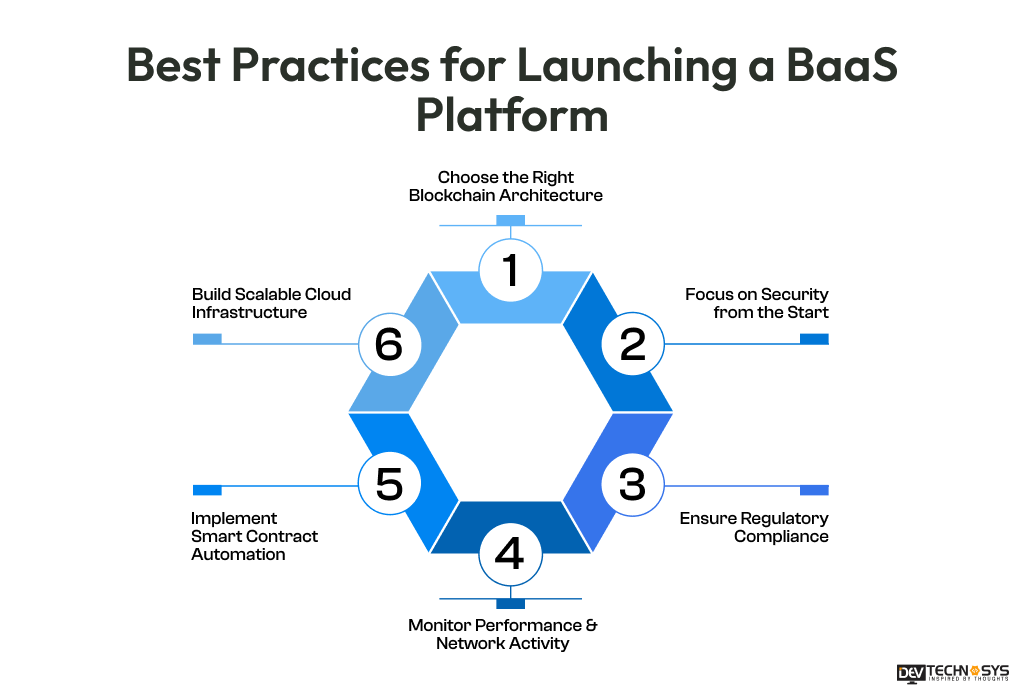
1. Choose the Right Blockchain Architecture
Select a public, private, or hybrid blockchain model based on your business goals, scalability needs, security requirements, and target industry use cases before starting development. The right architecture directly impacts transaction speed, privacy, operational flexibility, and long-term scalability.
2. Focus on Security from the Start
Implement encryption, smart contract audits, identity management, multi-factor authentication, and continuous monitoring to protect blockchain infrastructure and sensitive enterprise data. Developers who offer smart contract development also implement strong security frameworks to help build user trust and reduce potential cyberattack risks.
3. Build Scalable Cloud Infrastructure
Use scalable cloud platforms like AWS, Azure, or Google Cloud to ensure high availability, flexible resource allocation, and seamless blockchain network expansion as user demand grows. Cloud-based infrastructure also minimizes downtime and improves overall system performance.
4. Ensure Regulatory Compliance
Top providers of crypto wallet development services often integrate KYC, AML, GDPR, and industry-specific compliance mechanisms to meet legal requirements and avoid regulatory risks in global blockchain operations. Compliance-ready systems also improve business credibility and support enterprise-level adoption.
5. Implement Smart Contract Automation
Enable automated workflows through secure smart contracts to improve operational efficiency, reduce manual intervention, and increase transaction transparency. Properly audited smart contracts also help prevent vulnerabilities and costly execution errors.
6. Monitor Performance & Network Activity
Use real-time analytics, monitoring tools, and performance dashboards to track blockchain activity, detect anomalies, and optimize system efficiency continuously. Continuous monitoring helps businesses identify bottlenecks early and maintain stable platform operations.
Industry Insights: Statista.com reports that the global Blockchain-as-a-Service market is expected to surpass $8.7 billion by 2027, growing rapidly due to increased enterprise demand for secure cloud-based blockchain infrastructure.
2026 update: The Evolution of BaaS
The Blockchain-as-a-Service ecosystem is still developing as 2026 goes on. The industry is moving away from simple infrastructure management and toward sophisticated, value-driven capabilities that enable businesses to create blockchain applications that are more intelligent, connected, and scalable. Important patterns influencing this evolution consist of:
1. Convergence of Blockchain and AI
One emerging trend is the combination of blockchain technology and artificial intelligence. This convergence is opening the door for autonomous, intelligent, and self-optimizing digital systems, from decentralized AI marketplaces to AI-enhanced smart contracts. Hire blockchain developer from a reputable company to integrate AI with blockchain.
2. Interoperability:
BaaS providers are now taking more interest in cross-chain connectivity, enabling seamless communication between different blockchain networks. This shift is helping businesses eliminate data silos, streamline multi-network operations, and unlock more flexible blockchain architectures.
3. Tokenization Services
Choose blockchain platform because it simplifies the tokenization of real-world assets, such as property, commodities, and financial instruments. Tokenization makes it easier for businesses to enable fractional ownership, improve liquidity, and create new investment opportunities.
Why Choose a Prominent BaaS Provider?
Choosing a reliable Blockchain-as-a-Service (BaaS) provider can greatly improve the success, scalability, and security of your blockchain initiatives. Experienced providers simplify blockchain adoption while reducing technical complexity and operational risks for businesses.
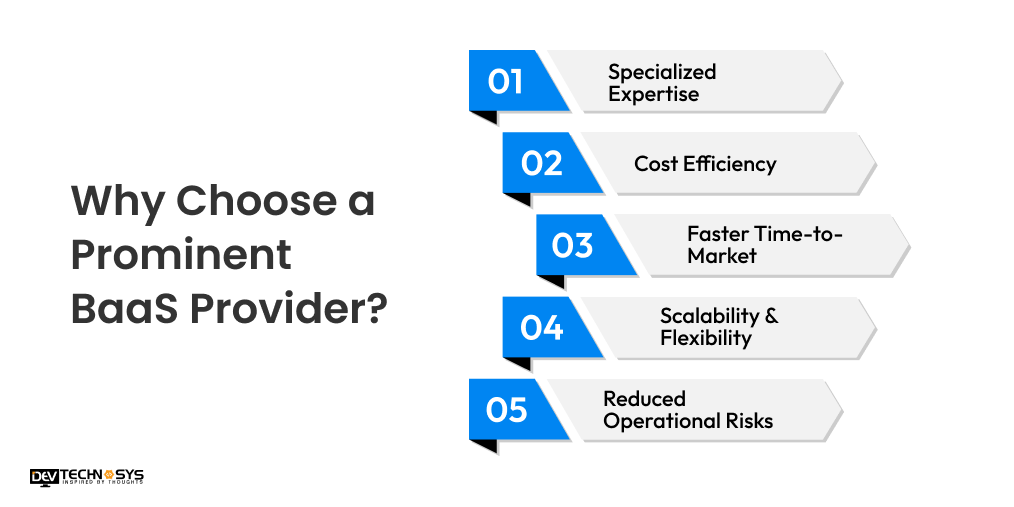
1. Specialized Expertise
BaaS providers have deep knowledge of NFT marketplace development services, blockchain architecture, smart contracts, cloud infrastructure, and decentralized applications. Their technical expertise helps businesses build secure and efficient blockchain solutions faster.
2. Cost Efficiency
Businesses can avoid large investments in hardware, infrastructure setup, and blockchain maintenance. BaaS platforms provide ready-to-use environments that significantly reduce development and operational costs.
3. Faster Time-to-Market
Pre-built blockchain frameworks, APIs, and deployment tools help accelerate the RWA tokenization platform development process. This allows companies to launch blockchain applications quickly and stay competitive in the market.
4. Scalability & Flexibility
BaaS platforms offer scalable cloud-based infrastructure that can grow with business needs. Companies can easily expand blockchain operations without rebuilding the entire ecosystem.
5. Reduced Operational Risks
Providers handle security updates, monitoring, node management, and maintenance. This minimizes technical risks, improves reliability, and ensures continuous blockchain performance for enterprise operations.
Conclusion
The above-provided details and information show the importance of BaaS for enterprises. We hope all your doubts and queries are clear by now. The blockchain-as-a-service is not just a convenience; it has become a strategic enabler, bringing the benefits of blockchain within reach for every business looking to stay competitive in the digital era.
If you are a business interested in building a BaaS, contact a top blockchain development company like Dev Technosys. With 15+ years of expertise and support of 500+ technology specialists, we deliver secure, scalable, and enterprise-grade blockchain solutions tailored to your business needs.
Frequently Asked Questions
Find answers to the most common questions related to this article.
BaaS eliminates the need for expensive hardware, specialized infrastructure, and in-house blockchain experts. Businesses pay only for the resources they use, reducing upfront investment and ongoing maintenance expenses.
You can integrate blockchain features into your mobile app using the APIs, SDKs, and tools provided by the BaaS platform. The provider manages blockchain operations while your app focuses on user experience.
BaaS provides ready-to-use blockchain infrastructure managed by third-party providers. Users select a blockchain network, build applications, deploy smart contracts, and manage everything through a cloud-based dashboard.
BaaS offers cost efficiency, fast deployment, enhanced security, scalability, reduced complexity, and the ability to build blockchain applications without requiring deep technical expertise.
Blockchain as a Service cost depends on the provider, usage, and features. Most follow a pay-as-you-go model, where costs are based on compute resources, storage, transactions, and level of support.
Yes. BaaS platforms include tools for developing, testing, and deploying decentralized applications. Developers can create smart contracts, connect to blockchain nodes, and scale their DApps without managing infrastructure.
Yes. BaaS is designed to lower technical barriers, making blockchain accessible even to SMEs that lack specialized blockchain teams or large budgets.
Industries such as finance, supply chain, healthcare, real estate, retail, government, and logistics can leverage BaaS for transparency, fraud prevention, automation, and secure data sharing.