
















Quick Summary:
The cost of developing a messaging app usually falls between $10,000 and $100,000. This range depends on variables such as the complexity of the app, the platforms it supports, the infrastructure for real-time communication, the features included, security needs, integrations with third-party services, scalability, and any AI functionalities.
Cost to develop a messaging app based on complexity:
-
- Basic/MVP Messaging App: $10,000-$30,000
- Standard Messaging App: $30,000-$60,000
- Advanced Messaging App: $60,000-$100,000
Chat App Development Cost Based on App Type:
-
- Personal Messaging App: $10,000-$30,000
- Business Messaging App: $30,000-$60,000
- Community Messaging App: $30,000-$60,000
- Social Messaging App: $40,000-$80,000
- Secure Messaging App: $60,000-$100,000
- Industry-Specific Messaging App: $60,000-$100,000
Additional Costs to Consider:
-
- Maintenance Expenses: The maintenance of a messaging app can be around 15%-25% of the overall development cost annually. This could be anything from bug fixes, security updates, performance optimization, server management, infrastructure maintenance, and new feature development.
- AI Integration Cost: Integrating AI-powered features may lead to increased overall messaging app development costs. This can include AI chatbots, smart replies, message summarization, real-time translation, AI-powered search, and content moderation.
- Real-Time Communication Costs : Real-time communication features like instant messaging, message synchronization, voice messaging, and video calling require extra investment in backend infrastructure, cloud services, servers, and real-time communication technologies.
- Third-Party Integration Costs: The total messaging app development budget can also be influenced by the integration of third-party services like authentication, push notifications, cloud storage, AI APIs, analytics, payment gateways, voice or video communication solutions, etc.
Messaging is an indispensable tool in the process of communicating and collaborating, as well as shopping and learning. Messaging apps have a wide range of applications, from personal conversations and social groups to collaboration at workplaces and customer service.
However, the development of an appropriate messaging platform is not limited to creating the chat app interface. Developers must build reliable real-time messaging capabilities, ensure fast message delivery, support media sharing, protect users’ personal information, and create a scalable platform that can support future growth.
So, how much does it cost to build a messaging app in 2026? On average, the cost to develop a messaging application can range from $10,000 to $100,000, depending on the specific features of the application. The following guide will break down the messaging app development cost mentioned above and highlight what can affect the final investment.
Messaging App Market Statistics in 2026
The messaging app market continues to grow due to increasing smartphone adoption, internet access, business communication, and AI-powered customer interactions. Nowadays, messaging is not only used for personal conversations, but it is also used for customer support, workplace collaboration, commerce, and community engagement.
In this section, we have provided the market statistics that highlight the reasons why startups and businesses continue to invest in messaging app development and messaging app development services:
Messaging App Statistic |
What It Means for Businesses |
Source |
| 94.1% of internet users worldwide accessed online chat and messaging services monthly in Q2 2025. | Messaging has become a mainstream digital activity, creating strong demand for innovative consumer, business, and niche communication platforms. | Statista: Global Chat and Messaging Usage |
| WhatsApp reached approximately 3 billion monthly active users in 2025. | The scale of WhatsApp demonstrates the enormous global demand for instant communication and the potential of messaging-based digital products. Businesses looking to build an app like WhatsApp can target specialized audiences and unique use cases. | Statista: Most Popular Global Mobile Messaging Apps |
| Around 6 billion people, or 74% of the global population, were using the internet in 2025. | The expanding internet population continues to increase the addressable audience for mobile and web-based messaging applications. | International Telecommunication Union: Facts and Figures 2025 |
| 96% of internet users use a mobile phone to access the internet at least some of the time. | This highlights the importance of mobile-first messaging experiences and supports investment in Android, iOS, and cross-platform application development. | DataReportal: Global Digital Overview |
| 73.3% of consumers prefer messaging when communicating with a business, according to a 2025 global study covering 11,056 consumers across 22 markets. | Businesses can use messaging apps for customer support, sales, engagement, and conversational commerce, creating opportunities beyond traditional personal chat platforms. | WhatsApp Business: State of Business Messaging 2026 |
What Is a Messaging App?
A messaging app is a computer program that lets users communicate with each other via various means, either instantly or at a different time. Users can send not only messages but also pictures, videos, audio, documents, and other types of content through multimedia messaging.
Modern messaging apps can include features such as instant messaging, voice and video calls, group messaging, AI assistance, message searching, message moderation, and business collaboration tools as well.
The four major types of messaging apps are:
- Apps for personal messaging
- Apps for business messaging
- Community messaging apps
- Encrypted messaging apps
Modern platforms can support one-to-one chat, group chat, private messaging, voice messaging, video calling, message read receipts, typing indicators, and message history.
The type of app affects the complexity of the development process and the overall messaging app development cost estimate.
Planning a Mobile App?
Get a tailored development cost estimate in 3 simple steps — app basics, features, timeline, and your contact details.
- 3 quick steps
- 100% free
- Reply in 1 business day
2 Minutes Read
How Much Does It Cost to Develop a Messaging App in 2026?
The average messaging app cost to develop can range from $10,000 to more than $100,000. The amount of money required for the completion of the project is influenced by many factors, including the overall number of features of the messaging application, the platforms used for its creation, the cost of application design and security, and many more.
But how long does development take? Well, a standard messaging app takes 3 to 6 months to build (at Dev Technosys), covering discovery, UI/UX design, development, QA, and app store deployment.
For businesses wondering what is the cost of developing a messaging app, the following estimates provide a general pricing overview:
Development Level |
Typical Features |
Estimated Cost |
Timeline |
| Basic/MVP | Registration, one-to-one chat, notifications, basic media sharing | $10,000-$30,000 | 3-6 months |
| Standard | Groups, advanced media sharing, admin tools, search, voice features | $30,000-$60,000 | 6-8 months |
| Advanced | Video calling, AI features, advanced security, analytics, scalability | $60,000-$100,000 | 8-12+ months |
These figures should not be viewed as fixed costs but as estimates. For instance, an MVP developed for one operating system will be cheaper than a complex messaging application designed for several platforms and millions of users.
The estimation of messaging app MVP development cost should begin with the phase of discovery, during which the developers determine user journeys, app features, technical architecture, integrations, and security requirements of the application.
Messaging App Development Cost Breakdown by Development Stage
The cost breakdown depends on various phases, including planning, UI/UX design, coding, testing, launching, and supporting the app. Every stage of the project impacts its final messaging app development budget differently depending on its difficulty, features, technology stack, and scalability.
Development Stage |
Purpose |
Estimated Cost (USD) |
| Discovery and Planning | Requirements, market research, user flows, project planning | 1,000–5,000 |
| UI/UX Design | Wireframes, prototypes, interface design, user experience | 2,000–8,000 |
| Frontend Development | Mobile or web application development | 8,000–25,000 |
| Backend Development | APIs, databases, authentication, business logic | 10,000–30,000 |
| Real-Time Communication | Message synchronization and delivery infrastructure | 5,000–20,000 |
| QA and Testing | Functional, performance, compatibility, and security testing | 2,000–8,000 |
| Deployment | Cloud configuration and application launch | 1,000–4,000 |
The messaging app UI UX design cost depends on the complexity of user journeys, custom animations, interface requirements, and the number of supported devices.
Similarly, the messaging app backend development cost can increase significantly when the application requires real-time synchronization, high availability, advanced database architecture, and scalable server-side development.
The messaging app testing cost also depends on the number of platforms, features, integrations, and security requirements involved.
Expert Insight: Cost Planning
“Messaging app costs depend on more than features. Real-time infrastructure, security, scalability, and platform requirements should be evaluated early to prevent unexpected development expenses.”
Messaging Application Development Cost by App Type
The mobile chat app development cost is different depending on the various levels of functionality and infrastructure.
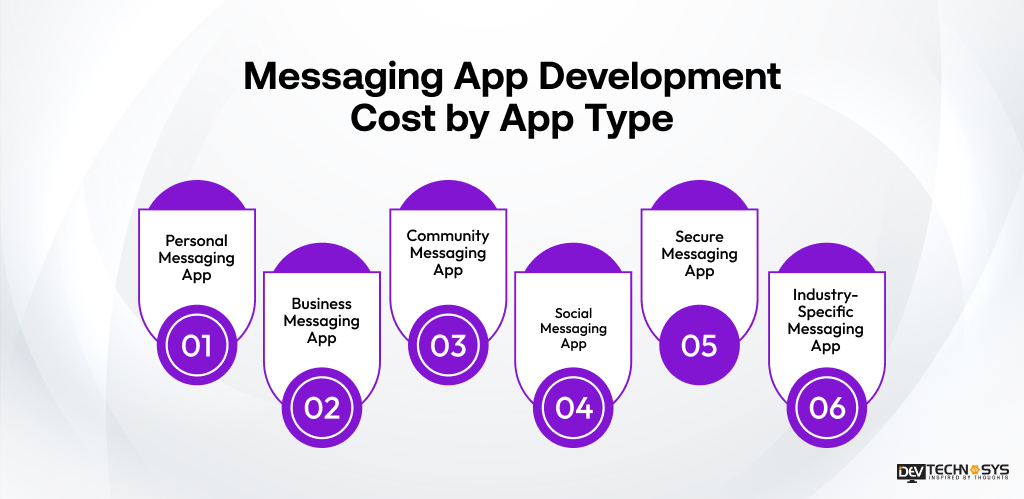
Type of Messaging App |
Primary Use Case |
Estimated Cost |
| Personal Messaging App | Private conversations and media sharing | $10,000-$30,000 |
| Business Messaging App | Team and customer communication | $30,000-$60,000 |
| Community Messaging App | Groups and interest-based communities | $30,000-$60,000 |
| Social Messaging App | Social networking with integrated chat | $40,000-$80,000 |
| Secure Messaging App | Privacy-focused communication | $60,000-$100,000+ |
| Industry-Specific Messaging App | Healthcare, education, finance, or enterprise | $60,000-$100,000+ |
1. Personal Messaging App
Personal messaging applications are built to facilitate one-on-one private communication between users. Such applications are capable of text messaging, sending voice notes, and sharing images/videos, as well as communicating in real time. The advantages of these applications are their straightforwardness, speed, and user privacy, which make them the best for communication with friends and family.
2. Business Messaging App
Business messaging software allows efficient communication between departments, teams, and clients. They feature group chats, document sharing, video meetings, task organizing, and integration with other productivity programs. Usage of business messaging programs enhances collaboration between departments, optimizes workflows, and improves customer support operations.
3. Community Messaging App
Community messaging applications are made to connect users with similar interests, hobbies, or goals. They provide the possibility to have discussions, share information, and organize events. Community messaging applications create strong interaction and networking among people.
4. Social Messaging App
Social messaging applications are designed to combine social networking features with instant messaging functions. They enable users to connect, communicate instantly, share updates, and post media with their friends and followers. Businesses that want to create such platforms may also work with a social media app development company to combine social features with messaging functionality.
5. Secure Messaging App
Secure messaging apps specialize in safeguarding users’ privacy and security during communication. They ensure that the messages sent/received by users are encrypted using end-to-end encryption technology, advanced security protocols, and two-factor authentication, which results in complete safety of users’ messages. Advanced security requirements can significantly increase the overall messaging app development charges.
6. Industry-Specific Messaging App
Industry-specific messaging applications have been designed specifically for different sectors such as education, healthcare, corporate affairs, finance, etc. These applications have specialized features that allow for compliance tool usage, secure data exchange, and easy workflow automation across industries.
For example, healthcare and SaaS platforms may require advanced compliance and backend infrastructure, similar to considerations involved in SaaS application development cost planning.
Free App Idea Reality Check: Let's Stress-Test Your Concept
Share your app idea with us. Within 3 business days, we'll uncover UX gaps, feature opportunities, and potential development challenges, so you can build with confidence. No strings attached.
Key Features Affecting Messaging Application Development Cost
Features are considered the biggest factors that directly affect messaging app development cost by features. Most startups and businesses can reduce the initial investment by launching an MVP with core functionality and then adding the advanced features later on after understanding the market demand.
Feature |
Description |
Estimated Cost (USD) |
| User Authentication | Secure login, signup, OTP verification, and social login integration | 500-3,000 |
| Real-Time Messaging | Instant text messaging with a low-latency delivery system | 2,000-8,000 |
| Media Sharing | Sending images, videos, documents, and file compression support | 1,500-5,000 |
| Push Notifications | Real-time alerts for calls, messages, and updates | 500-2,000 |
| End-to-End Encryption | Secure message encryption for privacy and data protection | 3,000-10,000 |
| Group Chats | Multi-user chat rooms with admin controls and moderation tools | 2,000-6,000 |
| Voice & Video Calls | Real-time audio/video communication using WebRTC or similar tech | 5,000-20,000 |
| Cloud Storage Integration | Scalable storage for backups, media, and message history | 1,000-4,000 |
| Admin Dashboard | Management panel for users, analytics, and content moderation | 2,000-7,000 |
| AI Chatbot Integration | Smart replies, automation, and AI-based user assistance | 3,000-12,000 |
Each additional feature, such as in-app notifications, message synchronization, push notifications, and offline messaging, increases development and testing requirements. The messaging app API integration cost can also increase when multiple third-party services are required for notifications, authentication, payments, AI, analytics, or communication.
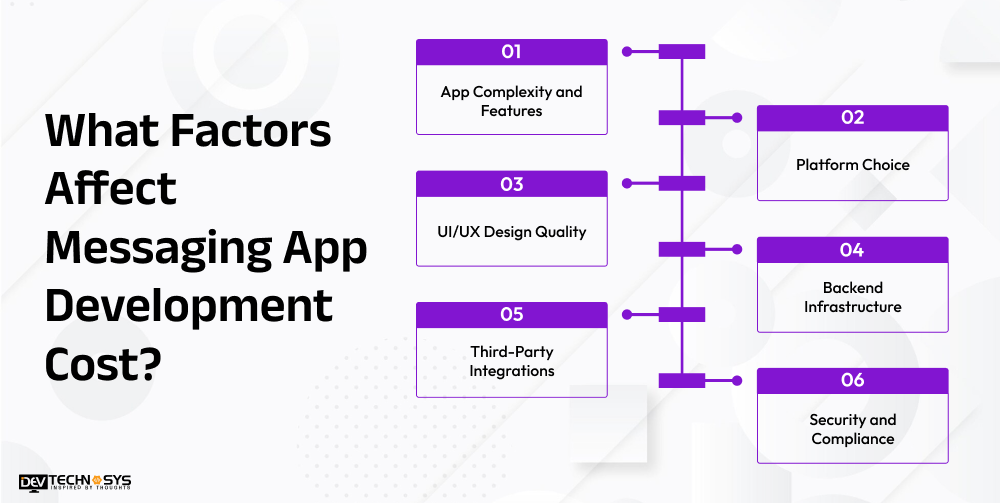
What Factors Affect Messaging Application Development Cost?
To develop an app like Kik, the overall custom messaging app development cost by complexity, depends on several technical and business factors.
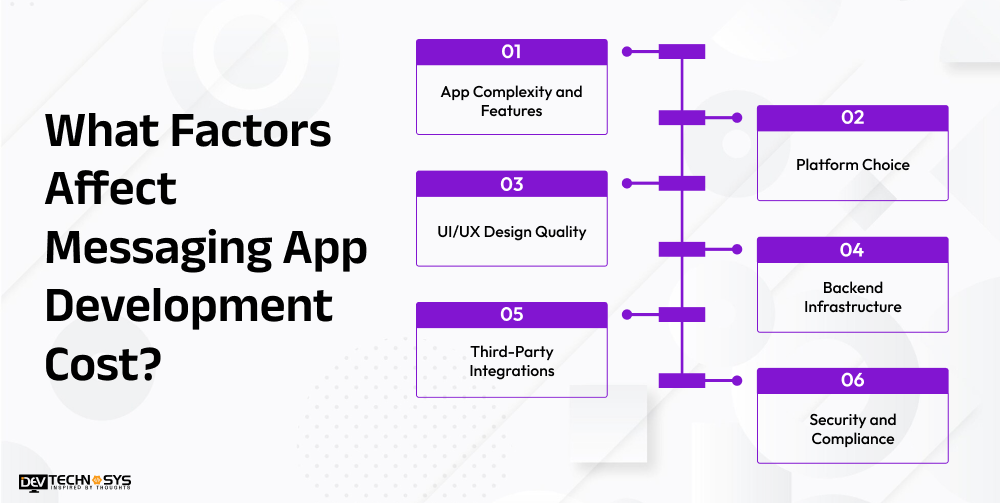
Cost Factor |
Estimated Cost Impact |
| App Complexity and Features | $5,000-$25,000 |
| Platform Choice | $5,000-$15,000 |
| UI/UX Design Quality | $2,000-$8,000 |
| Backend Infrastructure | $5,000-$25,000 |
| Third-Party Integrations | $1,000-$8,000 |
| Security and Compliance | $2,000-$12,000 |
1. App Complexity and Features
The complexity of the application and the features included in it have a direct impact on the cost involved in building it. Basic messaging apps require the least investment, while more developed features like video calls, file-sending options, AI chatbots, and real-time synchronization require more resources and construction efforts.
2. Platform Choice
The choice of the platform (whether to choose Android, iOS, or web platforms) has an impact on cost as well. A cross platform messaging app development cost may be lower because frameworks such as Flutter and React Native allow developers to share a large portion of the codebase across Android and iOS.
However, a native messaging app development cost by platform can be higher because separate applications may need to be developed and maintained for each platform.
3. UI/UX Design Quality
Quality of the UI/UX design affects the mobile app development cost too. The ease of use of the interface and usability require preliminary research, prototyping, and testing of different design solutions. Custom animations, attractive elements, and user-oriented improvements require much time to implement.
4. Backend Infrastructure
Cost will be largely influenced by factors related to backend infrastructure and scalability. Real-time communications rely on proper backend architecture within the server, database, and cloud infrastructure of the application. Due to the complexity of dealing with a high number of users, timely message delivery, and massive storage demands, it is necessary to hire dedicated developers who will provide solutions that will guarantee the efficiency of the operations provided.
5. Third-Party Integrations
Third-party integrations introduce an extra impact on the cost. Different integrations require different integrations that must be performed. The more integrations are introduced, the more time is necessary to complete the development and deal with possible errors arising from the different program ecosystems. A REST API, GraphQL API, or other API integration may be required depending on the technical architecture.
6. Security and Compliance
The necessity to fulfill the security or compliance requirements takes its toll on the cost of developing messaging software. Features like end-to-end encryption, secure messaging, various authentication systems, and compliance with regulations arising from GDPR and HIPAA mean that more time and effort will be required in implementing and testing these features.
Expert Insight:
“At Dev Technosys, we hire mobile app developers who incorporate PCI-DSS and SOC 2 requirements into development from the start, not as a final review step.”
AI Features and Their Impact on Messaging App Development Cost
The messaging experience can be enhanced by AI through automation of mundane tasks and facilitating communication processes through quicker means. But on the flip side, should AI become part of the communication process, additional requirements in development and implementation will arise.
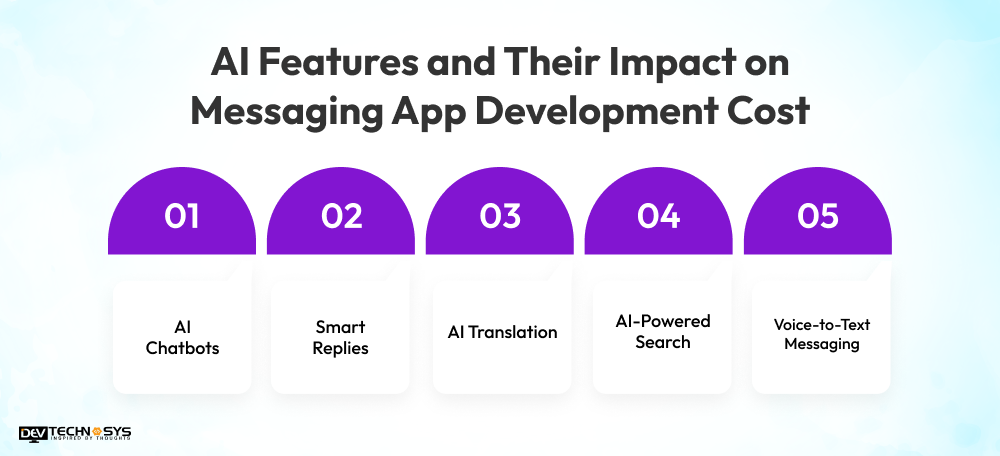
1. AI Chatbots
AI assistant is capable of providing answers in real time, as well as automating support processes and assisting users in completing complicated flows, thus achieving efficiency of communication and reducing response time.
2. Smart Replies
This system provides suggestions based on the conversation history and the meaning of the messages that are sent, and thus helps users reply quickly and with less effort, making the conversation less tiresome.
3. AI Translation
AI provides the ability to get real-time translation, which helps people from different countries communicate with each other by sending messages that are automatically translated into the original language.
4. AI-Powered Search
Instead of looking for specific keywords, users can make use of the features for searching through chats with the help of natural language question answering, thereby facilitating exploration of chats, speeding up retrieval, and increasing usability.
5. Voice-to-Text Messaging
The speech recognition feature is able to convert spoken dialogues into searchable written text, which can be used in future searches, stored, and reused by users.
AI Feature |
Primary Use |
Estimated Cost Impact |
| AI Chatbot | Support and automation | 2,000-8,000 |
| Smart Replies | Faster responses | 1,500-5,000 |
| Message Summarization | Conversation summaries | 2,000-6,000 |
| AI Translation | Multilingual communication | 2,000-8,000 |
| AI Moderation | Content safety | 3,000-10,000 |
| AI Search | Natural-language search | 3,000-10,000 |
The use of AI may lead to recurring expenses for APIs, model inference, data processing, monitoring, and data optimization. Thus, it is essential for businesses to understand whether each AI service offers benefits for users.
How to Reduce Messaging Application Development Costs
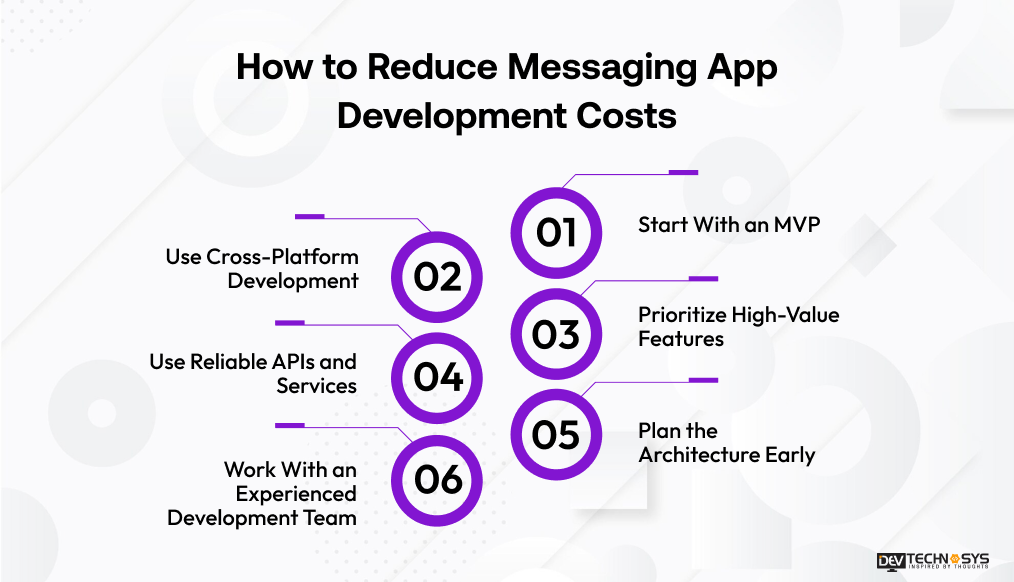
It is not important to launch a high-quality messaging app with all possible and advanced features. To build messaging apps like Slack, startups should control their investment in the beginning by making certain strategic development decisions.
1. Start With an MVP
Select important features such as sign-up, messaging, notifications, and communication of media files. A good MVP helps in testing the idea and reducing the initial investment. Moreover, it prevents the spending of resources on pricey features that do not necessarily impact the business.
2. Use Cross-Platform Development
Using cross-platform frameworks like Flutter or React Native will help you code for iOS and Android with one codebase. This reduces double coding, shortens the total time needed for project completion, decreases the amount spent on maintenance, and allows startups to connect to many platforms without spending too much money.
3. Prioritize High-Value Features
The developer should choose only the features that solve the problems of the users. Also, he should make sure that his company is not going to add unnecessary features to the program during its first stage of development. Doing so helps save time on the development, testing, and launching of the program and helps save money.
4. Use Reliable APIs and Services
Rather than creating every component from scratch, it is advisable to utilize established APIs for various services, such as notification, authentication, payment, or video conferencing solutions. While this method simplifies development and reduces complexity, it is crucial for the company to weigh the costs related to long-term subscription, utilization, and maintenance before choosing a provider for the APIs.
5. Plan the Architecture Early
An efficiently planned architecture helps avert costly changes at a later stage. Early on, you should determine scalability parameters, database format, integrations, and security requirements, as it contributes to minimizing redoing activities, better efficiencies of the development process, and ensuring that your messaging application will not require significant modifications of the infrastructure post-launch.
6. Work With an Experienced Development Team
A competent development team can help identify the technical risks, suggest the right technologies, and thus avoid making costly mistakes. Good communication, solid planning, and organized development processes allow cutting down the revisions needed and providing better quality of coding, thus enabling the company to deliver its messaging application on time and on budget.
Cost Reduction Strategy |
Potential Cost Reduction |
| Start With an MVP | 20%-40% |
| Use Cross-Platform Development | 20%-35% |
| Prioritize High-Value Features | 10%-25% |
| Use Reliable APIs and Services | 10%-30% |
| Plan the Architecture Early | 10%-20% |
| Work With an Experienced Development Team | 10%-25% |
Delivery Head Insight: By Narayan Das
“Launching with essential messaging features helps businesses validate user demand, control initial investment, and prioritize advanced functionality based on real-world feedback.”
Build vs. Buy vs. Hire a Development Partner for Your Messaging App
Organizations have a few paths when creating a messaging app: an in-house development project, a purchase of a pre-built solution, and contracting with a third party. These paths differ in cost, flexibility, speed, and ongoing ownership.
In-house development is the most flexible option, but it requires experienced developers, designers, testers, and managers. Buying a pre-built or off-the-shelf solution can speed up the process, but it may limit customization. Choosing to partner with a software development expert can give organizations access to talent and experience but save the expense of an entire internal development organization.
The correct approach for developing your app depends on your budget, timeline, technical requirements, and long-term business goals.
Approach |
Initial Cost |
Time to Market |
Customization |
Best For |
| Build In-House | High | Longer | Very High | Businesses with an experienced internal technical team and long-term product requirements |
| Buy a Ready-Made Solution | Low to Medium | Fast | Limited | Businesses needing basic messaging functionality and quick deployment |
| Hire a Development Partner (Dev Technosys) | Medium to High | Moderate | High | Startups and businesses requiring a custom, scalable messaging solution |
To develop a messaging app like IMO, it is recommended to work with an experienced development partner, such as Dev Technosys, to develop a unique messaging platform. They can provide a practical balance between customization, cost, speed, and technical expertise.
How Do Messaging Apps Make Money?
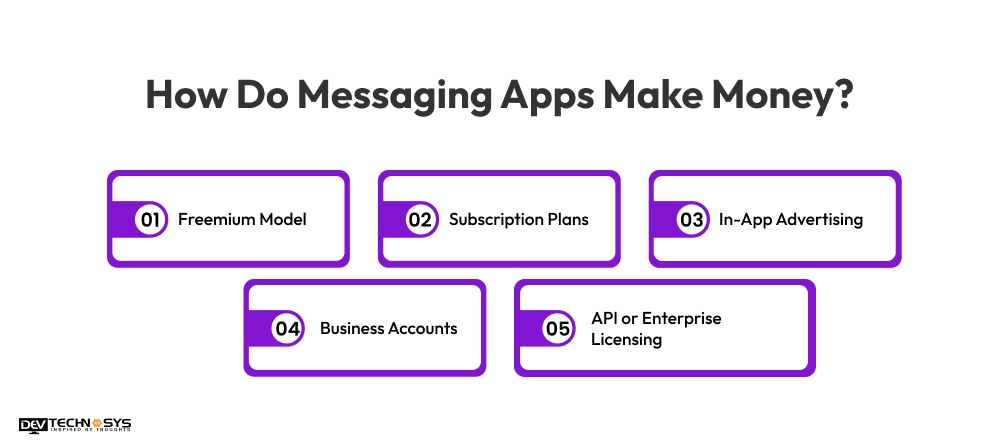
There are many monetization models for messaging apps based on their business strategy and audience:
1. Freemium Model
The freemium approach focuses on the basic features of messaging services, charging users for its premium offerings. The features that users pay for may include extra storage space, added customization options, advanced communication options, a better privacy level, or artificial intelligence features. Thus, it allows businesses to turn the use of messaging platforms into a stream of recurring revenue for the business.
2. Subscription Plans
Subscription plans are aimed at generating constant revenue by charging users on a monthly or yearly basis. Нaving such plans allows businesses to offer different tiers and pricing options based on functionalities, thus allowing users to choose a plan starting from the basic pay-as-you-go option and up to the most sophisticated plan available.
3. In-App Advertising
Messaging applications can earn revenue through the display of advertisements to users, especially if they attract a large user base. It can come in the form of sponsored messages, advertisement banners, or promotional content while trying to maintain a good balance of advertisements with user experience, privacy standards, and engagement levels.
4. Business Accounts
Business accounts work as a source of income for businesses, as they allow them to pay for tools that provide professional messaging features like auto-response capabilities, customer support features, analytical tools, verified accounts, and messaging management support. This technique allows messaging platforms to earn income from their usage while providing businesses more tools for communicating with customers.
5. API or Enterprise Licensing
Messaging platforms can sell licenses for their messaging technologies, APIs, or complete technologies to third-party companies. Revenue can be generated through subscriptions, pricing models, or business contracts allowing companies to integrate messaging features in their own systems, products, or applications.
Hidden and Ongoing Costs of a Messaging App
Businesses should not depend only on the estimated development budget at the start. After launching a messaging platform, one also needs to think about ongoing investment in its operation-keeping it running well, secure, and user-friendly.
In the table given below, we have mentioned some of the ongoing costs that add some extra amount to the development costs on an annual basis.
Ongoing Cost |
Purpose |
Potential Additional Cost |
| Cloud Hosting | Hosts application servers and supports growing user traffic. | 5%-15% annually |
| Database Management | Maintains message data, user records, backups, and database performance. | 3%-8% annually |
| Media Storage | Stores images, videos, documents, voice notes, and other shared files. | 3%-10% annually |
| Content Delivery | Ensures faster delivery of media and content across different locations. | 2%-5% annually |
| Third-Party API Fees | Covers services for authentication, notifications, AI, analytics, and communication. | 3%-10% annually |
| Voice and Video Infrastructure | Supports real-time voice and video calling services. | 5%-15% annually |
| AI Usage Costs | Covers AI APIs, model inference, processing, and monitoring. | 3%-12% annually |
| Security Updates | Includes vulnerability fixes, security monitoring, and compliance updates. | 3%-8% annually |
| Bug Fixes and Maintenance | Resolves technical issues and maintains application performance. | 5%-10% annually |
| Feature Enhancements | Supports the development of improvements and new functionality. | 5%-15% annually |
| Customer Support | Covers user support, issue resolution, and service operations. | 3%-10% annually |
In general terms, annual maintenance can account for around 15% to 25% of the initial cost of developing a messaging service. But it should be noted that the actual maintenance expenses largely depend on the infrastructure used, features implemented, security needs, and growth of users.
An app that expands rapidly will require more money on cloud infrastructure compared to a small messaging service with a stable audience.
Why Choose Dev Technosys Messaging App Development Services?
If you plan to create a custom messaging service, the most sensible approach is to let Dev Technosys, an experienced mobile app development company, determine your needs with regard to the selection of basic features, the technology stack needed to create your messaging system, timelines for when the system is supposed to be ready, and how much money it will cost.
In our past projects, we have accurately detected 98% of the fraud and achieved 99.50% transaction uptime. We have also successfully reduced the total operational costs by 30%. These capabilities help us in building a secure messaging app that matches your goals and requirements.
Conclusion
In 2026, the cost to create a messaging application will fall somewhere between $10,000-$100,000 depending on a variety of factors, including the complexity of the app and technical requirements associated with it. A minimal viable product (MVP) with a simple chat feature can come in on the lower end of this spectrum, while more sophisticated apps/services with video calls, AI, IP security, etc. will have a much higher price tag.
Starting from an MVP will allow you to gather feedback from clients and comprehend their needs before spending considerable sums to have unwanted features created.
Frequently Asked Questions
Find answers to the most common questions related to this article.
Mobile messaging app development costs between $10,000 and $100,000+. In general, the cost of a simple MVP is around $10,000-$30,000, and an advanced product (which includes features such as AI, video calls, boosted security, and scalable infrastructure) may cost around $60,000-$100,000+.
A simple app usually takes 3-6 months to develop, while a regular app needs around 6-8 months. In contrast, the development of advanced solutions may require 8 to 12 months or even longer because such applications include advanced features of text, voice, or video communication, AI tools, intricate security systems, and support for several devices and platforms.
Audio and video communications, advanced encryption and security, AI functionality, complex infrastructure, and moderation systems are usually the most expensive features of any messaging app. The cost of a project greatly depends on whether the company develops the features internally or integrates them through other providers.
A simple MVP can be created for $30,000-$50,000 since such an app will include only essential features. Some features can be added after receiving positive feedback from users and testing the first version of an app.
Messaging app maintenance costs vary and depend on users, infrastructure, third-party services, security demands, and update frequency. As a rough estimate, companies should dedicate around 15 to 25% of the budget to support, maintenance, security updates, and other improvements.