











Your all-in-one smart app—powered by intelligent AI
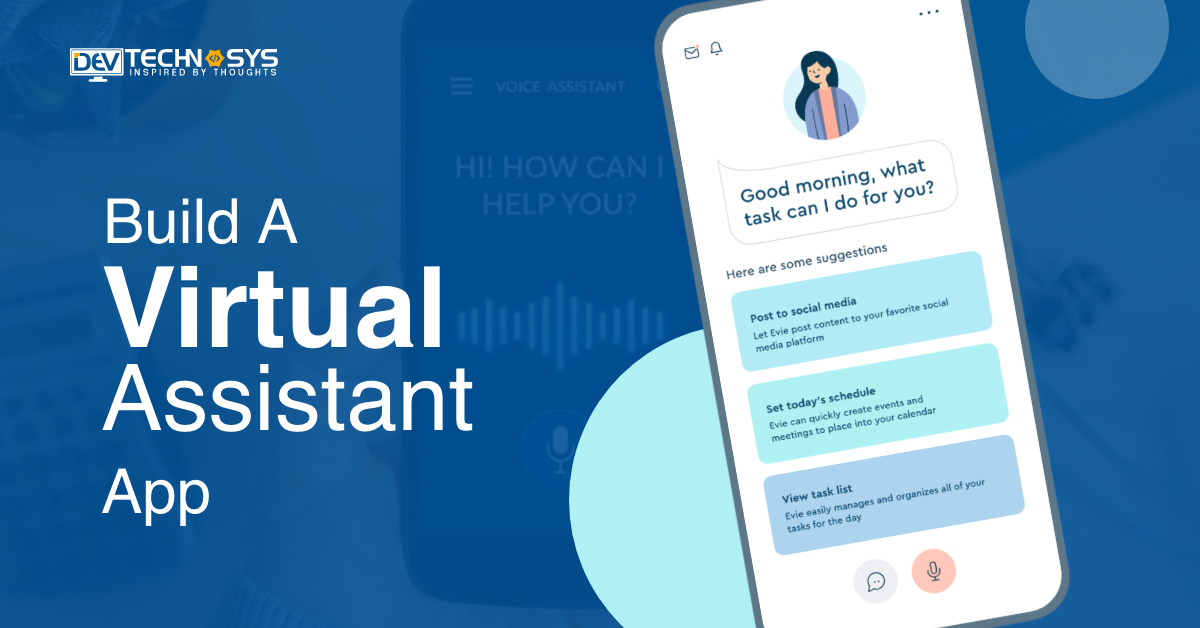
In today’s modern era, digital apps have become a necessity for individuals. With a virtual assistant, you can automate routine tasks and manage a complex schedule with efficiency. AI-powered virtual assistants are working effortlessly, enhancing the user experience.
Let’s imagine having a personal assistant who constantly reminds you to do tasks and is always available with innovative solutions. Yes, this is now possible with a virtual assistant app, which helps in sending messages, managing schedules, setting reminders, and saving time.
By 2032, the virtual assistant app market is expected to reach $168.88 billion. Does this market growth rate attract you to build a virtual assistant app?
Then, let’s dive into this blog to find out the features, benefits, steps, and costs required to create an app.
Introduction of the Virtual Assistant App
Virtual Assistance is a cognitive computing system that interacts with users and provide them with information that is pertinent to their context, much like a human operator might. It uses artificial intelligence to send messages, organize calendars, operate smart devices, comprehend and reply to user inquiries, and more. Amazon’s Alexa and Google Assistant are key examples of virtual assistant apps that enhance productivity and convenience in regular activities.
Market Stats of Virtual Digital Assistant
- In 2023, the global intelligent virtual assistant market was valued at approximately USD 16.08 billion.
- By 2030, this market is projected to reach USD 14.10 billion, reflecting evolving trends in AI-driven solutions.
- Looking ahead to 2034, the market is expected to reach around USD 178.80 billion, driven by the rapid adoption of technology across various industries.
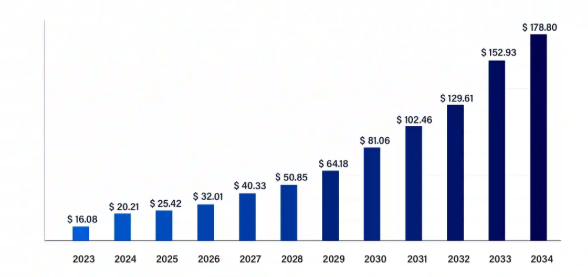
- In 2025, the intelligent virtual assistant market is expected to reach a valuation of approximately USD 8.17 billion, indicating steady growth and demand.
Top Virtual Assistant Apps Existing In Market
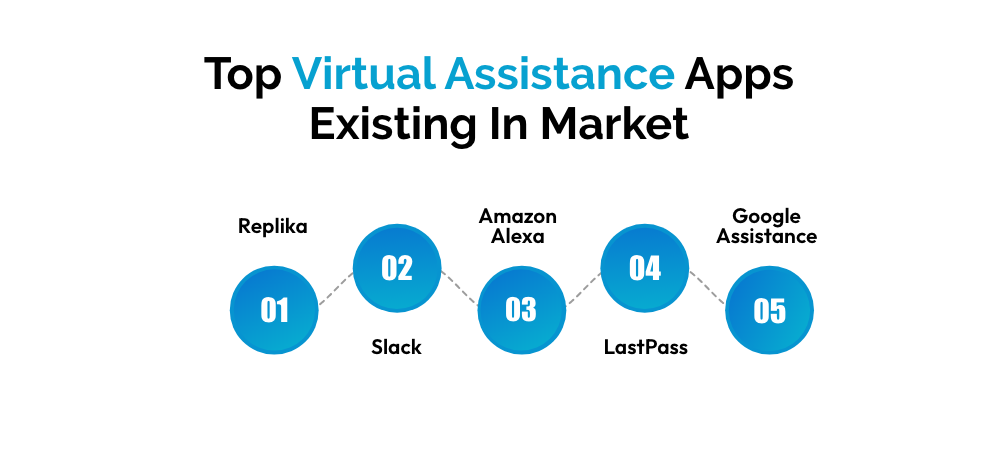
A business that is looking to make the best virtual assistant app iPhone or Android, must study the existing competitors. It will help you understand what you need to offer, and if there are any market gaps, you can fill them with your offering. Hence, here is a list of the top 5 virtual assistant apps that you must examine:
- Replika
- Slack
- Amazon Alexa
- LastPass
- Google Assistant
1. Replika
It’s a chatbot app that uses Artificial intelligence to simulate a conversation with a real person. The app can be used for entertainment, companionship, or even to practice social skills. apps like Replika adapts to the users with time, so the more users interact with it, the more personalized and realistic the conversation becomes.
2. Slack
As a virtual assistance app, Slack is a powerful communication and collaboration platform widely used by businesses to facilitate streamlined workflows, communication, and enhanced productivity. If you also want to develop such an app, it would be better for you to hire a virtual assistant app development company.
3. Amazon Alexa
This VA is built into Amazon Echo devices that answer questions, play music, and control smart home devices. With such cross platform app development, users can get news updates and order products from Amazon.
4. LastPass
It’s one of the best virtual assistant apps that aims to store and manage users’ passwords securely. This virtual assistant app can also generate strong passwords, fill in forms automatically, and monitor the web for data breaches. LastPass is a great tool for businesses that want to improve their online security.
5. Google Assistant
Google Assistant is used to perform several of the same tasks as Alexa, such as playing music, setting alarms, and controlling smart home devices. The app is known for its ability to answer the question in an informative and natural way.
How do Virtual Assistant Apps Work?
Do you know how the virtual assistant app works? Well, if yes, it’s better; however, if you do not know, look here:
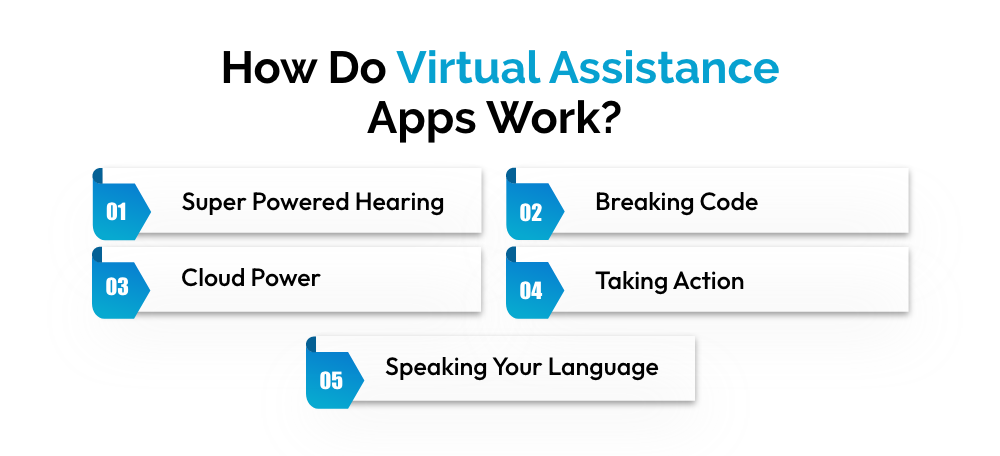
- Superpowered Hearing
- Breaking Code
- Cloud Power
- Taking Action
- Speaking Your Language
1. Superpowered Hearing
The virtual assistant app uses automatic speech recognition technology to understand user commands. The app has a super-powered ear that constantly analyzes sound waves and translates them into digital text that the VA can understand.
2. Breaking Code
With the help of natural language processing, VA can easily understand what your words means. As per the machine learning development company, it works as a codebreaker that interprets the user’s request by considering context, grammar, and slang.
3. Cloud Power
After understanding your request, VA will send your request to robust cloud servers. Advanced software accesses and processes a huge amount of information or data to complete your task.
4. Taking Action
The Virtual assistant might need to connect with different apps based on your request. Seamlessly integrating allows you to set the remainder in your playing music, calendar, or control smart home devices.

5. Speaking Your Language
Eventually, Text-to-Speech technology converts the VA’s response into a human-sounding speech. It ensures users can easily understand what the virtual assistant is telling them.
Benefits of a Virtual Assistant App
There is no wonder that the virtual assistant industry is growing rapidly. But why build a virtual assistant app? How can it help a business? Well, there are several benefits that a business can enjoy with VA or chatbot app development . Some of the benefits are mentioned here:
- Personalized User Experience
- 24/7 Customer Support Without Added Staff
- Streamlined Operations & Task Automation
- Multichannel Presence
1. Personalized User Experience
AI virtual assistant app provide personalized experiences to users by understanding their routines, preferences, and behavior. With these apps, businesses can offer tailored suggestions to users, which increases app engagement.
2. 24/7 Customer Support Without Added Staff
With a virtual personal assistant app, entrepreneurs can offer 24/7 assistance to users, addressing their inquiries and resolving issues. An AI-powered virtual assistant app helps you provide continuous consumer service support without adding staff.
3. Streamlined Operations & Task Automation
With virtual assistants, businesses can streamline business operations by automating tasks. Task automation enhances businesses’ efficiency by reducing human errors, thereby improving the scalability of virtual applications.
4. Multichannel Presence
A virtual assistant app enables businesses to operate across multiple channels, including smart devices, mobile apps, and websites. With a multichannel presence, companies can seamlessly maintain app accessibility and reach.
Having worked as a mobile app developer for different industries, I found my working journey on virtual app development exciting. This is because I learned a lot about the app and the entire industry when working on the app. As per my learning, virtual assistant apps are becoming more popular as businesses look for the most effective methods to manage workload and increase productivity. The app provides individualized help with scheduling and an amazing home setting that has transformed the way people engage with technology. Hence, this change benefits the organization in terms of increased revenue and a strong online presence.
Mohit Nag (Project Manager):
So, if you are also looking to make virtual assistant app, learn how to achieve this successfully with my learning experience, which I am sharing in my blog.
Impact of AI on the Virtual Assistant App Market
The virtual app market is evolving at a rapid rate, with artificial intelligence tools like natural language processing (NLP), machine learning, and AI predictive analytics. With the help of a virtual assistant app development company, you can ensure that the integration of AI has dramatically transformed the virtual assistant app market.
AI in the virtual assistant industry has enabled personalization features, allowing businesses to provide real-time responses and customized recommendations to users. AI is also driving the virtual assistant app market with its natural conversation capabilities and voice recognition abilities. This helps in improving operational efficiency and natural interactions.
7 Key Steps to Build a Virtual Assistant App
Developing a virtual assistant app is quite challenging but significant for business growth. If you have your own mobile app development team, it’s good, but if you do not, you can hire an AI development services provider. With the following critical steps, professionals can create a virtual assistant app, taking your business to the next level:
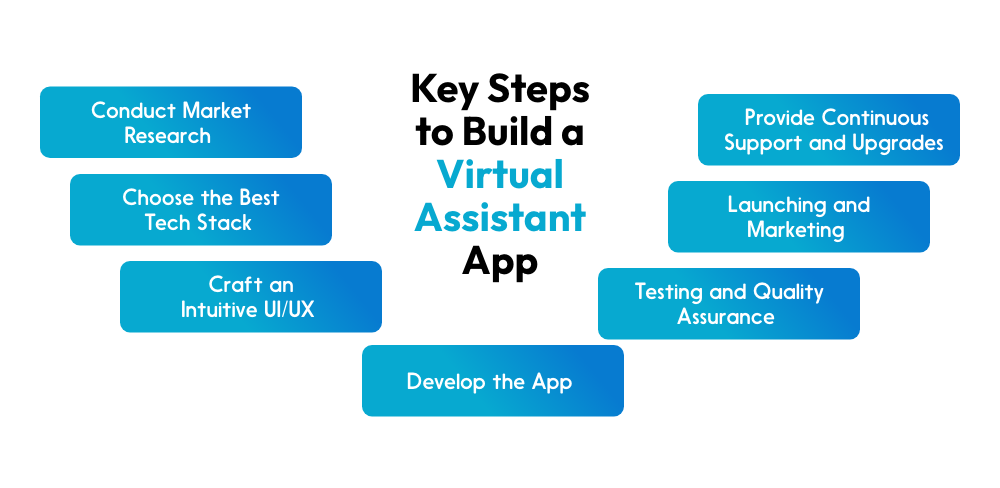
- Conduct Market Research
- Choose the Best Tech Stack
- Craft an Intuitive UI/UX
- Develop the App
- Testing and Quality Assurance
- Launching and Marketing
- Provide Continuous Support and Upgrades
1. Conduct Market Research
Before you start to develop a virtual assistant app, conduct market research to understand the relevant landscape. Research involves understanding target customers, their needs, market trends, and identifying existing competitors. It helps you understand what is trending in the market and what you need to offer differently so that you can build your AI virtual assistant app accordingly.
2. Choose the Best Tech Stack
The next step is to choose the appropriate tech stack that has a major impact on the app’s performance, development speed, and scalability. For a successful virtual assistant app development, you are advised to hire app developers who can help you pick the most suited technology stack. Additionally, ensure your tech stack supports cross-platform development to reach a big audience.
3. Craft an Intuitive UI/UX
An intuitive user interface and user experience are critical for user engagement and satisfaction. Ensure your virtual assistant app’s design is user-friendly, with a clean layout and easy navigation. You are advised to focus on building a seamless experience where users can interact with your virtual assistant app.
4. Develop the App
This stage of virtual assistant app development involves writing coding, setting up databases, and integrating APIs. Furthermore, it ensures contextual understanding, voice recognition, and multi-language support. Ensure the hired AI Application development company follows the best coding practices and emphasizes code quality. Also, implement robust security measures in your virtual assistant app to protect user data.
5. Testing and Quality Assurance
Testing is a critical part of developing a virtual assistant app as it ensures that it has no technical issues and is ready to launch. Businesses conduct different tests, such as unit tests, user acceptance tests, and integration tests. You need to pay attention to your app’s performance under different conditions. Additionally, based on testing feedback, you should update your app to enhance its performance and reliability.

6. Launching and Marketing
Once the testing process is complete, your app will be ready for deployment. Choose the right platform and time for app deployment. Create a buzz through press releases and social media. To attract more customers toward your app, highlight your app’s unique features and produce a demo of its capabilities. Also, we offer free trials to make customers curious about your app.
7. Provide Continuous Support and Upgrades
Only app deployment is not enough to build a successful virtual assistant app. To keep your app competitive and successful for a long time, you should monitor it continuously so that the app’s performance can be traced and improved as needed. With the help of a generative AI development company, keep your app updated by adding new features, bug fixes, security patches, and other updates, keeping targeted users engaged.
Must-have Features of a Virtual Assistant App
For a successful virtual assistant app development, finding the right balance of app features is crucial. Adding more features can complicate your app. Hence, here is a list of the top features that you must insert into your virtual assist app:
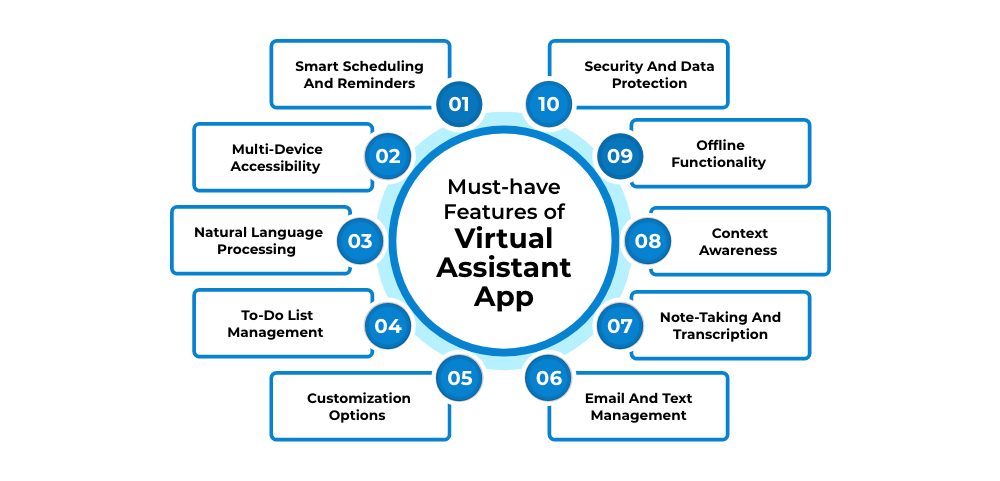
| Smart Scheduling and Reminders | Virtual assistant apps allow users to manage calendars, receive timely reminders for appointments, bills, and tasks, and set deadlines. |
| Multi-device Accessibility | Build a virtual assistant app that allows users to access their VA seamlessly across different devices, including computers, smartphones, and tablets. |
| Natural Language Processing | Hire a natural language processing services provider to Ensure your VA app can understand the user’s request and respond intelligently. |
| To-do-list Management | VA enables users to create, prioritize, and track their to-do lists, which ensures that they stay focused and attain their goals. |
| Customization Options | Personalize the interface, notification, and voice setting preferences with VA to suit users’ needs. |
| Email and Text Management | VA facilitates streamlined communication by allowing users to compose, send, and manage text and emails directly within the app. |
| Note-taking and Transcription | Create a mobile app that allows users to dictate notes and have effective communication transcribed for easy reference and future action. |
| Context Awareness | Ensure your virtual assistant app learns user’s preferences and adapts to their work style over time. |
| Offline Functionality | Use the app even if the internet is not available. Ensure core features include task management and note-taking when offline. |
| Security and Data Protection | Build a virtual assistant app prioritizing data security with reliable storage practices and encryption. |
How Can Virtual Assistant Apps Improve the Total Experience?
Virtual assistant apps can potentially enhance the overall user experience across different domains. The following points depict how a user with virtual assistant apps can enhance their experience:
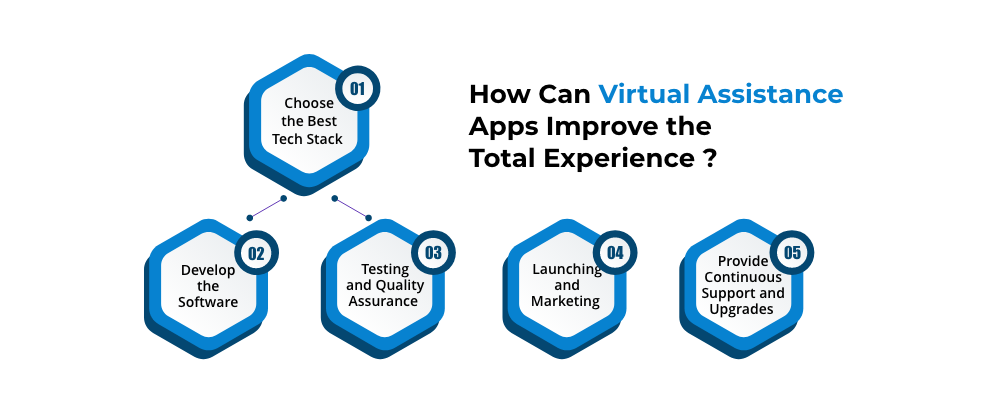
- Increased Productivity
- Personalized Experience
- Enhanced Organizations
- 24/7 Accessibility
- Simplified Communication
1. Increased Productivity
Virtual assistant apps help users tackle repetitive tasks so that they can focus on more significant tasks. Whether scheduling appointments or managing a to-do list, the apps free up the user’s time, which actually matters.
2. Personalized Experience
Over time, the VA understands users’ preferences. This allows them to predict needs, provide relevant suggestions, and personalize their experience, depicting how VA improves the total experience.
3. Enhanced Organizations
VA assists in managing information overload. The apps organize notes, set reminders, and manage calendars. Hence, they ensure that important details are not missed and that required information can be obtained immediately.
4. 24/7 Accessibility
Unlike humans, virtual assistant apps are also available around the clock. VA can easily handle it if you want to reschedule a meeting anytime. With a successful VA or messaging app development, you can stay on top of things anywhere and anytime.
5. Simplified Communication
A virtual assistant can handle basic communication tasks, like sending texts or emails. This function frees users from repetitive communication and allows them to focus on other interactions.
Cost Analysis To Build a Virtual Assistant App
Undoubtedly, developing a virtual assistant app is a wise investment decision; however, you must be aware of the development cost when considering developing such an application. So, if you are wondering how much it cost to build a chatbot or VA app, you can estimate it to be around $8000 to $27000. But, this cost can be changed based on various factors, including the app’s features, design, development team, etc. Additionally, if your app has some unique requirements, it will increase its complexity level, increasing cost, as mentioned in the table below:
Cost to Build a Virtual Assistant App
| Virtual Assistant App Development | Estimated Cost | Time Frame |
| Simple Virtual Assistant App Development | $8000 – $13000 | 3 to 6 Months |
| Medium-Complex Virtual Assistant App Development
|
$13000 – $21000 | 6 to 9 Months |
| High-Complex Virtual Assistant App Development | $27000+ | 10+ Months |
Factors Affecting the Cost of a Virtual Assistant App
1. Features and Complexity
The cost to create a virtual assistant app is primarily affected by the integration of new features and technologies, such as voice recognition and natural language processing (NLP). Entrepreneurs need to identify the features and their cost to build virtual assistant app.
| Feature Complexity | Development Cost | Time Scale |
| Basic Listings & Search | $2,500 – $4,500 | 1 – 1.5 Months |
| Intermediate (Chat, Filters, Profile) | $5,500 – $9,000 | 2 – 3 Months |
| Advanced (AI, AR, Blockchain) | $5,500 – $9,000 | 3 – 4 Months |
2. Platform(s) Targeted
The virtual assistant app development cost is affected by the basis of platform selection, as Android, IOS, and web platforms have different cost sets. To develop a virtual assistant app differences between these platforms need to be considered by entrepreneurs.
| Platform Complexity | Development Cost | Time Scale |
| iOS, Android only, and Web | $3,000 – $5,000 | 1 – 1.5 Months |
| All (Native) | $6,000 – $10,000 | 2 – 3 Months |
| Cross-Platform | $6,000 – $10,000 | 3 – 4 Months |
3. Design (UI/UX)
To provide a seamless virtual assistant experience to users, businesses must consider virtual to analyse virtual assistant apps and tools. By integrating UX features like video and image quality with the use of tools like Figma. However, these tools increase the cost to develop a virtual assistant app iPhone.
| UI/UX Complexity | Development Cost | Time Scale |
| Basic UI | $1,500 – $2,500 | 2 – 3 Weeks |
| Custom & Responsive UI/UX | $3,000 – $5,000 | 1 – 1.5 Months |
| High-End Interactive Design | $6,000 – $8,000 | 2 Months |
4. Third-Party Integrations
Looking to create my virtual assistant app unique from competitors, you need to have third-party integrations with maps, GPS tracking platforms, and synchronization between partners. However, the cost to create a virtual assistant app increases by adding different UX/UI tools and technology.
| Third-party integration Complexity | Development Cost | Time Scale |
| Basic Backend (CRUD APIs) | $2,500 – $4,000 | 2 – 3 Weeks |
| Scalable Backend + DB | $5,000 – $8,000 | 1 – 1.5 Months |
| Third-party Integrations | $4,000 – $7,000 | 1 – 2 Months |
5. Testing & Quality Assurance
To offer users a bug-free virtual assistant app, testing and quality assurance play a crucial role. Frequent testing increases the cost of virtual assistance app development. There are different types of testing, such as advanced, manual, and automated testing, which have different cost structures. This affects the cost to create the best virtual assistant app for Android.
| Testing Complexity | Development Cost | Time Scale |
| Manual Testing Only | $1,000 – $2,000 | 2 Weeks |
| Manual + Automated Testing | $2,000 – $4,000 | 3 – 4 Weeks |
| Advanced Testing + Security Audits | $4,000 – $6,000 | 1 Month |
6. Maintenance and Updates
To create virtual personal assistant app, businesses need to invest in maximising features, integrating updates, making security updates, and fixing issues. For this, entrepreneurs need to partner with virtual assistant app development companies to have expert guidance and support to build an app at a cost.
| Updates Complexity | Development Cost | Time Scale |
| Basic (Bug Fixes, Minor Updates) | $1,500 – $2,500 | Monthly Basis |
| Standard (Feature Updates, Monitoring) | $3,500 – $5,500 | Monthly Basis |
| Premium (24/7 Support) | $6,000 – $9,000 | Monthly Basis |
Tech Stack for Virtual Assistant App Development
| Component | Technologies |
| Frontend | React Native, Flutter, Swift, Kotlin |
| Backend | Node.js, Java (Spring Boot)
Python (Django/Flask), |
| API Integration | GraphQL, RESTful APIs, SOAP |
| Database | SQLite, PostgreSQL, MySQL, MongoDB, Firebase |
| Analytics | Google Analytics, Firebase Analytics |
| Authentication | OAuth, JWT |
| Push Notifications | Apple Push Notification Service, Firebase Cloud Messaging |
| Version Control | Git, GitHub, Bitbucket |
| Deployment | Apple App Store, Google Play Store, TestFlight, Firebase App Distribution |
How to Earn Money From a Virtual Assistant App?
To build a virtual app, businesses need to invest a large amount of funds. However, some attractive strategies offer entrepreneurs an opportunity to generate income. Let’s explore some attractive monetization strategies.
1. Freemium Model
Businesses can earn extra income from a virtual assistant app by using a freemium model. This allows users to access app features for free at a certain level, and for additional functionalities, they need to pay a premium. With the help of this revenue model, entrepreneurs can turn basic users to paid ones and can best virtual assistant app.
2. Subscription Plans
Subscription plans are a highly revenue-generating monetization model. It offers a continuous source of income to businesses. With the help of integrating AI tools, you can provide advanced services to users. For this, you can charge users on a monthly and yearly basis.
3. In-App Purchases
With the help of the in-app purchase business model, businesses can offer users the opportunity to make purchases directly within their apps. There, you can provide third-party support, custom voice packs, and language support. This helps to create the best apps for virtual assistants and boosts users’ retention and engagement in the virtual assistant app.
4. Advertising & Sponsored Content
Advertising and sponsored content are one of the effective way that offers businesses an opportunity to earn from a virtual app. Here, you can provide an assistant that suggests sponsored services or displays contextual ads during interactions. This is one of the reliable, steady sources of income.
The Future of Virtual Assistant App
The future of virtual assistant apps is going to be transformed by AI-powered tools. This market is evolving, where users are expecting human-like interactions. Here, we will discuss the future of the virtual assistant app.
-
Hyper-Personalization Through AI
Artificial intelligence is continuously evolving, which offers virtual assistant apps an opportunity to provide hyper-personalised experiences to users. With AI in the future, you can analyze the communication style of users in real-time and their preferences. This helps in improving emotional connections with technology and users.
-
Enhanced Security & Data Privacy
The world is getting closer to a digital assistant, which enhances the need for data protection. In the future, virtual assistant apps will enable entrepreneurs to utilize biometric authentication, advanced encryption, and user-controlled privacy to establish trust and confidence.
-
Expansion Across Industries
In the future, virtual assistants will not only be limited to the smart home. The virtual assistant app expansion will be rapidly seen in booking medical appointments, providing financial advice, and automating consumer services. This offers businesses an opportunity to have cross-industry adoption and experience growth.
-
Seamless Integration with IoT & Smart Devices
The future of virtual assistants lies in the seamless adoption of AI to enhance their ability to connect with the Internet of Things ecosystem. Businesses with virtual assistant apps in the future can enable users to have centralized control and use the app across multiple devices via voice commands.
Wrapping Up!
As you can see in the above blog, virtual apps are significant for businesses. They open doors to the captivating world of artificial intelligence and empower businesses to create a distinctive tool that simplifies business activities. However, developing the best virtual assistant app for Android or iOS is quite difficult as it requires careful planning and implementation, for which you may hire a virtual assistant app development services provider.
So, if you also want to build a virtual assistant app and are unaware of its development process, look no further than Dev Technosys. It’s an on demand app development company. Our team of dedicated developers provides top-class app development services.
So, what are you waiting for? Share what unique you want in your virtual assistant app, and let us bring your dream to life.
Frequently Asked Questions
Q1. How Much Does It Cost To Build a Virtual Assistant App?
The VA or language translation app development cost is mentioned below:
- Simple Virtual Assistant App – $8000 – $13000
- Medium-Complex Virtual Assistant App – $13000 – $21000
- High-Complex Virtual Assistant App – $27000+
Q2. How Long Does It Take To Build a Virtual Assistant App?
On average, virtual app development takes 3 to 8 months. However, if your app requires a unique design, the time can be extended by 1 year.
Q3. How to Make Money With the Best Virtual Assistant Apps?
With the following techniques, you can make money by developing a VA app:
- In-app advertising
- Freemium model
- In-app purchase
- Subscription model
Q4. Why Should You Choose Dev Technosys to Build a Virtual Assistant App?
Dev Technosys is an experienced and reputed virtual assistant app development solution provider that is known for delivering engaging and innovative mobile app solutions.