












Key Takeaways
-
- Identify whether your mode of commerce requires a currency transmitter’s license in the USA depending on the activities you perform and the movement of your money.
- FinCEN MSB registration is no substitute for state currency transmitter’s licenses.
- Take into account expenses in application fees, surety bonds, minimum capital, attorney fees, and compliance costs.
- Contrast between having your own licenses and working with the established, suitably licensed partner.
- Start executing KYC verification procedures and apply BSA/AML measures to ensure security.
Launching a money transfer app in the USA requires all the hassle of establishing secure payment processing. Before the firm starts to transfer funds to its clients, it needs to learn federal registration requirements, licensing policies in the states, financial protection guarantees, as well as anti-money laundering laws.
In state-of-the-art money transfer app development, it is crucial for fintech startups that offer apps for domestic transfers, international remittances, digital wallets, and payment services. Depending on the company’s business model and the way money is transferred through the platform, there may be a requirement to apply for licenses in different states or to use a legitimate exemption or partnership.
In the blog post, we have outlined money transmitter licensing in the US, the process of applying for the permit, possible costs involved, differences between licensing policies in different states, and compliance tips.
Do You Need a Money Transmitter License in the US for an App?
If a funds transfer application is engaged in accepting money or value from a person, a money transmitter license may be required, which can be examined based on federal and state statutes, the transactions involved, and exemptions allowed. Simple business cases requiring licensing include:
- Fund-transferring apps accepting funds from clients and transferring them to others
- International remittance businesses
- Digital wallets, which hold and transfer balances of people
- Payment systems that take money from clients before transferring it to businesses and similar beneficiaries
However, not all fintech app development services are required to have their own license, as software providers could be considered differently when they do not own or have control over clients’ funds.
Expert advice
Investigate the entire cash flow before determining whether you need a license. It is important to pinpoint the money’s recipients, controllers, holders, and the delivery process. Rather than simply depending on the app’s functions, get licensed experts to evaluate each applicable state.
FinCEN MSB Registration vs. State Money Transmitter Licenses
In fintech licensing, it is critical to understand the important difference between federal registration and the state licensing process. The Federal Government, through the Financial Crimes Enforcement Network (FinCEN), administers the federal anti-money laundering requirements as outlined under the Bank Secrecy Act (BSA).
In such a case, businesses that fall under the definition of a Money Service Business (MSB) must undergo FinCEN MSB registration in order to comply with federal requirements.
A state-level money transmitter license, on the other hand, is a license specific to conducting regulated money transmission in accordance with the laws of the state where the business operates.
| Requirement | FinCEN MSB registration | State money transmitter license |
| Authority | Federal | State |
| Primary purpose | BSA compliance and registration | Authorization to conduct regulated activities |
| Application | FinCEN Form 107, where required | State regulator, often through NMLS |
| Coverage | Federal MSB framework | Depends on each state’s laws |
| Replaces the other? | No | No |
It is important for start-ups to critically assess both obligations separately since the filing of FinCEN Form 107 does not mean approval for effective money transmissions in all states.
In the same way, the possession of a state license does not eliminate the need to comply with federal obligations.
It is also important for MSBs to develop an AML program, as well as customer identification, suspicious activity reporting, and other controls depending on their activities.
Expert advice
Prepare a compliance accountability matrix prior to the launch. Coordinate who will be responsible for federal registration, state licenses, report generation, record-keeping, and communication with regulators.
Requirements of Money Transmitter Licensing in the US
The regulations on money transmitter licensing in the US differ from state to state but, in general terms, they include looking into the financial position of the company, its ownership, and its management, and in addition, its operational controls and the capability to safeguard customer funds.
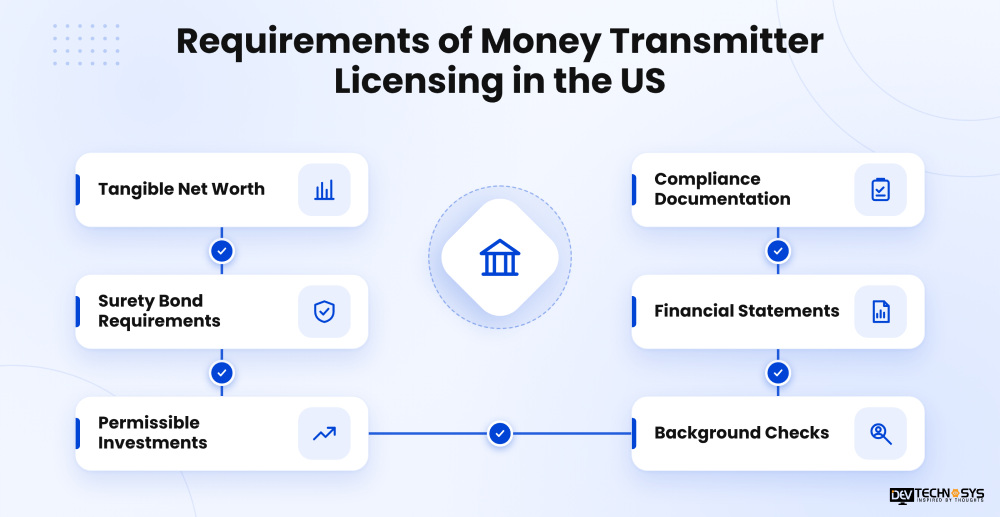
Typical requirements include:
- Tangible net worth: Prove that the business fulfills the minimum financial standard of the state.
- Surety bond requirements: Acquire a bond of the value required according to the regulator.
- Permissible investments: Have enough allowable assets to cover the outstanding obligations.
- Background checks: Provide needed details regarding the owners, controlling persons, and the top officials.
- Financial statements: Present financial documents and forecasts along with any information confirming the financial viability of the company.
- Compliance documentation: Describe AML procedures, transaction monitoring processes, duty of complaints management, and record-keeping.
It is common practice to use the Nationwide Multistate Licensing System (NMLS) for the application submission process, which allows states to conduct their licensing and regulatory processes.
On the same note, novice companies should be prepared for ongoing obligations, including an MSB call report when needed.
Application checklist for money transmitter licensing in the US
Startup readiness checklist:
- Document the complete flow of funds
- Identify every state in which the business will operate
- Assess federal registration and state licensing obligations
- Prepare ownership records and financial statements
- Confirm bond, net worth, and permissible investment app development requirements
- Document AML, KYC, sanctions screening, and reporting controls
- Prepare NMLS filings and state-specific application materials
- Establish renewal, reporting, and examination procedures
Expert advice
Do not estimate your capital requirements using another company’s license as the benchmark. State requirements, projected transaction volume, outstanding liabilities, and business structure can materially affect the amount needed.
How to Get a Money Transmitter Licensing in the US: Application Process
The money transmitter license application process should begin before development reaches the point where customers can transfer actual funds.
- Describe the business model. Give details about how customers make payments to their accounts, how money transfers happen between entities, and how payments reach the intended recipients.
- Calculate licensing requirements. Look at relevant state laws, the exemptions that could apply, and MSB registration requirements for the operators, with help from specialized law firms.
- Create materials to apply with. Collect information about ownership, financial records, business plans, compliance guidelines, and details for the background check.
- Finish the NMLS registration. File the necessary forms, fees, and documents for every jurisdiction with NMLS.
- Tackle the review process. If any clarifications, additional documents, or changes to the operations are necessary, the response should be prepared.
- Develop a compliance process. Create the procedures for renewals, reporting to regulatory bodies, auditing, and complying with regulations after the registration is finished.
The duration for the procedures of obtaining a money transmitter licensing in the US will depend on various factors: the level of completeness of the application, the state review process, the complexity of the business entity, and its ability to follow through with the state regulations. Incomplete money transmitter license applications or their denial can lead to unnecessary expenses and delays.
Can I operate while my application is pending? Do not presume that you can. Launching a regulated money transmission operation without the required approval is illegal unless a specific law, exemption, or authorization allows it.
Money Transmitter License Cost and Timeline
The money transmitter license cost depends on the states involved, the company’s financial profile, and the complexity of its operations. There is no single price for a nationwide license.
| Cost component | What affects the expense? |
| Application and filing fees | State-specific fees and NMLS charges |
| Surety bond | Required bond amount and underwriting assessment |
| Capital requirements | State minimums and financial condition |
| Legal and compliance support | Number of jurisdictions and business complexity |
| Technology and monitoring | Transaction volume, fraud controls, and reporting needs |
| Ongoing maintenance | Renewals, examinations, reporting, and compliance staffing |
One should not confuse a surety bond’s required amount with the premium paid by the company, as premiums depend on underwriting and other factors. Likewise, minimum net worth and allowed investment requirements are financial obligations, meaning their measurement is far more complex than merely establishing the application fees.
To get the right estimate for budgeting purposes, it is advisable to distinguish between the initial expenses related to licensing and other operational costs and capital.
Expert advice
Prepare a budget based on the rates set by regulators for various states and surety bonds. Try not to depend on the figures given or those not concretely defined as generic.
Money Transmitter Licensing in the US: Key Differences
In the US, there is no universal money transmitter license that is accepted from coast to coast. Businesses should check the licensing regulations of every jurisdiction where they operate.
Here are some noteworthy examples:
- New York money transmitter license: New York has specific licensing regulations under its state’s money transmission laws. Certain virtual currency activities also might require a separate BitLicense or some other required authorization.
- California money transmitter license: The state of California regulates money transmission through its Money Transmission Act. The Digital Financial Assets Law (DFAL) specifies some digital financial activities separately.
- Texas money transmitter license: Texas has its own licensing regime, financial obligations, and regulations for money transmission.
The Money Transmission Modernization Act (MTMA) intends to unify the regulations regarding capital, surety bonds, and acceptable investments. The Conference of State Bank Supervisors reports that as of September 2026, there are 31 states that have implemented the law in full or in part. Since the execution of the law is sporadic, it is not able to harmonize licensing.
New startups that require licenses in multiple states may benefit from an incremental approach to licensing, which will allow them to allocate resources to priority markets.
Can Startups Use a Licensed Partner Instead of Their Own License?
It is possible for a startup to partner with a licensed money transmitter or other financial institution instead of applying for its own licenses. But the arrangement needs to be legally justified.
There are two general approaches to it:
- License your own or find a partner: Getting licenses on your own allows for more control over operations but requires more investment, compliance effort, and time.
- Using a partner with relevant licenses can facilitate market entry, but certain licensing laws must still apply to the existing agreement.
A partnership with a sponsor bank or authorized delegate can allow certain payments to be processed, but it does not exempt a business from the obligation to be licensed.
When selecting a partner, it is important to analyze the type of licenses they have, the services they can provide, the limits of transactions, specific responsibilities in regard to compliance, the process of settlement, and conditions of termination.
Expert advice
Define responsibility for customer onboarding, transaction monitoring, complaints, suspicious activity escalation, and safeguarding funds in the contract. Have counsel verify whether the proposed structure supports the intended launch states.
Compliance and Security Requirements for Money Transfer Apps
Licensing is only one part of payment app development compliance. Money transfer startups must also design controls that help prevent fraud, detect suspicious transactions, and protect customer information.
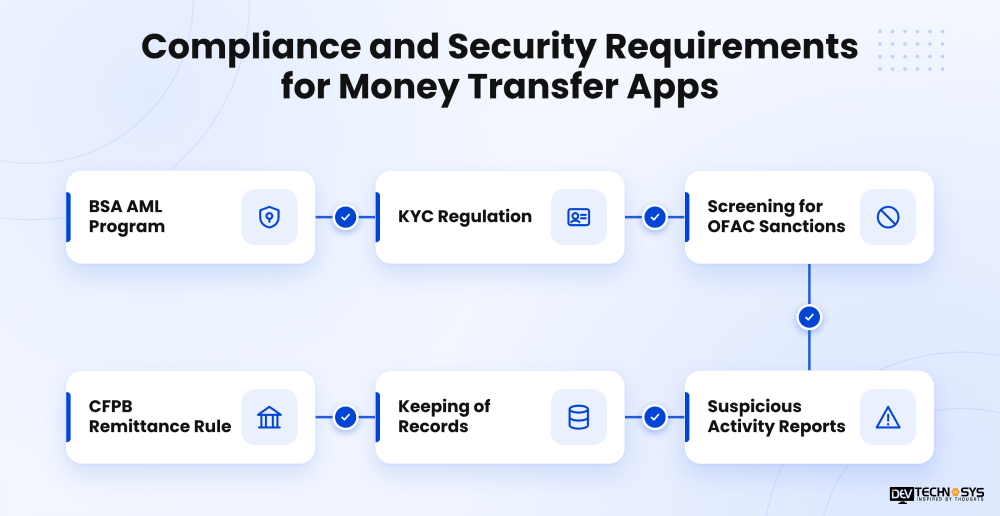
Key areas include:
- BSA AML program: Establish proper measures in terms of controls within the organization, staff training, independent examination, and compliance oversight.
- KYC regulation: Identify customers in compliance with the applicable rules and estimate risks connected with transactions.
- Screening for OFAC sanctions: Make sure whether the party concerned complies with relevant sanctions.
- Suspicious activity reports: File reports when necessary and hold adequate supporting documents.
- Keeping of records: Adhere to rules for saving records of clients and operations.
- CFPB Remittance Rule: Analyze obligations for disclosure, cancellation, and resolution of errors with reference to international transfers subject to regulation.
Technical architecture matters, too. A money transfer app development should maintain an auditable ledger, enforce transaction limits, reconcile settlement records, and use idempotency controls to prevent duplicate processing.
A basic transaction flow might look like this:
- Customer onboarding
(Identity checks and risk assessment)
↓
- Payment authorization
(Balance, limits, and sanctions controls)
↓
- Ledger and settlement
(Atomic entries, reconciliation, and error handling)
↓
- Recipient payout
(Confirmation, receipts, and audit records)
Unlicensed money transmission can result in regulatory enforcement and potential criminal consequences. Federal law, including 18 U.S.C. § 1960, addresses specified forms of unlicensed money transmission.
How to Choose the Right Licensing Strategy for Your Startup
The right strategy depends on your launch timeline, available capital, transaction model, and long-term growth plans.
| Decision factor | Own licenses | Licensed partner |
| Initial investment | Generally higher | Potentially lower |
| Operational control | Greater | Shared or contractually limited |
| Compliance responsibility | Direct licensee obligations | Depends on the arrangement and applicable law |
| Market expansion | Requires jurisdiction-by-jurisdiction planning | Depends on partner coverage and structure |
| Long-term flexibility | Greater independence | Potential provider dependency |
Startups must also determine if they need legal advice from specialists regarding their money transmitter license before deciding on their operational workings.
When developing a money transfer application, founders can utilize the expertise of fintech software development who would help them with the ledger systems, payment system integrators, KYC, and transaction monitoring processes. However, even though being technically ready is crucial, it cannot replace the legal license.
Conclusion
In the US, obtaining money transmitter licenses does not only involve compliance with several federal laws but also with state regulations, technology systems, and monetary safety mechanisms. The startups should start by understanding their money flow, figuring out where they might need licenses, and deciding whether it would be better to directly obtain licenses or partner with already compliant entities.
Collaboration with an experienced technology partner may help convert legal compliance into functional software features. Dev Technosys is a fintech application development company that can help clients develop safe and scalable money transfer systems that include payment integration services, identity verification systems, transaction monitoring tools, and technical solutions focused on compliance.
Frequently Asked Questions
Find answers to the most common questions related to this article.
If your application is sending or receiving money from customers, you might be required to have a license. The requirements for having a license will differ from one business model to another, depending on state laws and any other exemptions you can access. Seek guidance from licensing counsel before you go live.
FinCEN MSB registration deals with federal registration and anti-money laundering responsibilities, while money transmitter licenses at the state level facilitate regulated activities as per the state regulations. These two do not substitute each other.
Costs and timelines are not the same across the states, as affected by different factors. Make a budget and timeline that are appropriate for a specific state in line with the regulator's recommendations.
Yes, indeed, some startups can work under a properly established licensed-partner agreement. Nevertheless, it is important that the licensee’s permission should embrace the activities conducted by the startup, which, however, may also require its own licensing compliance.
Not necessarily. As a rule, filing an application does not allow carrying out controlled money transfer activities. You need to make sure in advance that you have the appropriate exemption approval before accepting customers' funds.