



















Key takeaways:
-
- In a nutshell, Dart is a coding language, and Flutter is a software development framework.
- Flutter manages the app’s UI, and Dart handles data and application flow. Dart can be used independently, while Flutter always requires Dart.
- Flutter and Dart relationship is intimately related and are often used together to create powerful cross-platform apps.
If you have been researching about app development, then you must have come across terms like Flutter vs Dart. It might seem confusing, are they both the same? And which one do I use? Worry not, your own expert guide is here to help you.
In this blog, we’ll explain everything you need to know about Flutter vs Dart difference and so you can make the best choice for your business.
Dart vs Flutter are closely related, making the choice difficult. Flutter is a framework used to build cross-platform and desktop apps. Dart is a programming language used to develop Flutter apps. Both of these complement each other and are mostly used together in the app development process.
What Is Flutter?
Many people ask is Flutter a programming language or framework? Well, to answer your question in the simplest way. No, Flutter is a cross-platform framework that provides pre-built UI components and tools.
Developed by Google in 2017, it is an open-source app development platform with high performance and polished UI/UX. Flutter uses Dart programming language to build high-end apps with a single codebase. Between Flutter vs Dart comparison, Flutter is widely used by developers in the ever-changing tech landscape of the US.
Syntax:
import ‘package: flutter/material.dart’;
void main() {
runApp(
const MaterialApp(
home: Center(
child: Text(‘Hello, World!’),
),
),
);
}
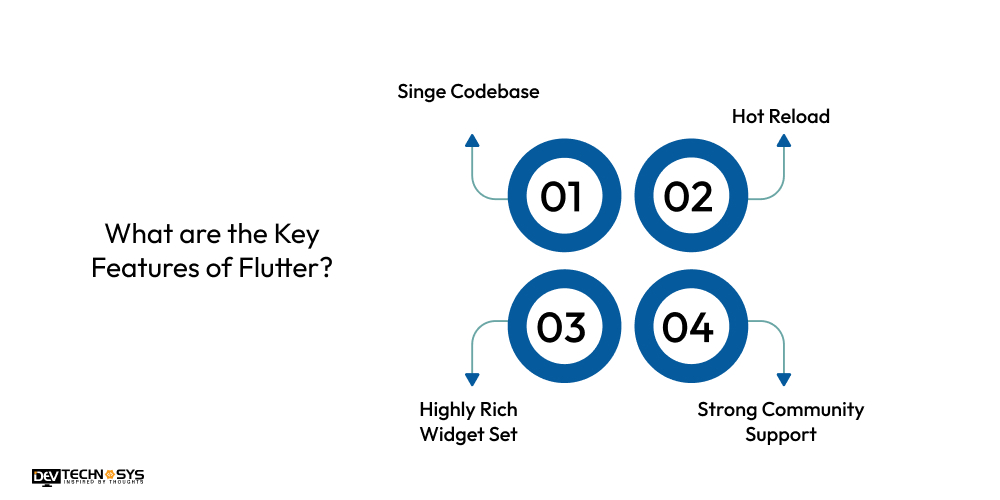
What are the Key Features of Flutter?
To know the difference between Flutter and Dart, first, you must understand the key features of the Flutter app development framework. Below, we have highlighted some of the important Flutter UI framework features.
1. Singe Codebase
One of the key features of Flutter is to build apps for multiple platforms with a single codebase. With Flutter, you do not need to write separate code for each platform, and all updates and changes can be made only once.
2. Hot Reload
Hot reload in Flutter is another key feature of the Flutter app development framework. With this features, developers can see all the changes made to the code in real-time. They do not have to restart the app.
3. Highly Rich Widget Set
To understand Flutter vs Dart for beginners, one must know that Flutter comes with a rich widget tree in Flutter. These widgets are customizable and adaptable, providing a unified object model for app layout.
4. Strong Community Support
As an open-source platform, Flutter is backed by a strong and active developer community. It provides access to hundreds of libraries, widgets, packages, and other resources.
What Is Dart?
Is Dart a framework or language? No, Dart is a class-based programming language for building fast and scalable applications. In November 2013, Google launched Dart with the intention of replacing JavaScript.
In Dart vs Java vs Kotlin, JavaScript still remains the undisputed king of the web. A software development company like Dev Technosys integrates Dart with Flutter to take the app development to the next level. Between Dart vs Flutter, Dart provides a structured, object-oriented approach to developers in the US.
Syntax:
void main() {
print(“Hello, World!”);
}
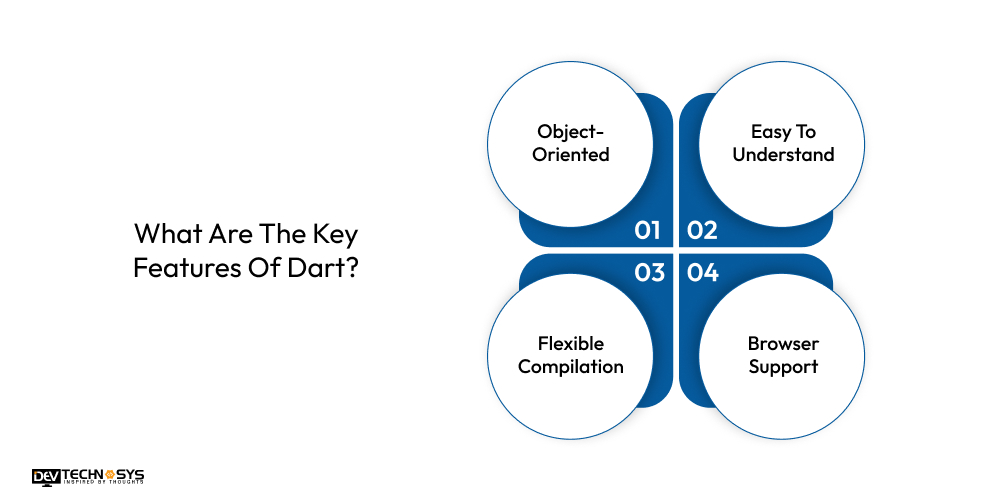
What Are The Key Features Of Dart?
To learn more about the Flutter framework vs Dart language, you must know the key features of Dart for mobile app development. The following are some of the prominent Dart programming language features.
1. Object-Oriented
Being an object-oriented language, Dart supports classes, inheritance, interfaces, and polymorphism. This features make Dart a modern and efficient choice for mobile app development.
2. Easy To Understand
One of the main features of the Dart programming language is its ease of understanding and use. If you have experience in languages like C++ or Java, then understanding the Dart language is a piece of cake for you.
3. Flexible Compilation
Dart supports both Just-in-Time (JIT) compilation and Ahead-of-Time (AOT) compilation. It enables faster iterations and hot reloading, producing highly optimized executables and adding extra value.
4. Browser Support
Thanks to dart2js compiler, Dart is supported by all modern browsers. The Dart2js compiler converts Dart code into JavaScript. This feature enables seamless execution in web environments.

What Is The Difference Between Flutter And Dart?
In this section, we have explained the difference between Flutter vs Dart. In the world of app development, both of these serve different roles. Below, the table provides an in-depth Flutter vs Dart comparison.
| Aspect | Flutter | Dart |
| Type | UI framework | Programming language |
| Developed By | ||
| Primary Purpose | Build cross-platform user interfaces | Write application logic |
| Role in App Development | Handles UI, widgets, rendering, and app structure | Handles business logic, syntax, and functionality |
| Usage Relationship | Built using Dart | Used to write Flutter applications |
| Platforms Supported | iOS, Android, Web, Desktop (Windows, macOS, Linux) | Cross-platform language (mobile, web, server) |
| Learning Focus | Widgets, layouts, state management | Syntax, data types, OOP concepts |
| Performance | Near-native performance via Skia rendering engine | High performance with JIT and AOT compilation |
| Compilation | Compiles Flutter apps to native ARM code | Supports JIT (development) and AOT (production) |
| UI Development | Rich widget-based UI system | No UI components by themselves |
| Hot Reload Support | Yes (powered by Dart JIT) | Enables Hot Reload functionality |
| Use Outside Flutter | Not usable without Dart | Can be used independently of Flutter |
| Community & Ecosystem | Strong UI-focused ecosystem | Growing language ecosystem |
| Ideal For | Cross-platform mobile and web app development | Learning programming and app logic |
| Career Relevance | Flutter Developer | Dart / Flutter Developer |
How Flutter & Dart Work Together?
At this point, you should know that Flutter uses the Dart programming language, and apps built with Flutter run on multiple platforms. By that, it must be clear that Flutter and Dart are meant to work together.
Both amy serve different roles, but were designed to work together seamlessly. By integrating Dart as the primary language, the development process becomes more efficient. It allows Flutter to take full advantage of Dart programming language features. Together, Dart and Flutter form a powerful, consistent platform for building cross-platform applications.
Wrapping Up!
Hopefully, now you understand the difference between Flutter vs Dart and all your doubts have been cleared. Dart and Flutter together make the perfect duo for developing mobile apps more efficiently and quickly.
If you want to build an app using the Flutter framework and the Dart programming language, then you must hire software developers. These technologies create powerful, scalable, visually attractive cross-platform mobile and web apps.
Most Searched Questions
1. What Is Dart Used For?
Dart is a programming language that is used to develop Flutter applications. It combines various elements from different programming languages and runs on both the client and server sides. It provides fast performance and strong typing during app development.
2. What Is Flutter Used For?
Flutter is a UI framework that allows developers to create native-like applications for mobile and web. It allows developers to write code once and deploy it across multiple platforms. For its performance and flexibility, Flutter has attracted attention from developers and engineers.
3. Which Tool Is The Best For App Development?
Flutter is a great choice if you want to quickly develop an app with a beautiful UI. On the other hand, if you require a versatile programming language for a wide range of application development, then Dart might be the best choice for you.
4. What Are The Dart Programming Language Features?
Key features of the Dart programming language are:
- Object-Oriented
- Browser Support
- C Style Syntax
- Class-Defined
- Easy To Understand
5. What Are The Flutter App Development Framework Features?
Key features of the Flutter app development framework are:
- Hot Reload
- Single Codebase
- Strong Community
- Rich Widget Set
- Cross-Platform Support