



















Key Takeaways:
Telehealth software development cost in 2026 typically ranges between $30,000 and $150,000+, depending on the platform complexity, healthcare features, compliance requirements, and integrations.
Cost Breakdown by Complexity:
-
- MVP Telehealth Software: $30,000 – $60,000 (appointment scheduling, video consultation, patient registration, and basic admin panel)
- Mid-Level Telehealth Solution: $60,000 – $100,000 (EHR integration, secure messaging, e-prescriptions, payment gateway, and patient management)
- Enterprise Telehealth Platform: $100,000 – $150,000+ (remote patient monitoring, AI features, analytics dashboards, multi-provider support, and advanced integrations)
Major Cost Factors:
UI/UX design, features, healthcare compliance requirements, third-party integrations, security standards, platform selection, and development team location.
Development Timeline:
Building a fully functional telehealth software solution generally takes 4 to 10 months, depending on the project’s scope and technical complexity.
Healthcare Compliance Impact:
Regulations such as HIPAA, GDPR, HL7, and FHIR significantly affect development costs because of additional security, privacy, and data protection requirements.
Major Cost Factors:
Outsourcing telehealth software development to regions such as India can reduce overall development costs by 40–60% compared to development teams in the United States or Western Europe.
Additional Expenses:
Ongoing costs may include software maintenance, cloud hosting, compliance audits, API subscriptions, security updates, infrastructure scaling, and technical support services.
Future Investment Trends:
Technologies such as AI-powered diagnostics, remote patient monitoring, wearable integrations, and predictive healthcare analytics are expected to influence telehealth software development costs beyond 2026.
Telehealth has emerged as one of the most significant innovations in modern patient care. Earlier, patients had to travel a certain distance, but now they can discuss a treatment with the doctor, and now patients have to simply share their details with teh doctor to complete the checkup. The telehealth software allows doctors to extract data from EHRs and other medical records.
Understanding the telehealth software development cost is essential for healthcare enterprises to manage their budgeting. The use of advanced technologies such as artificial intelligence, cloud computing, and remote patient monitoring, businesses should have a clear understanding of cost, development timeline, and factors affecting it before starting the project.
This comprehensive guide clearly states the cost of developing a telehealth software.
What is Telehealth Software?
Telehealth software allows healthcare providers and patients to communicate through internet-connected devices. Doctors can diagnose and monitor a patient’s health in real-time, while patients can get prescriptions and consult with doctors without physically visiting the hospital.
Modern telehealth software features video consultations, secure messaging, digital prescriptions, remote patient monitoring, and more in a single platform. Healthcare providers can improve patient care by investing in medical staffing software development to manage the workforce and focus more on patient care. A typical telehealth platform consists of three major components:
-
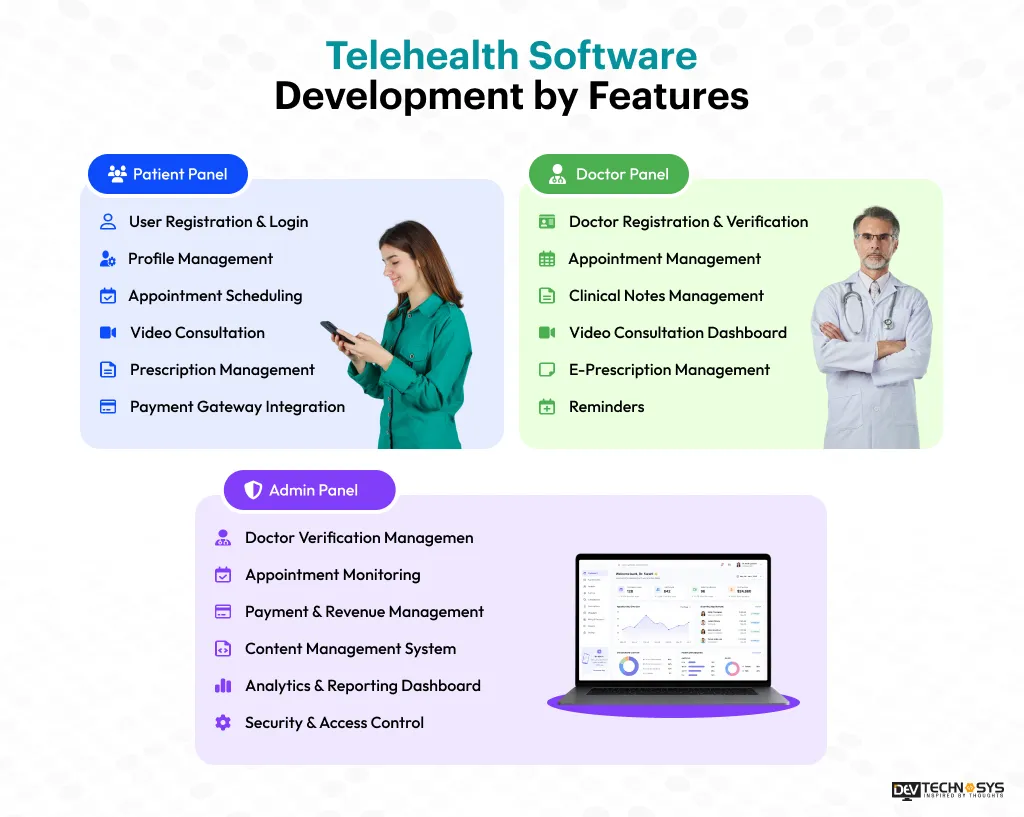
Patient Panel
The patient panel allows users to register, book appointments, attend video consultations, access prescriptions, review medical records, and make secure payments.
-
Doctor Panel
The doctor panel enables healthcare professionals to manage appointments, conduct virtual consultations, access patient records, issue electronic prescriptions, and maintain clinical documentation efficiently.
-
Admin Panel
The admin panel helps administrators manage users, monitor appointments, oversee payments, generate reports, and ensure compliance with healthcare regulations and security standards.
Telehealth Market Statistics and Industry Trends in 2026
Telehealth was adopted by healthcare providers post-COVID-19 era. People wanted safety and convenience to schedule an appointment with the doctor. Also, medical care providers wanted to reach rural areas and patients.
As per our understanding of the telehealth market from Grand View Research, this technology is growing and facilitating users worldwide. Some of the statistics also cover the analysis:
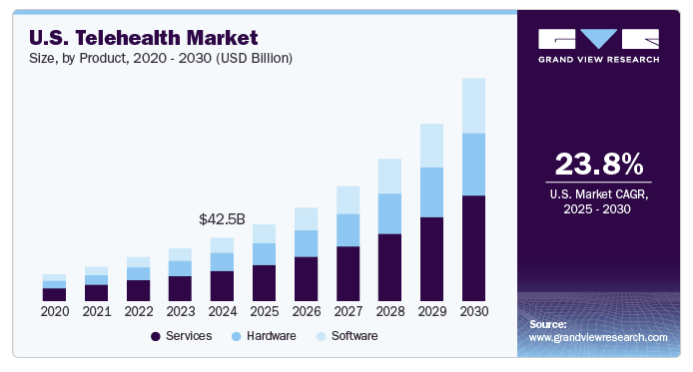
- The global telehealth market is expected to surpass $219 billion in 2026. This data shows an increasing demand for software development across the globe.
- The growing need for virtual consultations and remote monitoring has led to an increase in the use of telehealth software.
- The U.S. telehealth market is projected to grow at a nearly 24% CAGR through 2030, with revenue of $51.53 billion in 2025.
- Market players are actively seeking software development companies to build cost-effective, scalable telehealth solutions. This creates an opportunity for developers to identify the best development scenarios.
Planning a Mobile App?
Get a tailored development cost estimate in 3 simple steps — app basics, features, timeline, and your contact details.
- 3 quick steps
- 100% free
- Reply in 1 business day
2 Minutes Read
How Much Does it Cost to Develop Telehealth Software?
The average telehealth software development cost can range between $30,000 and $150,000+, depending on multiple factors. These include security compliance, stable internet connectivity for video calls, database management, features, and functionalities for the users.
Businesses can analyze healthcare app development cost by choosing one among MVP, a mid-level solution, or an enterprise-grade telehealth platform.
Let’s understand the pricing breakdown:
- An MVP telehealth solution is a minimal viable product that is suitable for small clinics. The average cost ranges from $30,000 to $60,000. The platform comprises minimum features and functionalities such as registration, video consultation, and appointment scheduling.
- A mid-level telehealth solution is the best fit for a multi-specialty clinic that offers additional features than MVP. These include electronic health records, payment integration, and secure messaging. This solution helps in reducing administrative work, allowing medical providers to save costs.
- An enterprise telehealth platform serves insurance companies, hospitals, and large healthcare networks. The advanced functionalities include AI-powered analytics, custom dashboards, Strong security, and compliance. The overall development cost is $150,000+ support high-level operations.
We will clearly explain this telehealth software pricing breakdown through the table below:
Types of Telehealth Software |
Best For |
Key Features |
Estimated Cost (USD) |
| MVP telehealth software | Small Clinics | User profile panel, video consulting, appointment booking | Upto $60000 |
| Mid-level telehealth software | Growing medical centers | EHR integration, a secure payment gateway, along with all features included in MVP | Up to $100,000 |
| Enterprise telehealth software | Hospital Chains or large healthcare organizations | AI analytics dashboard, API integration, compliance management, and all other features of MVP and mid-level telehealth software | $100,000 – $150,000 |
Telehealth Software Development Cost Breakdown by Features
The overall telehealth software development cost largely depends on the features integrated into the patient, doctor, and admin panels. Each module serves a different purpose and requires specific functionalities to ensure seamless healthcare delivery. The following tables provide a detailed feature-wise cost breakdown for every panel of a telehealth platform.
1. Patient Panel
This is a dedicated interface for the patients who can even access it on their mobile phones. They can analyze their scheduling and medical reports. The panel can be easily accessed through a mobile app or a computer device.
Feature |
Description |
Estimated Development Cost |
| User Registration & Login | Patients can securely register and log in to the system | $4,000–$5,000 |
| Profile Management | Users can update their information so that the doctors can properly diagnose them | $4,000–$5,000 |
| Appointment Scheduling | Patients can schedule, cancel, or rebook an appointment | $5,000–$7,000 |
| Video Consultation | Patients can connect to the doctors in real time | $7,000–$8,000 |
| Prescription Management | Users can view, manage, and download prescriptions digitally | $4,000–$5,000 |
| Payment Gateway Integration | Supports online payments | $5,000–$7,000 |
2. Doctor Panel
Doctors can conveniently manage patient data. They can check the reports of patients and share the medical records. They can easily analyze the patient’s illness.
Feature |
Description |
Estimated Development Cost |
| Doctor Registration & Verification | Doctors have to create their profile and manage it | $4,000–$5,000 |
| Appointment Management | Doctors can update their availability and manage schedules | $5,000–$6,000 |
| Clinical Notes Management | Doctors have access to patients’ medical records. They can also jot down the necessary details of a patient | $4,000–$6,000 |
| Video Consultation Dashboard | Patients can connect to the doctors in real time | $7,000–$8,000 |
| E-Prescription Management | Users can view, manage, and download prescriptions digitally | $4,000–$5,000 |
| Reminders | Follow-up reminders to the doctors | $4,000–$5,000 |
3. Admin Panel
All the activities of doctors and patients can be managed by the admin. He can even check for any security vulnerabilities or threats. This panel has limited access as it is given as a role-based access control.
Feature |
Description |
Estimated Development Cost |
| User Management | Allows administrators to manage patients, doctors, and staff accounts. | $5,000–$6,000 |
| Doctor Verification Management | Enables approval and verification of healthcare providers. | $4,000–$5,000 |
| Appointment Monitoring | Tracks appointments, cancellations, and consultation activities. | $5,000–$6,000 |
| Payment & Revenue Management | Monitors transactions, billing, and financial reports. | $6,000–$8,000 |
| Analytics & Reporting Dashboard | Provides insights into platform performance, users, and revenue metrics. | $6,000–$8,000 |
| Content Management System | Enables administrators to manage blogs, FAQs, and educational content. | $4,000–$5,000 |
| Security & Access Control | Manages roles, permissions, and data access policies. | $5,000–$7,000 |
Industry Insight:
According to Research and Markets, the global telehealth software development market is growing at a rate of 18.2%, encouraging healthcare organizations to understand telehealth software pricing.
Telehealth Software Cost by Region (2026-2027)
Companies offering Healthcare App Development in Australia, North America, the UK, or Western Europe generally charge higher rates. because of stringent healthcare requirements (HIPAA and GDPR).
While countries such as India offer cost-effective solutions with experienced IT teams. However, the growing demand for EMR software development significantly increases costs.
Average Developer Hourly Rates by Region
Businesses seeking Medical device software development services must select companies based on cost-effective locations. This will support their future investment goal.
Region |
Cost Impact Level |
Average Hourly Rate |
| India | Highly cost-effective | $20 – $50/hour |
| Eastern Europe | Moderate cost | $40 – $80/hour |
| UAE | Mid-to-high cost | $50 – $120/hour |
| Australia | High cost | $80 – $140/hour |
| North America | Premium pricing | $120 – $200/hour |
Want a chatbot demo or pricing? Fill the form and talk to our experts today.
Pick what you need below — you can select more than one — then tap Get detail to continue.
-
Chatbot demo dashboard
-
Cost to develop an app
-
Industry report
-
Case study
Estimated Telehealth Software Pricing by Region
Whether the project is based on Fitness & Wellness App Development or medical staffing software development, select the region where you will find the best at cost-effective prices.
1. Telehealth App Development Cost in India
This country has a large pool of experienced developers offering flexible engagement models. The experts have a strong technical expertise that builds software with efficiency, ensuring security, full functional and regulatory compliance.
Project Type |
Estimated Cost |
| MVP Telehealth App | ₹8,00,000 – ₹16,00,000 |
| Mid-Level Solution | ₹16,00,000 – ₹22,00,000 |
| Enterprise Platform | ₹22,00,000 – ₹30,00,000+ |
2. Telehealth App Development Cost in Eastern Europe
Development cost in this region is reasonable compared to North America and Western Europe. The remote patient monitoring app cost is affordable, along with the collaboration with highly skilled developers.
Project Type |
Estimated Cost |
MVP Telehealth App |
€35,000 – €50,000 |
| Mid-Level Solution | €50,000 – €90,000 |
| Enterprise Platform | €90,000 – €130,000+ |
3. Healthcare App Development Cost in UAE
Businesses will experience higher operational costs as this region is well-suited for GCC markets and enterprises seeking telehealth software development.
Project Type |
Estimated Cost |
| MVP Telehealth App | AED 120,000 – AED 180,000 |
| Mid-Level Solution | AED 180,000 – AED 350,000 |
| Enterprise Platform | AED 350,000 – AED 550,000+ |
4. Healthcare App Development Cost in Australia
Healthcare organizations prioritizing security and quality assurance can choose developers from this location. But the cost is extremely high compared to other regions due to high demand.
Project Type |
Estimated Cost |
| MVP Telehealth App | AUD 50,000 – AUD 75,000 |
| Mid-Level Solution | AUD 75,000 – AUD 150,000 |
| Enterprise Platform | AUD 150,000 – AUD 230,000+ |
5. Telehealth Software Development Cost in USA
The telehealth development budget in this region is the most expensive due to high labor costs. While this is the best location for choosing an enterprise-grade application, businesses should be prepared for increased costs.
Project Type |
Estimated Cost |
| MVP Telehealth App | $30,000 – $50,000 |
| Mid-Level Solution | $50,000 – $100,000 |
| Enterprise Platform | $100,000 – $150,000+ |
Industry Insight:
According to Fortune Business Insights, the global telehealth market is expected to grow at a CAGR of 24.60% by 2034. This statistic indicates that businesses should analyze the EHR integration cost for telehealth.
Key Factors That Influence Telehealth Software Development Costs
The cost of Telehealth Software Development depends on operational, technical, and regulatory factors. Understanding these cost drivers helps organizations to estimate budgets and conduct proper investment planning.
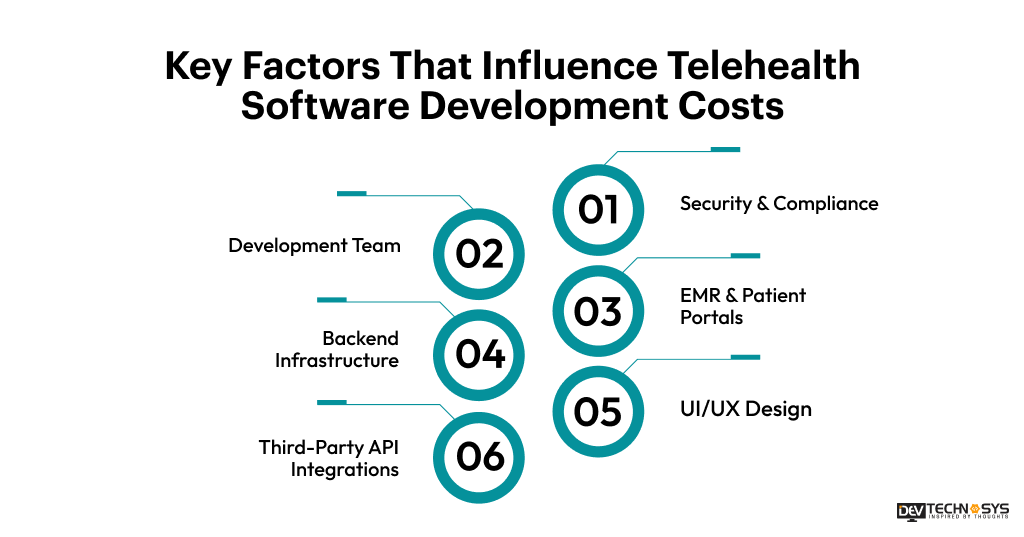
1. Security & Compliance
Telehealth platforms must comply with HIPAA, GDPR, and regional healthcare regulations while implementing data encryption, secure authentication, and audit logs. Investing in HIPAA-compliant software development ensures patient privacy and reduces legal risks.
Component |
What it Covers |
Estimated Cost (USD) |
| Data Encryption & Security | Protect patient records and consultations | $3,000 – $8,000 |
| HIPAA/GDPR Compliance | Regulatory compliance implementation | $5,000 – $15,000 |
| Multi-Factor Authentication | Secure user login and access control | $2,000 – $5,000 |
2. Development Team
From among the freelancers, experienced developers, and a company, choose effectively according to the business model and size. Large enterprises must always select a company for faster project execution.
Team Type |
Best For |
Estimated cost (USD) |
| Freelancers | MVPs and basic applications | $10,000 – $25,000 |
| In-House Team | Long-term product development | $40,000 – $100,000 |
| Healthcare Development Company | End-to-end telehealth solutions | $50,000 – $200,000+ |
3. EMR & Patient Portals
Patient Portal Development and EMR integration that will allow doctors to assess patients’ history and health records in real time.
Integration Type |
What it Covers |
Estimated Cost (USD) |
| EMR/EHR Integration | Patient health records synchronization | $8,000 – $20,000 |
| Patient Portal Features | Appointment and record access | $5,000 – $15,000 |
| Clinical Data Exchange | Interoperability and data sharing | $4,000 – $12,000 |
4. Backend Infrastructure
An effective data and cloud management infrastructure requires companies to invest in the cost to build a Telehealth App. Remote patient monitoring, video consultation, and more features require stable backend systems.
Component |
What it Covers |
Estimated Cost (USD) |
| Server Infrastructure | Hosting and server management | $3,000 – $8,000 |
| Database Management | Patient data storage and optimization | $4,000 – $10,000 |
| Cloud Integration | AWS, Azure, or Google Cloud services | $5,000 – $15,000 |

5. UI/UX Design
A user-friendly interface is the basic requirement that directly influences the cost. The design has to be quickly adaptable for the users to avoid training scenarios.
Design Element |
What it Covers |
Estimated Cost (USD) |
| Wireframing & Prototyping | Screen layouts and user flows | $2,500 – $6,000 |
| Visual UI Design | Branding and interface design | $4,000 – $10,000 |
| User Experience Optimization | Accessibility and usability | $5,000 – $12,000 |
6. Third-Party API Integrations
Modern applications require technical complexity. In telehealth apps or software APIs for video conferencing, payment gateways, e-prescriptions, and messaging, the development cost increases.
API Type |
What it Covers |
Estimated Cost (USD) |
| Video Consultation APIs | Real-time audio and video calls | $3,000 – $8,000 |
| Payment Gateway Integration | Secure billing and payments | $1,000 – $3,000 |
| E-Prescription APIs | Digital prescription management | $2,000 – $6,000 |
How Long Does it Take to Develop Telehealth Software?
The time to develop a telehealth software is 4 to 7+ months. The time is utilized from planning to a dedicated software development. Businesses must know realistic timelines to keep track of the project.
Development Stage |
Estimated Timeline |
Key Activities |
Deliverables |
| Discovery & Planning | 2-3 Weeks | Requirement analysis, workflow planning, compliance assessment | Project roadmap, feature list, technical specifications |
| UI/UX Design | 3-4 Weeks | Wireframing, prototyping, and user journey design | Interactive designs and prototypes |
| Frontend & Backend Development | 8-12 Weeks | App development, APIs, database setup | Patient app, doctor panel, admin dashboard |
| Healthcare Integrations | 2-4 Weeks | EHR/EMR, payment, video API integration | Connected healthcare systems |
| Security & Compliance | 2-4 Weeks | HIPAA/GDPR implementation, encryption, and access control | Secure and compliant platform |
| Testing & Quality Assurance | 2-3 Weeks | Functional, security, and performance testing | Validated and bug-free software |
| Deployment & Launch | 1-2 Weeks | Cloud deployment, app release, and monitoring setup | Production-ready telehealth solution |
| Ongoing Maintenance & Support | Continuous | Updates, bug fixes, security patches | Improved performance and long-term support |
| Total Development Timeline | 4–7+ Months | End-to-end software development | Market-ready telehealth platform |
Healthcare Compliance Costs in Telehealth Software Development
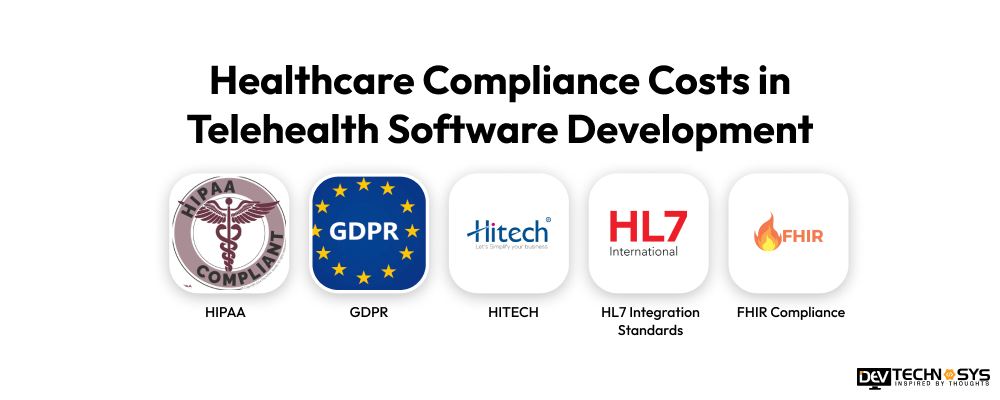
Since healthcare applications handle sensitive information of the patients. Thus, it is necessary for the developers to build software while following th e essential regulatory compliance. Standards such as HIPAA, GDPR, HITECH, HL7, and FHIR require additional security measures.
1. HIPAA
The Health Insurance Portability and Accountability Act is the most common act that is followed in the United States and has to be included while developing a software product. HIPAA-Compliant Software Development practices increase development efforts while protecting patient data.
Component |
What it Covers |
Estimated Cost (USD) |
| Data Encryption | Secure PHI and patient records | $3,000 – $8,000 |
| Access Controls | Role-based permissions and authentication | $2,000 – $6,000 |
| Audit Logs & Monitoring | Activity tracking and compliance reporting | $3,000 – $7,000 |
2. GDPR
This regulation focuses on protecting the data of patients. Since the software will be accessible internationally, it meets GDPR compliance requirements.
Component |
What it Covers |
Estimated Cost (USD) |
| Consent Management | Patient data permissions | $2,000 – $5,000 |
| Data Privacy Controls | User rights and data protection | $3,000 – $7,000 |
| Compliance Documentation | Legal and regulatory requirements | $2,000 – $6,000 |
3. HITECH
Telehealth software extracts patients’ information from EHR, which requires an additional security layer to protect the data. This helps to secure data from security breaches and threats.
Component |
What it Covers |
Estimated Cost (USD) |
| Breach Notification Systems | Security incident reporting | $2,000 – $5,000 |
| Electronic Health Records Security | Data protection standards | $3,000 – $8,000 |
| Risk Assessment & Audits | Security evaluations and testing | $2,500 – $6,000 |
Industry Insight:
An important statistic by Sprinto reports that implementing log and monitoring (which costs up to $7000) protects a telehealth software system from data breaches.
4. HL7 Integration Standards
The same concept is used here that the patient’s data is extracted from multiple sources, such as clinical notes, EHR, laboratories, and healthcare management systems.
Component |
What it Covers |
Estimated Cost (USD) |
| HL7 Messaging Integration | Clinical data exchange | $5,000 – $12,000 |
| Hospital System Connectivity | Interoperability between systems | $4,000 – $10,000 |
| Data Mapping & Validation | Accurate healthcare data transfer | $3,000 – $8,000 |
5. FHIR Compliance
Fast Healthcare Interoperability Resources is a standard used for data exchange. It improves interoperability and ensures seamless communication between telehealth platforms.
Component |
What it Covers |
Estimated Cost (USD) |
| FHIR API Development | Standardized healthcare APIs | $5,000 – $15,000 |
| EHR/EMR Integration | Patient record synchronization | $4,000 – $12,000 |
| Interoperability Testing | System compatibility validation | $3,000 – $7,000 |
Real-World Case Study: Healthcare Application “Mobile Medical Lab ”
At Dev Technosys, we developed “Mobile Medical Lab”, a healthcare platform that simplifies medical services. The application supports patients in assessing their medical health remotely under the guidance of medical professionals.
The platform offers an intuitive interface for all users. The estimated development cost ranged between $50,000. However, the project involved additional enhancements, such as payment integration, that increased the budget.
Challenges Faced: The major challenge was implementing regulatory compliance, and another was maintaining high application performance.
Project Highlights
Project Name: Mobile Medical Lab
About Client: Confidential Healthcare Client
Industry: Healthcare & Diagnostic Services
Client Location: United States
Development Timeline: 12 Months
Team Size: 6 Developers
Platform Type: Mobile Healthcare, Laboratory Booking & Remote Diagnostic Services Platform– Pramod Jangid (CTO)
Best Technology Stack for Custom Telehealth Software Development in 2026 – 2027
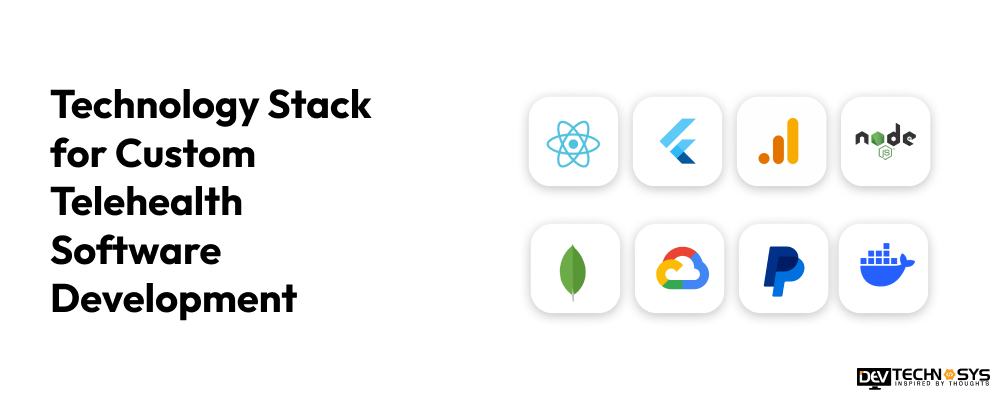
Choosing the right technologies helps healthcare providers deliver secure video consultations, manage patient records, integrate EHR systems, and ensure regulatory compliance. Selecting a reliable tech stack not only accelerates development but also reduces the digital health platform development cost and ensures long-term scalability.
Technology Layer |
Technologies Used |
Purpose |
| Frontend (Web) | React.js, Angular | Responsive user interfaces |
| Mobile Development | Flutter, React Native | Cross-platform mobile apps |
| Backend | Node.js, Python, .NET | Business logic and APIs |
| Database | PostgreSQL, MongoDB | Patient data storage |
| Cloud Services | AWS, Azure, Google Cloud | Hosting and scalability |
| Video Consultation | WebRTC, Twilio | Real-time video calls |
| Payment Gateway | Stripe, PayPal | Secure transactions |
| EHR/EMR Integration | HL7, FHIR APIs | Healthcare interoperability |
| Security & Compliance | OAuth 2.0, AES Encryption | Data protection and access control |
| DevOps & Deployment | Docker, Kubernetes | Application deployment and scaling |
| Analytics & Monitoring | Google Analytics, Grafana | Performance monitoring |
| Notifications | Firebase, Twilio | SMS and push notifications |
Third-Party Integration Costs in Telehealth Software Development
Third-party integrations are crucial to enable advanced functionalities such as pharmacy connectivity, video consultations, and more. But these are introduced with the cost of subscription, licensing, implementation, and maintenance. Though the budget depends on the enterprises that want to add specific functionalities.
Integration Type |
Purpose |
Estimated Cost (USD) |
| Video APIs | Virtual consultations and video calls | $2,000 – $8,000 |
| Payment Gateways | Online billing and transactions | $1,000 – $3,000 |
| EHR Systems | Patient records and clinical data exchange | $5,000 – $20,000 |
| Pharmacy Integrations | Prescription and medication management | $3,000 – $10,000 |
| Wearable Devices | Remote patient monitoring and health tracking | $4,000 – $15,000 |
| SMS Services | Appointment reminders and notifications | $500 – $2,500 |
Hidden Costs of Telehealth Software Development
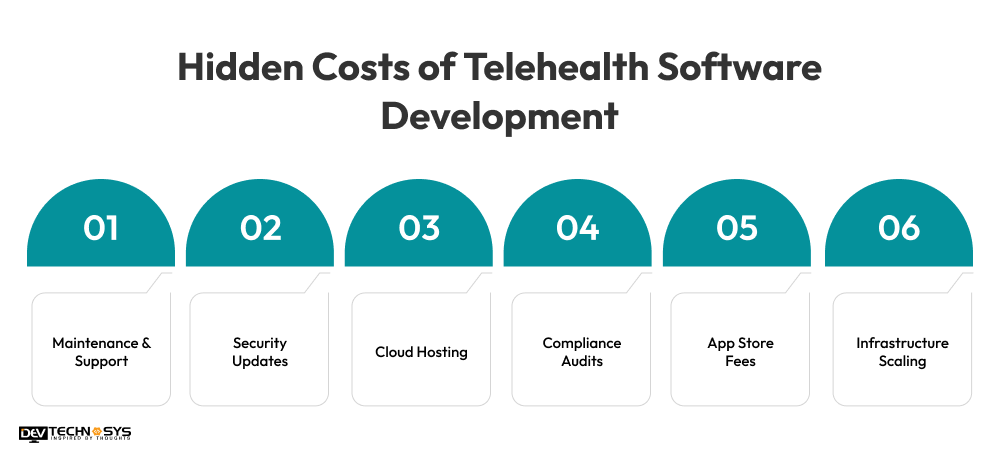
Businesses make the mistake of skipping the crucial costs associated with development, such as security and other maintenance costs. Identifying these hidden costs helps businesses to ensure reliable investment planning.
Hidden Cost |
Purpose |
Estimated Annual Cost (USD) |
| Maintenance & Support | Bug fixes, updates, and enhancements | $5,000 – $25,000 |
| Security Updates | Vulnerability patches and monitoring | $3,000 – $10,000 |
| Cloud Hosting | Servers, storage, and backups | $2,000 – $20,000 |
| Compliance Audits | HIPAA, GDPR, and security assessments | $5,000 – $15,000 |
| App Store Fees | Apple and Google platform charges | $100 – $500 |
| Infrastructure Scaling | Additional resources for user growth | $3,000 – $20,000+ |
Industry Insight:
At Dev Technosys, our experience across multiple healthcare projects shows that early cost mapping helps businesses to make long-term investments.
Is It Worth Investing in Telehealth Software in 2026?
Due to rising patients’ expectations, healthcare providers have to find a relevant technological solution. Definitely investing in telehealth software is profitable to reduce operational costs.
This also reduces staffing costs. Since all the services are remote, it creates better revenue generation opportunities. When combined with Healthcare CRM Software Development, telehealth platforms streamline communication and improve patient monitoring.
How to Reduce Telehealth Software Development Costs?
Though healthcare providers are willing to invest in software development, they should know the correct ways to reduce the E-prescription App Development cost. The following strategies will support the decision of enterprises.
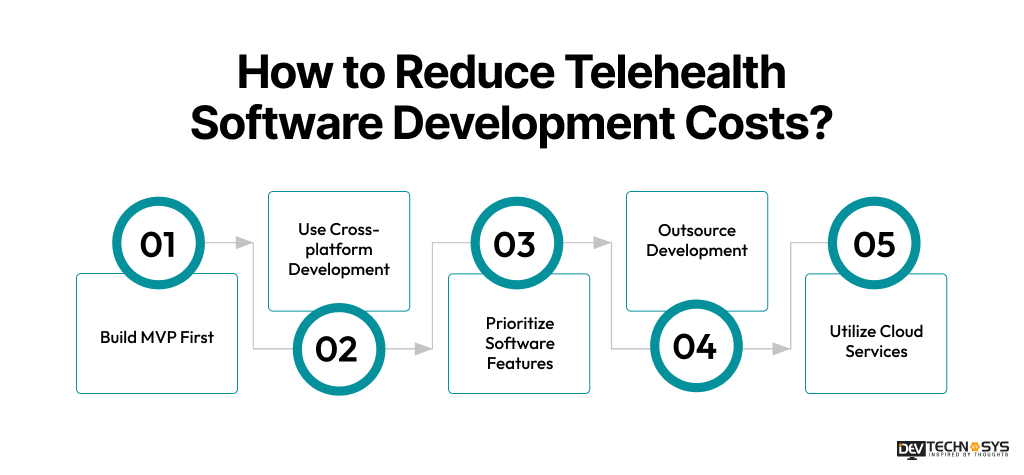
1. Build MVP First
Instead of investing in a fully featured software, build a minimal viable product. Businesses can analyze the performance with the basic version without spending much on development. This approach is beneficial for startups or small businesses. Though many organizations implement this technique to create a long-term investment strategy.
2. Use Cross-platform Development
Businesses can save costs by building cross-platform applications. These are developed using Flutter or React Native technologies for both iOS and Android platforms. Enterprises can communicate with the developers for Doctor On Demand App Development solutions or telehealth software while saving upto 15% cost.
3. Prioritize Software Features
During the development phase, only core features should be prioritized. Businesses that hire dedicated developers who communicate include payment integration, video consultations, and e-prescriptions. Advanced features such as AI analytics can be developed in a later phase. This will allow businesses to control expenses.
4. Outsource Development
Partnering with an experienced telehealth software development company in cost-effective regions helps to reduce development expenses. Their teams understand regulatory compliance and healthcare workflow, which is perfect for you to complete the project. This lowers the development expenses to 10%.
5. Utilize Cloud Services
Businesses can significantly reduce long-term telehealth software development and operational costs by adopting cloud services. These platforms provide easy accessibility and scalable computing resources that help businesses to save costs.
Conclusion
Telehealth software development usually costs up to $150,000, depending on multiple factors. While security, data management, and regulatory compliance costs are high, there are ways to reduce them.
This includes building an MVP and using cloud services. These have low costs, allowing businesses to save on expenses. Partnering with an experienced software development company or hiring developers can further help businesses to build cost-effective telehealth solutions.
Frequently Asked Questions
Find answers to the most common questions related to this article.
The cost of developing telehealth software typically ranges between $30,000 and $150,000+, depending on the platform's complexity, features, integrations, and compliance requirements.
Telehealth software development generally takes 4 to 7+ months, depending on the project's scope, features, and customization requirements.
Major cost factors include feature complexity, UI/UX design, healthcare compliance, third-party integrations, technology stack, security requirements, and development team location.
Yes, HIPAA compliance requires additional security measures, data encryption, access controls, and compliance testing, which can increase development expenses.
Telehealth platforms commonly use technologies such as React, Flutter, Node.js, cloud services, video conferencing APIs, AI tools, and electronic health record integrations.