



















Key takeaways:
-
Overall Cost Range:
Manufacturing ERP software development cost in 2026 typically ranges from $30,000 to $150,000+, depending on business size, required modules, customization, integrations, and deployment model.
Cost Breakdown by Complexity:
-
- Basic ERP (MVP): $30,000 – $50,000 (inventory management, procurement, accounting, order management, and reporting)
- Mid-Level ERP: $50,000 – $100,000 (production planning, warehouse management, CRM, HRM, quality management, and third-party integrations)
- Enterprise ERP: $100,000 – $150,000+ (AI-powered analytics, MES integration, IoT connectivity, multi-plant operations, advanced automation, and custom workflows)
Key Cost Factors:
Manufacturing ERP software cost is influenced by ERP modules, custom features, UI/UX design, cloud vs. on-premise deployment, API integrations, data migration, AI capabilities, cybersecurity, compliance, and technology stack.
Development Timeline:
Building a custom manufacturing ERP solution generally takes 6 to 12+ months, depending on project scope, customization, testing, and implementation requirements.
Regional Development Costs:
Outsourcing ERP development to countries like India can reduce development costs by 15% compared to the United States, Canada, or Western Europe, while maintaining enterprise-grade quality.
Deployment Model Impact:
-
- Cloud ERP offers digital manufacturing solutions with lower upfront infrastructure costs and faster deployment.
- On-premise ERP requires higher initial investment for servers, licensing, and maintenance.
High-Cost ERP Modules:
Production Planning, Manufacturing Execution System (MES), Supply Chain Management (SCM), Business Intelligence (BI), AI-powered forecasting, and IoT integration are among the most expensive modules to develop
Hidden Cost Drivers:
Data migration, legacy system modernization, employee training, change management, compliance certifications, third-party software licenses, and post-launch support can significantly increase the total project budget.
Annual Maintenance Cost:
Businesses should budget approximately 10% of the initial development cost annually for software maintenance, security updates, cloud infrastructure, performance optimization, and feature enhancements.
Business Value:
Investing in a custom manufacturing ERP enables organizations to improve production efficiency, optimize inventory, streamline operations, reduce manual processes, and achieve higher long-term ROI through data-driven decision-making.
-
Manufacturing ERP is a centralized system that integrates core functions such as finance, inventory, supply chain, and production planning into a single platform. It enables manufacturers to achieve real-time visibility and streamline workflows.
As manufacturing operations are increasingly becoming complex, organizations are rapidly adopting intelligent ERP solutions. However, Organizations should be aware of the manufacturing ERP software development cost to ensure a careful implementation.
Why Manufacturing ERP Development Costs are Rising in 2026?
Modern ERP platforms are expected to deliver real-time analytics and enterprise security that directly affects the cost to develop ERP software.
1. AI and Predictive Manufacturing
AI-powered forecasting, predictive maintenance, and demand planning require advanced ML infrastructure, increasing overall cost.
2. IoT-Driven Smart Factories
Real-time machine monitoring increases backend complexity and cloud dependency. Support for these requirements adds up to the budget.
3. Custom Integration Requirements
Manufacturers now require integration with:
- MES (Manufacturing Execution Systems)
- SCM platforms
- Material Requirements Planning (MRP)
- CRM systems
- Industrial IoT sensors
4. Cybersecurity Requirements
Strong security requirements for ERP systems and compliance with industry regulations increase costs.
5. Cloud Migration Costs
Hybrid and cloud-native ERP architectures require scalable infrastructure design. These cloud services add to the overall software development budget.
ERP Software Development Cost for Manufacturing Variations by Industry Type
Depending on the business type and size, manufacturing IT solutions costs vary by industry. A clear understanding of the manufacturing model allows businesses to invest in the right ERP system.
Manufacturing Model |
Description |
Estimated ERP Development Cost (2026) |
| Discrete Manufacturing | Requires BOM management, production planning, and Inventory Management ERP | $30,000 – $70,000 |
| Process Manufacturing | Supports batch production, recipe management, quality control, and regulatory compliance. | $60,000 – $110,000 |
| Hybrid Manufacturing | Combines discrete and process workflows with advanced planning and inventory management. | $90,000 – $150,000 |
Industry Insight:
According to Statista, the United States is projected to generate the highest revenue, amounting to US$28.77bn in 2026. This data reflects an increase in adoption of enterprise resource planning software across industries.
Want a chatbot demo or pricing? Fill the form and talk to our experts today.
Pick what you need below — you can select more than one — then tap Get detail to continue.
-
Chatbot demo dashboard
-
Cost to develop an app
-
Industry report
-
Case study
Core Features of Manufacturing ERP Software with Estimated Cost
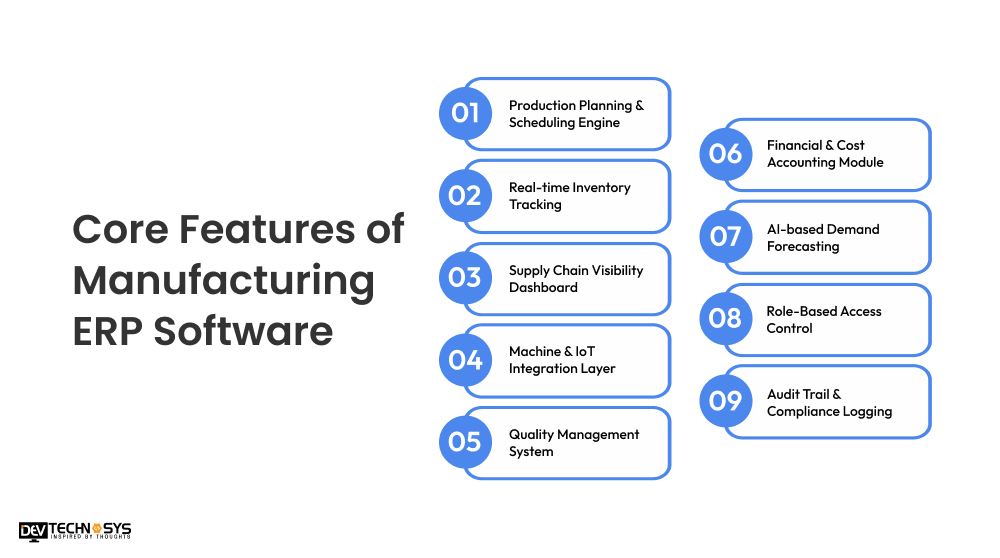
What is ERP has become an outdated question in 2026-2027, as businesses are now focusing on two-tier ERP strategies. They are planning to integrate capabilities such as real-time inventory tracking and AI-based demand forecasting in ERP systems to support effective decision-making for businesses.
Manufacturing ERP Feature |
Feature Description |
Estimated Manufacturing ERP System Development Cost (USD) |
Production Planning & Scheduling Engine |
Automates production schedules, resource allocation, and manufacturing workflows to improve operational efficiency | $8,000 – $15,000 |
| Real-time Inventory Tracking | Monitors raw materials, work-in-progress, and finished goods inventory across locations in real time | $5,000 – $10,000 |
| Supply Chain Visibility Dashboard | Provides centralized insights for ERP solutions for logistics and supply chain management | $6,000 – $12,000 |
| Machine & IoT Integration Layer | Connects ERP systems with machines, sensors, and industrial IoT devices for real-time production monitoring | $12,000 – $25,000 |
| Quality Management System | Tracks quality inspections, defect management, and compliance standards throughout production processes | $7,000 – $15,000 |
| Financial & Cost Accounting Module | Manages budgeting, cost analysis, invoicing, financial reporting, and manufacturing expenses | $8,000 – $18,000 |
| AI-based Demand Forecasting | Uses predictive analytics and machine learning to forecast demand and optimize production planning | $15,000 – $30,000 |
| Role-Based Access Control | Restricts system access based on user roles to improve security and data governance | $3,000 – $8,000 |
| Audit Trail & Compliance Logging | Maintains detailed records of system activities and transactions to support audits and regulatory compliance | $5,000 – $12,000 |
What is the Cost to Build Manufacturing ERP Software in 2026 – 2027?
The average manufacturing ERP software development cost can range between $30,000 and $150,000+. The overall development expenses mainly depend on the software complexity, number of modules, customization requirements, integrations, deployment model, and business size. Let’s understand:
- A basic manufacturing ERP system can range from $30,000 to $60,000. This follows a minimal viable product approach comprising basic features and functionalities. It can be used by small businesses for production planning, reporting, and to accomplish other tasks.
- A mid-level manufacturing ERP system costs a bit more due to core functionality and moderate customization. The development cost of a mid-level manufacturing ERP system can range between $60,000 and $100,000. It supports quality control, CRM, warehouse management, and other business processes.
- An advanced manufacturing ERP system includes enterprise-grade security features. This system is usually developed by large organizations with an average cost of $100,000 to $150,000+. Most businesses choose custom software development services for advanced reporting, IoT integration, AI-driven analytics, and predictive maintenance.
We will clearly explain this manufacturing ERP software development cost breakdown through the table below:
ERP Type |
Best For |
Included Features & Modules |
Enterprise Manufacturing ERP Development Cost (USD) |
| Basic Manufacturing ERP | Small manufacturers and startups | Production planning, inventory management, procurement, basic reporting, user management, and financial tracking with minimal customization | $30,000 – $55,000 |
| Mid-Level Manufacturing ERP | Growing manufacturers and multi-department operations | Production scheduling, supply chain management, quality control, accounting, custom dashboards, role-based access control, and third-party integrations | $55,000 – $95,000 |
| Advanced Manufacturing ERP | Large enterprises and smart factories | AI-based demand forecasting, IoT integration, predictive analytics, compliance management, multi-location support, real-time reporting, and advanced automation | $95,000 – $150,000+ |
Key Factors Affecting Manufacturing ERP Software Development Cost in 2026 – 2027
Several technical and operational factors affect the manufacturing software development cost. Key drivers are adoption of Industry 4.0 technologies, deployment model, and system complexity. Understanding these cost drivers helps manufacturers plan realistic budgets, reduce implementation risks, and select ERP solutions that align with their operational objectives and future growth.
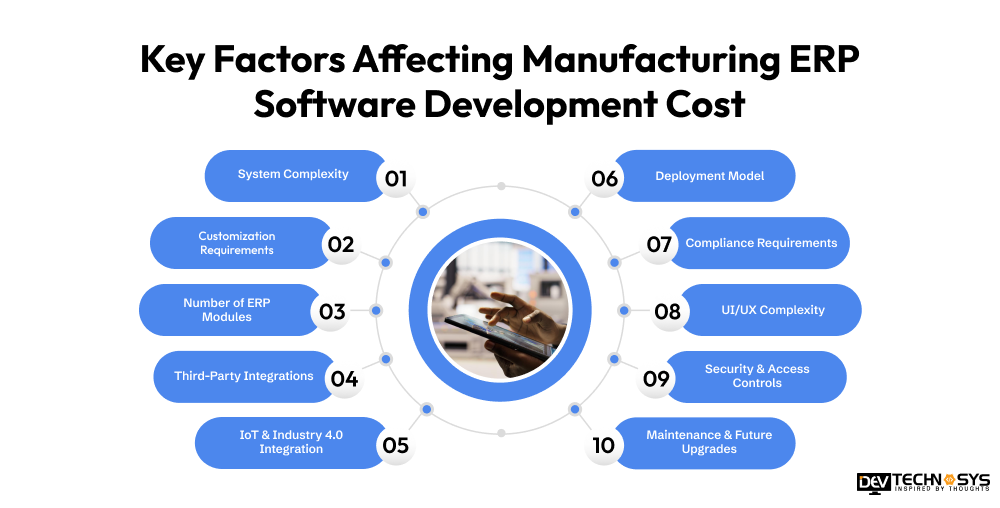
Cost Factor |
Impact on ERP Development |
Estimated Cost Impact |
| System Complexity | Complex workflows, multi-location operations, and advanced business processes require additional development efforts. | High |
| Customization Requirements | Custom modules, workflows, dashboards, and reports increase development time and costs. | $5,000 – $30,000 |
| Number of ERP Modules | Adding production, inventory, procurement, finance, HR, and quality modules increases project scope. | $3,000 – $15,000 per module |
| Third-Party Integrations | Integration with CRM, MES, SCM, accounting software, and APIs adds development complexity. | $5,000 – $20,000 |
| IoT & Industry 4.0 Integration | Machine connectivity, sensor integration, and real-time monitoring require advanced architecture. | $10,000 – $35,000 |
| Deployment Model | Cloud-based, on-premise, or hybrid deployment affects infrastructure and operational costs. | Moderate to High |
| Compliance Requirements | ISO, FDA, GDPR, and industry regulations require additional security and documentation features. | $5,000 – $20,000 |
| UI/UX Complexity | Custom dashboards, role-based interfaces, and reporting systems increase design efforts. | $3,000 – $10,000 |
| Security & Access Controls | RBAC, encryption, audit logs, and cybersecurity measures increase implementation costs. | $3,000 – $12,000 |
| Maintenance & Future Upgrades | Ongoing updates, technical support, monitoring, and feature enhancements add long-term expenses. | 15–20% annually |
Industry Insight:
According to McKinsey, businesses are rapidly adopting artificial intelligence for their ERP systems to increase productivity. This technology automates workflows, reducing overall costs and improving operational efficiencies.
Industry 4.0, IoT & Smart Factory Integration Costs in Modern Manufacturing ERP Systems
Manufacturers are gradually embracing Industry 4.0 as it helps in integrating technologies such as PLCs, IoT sensors, manufacturing execution systems, and predictive maintenance tools. This enables end-to-end visibility for businesses across their production processes. The cost of Industry 4.0 integration depends on the specific requirements of an organization.
For example, cybersecurity, AI and IoT integration, and more. However, partnering with the right company that provides manufacturing software development services can be a feasible choice for businesses. Manufacturers should also consider ongoing maintenance costs and complexity of AI automation workflows.
Regulatory Compliance Standards Impacting Manufacturing ERP Development
Specific regulations need to be followed by organizations while building an ERP system. These avoid operational disruptions, financial penalties, and failed audits.
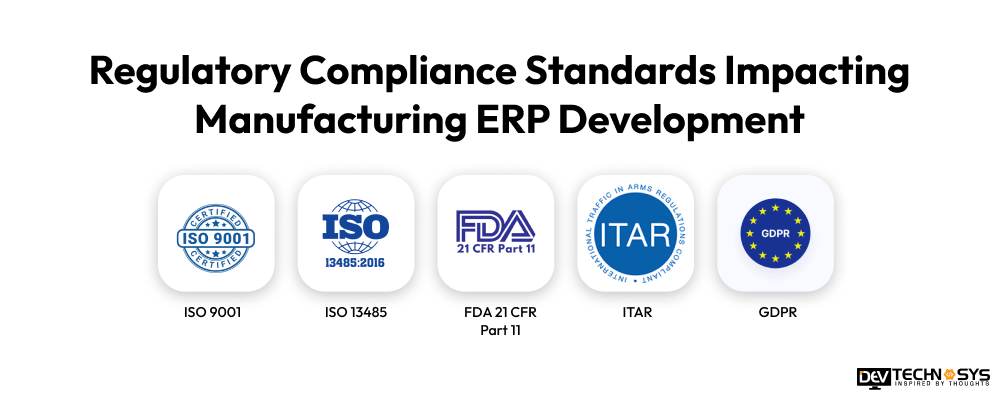
1. Manufacturing Compliance Standards
Manufacturing ERP software cost for small businesses are mainly affected due to compliance. But industries such as healthcare, biotechnology, and more should incorporate these.
-
ISO 9001
This standard is specifically used to maintain the quality of the software. This compliance increases cost because it includes quality inspection workflow, internal audit management, document control systems, and more.
-
ISO 13485
This is used for risk management, controlled document revisions, device history records, and batch and lot traceability. Thus, it directly adds to the software cost.
-
FDA 21 CFR Part 11
Manufacturers that operate their business in the pharmaceutical or biotechnology industry and life sciences must incorporate this regulation. This typically includes audit trails, secure user authentication, user validation, and controlled access mechanisms.
-
ITAR compliance
Defense and aerospace industries have sensitive information that needs to be protected using ITAR compliance. The main strategy is user activity monitoring and secure data management.
-
GDPR
Manufacturing Resource Planning in the European market is conducted in accordance with GDPR, which directly affects the software development cost. However, manufacturers of other countries also follow this standard to maintain legal compliance.
2. Compliance Cost Impact
For example, a business wants to know the cost to develop a factory management software, they must first understand the compliance cost. This covers the technical aspects of compliance that manufacturers need to follow.
-
Validation Documentation Costs
Large organizations require extensive validation documentation, such as risk assessment reports, functional requirement specifications, validation protocols, testing records, and change management logs. However, partnering with a CMMI Level 3-based company helps to build secure ERP systems.
-
Audit Trail System Implementation
This standard is effective at tracking user business activities, such as system events, user actions, and data modifications. Manufacturers can keep track of these and can make necessary changes according to regulatory compliance.
-
Role-based Access Control (RBAC)
This compliance is usually assessed by quality managers, financial teams, administrators, and production operators to prevent unauthorized access to sensitive data.
-
Data Traceability & Reporting Layers
Manufacturers should be aware of the product quality throughout the production process to avoid issues later. Enterprise resource planning systems can track quality in real time to improve product visibility to manufacturers.
Industry Insight:
According to Research and Markets, the ERP market size is projected to expand from USD 6.36 billion in 2026 to USD 10.17 billion by 2031. This research clearly shows interest of large organizations to implement cloud ERP AI solutions.
How ERP Architecture Affects Manufacturing ERP Development Cost?
With the advancement in technology, manufacturers should be aware of the architecture and its related cost. This helps to create an effective investment plan.
ERP Architecture |
Description |
Scalability Level |
Cost Impact |
| Monolithic ERP Architecture | A single, unified application where all modules operate within one codebase and database environment | Low to Moderate | Lower initial development cost and easier deployment, but limited flexibility and scalability |
| Microservices ERP Architecture | Individual ERP modules are developed and deployed independently, allowing greater flexibility and easier upgrades | High | Increases overall development costs by 15% due to additional infrastructure and integration complexity |
| Cloud-Native ERP Architecture | Designed specifically for cloud environments using containerization, APIs, and scalable infrastructure services | High | Shifts approximately 15% of costs toward Cloud Manufacturing ERP Development Cost |
| Legacy System Migration | Modernizing or replacing existing ERP systems while transferring historical data and business processes | Moderate to High | Requires significant investment in data migration, system integration, and workflow transformation |
Manufacturing ERP Development Timeline: Project Phases, Duration & Budget
Businesses should know the manufacturing ERP development timeline and cost to keep track of the project. They can coordinate with the project manager to know about the reports.
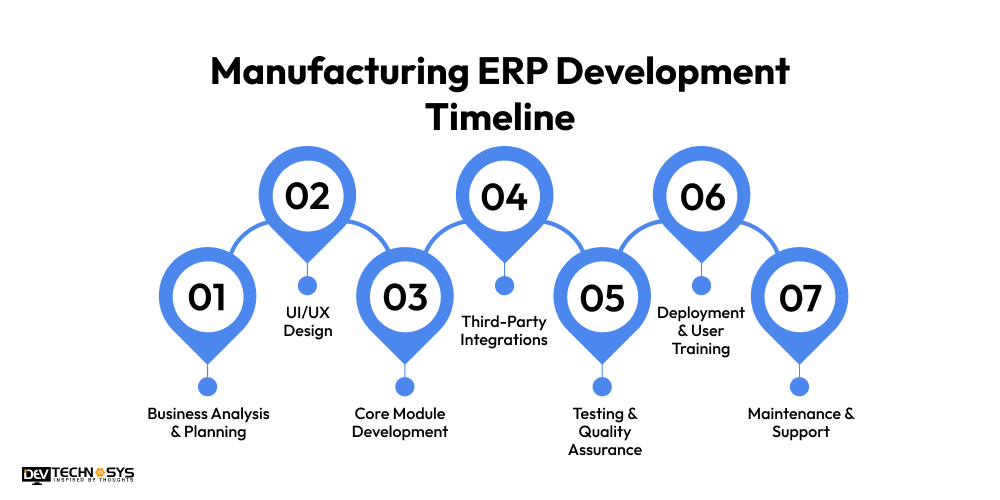
Development Phase |
Key Activities |
Estimated Timeline |
Estimated Cost (USD) |
| Business Analysis & Planning | Requirement gathering, workflow analysis, business process automation, feasibility study, and ERP roadmap creation | 1–2 Weeks | $3,000 – $7,000 |
| UI/UX Design | User journey mapping, dashboard design, wireframes, and manufacturing workflows | 1–3 Weeks | $3,000 – $8,000 |
| Core Module Development | Development of production planning, inventory, procurement, finance, and reporting modules | 4–12 Weeks | $15,000 – $50,000 |
| Third-Party Integrations | Integration with CRM, MES, SCM, IoT devices, APIs, and accounting systems | 2–6 Weeks | $5,000 – $20,000 |
| Testing & Quality Assurance | Functional testing, performance testing, security validation, and compliance checks | 1–4 Weeks | $4,000 – $12,000 |
| Deployment & User Training | Data migration, system deployment, employee training, and documentation | 1–2 Weeks | $3,000 – $8,000 |
| Maintenance & Support | Bug fixes, upgrades, monitoring, optimization, and technical support | Ongoing | 15–20% of annual ERP cost |
Expert Insight:
Research from Statista reports that cloud-based ERP solutions offer scalability and flexibility for businesses. These solutions are perfect for mid-level to large businesses that are seeking cost-effective strategies for overall business improvement.
ERP Implementation Risk, Failure Costs & Budget Overrun Analysis in Manufacturing Systems
Businesses must know that the biggest risk is when industrial ERP solutions are implemented. Delayed deployments, inaccurate requirements, poor change management, and complex legacy integrations can significantly increase project expenses. Understanding these risks enables manufacturers to create a realistic budget and avoid deployment delays.
Common ERP Implementation Risks That Increase Costs
Risk Area |
Impact on Budget |
How to Mitigate |
| Poor requirement gathering | Frequent scope changes increase development hours | Conduct detailed business process analysis before development |
| Excessive customization | Higher development and testing costs | Customize only business-critical workflows |
| Legacy system integration | Additional API development and migration expenses | Audit existing systems before implementation |
| Data migration errors | Production downtime and costly rework | Perform multiple migration testing cycles |
| Inadequate testing | Post-launch defects requiring emergency fixes | Execute functional, security, and UAT testing before deployment |
ERP Budget Overrun Analysis
Large organizations should also be aware of the budget overrun to estimate additional expenses. This supports the effective decision-making process for overall business growth.
Scenario |
Estimated Additional Cost |
| Scope expansion after development starts | 10% |
| Legacy system integration changes | 15% |
| Poor data migration planning | 10% |
| Regulatory compliance updates | 5% |
| Delayed stakeholder approvals | 10% |
| Infrastructure upgrades | 20% |
Best Practices to Prevent ERP Budget Overruns & Ensure Successful Implementation
Keeping a manufacturing ERP project within budget requires more than accurate cost estimation. It demands strategic planning, technical expertise, and the guidance of an experienced ERP development partner.
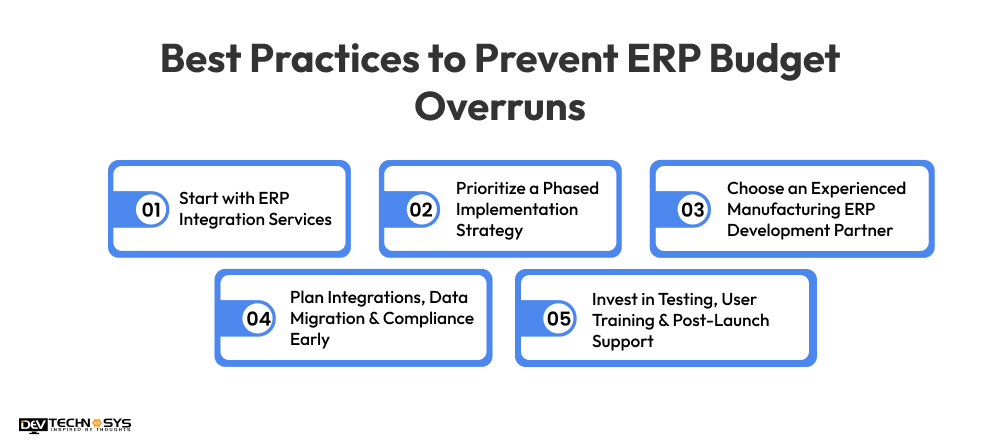
By following these best practices, manufacturers can reduce implementation risks, avoid unexpected expenses, and maximize long-term ROI.
Best Practice |
How It Helps Reduce Costs & Risks |
| 1. Start with ERP Integration Services | Evaluate existing business processes, define project scope, identify technical requirements, and establish realistic budgets before development begins |
| 2. Prioritize a Phased Implementation Strategy | Deploy core ERP modules first (MVP), followed by advanced features and integrations, to minimize upfront costs, reduce implementation risks, and simplify user adoption |
| 3. Choose an Experienced Manufacturing ERP Development Partner | An industry-focused ERP partner can design scalable architecture, estimate realistic budgets, identify hidden cost drivers, and build manufacturing-specific workflows that reduce long-term ownership costs |
| 4. Plan Integrations, Data Migration & Compliance Early | Preparing API integrations, legacy data migration, cybersecurity measures, and regulatory compliance during the planning phase prevents costly rework and deployment delays |
| 5. Invest in Testing, User Training & Post-Launch Support | Comprehensive testing, employee training, continuous monitoring, and ongoing maintenance improve system adoption, reduce operational disruptions, and lower future support costs |
Our Recommendation:
Before starting ERP development, conduct a comprehensive business process assessment, define measurable project goals, prioritize core modules for the initial release, and establish a phased implementation roadmap. Partnering with an experienced ERP development team can help identify hidden cost drivers early, ensure scalable system architecture, and minimize budget overruns throughout the project lifecycle.
Manufacturing Automation Software Total Cost of Ownership (TCO): 5-Year Investment & Lifecycle Cost Projection
An ERP total cost of ownership is the cumulative cost of owning and operating an ERP system. Businesses should analyze the total cost of ownership (TCO), which discusses the price associated with development, deployment, operations, and maintenance of that ERP system.
Factors That Increase ERP TCO
Several variables influence long-term ERP ownership costs.
1. Customization Level
Highly customized ERP systems require:
- More development
- Extensive testing
- Longer implementation
- Increased upgrade complexity
Using configurable modules where possible reduces maintenance costs.
2. Integration Complexity
Every external integration increases:
- API maintenance
- Security monitoring
- Version compatibility
- Support requirements
Standardized APIs help lower long-term ownership costs.
3. Deployment Strategy
Cloud ERP generally reduces:
- Hardware investment
- IT staffing
- Backup infrastructure
- Disaster recovery expenses
On-premise ERP offers greater control but requires ongoing infrastructure investments.
4. Business Growth
As manufacturers expand, ERP systems often require:
- Additional users
- Multi-location support
- International compliance
- New production facilities
- Additional integrations
Designing for scalability from the outset minimizes future redevelopment costs.
Example 5-Year ERP Investment Projection
According to our deep research and study, we have curated the investment plan for the businesses. This bifurcation of manufacturing ERP software development cost will support the 5-year investment plan.
Expense Category |
Estimated Cost |
| ERP development | $70,000 |
| Implementation | $18,000 |
| Data migration | $8,000 |
| Integrations | $15,000 |
| Cloud infrastructure | $12,000 |
| Employee training | $7,000 |
| Security & compliance | $8,000 |
| Maintenance (5 years) | $55,000 |
| Feature enhancements | $20,000 |
Estimated 5-Year TCO |
$213,000 |
Real-World Use Cases of Manufacturing ERP Software Development
Real-world business scenarios help to understand the benefits of production planning software in the era of digital transformation.
1. Smart Factory Automation
Manufacturers consistently experience challenges in monitoring machine performance. The development of a custom ERP integrated with IoT sensors, MES, and predictive maintenance helps businesses overcome the issue.
2. Supply Chain & Inventory Optimization
Stock shortages and excess inventory are a serious concern for businesses. The development of a manufacturing execution system (MES) and an inventory management ERP helps businesses analyze data in real time with advanced dashboards.
3. Multi-Plant Manufacturing Management
Large organizations that require centralized visibility implement ERP modules for Warehouse Management, inventory, supply chain, and other operations.
Manufacturing ERP Cost Stack Breakdown: Hidden Cost Drivers Most Enterprises Overlook
Budgeting is the most important part of manufacturing ERP software development, but businesses should also be aware of the hidden costs. Businesses should evaluate expenses related to infrastructure upgrades, data migration, and more to avoid budget overruns.
- Compliance & Audit Requirements
Regulatory documentation and validation activities add additional costs, accounting for around 12% of the total expenses.
- Maintenance & System Upgrades
Production scheduling software updates affect 15% of annual ERP cost. This includes feature improvements, bug fixes, and overall ERP maintenance.
- Legacy Data Migration
Transferring historical production, inventory, customer, and financial data from existing systems to the new ERP platform.
How to Reduce Manufacturing ERP Software Development Cost?
The common reason that businesses spend is unclear requirements. Organizations should be aware of unnecessary investments and the ways to reduce the overall expenditure. By focusing on a balanced approach, business-driven solutions, and emerging technologies, businesses can reduce overall costs.
1. Use a Modular Development Approach
Businesses should implement advanced modules such as predictive maintenance, IoT monitoring, and AI forecasting as they are comparatively cost-effective. A phased approach will help businesses to reduce initial investment and validate workflows, minimizing implementation risks.
2. Adopt Cloud-Native Infrastructure
Businesses can skip investing in servers, hardware, or other IT setup by simply implementing cloud environments. These offer flexible resource allocation, faster deployment, lower infrastructure costs, automatic updates, and improved scalability.
3. Leverage Open-Source Frameworks
Businesses involved in procurement management should choose open-source technologies such as React, Node.js, and PostgreSQL for easier customization and faster development cycles and to lower licensing expenses.
4. Prioritize MVP Features First
A Minimum Viable Product (MVP) strategy is made with minimum features and functionalities. This can be shared with the client to save overall development cost. This step helps organizations to avoid potential risks.
5. Optimize Integration Scope
Businesses should integrate existing systems with IoT devices, CRM software, MES systems, supply chain applications, and accounting software to simplify business operations. This will reduce API development costs, maintenance costs, and prevent security risks.
Industry Insight:
At Dev Technosys, we have learned and understood that most enterprises are adopting ERP solutions, but they should also be aware of the Cost to Build Manufacturing ERP Software to ensure long-term financial success.

How to Choose the Right Manufacturing ERP Software According to Your Business?
The right ERP system impacts production quality, inventory management, supply chain, and related operations in the manufacturing industry. Businesses should evaluate multiple critical factors to ensure long-term business growth.
1. Scalability for Future Production Growth
Businesses must prioritize building scalable ERP systems to avoid costly software implementations when they need to scale their existing systems. Cloud-based modular ERP systems are the best for future growth.
2. AI and Automation Readiness
An ERP system should have AI-powered capabilities to optimize production efficiencies. Businesses should build systems that support future Industry 4.0 initiatives. The intelligent reporting capabilities allow businesses to optimize production schedules.
3. Integration Capabilities
Large organizations should build ERP systems with strong API integration capabilities. This allows businesses to work on a single system rather than developing multiple ERP systems.
4. Compliance Support
ERP system should support compliance frameworks such as ISO 9001, ISO 13485, FDA 21 CFR Part 11, GDPR, and industry-specific regulations to avoid legal and operational disruptions.
5. Customization Flexibility
Enterprises should hire dedicated developers who can customize ERP systems rather than developing them. This flexibility allows businesses to adapt to changing needs.
6. Vendor Expertise in Manufacturing
Organizations should partner with the right ERP software development company or hire an experienced developer. Development practices such as CMMI Level 3 processes should be followed by the companies.
Conclusion
Organizations should understand the cost of manufacturing ERP software development to make a strategic decision about streamlining operations. The system capabilities should be selected based on the business type, required security, and scalability.
Businesses should also consider hidden cost drivers, such as quality assurance, third-party integrations, and more, before planning their budget. Lastly, businesses have to ensure that manufacturing automation software is built with regulatory compliance in mind.
Trusted by Global Businesses for Manufacturing ERP Software Development
Real feedback from real clients who trust us to deliver results.
The project was based on a cross-platform mobile app and manufacturing ERP development. The team coordinated from the project initiation to its maintenance.
Frequently Asked Questions
Find answers to the most common questions related to this article.
The average manufacturing ERP development cost ranges from $30,000 to $150,000+ depending on the number of modules, customization requirements, integrations, and compliance standards. Enterprise-grade ERP systems with AI, IoT, and Industry 4.0 capabilities generally fall at the higher end of the pricing range.
Manufacturing ERP development typically takes between 4 weeks and 7+ months. Basic ERP solutions can be developed within 1–2 months, while advanced enterprise ERP systems with custom modules, integrations, and compliance requirements may require more than 7 months.
- Modern manufacturing ERP systems commonly use technologies such as:
- React or Angular for frontend development
- Node.js, Java, or .NET for backend development
- PostgreSQL or MongoDB databases
- AWS, Azure, or Google Cloud platforms
- REST APIs and microservices architecture
- IoT frameworks and AI analytics tools
Industry 4.0 technologies such as IoT sensors, machine connectivity, predictive maintenance, real-time monitoring, and AI-driven analytics can increase ERP development costs by 20%. However, these technologies improve operational efficiency and provide long-term business value. These have a significant impact on businesses in improving ROI.
- Several regulations influence ERP development, including:
- ISO 9001
- ISO 13485
- FDA 21 CFR Part 11
- ITAR compliance
- GDPR
Custom manufacturing ERP software generally costs between $30,000 and $150,000+ depending on business requirements, integration capabilities, and long-term investment. Businesses should partner with an experienced software development company to build scalable manufacturing ERP
- The major cost factors include:
- System complexity
- Number of modules
- Third-party integrations
- Compliance requirements
- AI and IoT features
- Cloud infrastructure
- Custom workflows and reporting
- Businesses should evaluate ERP solutions based on:
- Scalability for future growth
- Industry-specific compliance support
- Integration capabilities
- Customization flexibility
- AI and automation readiness
- Vendor experience in manufacturing ERP development