


Key takeaways:
-
- Language learning apps lose users after Day 3 because of a lack of motivation after initial curiosity, repetitive learning experiences, generic lessons, and a lack of visible progress.
- Top personalization programs include AI-based search, market segmentation, behavioral targeting, personalized content, and cross-channel personalization.
- A high-retention language learning app doesn’t rely on a single feature. It creates a repeatable behavioral loop that connects user motivation, learning activity, feedback, and measurable progress.
- Microlearning reduces the cognitive and time burden of language practice by breaking larger learning goals into small, focused interactions.
When most people download a language learning app, they do so with the best of intentions. They finish a handful of lessons, maintain a streak, and envision themselves fluently speaking the language in no time. After about three days, however, the energy that comes with downloading an app quickly dissipates. The lessons might feel the same every time, or they haven’t seen any concrete results, and the app does not fit into their day-to-day lives. In the eyes of the app designers, this early loss of users is not simply a number; it speaks volumes about the necessity for improvements that would ensure constant and pleasant learning.
The question then arises: what attracts certain users to use the app on a regular basis while others uninstall the app after only a few uses? In this guide, we will discuss the psychology behind language learning app retention, their features, personalization options, and overall language app user engagement strategies.
Why Language Learning Apps Lose Users After Day 3
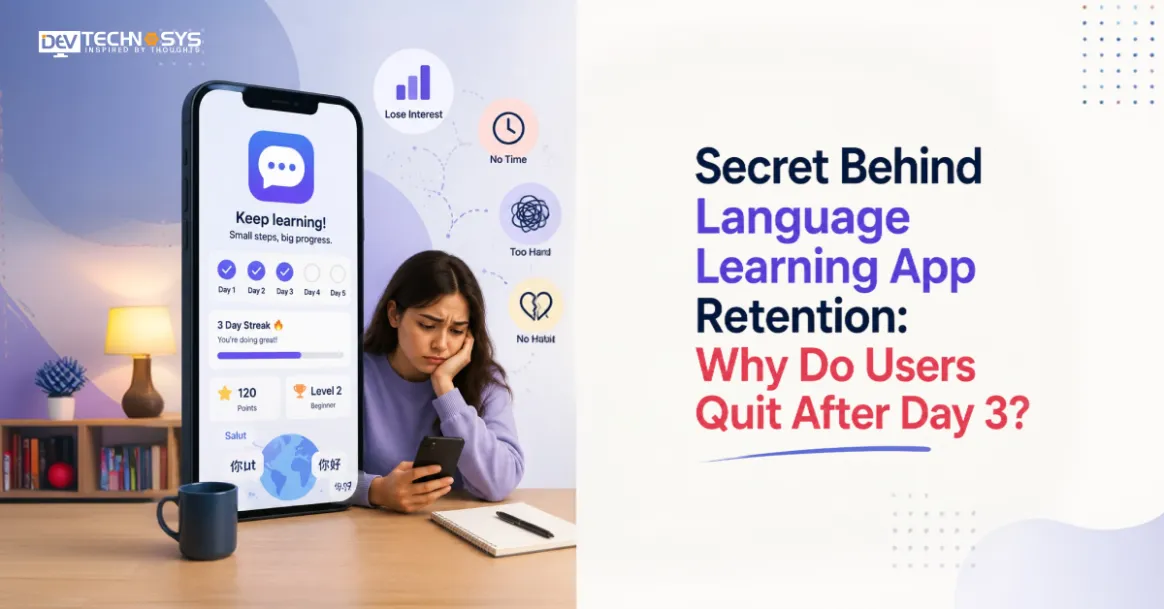
Getting a language learning application downloaded to one’s phone is an easy task, but it is the hardest to keep it as a part of a person’s daily routine. But why do users quit apps after 3 days? Once the motivation diminishes, users will quickly evaluate whether the app actually helps them learn and whether it is just another activity on their to-do list. Various issues with the product or with the experience of using it can be the cause of the early drop-off mentioned above:

- Motivation fades after initial curiosity: User retention in language learning apps decreases with lack of motivation. A new user starts with a spark of enthusiasm, but once the process of learning is perceived as slow, the excitement ends as well.
- Repetitive learning experiences: When a learner encounters the same types of vocabulary exercises, quizzes, or lessons, the learning process becomes unchallenging, and, as a result, motivation to continue learning diminishes.
- Generic Learning: A problem of a lack of individual approach is evident when every student is given the same material irrespective of their abilities, interests, or intentions.
- No Visible Progress: Why users quit apps after day 3? Well, people need clear proof that their effort does pay off. Otherwise, there will be no motivation to continue learning.
- Absence of Visible Advancement: Users require concrete proof that their effort is rewarded. Lack of milestones, progress in skills, or personalized feedback can make daily exercises seem meaningless.
- Learning Becomes a Task: Long lessons, difficult exercises, and complicated steps can transform language practice into yet another task competing for the user’s limited attention.
- Poor onboarding and UX: Conflicting first impressions, lengthy registration, unclear purposes, and constant delays to the first lesson can lead to dropping the app before the learning habit is formed.
Industry Insights:
“According to Grand View Research, the global online language learning market is projected to reach $54.8 billion by 2030, growing at a 16.6% CAGR from 2025–2030”
The “False Progress” Trap: When Users Feel Productive but Aren’t Learning
Why do people stop using language learning apps? A language app can have impressive engagement metrics while delivering mediocre learning outcomes. A user completing 20 lessons doesn’t necessarily mean they retained the vocabulary. This is where learning analytics and knowledge measurement become critical. Developers need to distinguish between activity metrics and learning-outcome metrics when designing the product.

Lesson Completion ≠ Knowledge Retention
Measuring an indicator that measures how many lessons are finished is good, but it says nothing about the person has reached the end of the lesson or completion only. A better analytic pattern should link lesson completion and knowledge gain together as well as measure how well it is remembered, how accurate the answers are, and so on.
To illustrate the point, one can list the steps of an analytic flow as follows:
Lesson Completed → Vocabulary Introduced → Recall Attempt → Accuracy → Need to Repeat → Retention
This is helpful for product teams in determining whether or not users are actually learning something or if they are merely going through screens.
A linguistic application might provide high user involvement figures while receiving low results in educating users. For instance, the fact that a user has completed the first twenty hours of lessons does not prove they know any of the words taught during these sessions. This is the reason why knowledge measurement and performance analysis have to be separated during tutor app development.
Recognition vs. Active Recall
Multiple-choice activities might provide a high degree of accuracy because the user recognizes the right answer instead of producing it. Therefore, linguistic apps need to combine recognition-type questions with active recall exercises, such as translating a phrase, finishing a sentence, saying a word, or making a reply without clues.
At this point, kids learning app development teams come to the importance of mobile app onboarding best practices and spaced repetition. Research demonstrates how efficient retrieval practice is in strengthening long-term memory.
XP and Streaks vs. Real Proficiency
Gamification in language learning apps creates highly visible metrics—XP, streak length, badges, levels- but these are engagement indicators, not proficiency indicators.
A better product architecture separates:
- Engagement KPIs: DAU → Session Frequency → Streak → Lesson Completion
from:
- Learning KPIs: Recall Accuracy → Vocabulary Retention → Error Reduction → Speaking Accuracy → Skill Mastery
This distinction prevents teams from optimizing the app for more taps and longer streaks instead of better learning outcomes, which overall impacts the language learning app retention.
Use Knowledge Tracing to Model What Users Actually Know
For more advanced language-learning platforms, knowledge tracing models are used by developers in order to evaluate learners’ progress in their mastery of individual subjects over time.
A system may keep a learner record like:
- Vocabulary A → 85% mastery
- Grammar B → 62% mastery
- Listening C → 41% mastery
The next lesson could place a priority on subjects that are predicted by the model to present a higher chance of making mistakes or forgetting.
Design Assessments Around Learning Outcomes
The assessment engine has to make findings beyond whether an answer is correct or not. It is one of the most effective app retention strategies for education apps.
Useful indicators include:
- Recall accuracy
- Response time
- Number of hints used
- Attempts per question
- Error type
- Vocabulary retention after 24 hours/7 days
- Speaking/pronunciation accuracy
- Grammar error frequency
- Difficulty level
- Repeated mistakes
These indicators can help AI-powered adaptive learning engines decide whether the learner should continue studying, return to the topic, or get extra practice.
The Language Learning Retention Loop
An effective language learning App like Busuu is not just dependent on one thing. It creates a cycle of events where learner motivation, studies, outcomes, and progress are connected. This cycle leads a person from one action to another.

Trigger → Study → Apply → Reward → Progress → Come back
Trigger: A push notification re-engagement, reminder to reach goals, notification about the streak, or some educational prompt makes the learner come back at the right time. By analyzing behavioral patterns in previous studies, a company can identify the best timing for each person.
↓
Learn: The person gets the lesson tailored to their CEFR level, study goals, previous results, and weaknesses rather than a generic lesson.
↓
Apply: The newly learned material is consolidated through active recall, spaced repetition, tests, pronunciation exercises, or AI chats.
↓
Reward: According to a top education app development company, positive feedback, XP points, badges, streaks, or certificates make people stick to the behavior they have shown after receiving their rewards.
↓
Progress: The dashboards present relevant indicators like mastery of vocabulary, improvement of accuracy, accomplished skills, advancement with CEFR, and speech results.
↓
Return: Visible progress makes it possible to move on to the next step. Thus, the application uses the learner’s performance as a basis for the next personalized stimulus and repeats the cycle again.
It is important to ensure that the next session feels like the continuation of the previous one instead of making learners restart their learning journey every time they access the app.
Microlearning: Give Users Less to Finish More
Microlearning reduces the cognitive and time burden of language practice by breaking larger learning goals into small, focused interactions. Instead of asking users to commit 30–60 minutes, the app can deliver short activities that fit naturally into daily routines.

- 5- to 10-minute lessons: Keep each session focused on one learning objective, such as vocabulary, grammar, listening, or speaking.
- Bite-sized vocabulary exercises: One of the best retention strategies for edtech apps 2026 is introducing a small set of words and reinforcing them using spaced repetition rather than overwhelming users with long word lists.
- Quick pronunciation challenges: Let learners practice individual words or phrases using speech recognition and receive immediate pronunciation feedback.
- Daily conversation practice: Short AI-powered role-play sessions can give users practical speaking experience without requiring a lengthy lesson.
- One-tap revision: Surface previously learned words based on recall accuracy, error history, and forgetting patterns, allowing users to revise without navigating through multiple screens.
Key insight:
Microlearning isn’t simply about making lessons shorter. It’s about reducing the activation energy required to start learning while keeping each interaction meaningful enough to move the learner forward.
Personalization Is the Real Retention Engine
A one-size-fits-all learning path can quickly become irrelevant. A high-retention language app should use learner data, behavioral analytics, and adaptive algorithms to continuously adjust content based on what each user knows, struggles with, and wants to achieve.

- AI-powered Learning Paths: AI and Generative AI in education app development involve the use of onboarding data, proficiency level, goals, and in-app behavior to dynamically recommend the next lesson instead of following a fixed curriculum.
- Adaptive Difficulty: Adjust question complexity based on accuracy, response time, error frequency, and recent performance. Too easy becomes boring; too difficult creates frustration.
- Personalized Vocabulary: Recommend words based on the learner’s goals, such as travel, business, academics, or everyday conversation, while prioritizing words they frequently get wrong.
- Weak-Area Detection: Use performance analytics to identify recurring problems in grammar, vocabulary, listening, or pronunciation, then automatically assign targeted practice.
- Learning-Speed Adjustment: Monitor session frequency, completion patterns, and response behavior to adjust lesson length and content density to the learner’s pace.
- Personalized Revision Schedules: Combine spaced repetition with individual performance data so difficult words return more frequently while mastered concepts appear less often.
Developer takeaway
“Personalization shouldn’t be a separate feature. It should function as a continuous feedback loop: User Data → Skill Assessment → Content Recommendation → Performance → Model Update → Next Lesson.”
Make Progress Impossible to Ignore
Language improvement can feel invisible, especially during the early stages. A well-designed app should turn learning activity into clear, measurable progress, giving users a reason to keep coming back.

- Fluency Score: Combine vocabulary, grammar, listening, and speaking performance into an easy-to-understand indicator.
- Vocabulary Mastered: Track words as introduced, learning, retained, or mastered instead of simply counting words viewed.
- CEFR-level Progress: Show movement across A1–C2 levels and highlight skills needed to reach the next stage.
- Weekly Learning Reports: Summarize practice time, lessons completed, recall accuracy, and areas of improvement.
- Skills Dashboard: Track progress across speaking, listening, reading, writing, vocabulary, and grammar.
- Milestones: Celebrate meaningful achievements such as completing skills or successfully finishing conversation tasks.
- Personalized Insights: Turn analytics into actionable feedback, such as identifying weak skills or recommending what to practice next.
Beyond Streaks: How to Gamify Without Hurting Learning
Gamification can bring users back, but simply adding XP, badges, and streaks doesn’t guarantee better learning. The goal is to use game mechanics as reinforcement, while keeping actual skill development at the center of the experience.
- XP and Levels: Reward meaningful learning actions, such as completing recall exercises or speaking practice, not just opening the app.
- Streaks: Encourage consistency, but offer streak recovery or flexible streaks so missing one day doesn’t discourage users from returning.
- Challenges and Quests: Create short-term goals around vocabulary, listening, speaking, or completing a weekly skill.
- Leaderboards: Optional or segmented leaderboards to avoid discouraging beginners who are competing against highly active learners.
- Rewards: It is one of the important features to develop educational app. Tie rewards to useful learning behavior, such as completing revision sessions or maintaining accuracy.
- Avoiding Gamification Fatigue: Rotate challenges, personalize goals, and avoid excessive notifications or repetitive rewards.
- Engagement vs. Learning Outcomes: Track XP and streaks as engagement metrics, but measure recall accuracy, skill mastery, retention, and proficiency to determine whether gamification is actually improving learning.
Industry Insights:
“McKinsey’s language learning app churn rate statistics 2026 state that 76% of consumers said personalized communications influenced their consideration of a brand, while 78% said personalization made them more likely to repurchase.”
AI Features That Can Reduce Language-App Churn
AI can make language learning more personal, interactive, and responsive, but its value comes from solving specific learner problems, not simply adding an “AI tutor” label.

- AI Conversation Partners: Enable realistic conversations that adapt to the learner’s proficiency, vocabulary, interests, and speaking goals, making regular practice more engaging and personalized.
- Real-time Pronunciation Feedback: Use speech recognition to analyze pronunciation, identify problematic sounds, and provide instant corrective feedback so learners can improve speaking accuracy.
- AI Writing Correction: Analyze grammar, sentence structure, vocabulary, and contextual errors, while explaining corrections to help users understand and avoid repeating mistakes.
- Personalized Lesson Generation: Generate lessons based on CEFR level, learning goals, previous mistakes, interests, and performance data, keeping content relevant to individual learners.
- AI Vocabulary Recommendations: The mobile app development company includes this feature to analyze recall accuracy, error patterns, and learning history to recommend words that require additional practice or reinforcement.
- Role-play Conversations: Simulate real-world situations such as interviews, travel, meetings, and customer interactions, helping users practice practical communication in low-pressure environments.
- Adaptive Quizzes: Dynamically adjust question difficulty based on accuracy, response time, previous mistakes, and mastery levels to maintain an appropriate learning challenge.
- AI Tutors: Provide contextual explanations, hints, examples, and follow-up questions, giving learners personalized support without requiring constant access to a human instructor.
What Happens When AI Gets the Answer Wrong? Building Trust Into AI Language Learning Apps
AI can personalize learning, but incorrect feedback can quickly damage trust. Reliable language apps need validation, monitoring, human oversight, and confidence-aware AI systems.

- Incorrect Translations: Combine contextual AI models with curated language datasets, translation rules, and automated validation to reduce literal, ambiguous, or contextually incorrect translations.
- Hallucinated Explanations: Ground AI responses in verified grammar resources, structured knowledge bases, and approved learning content to minimize unsupported or factually incorrect explanations.
- Pronunciation Errors: Combine speech recognition, phoneme-level analysis, pronunciation scoring, and validated reference audio to provide more accurate feedback across different words and speaking patterns.
- Cultural/Contextual Mistakes: Evaluate AI-generated examples for regional expressions, slang, idioms, formality, and cultural context before presenting them as reliable learning material.
- Accent Bias: Test speech-recognition models across diverse accents, dialects, and speaking patterns to identify recognition gaps and improve pronunciation assessment fairness.
- Low-Resource Languages: Use language-specific datasets, specialist evaluation, and additional human validation when training data is limited and model performance may be less reliable.
- AI-Generated Lesson Quality: Validate generated exercises for grammar, vocabulary accuracy, difficulty level, duplication, and alignment with the learner’s proficiency before publishing them.
- Human Review: Language experts can review high-impact content, recurring model errors, unusual cases, and AI-generated material that automated validation systems cannot confidently assess.
- Confidence Scoring: Combine model confidence with validation signals to determine whether the system should answer directly, qualify its response, or request additional context.
- Feedback Loops: Allow users to report incorrect answers and feed verified corrections into evaluation pipelines to improve prompts, datasets, models, and future responses.
- When AI Should Say “I’m not sure”: If confidence is low or sources conflict, the app should acknowledge uncertainty rather than provide a confident but potentially incorrect explanation.
Industry Insight:
“According to Market Reports World, when it comes to average retention rate for language learning apps, the 30-day retention rate for general education apps is very low at around 2% to 3%. However, top-tier language learning apps perform better, averaging roughly 25% user retention by Day 30”
You can reach out anytime; we are available 24/7. Our team provides a quick response.

Want a chatbot demo or pricing? Fill the form and talk to our experts today.
Pick what you need below — you can select more than one — then tap Get detail to continue.
-
Chatbot demo dashboard
-
Cost to develop an app
-
Industry report
-
Case study
Designing for the “Comeback User,” Not Just the Daily User
Not every learner maintains a perfect streak. Instead of treating inactivity as failure, retention-focused apps can create personalized re-engagement flows that make returning feel easy, useful, and rewarding.

- After a 3-Day Absence: Trigger personalized reminders using previous activity, preferred learning times, unfinished lessons, and engagement patterns to reconnect users without overwhelming them immediately.
- Avoiding Guilt-Based Messaging: Replace messages highlighting broken streaks with supportive prompts that acknowledge the user’s absence and encourage them to resume learning without unnecessary pressure.
- Restarting Without Losing Progress: Preserve completed lessons, vocabulary mastery, skill levels, and achievements so returning learners can continue from where they stopped instead of starting over.
- Personalized Catch-up Lessons: Use AI and performance data to generate short revision sessions covering missed concepts, forgotten vocabulary, and weak areas without forcing users through every skipped lesson.
- “Welcome back” Experiences: Show returning users their previous achievements, learning history, and current skill status, then recommend one simple activity that helps rebuild momentum immediately.
- Rebuilding a Broken Streak: Offer streak recovery, flexible streaks, or comeback milestones that reward users for returning instead of making uninterrupted daily activity the only measure of success.
- Adaptive Re-Entry Difficulty: Adjust lesson length, content complexity, and revision frequency according to absence duration, previous performance, recall accuracy, and the learner’s current confidence level.
Build Social Motivation Into the Experience
Make language learning feel less like a solo task and more like a shared journey. Social features can create accountability, friendly competition, and stronger reasons for users to return regularly.
- Friend Challenges: Let users challenge friends to complete lessons, earn XP, maintain streaks, or reach weekly learning goals. Friendly competition can make daily practice more engaging.
- Community Discussions: Create language-specific communities where learners can ask questions, share learning tips, discuss difficult concepts, and interact with others at similar skill levels.
- Speaking Clubs: Enable users to join virtual speaking groups based on language, proficiency, interests, or learning goals. This gives learners opportunities to practice real conversations.
- Peer Challenges: Allow learners to participate in vocabulary, pronunciation, grammar, or lesson-based challenges with peers. Shared objectives can make otherwise repetitive exercises more motivating.
- Group Learning: Let users form small learning groups with shared goals, activities, gamified progress tracking, and group leaderboards. This can turn individual learning into a collaborative experience.
- Progress Sharing: Allow users to share milestones such as completed courses, new vocabulary levels, achievements, or learning streaks with friends or communities.
- Social Accountability: Pair learners with study partners or groups and provide reminders when goals are missed. Knowing that others are progressing alongside them can encourage users to stay consistent.
How to Measure Language Learning App Retention?
Language learning app retention metrics help you understand whether learners are building a consistent habit or abandoning the app after the initial excitement. Track both user-level retention and engagement to identify where learners lose interest.
- D1, D3, D7 & D30 Retention: Measure how many users return after 1, 3, 7, and 30 days.
- DAU/MAU: Shows how frequently users engage with the app.
- Lesson Completion Rate: Reveals whether users finish assigned lessons.
- Session Frequency: Tracks how often learners return to practice.
- Churn Rate: Measures users who stop using the app.
- Cohort Analysis: Compares retention across different user groups.
- Feature-Level Engagement: Identifies features that drive repeat usage.
- User Drop-Off Points: Shows where learners abandon onboarding or lessons.
The Retention-Focused Feature Stack for a Language Learning App
A retention-focused stack should connect learning, personalization, engagement, and analytics so the educational apps for preschoolers and toddlers continuously adapt to user behavior and encourage consistent practice.
Layer | Key Technologies / Features |
| Learning | habit loops, streaks, micro-learning, quizzes, spaced repetition, vocabulary drills |
| Personalization | AI/ML, adaptive learning paths, skill-based recommendations |
| Engagement | Gamification, streaks, rewards, challenges, smart notifications |
| Communication | Speech recognition, text-to-speech, pronunciation analysis |
| Social | Friend challenges, leaderboards, speaking clubs, group goals |
| Analytics | Event tracking, retention cohorts, funnel analysis, A/B testing |
| AI Layer | AI tutors, conversational practice, feedback generation |
| Backend | Node.js, Python, REST APIs, real-time services |
| Infrastructure | AWS/GCP/Azure, scalable databases, CDN, monitoring |
| Security | Encryption, secure authentication, privacy controls, access management |
Retention vs. Monetization: Don’t Sacrifice Engagement for Revenue
A strong monetization strategy should generate revenue without interrupting the learning habit. Paywalls, ads, and premium features should be introduced at moments that preserve user value and encourage continued learning.

- Freemium Models: Many businesses can’t decide between freemium vs subscription models. Freemium offers enough useful content for free to build trust and demonstrate the app’s value before asking users to upgrade.
- Premium Subscriptions: Provide advanced lessons, personalized learning paths, offline access, or deeper progress insights through recurring plans.
- AI Tutor Credits: Let users access AI conversation practice through usage-based credits while keeping core learning features available.
- Ad-Supported Learning: Use relevant, non-intrusive ads for free users without disrupting lessons, quizzes, or speaking exercises.
- Family Plans: Allow multiple learners to share one subscription, increasing perceived value while supporting long-term household engagement.
- Lifetime Plans: Offer one-time purchase options for users who prefer avoiding recurring subscriptions, particularly during promotional campaigns.
- Strategic Paywalls: Place paywalls after users experience meaningful value, such as completing initial lessons or reaching a learning milestone, rather than blocking engagement too early.

Model | Retention-Friendly Approach |
| Freemium | Provide valuable core lessons for free. |
| Premium Subscriptions | Unlock advanced learning and AI features. |
| AI Tutor Credits | Charge based on AI practice usage. |
| Ad-Supported | Keep ads limited and non-disruptive. |
| Family Plans | Offer shared access for multiple learners. |
| Lifetime Plans | Provide a one-time payment option. |
| Strategic Paywalls | Introduce upgrades after users see value. |
Conclusion
Day-3 churn is rarely caused by one missing feature. Users leave when the learning experience feels difficult, repetitive, impersonal, or unrewarding. A retention-focused language learning app should combine frictionless onboarding, short learning sessions, personalization, social motivation, gamification, and timely feedback. Most importantly, use retention analytics to identify where learners struggle and continuously optimize the experience around real user behavior.
If you want to know more, contact our school management software development team. With 15+ years of expertise in language-learning app development, we help businesses build engaging, personalized, and retention-focused language-learning platforms designed around real learner behavior.
Frequently Asked Questions
Find answers to the most common questions related to this article.
Users often leave when motivation drops, lessons feel repetitive, progress is unclear, or the learning experience becomes too difficult. Personalized content, achievable goals, and early rewards can help maintain engagement.
Focus on simple onboarding, microlearning, personalized lessons, progress tracking, streaks, social challenges, useful notifications, and continuous optimization based on retention and engagement data.
High-impact features include adaptive learning, spaced repetition, gamification, streaks, AI tutors, speaking practice, progress tracking, personalized recommendations, social challenges, and achievement systems.
Day 3 is often an important early retention checkpoint because users are moving beyond initial curiosity. If they do not perceive value, progress, or a reason to return, retention can decline rapidly.
Analyze Day 1–3 user behavior to identify friction points, then improve onboarding, shorten sessions, personalize content, reinforce progress, and use timely re-engagement messages without overwhelming users.
Day 3 helps reveal whether initial interest is turning into repeat usage. Retention analysis commonly tracks Day 1, Day 3, Day 7, and Day 30 to identify where users begin dropping off.
Create short, achievable lessons, personalized learning paths, visible progress, rewards, challenges, feedback, and relevant reminders. The goal is to create a repeatable learning loop that gives users a clear reason to return.
Common reasons include difficult onboarding, repetitive lessons, unclear progress, lack of personalization, unrealistic learning goals, insufficient motivation, and poor alignment between the user's expectations and actual learning experience.
Focus on delivering value during the first session, reducing unnecessary onboarding steps, recommending relevant content, showing meaningful progress, and triggering personalized re-engagement based on user behavior rather than generic reminders.
High churn can result from onboarding friction, lengthy or difficult learning sessions, weak progress visibility, notification fatigue, poor personalization, and a lack of meaningful learning outcomes. Tracking behavioral cohorts helps identify the specific causes.


