

















Key Takeaways:
-
- A consideration in the architecture and development of a CRM that determines how to handle custom crm gdpr compliance rather than after deployment.
- Centralized consent management for customer preferences and applicable processing consents.
- Automated access, correction, deletion, and opt-out workflows streamline privacy requests.
- Encryption, RBAC, audit logging, and secure API integrations improve customer data protection.
- Consistent testing for compliance and reviews of third-party vendors permit the ongoing maintenance of privacy controls as CRM systems change.
CRM systems are known to store large amounts of private data, which includes names, emails, cellphone numbers, purchase histories, communication exchanges, and customer preferences. Collection of this information helps businesses personalize customer experience and optimize their sales efforts, but it also creates serious data protection obligations.
Regulations like GDPR, CCPA, and the California Privacy Rights Act (as modified by CPRA) define the requirements for how companies must handle private data.
In this blog, we highlight GDPR and CCPA compliance in crm development and the impact they have on CRM outlines and the delivery of privacy measures in the course of building a CRM system.
Understanding GDPR vs. CCPA: Key Differences
GDPR and CCPA both have one goal, i.e., protecting the privacy of personal data, but they do this in different regulatory ways. Knowing these differences enables the development teams to create a CRM that meets the requirements of the regulations used by a company.
What Is GDPR?
The GDPR (General Data Protection Regulation) is a regulation from the EU concerning the processing of personal information. It is applicable to companies operating in the EU and some other companies outside of the EU that are doing business with EU citizens or monitoring their activities.
Through the regulation, a number of key requirements are set out:
- Lawful processing: Companies must have valid legal grounds prior to the processing of personal data.
- Transparency: The clients must be given sufficient information as to how and where their data is collected and processed.
- Data minimization: Organizations may collect only the amount of personal data which is needed for the defined purposes.
- Limitation of purpose: Individuals may not use their personal data for other purposes and must not transgress them.
- Individual rights: Clients may exercise their rights regarding the transferred data, such as access rights, rectification, deletion, right to portability, and others.
- Accountability: Organizations must be able to prove that they have the relevant data protection methods implemented.
For developers of CRM systems, this means that they have to include such functionalities as keeping records of consents, management of permissions, data authorization, and implementing deletion processes.
What Are CCPA and CPRA?
The California Consumer Privacy Act (CCPA) affords consumers in the state of California a number of rights in relation to their data. The California Privacy Rights Act (CPRA), which amended the CCPA, added to the CCPA provisions and created new obligations for businesses.
Among other things, the key requirements of these laws are:
- To inform consumers about the categories of personal data collected and their purposes.
- To comply with consumer requests for the right to know, the right to delete, and the right to rectification of the data.
- To form the right framework of opt-out mechanisms related to the sale or sharing of consumer data.
- To be aware of limitations in relation to the use and disclosure of sensitive data.
- To implement necessary security measures and practices.
- To provide consumers with the necessary privacy notices and respect their preferences.
Unlike GDPR compliance in IT, CCPA does not necessarily state the requirement of consent as the lawful ground for all operations. Specific opt-in requirements are, however, necessary, such as for working with minors and using sensitive personal data.
GDPR vs. CCPA: Compliance Comparison
Compliance Area |
GDPR |
CCPA/CPRA |
| Geographic scope | EU/EEA-related applicability | California-related applicability |
| Legal basis | Requires a lawful basis for processing | Focuses on notice, consumer rights, and applicable use restrictions |
| Individual rights | Access, rectification, erasure, portability, objection | Know, delete, correct, opt out, and limit certain sensitive information uses |
| Consent | Required where consent is the selected lawful basis | Required in specific circumstances |
| Data protection | DPIAs for applicable high-risk processing | Risk assessments and cybersecurity audits in applicable circumstances |
| Accountability | Controllers and processors have defined responsibilities | Covered businesses have specific compliance obligations |
Expert Advice
Companies based in the EU and California are advised not to create separate privacy systems to solve different regulations. A unified privacy layer to handle requirements of different jurisdictions facilitates the management of customer preferences and requests and regulations concerning processing.
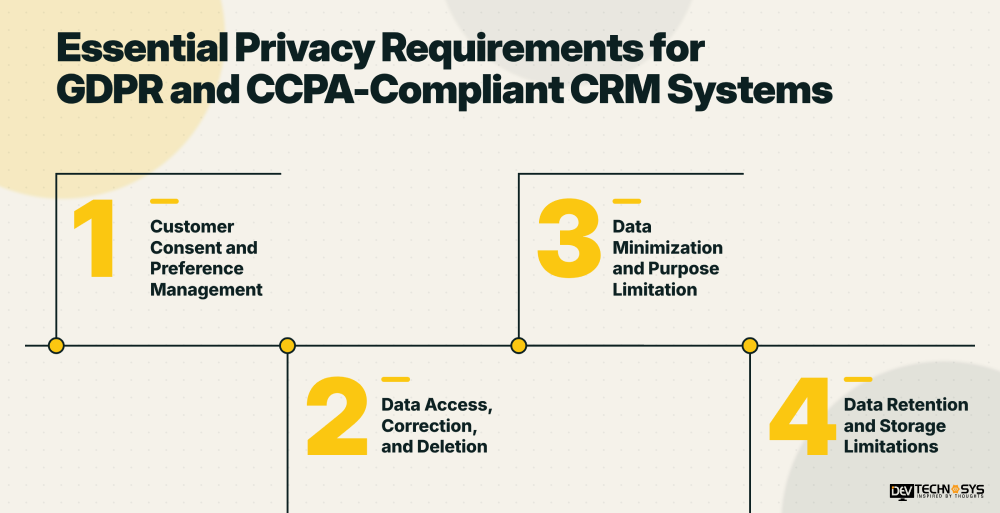
Essential Privacy Requirements for GDPR and CCPA-Compliant CRM Systems
A GDPR and CCPA compliant CRM must secure data while ensuring personal information is collected, stored, shared, and deleted appropriately.
The following requirements should be considered during CRM planning and development.
Customer Consent and Preference Management
A centralized consent management system must be available as part of any CRM platform so it can be used to track customer consents and preferences. According to GDPR data protection,consent is considered valid if it is given freely, is specific, and unambiguous.
Customers are also entitled to revoke consent given earlier. CCPA requires companies to establish opt-out options during the selling or sharing of information with third parties.
A module for managing consents must include such information as:
- Customer consent status and preferences.
- Time of consent and consent sourcing.
- The purpose behind permission.
- History of consent revocation and changes in preferences.
- Restrictions on communications via emails, SMS, and other channels.
Data Access, Correction, and Deletion
It is mandatory for customers to have methods of exercising their privacy rights available.
A compliant CRM should provide:
- Access to data: Retrieve required customer data in an understandable format.
- Data update: Correct any inaccuracies in personal data.
- Data removal: Find and delete customer data from connected systems.
- Data portability: Facilitate data exports where required by the GDPR.
Furthermore, it is important for businesses to consider retention periods and legal exemptions prior to fulfilling deletion requests.
Data Minimization and Purpose Limitation
CRM developers need to refrain from gathering superfluous information about the customers. For instance, it is essential for a Sales CRM to collect a customer’s name, work email, and purchase history, but it does not have to collect other unnecessary personal information.
Developers can use various methods such as field restrictions, mandatory field verification, and access rights based on purposes to limit data collection.
Data Retention and Storage Limitations
CRM systems need to systematically determine the time period for which different kinds of customer data should be kept.
Inactive marketing leads, completed transaction information, and support information of customers may all require their own retention schedules.
By using automated workflows, the outdated records can be flagged for deletion, anonymization, or for limited usage based on applicable laws.
Recommendation: Make your retention rules based on data categories and purposes of processing rather than a single period of deletion for the whole AI in CRM database. This will assist in better management of customer records as well as in saving storage costs.
Implementing GDPR and CCPA Compliance in CRM Development
Once the architecture is in place, developers are to convert privacy requirements into functional capabilities of the CRM system. A systematic approach to implementation allows for eliminating scattered compliance efforts.
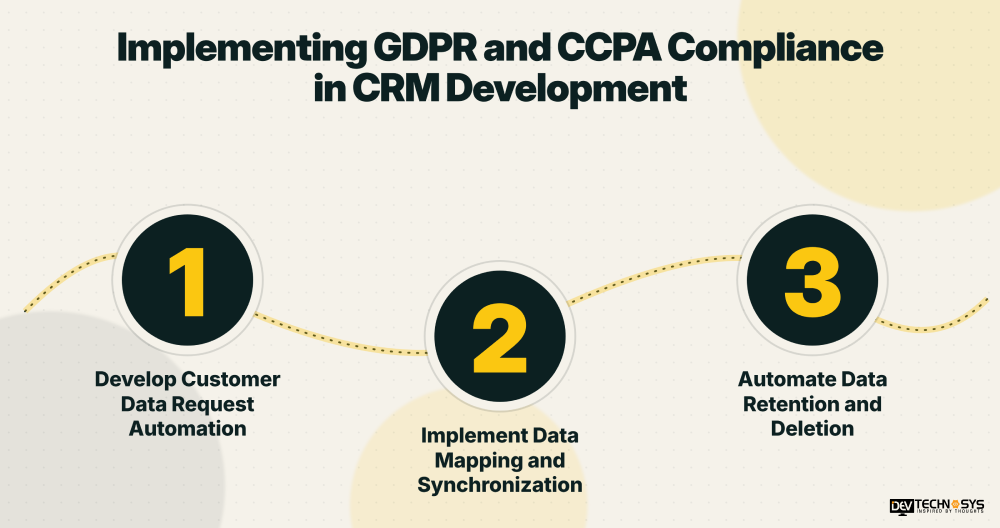
Develop Customer Data Request Automation
It is essential for CRM systems to incorporate a privacy request management component to handle customer inquiries in a systematic way.
Typically, it consists of the following steps:
- Receipt of a privacy request, e.g., access, correction, erasure, or opt-out.
- Verification of the client’s identity through a proper procedure.
- Locating the correct records in the CRM system(s).
- Checking for any exemptions and restrictions.
- Implementing the request in accordance with approval.
- Logging the request completion and sending a notification.
Implement Data Mapping and Synchronization
Customer data exists in different CRM modules and outside applications. An email address, for instance, can be found in the CRM database, marketing automation tool, customer support platform, and analytics tool.
Developers should create a centralized data inventory and field-mapping framework.
CRM Field |
Connected System |
Synchronization Requirement |
| Customer email | Email marketing | Update applicable preferences |
| Customer ID | Support platform | Identify linked records |
| Marketing status | Campaign tool | Apply opt-out restrictions |
| Customer profile | Analytics platform | Apply relevant privacy restrictions |
This ensures that privacy changes are not limited to the primary CRM database.
Automate Data Retention and Deletion
Developers should set up job scheduling to detect records nearing their retention period.
The process should be:
- Confirm retention rules for every type of data.
- Detect records that can be deleted or anonymized.
- Keep records that need to be kept for legal purposes.
- Send the relevant deletion commands to the connected systems.
- Register the performed actions in the logs.
Backup copies and archives of deleted data should also be the focus during the scheduling of the process.
Managing Third-Party Integrations and Cross-Border Data Transfers
CRM solutions often work in unison with email marketing software, payment services, and analytics programs. While these integrations are convenient, they may also put customer data at risk if information is shared carelessly.
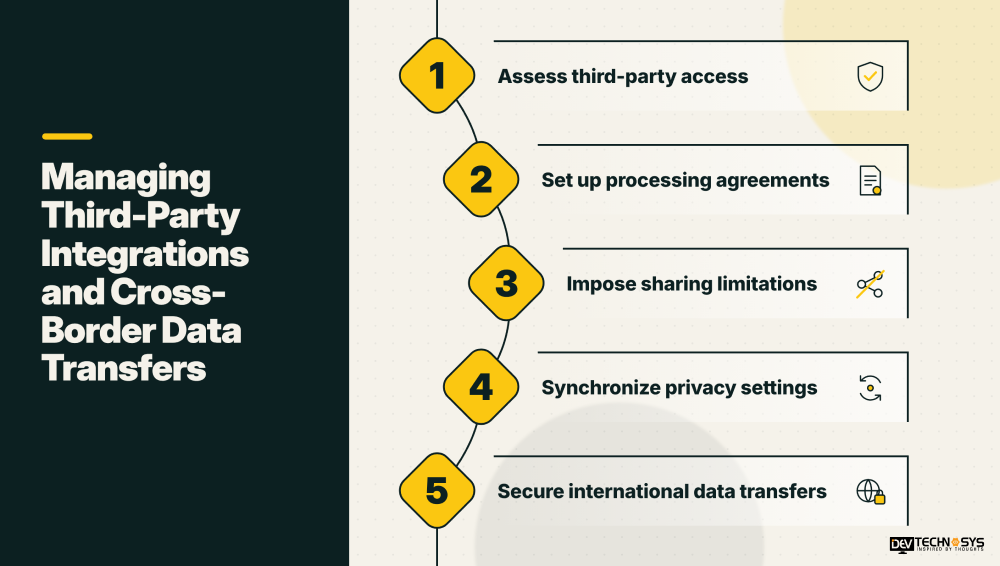
In order to maintain CRM data privacy compliance, it is advisable for development teams to take the following steps:
- Assess third-party access: Find out who receives and uses customer information.
- Set up processing agreements: When necessary, designate the tasks of data controllers and processors.
- Impose sharing limitations: Ensure that partner companies only get the minimum amount of data they require to provide their services.
- Synchronize privacy settings: Automatically distribute information about consent withdrawal or opting out across the integrated platforms.
- Secure international data transfers: Use appropriate tools from GDPR such as adequacy decisions or adequate safeguards like SCCs.
When organizations transfer personal data outside the European Economic Area, they must make sure to comply with international transfer rules of the GDPR.
Common GDPR and CCPA Compliance Challenges in CRM Development
Even well-designed CRM implementation services can experience compliance issues when privacy controls are not consistently implemented across business operations.
Compliance Challenge |
Potential Impact |
Recommended Solution |
| Fragmented customer data | Incomplete privacy requests | Centralized data mapping |
| Poor consent tracking | Incorrect marketing permissions | Consent management module |
| Third-party data sharing | Unauthorized or uncontrolled disclosure | Vendor access governance |
| Weak access controls | Unauthorized customer data access | RBAC and MFA |
| Inconsistent retention policies | Excessive data storage | Automated retention workflows |
| Incomplete audit logs | Difficulty demonstrating compliance | Centralized audit monitoring |
Consider a situation in the real world: The customer opts out of marketing emails from the organization via its CRM system. However, the marketing automation tool still retains the earlier subscription status of the customer.
Otherwise, the customer may keep receiving advertisements. In order to solve this issue, there is a need for a centralized preference management system that can communicate all changes to the connected systems via APIs and event-driven workflows.
Another challenge deals with deletion requests. It might happen that deleting the customer profile from the main CRM database still leaves the personal information in the support systems, websites with analytics, and backups. Because of that, companies need to adopt data discovery and deletion processes as opposed to one-shot database deletion processes.
Expert Advice
Test privacy workflows across the entire CRM ecosystem, including third-party applications and background processes. A successful deletion or opt-out operation should be validated at every relevant data destination.
CRM Compliance Testing and Implementation Checklist
It is very important to test in order to verify the effectiveness of privacy features. The teams responsible for the development of the CRM migration services should carry out, before the deployment, tests of four types: functional, security, integration, and regression.
Functional Compliance Testing
Check whether it is possible for customers to realize their rights to privacy through the CRM system. The following processes should be validated: withdrawal of permission to use information, changing preferences, getting access to information, and making corrections to data.
Security and Privacy Testing
As for the security testing, it should be performed in order to find vulnerabilities in terms of authentication, authorization, the API endpoints, access to databases, and transmission of data. In addition, it is necessary to test whether employees can access only the information they can access according to their roles.
CRM Compliance Implementation Checklist
- Utilize this checklist when developing and deploying CRM:
- Detect and categorize personal data.
- List processing objectives and legal grounds.
- Set up consent and preferences management systems.
- Design privacy request workflows for clients.
- Define data retention and deletion policies.
- Safeguard APIs and integrations with vendors.
- Provide protected data-transmission processes.
- Create access to information based on users.
- Write down the audit logs.
- Examine vendor terms and agreements regarding data sharing.
- Perform checks on systems regarding privacy synchronization.
Repeat the procedure each time there is an addition of a new system or change in data categorization, etc.
Choosing the Right Approach: Build vs. Buy for CRM Privacy Compliance
Companies may use either pre-existing CCPA data privacy features or create their own compliance modules. It is necessary for businesses to understand the best option based on the complexity of the system, integration needs, customization requirements, and costs of future maintenance.
Business Requirement |
Recommended Approach |
| Standard consent and preference workflows | Existing CRM compliance features |
| Complex customer data structures | Custom privacy modules |
| Multiple connected platforms | Centralized privacy middleware |
| Industry-specific workflows | Custom CRM development |
| Limited development resources | Third-party privacy management tools |
Which CRM Compliance Approach Should You Choose?
- In cases where the business has common privacy workflows and the platform complies with the corresponding requirements, it is possible to use existing CRM tools.
- In case your business has complicated client files, special processing requirements, or big integrations, it is better to go for custom development.
- In case one or more applications require central consent management and synchronization of privacy inquiries, you should use middleware.
Expert Advice
Pre-existing CRM platforms ease the implementation process. However, the data flow covered by their privacy features has to be assessed by businesses. Custom CRM development provides improved control over data models, permissions, and process automation in complicated corporate settings.
Conclusion
GDPR and CCPA compliant CRM development involves more than just adding notifications about privacy or consent boxes. Compliance requires a comprehensive approach that includes secure architecture, transparency in the processing of data, automated privacy processes, regulated integration, and continuous testing.
A proper privacy-centric CRM enables companies to protect private data while saving time on sales, marketing, and support. Having the right approach to development allows companies to embed regulations into software architecture.
Dev Technosys allows companies to get custom CRM development services tailored for specific needs and priorities.
Frequently Asked Questions
Find answers to the most common questions related to this article.
Yes. The B2B exemption under CCPA ceased to function as of December 31, 2022. Thus, business contact information of California residents, including names, work emails, phone numbers, and job titles, may now be recognized as protected personal information.
A custom-built CRM has to check the identity of customers, inspect the databases with personal information, check the conditions for legal exceptions, and perform the eligible deletions automatically. It should also keep the audit trail, report on the results of the requests, and ensure the deletion has been coordinated with the respective third-party processors.
Yes, in general. Routine lead scoring is not illegal per se. Nevertheless, GDPR Article 22 imposes certain restrictions on the solely automated decisions that may yield a rather profound impact. Moreover, ADMT laws of California may also apply to cases when an automated technology makes a great number of significant decisions.
As of January 1, 2026, some new regulations will impose risk assessments and a cybersecurity audit. The rules of ADMT will be effective on January 1, 2027. CRM companies affected should assess the processing risks concerning automated decisions as well as the security measures implemented.